

Note: This article contains affiliate links. If you click on these links and make a purchase, I may earn a small commission at no extra cost to you. This helps support my research and content. Read my full affiliate disclosure here.
When clover and dandelions take hold they compete with grass for light, water, and nutrients, leaving lawns thin and patchy. Choosing the right weed killer for clover and dandelions matters because products vary in how selectively they act, how quickly they work, and how they affect desirable turf. This guide covers seven shortlisted options that perform well in typical home lawns and explains the real-world tradeoffs gardeners face. We evaluated products on how effectively they eliminate broadleaf weeds, how safe they are for common lawn grasses, and how easy they are to apply and manage. Read on to understand the evaluation criteria and find the product traits that fit your lawn care schedule and maintenance goals.
Top Picks at a Glance
| Best Overall The best all-around choice for most situations | Ortho WeedClear Ready-To-Spray Lawn Weed Killer, 32 fl. oz. |  |
| Best Quality Built to a higher standard if you want something more solid | Spectracide Weed & Grass Killer with AccuShot Power Sprayer, 1.33 Gal |  |
| Best Value The sweet spot between price and what you get | Spectracide Large Plot Weed Stop for Lawns Concentrate, 1 Gal |  |
| Best Budget The cheapest option that still gets the job done reliably | Spectracide Weed Stop for Lawns Ready-to-Use Spray, 32 oz | 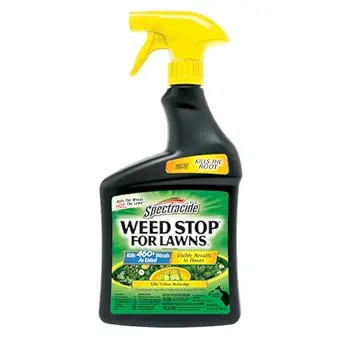 |
| Highest Rated A top-rated pick with lots of positive feedback | Roundup Weed & Grass Killer Concentrate, 1 gal. |  |
| Most Popular A crowd favorite that many people choose with confidence | Spruce Weed & Grass Killer Power Wand Kit with 64 oz Refill |  |
| Best Seller A high-volume bestseller chosen again and again | Roundup Weed & Grass Killer with Comfort Wand, 1.33 gal. |  |
Ortho WeedClear Ready-To-Spray Lawn Weed Killer, 32 fl. oz.

| Item Form | Liquid |
|---|---|
| Coverage | 16000 square_feet |
| Liquid Volume | 32 fluid ounces |
| Active Ingredients | Herbicide |
Ortho WeedClear Ready-To-Spray is a hose-attach liquid herbicide designed to kill common broadleaf lawn weeds, including clover and dandelions, down to the root. You use it by connecting the bottle to a garden hose, switching the sprayer on, and sweeping the spray over affected areas; the formula produces visible results within hours and becomes rainproof about an hour after drying. Notable features include a three-ingredient herbicide blend targeted at turf weeds and a coverage claim that one 32 fl. oz. bottle treats up to 16,000 sq. ft. (Southern lawns) or 8,000 sq. ft. (Northern lawns). The ready-to-use hose connection and fast activity make spot treatments and larger-area applications straightforward for typical homeowners. Limitations to keep in mind are that it targets broadleaf weeds rather than grassy weeds and it must be used when weeds are actively growing for best results, so timing matters. Follow label directions closely to protect desirable grass and to know when people and pets can safely re-enter treated areas.
Best for: Homeowners who want a simple, fast way to remove clover and other broadleaf weeds from established lawns without complex mixing or equipment.
Less Ideal for: People seeking a product to control grassy weeds or those who need season-long residual prevention should consider other specialized products.
- Ready-to-spray hose connection makes application quick and easy for homeowners
- Kills over 250 common broadleaf weeds, including clover and dandelions, down to the root
- Visible results in hours and becomes rainproof about one hour after drying
- One 32 fl. oz. bottle covers a large area (up to 16,000 sq. ft. for Southern lawns)
- Formulation is for broadleaf weeds only and will not control grassy weeds
- Effectiveness depends on applying when weeds are actively growing, so seasonal timing is required
Verdict: Choose this ready-to-spray bottle if you want a fast, easy way to kill clover and other broadleaf weeds in your lawn with minimal prep.
Spectracide Weed & Grass Killer with AccuShot Power Sprayer, 1.33 Gal

| Unit Count | 170 Fluid Ounces |
|---|---|
| Item Form | Spray |
| Coverage | 1 gallon |
| Active Ingredients | Diquat Dibromide 0.12%, Fluazifop-p-butyl 0.06%, Dicamba 0.04% |
Spectracide Weed & Grass Killer pairs a concentrated non-selective formula with a battery-powered AccuShot sprayer to clear weeds from driveway cracks, patios and around foundations. The product is used by aiming and spraying foliage until leaves are covered; the active ingredients move through the leaf to the root and can show visible die-back in as little as three hours. The AccuShot wand is extendable and provides continuous spray without manual pumping, which improves accuracy for narrow cracks and reduces hand fatigue during larger jobs. It is rainproof within 15 minutes, so treated areas are protected quickly. Practical benefits include fast results that let you replant or resume use of the area within a day and a reusable sprayer for follow-up applications. Important limitations are that the herbicide is non-selective so it will kill any plant it contacts, it requires careful handling and PPE to avoid skin or eye exposure, and the sprayer runs on four AA batteries that must be replaced periodically. Follow label directions to avoid runoff into water.
Best for: Buyers who want a fast, no-nonsense solution for weeds growing in driveways and hard surfaces and who prioritize tools with clear user feedback and proven results.
Less Ideal for: Gardeners who need a selective lawn-safe treatment, people unwilling to follow pesticide safety precautions, or those treating areas adjacent to water features.
- AccuShot battery-powered wand gives continuous spray for accurate application in tight cracks
- Formula moves through foliage to kill weeds down to the root with visible results in about three hours
- Rainproof after 15 minutes so treatments are not easily washed away by brief showers
- Covers approximately 300 square feet per gallon, suitable for multiple crack-treatment sessions
- Non-selective herbicide will damage any desirable plants it contacts
- Sprayer requires four AA batteries and occasional replacement to maintain function
- Product is toxic to aquatic life and must not be used near water or allowed to run off
Verdict: A fast-acting, easy-to-aim non-selective herbicide with a battery-powered wand that is well suited to reliably clear weeds from driveway cracks and other hard surfaces.
Spectracide Large Plot Weed Stop for Lawns Concentrate, 1 Gal

| Unit Count | 128 Fluid Ounces |
|---|---|
| Item Form | Liquid |
| Coverage | 32000 square feet |
Spectracide Large Plot Weed Stop is a concentrate lawn herbicide you mix with water and apply with a sprayer to control broadleaf weeds across large areas. It targets more than 200 listed weeds, including common offenders like dandelion, chickweed and clover, and is formulated to kill weeds down to the root for visible results in hours. The bottle links to hose-end or tank sprayers and includes settings for concentrate or ready-to-spray use, which makes covering up to tens of thousands of square feet practical for homeowners with large yards. It is rainproof within hours and is labeled for both northern and southern grass types when applied at recommended rates. Important limitations are the temperature window for safe application and safety precautions for people, pets and water features; do not apply when air temperatures exceed 85°F and keep off treated areas until dry. For persistent or isolated tough weeds you may need targeted repeat spot treatments.
Best for: Homeowners who need an effective, large‑area solution for common broadleaf weeds and prefer a concentrated product they can mix and spray themselves.
Less Ideal for: Small-plot gardeners who prefer spot-only, non-chemical methods or anyone who cannot follow temperature and safety application restrictions.
- Concentrate treats large areas—label lists coverage up to 32,000 sq ft for northern grasses
- Kills over 200 listed broadleaf weeds and works down to the root for longer control
- Rainproof within hours so light rain soon after application is less likely to wash it away
- Works with common sprayers and has a built-in hose connector for easier mixing and application
- Must not be applied when air temperatures exceed 85°F to avoid turf damage
- Contains chemicals that require safety precautions and keeping people and pets off treated areas until dry
Verdict: Choose this concentrated sprayer-ready formula if you need a practical, large‑area herbicide that kills common broadleaf weeds down to the root while preserving lawn when used as directed.
Spectracide Weed Stop for Lawns Ready-to-Use Spray, 32 oz

| Item Form | Spray |
|---|---|
| Liquid Volume | 32 |
| Coverage | Up to 10,000 square feet (for cool season grasses) |
Spectracide Weed Stop for Lawns is a pre-mixed spray designed for quick spot and broadcast applications on common turfgrasses. You simply spray until weeds are wet and wait for visible decline, often within hours, because the formula kills by contact down to the root. It lists control for more than 460 weed types including dandelion, clover and chickweed and is labeled for use on bluegrass, fescue, ryegrass, Bermuda and established zoysia. The ready-to-use bottle requires no mixing, which keeps application straightforward and reduces setup time for homeowners. Practical benefits include broad weed spectrum, fast visible results and instructions for safe use (temperature window and re-entry guidance). Important limitations are that it can damage turf if applied outside temperature recommendations or on grass just coming out of dormancy, and coverage claims are for cool-season grasses only. For larger properties you may need multiple bottles or a concentrate product to be more economical.
Best for: Homeowners who want a simple, no-mix weed control that gives fast visible results and prefer a straightforward spray solution for small to medium lawns.
Less Ideal for: Large-property owners or landscape professionals who need a cost-per-acre solution or who require year-round, temperature-agnostic applications.
- Ready-to-use spray requires no mixing or extra equipment
- Kills over 460 listed weeds including common broadleaf and grassy weeds
- Produces visible results within hours by killing weeds down to the root
- Labeled for use on multiple common lawn grasses when directions are followed
- Can harm turf if applied outside the 45° to 90° F window or to grass just emerging from dormancy
- Ready-to-use format may be less economical for treating large lawns compared with concentrates
Verdict: A convenient ready-to-use spray that delivers fast control of common broadleaf weeds for budget-minded homeowners treating small to medium lawns.
Roundup Weed & Grass Killer Concentrate, 1 gal.

| Unit Count | 128 Fluid Ounces |
|---|---|
| Coverage | 300 Square_Feet per gallon of spray solution |
| Item Form | Liquid |
| Active Ingredients | Triclopyr; Diquat Dibromide; Puazifop-P-Butyl; Triethylamine Salt |
This 1 gallon Roundup concentrate is designed for homeowners who need a fast, reliable solution to persistent weeds and crabgrass. You mix the concentrate per label and apply with a tank or hose-end sprayer; one gallon of concentrate makes 21 to 42 gallons of spray and each gallon of spray covers about 300 sq. ft., so a single bottle treats large areas or many spot treatments. The formula lists active ingredients including triclopyr and diquat and promises visible results in hours and rainproof performance in about 30 minutes, which reduces the chance of wasted applications. It is suitable for use around driveways, walkways, flower beds, and fence lines and allows replanting after the interval specified on the label. Important practical limitations are the safety precautions and application limits on the label: avoid drift to desirable plants, keep people and pets away until spray dries, and do not exceed the maximum single or yearly application rate. For buyers who prefer clear instructions and predictable performance, this concentrate is straightforward to use but requires careful, label‑compliant handling.
Best for: Homeowners who want a dependable, proven herbicide to eliminate stubborn crabgrass and other broadleaf weeds and who follow label directions and safety precautions.
Less Ideal for: People seeking an organic or nonchemical option or those who need a product safe for immediate access by children or pets without waiting for treated areas to dry.
- Concentrated formula stretches to 21–42 gallons of spray, enabling coverage of large areas
- Fast visible results in hours and rainproof in as fast as 30 minutes
- Effective on a wide range of weeds and grasses, including crabgrass and dandelion
- Can be used around beds, walkways, driveways and for lawn replacement when applied correctly
- Requires careful mixing and strict adherence to label rates and replanting intervals
- Potential for drift can damage desirable plants if applied in windy conditions
Verdict: A concentrated, fast-acting herbicide that reliably knocks out crabgrass and other tough weeds when mixed and applied according to the label.
Spruce Weed & Grass Killer Power Wand Kit with 64 oz Refill

| Unit Count | 64 Fluid Ounces |
|---|---|
| Coverage | 1 bottle treats up to 400 weeds |
| Item Form | Multiple |
| Liquid Volume | 64 fluid ounces |
This kit combines a 64 oz ready-to-use herbicide with a battery-powered Power Wand for fast, targeted spot treatments. The formula is non-mixing and designed to work on contact, dehydrating leaves so you can see darkening or wilting within an hour and complete die-off by about 24 hours when used as directed. The wand is reusable and comes with two AA batteries so you can spray cracks, edges, mulch beds, driveways, and walkways without pouring or measuring. Practical benefits include ease of use, rainproofing within 10 minutes, and a formula advertised as safe around people, pets, and bees when directions are followed. Limitations are that it is non-selective so it must be applied carefully to avoid desirable plants and grass, it is intended for spot treatment rather than broadcast lawn application, and best results require spraying in dry, warm conditions above 60°F with no immediate rain forecast.
Best for: Buyers who want a fast, easy-to-use spot weed killer for driveways, cracks, mulch beds, and edges and who prioritize quick visible results and minimal setup.
Less Ideal for: Those needing large-area lawn herbicide or selective weed control within turf should look for products made for broadcast lawn treatments or selective formulas.
- Ready-to-use 64 oz refill eliminates measuring or mixing
- Visible results in about one hour and full effect around 24 hours
- Includes battery-powered reusable wand for precision spot treatments
- Rainproof within 10 minutes so light showers are less likely to wash it off
- Formulated for use around people, pets, and bees when directions are followed
- Non-selective formula can damage desirable plants if oversprayed
- Designed for spot treatments not for broadcasting over large lawns
- Performance depends on spraying in recommended weather conditions
Verdict: A convenient, no-mix spot-treatment kit that delivers fast visible weed kill with a reusable powered wand for precise, low-fuss applications.
Roundup Weed & Grass Killer with Comfort Wand, 1.33 gal.

| Item Form | Liquid |
|---|---|
| Coverage | 400 sq. ft. |
| Liquid Volume | 1.33 gallons |
This Roundup package pairs a 1.33 gallon liquid formulation with a Comfort Wand for easier spraying around beds, walkways, and foundations. It is formulated to kill common broadleaf weeds and grasses down to the root, with visible wilting in hours and rainfast protection in about 30 minutes, so treated areas are less likely to wash away after a brief rain. The wand offers one-touch continuous spray, which reduces hand fatigue during spot treatments and makes edging and targeted applications simpler than using a separate sprayer. Coverage is listed at about 400 sq. ft., appropriate for small yards, beds, or multiple spot-treatment sessions. Important limitations are that this is a nonselective herbicide so it will damage desirable plants if contacted and the product directions include replanting wait times of 1 to 30 days depending on use. Users should follow label precautions about keeping people and pets away until spray has dried and applying only in calm conditions to avoid drift.
Best for: Buyers who want a straightforward, ready-to-use herbicide for targeted spot treatments and edging where quick, reliable weed control is the priority and minimizing application fuss matters.
Less Ideal for: Large properties or users who need selective lawn-safe control should consider professional application methods or products formulated specifically for turf.
- Fast visible results in hours and rainproof in as fast as 30 minutes
- Comfort Wand with one-touch continuous spray reduces hand fatigue and improves targeting
- Kills a wide range of broadleaf weeds and grasses to the root
- Ready-to-use liquid requires no mixing and covers up to 400 sq. ft.
- Nonselective formula will damage desirable plants if contacted
- Container and wand limit treatment area per refill compared with larger tank sprayers
Verdict: A convenient, ready-to-use herbicide with a Comfort Wand that delivers fast, reliable spot control of broadleaf weeds and grasses for homeowners who want an easy, low-fuss solution.
Choosing the Right Weed Killer for Clover and Dandelions: Key Factors to Consider
Active Ingredient and Mode of Action
Different active ingredients attack weeds in different ways and influence how quickly clover and dandelions die. Some herbicides target broadleaf-specific physiological pathways, which helps spare grasses. Understanding whether a product is a systemic herbicide that moves through the plant to the root or a contact herbicide that kills only foliage affects timing and likelihood of regrowth.
Knowing the mode of action also reduces the risk of resistance when you rotate products over multiple seasons. Read label chemistry descriptions and match them to the weeds you need to control and the level of regrowth suppression you expect.
Selectivity and Turf Compatibility
Selectivity is critical when treating clover and dandelions in a lawn because nonselective products can damage grass and create bare spots. Check if the treatment is labeled safe for your grass species, including cool-season varieties like fescue and rye or warm-season grasses like bermudagrass and zoysia.
Application rate, timing, and weather conditions influence turf tolerance. Applying during the recommended growth stage for the turf and weeds reduces stress and improves safety. When in doubt, use a spot-treatment approach on small infestations to test turf response first.
Application Method and Ease of Use
Weed killers come as ready-to-use sprays, concentrates, or granules, and each format affects convenience, coverage, and precision. Sprays allow direct foliar contact and even coverage but require mixing and careful calibration. Granules can be easier to broadcast for larger areas but may deliver slower knockdown and are less suitable for targeted spot control.
Consider how much area you need to treat, whether you want to spot-treat or blanket-spray, and how comfortable you are with measuring and applying concentrates. Application equipment and the ability to control spray drift also influence selection.
Timing and Environmental Conditions
Effectiveness depends on applying treatments when weeds are actively growing and environmental conditions are favorable. Clover and dandelions respond best when temperatures are moderate and plants are not drought-stressed. Rain soon after application can wash away non-residual products and reduce effectiveness.
Follow label guidance on temperature ranges, watering intervals, and mowing before or after treatment. Planning around weather forecasts and lawn care activities increases success and reduces wasted applications.
Residual Control and Need for Repeat Applications
Some products offer residual control in the soil that prevents new seedlings from establishing, while others kill existing foliage but do not prevent future germination. If you face recurrent seedling pressure or a heavy seedbank, a residual option can reduce follow-up work but may restrict reseeding or overseeding windows.
Balance desire for long-term suppression with the need to repair lawn patches. Understand how long a product persists and how that timing fits with your renovation or overseeding plans.
Safety, Environmental Impact, and Label Restrictions
A product that is effective but difficult to use safely is often a poor fit for home lawns. Review personal protective equipment recommendations, re-entry intervals, and any restrictions around pets, children, or edible gardens. Some active ingredients have specific buffer zone or runoff precautions.
Consider the broader environmental implications such as impact on pollinators and nearby plantings. Choose products with clear label instructions and adopt practices that minimize off-target exposure, such as spot treatments and careful timing.
When to Treat Clover and Dandelions
Treat broadleaf weeds when they are actively growing and leafing out rather than during dormancy. Early spring and early fall are often ideal windows because plants are drawing energy into roots and systemic herbicides can translocate more effectively.
Avoid treating during drought stress, extreme heat, or immediately before heavy rain. Those conditions reduce uptake and can force repeat applications. Also plan treatments relative to mowing and irrigation to maximize contact time on foliage.
- Ideal temperature ranges and growth stage guidance come from product labels
- Spot-treating small patches reduces chemical use and limits turf stress
- Delay overseeding or lawn renovation following residual herbicide applications as instructed on the label
Spot Treatment Vs Whole-Lawn Applications
Spot treatments are efficient for isolated clover or dandelion patches and limit exposure to desirable plants and pollinators. They require less product and let you track turf response on a small scale before treating larger areas.
Whole-lawn applications are useful when weeds are widespread or when you need to correct a lawn that is generally thin and dominated by broadleaf species. Choose the format and volume that matches infestation size to avoid overapplication.
- Spot treatments: lower product use, quick put-away, less turf risk
- Whole-lawn treatments: uniform coverage but greater need for careful calibration
Combining Cultural Practices with Chemical Control
Long-term weed control is as much about cultural care as it is about herbicides. Improving mowing height, fertility, and watering practices helps build a dense, competitive turf that resists clover and dandelion invasion.
Core aeration, overseeding thin areas, and proper fertilization reduce open niches that weeds exploit. Use chemical control to reduce existing weed pressure, then follow with cultural practices to prevent reestablishment.
- Raise mowing height to favor turfgrass over low-growing clover
- Address soil compaction and bare spots to limit future weed colonization
- Time fertilizer and overseeding to align with herbicide label restrictions
Managing Expectations and Follow-Up
Expect visible dieback in days to a few weeks depending on product speed and weather. Systemic products often take longer to kill the root, while contact products show faster foliar browning but may not prevent regrowth.
Plan for follow-up inspections and targeted spot treatments for any survivors. If you are preparing for lawn renovation, allow the recommended interval after herbicide use before reseeding to ensure seedling safety.
- Monitor treated areas for new seedlings and treat early
- Record application dates and conditions to refine future timing
How We Chose the Best Weed Killer for Clover and Dandelions
We focused on treatments that deliver consistent control of broadleaf weeds, specifically clover and dandelions, across typical cool- and warm-season residential lawns. Key evaluation dimensions included active ingredient efficacy against broadleaf species, selectivity and turf safety for common grass types, application flexibility (spray, granular, or spot treatment), and persistence or need for reapplication. We also considered user safety and environmental profile, favoring formulations with clear label instructions for safe use around people, pets, and sensitive plantings. Ease of application and timing windows mattered because many gardeners must treat weeds without disrupting mowing or irrigation schedules. Products that addressed common lawn scenarios such as established infestations, spot treatments, and preventive options were prioritized. We excluded experimental or specialty agricultural formulations that are not labeled for standard residential lawns, and we did not consider products lacking clear label guidance for clover and dandelion control. The selected criteria reflect practical decisions gardeners make when choosing treatments for home turf.
FAQ
Can I apply lawn fertilizer the same week I treat weeds?
It depends on product labels. Some herbicides recommend waiting a few days before fertilizing to avoid stressing turf. Others have no conflict. Check the label for specific timing and combine activities when both lawn and weeds are actively growing.
Will clover and dandelions come back after one treatment?
Often a single treatment reduces a majority of plants but follow-up can be necessary. Seedbanks and new seedlings commonly appear later, so monitor the lawn and spot-treat as needed, and pair chemical control with cultural fixes to lower recurrence.
Is it safe to use weed killers around children and pets?
Safety varies by formulation and label instructions. Many products have re-entry or pet reintroduction intervals. Use spot treatments, follow personal protective equipment guidance, and keep treated areas off-limits until the label-specified drying or re-entry time has passed.
Can I overseed shortly after applying a weed killer?
Some products have significant persistence that inhibits new seed germination. Labels will state waiting periods before overseeding or renovation. If you plan to reseed, choose non-residual options or delay seeding according to label timing.
Which application method gives the most consistent results?
Systemic foliar sprays often give consistent control of established clover and dandelions because they move to the root. Granules and contact products can work well for certain scenarios but may require more careful timing or repeat treatments.
Final Verdict
For clover and dandelions, prioritize treatments that match the scale of the problem and your lawn type. Choose selective chemistries that are labeled safe for your grass, apply when weeds are actively growing, and combine chemical control with cultural practices to strengthen turf and reduce future weed pressure. Balance the desire for residual suppression against renovation plans and always follow label guidance for timing and safety. With a thoughtful plan that pairs the right product format and application timing, you can regain a denser, healthier lawn while minimizing repeat work.
