

Note: This article contains affiliate links. If you click on these links and make a purchase, I may earn a small commission at no extra cost to you. This helps support my research and content. Read my full affiliate disclosure here.
If you maintain large lawns, sports fields, or commercial landscapes, the right commercial broadcast spreader makes routine applications faster and more uniform. You want a unit that handles heavy loads, meters granular products consistently, and survives repeated daily use in varied conditions. This guide shortlists six top-performing commercial spreaders and evaluates them on the real-world factors that matter to contractors and grounds crews. Read on for clear guidance about capacity, metering accuracy, build durability, and the operational details that determine how a spreader performs on a busy job.
Top Picks at a Glance
| Best Overall The best all-around choice for most situations | EarthWay 2170 Commercial 100 lb Walk-Behind Broadcast Spreader |  |
| Best Quality Built to a higher standard if you want something more solid | CHAPIN 8400C Professional 100‑Pound Turf Broadcast Spreader |  |
| Best Value The sweet spot between price and what you get | VEVOR 100 lb Capacity Walk-Behind Broadcast Spreader |  |
| Highest Rated A top-rated pick with lots of positive feedback | The Andersons Pacer Pro Walk-Behind Broadcast Spreader (80 lb Hopper) |  |
| Most Popular A crowd favorite that many people choose with confidence | Agri-Fab 130-lb Walk-Behind Broadcast Spreader (Model 45-0462) |  |
| Best Seller A high-volume bestseller chosen again and again | CHAPIN SaltPro 80 lb Contractor Walk-Behind Salt Spreader (88300B) |  |
EarthWay 2170 Commercial 100 lb Walk-Behind Broadcast Spreader

| Capacity | 100 lb |
|---|---|
| Tire type | 13 inch pneumatic |
| Frame | Tube steel |
| Gearbox | Enclosed heavy-duty |
The EarthWay 2170 is a contractor-focused broadcast spreader designed to handle large jobs with a 100 pound hopper and a heavy-duty gearbox that keeps the agitator and metering consistent under load. It is used by pushing across turf or open areas while the pneumatic 13 inch tires and steel frame provide stable rolling over uneven ground. Notable features include side spread control for reducing waste along borders, a sturdy tube steel frame with enclosed gears for durability, and an adjustable handle for operator comfort. In practice the spread pattern is noticeably more even than economy models, which reduces respreading and striping. The reinforced controls and metal components mean less maintenance and fewer broken plastic parts in frequent use. The main compromises are size and weight that make it overbuilt for very small yards and the plastic hopper material which may be vulnerable to prolonged UV exposure without storage. For anyone maintaining large lawns, rental fleets, or commercial turf, this spreader emphasizes reliable, repeatable coverage and long-term durability.
Best for: Buyers who need a durable, professional-grade spreader for regular large-area lawn care, rental fleets, or contractor use and who prioritize consistent, even coverage over compact size.
Less Ideal for: Casual homeowners with small lawns or limited storage space should consider smaller, lighter spreaders that are easier to maneuver and store.
- 100 lb hopper capacity reduces refill frequency on large jobs
- Heavy-duty gearbox with enclosed gears for longer component life
- 13 inch pneumatic tires and steel frame provide stable movement over rough turf
- Side spread control helps reduce waste and improves edge accuracy
- Plastic hopper may degrade if left in sun long term
- Large and heavy for small residential yards
Verdict: Choose the EarthWay 2170 when you need a tough, professional spreader that delivers even, repeatable coverage on large lawns and job sites.
CHAPIN 8400C Professional 100‑Pound Turf Broadcast Spreader

| Load Capacity | 100 pounds |
|---|---|
| Wheel Type | Rubber |
| Number of Wheels | 2 |
| Material Type | Polyethylene, Stainless Steel |
The CHAPIN 8400C is a workhorse broadcast spreader aimed at serious homeowners and pros who need consistent coverage across lawns or larger properties. It pushes like a traditional walk‑behind spreader and uses a 100‑pound poly hopper on a stainless steel frame, an enclosed gearbox and cast agitator to keep material flowing without frequent clogging. The adjustable rotary gate and steel linkage let you control application pattern and rate for fertilizers, seed, and weed control products, while the 14‑inch pneumatic tires provide stability on uneven turf and moderate slopes. Practical touches include a rain cover, hopper grate to stop clumping, molded grips and a T‑handle for easier pushing. The unit requires assembly and is not recommended for salt, sand, or lime powders, so it is best for granular lawn products. Size and 38‑pound weight make it substantial to maneuver in tight beds, but that robustness is exactly what delivers steady, professional spread performance over larger areas.
Best for: Buyers who prioritize reliable, even application and durability for frequent use across lawns, acreage, or professional jobs where uptime and consistent coverage matter.
Less Ideal for: If you only need an occasional small‑yard spreader or must regularly apply salt, sand, or fine lime powders, a lighter-duty or specialty spreader would be a better fit.
- Large 100‑pound hopper reduces refill frequency for big yards
- Stainless steel frame and enclosed gearbox improve durability and reduce weather exposure
- Adjustable rotary gate and directional control for accurate application with different granular products
- 14‑inch pneumatic tires provide traction and stability on uneven terrain
- Included rain cover and hopper grate help prevent clumping in damp conditions
- Not recommended for salt, sand, lime or powderized materials
- Relatively heavy and sizeable which can make storage and maneuvering in tight spaces harder
Verdict: Choose the CHAPIN 8400C when you need a durable, high‑capacity broadcast spreader that delivers consistent professional‑grade coverage across larger lawns and properties.
VEVOR 100 lb Capacity Walk-Behind Broadcast Spreader

| Load capacity | 100LB |
|---|---|
| Hopper volume | 56L |
| Spread width | 0-9.8 ft |
| Wheels | 13-inch anti-slip rubber |
| Adjustment | 30-step control |
The VEVOR walk-behind broadcast spreader is a heavy-capacity push model designed to cover large areas with fewer refills thanks to its 100 lb (56 L) hopper. It uses a 30-step control and an infinite adjustment system to change output size and achieve an even spread; the listed spread width adjusts with push speed so you can fine-tune application for seed, fertilizer, or granular weed control. Key practical features include pre-installed components to speed assembly, a powder-coated carbon steel frame and rust-resistant hopper for durability, and 13-inch anti-slip wheels that help it roll over uneven turf. The sealed gearbox and four-sided baffle design aim to reduce clogging and protect gears from corrosion. Trade-offs are that it is a manual push spreader so coverage speed depends on operator pace, and precise calibration for different products will require test passes to dial settings. For commercial crews or heavy homeowners who need a robust, budget-friendly high-capacity spreader, it offers straightforward, reliable performance for routine fertilizing and seeding tasks.
Best for: Buyers who need a high-capacity, no-frills spreader for regular fertilizing or seeding and prioritize value and durability over motorized convenience.
Less Ideal for: Those who need fast, large-acreage coverage or hands-free operation should consider tow-behind or ride-on commercial spreaders instead.
- Large 100 lb/56 L hopper reduces refills and speeds coverage
- 30-step adjustment plus infinite output control for precise application
- Powder-coated carbon steel frame and rust-resistant hopper for durability
- 13-inch anti-slip wheels handle uneven terrain and improve maneuverability
- Manual push design limits application speed compared with tow-behind or motorized spreaders
- Requires trial runs to calibrate settings for different granular products
Verdict: A sturdy, high-capacity push spreader that gives budget-focused crews reliable, precise coverage for routine fertilizing and seeding.
The Andersons Pacer Pro Walk-Behind Broadcast Spreader (80 lb Hopper)

| Hopper capacity | 80 lb |
|---|---|
| Tires | 12-inch pneumatic |
| Agitator | Spider agitator |
| Application control | Adjustable drop rate with 3-hole shut-off |
| Frame finish | Powder-coated frame |
The Andersons Pacer Pro is a heavy-duty broadcast spreader built to deliver consistent, reliable coverage for lawn care and winter tasks. It uses a spider agitator and dual material plates to keep fertilizer, seed, and salt flowing evenly, while the three-hole drop shut-off and adjustable drop rate let you dial in application without constant tweaks. The 80-pound hopper and included cover reduce refill frequency and protect materials from moisture, and the 12-inch knobby pneumatic tires give good traction and weight distribution across uneven terrain. The frame is powder-coated for corrosion resistance and the unit ships partially assembled, though you will need to finish setup and calibrate it before first use. If you expect pro-level consistency and year-round versatility, this spreader performs well, but it is a large, purpose-built tool better suited to medium to large lawns than tight, highly landscaped yards.
Best for: Buyers who prioritize dependable, pro-level spreading performance for medium to large lawns and need a durable, year-round tool for fertilizer, seed, and salt applications.
Less Ideal for: Not the best choice for owners of small, tightly planted yards or those who need a compact, lightweight spreader for occasional use.
- Large 80 lb hopper reduces refill frequency and includes a cover to protect materials
- Spider agitator and dual material plates promote consistent, even flow of fertilizer, seed, and salt
- Adjustable drop rate and three-hole shut-off allow precise application control
- 12-inch knobby pneumatic tires provide traction and smoother handling on uneven ground
- Arrives only partially assembled and requires calibration before first use
- Size and capacity make it less convenient for very small or highly detailed lawns
Verdict: Choose the Pacer Pro if you want a rugged, professional-grade spreader that delivers consistent, reliable applications across medium to large lawns.
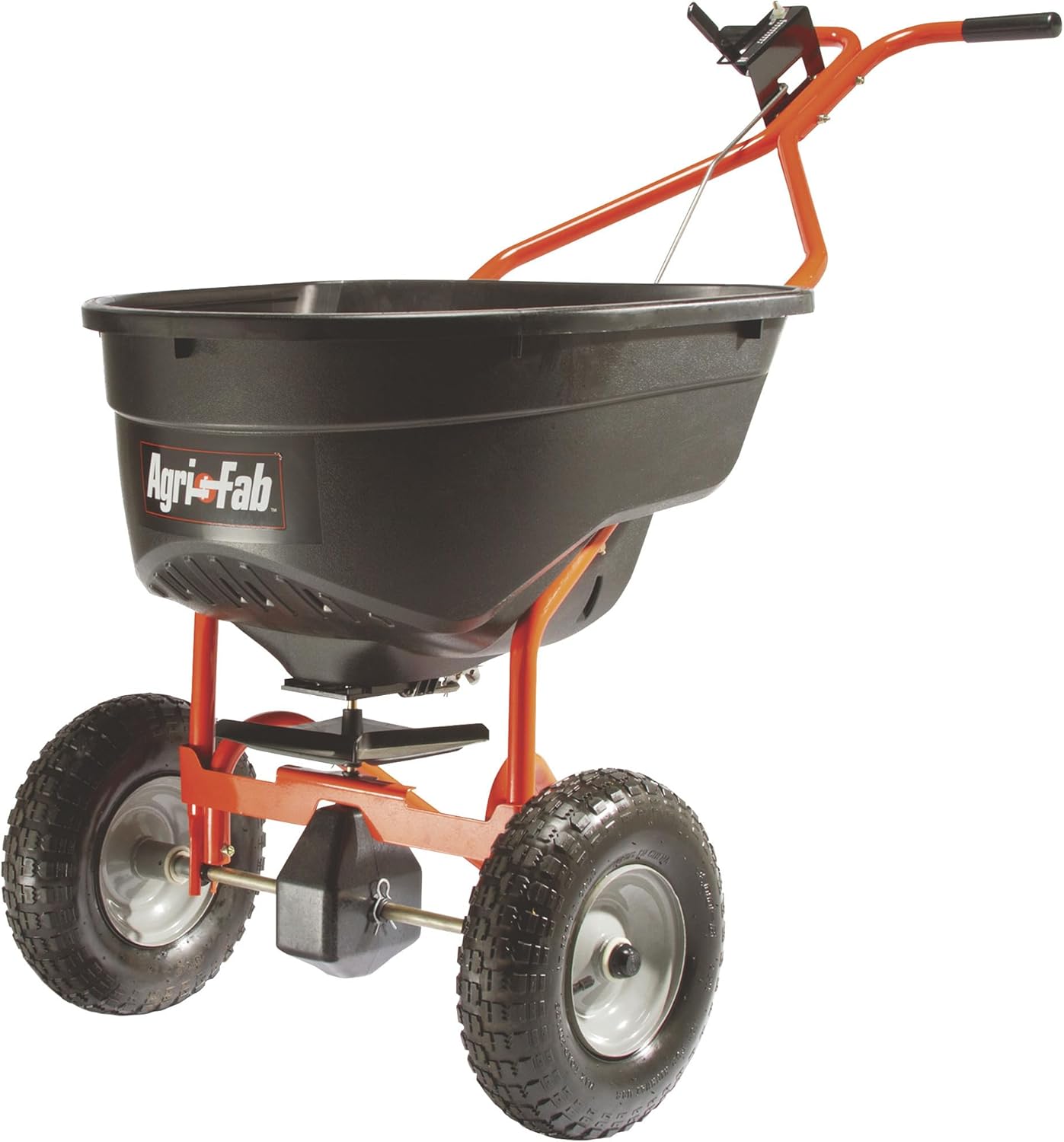
Agri-Fab 130-lb Walk-Behind Broadcast Spreader (Model 45-0462)
| Weight Capacity Maximum | 130 pounds |
|---|---|
| Number of Wheels | 2 |
| Tire Type | Tubeless |
| Material Type | Poly and steel |
The Agri-Fab 130-lb walk-behind broadcast spreader is a straightforward, high-capacity tool for spreading fertilizer, grass seed, or ice melt over lawns up to about half an acre. It uses a large polyethylene hopper and pneumatic tires to move smoothly over uneven turf, while a direct rod control makes adjusting and engaging the spread pattern simple during use. The wide broadcast pattern covers more ground per pass, reducing time spent spreading compared with lawn-size handheld options. Construction mixes poly and steel for a balance of durability and lighter weight, and the ergonomic handle improves comfort during longer passes. Expect reliable performance for routine residential lawn care, though assembly is required and the unit is a push-style spreader so it is physically demanding on larger sites. Controls are basic rather than precision-calibrated, so granular control for very small application rates may require extra care. For seasonal tasks from spring seeding to winter deicing, this model delivers consistent, no-frills coverage for homeowners focused on efficiency and capacity.
Best for: Homeowners who want a no-nonsense, high-capacity spreader to finish lawn tasks faster and who prioritize durability and ease of use over precision metering.
Less Ideal for: Owners of very large properties who prefer tow-behind or tractor-mounted spreaders and users who need highly precise, small-rate fertilizer application.
- Large 130 lb hopper reduces refills and speeds work on medium lawns
- Pneumatic tires and simple frame roll well over uneven yards
- Direct rod control is easy to use and intuitive while walking
- Polyethylene hopper and steel components provide a durable yet reasonably light build
- Push operation can be tiring on larger properties
- Controls are basic and may require testing to dial in precise spread rates
Verdict: A rugged, high-capacity push spreader that saves time on medium residential lawns by covering large areas with one hopper load.
CHAPIN SaltPro 80 lb Contractor Walk-Behind Salt Spreader (88300B)

| Power Source | manual |
|---|---|
| Wheel Size | 12 inches |
| Item Type Name | Salt Spreader |
| Item Highlight | 30+ gate settings, adjustable baffles, metal gears, pneumatic tires |
The CHAPIN SaltPro 88300B is a heavy-duty walk-behind broadcast spreader built to handle repeated winter use on driveways and sidewalks. It carries up to 80 pounds of material in a weather-resistant poly hopper and lets you fine-tune application with more than 30 gate settings and adjustable front and side baffles to limit overspray. A spiked auger helps keep pelletized ice melt moving and reduces clogs while enclosed metal-alloy gears and a powder-coated steel frame give the unit durability for frequent runs. The 12-inch pneumatic tires smooth movement over uneven ground and the rubber-grip T-handle is comfortable with gloves. Practical limits include the recommendation to avoid sand and lime products and the unit s size makes it less convenient for very small patios or occasional, light-duty tasks. For risk-averse buyers this model offers visible, serviceable hardware and a clear control range that makes consistent, repeatable spreading straightforward.
Best for: Buyers who want a dependable, serviceable spreader for regular winter maintenance and value consistent, adjustable application over many seasons.
Less Ideal for: Those who only need an occasional light-duty spreader for tiny patios or need to broadcast sand or lime-based materials.
- 30+ gate settings and adjustable baffles for precise material control
- Spiked auger reduces clumping and helps keep material flowing
- Enclosed metal-alloy gears and powder-coated steel frame for durability
- 12-inch pneumatic tires improve pushability over uneven surfaces
- Not recommended for sand or lime products which limits material choices
- Relatively large capacity and footprint may be overkill for very small properties
Verdict: Choose the SaltPro 88300B if you need a rugged, easy-to-control walk-behind spreader that delivers repeatable results for regular winter salt and ice-melt applications.
Choosing the Right Commercial Broadcast Spreader: Key Factors to Consider
Hopper Capacity and Loading Ergonomics
Hopper size determines how often you stop to refill during large jobs. Larger capacities reduce downtime but add weight when full, which affects towing requirements and handling. Look for designs with sloped floors, agitators, or vibration features that prevent bridging of moist or coated granules.
Loading ergonomics matter for crews who lift bags or use bulk loaders. Low hopper lips, wide openings, and reinforced rims speed refills and reduce back strain. Also consider whether the frame and hitch height align with your vehicle or trailer to simplify transfer and reduce awkward lifting.
Metering Precision and Adjustment Range
A spreader's metering system controls how much product is applied per pass. For commercial work you need fine, repeatable adjustments so application rates match product label rates across different materials. Look for clearly marked settings, positive-click detents, or graduated dials that are protected from debris.
Metering design affects consistency from light granular fertilizers to coarse seed or rock salt. Systems that allow fast, safe calibration and include spare parts or easy access to the rate plate will save time and reduce costly misapplications.
Spread Pattern and Width Consistency
Even coverage is the main goal when treating turf at scale. Spinner size, deflector design, and feed alignment all influence how far and how uniformly material is broadcast. Wider spread patterns reduce passes but must remain consistent at the edges to avoid streaks.
Consider a spreader that offers adjustable spinner speed or adjustable vanes to tune the pattern for different product weights. In commercial settings, testing a spread width on a representative surface before a large application is standard practice to confirm overlap rates and avoid missed strips.
Frame Strength and Component Durability
Commercial machines face repeated loading, vibration, and exposure to corrosive fertilizers and salts. Sturdy steel frames, corrosion-resistant coatings, sealed bearings, and heavy-duty axles extend service life and reduce downtime. Pay attention to weld quality and whether critical components are bolted or welded for easier field repair.
Replaceable wear parts, like spinner discs and metering blades, reduce long-term cost and allow quicker maintenance between jobs. Also consider how exposed cables, linkages, and controls are to dirt and moisture, since frequent exposure accelerates wear.
Material Compatibility and Product Handling
Commercial users apply a range of products: fertilizers, lime, seed, salt, and sometimes specialty granules. Not every spreader handles every product equally. Fine dusts can bridge or cake, while coarse, irregular materials may jam or fall unevenly.
Check manufacturer guidance on particle size limits and whether the agitator and spinner can be adjusted or swapped for specific materials. Systems that minimize product degradation and avoid crushing fragile seeds are critical when product integrity matters.
Serviceability and Field Maintenance
Even the toughest spreaders need periodic maintenance. Easy access to bearings, adjustable linkages, and a straightforward procedure for replacing meter components keeps machines working between service intervals. Consider how quickly a crew can strip and replace wear parts without specialized tools.
Availability of common replacement parts and the simplicity of routine checks such as lubrication points, cable tensioning, and spinner alignment reduce downtime. Features like modular components and clear maintenance access panels are especially valuable for scheduling work in high-use fleets.
Choosing the Right Hitch and Towing Setup
Match the spreader hitch height and coupling type to your vehicle or ATV to maintain stable towing and safe operation. Commercial spreaders vary between pintle, ball, and specialized hitch interfaces, and a poor fit can change tongue weight and handling when the hopper is full.
Also consider braking and lighting integration if you will operate on roads or municipal sites. Heavier spreaders loaded with product increase stopping distances and may require upgraded tow vehicle capacity. Confirm tongue weight limits and balance to avoid excessive sag or sway.
- Check tow vehicle payload and tongue weight ratings
- Confirm electrical connectors for lights if required by local regulations
- Consider a weight-distribution hitch or stabilizer for very large hoppers
Calibration Tips for Consistent Applications
Calibrating a broadcast spreader before use is essential for meeting labeled application rates. Use a small test strip on a measured area and collect or measure product delivered per pass to determine the actual rate. Adjust the metering setting until the calculated rate matches the target.
Calibrate for each product type and for different ground speeds. Keep a simple log of settings for common products and speeds so crews can replicate results quickly. Recalibrate after changing spinner vanes, metering plates, or after significant wear is observed.
- Test with a measured run at the intended ground speed
- Record settings per product and vehicle speed for quick reference
- Recheck calibration after maintenance or part replacement
Managing Corrosion and Chemical Exposure
Fertilizers and de-icing salts are corrosive and can rapidly degrade components if not managed. Rinse spreader components after use when safe and practical, and dry them thoroughly before storage. Use protective coatings or sacrificial anodes on exposed steel if you operate in particularly corrosive environments.
Inspect for pitting, loosening fasteners, and worn seals regularly. Replacing small parts early is far cheaper than rebuilding a corroded frame or axle. Store spreaders under cover and off the ground when not in use to limit exposure to moisture.
- Rinse and dry after corrosive product use
- Apply protective coatings to vulnerable areas
- Store covered and elevated to reduce moisture exposure
Optimizing Application Patterns for Large Areas
Plan passes to maximize overlap without double-applying the same strip. Use consistent ground speed and track a visual reference on the spreader to maintain even spacing. When mowing lines or landscape edges limit paths, adjust overlap and test small sections to confirm uniformity.
When treating irregularly shaped sites, break the area into predictable segments and set up start and stopping points so crews can reproduce each pass consistently. Consider marking key lines in the field for quick alignment during repeated jobs.
- Maintain steady ground speed for consistent delivery
- Use fixed overlap percentages based on measured spread width
- Divide irregular areas into regular passes to simplify coverage
Storage, Winterizing, and Off-Season Care
Proper off-season care extends service life. Drain and clean the hopper, lubricate bearings, and inspect seals and cables before storing. Replace worn parts and keep a parts inventory for quick spring commissioning.
Winterize hydraulic or mechanical drive components per manufacturer guidance. If left outdoors during cold months, protect components from freeze damage and remove battery or fluid reservoirs where applicable.
- Clean and lubricate before long-term storage
- Inspect and replace worn seals and bearings
- Store elevated and covered to prevent moisture ingress
How We Chose the Best Commercial Broadcast Spreader
We focused on features and performance attributes that affect everyday commercial use rather than consumer conveniences. Primary evaluation criteria included hopper capacity and fill ergonomics, metering accuracy and adjustment range, material compatibility with common turf products, drive and distribution mechanics, and frame durability for long service life. We tested documentation and maintenance accessibility on representative units to judge ease of service and wear-part replacement. Units were excluded if they were clearly sized only for homeowner use, lacked explicit specifications for spread width or rate, or had construction materials unsuitable for frequent professional use. The final list favors spreaders that balance large capacity, controllable application rates, reliable distribution across wide swaths, and repairability for field maintenance.
FAQ
What spread width should I expect from a commercial broadcast spreader?
Spread width varies with spinner size, product weight, and ground speed. Commercial units often achieve wider coverage than homeowner models, but expected width should be confirmed by field testing with your product. Use measured test passes to determine practical effective width for planning overlap.
Can one spreader handle fertilizer, seed, and salt reliably?
Many commercial spreaders can handle multiple materials, but performance depends on hopper design, metering range, and agitator capability. You may need to adjust metering settings, change spinner vanes, or perform extra cleaning between products to avoid contamination and ensure consistent distribution.
How often should bearings and linkages be serviced on high-use units?
Service intervals depend on use intensity and environmental exposure, but frequent inspections are recommended. Light lubrication every few weeks during heavy use and full inspections at the start and end of each season help catch wear early. Replace bearings at the first sign of play or roughness.
Is it better to choose a larger hopper or more frequent refills?
Larger hoppers reduce downtime but increase towing weight and may require stronger vehicles. Frequent refills allow lighter towing setups and easier handling. Balance capacity with your tow vehicle limits, crew workflow, and the typical job size you handle.
How do I prevent material bridging in the hopper?
Choose a spreader with an agitator, sloped hopper floor, or vibration feature if bridging is a concern. Storing products correctly and avoiding moisture exposure before loading also reduces the risk. For stubborn materials, intermittent agitation during use can keep the flow consistent.
Final Verdict
For commercial turf and landscape work, prioritize a spreader that matches your job scale and material types. Focus on hopper capacity and ergonomics if you want fewer stops, or on metering precision and spread uniformity if application accuracy is critical. Durable frames, serviceable components, and corrosion protection reduce lifecycle costs and downtime. Decide which tradeoffs fit your operations: heavier, higher-capacity units for large continuous jobs, or more modular setups for varied materials and lighter towing. Use calibration and regular maintenance to get predictable results regardless of the spreader you choose.
