

Note: This article contains affiliate links. If you click on these links and make a purchase, I may earn a small commission at no extra cost to you. This helps support my research and content. Read my full affiliate disclosure here.
A tow broadcast spreader can save hours when you need to apply seed, fertilizer, or ice melt across lawns, large yards, and small acreage. Choosing the right tow-style spreader matters because hopper capacity, axle strength, and spread pattern determine how quickly and evenly you cover ground and how often you need to refill. This guide covers six shortlisted tow broadcast spreaders that suit different yard sizes and materials. We evaluated durability, spread accuracy, ease of hookup, and maintenance needs to help you find the best option for regular lawn upkeep, renovation projects, or seasonal treatments. Read on for the criteria we used and practical advice for using a tow spreader in real garden conditions.
Top Picks at a Glance
| Best Overall The best all-around choice for most situations | Agri-Fab 185 lb Tow-Behind ATV/UTV Broadcast Spreader |  |
| Best Quality Built to a higher standard if you want something more solid | Brinly BS36BH-A Tow-Behind Broadcast Spreader (175 lb) |  |
| Best Value The sweet spot between price and what you get | Yard Commander 125 lb Tow-Behind Broadcast Spreader |  |
| Best Budget The cheapest option that still gets the job done reliably | COZONY Tow-Behind Broadcast Spreader, 85 lb Capacity |  |
| Highest Rated A top-rated pick with lots of positive feedback | Agri-Fab 130-Pound Tow Broadcast Spreader with 110–130 lb Spreader Grate Kit |  |
| Most Popular A crowd favorite that many people choose with confidence | Agri-Fab Tow-Behind Broadcast Spreader, 85 lb Capacity (Model 45-0530) |  |
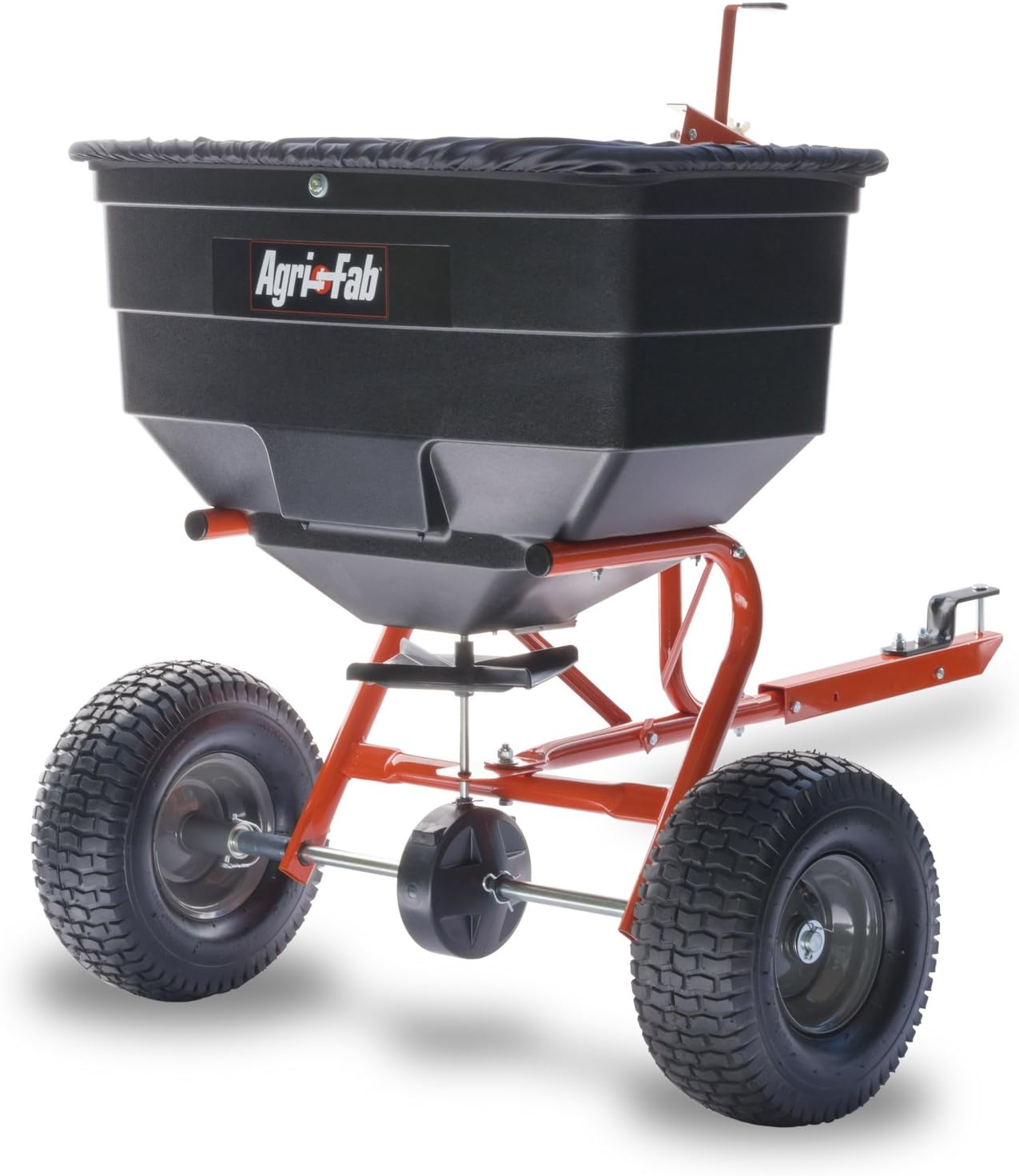
Agri-Fab 185 lb Tow-Behind ATV/UTV Broadcast Spreader
| Weight Capacity Maximum | 185 pounds |
|---|---|
| Tire Type | Pneumatic Tires |
| Number of Wheels | 2 |
| Material Type | Metal, Polypropylene (PP) |
The Agri-Fab 185 lb tow-behind broadcast spreader is built to cover large yards and properties from the seat of an ATV, UTV, or small tractor. Its large polypropylene hopper holds enough material to cover roughly an acre on one fill, letting you finish jobs with fewer stops. Operation is straightforward: a raised on/off rod flow control is reachable from the vehicle seat, and a heat-treated steel gear drive with enclosed gearbox helps protect internals when spreading corrosive materials like salt or ice melt. The spread pattern reaches up to about 12 feet for fast, even coverage, and the pneumatic turf tires with ball bearings smooth transport over uneven ground. Durable alloy steel frame and rust-proof components make it suitable for year-round use. The unit is practical for homeowners and property managers who need efficient, repeatable distribution across larger areas. It is fairly large and requires a tow vehicle and storage space, and assembly and maintenance of the gearbox and tires add some upkeep compared with small hand spreaders.
Best for: Buyers who need a durable, vehicle-towed spreader to cover large lawns, acreage, or commercial properties efficiently without frequent refills.
Less Ideal for: Not a good fit for small urban yards, gardeners who prefer walk-behind or handheld tools, or anyone without a compatible tow vehicle.
- Large 185 lb hopper covers up to about 40,000 sq ft per fill to reduce downtime
- Raised flow-control rod usable from ATV/tractor seat for convenient operation
- Enclosed gearbox and rust-proof poly components resist corrosion from salt and fertilizer
- Wide spread pattern up to 12 ft speeds coverage and promotes even distribution
- Pneumatic turf tires with ball bearings improve transport over rough ground
- Requires a tow vehicle and significant storage space when not in use
- Heavier, larger unit that needs occasional gearbox and tire maintenance
Verdict: If you want a robust tow-behind spreader that handles large areas with fewer refills and seat-mounted control, this 185 lb Agri-Fab model is a practical choice.
Brinly BS36BH-A Tow-Behind Broadcast Spreader (175 lb)

| Capacity | 175 lb (3.5 cu ft) |
|---|---|
| Hopper material | Polyethylene |
| Drive ratio | 6:1 glass-filled nylon gears |
| Spread width | Up to 12 ft |
| Hitch | Universal tow-behind single pin |
The Brinly BS36BH-A is a tow-behind broadcast spreader built for covering large lawns efficiently. It mounts to most lawn tractors, ATVs, or UTVs via a universal hitch and holds up to 175 lb (3.5 cu ft) of granular material so you spend less time refilling on bigger jobs. The poly hopper and stainless-steel contact hardware resist corrosion from fertilizer and ice melt, while enclosed glass-filled nylon gears and a nylon gearbox protect drive components. Notable features include an easy-to-reach calibrated setting dial with a lock, patented autoflow that stops material when you stop, and directional spread pattern control to even out coverage up to about 12 feet. Thick pneumatic tires and a 6:1 gear ratio make it practical across uneven terrain. Important limitations are its assembly requirement and that it is primarily for tow-behind use on tractors or similar vehicles, so it is not a walk-behind solution for small lawns. Expect professional-level coverage for one-acre-plus properties but plan for occasional maintenance of moving parts if used heavily.
Best for: Good choice for homeowners and small commercial users who need efficient, accurate spreading across large lawns or acreage and prioritize coverage performance and durability.
Less Ideal for: Not a great fit for owners of small urban lawns who need a compact walk-behind spreader or for those without a tractor, ATV, or UTV to tow it.
- Large 175 lb (3.5 cu ft) hopper reduces refill trips on big yards
- Polyethylene hopper and stainless-steel contact hardware resist corrosion from fertilizers and ice melt
- Patented autoflow and directional spread control improve accuracy and reduce waste
- Easy-to-reach calibrated settings with lock for repeatable application rates
- Enclosed gearbox and durable gears designed for reliable, low-maintenance operation
- Designed only as a tow-behind unit so it is not suitable for small yards where a walk-behind spreader is preferable
- Requires assembly and periodic maintenance of gearbox and moving parts with heavy use
Verdict: If you need professional-level coverage for one-acre-plus properties, this durable tow-behind spreader delivers high-capacity, accurate spreading with minimal refilling.
Yard Commander 125 lb Tow-Behind Broadcast Spreader

| Capacity | 125 lb |
|---|---|
| Spread radius | 10–12 ft |
| Tire type | 12-inch pneumatic tires |
| Hopper | Corrosion-resistant composite with cover |
| Gears | Cast aluminum |
The Yard Commander 125 lb tow-behind broadcast spreader is built to handle large lawns and heavier materials like fertilizer, seed, and ice melt. It mounts to tractors, riding mowers, ATVs, or UTVs via a universal hitch and uses premium cast aluminum gears to deliver a steady 10–12 foot spread radius. The corrosion-resistant composite hopper and included weather cover keep materials dry and prevent clumping during light precipitation. Large 12-inch pneumatic tires improve flotation and traction across uneven or soft turf so you can tow it over rough ground without frequent stoppages. Flow is controlled with a simple gate lever for dosing adjustments so you can tune application rate for different materials. Expect basic assembly and occasional maintenance on moving parts, and note capacity varies by material so very dense mixes may not reach the full 125 lb in practice. The unit is practical for large properties where tow-behind performance, corrosion resistance, and a wide spread pattern matter most.
Best for: Gardeners and property owners who prioritize performance and efficiency on large lawns and need a tow-behind spreader that handles varied terrain and heavier materials.
Less Ideal for: Small-lot homeowners who prefer a walk-behind unit or users who want a completely maintenance-free, plug-and-play spreader.
- Large 125 lb composite hopper resists corrosion and holds enough material to cover up to 25,000 sq ft in one fill
- Premium cast aluminum gear drive provides smoother, durable spreading and supports a 10–12 ft broadcast width
- Universal hitch fits most lawn tractors, riding mowers, ATVs, and UTVs for versatile tow-behind use
- 12-inch pneumatic tires improve flotation and traction on rough or soft terrain
- Included hopper cover reduces clumping and allows light-rain operation
- Requires assembly and periodic maintenance of moving parts
- Actual capacity and coverage depend on material density and may be less than rated with heavy mixes
Verdict: Choose this spreader if you need a durable, tow-behind broadcast unit that covers large lawns efficiently while handling rough terrain and damp conditions.
COZONY Tow-Behind Broadcast Spreader, 85 lb Capacity

| Capacity | 85 lbs |
|---|---|
| Spread width | Up to 9.8 ft |
| Flow settings | 30 levels |
| Tire type | 10-inch pneumatic |
This COZONY tow-behind broadcast spreader is built for homeowners who need a high-capacity, all-season applicator without a professional price tag. The 85 lb hopper cuts refill frequency for larger lawns and small acreage, and the 30-level flow control with adjustable spread width (up to about 9.8 feet) helps achieve even coverage for seed, fertilizer, salt, or ice melt. The powder-coated steel frame and rustproof poly hopper improve durability, while 10-inch pneumatic tires make it easier to tow across grass, gravel, or light snow. A universal hitch adds compatibility with many riding mowers, ATVs, and UTVs so you can use existing equipment. Assembly is straightforward and controls are simple to operate, which is helpful if you only use a spreader seasonally. Expect basic, functional construction rather than commercial-grade components, so occasional maintenance and cautious storage will extend service life. For a budget-focused buyer wanting a versatile, high-capacity tow spreader, this model delivers strong value with practical, user-friendly features.
Best for: Homeowners or small-acreage owners who want a high-capacity, versatile tow-behind spreader that handles fertilizer, seed, and ice melt without spending on pro-level equipment.
Less Ideal for: Large commercial landscapers or users who need industrial-strength, maintenance-free equipment for daily heavy use.
- Large 85 lb hopper reduces refill stops for medium to large lawns
- Adjustable flow with up to 30 settings and side spread control for precise application
- Durable powder-coated steel frame and rustproof poly hopper resist corrosion
- 10-inch pneumatic tires provide easier towing across uneven terrain
- Universal hitch fits most lawn tractors, ATVs, and UTVs
- Not built to commercial heavy-duty standards and may need periodic maintenance
- Product features like spread width and flow settings are mechanical and may require calibration for perfect uniformity
Verdict: A high-capacity, budget-friendly tow spreader that gives homeowners precise, versatile coverage for seed, fertilizer, and ice melt when paired with a riding mower or ATV.
Agri-Fab 130-Pound Tow Broadcast Spreader with 110–130 lb Spreader Grate Kit

| Wheel Type | Pneumatic |
|---|---|
| Load Capacity | 130 pounds |
| Number of Wheels | 4 |
| Material Type | Metal, Rubber |
The Agri-Fab tow broadcast spreader is designed for homeowners with larger lots who need a reliable tow-behind unit for seed, fertilizer, or ice melt. It uses a 130 pound rustproof poly hopper and an enclosed gearbox with tapered gears to deliver consistent, even spreading while protecting internal components from debris and weather. The rod-linked on-off flow gate is operable from the tractor seat for precise application control, and the large pneumatic tires with a wide wheelbase give stability across uneven terrain. The included 110–130 lb grate kit helps prevent clogs and improves material flow for damp or clumpy products. Practical benefits are reduced refill frequency on bigger lawns, straightforward adjustment from the seat, and long-lived mechanical parts. Expect basic assembly to be minimal but note this is a tow-only unit rather than a self-propelled spreader; very fine or highly moist materials may still need attention despite the grate. The construction emphasizes durability and serviceability for season-to-season use.
Best for: Buyers who prioritize a durable, dependable tow spreader for regular use on larger yards and want straightforward controls and long-term reliability.
Less Ideal for: If you need a push spreader, a compact unit for small lawns, or a self-propelled option, this tow-only model is not the best choice.
- Large 130 lb poly hopper reduces how often you refill on bigger lawns
- Enclosed tapered gearbox protects gears and promotes even distribution
- Rod-linked on-off flow gate adjustable from the tractor seat for precise control
- Pneumatic tires and wide wheelbase improve stability on uneven ground
- Grate kit reduces clogs and improves flow of damp or clumpy materials
- Designed as a tow-behind unit so it requires a tractor or ATV with a hitch
- May require trimming to fit certain 110 lb spreader models when installing the grate kit
Verdict: A heavy-duty, seat-operable tow spreader built for consistent, low-maintenance performance on larger properties.
Agri-Fab Tow-Behind Broadcast Spreader, 85 lb Capacity (Model 45-0530)

| Weight Capacity Maximum | 85 pounds |
|---|---|
| Number of Wheels | 2 |
| Tire Type | Tubeless |
| Additional Features | Heavy Duty |
The Agri-Fab tow-behind broadcast spreader is a straightforward model for treating medium to large lawns from a tractor or ATV. It holds up to 85 pounds of material and disperses seed, fertilizer, or ice melt across a spread up to about 10 feet while the operator uses an on/off control reachable from the tractor seat. The unit rides on 10-inch pneumatic tires and uses a heavy-duty alloy steel frame and metal handle for durability in regular outdoor use. Assembly is required but supported by a video guide. Practical strengths are its simple mechanical design, large hopper for fewer refills, and tractor-seat control that keeps you from dismounting. Limitations to expect are basic features only—there is no precision metering electronics and the spread pattern can require calibration and occasional overlap to avoid streaking. Buyers should also plan time for setup and routine maintenance to keep the pneumatic tires and gearbox operating smoothly.
Best for: Best for homeowners or groundskeepers who want a durable, no-frills tow-behind spreader to treat lawns up to roughly a quarter acre from a tractor or ATV and who value straightforward, proven mechanics over gadgetry.
Less Ideal for: Not a good fit for users who need precise, programmable application rates or those who only have hand-push spreaders for very small lawns.
- Large 85 lb hopper reduces refill frequency during medium to large lawn jobs
- On/off control accessible from the tractor seat for convenient operation
- 10-inch pneumatic tires provide smoother towing over uneven turf
- Alloy steel frame and metal handle offer heavy-duty durability for outdoor use
- No electronic or precision spread-rate control for fine calibration
- Requires assembly and occasional maintenance to maintain performance
Verdict: A robust, easy-to-use tow-behind spreader that handles large hopper loads and simple tractor-seat control, ideal if you want reliable, low-complexity lawn coverage.
Choosing the Right Tow Broadcast Spreader: Key Factors to Consider
Hopper Capacity and Material
Hopper size determines how much seed or fertilizer you can carry between refills and directly affects how productive a day of spreading will be. Larger hoppers reduce downtime but add weight, so the towing vehicle and axle design must match the filled load.
Material matters because poly hoppers resist dents and corrosion but can crack under UV exposure if thin. Steel hoppers offer ruggedness and better impact resistance, but untreated steel can rust when exposed to damp materials. Look for reinforced rims and internal baffles that slow material surges during turns; those features improve meter consistency and reduce clogs.
Spread Mechanism and Adjustment
The type of spreader plate and agitator design controls how uniformly the granules fly out. A well-designed spinner and adjustable gate let you tune application rate for different granular sizes, from fine seed to coarse rock salt.
Calibration matters. You want a mechanism with clear settings or an easy way to test output per pass so you can match the product label rates. Systems that allow quick shutoff and flow control at the hitch save material when crossing driveways or landscaping beds.
Chassis, Axles, and Tires
A strong frame and axle reduce flexing under heavy loads and towing vibrations. Garden terrain often includes ruts, slopes, and soft spots, so a spreader needs sturdy support to maintain consistent height and spinner clearance.
Tire size and tread affect how smoothly a spreader tows behind different vehicles and how much compaction occurs. Air-filled tires absorb bumps but require occasional pressure checks. Solid tires avoid flats but transmit more vibration to the frame. Confirm the axle rating matches intended loaded weight to avoid premature wear.
Tow Vehicle Compatibility and Hitching
Not all tow spreaders fit every garden vehicle. Check hitch type, mounting height, and drawbar connections. Some spreaders are designed for three-point hitch tractors while others use a ball or pin hitch for zero-turn mowers and ATVs.
Consider whether the spreader needs a driven gearbox linked to the towing vehicle or uses ground-driven wheels. Ground-driven systems are simple but can underdeliver on steep slopes or at slow speeds. Choose a hitch setup that lets you attach and detach quickly and that provides the correct operating geometry for your towing rig.
Material Compatibility and Flowability
Different granular materials behave differently. Fertilizer, seed, lime, and ice melter each have unique flow characteristics that affect how they pass through the hopper and dispenser.
Assess whether the spreader has an agitator or vibration option to handle sticky or damp materials. Look for signs of bridging in the hopper design and a delivery gate that accommodates the coarsest material you expect to use. Being able to fine-tune gate openings and test spread width reduces waste and helps maintain turf health.
Ease of Maintenance and Winter Storage
Outdoor equipment is exposed to moisture and corrosive materials, so easy access to moving parts for cleaning and lubrication extends service life. Quick-release shafts, removable spinners, and simple gearbox drains mean fewer tools and less time during seasonal maintenance.
Consider how the spreader will be stored in winter. Drain paths that let residual materials fall clear and hoppers that can be rinsed or tipped simplify off-season care. Parts that can be replaced without specialty tools minimize downtime if a bolt or spring fails.
Preparing Your Tow Vehicle and Hitch
Confirming your towing setup is the first step before attaching a broadcast spreader. Measure hitch height and ensure the towing vehicle can handle the gross load when the hopper is full. Verify your tow vehicle's drawbar rating and brake capacity if you will be hauling heavy materials over slopes.
- Match hitch type and height to the spreader mounting plate.
- Check the tow vehicle owner manual for payload limits.
- Ensure safe braking distance with a fully loaded spreader.
Calibrating Spread Rate and Width
Set aside a small test area to measure output before treating your whole lawn. Use a known gate setting, drive a measured pass, then weigh or collect the spread material to confirm the application rate. Repeat across different settings until the spread matches label recommendations for the material you are using.
- Use consistent towing speed during calibration.
- Test with the actual material you will apply.
- Adjust gate and spinner height to fine-tune spread width.
Common Maintenance Tasks to Extend Service Life
Rinse and dry the hopper after use, especially when applying corrosive materials like deicing salts. Inspect the gearbox, bearings, and agitator for wear, and lubricate per the manufacturer guidance. Tighten fasteners and check tires for correct pressure or signs of damage regularly.
- Remove residual materials from under the spinner to prevent buildup.
- Cover moving linkages with grease and replace seals that show corrosion.
- Store indoors or under a dry cover when not in use for long periods.
Using a Tow Spreader on Slopes and Uneven Ground
Operating on slopes may change distribution because ground speed and wheel slip affect the drive mechanism. Keep passes perpendicular to the slope where possible to minimize material surge and remember that downhill runs can concentrate material lower on the slope. Slow down on uneven ground to maintain steady feed rates and consider smaller passes with overlap to avoid banding. If your spreader struggles to maintain consistent flow on steep grades, consider a model with a gearbox-driven dispenser rather than ground-driven wheels.
- Avoid sudden turns while the hopper is full to prevent material surge.
- Make lighter, more frequent passes on slopes for even coverage.
- Use overlap patterns to minimize visible striping.
Seasonal Uses Beyond Fertilizer and Seed
Tow broadcast spreaders are versatile for many tasks: spreading topdressings, limestone, ice melt on long driveways, or cover crop seed across larger plots. Choosing a spreader with adjustable gate settings and a durable hopper makes it easier to switch between materials without clogging. When moving between tasks, fully clean the hopper and spinner and recalibrate for the new material. Some gardeners keep a dedicated unit for corrosive winter materials to avoid cross-contamination of fertility products.
- Label gate settings for common materials to speed future setups.
- Rinse or sweep the hopper between material types.
- Consider a spare spinner or gate components if you switch materials frequently.
How We Chose the Best Tow Broadcast Spreader
We focused on the features and performance dimensions that matter most to gardeners who will tow a spreader behind a lawn tractor, ATV, or utility vehicle. Selection began by filtering for spreaders designed for tow mounting rather than walk-behind or ATV-only rigs. We excluded lightweight handheld or hand-crank models and any units intended solely for spot applications. Key evaluation criteria included hopper construction and capacity, because material and size determine how long you can work without refilling and how resistant the hopper is to cracking or corrosion. We assessed spread mechanism and calibratability to judge how evenly different granules and seeds would be distributed. Chassis and axle strength were reviewed to ensure the spreader tolerates the loads of heavy materials and towing stresses. Drive system reliability and ease of hookup scored how simply a gardener can attach, disconnect, and engage the spreader from typical garden vehicles. Maintenance accessibility covered how easy it is to clean, keep moving parts lubricated, and winterize the unit. We also considered compatibility with common broadcast materials such as seed mixes, granular fertilizer, and ice melter. Units that required complex tools for setup or had proprietary parts that are hard to service were screened out. Final selections balance durability, spread accuracy, and practical handling so gardeners get reliable results in everyday use.
FAQ
Will any tow spreader work with my lawn tractor?
It depends on hitch type and payload capacity. Many tow spreaders use a pin or ball hitch and fit common lawn tractors, but you must confirm hitch height, drawbar mounting, and the tractor's rated payload for a full hopper. If your tractor's manual limits towing loads, choose a spreader with a smaller hopper or ensure the axle rating is compatible.
How do I prevent clogging when spreading damp material?
Prevent bridging by using an agitator or vibrator feature and by keeping the hopper dry before filling. Sift or break up clumps before loading and avoid filling the hopper with very wet product. Some spreaders offer anti-bridging cones or agitator paddles to keep flow consistent.
Can I use a tow spreader for ice melt and fertilizer with the same unit?
You can, but be careful about corrosion and cross-contamination. Rinse and thoroughly dry the spreader after applying ice melt. Consider designating a dedicated unit for corrosive materials or use a well-maintained model with corrosion-resistant components if you plan to alternate uses frequently.
How often should I calibrate the spreader?
Calibrate whenever you change materials, gate settings, or towing speed. Also recalibrate after repairs or if you notice uneven coverage. A quick test pass before a full application ensures you apply the correct rate and avoid over- or under-application.
What maintenance tasks are essential before winter storage?
Empty and clean the hopper, remove or protect the spinner and gearbox, lubricate bearings, and touch up rust-prone areas. Store the spreader in a dry place or under a breathable cover. Drain any gearboxes if the manufacturer recommends it to prevent moisture damage.
Final Verdict
A tow broadcast spreader is a workhorse for larger lawns, long driveways, and small acreage. Prioritize hopper durability, a reliable spread mechanism, and a chassis rated for the filled load to get consistent application and fewer service headaches. Match hitch type and axle strength to your tow vehicle and take time to calibrate with the actual material you will use. Balance capacity against maneuverability: larger hoppers mean fewer refills but more stress on axles and towing setups. With the right combination of capacity, spread control, and maintenance routine, you can achieve even coverage and efficient seasonal treatments across your property.
