

Note: This article contains affiliate links. If you click on these links and make a purchase, I may earn a small commission at no extra cost to you. This helps support my research and content. Read my full affiliate disclosure here.
If you are dealing with a persistent roach problem, the right chemical cockroach killer can stop activity quickly and reduce the chance of reinfestation. In kitchens, basements, and multiunit housing, formulation, residual action, and application method affect how effectively an insecticide suppresses roaches in real use. This guide covers seven top-rated chemical cockroach killers we shortlisted for common indoor infestations and evaluates them across practical criteria gardeners and homeowners care about. Read on for how each option behaves, what to expect after treatment, and which attributes matter most for your situation.
Top Picks at a Glance
| Best Overall The best all-around choice for most situations | Syngenta Advion Cockroach Gel Bait, 4 x 30 g Tubes |  |
| Best Quality Built to a higher standard if you want something more solid | Fipronil Plus-C Insecticide Concentrate, 16 oz |  |
| Best Value The sweet spot between price and what you get | TERRO Roach Killer Gel Bait Stations, 12-Pack |  |
| Best Budget The cheapest option that still gets the job done reliably | HARRIS Boric Acid Roach and Silverfish Killer Powder (16 oz) |  |
| Highest Rated A top-rated pick with lots of positive feedback | Atticus Talak 7.9% Indoor/Outdoor Bifenthrin Insecticide Concentrate (1 gal) |  |
| Most Popular A crowd favorite that many people choose with confidence | Combat Max Roach Killing Gel, 2.1 oz Syringe |  |
| Best Seller A high-volume bestseller chosen again and again | Atticus Talak 7.9% Bifenthrin Indoor/Outdoor Insecticide Concentrate, 32 oz |  |
Syngenta Advion Cockroach Gel Bait, 4 x 30 g Tubes

| Item Form | Gel |
|---|---|
| Target Species | Insects |
| Active Ingredients | Carboxylate / Indoxacarb 0.6% |
Syngenta Advion Cockroach Gel Bait is a ready-to-use gel designed for targeted crack-and-crevice applications to eliminate common cockroach species, including German, American, and brown-banded roaches. You dispense small spots of gel into hiding places or along runways using the tube tip, which makes it suitable for homes, commercial kitchens, and industrial sites where discreet placement matters. The active ingredient (indoxacarb 0.6%) is incorporated into a high-performing bait matrix that remains attractive to bait-averse roaches, so you can expect faster knockdown in many infestations compared with simple insecticide sprays. It is labeled for use in food handling areas when applied as directed and can be applied both indoors and outdoors. Limitations include the need for careful spot placement for effectiveness and adherence to label directions to keep pets and children safe. This product treats infestations through baiting rather than broad residual contact, so it works best as part of a sanitation and exclusion plan rather than as a sole long-term barrier treatment.
Best for: Homeowners or facility managers who want a targeted, professional-grade bait to reduce active cockroach populations while integrating with sanitation and exclusion practices.
Less Ideal for: People seeking an instant area-wide spray or long-lasting surface barrier should consider alternative control methods or combined treatments rather than a spot-applied gel alone.
- Formulated gel matrix attracts even bait-averse roaches for higher uptake
- Designed for precise crack-and-crevice placement indoors and outdoors
- Labeled for use in food handling areas when applied according to directions
- Includes professional-strength active ingredient (indoxacarb 0.6%)
- Requires correct placement and periodic reapplication to maintain effectiveness
- Not a surface residual barrier so sanitation and exclusion are still necessary
Verdict: Choose this gel bait when you need a professional, spot-applied solution that attracts and controls bait-averse cockroaches in targeted indoor or outdoor locations.
Fipronil Plus-C Insecticide Concentrate, 16 oz

| Unit Count | 16 Fluid Ounces |
|---|---|
| Item Form | Spray |
| Target Species | Insects |
| Active Ingredients | Fipronil |
| Specification Met | EPA |
Fipronil Plus-C is a concentrated insecticide intended for pump or backpack sprayer use to treat cracks, voids, ant trails, foundations and other localized pest harborage sites. The formula uses 0.65% fipronil with a cellulose entrapment technology that improves residual life and reduces breakdown from UV and microbes, so a single application can provide weeks to months of control. Typical use is mixing the measured concentrate into water (built-in chamber for accurate dosing) at maintenance or higher rates depending on infestation severity, then applying as spot or crack-and-crevice treatments rather than broad surface spraying. For German cockroaches it acts as a transferable active ingredient that insects pick up and carry to nestmates, which helps collapse colonies over days. Important limitations are that it is a concentrated professional-style product requiring careful mixing and protective measures, it is toxic to birds and aquatic life so outdoor use needs caution, and it is not intended as a full surface spray or for every ant or spider species listed on the label.
Best for: Buyers who prioritize fast, long-lasting control and are comfortable using concentrated treatments and sprayers to knock down and eliminate established infestations.
Less Ideal for: Casual users who want ready-to-use aerosols, those unable to follow mixing and safety directions, and homeowners with ponds or habitats for birds and aquatic life.
- Professional-grade active ingredient effective for colony elimination via transfer
- Cellulose entrapment technology extends residual control and reduces breakdown
- Built-in measuring chamber simplifies accurate dilution for sprayers
- Versatile for indoor cracks/voids and targeted outdoor spot treatments
- Concentrate requires careful mixing and protective equipment for safe use
- Toxic to birds, fish and aquatic invertebrates so cannot be applied near water
- Not formulated for broad surface spraying and excludes some ant and spider species from control
Verdict: Choose this concentrate when you need a professional-strength, transferable insecticide that delivers long-lasting, colony-level control for heavy German cockroach infestations.
TERRO Roach Killer Gel Bait Stations, 12-Pack

| Unit Count | 12 Count |
|---|---|
| Target Species | Cockroach |
| Material Type | Plastic |
The TERRO Roach Killer Gel Bait Stations are a 12-pack of compact, no-mess stations that use a dual-action gel to kill German, American, and Oriental roaches. Each station is activated by cutting open the bait tunnels and squeezing a bubble to push fresh gel into the feeding chamber; roaches enter the station, feed on the gel and then carry bait back to harborage areas where it spreads the effect. In practice these are placed along walls, in corners, near cracks and around kitchens, bathrooms, basements, or garages for targeted treatment. The enclosed station keeps the gel contained, which reduces cleanup and lets you deploy units discreetly. Because the formula works by both ingestion and contact and is designed to persist, a single station can address dozens or even hundreds of roaches in an infested area. Limitations are the need to place stations out of reach of children and pets and to follow the activation steps for the gel to be accessible; heavy infestations may still require multiple placements and complementary sanitation or professional follow-up.
Best for: Buyers who want a straightforward, low-maintenance solution to reduce German roach populations by placing discreet bait stations where they see activity.
Less Ideal for: Those needing an immediate one-time elimination of very large infestations or people who cannot safely place bait where children or pets might access it.
- Dual-action formula works by ingestion and contact to reach hidden roach harborage
- No-mess enclosed station keeps gel contained for cleaner placement
- Ready-to-use design with simple activation for quick deployment
- Twelve stations provide coverage for multiple rooms or larger infestations
- Requires cutting and squeezing to activate each station which adds small setup time
- Must be kept away from children and pets, limiting placement options
Verdict: A practical, no-mess 12-pack of gel bait stations that makes targeted control of German roaches easy for homeowners tackling active infestations.
HARRIS Boric Acid Roach and Silverfish Killer Powder (16 oz)

| Item Form | Powder |
|---|---|
| Target Species | Insects |
| Active Ingredients | boric acid |
| Unit Count | 1 Count |
This 16 oz HARRIS boric acid powder is a straightforward, no-frills roach and silverfish killer that pairs an attractant lure with a dry powder that continues working as long as it stays dry. You apply it from the puffer-style bottle to cracks, baseboards, behind appliances, and other hard-to-reach hiding spots where insects travel. The lure draws insects to the powder, and affected pests typically die within a few days after contact; the residue can remain effective for weeks in dry locations. Notable features are the built-in food-grade lure, EPA registration for household use, and a compact applicator that makes spot treatments quick. Limitations are inherent to boric acid powder: it must remain dry to work, it is not an immediate knockdown, and extra care is required to keep it away from children and pets. For widespread heavy infestations you will likely need repeated treatments or a complementary baiting strategy to reach deep harborage sites.
Best for: Buyers looking for a low-cost, easy-to-apply solution to reduce roach and silverfish activity in localized areas of the home and who prefer a product that provides lasting residue when applied correctly.
Less Ideal for: Homes needing immediate elimination of a heavy, widespread infestation or users who cannot safely restrict access to treated areas from children or pets.
- Contains a food-grade lure to attract insects to the powder
- Long-lasting residual effect when applied in dry areas
- Puffer applicator allows targeted application into cracks and tight spaces
- EPA registered for use in homes
- Requires dry placement to remain effective and will fail if disturbed or wetted
- Not an instant knockdown—pests can take up to 72 hours to die
Verdict: A budget-friendly, EPA-registered boric acid powder that provides an easy, long-lasting spot treatment for household roaches and silverfish.
Atticus Talak 7.9% Indoor/Outdoor Bifenthrin Insecticide Concentrate (1 gal)

| Active Ingredients | Bifenthrin |
|---|---|
| Formulation | Suspension Concentrate |
| Unit Count | 128 Fluid Ounces |
| Specification Met | EPA |
Talak 7.9% is a water-based bifenthrin concentrate meant as a flexible indoor and outdoor insect control product. You dilute the concentrate with water and apply it as a spray for perimeter barrier treatments, to turf, to ornamentals, or to interior baseboards and other problem areas. The label lists control of more than 75 pests including mosquitoes and ticks, and the formula is designed to kill on contact and provide residual control for up to three months. Practical benefits include a clear, odor-free spray that dries without staining and a bottle that allows easier small pours for accurate mixing. Important limitations are that mixed solutions should be used the same day and it is not approved for fogger use, so it is best for targeted spray applications rather than broadcast fogging. As with any bifenthrin product, users should follow label directions closely and consider nonchemical options for integrated mosquito management.
Best for: Buyers who want a single, versatile insecticide to treat both perimeter and landscape mosquito problems and prefer a product that delivers residual control without odors or visible residue.
Less Ideal for: People seeking a ready-to-use fogging or misting solution or those who need an insecticide they can pre-mix and store for later use.
- Broad-spectrum control listing more than 75 indoor and outdoor pests including mosquitoes and ticks.
- Water-based formula that dries clear, leaves no residue, and is odor-free for use around living areas.
- Long residual effect with label claim of up to three months of control per application.
- Mixes with water for adjustable application rates across lawns, landscapes, and surfaces.
- Bottle design supports easier small pours to reduce mess when measuring concentrate.
- Mixed spray cannot be stored and must be used the same day.
- Not approved for use in foggers, limiting application methods to direct sprays.
Verdict: A versatile, long-lasting bifenthrin concentrate that provides broad-spectrum mosquito and perimeter control for users who want one product for indoor and outdoor applications.
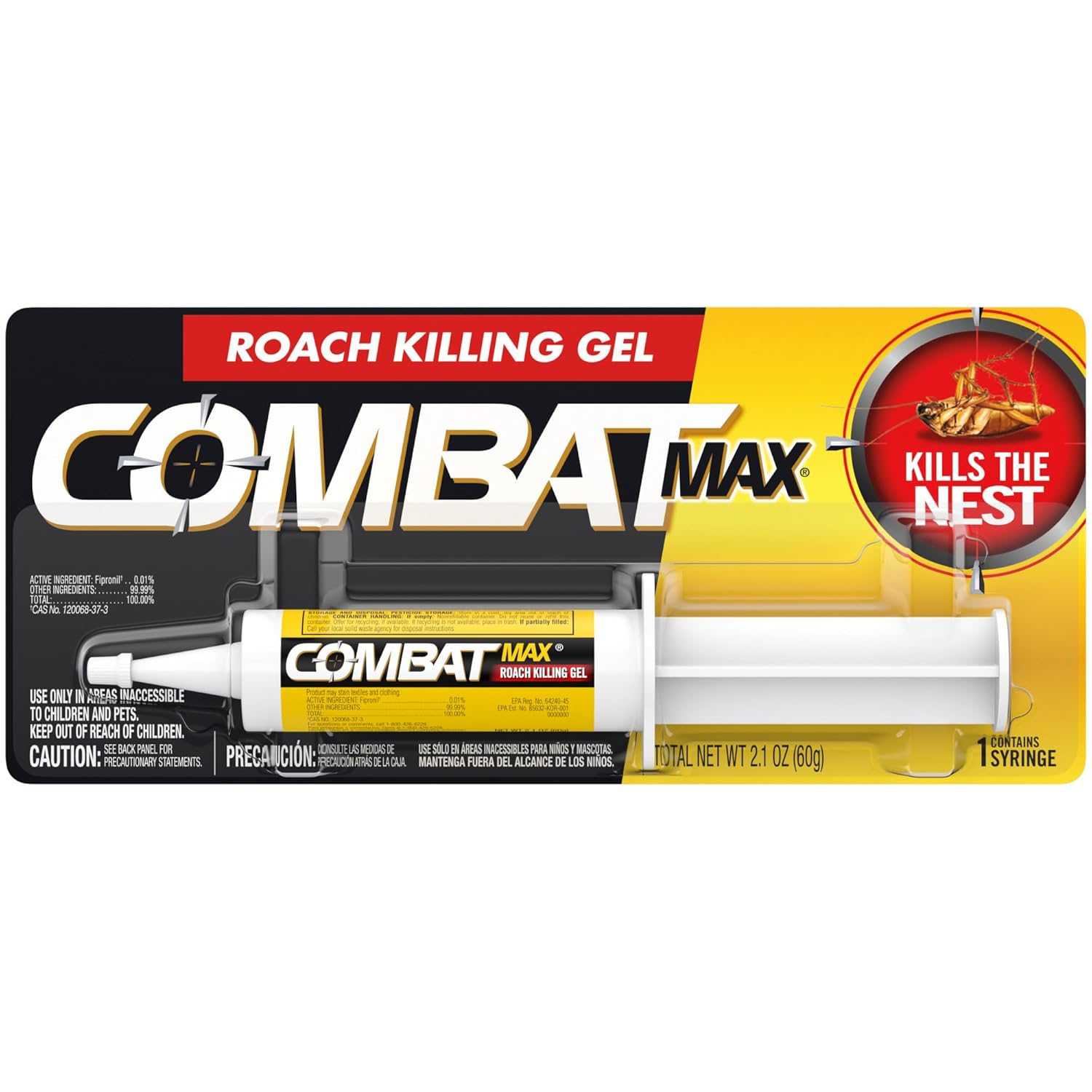
Combat Max Roach Killing Gel, 2.1 oz Syringe
| Unit Count | 2.1 Ounce |
|---|---|
| Item Form | Gel |
| Active Ingredients | Fipronil |
| Special Features | Fast control; for cracks and crevices |
Combat Max Roach Killing Gel is a syringe-applied bait intended for spot treatment of roach activity indoors and in protected outdoor areas. You apply dime-sized spots or short lines of the odorless gel in cracks, crevices, along baseboards and other hiding places; roaches consume the bait, return to the nest, and spread the active ingredient so the infestation is reduced at the source. The formula contains fipronil and is described as fast-acting with residual control up to about three months when kept out of direct sunlight and water. The syringe applicator makes precise placement easy and minimizes mess, and the gel is fume-free so it can be used in kitchens and living areas if applied away from food prep surfaces. Important limitations are that the product requires regular inspection and reapplication when the gel is no longer visible and that outdoor effectiveness drops where sunlight or moisture reach the bait. As with any insecticide, follow safety directions to avoid contaminating food or utensils.
Best for: Buyers who want a proven, targeted gel bait to tackle existing roach problems and prefer solutions that act quickly and provide measurable results backed by widespread use.
Less Ideal for: Those seeking a single, no-maintenance cure or a broad outdoor perimeter treatment exposed to weather should consider alternative methods or professional services.
- Targeted syringe applicator for precise placement in cracks and crevices
- Fipronil-based formula that begins acting within hours and claims long residual control
- Odorless and fume-free so it can be used in occupied spaces when applied correctly
- Requires periodic inspection and reapplication every few months to maintain effectiveness
- Less effective outdoors if exposed to direct sunlight or water which reduces residual action
Verdict: Choose this gel when you need a precise, fast-acting bait that eliminates roaches at the nest and delivers sustained control for up to three months.
Atticus Talak 7.9% Bifenthrin Indoor/Outdoor Insecticide Concentrate, 32 oz

| Active Ingredient | Bifenthrin |
|---|---|
| Formulation | Suspension Concentrate |
| Liquid Volume | 32 fluid ounces |
| Length of Control | Up to three months |
| Target Species | Insects |
Talak 7.9% is a liquid concentrate for treating lawns, landscaping, outdoor living areas and indoor perimeter spots like baseboards and cabinets. You dilute the concentrate with water to create a spray for barrier treatments, spot applications or lawn mixes; label rates explain how much to mix per gallon depending on the use. The product uses bifenthrin, a proven broad-spectrum active ingredient, and the manufacturer states it controls over 75 species and can give residual control for as long as three months. Its water-based formula dries clear, leaves no odor or visible residue, and is not phytotoxic on plants when used per label. Practical benefits include flexible indoor and outdoor use, clear drying, and a bottle designed for easier pouring. Important limitations are that solutions should be mixed only for same-day use, it is not registered for sale in a few states, and it is not approved for fogger application, so professional-style misting methods are not appropriate.
Best for: Buyers who want a single, reliable product to protect yards, patios and building perimeters from a wide range of common pests and prefer conservative, label-driven application practices.
Less Ideal for: People seeking ready-to-use sprays or fogger-compatible products or those in states where this formulation is not registered should look at alternatives.
- Broad-spectrum control listed for 75+ indoor and outdoor pest species
- Water-based formula that dries clear and leaves no odor or residue
- Flexible label directions for lawns, landscapes, hardscapes and indoor perimeter treatments
- Long residual activity up to three months when applied at recommended rates
- Mixed spray solutions cannot be stored and must be used the same day
- Not approved for fogger application and not available for sale in some states
Verdict: A versatile, water-based bifenthrin concentrate that delivers long-lasting, broad-spectrum outdoor (and perimeter indoor) control when used according to the label.
Choosing the Right Chemical Cockroach Killer: Key Factors to Consider
Active Ingredient and Mode of Action
Knowing the active ingredient tells you how the product affects roaches and whether it will work on resistant populations. Some actives provide quick nerve-agent knockdown while others are slower but transfer through bait feeding and contact exposure. Matching mode of action to the infestation type matters because fast knockdown is helpful for visible, heavy activity while feeding-based actives are stronger at reducing colony numbers over time.
Active ingredient also affects where a product can be used safely. Some chemistries are formulated for spot treatments and baits inside living areas, while others are better for cracks, voids, or perimeter work. Read label directions to confirm labeled uses and restrictions before treating indoor spaces.
Residual Effect and Longevity
Residual duration defines how long treated areas remain lethal to roaches after application. Products with longer residuals reduce the need for frequent reapplication, which is helpful in persistent infestations or hard-to-access harborages. Residual effectiveness can vary with surface type, humidity, and cleaning frequency, so expected longevity is a guideline rather than an absolute.
Consider where you will apply the product. Porous or frequently cleaned surfaces will shorten residual life. For long-term suppression, pair a residual product with sanitation and exclusion to limit food and water that draw roaches back.
Application Method and Placement
Application format changes how and where you can use a product. Baits allow targeted placement at harborages and are less intrusive in kitchens. Ready-to-use sprays let you quickly treat visible activity, while aerosols and crack-and-crevice formulations access tight spaces. Concentrates require mixing but can cover larger areas at lower cost per square foot.
Choose a method that matches the infestation size and the locations you can legally and safely treat. Proper placement-behind appliances, along baseboards, inside cabinets, and near pipe penetrations-matters more than raw product potency for long-term control.
Safety and Indoor Use Restrictions
Indoor safety instructions and labeled restrictions determine whether a product is appropriate for occupied homes, around children, pets, and food preparation areas. Some chemistries require evacuation during application or limit use near food-contact surfaces. Follow reentry intervals, ventilation recommendations, and personal protective equipment guidance exactly as stated on the label.
If you have pets or young children, prefer formulations that minimize accessibility to treated surfaces, such as enclosed baits or low-drift sprays. Good safety practices reduce exposure risk without sacrificing control.
Resistance Management
Cockroach populations can develop tolerance to repeated use of the same active ingredient. Rotating actives or combining contact sprays with bait strategies helps manage resistance and maintain long-term effectiveness. Knowing the primary active in your current and previous treatments can guide rotation choices.
Integrate nonchemical measures like sanitation and exclusion to reduce selection pressure on roaches. Resistance management is a long-term consideration rather than a quick fix for visible infestations.
Ease of Application and Maintenance
How easy a product is to apply influences whether treatments get done properly and consistently. Ready-to-use formulations that deliver measured amounts reduce user error, while concentrates demand correct dilution and careful handling. Baits that require simple placement are often the most user-friendly for homeowners.
Maintenance needs also matter. Some products require repeat spot treatments, while others provide weeks of residual activity. Factor in how often you can realistically monitor and reapply treatments when choosing a solution.
When to Choose Quick-Knockdown Versus Bait-Based Approaches
Quick-knockdown sprays are useful when you need immediate reduction of visible roaches, such as when activity is high or when treating a limited area. They reduce adult numbers rapidly but may not reach hidden nymphs or eggs inside deep harborages. Expect visible results within hours, but follow up with sanitation and targeted residual work.
Bait-based approaches work more slowly but address the colony by targeting feeding behavior. Modern baits are formulated to transfer among roaches and reduce population levels over several weeks. For ongoing suppression and to lower recurrence, combine baiting with spot residuals in entry points and cracks.
- Use knockdown formulations for heavy, visible infestations requiring immediate control.
- Use baits for sustained suppression and to target colony members not exposed to sprays.
- Combining both approaches often gives the fastest and longest-lasting reduction.
Treating Common Indoor Harborages
Roaches hide in warm, humid, and dark locations such as behind appliances, inside cabinets, under sinks, and near drains. Successful control targets these sites with appropriate formulation and placement. Crack-and-crevice sprays and gel baits are effective for reaching voids and crevices without widespread surface contamination.
Inspect typical harborages and focus applications where droppings, egg cases, or grease accumulations indicate activity. Avoid blanket spraying broad surfaces; targeted placements reduce non-target exposure and preserve residual activity on critical edges and seams.
- Check behind refrigerators, stoves, and dishwashers.
- Apply bait along baseboards, under sinks, and in cabinet corners.
- Use crack applicators for junctions and wall voids where allowed by the label.
Integrating Sanitation and Exclusion with Chemical Treatments
Chemical control is far more effective when paired with improved sanitation and exclusion. Removing food crumbs, sealing entry points, fixing leaks, and reducing clutter eliminates attractants and reduces harborages. These steps amplify chemical treatment results and reduce the need for repeated applications.
Small, practical changes such as storing food in sealed containers, cleaning under appliances regularly, and installing door sweeps can cut reinfestation rates. Treat chemical control as one component of an integrated pest management plan rather than a standalone solution.
- Seal gaps around pipes and wiring to deny entry.
- Fix leaking plumbing to remove water sources.
- Store pet food and dry goods in airtight containers.
Safe Use and Ventilation Tips for Indoor Applications
Read and follow label directions for ventilation, reentry times, and personal protective equipment. Open windows and run fans where permitted to reduce airborne residues after application. Avoid applying products directly to food preparation surfaces unless the label explicitly allows it and follow any post-application cleaning guidance.
When treating near pets, remove animals from the area until the product dries or as the label directs. Keep bait stations out of reach of children and pets and place them in protected voids or behind appliances where possible.
- Ventilate treated rooms as directed on the label.
- Keep children and pets away from freshly treated areas until safe.
- Store insecticide products in original containers with labels intact.
When to Call a Professional
Consider professional assistance for large, hidden, or recurring infestations that do not respond to properly applied DIY measures. Professionals can locate inaccessible harborages, perform targeted baiting and residual treatments, and advise on resistance management strategies.
A pro may also offer integrated inspection services and exclusion work to address structural issues that contribute to infestation. If household members have health sensitivities or if the infestation is widespread in multiunit housing, professional treatment can reduce risk and improve outcomes.
- Persistent activity after repeated attempts may indicate resistance or inaccessible harborages.
- Structural entry points and plumbing issues are often best handled alongside chemical control.
- Professionals can help implement an integrated long-term plan.
How We Chose the Best Chemical Cockroach Killer
We filtered products for formulas and delivery methods suited to indoor roach control and prioritized materials with documented active ingredients commonly used for cockroach suppression. Selection focused on effectiveness against multiple roach species, speed of knockdown, and length of residual protection in indoor settings. We also evaluated user-friendly application formats such as ready-to-use sprays, baits, and concentrates that can treat cracks and voids safely when label directions are followed. Exclusions included outdoor-only treatments, products labelled solely for other pests, and any formulations requiring specialized commercial licensing. We gave weight to clear label instructions, labeled indoor use, and the range of application options for targeting harborages. Final picks balance rapid control, residual efficacy, ease of application, and safety guidance for occupied homes.
FAQ
Which formulation is safest to use around pets and children?
Enclosed bait stations and gel baits usually present lower exposure risk because they restrict access to the active ingredient. Always follow label directions about placement and reentry and keep baits in protected locations out of reach.
How long after treatment should I expect to see results?
Visible knockdown can occur within hours for contact sprays, while bait-based programs typically reduce populations over days to weeks. Results depend on infestation size, placement accuracy, and sanitation efforts.
Can I mix different chemical cockroach killers to improve results?
Mixing products is not recommended unless the label permits it. Combining different actives unintentionally can reduce effectiveness or create safety risks. Use complementary strategies like alternating actives over time and combining baits with targeted residuals instead.
How often should I reapply a residual product indoors?
Reapplication frequency depends on the product's labeled residual duration and household conditions. High-traffic or frequently cleaned areas typically need more frequent treatment. Follow the label for reapplication intervals and only retreat where activity or loss of residual is evident.
Will chemical treatments eliminate eggs and nymphs?
Some contact treatments can kill exposed nymphs, but eggs inside protected oothecae may survive certain sprays. Baiting that is consumed by adults and transferred can reduce future generations. Multiple applications and integrated sanitation are often necessary for full population collapse.
Final Verdict
Focus on a combination of rapid action and sustained residual protection when choosing a chemical cockroach killer. Prioritize formulations and application methods that match the infestation pattern you observe, and follow label directions for safe indoor use. Pair chemical treatments with sanitation and exclusion to reduce recurrence and consider rotating active ingredients over time if problems persist. With targeted placement and routine maintenance, you can confidently reduce roach activity and keep populations suppressed.
