

Note: This article contains affiliate links. If you click on these links and make a purchase, I may earn a small commission at no extra cost to you. This helps support my research and content. Read my full affiliate disclosure here.
Summer is when crabgrass spreads quickest, turning thin patches into broad messy areas if left unchecked. Choosing the right crabgrass killer for summer matters because warm-season growth, lawn type, and timing all determine whether you eliminate current plants without damaging desirable grass. This guide covers the five top products we shortlisted for summer control and prevention. We explain how each option performs in real lawns, and we evaluate them on turf safety, speed of control, application ease, and residual prevention. Read on to understand which traits matter most for your lawn and how to match product features to your summer care plan.
Top Picks at a Glance
| Best Overall The best all-around choice for most situations | Liquid Harvest Pro Crabgrass & Grassy Weed Killer, 64 fl oz (18.92% Quinclorac) |  |
| Best Quality Built to a higher standard if you want something more solid | BASF Drive XLR8 Crabgrass Killer Concentrate, 64 oz |  |
| Best Value The sweet spot between price and what you get | Spectracide Weed Stop for Lawns Plus Crabgrass Killer Concentrate, 40 oz |  |
| Best Budget The cheapest option that still gets the job done reliably | Spectracide Weed Stop for Lawns Plus Crabgrass Killer Concentrate, 32 oz |  |
| Best Seller A high-volume bestseller chosen again and again | Roundup Weed & Grass Killer4 with Pump 'N Go 2 Sprayer, 1.33 gal |  |
Liquid Harvest Pro Crabgrass & Grassy Weed Killer, 64 fl oz (18.92% Quinclorac)

| Active ingredient | 18.92% Quinclorac |
|---|---|
| Form | Liquid |
| Unit count | 64 Fluid Ounces |
| Coverage | Turfgrasses |
This is a professional-strength, post-emergent crabgrass and grassy weed killer designed for use on residential and non-residential turfgrasses. It contains 18.92% quinclorac, a formulation that penetrates and controls crabgrass, foxtail, dallisgrass and several broadleaf weeds while leaving established turfgrass largely unaffected when used according to label directions. Typical use is spot or broadcast spraying after weeds have emerged; the label notes a common rate of 1.45 ounces per 1,000 sq ft for post-emergent spot applications and says treated areas are safe to enter once dry. The product offers long residual control for up to 90 days and recommends adding a surfactant to improve performance. Practical benefits include a high active concentration for faster visible results and coverage suitable for lawns, golf courses, parks and sod farms. Important limitations are that timing and correct mixing are critical for safety and effectiveness and that label precautions must be followed to avoid injury to sensitive ornamentals or newly seeded turf.
Best for: Buyers who prioritize fast, long-lasting control of crabgrass and grassy weeds on established lawns or commercial turf and who are comfortable following label rates and mixing instructions for professional-level results.
Less Ideal for: Homeowners treating newly seeded or delicate ornamental beds, or users who prefer ready-to-use, non-mixed solutions that require minimal handling.
- High active ingredient (18.92% quinclorac) for strong, fast control of crabgrass and other grassy weeds
- Labeled for both residential and commercial turf use including golf courses and sod farms
- Provides residual control up to about 90 days when applied correctly
- Suitable for spot or broadcast applications and compatible with added surfactant to boost uptake
- Requires careful timing, mixing, and adherence to label to avoid damage to non-target plants
- Not intended for use on newly seeded lawns without following the specified wait periods
Verdict: A concentrated, performance-focused post-emergent herbicide that delivers fast, residual control of crabgrass and other grassy weeds on established lawns when applied per label instructions.
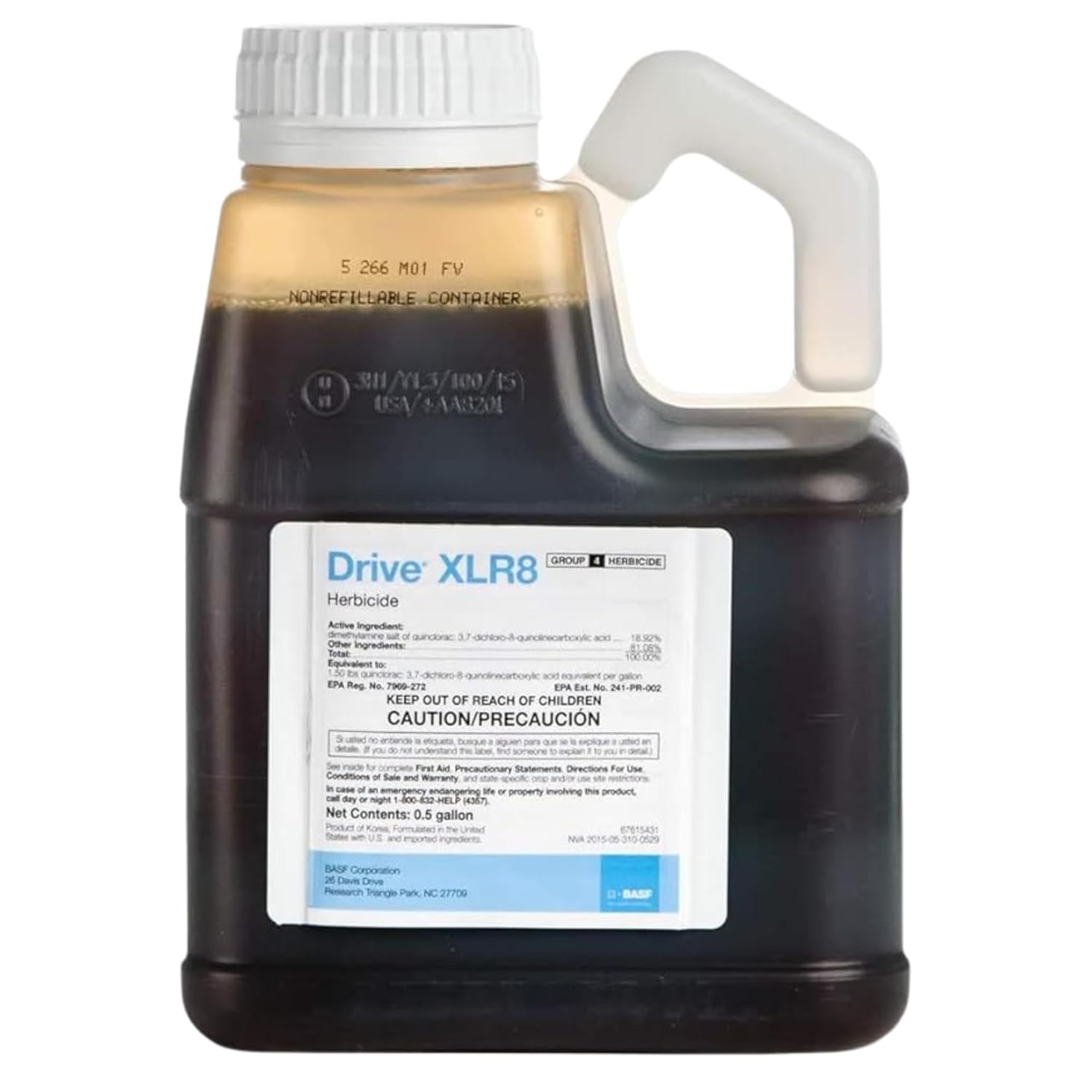
BASF Drive XLR8 Crabgrass Killer Concentrate, 64 oz
| Unit Count | 64 Ounce |
|---|---|
| Item Form | Liquid |
| Active Ingredients | Quinclorac 18.92% |
| Coverage | Full |
Drive XLR8 is a concentrated liquid herbicide built mainly to knock down crabgrass and other grassy and broadleaf weeds in turf. You mix a small measured amount with water and a methylated seed oil adjuvant and spray over the turf for spot or broadcast treatment. Its water-based formulation and quinclorac active ingredient deliver relatively fast uptake and labeled rainfast protection within about an hour, and the product advertises up to 30 days of residual control, which reduces how often you need to reapply. It is labeled for both warm- and cool-season turf and can be tank-mixed with other turf herbicides when label directions allow, giving flexibility for complicated weed problems. Important limitations are that it is a chemical herbicide that requires careful PPE and strict adherence to label directions, and some local restrictions apply, including reduced use patterns in certain states and spot-application limits. For gardeners who follow the label, it offers reliable, professional-strength control of crabgrass and many common lawn weeds.
Best for: Homeowners and groundskeepers who want a strong, professional-style postemergent solution to quickly reduce crabgrass and mixed weed populations and who are comfortable following label safety and application steps.
Less Ideal for: People seeking an organic or nonchemical approach to crabgrass control or users who prefer no-handling of concentrated herbicides should consider alternative cultural or nonchemical options.
- Concentrated 64 oz formula covers large areas when mixed per label directions
- Water-based formulation for faster plant uptake and rainfast protection in under an hour
- Provides up to 30 days of residual control against crabgrass and several grassy weeds
- Labeled for use on both warm-season and cool-season turf and compatible with some tank mixes
- Requires careful handling and PPE because it is a chemical herbicide
- Some state-specific use restrictions and label limitations apply
Verdict: Choose Drive XLR8 when you want a concentrated, fast-acting postemergent herbicide that delivers reliable crabgrass control and multi-week residual protection.
Spectracide Weed Stop for Lawns Plus Crabgrass Killer Concentrate, 40 oz

| Unit Count | 40 Fluid Ounces |
|---|---|
| Coverage | 6250 square feet |
| Item Form | Spray |
| Kills | 470+ listed weeds |
Spectracide Weed Stop Plus Crabgrass is a ready-to-spray concentrate formulated to kill a wide range of broadleaf and grassy weeds, including crabgrass, with visible results in as little as five hours. You mix the concentrate and apply it over the lawn when temperatures are between 45 and 90 degrees, spraying until weeds are wet; the formula is rainproof about three hours after application. Notable features include claimed control of more than 470 weed types, contact action down to the root, and coverage sufficient for several thousand square feet from a single bottle. In practice this makes it useful for seasonal spot treatments or treating larger areas where quick knockdown is desired. Important limitations are following label directions carefully to avoid lawn injury in hot conditions and potential temporary discoloration on bermudagrass. The product is straightforward for homeowners who want a fast, broad-spectrum solution but requires attention to temperature windows and application rates for safe use.
Best for: Homeowners who want a practical, fast-acting solution to reduce common lawn weeds and crabgrass across medium to large lawns and who follow label directions carefully.
Less Ideal for: People seeking an organic or non-chemical method of weed control or those who need a product safe for application in very hot climates without risk to sensitive turf varieties.
- Controls over 470 listed broadleaf and grassy weeds including crabgrass
- Visible weed knockdown in about five hours
- Rainproof roughly three hours after application so it resists washing off
- Concentrate covers a large area from one bottle, suitable for several thousand square feet
- Can cause temporary yellowing or discoloration on bermudagrass
- Must not be applied when daytime temperatures exceed 90°F to avoid lawn injury
Verdict: A fast, broad-spectrum concentrate that delivers quick visible control of crabgrass and hundreds of common lawn weeds when you follow the label directions.
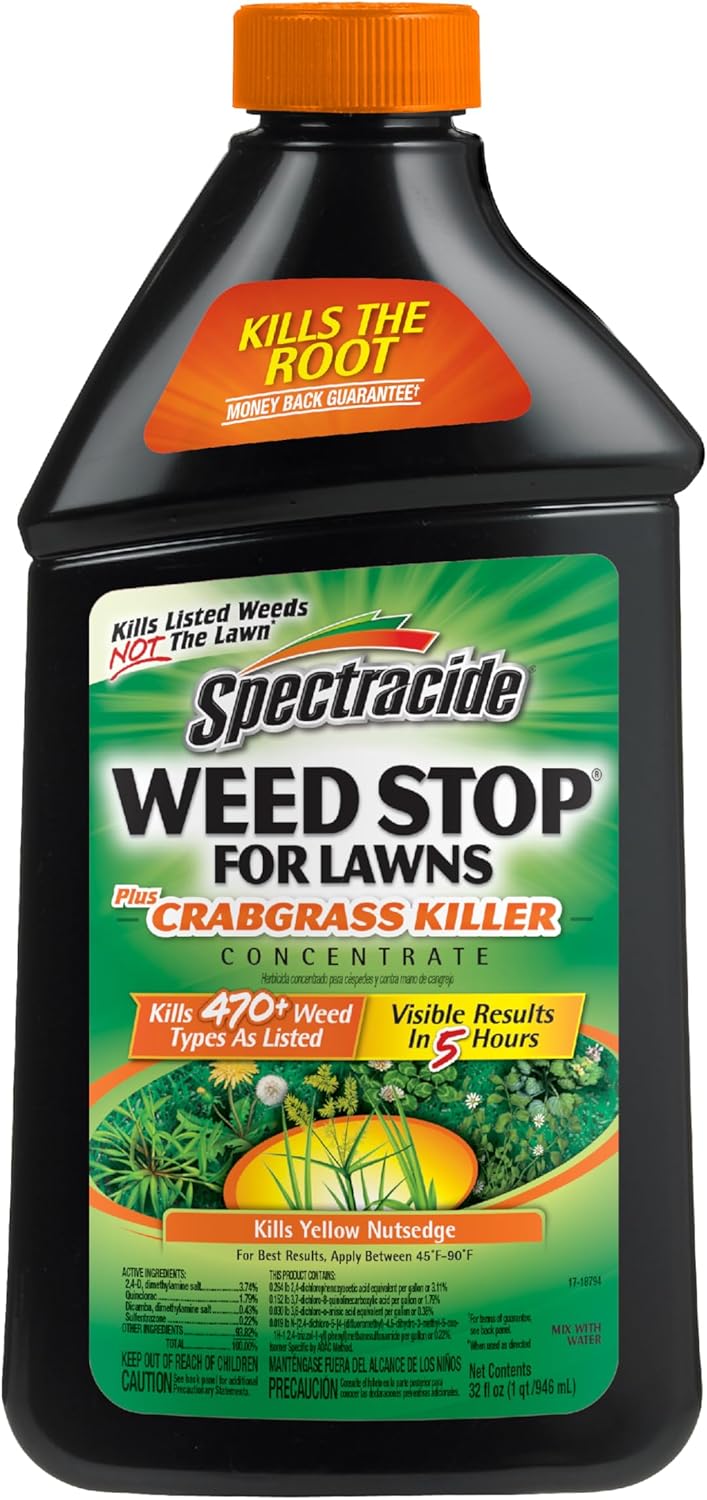
Spectracide Weed Stop for Lawns Plus Crabgrass Killer Concentrate, 32 oz
| Unit Count | 32 Ounce |
|---|---|
| Coverage | 5000 square_feet |
| Item Form | Liquid |
| Kills | 470+ listed weeds |
Spectracide Weed Stop Plus Crabgrass Killer is a ready-to-dilute concentrate designed to target grassy and broadleaf weeds across a typical yard. Mix and apply with a sprayer and the formula kills by contact down to the root with visible dieback in about 5 hours and becomes rainfast in roughly 3 hours. The 32 ounce bottle covers up to 5,000 square feet, making it a practical choice for treating whole lawns. Directions note best performance between 45 and 90 degrees daytime temperature and caution against treating Bermudagrass in very hot conditions to avoid temporary discoloration. Practical benefits include fast visible results, broad-spectrum control that includes dandelion and clover, and the convenience of a concentrated product that stretches across a larger area than ready-to-use sprays. Important limitations are the temperature restrictions for safe application, the need to let treated areas dry before people or pets return, and observing reseeding intervals after treatment. For routine crabgrass control on established lawns, this concentrate balances effectiveness and coverage for cost-conscious buyers.
Best for: Buyers who want an economical, concentrated treatment to control crabgrass and a wide range of weeds across a whole lawn and who are comfortable mixing and applying a spray product.
Less Ideal for: People with newly seeded lawns, very small patch treatments who prefer ready-to-use bottles, or those who cannot avoid applying during hotter daytime temperatures.
- Concentrated formula treats up to 5,000 sq ft from a 32 oz bottle
- Kills over 470 listed broadleaf and grassy weeds including crabgrass
- Visible results in about 5 hours and becomes rainfast in approximately 3 hours
- Designed to kill weeds down to the root when used as directed
- Must follow temperature limits to avoid lawn injury, particularly on Bermudagrass
- Requires mixing and a separate sprayer rather than being ready-to-use
Verdict: A budget-friendly concentrate that delivers fast, broad-spectrum crabgrass and weed control for established lawns while covering a large area per bottle.
Roundup Weed & Grass Killer4 with Pump 'N Go 2 Sprayer, 1.33 gal

| Unit Count | 170 Fluid Ounces |
|---|---|
| Item Form | Spray |
| Coverage | 300 Square_Feet |
| Active Ingredients | Triclopyr, Triethylamine Salt, Fluazifop-P-Butyl, Diquat Dibromide |
This Roundup Weed & Grass Killer4 comes in a 1.33 gallon container with an integrated Pump 'N Go 2 sprayer that lets you apply a continuous stream for up to 10 minutes without mixing. It is formulated to kill a wide range of broadleaf weeds and grasses down to the root and advertises visible browning in hours and rainproof protection in about 30 minutes, so treated areas can be replanted in 1 to 30 days depending on instructions. The extendable wand improves accuracy for edging around flower beds, foundations, and hard surfaces so you can target unwanted plants without bending over. Practical benefits include straightforward one-hand spraying, coverage suitable for small- to medium-scale cleanup, and a clear safety section that emphasizes protective clothing and keeping people and pets away until the spray dries. Important limitations are that it is a chemical herbicide with active ingredients buyers should review for toxicity and environmental impact, and it requires careful application to avoid drift onto desirable plants. The sprayer is convenient but adds weight as you carry and handle the full container.
Best for: Gardeners who want a ready-to-use, targeted herbicide to quickly clear weeds around beds and hardscapes and who prioritize easy application and fast visible results guided by other buyers' experience.
Less Ideal for: Organic gardeners or those who prefer nonchemical methods should look for mechanical or organic alternatives, and users who need very large-area broadcast control may prefer concentrate products or professional services.
- Built-in Pump 'N Go 2 sprayer with extendable wand for up to 10 minutes of continuous spray
- Produces visible results in hours and becomes rainproof in about 30 minutes
- Designed for use around flower beds, hardscapes, mulch and foundations for targeted spot treatment
- Covers a useful area from a single bottle suitable for small to medium beds
- Contains synthetic active ingredients that require careful handling and distancing of people and pets until dry
- Risk of harming nearby desirable plants if not applied precisely
Verdict: If you want a convenient, ready-to-use sprayer that gives fast, targeted weed control around garden beds and hardscapes, this package is a practical pick.
Choosing the Right Crabgrass Killer for Summer: Key Factors to Consider
Timing And Lawn Temperature
When you apply a crabgrass treatment in summer matters because crabgrass is actively growing in warm soil temperatures. Applications made when soil and air temperatures are high can produce faster symptom development, but some chemistries perform poorly if heat stresses desired turf. Consider the current stage of crabgrass growth: preemergent options work before crabgrass germinates, while postemergent controls are for visible plants. In midsummer you will often be using postemergent approaches, so check whether the active ingredient is labeled for treating large, established seedlings versus small young plants.
Proper timing also ties to irrigation. Applying treatments during or immediately before heavy irrigation can reduce effectiveness for products that rely on leaf uptake. Follow label guidance on watering windows to balance control and turf recovery.
Turf Type Compatibility
Different lawn grasses show different tolerance to herbicide active ingredients. Warm-season turfs such as bermudagrass or zoysia can be more sensitive to certain postemergent chemistries, while cool-season turfs can show damage if products are applied in high heat. Verify that a product explicitly lists compatibility with your grass species and read restrictions about summer applications on that turf.
Even within a single turf type, thin or newly sodded areas are more vulnerable to injury. In those zones choose a treatment with a wider safety margin or delay application until the turf has recovered and established more root mass.
Active Ingredient And Mode Of Action
Understanding the active ingredient helps predict how quickly crabgrass will die and how long the product prevents reinfestation. Some chemistries act as contact herbicides that burn down aboveground growth rapidly but offer little residual control. Others translocate or have residual soil activity that suppresses new seedlings for weeks.
Rotating modes of action over seasons reduces the chance of resistance and improves long-term control. Look for clear label information on persistence in soil so you can plan follow-up treatments or overseeding without risking injury.
Application Method And Coverage
How you apply a crabgrass killer affects both effectiveness and lawn health. Broadcast sprayers cover large areas quickly but require attention to calibration and wind to avoid drift. Pump sprayers or hose-end applicators make spot treatment easier but increase the risk of uneven dosing. Granular formulations can be simpler for whole-lawn applications but depend on uniform spreading.
Consider the applicator you are comfortable using and whether the product's label includes tips for handheld versus tow-behind equipment. Proper nozzle selection, walking speed, and overlap influence whether you get uniform control across the lawn.
Irrigation And Rainfall Considerations
Many summer herbicides have specific irrigation and rainfall windows that affect uptake. Some products need a rain event or light irrigation to move active ingredients into the root zone, while others advise avoiding water for a set period after application to maximize foliar absorption.
Plan applications around weather forecasts and your irrigation schedule. In hot, dry conditions, turf may be stressed and more susceptible to herbicide injury, so ensure proper soil moisture levels and follow label instructions concerning watering before and after treatment.
Safety And Environmental Precautions
Crabgrass treatments can pose risks to nearby plants, pollinators, and water bodies. Read label restrictions about applying near ornamental beds, vegetable gardens, or storm drains. Some chemistries have higher toxicity to aquatic organisms and require buffer zones from water features.
Wear appropriate personal protective equipment as specified on the label and avoid applications on windy days to prevent drift. Consider using targeted spot treatments when crabgrass presence is limited, which reduces overall chemical load and exposure.
When To Use Preemergent Versus Postemergent Options
Preemergent herbicides create a barrier that blocks crabgrass seedlings as they germinate and are most effective when applied before soil temperatures consistently reach the germination threshold. In summer scenarios where crabgrass has already emerged, preemergents offer little benefit until the next germination window.
- Preemergent: best applied in late spring or early spring depending on region.
- Postemergent: use on visible crabgrass plants during summer growth.
- Combine tactics: follow a preemergent program with targeted postemergent spot treatments as needed.
Spot Treatment Strategies For Small Infestations
If crabgrass is limited to patches, spot treatments reduce risk to surrounding turf and ornamentals. Use a carefully calibrated pump sprayer or a localized granular product to limit exposure. Treat when plants are actively growing and avoid applications during hottest midday hours when turf stress is highest.
- Mark patches before treatment to ensure full coverage.
- Repeat spot treatment according to label intervals until plants stop reappearing.
- Use mower clippings management to limit seed spread by removing seedheads before they mature.
Integration With Mowing And Fertility Practices
Mowing height and fertilization affect crabgrass competition. Maintaining a higher mowing height shades soil, lowering temperatures at the surface and reducing crabgrass seed germination. Avoid heavy nitrogen applications in midsummer that stimulate broadleaf and grassy weed growth unless your turf needs it for recovery. Coordinate herbicide timing with mowing so leaf area is present for postemergent uptake, but avoid mowing immediately before or after application if the label advises against it.
- Raise mower deck in summer to increase turf density and shade.
- Target fertility in cooler parts of the season rather than heavy summer feedings.
- Remove seedheads before they set to reduce future infestations.
Safe Practices Near Gardens And Water Features
Be cautious when treating lawns adjacent to vegetable beds, ornamental plantings, or ponds. Some products can injure garden plants if drift or runoff occurs. Establish buffer zones and avoid application on slopes where runoff is likely. If irrigation is required to activate a product, direct water away from garden beds and storm drains. When treating close to water, choose chemistries and application rates that minimize aquatic exposure and follow label buffer recommendations.
- Turn off irrigation zones that could carry product into non-target areas.
- Avoid application on windy or rainy days.
- Use physical barriers or spot treat strips near sensitive landscapes.
Follow-Up And Monitoring After Application
After applying a summer crabgrass treatment, monitor treated areas weekly. Expect visible browning or thinning of crabgrass within days to a couple of weeks depending on the mode of action. Track any turf discoloration as an early warning of non-target injury. Plan follow-up visits for retreatment only as the label allows. Overlapping applications too closely increases the risk of turf damage. Keep records of application dates, weather conditions, and observed outcomes to refine timing in future seasons.
- Inspect treated patches for regrowth and seedheads.
- Do not overseed into areas with active residual herbicide unless label permits.
- Record conditions that correlated with success or turf stress for future planning.
How We Chose the Best Crabgrass Killer for Summer
We prioritized products that suit real summer lawn conditions and typical gardener needs. Our selection process emphasized four to six concrete, garden-focused criteria: speed of visible control on actively growing crabgrass, residual prevention period after application, safety margin for common turf types, and ease and accuracy of application in hot weather. We also considered formulation adaptability for spot treatments versus whole-lawn use. To build the shortlist we filtered out options that are labeled only for ornamental beds or that require professional licensing to apply. We excluded products with unclear turf recommendations or lacking clear summer-use instructions. For each remaining product we reviewed label directions, active ingredient profiles, and user-focused factors such as spray drift risk and compatibility with irrigation schedules. The result is a focused list of candidates suited to gardeners seeking effective, turf-safe summer crabgrass control.
FAQ
Can I treat crabgrass in high summer heat without damaging my lawn?
Often you can, but it depends on the product and your turf type. Some postemergent herbicides are labeled for summer use and tolerate high temperatures, while others increase injury risk when turf is heat-stressed. Check turf compatibility and follow label irrigation and temperature guidance.
Will a single application prevent crabgrass for the whole summer?
It depends on the product's residual period. Some formulations provide several weeks of suppression, but no single treatment guarantees season-long control. Combining preventive measures, timely follow-ups, and cultural practices improves results.
Is spot treatment better than treating the whole lawn?
Spot treatment is safer for targeting isolated patches and reduces chemical exposure to desirable turf and nearby plants. Whole-lawn applications make sense for widespread infestations or preventive programs, provided you follow calibration and label directions.
Can I overseed after applying a crabgrass herbicide?
That depends on the herbicide and its soil persistence. Many products require a waiting period before overseeding to avoid injury to new seedlings. Check the label for recommended intervals between application and seeding.
How soon after rain can I apply a crabgrass treatment?
Timing depends on whether a product needs rain or irrigation to activate or whether it requires a dry window for foliar uptake. Follow label instructions about rainfall and irrigation windows to ensure the treatment is effective.
Final Verdict
When choosing a crabgrass killer for summer, prioritize products labeled for active summer control on your turf type and match the mode of action to your immediate goals: rapid knockdown or residual prevention. Pair chemical control with cultural practices such as higher mowing height, targeted irrigation, and timely seedhead removal to reduce future outbreaks. Accept tradeoffs between speed and safety: fast contact herbicides can show quick results but offer little residual protection, while residual options suppress new seedlings but may restrict overseeding. Use spot treatments when infestations are limited and reserve broadcast approaches for widespread problems following careful calibration and label compliance.
