

Note: This article contains affiliate links. If you click on these links and make a purchase, I may earn a small commission at no extra cost to you. This helps support my research and content. Read my full affiliate disclosure here.
If deer are browsing buds, leaves, or ripening fruit in your orchard or backyard, a targeted repellent can make the difference between a crop and disappointment. Choosing the right deer repellent for fruit trees matters because fruiting trees present specific challenges: damage often occurs at eye level, treatments must be safe around edible crops, and protection needs to last through changing seasons. This guide covers seven top shortlisted options suited for fruit trees and small orchards. We evaluate each product on real gardener priorities like seasonal effectiveness, ease of application, and safety for edible plants. Read on to understand the practical tradeoffs so you can pick the solution that fits your tree type, property size, and maintenance routine.
Top Picks at a Glance
| Best Overall The best all-around choice for most situations | DEER OUT 1 Gallon Ready-to-Use Deer Repellent (Minty Fresh) |  |
| Best Quality Built to a higher standard if you want something more solid | TRICO Home & Garden Deer Repellent Concentrate, 16 oz |  |
| Best Value The sweet spot between price and what you get | Liquid Fence Deer & Rabbit Repellent Concentrate, 40 Ounce |  |
| Best Budget The cheapest option that still gets the job done reliably | AMDEIUR Deer and Rabbit Repellent Balls, 8-Pack (90-Day Protection) |  |
| Highest Rated A top-rated pick with lots of positive feedback | AOHEY Natural Deer and Rabbit Repellent Balls (10 Pack) |  |
| Most Popular A crowd favorite that many people choose with confidence | Liquid Fence Deer & Rabbit Repellent Ready-to-Use Spray, 1 Gallon |  |
| Best Seller A high-volume bestseller chosen again and again | Bonide Repels-All Ready-to-Use Animal Repellent Spray, 32 oz |  |
DEER OUT 1 Gallon Ready-to-Use Deer Repellent (Minty Fresh)

| Product type | Ready-to-use deer repellent |
|---|---|
| Volume | 1 gallon |
| Scent | Minty fresh |
| Manufacturer | DEER OUT LLC |
DEER OUT 1 Gallon Ready-to-Use is a spray-on deer repellent designed for gardens, shrubs, vegetable plots and ornamental plants. The product is used by applying directly to foliage where two natural sticker agents help the formula adhere and resist washing off in rain. It relies on a peppermint-style scent that people find pleasant but deters deer, elk and moose, and it is marketed as safe for use around children and pets when used as directed. Practical benefits include long-lasting protection that reduces repeat treatments after light rain and a gallon volume that covers multiple plants or small beds. Limitations are that coverage per gallon is not specified on the label here so you may need to estimate how much you need for larger areas, and as with all scent-based repellents effectiveness can vary by local animal pressure and seasonal feeding habits. For gardeners wanting a human-friendly, low-toxicity option to discourage browsing animals, this is a straightforward, easy-to-apply choice.
Best for: Gardeners and homeowners who want a low-toxicity, easy-to-apply repellent to protect flower beds, shrubs and small vegetable plots without strong chemical odors.
Less Ideal for: Large-acreage applications or farms where precise coverage rates and industrial-scale deterrence are required should consider concentrated or professional solutions instead.
- Ready-to-use gallon eliminates mixing and is convenient for spot and blanket spraying
- Minty scent pleasant to people while deterring deer, elk and moose
- Contains natural sticker agents to improve rain resistance and longevity on foliage
- All-natural ingredients marketed as safe for use around children and pets
- Label does not state coverage area per gallon, so estimating needed quantity for large gardens is imprecise
- Effectiveness can vary with high local deer pressure and seasonal feeding behavior
Verdict: A convenient, pleasant-smelling, ready-to-use repellent that provides rain-resistant, low-toxicity protection for home gardens and ornamental plants.
TRICO Home & Garden Deer Repellent Concentrate, 16 oz

| Unit Count | 16 Ounce |
|---|---|
| Item Form | Spray |
| Target Species | Skunks |
| Special Features | Biodegradable, Long-Lasting, Weather-Resistant |
| Active Ingredients | Sheep Fat |
This 16 oz TRICO concentrate is built for serious deer protection on trees, shrubs, and small orchards. Mixed and sprayed onto foliage, the sheep fat formula creates a taste-and-scent barrier that starts working immediately and bonds to plant surfaces once dry. It is described as rainfast after drying and can provide residual repellency measured in months, which reduces repeat applications during critical growth periods for fruit trees and young transplants. The concentrate format makes it economical for treating multiple trees or larger properties, and the product is marketed as non-staining and benign to people once dry. Limitations to consider are the need to mix and apply correctly for coverage and the reliance on an animal sensory response rather than a physical barrier, so extremely hungry or persistent deer may still test treated plants. For growers focused on minimizing browsing with a low-maintenance, long-duration option, this concentrate is a strong fit.
Best for: Growers and homeowners who need a high-performance, low-maintenance deterrent for fruit trees and young orchard plantings and who prioritize long residual protection over frequent spot treatments.
Less Ideal for: People who prefer physical exclusion methods or need an instant, guaranteed barrier against every animal incursion should look at fencing or netting solutions instead.
- Long-lasting residual protection advertised up to several months after a single application
- Weather-resistant and rainfast once dried, reducing need for reapplication after storms
- Concentrate format is cost-effective for treating multiple fruit trees and larger areas
- Natural active ingredient (sheep fat) that dries odorless to people and is non-staining
- Requires correct mixing and thorough coverage during application to be effective
- Works by sensory deterrence so very determined or starving animals may still browse
Verdict: Choose this concentrate when you want a professional, long-lasting sensory barrier that reduces deer damage on fruit trees with infrequent reapplication.
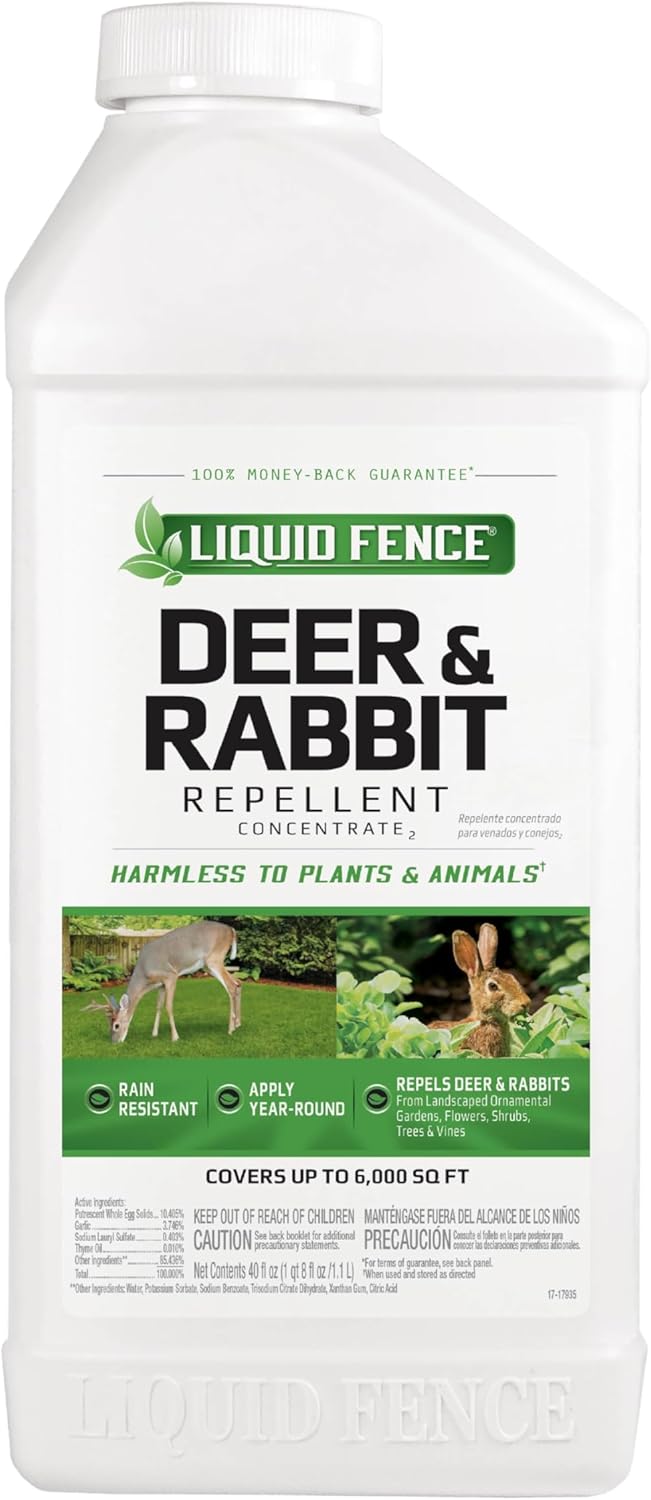
Liquid Fence Deer & Rabbit Repellent Concentrate, 40 Ounce
| Item Form | Concentrate |
|---|---|
| Unit Count | 40 Ounce |
| Indoor Outdoor Usage | Outdoor |
| Target Species | Deer |
| Scent Name | Unscented |
Liquid Fence Deer & Rabbit Repellent Concentrate is a scent-based concentrate you dilute and spray on ornamental gardens, flowers, shrubs, trees and vines to deter deer and rabbits before they feed. The formula relies on animals' natural aversion to the scent, so pests are repelled without having to eat treated foliage. It is intended for regular application: once weekly for three weeks and then about monthly, with reapplication after heavy rain. The product is marketed as long-lasting and rain-resistant when applied as directed and is formulated to be harmless to plants and animals if used and stored properly. Practical benefits include broad coverage from a single bottle and flexible year-round use on established plantings. Limits to expect are the need for repeated applications in high-pressure areas and diminished effectiveness where rain or new growth requires frequent retreatment; it also targets scent-averse species and may be less useful against pests that ignore odor cues.
Best for: Homeowners who want a practical, maintenance-minded solution to protect ornamental beds and shrubs from deer and rabbits and are willing to follow a simple reapplication schedule.
Less Ideal for: People seeking a one-time permanent fix or those trying to control pests that do not respond to scent-based repellents.
- Concentrated formula treats large areas when diluted, extending coverage from one bottle
- Works on scent so animals are deterred before they bite plants
- Rain-resistant formulation that can be used year-round on a variety of landscape plants
- Formulated to be harmless to plants and animals when used and stored as directed
- Requires an initial weekly reapplication period then monthly maintenance, which adds ongoing effort
- May need more frequent reapplication after heavy rainfall or on new growth
- Effectiveness is limited to animals that respond to scent and may not deter all pest types
Verdict: A concentrated, year-round scent repellent that practical gardeners can use to protect large ornamental areas from deer and rabbits with routine, straightforward maintenance.
AMDEIUR Deer and Rabbit Repellent Balls, 8-Pack (90-Day Protection)

| Package quantity | 8 packs |
|---|---|
| Coverage per unit | Approximately 120 sq ft |
| Duration per unit | About 60–90 days |
| EPA status | FIFRA 25(b) exempt (natural product) |
These repellent balls use natural ingredients and a light scent to discourage deer and rabbits from browsing flower beds, vegetable patches, and yard borders. Each ball is intended to protect an area up to about 120 square feet for roughly 60 to 90 days, so you hang or place them around garden edges, tree bases, or fence lines and replace them seasonally. The low-effort design makes them easy to deploy where animal activity is visible and suitable for family-friendly outdoor spaces because they are exempt under FIFRA 25(b). Practical benefits include multi-area use across gardens, orchards, and lawns and a low-maintenance, non-lethal method of protection. Limitations are that coverage is localized so larger properties will need multiple units, effectiveness can vary with local animal pressure and weather, and they are not a one-time solution for heavy deer populations.
Best for: Budget-minded gardeners who want an easy, low-maintenance way to protect individual beds and borders from occasional deer and rabbit browsing.
Less Ideal for: Homeowners with large properties or chronic, high-pressure deer problems who need broad or heavy-duty exclusion methods.
- Natural formula exempt under FIFRA 25(b) suitable for family outdoor areas
- Each unit covers about 120 sq ft for approximately 60–90 days reducing replacement frequency
- Simple to place or hang with no special tools or installation required
- Pack of eight provides enough units to protect multiple beds or zones
- Localized coverage means you may need many units for larger yards
- Effectiveness depends on local wildlife pressure and weather conditions
Verdict: An affordable, low-effort option for protecting individual garden beds from deer and rabbits for a couple of months at a time.
AOHEY Natural Deer and Rabbit Repellent Balls (10 Pack)

| Unit Count | 1 Count |
|---|---|
| Power Source | Ball |
| Number of Pieces | 1 |
These AOHEY repellent balls use a blend of plant-based ingredients such as peppermint, garlic, pepper, and ginger to create an odor that discourages deer and rabbits from entering and feeding in planted areas. They arrive as compact, low-tech spheres you place in the supplied mesh bags and position around vulnerable beds, fruit trees, or vegetable patches; the manufacturer recommends spacing balls every 40 to 80 inches and each ball is said to protect about 150 square feet for roughly 60 to 90 days. The product is simple to use, pet- and plant-safe, and requires no power or regular spraying, which makes it a convenient seasonal solution for steady protection. Expect the scent to be the active mechanism, so placement and replacing spent balls on schedule are important for consistent results. These work best as part of a layered approach rather than a sole defense in areas with heavy deer pressure, and effectiveness can vary by local animal habits and weather exposure.
Best for: Gardeners who want a low-maintenance, humane repellent that avoids sprays or electric devices and prefer a natural, set-and-forget option to protect beds and small orchards.
Less Ideal for: Properties with very high deer traffic or where immediate, guaranteed prevention is required should consider sturdier physical barriers or combined strategies instead.
- Natural plant-based formula (peppermint, garlic, pepper, ginger) that is safe around people, pets, and plants
- Long-lasting single application per ball with a claimed 60–90 day duration
- Easy, no-power installation—place balls in mesh bags and distribute where needed
- Each ball covers up to 150 square feet, allowing coverage of larger areas with multiple balls
- Scent-based deterrent can lose effectiveness in heavy rain or strong winds and needs periodic replacement
- May be insufficient alone in areas with persistent or habituated deer without additional barriers
Verdict: Choose these repellent balls if you want a simple, natural, low-maintenance way to reduce deer and rabbit damage around garden plants for a few months at a time.
Liquid Fence Deer & Rabbit Repellent Ready-to-Use Spray, 1 Gallon

| Formulation | Ready-to-use liquid |
|---|---|
| Target pests | Deer and rabbits |
| Active ingredients | Putrescent whole egg solids, garlic, thyme oil |
| Application areas | Ornamental gardens, flowers, shrubs, trees, vines |
Liquid Fence Deer & Rabbit Ready-to-Use is a gallon spray formulated to keep deer and rabbits away by using a strong scent and taste deterrent rather than toxic ingredients. It is applied directly to vegetation—leaves, stems and buds—and is marketed as rain resistant so a single application during a dry period will provide protection for several weeks with monthly reapplication or more frequent sprays in heavy-feeding areas. The formula lists putrescent egg solids, garlic and thyme oil as active components and is intended to be harmless to plants and animals when used as directed. Practical benefits include easy spray application for landscape beds and established plantings and no need to rotate products seasonally. Limitations are the need to reapply after extended rain or heavy browsing pressure and the obvious scent that may be noticeable near treated areas, which some users may find unpleasant.
Best for: Gardeners who want a proven, scent-based deterrent to protect ornamental beds and established plantings and who value straightforward, ready-to-use solutions supported by many users.
Less Ideal for: People who need an invisible or scent-free solution or those seeking a one-time, permanent fix for heavy, constant browsing across large acreage.
- Ready-to-use gallon is simple to apply directly to plants without mixing
- Scent- and taste-based formula repels deer and rabbits before they feed
- Rain-resistant formula reduces frequency of reapplication in normal conditions
- Uses ingredients that are described as harmless to plants and animals when used as directed
- Has a strong odor from active ingredients that may be noticeable to people
- Requires regular reapplication (monthly or weekly under heavy pressure) to maintain protection
Verdict: A reliable, easy-to-apply scent-based spray that protects ornamental gardens from deer and rabbits with monthly maintenance.
Bonide Repels-All Ready-to-Use Animal Repellent Spray, 32 oz

| Item Form | Spray |
|---|---|
| Target Species | Animal Repellent |
| Unit Count | 32 Ounce |
| Liquid Volume | 32 fluid ounces |
Bonide Repels-All is a 32 oz ready-to-use spray formulated to keep deer, rabbits, squirrels and many other critters away from gardens and yard areas. You spray it directly on foliage, bulbs and hard surfaces or use it as a perimeter treatment around beds to discourage browsing; the product relies on a strong natural odor that irritates animals' nasal passages and encourages avoidance. It is convenient for small-to-medium gardens because it requires no mixing and comes with a spray nozzle for spot treatments. The label states it is safe for people, pets and plants when used as directed and can be applied to ornamentals and edibles, which makes it appropriate for protecting tulip beds. Expect to reapply after heavy rain and follow reapplication guidance every 7 to 10 days for best results; effectiveness is claimed up to two months but will vary with weather and pest pressure. If you prefer a scent-free or long-term barrier solution, this sort of topical, scent-based repellent may need more frequent maintenance than physical barriers or electronic devices.
Best for: Gardeners protecting tulip beds who want a low-effort, ready-to-spray solution that is safe around people and pets and fits a modest budget.
Less Ideal for: Those who need a long-lasting, scent-free barrier or who prefer permanent exclusion methods like fencing or buried deterrents should consider other options.
- Ready-to-use spray requires no mixing and includes a spray nozzle for spot application
- Labels natural ingredients and is safe for people, pets and desirable plants when used as directed
- Broad-spectrum deterrent that lists deer plus many other garden pests
- Can be applied directly to bulbs, foliage and hard surfaces or used as a perimeter treatment
- Effectiveness depends on weather and may require reapplication after heavy rain
- Scent-based mechanism may not deter extremely persistent animals or in high pest-pressure areas
Verdict: A convenient, budget-friendly ready-to-use spray that provides a safe, easy way to deter deer from tulip beds with regular reapplication.
Choosing the Right Deer Repellent for Fruit Trees: Key Factors to Consider
Repellent Mechanism and Scent Profile
How a repellent deters deer matters for both short- and long-term control. Scent-based repellents rely on odors that deer find unpleasant, such as predator urine analogs, putrescent egg compounds, or strong botanical oils. These can be effective immediately but may lose strength with rain or as deer acclimate. Taste-based barriers work only after a deer starts nibbling and may be less effective if the animal tolerates the flavor. Visual or tactile deterrents that incorporate motion, noise, or physical barriers are not repellents per se but may complement a scent product.
Think about nearby human activity and pets when choosing a scent profile. Strong-smelling formulas can be objectionable to neighbors or to people working in the yard. For fruit trees, choose repellents labeled safe for edible plants and follow any harvest interval guidance to avoid residual flavors or contamination of the crop.
Safety for Edible Plants and Pollinators
Fruit trees are both food producers and pollinator attractors, so safety considerations go beyond deer deterrence. Check that any repellent is explicitly approved for use on fruiting trees and does not require a pre-harvest waiting period that conflicts with your harvest timeline. Some active ingredients can irritate tender leaves or damage bark if overapplied, so application rates and methods matter.
Also consider impacts on bees and other pollinators. Applying sprays during bloom can coat blossoms and reduce pollinator activity. For spring applications, favor repellents with low toxicity to pollinators and apply when pollinators are least active, such as early morning or late evening, or delay treatments until after petals have fallen, depending on the product directions.
Durability and Weather Resistance
How long a repellent holds up in sun, wind, and rain directly affects maintenance time and cost. Liquid sprays and paint-on gels can degrade with repeated rainfall or heavy irrigation, requiring reapplication after storms. Granular or timed-release formulations can offer longer protection but may disperse or dissolve under heavy rain. Products that bind to bark or use sticky carriers often last longer but can collect dust and require occasional cleaning.
Consider your local climate when choosing a product. In wet or humid regions you will want formulations with proven rainfastness. In hot, sunny areas ultraviolet breakdown can reduce longevity. Always follow label directions about reapplication intervals after precipitation.
Application Method and Labor
Application practicality determines whether a solution is realistic for your setup. Sprays require mixing, a pump sprayer or hose-on reservoir, and periodic retouching. Granules and sachets are usually easier to place but may need protection from wind and runoff. Paint-on gels or wraps require manual coating of trunks and lower branches and can be time-consuming for larger orchards. Automated delivery systems exist but are typically for commercial operations and were excluded from our picks.
Also think about storage and handling. Concentrated liquids take less shelf space but need careful storage out of reach of children and pets. Pre-mixed sprays are convenient but more expensive per use. Choose a format that matches your patience, capability to apply safely at height, and the number of trees you need to protect.
Seasonal Timing and Coverage Needs
Deer pressure changes through the year. In spring when buds and young shoots are emerging, damage can be devastating to future yield. During autumn, ripe fruit becomes a high-value food source and can attract heavier browsing. Select a repellent strategy that covers the critical vulnerability periods for your trees. For young trees, protect bark and leaders as deer rubbing and browsing can stunt growth irreversibly.
Coverage also matters. A single fruit tree near a hedgerow faces different pressure than an espaliered row along a patio. Adjust application concentration and frequency to the severity of local deer activity and the proximity of cover where deer bed down.
Environmental Impact and Neighborhood Considerations
Think about runoff, smell drift, and the broader ecological footprint of your chosen repellent. Some compounds can leach into soil or wash into storm drains if applied carelessly. Strong odors can cause neighbor complaints if your property is in a suburban setting. Wildlife other than deer may be affected, so avoid treatments that harm non-target mammals or birds.
When possible, choose lower-toxicity options and apply them in ways that minimize drift and runoff. Communicate with neighbors if you expect to apply strong-smelling products, and stagger applications to reduce scent overlap across property lines.
Timing Treatments Around Tree Phenology
Plan repellent schedules to protect trees during the most vulnerable stages. Focus spray or trunk-coating applications on bud break and early leaf-out to prevent browse on new growth, then maintain coverage into fruit set and ripening when fruit is attractive to deer.
Avoid applying sprays to open blossoms when pollinators are actively foraging. If a treatment is needed during bloom, target the trunk and lower branches rather than flowers, and schedule applications for times when pollinator activity is low.
- Prioritize early spring and late summer to fall windows
- Retouch after heavy rains according to product instructions
- Protect young saplings continuously until they reach deer-proof height
Combining Repellents with Physical Barriers
Repellents work best as part of an integrated approach. Netting, tree guards, and perimeter fencing can reduce the immediate pressure on fruit trees and give repellents a chance to be effective. Use breathable tree wraps on trunks to prevent rubbing and bark stripping while applying repellents to leaves and fruiting branches.
For small orchards, temporary netting over individual trees during peak ripening is effective and can reduce the need for frequent chemical applications.
- Use netting for high-value fruit during ripening
- Pair repellents with low-profile barriers for aesthetic yards
- Ensure netting is securely anchored to prevent deer entanglement
Application Tools and Best Practices
Match the repellent form to the right equipment. Pump sprayers work for concentrated liquids and cover multiple trees quickly. Hand brushes are useful for paint-on gels and trunk coatings. Granules can be spread by hand or with a broadcast spreader for larger areas.
Wear protective gloves and follow label PPE recommendations. Clean equipment after use and avoid overapplication, which can harm foliage or create excess runoff.
- Calibrate sprayers for even coverage
- Apply in calm weather to reduce drift
- Store unused product out of sunlight and extreme temperatures
Managing Deer Pressure Long Term
Expect to adapt your strategy as local deer behavior changes. Rotating scent profiles and alternating application types can reduce habituation. Monitor tree damage regularly and increase protection in years when mast or other wild food is scarce and deer are more likely to feed on cultivated fruit.
Encourage habitat features that make your property less attractive to deer, such as removing dense cover near orchards and avoiding plantings of high-attraction sacrificial crops next to fruit trees.
- Rotate active ingredient types to reduce habituation
- Maintain clear sightlines around orchards to deter deer movement
- Keep logs of treatment dates and observed damage to refine timing
Quick Assessment Checklist Before Applying Any Repellent
Walk each tree and note signs of recent browsing, rubs, or tracks. Check for ripening fruit, flowering status, and vulnerable young shoots. Observe prevailing weather for the next 48 hours so you do not waste treatments before heavy rain.
Decide whether a spray, gel, or physical barrier is most efficient for the number of trees and their locations. Confirm that any selected product is labeled safe for use on fruiting trees and follow all harvest-interval guidance.
- Inspect for fresh deer sign within 72 hours
- Check local weather for imminent rain
- Choose method based on tree height and number of trees
How We Chose the Best Deer Repellent for Fruit Trees
We shortlisted products based on criteria that match how gardeners actually protect fruit trees. Effectiveness against deer browsing in field and backyard conditions was a primary filter, judged by documented user experiences and manufacturer usage guidelines. Safety for edible plants and human households was required, so we excluded treatments that are explicitly unsafe for use on fruit-bearing wood or need long withholding periods before harvest. Longevity of protection under weather exposure was another key factor, because heavy rain or UV can quickly reduce performance. Ease of application and maintenance mattered for the typical home orchardist; options that require complicated equipment or daily reapplication were deprioritized. We also considered whether a product can be used on young trees and mature fruiting specimens without harming bark or foliage. Exclusions included industrial or agricultural-only formulations that are not intended for hobby gardeners, and any products lacking clear usage instructions for fruit trees. The final list balances protection, safety, durability, and practical application for home and small-scale growers.
FAQ
Are deer repellents safe to use on fruit that will be eaten?
Many repellents are formulated for use on fruit trees, but safety varies. Follow the label for any pre-harvest intervals and crop-specific instructions. When used according to directions, approved products should not contaminate the fruit, but avoid spraying blossoms to protect pollinators.
How often do I need to reapply repellents after rain?
It depends on the product. Some formulations are rainfast and last several weeks, while others require reapplication after heavy rainfall. Check the product label for reapplication intervals and inspect treated areas after storms to see if coverage has been reduced.
Will deer get used to the same repellent over time?
Deer can habituate to a consistent scent or taste if it does not pose a clear deterrent. Rotating between different types of repellents and combining them with physical barriers reduces the chance of habituation and maintains effectiveness.
Can I use repellents on young saplings without damaging them?
Many repellents are suitable for young trees, but young bark and foliage can be more sensitive. Use lower concentrations where recommended and avoid concentrated trunk coatings on very small saplings. Always test on a small area first and monitor for any leaf burn or bark issues.
Do repellents affect other wildlife or pets?
Some repellents can deter or harm non-target wildlife and may irritate pets if misapplied. Choose formulations with low toxicity for non-target species, follow label precautions about pet exposure, and apply in ways that minimize runoff into areas used by other animals.
Is netting better than repellents for protecting ripening fruit?
Netting offers reliable physical protection for high-value fruit and eliminates concerns about taste or food safety. However, it can be labor-intensive to install and may be unsightly. Many gardeners use netting for the final ripening period and repellents for ongoing seasonal protection.
Final Verdict
Protecting fruit trees from deer requires balancing effectiveness, crop safety, and maintenance effort. Prioritize products labeled for edible trees and choose application methods that fit your number of trees and local climate. Expect to rotate approaches and combine repellents with physical measures for the best long-term results. Focus on durability in your climate, minimal impact on pollinators, and realistic application labor. With those priorities in mind, you can confidently select a deer-repellent strategy that preserves both tree health and your harvests.
