

Note: This article contains affiliate links. If you click on these links and make a purchase, I may earn a small commission at no extra cost to you. This helps support my research and content. Read my full affiliate disclosure here.
Crabapple trees can be a seasonal showstopper, but fungal diseases quickly spoil flowers and turn leaves into unsightly blotches. Choosing the right fungicide for crabapple trees matters because timing, disease coverage, and how you apply the product determine whether a spray will stop an outbreak or just slow it. This guide covers seven top-rated options shortlisted for typical home and small-property crabapples and explains the practical differences gardeners need to know. We evaluate products based on when to spray, what diseases each controls, ease of application, and safety for nearby plants and pollinators. Read on to match a product to your crabapple's disease pressure and your maintenance routine.
Top Picks at a Glance
| Best Overall The best all-around choice for most situations | BioAdvanced 3-in-1 Fruit, Citrus & Nut Tree Spray, 32 oz |  |
| Best Quality Built to a higher standard if you want something more solid | ferti-lome Liquid Systemic Fungicide II Ready-to-Use, 32 oz |  |
| Best Value The sweet spot between price and what you get | BioAdvanced 3-in-1 Insect, Disease & Mite Control Spray, 32 fl oz |  |
| Best Budget The cheapest option that still gets the job done reliably | Bonide Copper Fungicide Ready-to-Use Spray or Dust, 16 oz |  |
| Highest Rated A top-rated pick with lots of positive feedback | Monterey Fruit Tree Spray Plus, 16 oz (Neem Oil & Pyrethrins) |  |
| Most Popular A crowd favorite that many people choose with confidence | BioAdvanced Organics Neem Oil Spray, Ready-to-Use, 24 fl oz |  |
| Best Seller A high-volume bestseller chosen again and again | Bonide Captain Jack's Liquid Copper Fungicide Ready-to-Use, 32 oz |  |
BioAdvanced 3-in-1 Fruit, Citrus & Nut Tree Spray, 32 oz

| Item Form | Liquid |
|---|---|
| Target Species | Insects |
| Included Components | 32 Oz Fruit & Nut Tree Care |
The BioAdvanced 3-in-1 Fruit, Citrus & Nut Tree Spray is a ready-to-use hose‑end treatment that tackles insects, mites, and common fungal diseases in a single application. You attach the bottle to a garden hose and spray thoroughly until foliage is dripping, which makes it quick to cover medium to large crabapple trees without mixing or measuring. The formula lists control for pests such as aphids, caterpillars, and mites and also targets diseases like black spot, powdery mildew, and rust, so it helps protect both leaves and fruit in one pass. Practical benefits include day‑before‑harvest use for edibles and the convenience of a single product for multiple problems, reducing the number of separate treatments needed. Important limitations are that it is a labeled, broad‑spectrum pesticide so you should follow directions carefully and avoid non‑target exposure, and hose‑end delivery gives less control over application rate than a calibrated sprayer. For routine seasonal protection on crabapples this product is an efficient, no‑mix option.
Best for: Home gardeners who want a simple, time-saving single product to protect small to medium fruit trees from both pests and common fungal diseases without mixing concentrates.
Less Ideal for: Organic growers or those who need fine control of application rates and targeted spot treatments should choose a more selective or manual spraying option.
- Ready-to-spray hose-end bottle requires no mixing or measuring
- Combines insect, mite, and fungal disease control in one product
- Labeled for use up to the day before harvest on edible fruit
- Covers large plants quickly with hose-driven application
- Hose‑end delivery offers less precise application rate than a handheld calibrated sprayer
- Broad‑spectrum formula may harm beneficial insects if not applied carefully
Verdict: Use this ready-to-spray 3-in-1 formula when you want an easy, single-application treatment that protects crabapple trees from common pests and fungal diseases.
ferti-lome Liquid Systemic Fungicide II Ready-to-Use, 32 oz

| Item Form | Liquid |
|---|---|
| Target Species | Fungus |
| Special Features | organic |
| Liquid Volume | 32 fluid ounces |
This ready-to-use ferti-lome Liquid Systemic Fungicide II is a 32 oz spray formulated to prevent and control a broad range of turf and plant fungal diseases such as take-all patch, brown patch, dollar spot, and various leaf spots. It is used by spraying to the point of runoff on plants and after mowing for lawns, which makes it straightforward for routine seasonal applications on ornamental trees including crabapples. The systemic action helps protect new growth after application, and the organic-listed labeling may appeal to gardeners who prefer that attribute. The bottle comes premixed for direct use so there is no measuring or dilution, saving time during regular disease-prevention programs. Limitations are that the product is an all-purpose fungicide rather than a tree-specific treatment and the ready-to-use volume is modest for large trees or multiple mature specimens, so larger properties may need multiple bottles or a concentrate option. Always follow label directions for timing and safety around beneficial plants.
Best for: Gardeners who prioritize effective, ready-made disease control and want a straightforward spray they can apply during the growing season to protect ornamental trees like crabapples and nearby plantings.
Less Ideal for: Property owners with many mature trees or large lawns who prefer concentrated products to treat large areas or to customize tank-mix rates.
- Ready-to-use spray for quick application without mixing
- Systemic formula offers protection for new growth after application
- Covers common turf and ornamental fungal diseases listed on the label
- Suitable for use on trees, shrubs, flowers, and lawns
- 32 oz ready-to-use bottle may be small for treating multiple mature trees or large lawns
Verdict: A convenient ready-to-use systemic fungicide that delivers broad fungal protection for crabapple trees and surrounding ornamentals with minimal prep.
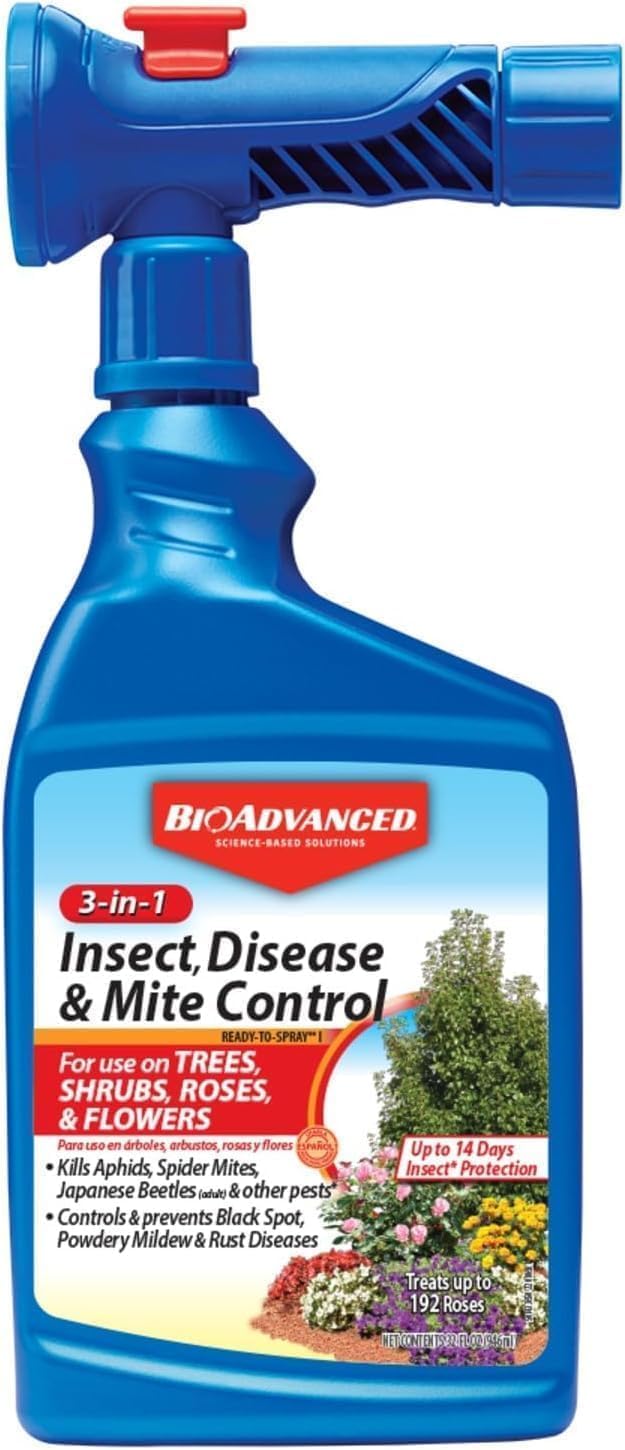
BioAdvanced 3-in-1 Insect, Disease & Mite Control Spray, 32 fl oz
| Unit Count | 32 Fluid Ounces |
|---|---|
| Item Form | Spray |
| Target Species | Aphids, caterpillars, leafminers, whiteflies and other listed pests |
| Active Ingredients | Tau-fluvalinate 0.61%, Tebuconazole 0.65% |
This BioAdvanced 3-in-1 spray is a performance-focused ready-to-use treatment that kills common pests on contact while also preventing and curing listed fungal diseases and controlling spider mites. It attaches to a garden hose for broad, even coverage and is labeled to treat up to 192 rose bushes, making it practical for medium to large beds and multiple shrubs. Key features include systemic ingredients plus contact control, rainproof protection lasting up to 14 to 30 days depending on labeled claims, and active ingredients targeting aphids, caterpillars, whiteflies, and mites. In use you spray foliage including undersides, and the product provides both immediate knockdown of insects and longer residual control so follow-up applications are less frequent. Limitations: it is a chemical treatment so users must follow safety directions and keep children and pets away until treated areas have dried, and it is not sold for use in New York. For someone prioritizing reliable, one-step control of aphids and associated fungal problems on roses and ornamentals, this bottle delivers convenient, broad-spectrum protection.
Best for: Gardeners who want a fast, high-performance one-step solution to control aphids and related pests while also preventing common fungal diseases on roses and ornamental plants.
Less Ideal for: Organic gardeners or those seeking nonchemical options should look for botanical or soap-based aphid controls instead.
- Combines insecticide, fungicide, and miticide in one ready-to-use formula for streamlined treatment
- Attaches to a garden hose for fast coverage of many plants including up to 192 roses
- Provides knockdown on contact and residual protection between labeled reapplications
- Controls a wide list of pests including aphids, spider mites, whiteflies, and caterpillars
- Contains chemical active ingredients that require careful handling and adherence to safety directions
- Not approved for sale in all states which limits availability for some users
Verdict: For gardeners focused on performance, this ready-to-spray 3-in-1 formula delivers fast aphid knockdown plus disease prevention in one convenient application.
Bonide Copper Fungicide Ready-to-Use Spray or Dust, 16 oz

| Unit Count | 16 Ounce |
|---|---|
| Item Form | Spray |
| Target Species | Plants |
| Special Features | organic |
Bonide Copper Fungicide is a ready-to-use copper spray or dust formulated to control powdery mildew, leaf spot, blight, peach leaf curl, rust and other common fungal diseases on a wide range of garden plants. You can apply it as a dust directly to branches or mix with water and use a hose-end or tank sprayer for even coverage. For crabapple trees it works as a preventative and early-treatment option, helping reduce infections that cause defoliation and blemished fruit. The active copper ingredient is accepted for organic gardening and can be used up to the day of harvest on edible plants, which makes it versatile around the yard. Practical limits are that it is a contact fungicide so thorough coverage and repeat applications are required for control, and repeated copper use should be managed to avoid soil buildup. Also the ready-to-use form is convenient but offers less concentrate per dollar than bulk formulations, so heavy users may prefer a concentrate.
Best for: Home gardeners with crabapple trees who want a simple, organic-approved product to prevent and treat common fungal diseases without mixing concentrates.
Less Ideal for: Large-scale or commercial growers who need higher-volume concentrates or systemic fungicides for long-term disease management.
- Ready-to-use spray or dust for easy application
- Broad control against common fungal diseases affecting fruit trees and ornamentals
- Approved for organic gardening and safe to use up to harvest on edibles
- Contact-only action requires thorough, repeated coverage for effective control
Verdict: A convenient, organic-approved ready-to-use copper option for home crabapple tree owners who need straightforward prevention and early treatment of common fungal diseases.
Monterey Fruit Tree Spray Plus, 16 oz (Neem Oil & Pyrethrins)

| Unit Count | 16 Ounce |
|---|---|
| Item Form | Oil |
| Brand | Monterey |
Monterey Fruit Tree Spray Plus is a 16 oz ready-to-use oil spray that mixes 70% neem oil with natural pyrethrins to deliver quick knockdown of pests plus some residual control. You use it as a foliar spray on fruit trees and ornamentals to target aphids, scales, whiteflies, caterpillars, mites and other common pests while also helping prevent fungal attack on foliage. Because it is OMRI listed, it fits into organic gardening routines and is simple to apply without dilution or complicated mixing. The combination of an oil and a botanical insecticide gives multiple modes of action, so it controls adults, larvae and eggs and reduces the chance of rapid resistance. Practical limits are that oil sprays can cause foliar phytotoxicity on sensitive varieties if applied in hot sun or at high rates, and this product is primarily an above‑ground contact treatment rather than a systemic fungicide for deep or persistent infections. For crabapple trees needing reliable, organic-friendly surface protection from both insects and early fungal problems, this is a convenient maintenance spray to keep in the toolbox.
Best for: Gardeners who prioritize consistent, reliable surface control and prefer organic-approved solutions for routine protection of fruit and ornamental trees.
Less Ideal for: Growers seeking a systemic fungicide for severe or deep-seated diseases or those who need treatments safe for spraying during hot, sunny conditions on sensitive varieties.
- Combination of neem oil and pyrethrins provides both knockdown and residual activity
- OMRI listed for use in organic gardening programs
- Ready-to-use formulation requires no mixing for easy spot or whole-tree applications
- Controls multiple pest stages including eggs, larvae and adults
- Contact action means limited systemic protection for established internal infections
- Oil-based formulation can cause leaf burn if applied in hot sun or to sensitive cultivars
Verdict: A convenient OMRI-listed spray that delivers dependable, multi-target surface control of insects and early fungal issues on crabapple and other fruit trees.
BioAdvanced Organics Neem Oil Spray, Ready-to-Use, 24 fl oz

| Unit Count | 24 Fluid Ounces |
|---|---|
| Item Form | Oil |
| Target Species | Spider |
| Specification Met | OMRI |
| Active Ingredients | Clarified Hydrophobic Extract of Neem Oil 0.9% |
This BioAdvanced Organics Neem Oil spray is a ready-to-use 3-in-1 treatment for home gardeners who need broad protection from both pests and common fungal diseases. The trigger bottle applies neem oil in a clarified hydrophobic extract formulation that kills eggs, larvae, and adults of listed insects such as aphids, whiteflies, and spider mites on contact while also helping prevent and control fungal problems like black spot, powdery mildew, and rust when used on a 7 to 14 day schedule. It is labeled for roses, flowers, vegetables, fruits and shrubs and can be used up to the day of harvest, making it suitable for edible gardens. Practical benefits include convenience of a pre-mixed spray, multi-target control in one treatment, and OMRI recognition for organic gardening. Limits to expect are that it is a contact-based product so full coverage is required for effectiveness and repeated applications are needed for prevention, and results can be slower than synthetic pesticides for heavy infestations. The bottle is best for small to medium gardens and spot treatments rather than large-scale applications.
Best for: Gardeners who want a single, organic-friendly spray to manage common insects and fungal issues on roses, ornamentals, and edible plants without mixing concentrates.
Less Ideal for: Those managing very large beds or commercial plantings who need high-volume coverage or fast knockdown from systemic synthetic products should consider concentrate or professional options.
- Ready-to-use trigger spray for easy application
- Combines insecticide, miticide, and fungicide action in one product
- Labeled for use on edible plants and permitted up to day of harvest
- OMRI listed formulation suitable for organic gardening
- Effectiveness depends on thorough coverage because it works primarily on contact
- Requires repeated applications on a regular schedule for disease prevention
Verdict: A convenient ready-to-use organic neem spray that gives home gardeners broad, multi-purpose protection against common insects and fungal diseases.
Bonide Captain Jack's Liquid Copper Fungicide Ready-to-Use, 32 oz

| Item Form | Spray |
|---|---|
| Unit Count | 32 Ounce |
| Active Ingredients | copper |
Bonide Captain Jack’s Liquid Copper Fungicide is a trigger-spray, ready-to-use copper treatment designed to control common fungal diseases such as black spot, powdery mildew, blight and peach leaf curl. It is applied by shaking and thoroughly spraying tops and undersides of leaves every 7 to 10 days or as needed, and the label allows application up to the day of harvest on listed edible plants. The product’s copper active ingredient makes it broadly effective against many foliar diseases and the convenient spray bottle removes the need to mix concentrates. Practical benefits include organic approval for many uses and clear directions for repeat treatments, which helps with consistent disease management. Important limitations are that it is a contact-style copper spray rather than a systemic cure, so thorough coverage and repeated applications are required for control, and care must be taken to follow label directions to avoid phytotoxicity on sensitive varieties.
Best for: Gardeners who prioritize established, proven solutions and want an organic-approved spray that controls common foliar diseases on roses and other plants with minimal setup.
Less Ideal for: Growers looking for a systemic fungicide or a single-application cure for long-term prevention should consider alternatives with systemic activity.
- Ready-to-use trigger spray for easy application without measuring or mixing
- Approved for organic gardening and label allows use up to day of harvest on listed edibles
- Effective copper active ingredient against a wide range of foliar fungal diseases including black spot
- Clear instructions for treatment interval make follow-up applications straightforward
- Contact-action copper requires thorough coverage and repeat sprays rather than a one-time systemic fix
- Potential for phytotoxicity on some sensitive plants if label directions are not followed
Verdict: A ready-to-use, organic-approved copper spray that provides reliable contact control of black spot and other foliar diseases when applied thoroughly and on schedule.
Choosing the Right Fungicide for Crabapple Trees: Key Factors to Consider
Target Diseases Controlled
Crabapple trees are vulnerable to several different fungal pathogens, and fungicides vary in which ones they suppress. Apple scab and powdery mildew are the most common problems; some products also reduce rust and bore control. Choosing a product that specifically lists the diseases you see on your trees improves the chance of success.
Knowing which disease is present affects when to spray and how often. For example, scab control often depends on protective sprays through the spring infection period, while powdery mildew may respond to curative sprays during active growth. Read label disease lists and match them to your symptoms before picking a product.
Application Timing And Spray Schedule
Timing is critical with fungicides for crabapple trees because many infections occur during narrow windows in spring and early summer. Some products are strictly protectants and must be applied before infection events, while others offer curative activity for early infections. Consider how much time you can commit to repeated sprays during bud break, petal fall, and early leaf expansion.
Also factor in the interval between applications and how weather affects reapplication. After heavy rain you may need to reapply sooner with low-residual products. Choose a product whose timing requirements fit your schedule and the local climate patterns where your trees grow.
Mode Of Action And Resistance Management
Fungal pathogens can develop resistance if the same mode of action is used repeatedly. Products belong to different chemical classes and may be protectant, systemic, or a mix. Alternating products with different modes of action across a season or using premix formulations with multiple modes helps slow resistance buildup.
If your crabapple has a history of recurring disease despite treatment, choosing products with different active ingredients and following label rotations is important. Resistance management also influences how long a product remains effective in your garden.
Ease Of Mixing And Application Method
Gardeners vary in the equipment they have and how large their trees are. Some fungicides come as ready-to-use sprays that attach to a hose or pump sprayer, while concentrates require measuring and mixing. Consider whether you need a handheld sprayer, a hose-end applicator, or a larger pump for bigger specimens.
Application method affects coverage. Dense crabapple canopies require thorough, even spray to reach undersides of leaves and interior shoots. Products that produce fine, uniform droplets and list tree canopy coverage are easier to use effectively, especially if you are treating multiple trees.
Safety For Pollinators And Non Target Plants
Timing sprays to avoid open blossoms protects bees and other pollinators. Some fungicides are less harmful to beneficial insects or have label instructions that reduce pollinator exposure. Read and follow directions about spraying before or after bloom, buffer zones, and reentry intervals to keep beneficials safe.
Also consider safety for nearby ornamentals and edible plants. Drift can damage sensitive foliage, so choose products with clear guidance on droplet size, wind limits, and tank mixes that are safe for mixed plantings.
Residual Protection And Rainfastness
Residual protection describes how long a fungicide remains active on foliage and resists wash-off from rain. Some products offer longer rainfast windows or systemic uptake that protects new growth after application. Residual performance affects how often you must reapply, which matters if you face frequent spring rains.
Understand local rainfall patterns and pick a product whose residual characteristics match your season. Products with shorter residuals can still work well if you can reapply after storms, while longer-lasting options reduce labor but may have other tradeoffs such as pollinator precautions.
When To Spray Crabapple Trees
Spring is the critical period for most crabapple fungal infections. Start protective sprays at bud break or during green tip for scab-prone varieties, and maintain coverage through petal fall and early leaf expansion for the highest protection. If powdery mildew appears later in the season, a targeted spray at early symptom onset can reduce spread.
Weather matters. Infection events often follow wet, cool periods in spring. Monitor local forecasts and apply protectant products ahead of predicted rain. For curative treatments, apply at first visible symptoms and follow label intervals for repeat applications.
- Begin protective sprays at bud break or green tip for scab control
- Avoid spraying during full bloom to protect pollinators unless label allows
- Reapply after heavy rain according to product rainfast guidance
Sprayer Choice And Coverage Tips
Small crabapples can be treated with a 1 to 2 gallon handheld pump sprayer that provides good pressure for coverage. Larger trees need a heavier-duty pump sprayer or larger-capacity sprayer to reach upper canopy and inner branches. A hose-end sprayer works for very small jobs but often gives less control over droplet size and concentration.
Coverage is the most important factor for success. Aim to wet both upper and lower leaf surfaces and new growth without causing run-off. Work systematically around the tree so each section receives even coverage.
- Use fine-to-medium spray to coat leaf undersides
- Maintain consistent pressure and sweep across branches
- Clean sprayers between different products to avoid mixing residues
Integrating Fungicide Use With Cultural Practices
Fungicides are most effective when combined with good cultural practices. Prune the canopy to improve air flow, remove fallen leaves and mummified fruit in autumn to reduce pathogen carryover, and avoid overhead watering that prolongs leaf wetness. These steps lower disease pressure and reduce reliance on chemicals.
Choose resistant crabapple varieties where available and maintain tree vigor through proper fertilization and mulching. Avoid excessive nitrogen late in the season, which can encourage lush growth that is more susceptible to mildew.
- Prune to open canopy and dry foliage faster
- Rake and destroy infected leaf litter each fall
- Water at the base of the tree to keep foliage dry
Tank Mixing And Combining Products Safely
Some fungicides can be tank-mixed with certain insecticides or foliar nutrients, but compatibility varies. Always run a jar test for physical compatibility before mixing and follow label restrictions about restricted tank mixes. Mixing incompatible products can reduce efficacy or increase plant phytotoxicity.
Be cautious when combining systemic and protectant chemistries. Alternating modes of action across applications is a safer strategy for resistance management than mixing in every tank. When in doubt, apply products separately according to label intervals.
- Perform a small jar test to check for precipitation or separation
- Follow label sequence guidance when combining with other sprays
- Avoid mixing during hot, sunny conditions that can increase leaf burn risk
Record Keeping And Seasonal Planning
Keep a simple spray log noting product used, application date, weather conditions, and observed symptoms. This record helps you refine timing and rotation strategies year to year. Note which infections responded and whether reinfection occurred after rain events.
Plan a seasonal spray calendar that maps bud break, bloom, petal fall, and expected rainy windows. A proactive schedule aligned with local microclimate reduces emergency sprays and improves long-term disease control.
- Track spray dates and intervals to maintain consistent protection
- Record local weather events that coincided with infections
- Adjust future schedules based on past season outcomes
How We Chose the Best Fungicide for Crabapple Trees
We focused on properties and traits that actually influence control of common fungal diseases on crabapple trees. Evaluation criteria prioritized effective disease coverage against apple scab, powdery mildew, and rust; clear application timing and spray intervals; user safety and pollinator guidance; and compatibility with common home orchard practices such as pruning and sanitation. We included only products with labeled directions for deciduous fruit or ornamental apples and crabapples or with clear guidance for the same diseases. We excluded formulations not registered for tree use or those lacking specific controls for the key pathogens that afflict crabapples. Our editorial filters eliminated products intended solely for turf or indoor use, and we did not consider unverified homemade remedies. In short, the shortlist reflects practical disease control, usable application methods, clear timing instructions, and safety guidance gardeners need when treating crabapple trees.
FAQ
How often should I spray fungicide on crabapple trees?
Frequency depends on the product and disease pressure. Many protectant fungicides require applications every 7 to 14 days during high-risk spring periods, and after heavy rains. Read the label for specific intervals and adjust for local weather and severity.
Can I treat crabapple diseases after I see symptoms?
Some products have curative activity and can slow early infections if applied promptly, but protectant sprays before infection are often more reliable. For powdery mildew and early scab signs, timely applications can reduce spread when combined with cultural controls.
Will spraying harm bees and other pollinators?
Spraying during bloom increases risk to pollinators. Many labels advise avoiding spray when flowers are open or applying late in the evening when bees are inactive. Choose products and timing that minimize pollinator exposure.
Is it necessary to remove fallen leaves from under crabapple trees?
Yes. Infected leaves and mummified fruit can harbor fungal spores that restart infections next spring. Raking and disposing of or composting infected material reduces the pathogen load and complements chemical control.
Should I rotate fungicide types each season?
Rotating modes of action helps prevent resistance. Use products with different active ingredients across a season and avoid repeating the same chemistry exclusively. Follow label rotation recommendations for best long-term control.
Final Verdict
Choosing the right fungicide for crabapple trees comes down to matching disease coverage, application timing, and your ability to provide thorough canopy coverage. Prioritize products that list the specific pathogens affecting your trees, fit your spray schedule, and include clear safety directions for pollinators. Combine chemical control with cultural practices such as pruning, leaf cleanup, and careful irrigation to reduce disease pressure. With a planned spray calendar, rotation of modes of action, and good coverage, you can protect blooms and foliage while minimizing risks and repeat infections.
