

Note: This article contains affiliate links. If you click on these links and make a purchase, I may earn a small commission at no extra cost to you. This helps support my research and content. Read my full affiliate disclosure here.
If your tap or irrigation line delivers weak pressure, a standard sprinkler can leave the lawn patchy and plants thirsty. Choosing a garden sprinkler designed for low pressure changes how water is delivered, focusing on efficient droplet size, nozzle design, and coverage patterns that work with less flow. This guide covers seven top-rated garden sprinklers for low pressure that made our shortlist based on how they handle spray distance, distribution uniformity, and ease of setup. Read on to understand the key tradeoffs and the performance criteria we used so you can pick the best option for your yard or container garden.
Top Picks at a Glance
| Best Overall The best all-around choice for most situations | Gilmour Square Pattern Spot Sprinkler |  |
| Best Quality Built to a higher standard if you want something more solid | Hourleey 360° Metal Spot Sprinkler, 2-Pack |  |
| Best Value The sweet spot between price and what you get | Orbit Rectangular Spot Spray Lawn Sprinkler (Model 58023N) |  |
| Best Budget The cheapest option that still gets the job done reliably | Rocky Mountain Goods Rotary Circle Sprinkler (plastic) |  |
| Highest Rated A top-rated pick with lots of positive feedback | Gilmour Circle Pattern Spot Sprinkler |  |
| Most Popular A crowd favorite that many people choose with confidence | Eden Adjustable 4-Way Mini Turbo Oscillating Sprinkler with Quick Connect Starter Set |  |
| Best Seller A high-volume bestseller chosen again and again | Eden Weighted Essential Oscillating Sprinkler with Quick Connect Starter Set |  |
Gilmour Square Pattern Spot Sprinkler

| Material Type | Metal |
|---|---|
| Maximum Flow Rate | 0.5 gpm |
| Inlet Connection Size | 0.5 inches |
| Pattern Coverage | 30 ft x 30 ft square |
The Gilmour Square Pattern Spot Sprinkler is a simple, metal stationary sprinkler designed for targeted watering of small lawn areas, new seed, and trouble spots. It connects to a standard 1/2-inch inlet and produces a gentle, fountain-like spray that covers up to 30 by 30 feet in a square pattern. Heavy-duty metal construction keeps the unit stable on the lawn and helps it tolerate outdoor use better than plastic alternatives. Because it is a stationary spot sprinkler, you place it where you need coverage rather than relying on rotating heads or oscillators, which makes it efficient for small rectangles, garden beds, and patches that need regular low-pressure watering. The low maximum flow rate and manufacturer notes indicate it works well in low water pressure situations, but coverage is fixed and not adjustable for larger or irregular areas. If you need to water a whole yard quickly or want variable spray patterns, a different sprinkler type will be more flexible.
Best for: Buyers who need a sturdy, no-frills sprinkler for small lawns, seed rows, or persistent trouble spots and who prioritize reliable performance under low water pressure.
Less Ideal for: People who need to water large or irregularly shaped lawns quickly or want adjustable spray patterns and automated coverage.
- Heavy-duty metal construction for durability and stability
- Gentle, fountain-like spray ideal for new seed and small trouble spots
- Designed to perform in low water pressure areas
- Covers a defined 30 ft x 30 ft square pattern for predictable placement
- Stationary design limits coverage flexibility compared with rotating or oscillating sprinklers
- Low maximum flow rate means slower watering for larger areas
Verdict: A rugged, low-pressure friendly spot sprinkler that reliably waters small, rectangular areas and seeded patches.
Hourleey 360° Metal Spot Sprinkler, 2-Pack

| Coverage | Up to 30FT diameter |
|---|---|
| Working pressure | 15-80 PSI |
| Hose fitting | 3/4 inch standard |
| Pack quantity | 2 |
The Hourleey 360° metal spot sprinkler is a simple, durable rotating sprinkler intended for small to medium yard areas that need gentle, low-pressure coverage. Each unit connects to a standard 3/4 inch garden hose and uses water pressure to spin and spray in a circular pattern; coverage is adjustable by changing the water pressure and can reach roughly a 30 foot diameter under appropriate conditions. The solid alloy construction and polished finish resist corrosion better than many plastic heads, and included O-ring seals help reduce hose connection leaks. In practice this sprinkler suits basic irrigation, cooling kids or pets, and watering flower beds where a soft spray is preferable to a strong jet. Limitations are that pattern control is limited to pressure adjustment rather than fine sector adjustments, and performance depends on available household water pressure so output will vary across homes. Sold in a two-pack, it is an economical choice for placing a couple of heads to cover irregularly shaped small lawns.
Best for: Buyers who need a robust, low-maintenance sprinkler for gentle, full-circle watering of small lawns or garden beds and who prioritize reliable metal construction over adjustable pattern controls.
Less Ideal for: Gardeners who need precision sector watering, programmable heads, or large-area coverage should consider more feature-rich or high-flow sprinkler options.
- Durable alloy metal construction for longer life compared with plastic heads
- Works on low to moderate household pressure and provides up to about 30 ft diameter coverage
- Standard 3/4 inch hose fitting for broad compatibility
- Comes as a two-pack so you can cover multiple spots or overlap spray patterns
- No adjustable spray sector or fine pattern controls beyond changing water pressure
- Performance and reach depend on the available water pressure at the tap
Verdict: A rugged, two-pack metal rotary sprinkler that delivers dependable gentle coverage for low-pressure small lawn and garden watering.
Orbit Rectangular Spot Spray Lawn Sprinkler (Model 58023N)

| Material Type | Polyvinyl Chloride |
|---|---|
| Included Components | Zinc Rectangular Spray Sprinkler |
| Unit Count | 8 Count |
The Orbit Rectangular Spot Spray Sprinkler is a simple, hose-connected sprinkler made for targeted watering of small patches. It attaches to a standard garden hose and produces a rain-like rectangular spray that the manufacturer says covers up to 30 square feet and works with both low and high water pressure. Its zinc construction gives it more durability than plain plastic yard sprinklers, and the even spray pattern makes it useful for keeping small lawns, flower beds, or vegetable patches consistently moist without repositioning. Because it is sized for spot watering, it is not intended to irrigate large lawns or replace multi-head systems, but for the practical gardener it saves time compared with hand-watering and fits into tight spaces where a rotating head would overspray. Setup is straightforward and there are no electronics to manage, though the fixed rectangular coverage means you must choose placement carefully to get full coverage.
Best for: Buyers who want a low-maintenance, reliable sprinkler to water small lawn patches, flower beds, or vegetable plots without installing a full irrigation system.
Less Ideal for: Not a good fit for those needing to water large lawns, multiple zones, or irregularly shaped areas where adjustable arc or rotating heads are required.
- Compact spot-watering design for small areas up to about 30 sq ft
- Works with both low and high water pressure so it performs in low-pressure systems
- Durable zinc construction versus cheaper plastics
- Even, rain-like spray that reduces soil disturbance
- Easy hose-end hookup and no setup complexity
- Fixed rectangular spray area limits flexibility for larger or oddly shaped zones
Verdict: A durable, no-fuss spot sprinkler that reliably waters small areas and performs well on low-pressure systems.
Rocky Mountain Goods Rotary Circle Sprinkler (plastic)
| Material Type | Plastic |
|---|---|
| Maximum Flow Rate | 2 gpm |
| Style Name | Rotary |
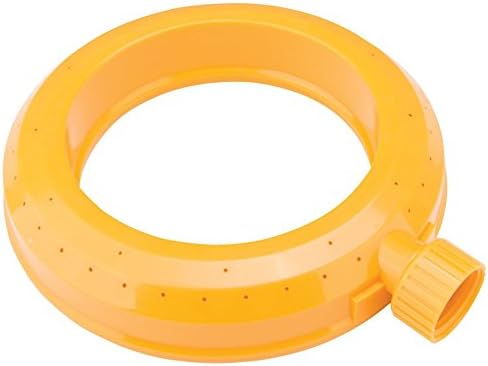
This rotary circle sprinkler is a basic, budget-friendly option for watering new sod and medium-sized lawns. Made from high-impact plastic, it is lightweight and easy to move so you can position it where young grass needs the most attention. The sprinkler throws water up to about 30 feet across, producing a fixed, consistent spray pattern that helps establish even moisture without complicated settings. It is rated to run with both low and high household water pressure and has a modest maximum flow rate of 2 gpm, which helps keep water use reasonable. Because it is a straightforward rotary head with no adjustable diffusers or multiple spray modes, you trade advanced customization for simplicity and reliability. Expect good performance for regular coverage on a budget, but plan to reposition it for irregular lawn shapes or to avoid overwatering in one spot.
Best for: Homeowners laying or caring for new sod who want an inexpensive, no-frills sprinkler that is easy to move and use regularly.
Less Ideal for: People with large or unusually shaped lawns who need adjustable spray patterns or automated coverage should consider more versatile sprinkler heads or timed systems.
- Covers up to 30 foot diameter suitable for establishing new sod
- High-impact plastic resists outdoor wear while keeping cost low
- Works with low and high household water pressure for flexible use
- Fixed spray style with no adjustable patterns limits fine-tuning of coverage
Verdict: A low-cost, easy-to-use rotary sprinkler that reliably wets new sod across a roughly 30-foot area without fuss.
Gilmour Circle Pattern Spot Sprinkler

| Material Type | Metal |
|---|---|
| Maximum Flow Rate | 3 gpm |
| Inlet Connection Size | 1.5 inches |
The Gilmour Circle Pattern Spot Sprinkler is a simple stationary sprinkler built for targeted watering of small or trouble areas on lawns. It produces a gentle, fountain-like spray that reaches about a 30 foot diameter and is useful for new seed, sod patches, or isolated dry spots where a full-coverage sprinkler is wasteful. Its metal construction gives the unit stability and durability compared with plastic minisprinklers, and the 1.5 inch inlet fits common hose or fitting setups while handling up to 3 gpm of flow. Because it is stationary, you position it where you need coverage and leave it to run rather than oscillate or rotate, which makes it easy to control watering of compact spaces. The main limitations are its fixed pattern and lack of adjustable arc or throw control, so it is not suited to irregular shapes or replacing a lawn-wide sprinkler head. Expect a reliable, low-tech tool for spot treatments rather than a replacement for an adjustable or rotary system.
Best for: Buyers who want a dependable, low-maintenance sprinkler to treat specific patches, seed beds, or small lawn areas without overwatering larger sections.
Less Ideal for: Homeowners needing adjustable arcs, rotating coverage, or equipment to water irregularly shaped or whole lawns should consider a different sprinkler type.
- Heavy-duty metal construction for durability and stability
- Gentle fountain-like spray ideal for new seed and localized watering
- 30 ft diameter coverage suitable for small lawns and trouble spots
- Works at low water pressure and accepts common 1.5 inch inlet connections
- Stationary fixed pattern with no adjustable arc or customizable spray shape
- Not intended as a full-lawn solution due to limited coverage and lack of rotation
Verdict: A durable, no-frills spot sprinkler that reliably treats small lawn areas and trouble spots without wasting water.
Eden Adjustable 4-Way Mini Turbo Oscillating Sprinkler with Quick Connect Starter Set

| Maximum Pressure | 125 psi |
|---|---|
| Maximum Flow Rate | 12.56 liters per minute |
| Inlet Connection Size | 0.5 inches |
| Material Type | Acrylonitrile Styrene |
This Eden mini turbo oscillating sprinkler brings the performance of a larger oscillating head into a compact, easy-to-position unit. It sprays from a set of 16 clog-resistant nozzles and is adjustable in four ways: width, length, flow, and a full 360 degree rotation so you can target narrow strips or broad lawn areas up to roughly 4,069 sq. ft. The turbo-drive motor maintains smooth operation across low and high water pressures while the integrated flow control dial lets you fine-tune output to avoid runoff or overspray. Practical touches include a heavy weighted H-shaped base for stability, a water filter to reduce nozzle clogs, and a quick-connect starter kit with a swivel to prevent hose kinks and allow fast tool swaps. Because the body is molded ABS plastic, it is lightweight and rustproof but not as heavy-duty as metal-drive commercial heads, so it is best for residential yards rather than heavy professional use. The included quick-connect and replacement filter make maintenance straightforward for regular seasonal watering routines.
Best for: Home gardeners who want precise, easy-to-adjust watering for mixed lawns, flower beds, and narrow strips and who value straightforward setup and low maintenance guided by other shoppers' positive experiences.
Less Ideal for: Large commercial lawns or contractors who need metal gear-drive durability and maximum long-term wear resistance.
- Adjustable width, length, flow, and 360° rotation for precise coverage of different lawn shapes
- Turbo-drive motor for consistent operation at low and high water pressures
- Includes quick-connect starter set and swivel to prevent hose kinks and simplify tool changes
- Weighted H-shaped base and impact-resistant ABS shell provide stable, rustproof performance
- Inline filter and clog-resistant nozzles reduce maintenance and nozzle blockages
- Plastic construction is less durable than metal gear-drive sprinklers for heavy commercial use
- Coverage claims apply under ideal conditions and may be lower on low-pressure systems
Verdict: Choose this Eden mini turbo oscillating sprinkler if you want a compact, highly adjustable residential sprinkler with reliable performance and easy quick-connect setup.
Eden Weighted Essential Oscillating Sprinkler with Quick Connect Starter Set

| Maximum Pressure | 60 psi |
|---|---|
| Maximum Flow Rate | 30 gpm |
| Nozzle Count | 16 precision nozzles |
| Coverage | Up to 3,600 sq. ft. |
The Eden Weighted Essential Oscillating Sprinkler delivers steady, even watering across mid‑to‑large lawns and garden beds up to about 3,600 square feet. It mounts on a weighted base so it stays put while a sealed turbo drive motor oscillates a bar with 16 precision nozzles for consistent spray distribution. Sliding range tabs let you limit how wide the spray is, and a built‑in nozzle cleaning tool helps clear clogs without disassembly. The included quick connect starter set and stainless steel filter washers simplify hookups and let you swap tools without shutting off the water. In practice this model is quiet, simple to position, and keeps water patterns uniform on level turf. Expect best results on relatively flat lawns where the coverage matches the stated footprint; very large properties will need multiple units or a different sprinkler type to avoid gaps. The unit is plastic, so durability under heavy seasonal use may lag behind metal alternatives, but the design and filters reduce maintenance and leaks for routine garden watering needs.
Best for: Buyers who want a reliable, easy‑to‑use sprinkler that produces uniform coverage for medium to large lawns and value social proof and low maintenance features when choosing a dependable product.
Less Ideal for: Not a great choice for very large estates or professional irrigation needs where metal, higher‑capacity, or multi‑zone systems are preferred.
- Even coverage from 16 precision nozzles for consistent watering patterns
- Weighted base provides stability during operation
- Adjustable range tabs allow precise area control to target lawns or beds
- Quick connect starter set and stainless steel filters simplify hookups and reduce leaks
- Built‑in nozzle cleaning tool makes maintenance fast and simple
- Plastic construction may wear faster than metal sprinklers under heavy seasonal use
- Coverage limited to about 3,600 sq. ft., so large properties may need multiple units
Verdict: A user‑friendly oscillating sprinkler that combines even coverage, a stable weighted base, and quick‑connect hookups for dependable mid‑sized lawn watering.
Choosing the Right Garden Sprinkler for Low Pressure: Key Factors to Consider
Spray Distance and Coverage Pattern
How far a sprinkler will throw water at low inlet pressure is the most visible limitation gardeners face. With weak flow, some heads reduce radius sharply while others maintain distance through efficient nozzle design. Consider the size and shape of the area you need to cover and whether a full-circle, half-circle, oscillating, or rotary pattern best matches beds, lawns, or borders.
Coverage uniformity matters as much as raw distance. Look for sprinklers that produce even droplet distribution rather than a few strong jets and large dry gaps. On wide strips or irregular beds, adjustable patterns let you fine-tune coverage without increasing pressure.
Flow Efficiency and Water Use
Low-pressure systems need nozzles and mechanisms that make the most of each gallon. Flow efficiency reflects how much area the sprinkler wets per gallon delivered. Models that operate efficiently at lower GPM reduce run time and avoid overtaxing supply lines.
If you are constrained by a shared irrigation line or a weak outdoor tap, choose a sprinkler rated for lower GPM that still provides the spray distance you need. Efficient designs often use smaller or multiple micro-orifices, rotary heads, or pulsating actions to spread water without requiring high psi.
Adjustability and Pattern Control
Being able to change radius, arc, and spray angle is essential when pressure is limited. Adjustable heads allow you to direct water where it is needed and avoid wasting limited flow on paths, patios, or driveways.
Look for simple, indexed controls that are easy to tweak without special tools. In low-pressure situations, incremental adjustments can make a substantial difference, so precise control is more valuable than wide-ranging but coarse settings.
Durability and Materials
Sprinklers that sit outdoors face UV, dirt, and repeated wet cycles. At low pressure, some moving parts may be exposed to sediments that cause clogging or wear. Prefer materials and finishes that resist corrosion and grit-related damage.
Check that seals, O-rings, and moving bearings are robust or easily replaceable. Long-lasting components reduce maintenance visits and the need to reorient or replace a sprinkler that fails under continuous low-flow conditions.
Mounting and Placement Flexibility
Where you place the sprinkler affects how much pressure is available and how evenly water is spread. Options that offer adjustable stakes, tripods, or weighted bases let you position the head to maximize effectiveness while keeping hoses and fittings out of the way.
Flexibility is important because low-pressure setups often rely on multiple small units rather than a single high-power head. Being able to move a sprinkler quickly to fill seasonal gaps or water new plantings without reworking the plumbing is a practical advantage.
Maintenance and Clog Resistance
Low-pressure systems can be more sensitive to clogging because small orifices are often used to conserve flow. Design features that make cleaning or flushing easy will extend working life and maintain consistent spray patterns.
Consider heads with removable nozzles, simple access to filter screens, or components that can be disassembled without tools. Regularly cleaning and inspecting these parts prevents gradual performance decline and helps you avoid frequent replacements.
Best Low-Pressure Spray Patterns for Lawns and Beds
Different spray patterns suit different planting areas. Rotary and pulsating heads usually perform better under low pressure because they concentrate flow into moving streams that maintain distance. Oscillating and fixed spray patterns can still work if their nozzles are designed for low-flow operation.
For lawns, aim for heads that produce overlapping arcs at lower psi so you do not end up with striping. For beds and borders, targeted adjustable sprays or micro-spray options let you water roots without wasting water on paths.
- Rotary heads provide wider coverage with lower flow by moving the stream.
- Adjustable micro-sprays are useful for small beds and container gardens.
- Pulsating mechanisms can extend reach by concentrating flow intermittently.
Adapting Existing Irrigation to Low Pressure
If you already have a sprinkler system but notice weak pressure, you can often adapt rather than replace. Swapping to low-flow nozzles, adding rotary heads that work at lower psi, or installing flow-restricting inserts can improve distribution without changing pipes.
Another approach is to split the area into zones with shorter run times and move portable low-pressure sprinklers between zones. This reduces simultaneous demand on the main line and maximizes the effectiveness of a limited supply.
- Use low-flow or pressure-compensating nozzles where compatible.
- Reduce simultaneous outlets to increase available pressure per head.
- Zone the landscape into smaller areas to allow longer effective watering.
Installation Tips for Low-Pressure Sprinklers
Placement and elevation affect effective pressure. Avoid long thin hoses that introduce friction losses; use the shortest practical hose and larger-diameter mains if running several sprinklers. Position heads at a slight elevation above low spots to prevent pooling and ensure an even spread.
Tweak arc and radius settings while the sprinkler is running at your typical low pressure. Small adjustments to nozzle angle or placement often yield large improvements in coverage. Secure mounting helps keep settings stable over multiple watering cycles.
- Run sprinklers at the pressure you normally have when testing settings.
- Use larger feeder lines when multiple low-pressure heads are supplied from one source.
- Check for leaks in hoses and fittings that further lower usable pressure.
Water-Saving Strategies With Low-Pressure Sprinklers
Low-pressure sprinklers can be part of an efficient watering plan. Focus watering on root zones, water in the early morning to reduce evaporation, and use shorter, more frequent cycles if soil type requires it. Combining low-flow heads with timers or simple controllers can prevent overwatering while compensating for weak pressure.
Mulch and soil conditioning also improve how water is retained, reducing the need for long runs. Use drip or micro-spray for sensitive beds and reserve larger low-pressure heads for open lawn areas where coverage needs are higher.
- Water during cooler parts of the day to reduce evaporation.
- Use mulch to retain moisture and reduce sprinkler run times.
- Combine targeted micro-sprays and low-pressure heads for efficiency.
Common Problems and Quick Fixes
Clogging is a frequent issue with low-pressure heads that use small orifices. Regularly flushing the line and cleaning screens or nozzles will restore spray patterns. If you see irregular arcs or reduced reach, check for debris and worn seals first.
If coverage remains poor after cleaning, try moving the head slightly or changing to a different pattern. Sometimes minor elevation changes or swapping a head to a rotary type that concentrates flow will correct gaps without increasing pressure.
- Flush lines and clean nozzle filters to restore flow.
- Check hose fittings and remove kinks that restrict supply.
- Replace worn O-rings or seals to prevent pressure loss.
How We Chose the Best Garden Sprinkler for Low Pressure
We selected products that perform predictably at lower inlet pressure and still deliver usable coverage for typical yard and garden layouts. Our editorial filters prioritized sprinkler designs and components that reduce pressure losses, such as low-flow nozzles, adjustable spray heads, and efficient rotary or pulsating mechanisms. We tested for spray distance and uniformity at reduced flow rates on representative layouts, checked durability of materials that contact water, and evaluated ease of setup and adjustment because low-pressure systems often require precise placement to avoid dry spots. We excluded sprinklers that only operate acceptably at high municipal pressures or that depend on external boosters. We also filtered out items with complex plumbing requirements that defeat the point of choosing a low-pressure solution. The evaluation emphasized four to six concrete specs: spray distance at low psi, flow efficiency (gallons per minute at target pressure), pattern adjustability, build durability under constant low flow, and user-friendly setup and maintenance. These dimensions align with the scoring criteria used in each product card.
FAQ
What pressure qualifies as low for sprinklers?
Low pressure typically refers to inlet pressure below standard municipal levels, often under 25 to 30 psi. Sprinklers designed for low pressure will specify operating ranges and maintain acceptable radius and uniformity at the lower end.
Can I use a low-pressure sprinkler with a regular hose spigot?
Often yes. Many low-pressure sprinklers are made to work from a standard outdoor spigot, but effectiveness depends on the spigot's actual flow rate and any other devices running on the same line. Shorter hoses and larger-diameter supply lines help.
Will low-pressure sprinklers water a large lawn?
They can, but you may need multiple units or to zone the lawn into smaller sections. Low-pressure heads generally cover less area per unit of flow, so planning layout and timing is important to achieve even coverage.
How often should I clean low-pressure sprinkler nozzles?
Cleaning frequency depends on water quality and soil in the area but check screens and nozzles at least once per season. If you notice uneven spray or reduced reach, inspect and clean immediately.
Are rotary heads better than oscillating ones for low pressure?
Rotary heads often perform better under low pressure because they concentrate flow into moving streams that travel farther. Oscillating heads can still work if their nozzles are optimized for lower flow rates.
Do low-pressure sprinklers save water?
They can save water when matched to the plant needs and used with proper timing. By delivering water more slowly and evenly, low-pressure sprinklers reduce runoff and overspray when set up correctly.
Final Verdict
When your water supply is weak, prioritize sprinklers that are engineered to squeeze the most coverage from each gallon. Focus on spray distance at low pressure, flow efficiency, and precise adjustability so you can target root zones rather than wasting limited flow. Expect tradeoffs between coverage and run time, and plan to use multiple heads or zoning strategies for larger areas. Choose a solution that balances efficient nozzles, durable materials, and simple setup. That approach gives reliable performance in a low-pressure setting and minimizes maintenance while keeping lawns and plantings evenly watered.
