

Note: This article contains affiliate links. If you click on these links and make a purchase, I may earn a small commission at no extra cost to you. This helps support my research and content. Read my full affiliate disclosure here.
If your yard has heavy leaf loads, wet debris, or large properties, a 4 cycle gas leaf blower can make quick work of clearing beds, driveways, and lawns. These blowers use a true four-stroke engine that runs on regular gasoline without mixing oil, which reduces fumes and simplifies refueling compared with two-stroke designs. Choosing the right unit matters because engine power, weight, and serviceability determine how fast you finish jobs and how often the machine needs attention. This guide shortlists seven solid options and explains the criteria we used to evaluate them, including raw airflow and real-world handling. Read on to see which blower style matches your yard size, typical debris type, and maintenance comfort level.
Top Picks at a Glance
| Best Overall The best all-around choice for most situations | cdar 4-Stroke 75.6CC Backpack Leaf Blower (750 CFM, 210 MPH) |  |
| Best Quality Built to a higher standard if you want something more solid | JellyMoving JM9900 75.6cc 4‑Stroke Backpack Leaf Blower |  |
| Best Value The sweet spot between price and what you get | Sarkoyar 75.6cc 4-Stroke Backpack Leaf Blower (750 CFM, 205 MPH) |  |
| Best Budget The cheapest option that still gets the job done reliably | Techimes 4-Stroke 75.6CC Backpack Leaf Blower |  |
| Highest Rated A top-rated pick with lots of positive feedback | Henf 37.7cc 4-Cycle Backpack Leaf Blower — 580 CFM |  |
| Most Popular A crowd favorite that many people choose with confidence | SENIX BL4C-M 49cc 4-Cycle Backpack Leaf Blower — 425 CFM, 195 MPH |  |
| Best Seller A high-volume bestseller chosen again and again | Dnveey 75.6cc 4‑Stroke Backpack Leaf Blower (750 CFM, 205 MPH) |  |
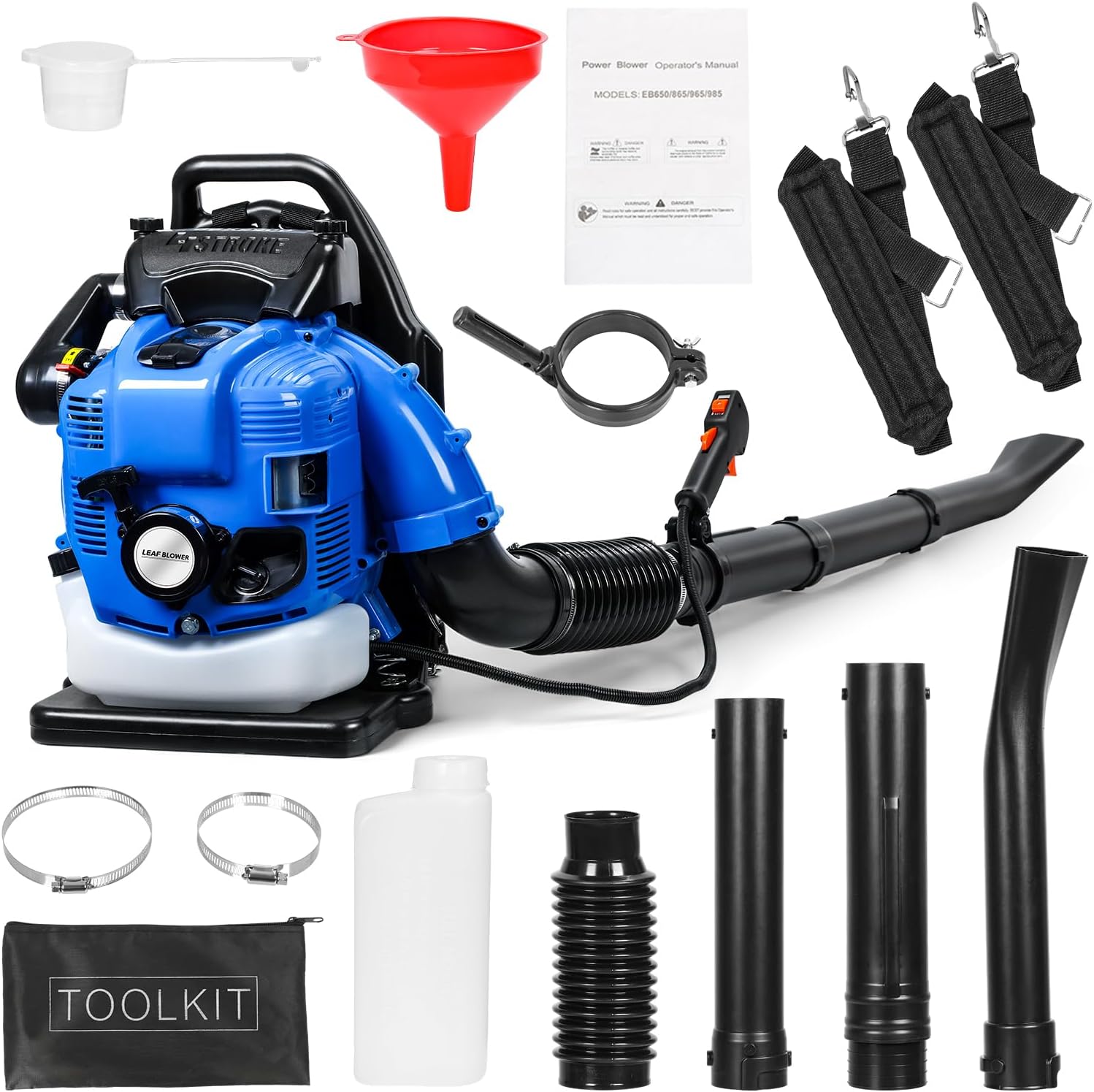
cdar 4-Stroke 75.6CC Backpack Leaf Blower (750 CFM, 210 MPH)
| Engine Displacement | 75.6CC |
|---|---|
| Airflow | 900CFM |
| Air Velocity | 210MPH |
| Power | 3.7KW/5HP |
| Fuel Tank Capacity | 1900ml |
This cdar backpack leaf blower packs a 75.6cc 4-stroke engine that produces up to 750 CFM and roughly 210 MPH airspeed, built for cleaning lawns, driveways, and heavier debris such as wet leaves. It is used as a shoulder-worn unit so you can cover large areas without dragging a handheld tool, and the padded shoulder straps and back support improve comfort during longer jobs. Notable features include a long outlet pipe and offset shock-absorbing handle that help direct airflow and reduce arm fatigue while providing stable control. The 4-stroke design runs on regular gasoline and uses common 10W-30 oil which simplifies maintenance and lowers emissions compared with two-stroke models. Practical benefits are strong clearing power, extended runtime from the 1.9L fuel tank, and easier handling for demanding yard work. Limitations to expect are the typical backpack blower noise and weight you must carry during use, and the need for routine engine maintenance and fuel storage that come with any gas-powered tool.
Best for: Buyers who need a powerful, gas-driven blower to clear medium to large yards and who value runtime and raw blowing power over the convenience of battery models.
Less Ideal for: People with very small yards, noise-sensitive neighborhoods, or those who prefer low-maintenance, cordless electric solutions should consider lighter or battery alternatives.
- High airflow (750 CFM) and strong airspeed (~210 MPH) for moving heavy or wet debris
- 4-stroke engine runs on regular gasoline and common oil for easier fueling and lower emissions
- Backpack form factor with padded straps and back support for longer comfortable operation
- Long outlet pipe and offset shockproof handle improve reach and control during use
- Requires regular engine maintenance and fuel storage typical of gas equipment
- Backpack units are heavier to carry than handheld or battery models and can be noisy
Verdict: Choose this backpack 4-stroke blower if you want a durable gas-powered machine that delivers strong airflow and longer runtime for demanding yard cleanup.
JellyMoving JM9900 75.6cc 4‑Stroke Backpack Leaf Blower

| Power Source | Gas Powered |
|---|---|
| Form Factor | Backpack |
| Air Flow Capacity | 900 cfm |
| Maximum Speed | 237 miles_per_hour |
| Additional Features | Adjustable Speed, Adjustable Tube Length, Anti-Vibration, Instant Start |
The JellyMoving JM9900 is a professional‑style 4‑stroke backpack leaf blower built for heavy-duty yard jobs where airflow and run time matter. Its 75.6cc engine produces up to 900 CFM and 237 MPH, which translates to strong, steady wind useful for moving wet leaves, grass clippings, and heavier debris across large properties. The 4‑stroke design means no fuel/oil premix, simpler fueling, and routine oil changes every few hours as directed. The backpack form with padded straps, a supportive backrest, and anti‑vibration features makes multi‑hour use more tolerable, and cruise control plus a variable throttle helps maintain a constant output without finger fatigue. A large replaceable air filter improves durability in dusty conditions but requires periodic maintenance. This blower is relatively large and intended for serious yard work rather than occasional light cleanup, and it needs regular engine maintenance and proper break‑in handling to reach peak life and performance.
Best for: Buyers who prioritize raw blowing power and sustained performance for large properties or frequent heavy cleanup and who are willing to perform routine engine maintenance.
Less Ideal for: People who only need occasional light yard cleanup, who prefer battery convenience, or who want a low‑maintenance handheld blower.
- High airflow (900 CFM) and top speed (237 MPH) suitable for moving wet leaves and heavy debris
- 4‑stroke engine requires no fuel/oil premix for easier fueling and cleaner operation
- Backpack harness with padding and anti‑vibration design for longer comfortable use
- Variable throttle and cruise control allow steady output and reduced hand fatigue
- Large replaceable air filter improves engine longevity in dusty conditions
- Size and engine power make it heavier and more maintenance intensive than handheld models
- Requires regular engine oil changes and a careful 50‑hour break‑in for best lifespan
Verdict: If you need a high‑power, professional 4‑stroke backpack blower for frequent heavy cleanup, the JM9900 delivers the sustained airflow and durability to get the job done.
Sarkoyar 75.6cc 4-Stroke Backpack Leaf Blower (750 CFM, 205 MPH)

| Power Source | Gas Powered |
|---|---|
| Form Factor | Backpack |
| Air Flow Capacity | 750 cfm |
| Noise Level | 69 db |
| Speed | 7000 rpm |
This Sarkoyar backpack blower pairs a 75.6cc four-stroke engine with a flexible long outlet pipe and an adjustable harness to tackle large lawns, driveways, paths, and similar outdoor areas. The backpack form spreads the load across the upper body and the offset handle helps counter downward pull, making longer runs less tiring than a handheld unit. Tube-mounted throttle and cruise control let you set and maintain airflow while you sweep leaves, grass clippings, hedge trimmings, and light surface snow. The four-stroke design avoids mixing oil and gasoline and runs on regular fuel, which simplifies refueling and seasonal storage. Practical limits are manual starting and a plastic/ABS exterior which may be less durable than all-metal prosumer units, and the unit is still relatively heavy to carry despite the harness. Noise is moderate at the listed level, so hearing protection is recommended during use. For routine seasonal cleanup over large properties this blower delivers strong airflow and usable control features, while buyers wanting the lightest or quietest option should compare battery models or quieter commercial backpack designs.
Best for: Buyers who want a powerful, reliable gas backpack blower for routine seasonal cleanup on larger properties and who prioritize ease of fueling and steady performance over the lightest possible tool.
Less Ideal for: Small-yard owners who prefer quieter battery models, users who need an electric start, or anyone who does mostly short, occasional cleanup and prefers minimal setup or weight.
- High airflow and speed (750 CFM, up to 205 MPH) clears wide areas quickly
- Backpack harness and offset handle distribute weight and reduce arm fatigue during long jobs
- Four-stroke engine eliminates fuel/oil mixing and simplifies fueling and storage
- Tube-mounted throttle and cruise control provide easy, consistent speed control
- Manual recoil start can be harder for some users compared with electric start options
- Construction uses plastic/ABS components that may show wear faster than heavier-duty metal parts
Verdict: Choose this blower if you need a robust four-stroke backpack unit that clears large areas efficiently while avoiding fuel/oil mixing.
Techimes 4-Stroke 75.6CC Backpack Leaf Blower

| Power Source | Gas Powered |
|---|---|
| Form Factor | Backpack |
| Additional Features | Adjustable Speed |
| Item Highlight | 750CFM 205MPH, 1.9L Tank |
This Techimes backpack leaf blower uses a 4-stroke gas engine to deliver high airflow and strong airspeed for clearing leaves, grass clippings, and light debris across larger properties. Its backpack form with an ergonomic harness and adjustable offset handle reduces arm strain during extended use, while the flexible outlet pipe and shockproof handle help direct airflow precisely. Cruise control and a tube-mounted throttle make it straightforward to operate without constant throttle adjustment. The 4-stroke design improves fuel efficiency and lowers emissions compared with typical 2-stroke units, and the blower is also pitched for light snow removal or jobsite dust clearing. Expect a machine that excels at moving large volumes quickly, but be prepared for the usual maintenance of a gas engine and the added bulk of a backpack unit compared with handheld blowers. Noise and vibration are described as reduced, though this is relative for gas-powered equipment.
Best for: Buyers who need a budget-friendly, high-capacity blower for clearing leaves and debris over larger yards or properties and who prefer fuel efficiency and longer run times over battery convenience.
Less Ideal for: Small-yard owners who prioritize lightweight, ultra-quiet, or zero-emission operation should consider compact electric or battery models instead.
- 4-stroke engine for better fuel economy and lower emissions than 2-stroke designs
- High airflow and airspeed (advertised 750 CFM and 205 MPH) for fast clearing of large areas
- Ergonomic backpack harness and offset handle reduce arm fatigue during extended use
- Adjustable speed, cruise control, and tube-mounted throttle for easier, sustained operation
- Backpack gas units are heavier and bulkier than handheld blowers and require routine engine maintenance
Verdict: A cost-conscious choice for buyers who want a fuel-efficient 4-stroke backpack blower that moves large volumes quickly.
Henf 37.7cc 4-Cycle Backpack Leaf Blower — 580 CFM

| Power Source | Gas Powered |
|---|---|
| Form Factor | Backpack |
| Air Flow Capacity | 580 cfm |
| Noise Level | 90 db |
This Henf backpack leaf blower pairs a 37.7cc 4-cycle engine with a backpack harness to tackle large yards and demanding cleanup tasks. In use it functions like a professional backpack blower: the padded harness and adjustable straps distribute weight so you can run it for longer periods, while the high-speed fan produces strong airflow to move leaves, light snow, gravel, and dust. Notable features include EPA certification for lower emissions, a claimed high air volume (listed near 580 to 750 CFM across materials), and design touches aimed at comfort such as an ergonomic handle and weight-leveling load system. Practical benefits are straightforward: powerful clearing capability, reduced vibration and fatigue from the backpack configuration, and simpler maintenance compared with two-stroke blowers since this is a four-cycle unit. Important limitations are the reported noise level around 90 dB which may still require hearing protection for prolonged use and some inconsistency in published airflow figures across the listing that could affect expected performance estimates. For someone prioritizing a dependable, gas-powered backpack unit, this model offers a solid balance of power and user comfort.
Best for: Buyers who need a reliable gas backpack blower for frequent yard maintenance and prefer an EPA-certified four-cycle engine that reduces fuss over fuel mixing and lowers emissions.
Less Ideal for: Casual users with very small yards or those who need a near-silent option should consider handheld electric or battery blowers instead.
- 37.7cc 4-cycle engine reduces emissions and avoids mixing oil with fuel
- Backpack harness with padded straps and weight-leveling system for longer comfortable use
- High reported airflow (listed around 580–750 CFM) suitable for large areas and heavy debris
- EPA certification indicating compliance with emissions standards
- Listed noise level of about 90 dB may require hearing protection during extended operation
- Inconsistent airflow figures in the listing make exact performance unclear
Verdict: Choose this backpack 4-cycle blower if you want a dependable, EPA-certified gas unit that prioritizes sustained power and operator comfort for large-area cleanup.
SENIX BL4C-M 49cc 4-Cycle Backpack Leaf Blower — 425 CFM, 195 MPH

| Power Source | Gas Powered |
|---|---|
| Form Factor | Backpack |
| Air Flow Capacity | 425 cubic meter per hour |
| Maximum Speed | 195 miles_per_hour |
| Additional Features | Adjustable Speed |
The SENIX BL4C-M is a backpack-style, gas-powered leaf blower built for clearing medium to large yards and tougher, wet debris. Its 49cc 4-cycle engine produces up to 425 CFM and 195 MPH, and the variable-speed throttle plus cruise control make it easy to dial in airflow for raking paths, driveways, and garden beds without constantly holding the trigger. The ergonomic harness distributes weight across the shoulders and hips so longer jobs feel less taxing than handheld blowers. Being a 4-cycle design reduces the need to mix fuel and lowers emissions compared with typical 2-cycle units, which is helpful for regular use. Expect more power and longer run sessions than battery models but also the usual gasoline drawbacks such as engine maintenance, noise, and exhaust. The blower’s backpack form and 18.2-pound listed weight improve control and reach but require proper fitting and periodic rest breaks for extended shifts. For homeowners or small-property contractors who want sustained high airflow and variable control, this is a practical, work-oriented choice.
Best for: Buyers who need sustained high airflow for half-acre to one-acre properties or light commercial cleanup and who prioritize proven performance and peer-reviewed reliability over cordless convenience.
Less Ideal for: People with very small lawns, tight spaces, or those who prefer quiet, low-maintenance electric or battery blowers should consider a smaller handheld or battery model instead.
- Powerful 49cc 4-cycle engine delivers sustained 425 CFM and 195 MPH for moving heavy, wet leaves
- Variable-speed throttle with cruise control lets you set and maintain airflow for longer jobs
- Backpack form with ergonomic harness distributes load for more comfortable extended use
- 4-cycle design eliminates fuel mixing and reduces emissions compared with 2-cycle engines
- Requires regular gasoline engine maintenance and produces exhaust and noise typical of gas units
- Backpack configuration is heavier and needs proper fit and occasional breaks for long sessions
Verdict: Choose this backpack 4-cycle blower when you need durable, mid-to-high power and cruise-control convenience for regular, heavy yard cleanup.
Dnveey 75.6cc 4‑Stroke Backpack Leaf Blower (750 CFM, 205 MPH)

| Power Source | Gas Powered |
|---|---|
| Form Factor | Backpack |
| Air Flow Capacity | 750 cfm |
| Noise Level | 78 db |
| Maximum Speed | 7200 rpm |
This Dnveey backpack blower pairs a 75.6cc 4‑stroke engine with a commercial‑style chassis to move large volumes of debris without fuel mixing. It delivers up to 750 CFM at about 205 MPH, which is useful for clearing wet leaves, dense clippings, and long driveways. The 4‑stroke design lets you run straight unleaded gasoline so you avoid pre‑mixing oil, and the tool‑free air filter and rugged build simplify maintenance after repeated jobs. Comfort features like a padded adjustable harness, vibration reduction, and cruise control make multi‑hour tasks less tiring. Expect typical backpack blower tradeoffs: it is heavier and bulkier than handheld units and requires basic engine maintenance and storage care. Noise is moderate for a gas unit at 78 dB, so hearing protection is still recommended during longer sessions. For reliability‑minded users this model emphasizes serviceable components and a commercial chassis that hold up to frequent seasonal use.
Best for: Buyers who need a durable, high‑output blower for regular seasonal and property‑scale cleanup and who prioritize ease of maintenance and long‑term reliability.
Less Ideal for: Users who only need occasional light leaf cleanup, have very small yards, or want a cordless or electric option with lower noise and no engine maintenance.
- High airflow capacity (750 CFM) suitable for heavy, wet, or compacted debris.
- 75.6cc 4‑stroke engine runs on straight gasoline so no premixing of oil is required.
- Padded adjustable backpack harness, vibration reduction, and cruise control for extended comfortable use.
- Tool‑free air filter and commercial chassis that simplify maintenance and support frequent use.
- Heavier and bulkier than handheld blowers which can be tiring for users who only need occasional light cleanup.
- As a gas unit it requires regular engine maintenance and fuel storage care.
Verdict: Choose this Dnveey 4‑stroke backpack blower if you want a serviceable, high‑output machine built to handle heavy seasonal cleanup reliably.
Choosing the Right 4 Cycle Gas Leaf Blower: Key Factors to Consider
Airflow and Airspeed
Airflow measured in cubic feet per minute and airspeed measured in miles per hour determine how the blower handles different debris types. High airflow helps move large piles of leaves and wet material, while higher airspeed is useful for dislodging compacted debris and blowing from a distance.
Gardeners should match airflow and airspeed to their yard conditions. Small, dry-leaf patios do not need the same CFM as large properties with wet leaves or small branches. Remember that real-world performance depends on nozzle design and how the blower channels air, not just the headline numbers.
Engine Type and Serviceability
A true four-cycle engine eliminates the need to mix oil with gasoline, which simplifies refueling and reduces exhaust smoke. However, these engines still require routine maintenance such as oil changes, valve checks, spark plug replacement, and carburetor cleaning.
Consider how easy it is to access service points. Blowers with simple top or side panels, clear dipstick locations, and widely available replacement parts will reduce downtime. If you are comfortable performing basic small-engine maintenance, a serviceable four-cycle unit can last many seasons.
Ergonomics and User Comfort
Weight, balance, and handle design directly affect how long you can operate a blower without fatigue. Backpack-style four-cycle blowers distribute weight across the hips and shoulders and suit longer jobs, while handheld models are lighter for short bursts but can cause arm fatigue.
Also evaluate vibration damping, throttle placement, and harness padding. Good ergonomics reduce strain during leaf blowouts, gutter cleanups, and work around trees or tight planting beds.
Fuel Efficiency and Run Time
Fuel efficiency matters when you are clearing large areas because frequent refueling interrupts work and adds task time. Four-cycle engines typically run on regular gasoline and can be more fuel-efficient under steady load compared with some two-stroke units.
Check manufacturer-stated tank capacity alongside expected runtime at typical workloads. For long properties, choose units with larger tanks or better fuel economy. Also consider whether the unit has features like fuel gauges or easy-access filler necks for faster refills.
Noise and Local Regulations
Gas blowers can be loud, and many municipalities or homeowner associations restrict hours of operation or specific blower types. Four-cycle engines can be slightly quieter or produce a different sound profile than two-strokes, but noise levels still vary by design and muffler quality.
Before buying, check local noise ordinances and consider models with quieter mufflers or lower-revving engines. If you frequently work in neighborhoods, a quieter unit will reduce community friction and allow more flexible scheduling.
Durability and Construction
Durable housings, reinforced fan housings, and impact-resistant nozzles extend a blower's service life in tough garden conditions. Look for unit construction that resists debris ingestion and has replaceable wear parts such as nozzles and air filters.
Ease of obtaining replacement parts and straightforward repairability influence long-term ownership cost. A well-built blower will tolerate occasional knocks, gravel ingestion, and repeated transport without frequent breakdowns.
Matching Blower Type to Yard Size
Handheld four-cycle blowers excel for small-to-medium yards where short bursts and maneuverability matter. They are lighter and easier to store, but expect more arm fatigue during extended use. Backpack four-cycle models are designed for larger properties and professional-style work because they shift weight to the hips and shoulders and typically include higher-capacity tanks for longer run times.
- Handheld units: best for quick cleanups, tight spaces, and light debris.
- Backpack units: best for large yards, prolonged tasks, and heavy or wet debris.
Nozzle Choices and Job Efficiency
Different nozzle shapes affect how air is focused and how efficiently you can move leaves. A tapered or concentrator nozzle increases airspeed for stubborn debris, while a wider flared nozzle moves more volume for large piles. Some blowers include interchangeable nozzles or extendable tubes that let you switch between tasks easily.
- Tapered nozzle: higher airspeed for compacted debris.
- Wide nozzle: moves higher volumes for sweeping piles.
Maintenance Schedule and Seasonal Care
Keep a simple maintenance log to track oil changes, spark plug checks, and air filter cleanings. Performing those tasks before and after heavy-use seasons prevents start-up problems and reduces wear. Store the blower with a stabilizer-treated tank if you will not use it for months, and drain fuel if recommended by the manufacturer for long-term storage.
- Change oil every season or after recommended hours.
- Inspect and clean air filter monthly during heavy use.
Using a Blower Safely Around Plantings
Blowers can uproot shallow-rooted plants, strip mulch, and scatter topsoil if used too close to beds. When working near plantings, reduce airflow or use a wider nozzle to lower local airspeed. Angle the nozzle parallel to the ground to sweep debris away rather than blasting at root zones.
Take special care around young plants, shallow bulbs, and loose decorative gravel. Use rakes or leaf scoops for delicate areas to avoid accidental damage from concentrated airflow.
- Keep nozzle at a low angle near beds to protect mulch.
- Use low-power settings for delicate plantings.
Transport and Storage Practicalities
Consider how you will move the blower to and from a storage shed or vehicle. Backpack models with quick-release harnesses and balanced load distribution are faster to put on and remove. Handheld units may fit in smaller storage areas but remember to secure fuel caps and store the unit on a stable shelf or hanging hook to prevent tip-overs.
Winter storage should be dry and ventilated. Protect exposed metal components from prolonged humidity to avoid rust and gumming.
- Use a dedicated storage hook or shelf.
- Keep a small toolkit and spare parts accessible for field fixes.
How We Chose the Best 4 Cycle Gas Leaf Blower
We assembled this list by focusing on practical performance and real-garden durability rather than specs alone. Key evaluation criteria included measurable airflow and airspeed, because these determine how effectively a blower moves wet leaves and compacted debris. We also assessed engine reliability and maintenance needs, since four-cycle engines are valued for less oil mixing but still require valve adjustments, carburetor care, and scheduled service. Ease of handling and operator comfort were considered next, covering weight distribution, harness or handgrip ergonomics, and vibration levels that affect how long you can work without fatigue. Fuel efficiency and run time matter for larger properties where frequent refueling interrupts workflow. Finally, we reviewed build quality and accessibility of service points so routine maintenance is straightforward. We excluded models with unclear specifications, units that require specialized fuels, and any blower with a documented history of hard-starting or major reliability complaints. The remaining picks represent a balance of power, durability, and maintenance practicality that gardeners can expect in everyday yard work.
FAQ
Are four-cycle blowers harder to start than two-stroke models?
They often start comparably once properly maintained. Four-cycle engines have more moving parts and valves, so cold starts can be slightly different, but regular tune-ups and fresh fuel usually keep start reliability high.
Can I use regular gasoline in a 4 cycle gas leaf blower?
Yes, four-cycle blowers are designed to run on regular gasoline without premixing oil. Always follow the engine manufacturer recommendations for octane and fuel additives.
Is a backpack or handheld four-cycle blower better for wet leaves?
Backpack blowers usually offer higher sustained airflow and larger fuel capacity, making them better for wet leaves and longer sessions. Handheld units can work for smaller areas but may struggle with heavy or wet debris.
How noisy are four-cycle leaf blowers compared with other types?
Noise varies by design, but four-cycle engines can be moderately loud. They sometimes run at lower rpm for the same output, which can change the sound profile. Check local regulations and consider muffler design if noise is a concern.
What routine maintenance should I expect with a four-cycle blower?
Expect oil changes, spark plug checks, air filter cleaning, and occasional carburetor or valve adjustments. Following a seasonal maintenance schedule preserves performance and reduces hard-start issues.
Can a homeowner perform repairs on a four-cycle blower?
Many routine tasks are homeowner-serviceable, such as oil changes and spark plug swaps. More complex repairs like valve tuning or carburetor rebuilds may require a small-engine technician unless you have experience.
Final Verdict
Focus on the tradeoffs between raw clearing power and everyday usability when choosing a four-cycle gas leaf blower. Prioritize airflow and airspeed for the types of debris you handle, and weigh ergonomics against fuel capacity if you regularly cover large properties. Maintenance accessibility and durability determine how much time you spend on upkeep rather than clearing chores. Choose the unit that aligns with your typical job length and debris conditions. A well-matched blower will reduce task time, limit fatigue, and deliver reliable performance across seasons.
