

Note: This article contains affiliate links. If you click on these links and make a purchase, I may earn a small commission at no extra cost to you. This helps support my research and content. Read my full affiliate disclosure here.
When you run a landscaping crew or manage large outdoor properties, a commercial gas leaf blower needs to do more than move leaves. You need dependable thrust, long run times between refuels, and a design that survives daily use in wet, dry, and dusty conditions. This guide narrows the field to seven top-rated commercial gas leaf blowers suited for heavy-duty cleanup. Each pick was shortlisted because it meets real-world demands like sustained airflow, serviceability, and operator comfort. Below we explain the evaluation criteria and what to expect from each style of blower, then outline the practical tradeoffs to help you choose the right unit for your workload and crew. Read on for a clear look at power, reliability, and features that matter on the job site.
Top Picks at a Glance
| Best Overall The best all-around choice for most situations | Husqvarna 360BT Gas Backpack Leaf Blower |  |
| Best Quality Built to a higher standard if you want something more solid | Husqvarna 580BTS III 75.6cc Gas Backpack Leaf Blower |  |
| Best Value The sweet spot between price and what you get | VEVOR 63cc Backpack Gas Leaf Blower (1110 CFM, 220 MPH) |  |
| Best Budget The cheapest option that still gets the job done reliably | HASANEN 850CFM Backpack Gas-Powered Leaf Blower (63CC, 2-Stroke) |  |
| Highest Rated A top-rated pick with lots of positive feedback | ECHO PB-9010T X Series 79.9cc Backpack Gas Blower |  |
| Most Popular A crowd favorite that many people choose with confidence | Husqvarna 150BT 51cc Gas Backpack Leaf Blower |  |
| Best Seller A high-volume bestseller chosen again and again | PROYAMA 72cc Gas Backpack Leaf Blower (880 CFM, 275 MPH) |  |
Husqvarna 360BT Gas Backpack Leaf Blower

| Power Source | Gas Powered |
|---|---|
| Form Factor | Backpack |
| Air Flow Capacity | 890 cfm |
| Noise Level | 60 db |
| Speed | 8100 rpm |
The Husqvarna 360BT is a gas-powered backpack blower built for large yards and professional-style clearing tasks. It pairs a 65.6-cc X-TORQUE 2-cycle engine with an 890 CFM air flow and up to 232 MPH wind speed to move wet leaves, heavy debris, and grass clippings quickly. The backpack form factor uses a vented, load-reducing harness and wide shoulder straps plus an adjustable offset handle to make extended use more comfortable, while LowVib technology and cruise control reduce arm fatigue and effort on long passes. Practical features like an air purge system help with reliable starting and routine operation. Expect strong clearing performance and durability typical of Husqvarna, but keep in mind this is a gas unit so you will have fuel mixing, routine maintenance, and higher noise and emissions compared with battery models. The blower is best when you need sustained power for large properties or commercial jobs and are prepared for the upkeep that comes with a gas engine.
Best for: Owners of large properties, landscapers, or homeowners who need sustained, commercial-level clearing power and prioritize performance and endurance over minimal maintenance.
Less Ideal for: Small-yard owners, occasional users, or anyone seeking quieter, low-maintenance battery-powered equipment should consider cordless alternatives instead.
- High air volume and speed (890 CFM and up to 232 MPH) for moving wet or heavy debris
- Ergonomic backpack harness and wide shoulder straps reduce operator fatigue during long jobs
- LowVib technology and adjustable offset handle improve comfort and control
- Air purge system and cruise control simplify starting and steady operation
- Gas engine requires fuel mixing, routine maintenance, and produces more noise and emissions than electric models
- Backpack design and engine weight increase physical load compared with handheld blowers
Verdict: Choose the Husqvarna 360BT when you need sustained, professional-grade blowing power and ergonomic support for large-area cleanup.
Husqvarna 580BTS III 75.6cc Gas Backpack Leaf Blower

| Max air flow at nozzle | 1000 CFM |
|---|---|
| Max air speed | 220 MPH |
| Max blow force | 47 N |
| Engine displacement | 75.6 CC |
| Engine cycle | 2-Cycle |
The Husqvarna 580BTS III is a commercial-style backpack blower built to move large volumes of debris quickly. It pairs a 75.6 cc two-stroke X-TORQ engine with an efficient fan to produce up to 1000 CFM and 47 N of blow force, making it well suited to clearing heavy leaves, grass clippings, and wet debris across large properties. The ventilated, load-reducing harness and padded hip belt improve weight distribution so operators can work longer with less fatigue, and the tube-mounted throttle gives straightforward control while walking. A larger fuel tank reduces refueling stops during long shifts and the two-stage commercial air filter helps protect the engine in dusty conditions. Expect loud operation typical of powerful gas blowers and plan for regular 2-stroke maintenance and fuel mixing. This unit favors contractors or experienced homeowners who need sustained power and durability rather than occasional light-use tasks.
Best for: Buyers who need a rugged, high-output blower for frequent or large-area clearing—commercial landscapers and homeowners with extensive properties who prioritize performance and uptime.
Less Ideal for: Those with small yards, infrequent need for a blower, or who prefer quieter, low-maintenance electric models should consider smaller or battery-powered alternatives.
- Very high airflow and blow force suitable for commercial clearing (1000 CFM, 47 N)
- Ergonomic ventilated backpack harness and padded hip belt reduce operator fatigue
- Large fuel tank supports longer run times between refuels
- Tube-mounted throttle and adjustable speed give straightforward control during use
- Commercial two-stage air filter for better engine protection in dusty conditions
- High noise and typical 2-stroke maintenance requirements
- Backpack format and power are oversized for small yards or occasional light use
Verdict: Choose the 580BTS III when you need professional-level blowing power and endurance for large or frequent cleanup jobs.
VEVOR 63cc Backpack Gas Leaf Blower (1110 CFM, 220 MPH)

| Power Source | Gas Powered |
|---|---|
| Form Factor | Backpack |
| Air Flow Capacity | 1110 cfm |
| Maximum Speed | 6500 rpm |
| Additional Features | Adjustable Speed |
This VEVOR 63cc backpack blower delivers strong airflow (listed at 1110 CFM and 220 MPH) from a two-stroke gas engine, making it well suited for clearing leaves, grass clippings, and light snow on large properties or commercial jobs. The backpack form factor and padded straps are designed to reduce operator fatigue and vibration during longer runs, and the 1.89L fuel tank is claimed to provide roughly 50 to 60 minutes of continuous operation between fill-ups. Controls include throttle, adjustable speed, and cruise lock for steady output while working. The unit ships with useful accessories such as a corrugated hose, extension and flat nozzles, noise-reducing earmuffs, and basic tools which help get the blower into service quickly. Expect the typical two-stroke maintenance tasks and some noise and exhaust associated with gas engines; this is not a cordless quiet option. Build materials mix plastic and metal, so durability should be acceptable for regular use but professional users should plan routine servicing for longevity. Overall the blower is a practical, high-power choice if you need runtime and raw airflow for large areas.
Best for: Buyers who need a high-airflow blower for large lawns or light commercial landscape work and who prioritize runtime and raw clearing power over quiet operation.
Less Ideal for: Users who want a low-noise, emission-free option for small yards or who prefer battery-powered equipment with minimal maintenance.
- High reported airflow (1110 CFM) and 220 MPH wind speed for fast clearing of large areas
- Ergonomic backpack design with padded straps and shock-absorption to reduce operator fatigue
- Large 1.89L fuel tank for roughly 50–60 minutes of continuous runtime
- Includes useful accessories such as hoses, nozzles, noise-reducing earmuffs, and basic tools
- Gas two-stroke engine produces noise and exhaust typical of petrol blowers
- Requires regular two-stroke maintenance and fuel mixing that some users may find inconvenient
Verdict: A high-airflow backpack gas blower built for extended runs and large-area clearing, ideal for practical users who value runtime and power.
HASANEN 850CFM Backpack Gas-Powered Leaf Blower (63CC, 2-Stroke)

| Power Source | Gas Powered |
|---|---|
| Form Factor | Backpack |
| Additional Features | Adjustable Speed |
| Noise Level | 101 db |
| Maximum Speed | 6800 rpm |
This HASANEN backpack leaf blower pairs a 63CC two-stroke engine with a backpack harness to deliver strong, continuous airflow for heavy clearing tasks. It is typically used for blowing leaves, grass clippings, light gravel, and even light snow across yards, driveways, and commercial grounds. Notable features include an adjustable nozzle angle for wider coverage, a large 0.47 gallon fuel tank for longer run times between refills, an adjustable throttle with a cruise/constant-speed switch, and breathable padded straps and backrest to reduce operator fatigue. Practical benefits are high clearing power and the ability to work longer stretches without frequent refueling, plus one-hand control that makes directional adjustments easier. Important limitations are the two-stroke gasoline engine that requires fuel mixing and produces noise around 101 dB, and a backpack form factor that is heavier to carry than handheld models and requires basic maintenance. For buyers focused on raw clearing performance on a budget, this unit gives strong power and useful features but comes with the usual maintenance and noise of gas engines.
Best for: Buyers who need a high-power, budget-friendly backpack blower for frequent heavy clearing on yards or commercial grounds and who are willing to handle basic gas-engine maintenance.
Less Ideal for: Those who prioritize quiet operation, zero-emissions use, or minimal maintenance should look at electric or battery models instead.
- High power 63CC two-stroke engine rated 2.7 kW for fast clearing of leaves and light debris
- Large 0.47 gallon fuel tank supports longer run time between refills
- Adjustable nozzle angle and hose make it easier to reach wider or awkward areas
- Backpack harness with padded straps and ventilated backrest reduces operator fatigue
- One-hand control with constant-speed switch simplifies sustained use
- Two-stroke gas engine requires fuel/oil mixing and routine maintenance
- Loud operation at about 101 dB makes hearing protection necessary
Verdict: If you want maximum clearing power on a budget, this backpack gas blower delivers strong airflow and long run time for heavy yard and commercial work.
ECHO PB-9010T X Series 79.9cc Backpack Gas Blower
| Power Source | gasoline-powered |
|---|---|
| Form Factor | Backpack |
| Additional Features | Throttle Lock |
| Noise Level | 48 db |
| Maximum Speed | 220 miles_per_hour |
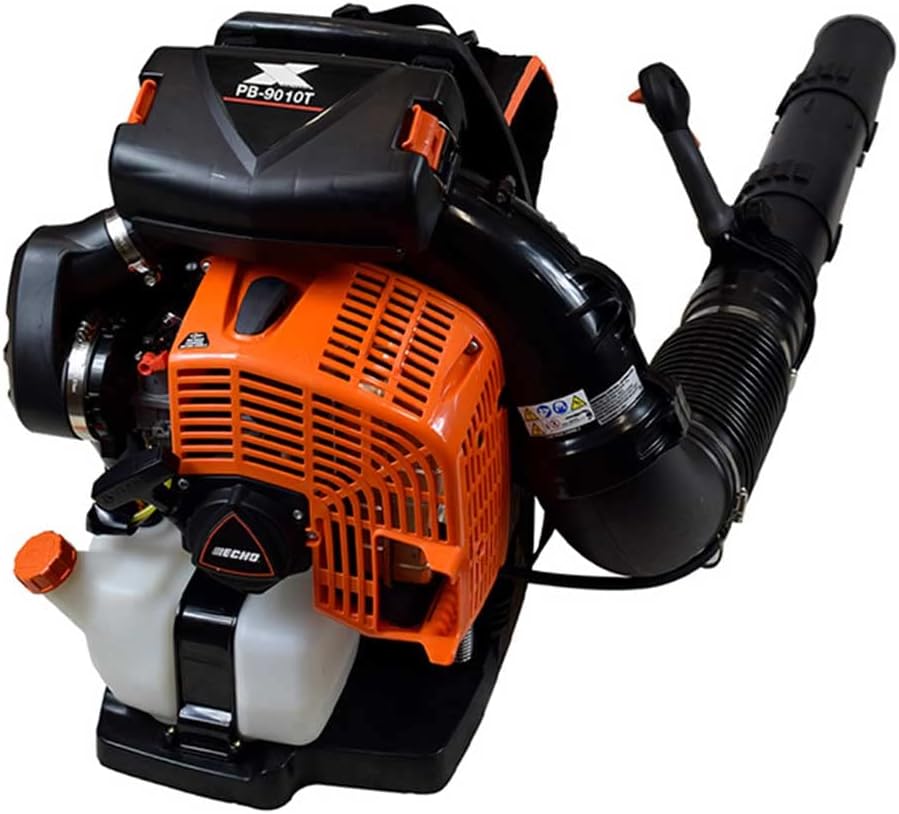
The ECHO PB-9010T X Series is a professional-style backpack blower built for heavy yard work and extended runs. Its 79.9 cc two-stroke engine produces up to 220 mph airspeed and a high airflow so you can move large piles of leaves, debris, and grass clippings quickly. The backpack form factor distributes the engine weight across the shoulders and hips for longer use than handheld units, and the tube-mounted throttle plus throttle lock help maintain a steady output during repetitive jobs. Practical benefits include strong clearing power for lawns, driveways, and beds and a design aimed at home users who need commercial-level performance. Limitations are the usual ones for gas backpack blowers: it requires fuel mixing and periodic engine maintenance, it is heavier and louder than electric alternatives, and it may be overkill for very small yards or infrequent light tasks.
Best for: Homeowners who need a reliable, high-power blower for frequent or large-area cleanup and who prioritize continuous performance over minimal maintenance.
Less Ideal for: Casual users with small yards, those who prefer low-maintenance electric equipment, or anyone seeking the quietest option for noise-sensitive neighborhoods.
- High reported maximum speed of 220 mph for strong clearing power
- Backpack form factor for longer, more comfortable operation than handheld blowers
- Tube-mounted throttle with throttle lock for steady speed control during extended use
- Gasoline power allows untethered operation and sustained output for large properties
- Requires fuel mixing and routine engine maintenance inherent to two-stroke gas engines
- Heavier and louder than electric or battery backpack models
- Likely more power than needed for very small yards or occasional use
Verdict: Buy this if you want a dependable, high-speed gas backpack blower that handles large yards and frequent heavy-duty cleanup.
Husqvarna 150BT 51cc Gas Backpack Leaf Blower

| Power Source | Gas Powered |
|---|---|
| Form Factor | Backpack |
| Air Flow Capacity | 765 cfm |
| Maximum Speed | 270 miles_per_hour |
| Additional Features | Adjustable Speed |
The Husqvarna 150BT is a gas-powered backpack leaf blower built for large yards and frequent clearing jobs. Its 51 cc 2-cycle engine produces up to 765 CFM and 270 MPH, which moves heavy or wet leaves quickly while the padded harness, hip belt, and weight-leveling system help distribute load for longer use. Variable speed throttle with cruise control lets you hold a steady speed without constant throttle input, and the air purge feature makes starting easier after refueling. In practice this blower is best for contractors or homeowners with many trees or large properties who need sustained blowing power and durability. Expect steady high performance and fewer passes on dense debris, but plan for routine maintenance typical of gas engines such as fuel mixing, spark plug checks, and quieter alternatives if noise or emissions are a concern. It comes with basic assembly items and a user manual so you can start using it right away.
Best for: Buyers who need sustained, professional-level blowing power for large yards or frequent heavy cleanups and who prioritize performance and durability over low-maintenance convenience.
Less Ideal for: Small-lot owners, noise-sensitive neighborhoods, or users who prefer low-emissions, low-maintenance electric or battery blowers.
- High clearing power: up to 765 CFM and 270 MPH for moving heavy or wet debris quickly.
- Ergonomic backpack harness with padded straps, hip belt, and weight-leveling for extended comfortable use.
- Variable speed throttle with cruise control for consistent operation without constant hand input.
- Air purge system to simplify starting after refueling and reduce pull-start issues.
- Gas engine requires regular fuel mixing and routine maintenance.
- Louder and higher-emission operation compared with electric or battery models.
Verdict: Choose the Husqvarna 150BT when you need professional backpack blower power and an ergonomic harness to clear large properties quickly.
PROYAMA 72cc Gas Backpack Leaf Blower (880 CFM, 275 MPH)
| Power Source | Gas Powered |
|---|---|
| Form Factor | Backpack |
| Air Flow Capacity | 880 cfm |
| Speed | 275 miles_per_hour |
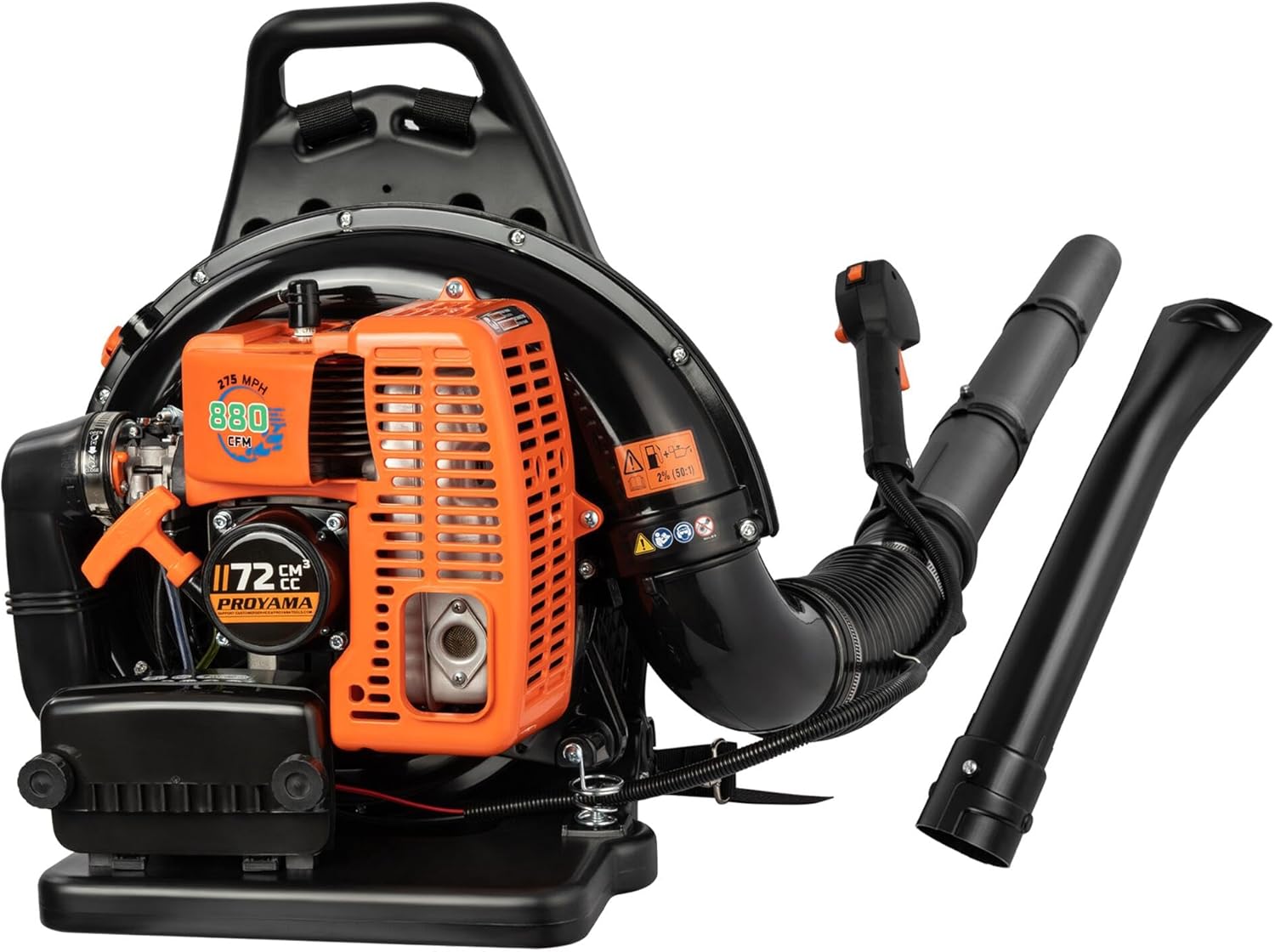
The PROYAMA 72cc backpack leaf blower brings commercial-level airflow and a harnessed design that keeps long jobs manageable. Its 72cc two-cycle engine produces strong airflow (up to 880 CFM and 275 MPH) and a self-throttle lock with cruise control helps maintain a steady speed without constant trigger pressure. Two interchangeable nozzles, flat and round, make it easy to switch between concentrated blasts for stuck debris and wider coverage for loose leaves. The padded harness, hip belt, and ventilated backrest improve comfort during multi-hour use, while the variable speed control lets you dial power to the task to save fuel and reduce noise. Practical features include an accessible air filter and a low-vibration design that reduce operator fatigue and maintenance time. Downsides are typical of gas backpack units: there is engine noise and vibration compared with battery models and it requires fuel mixing and routine engine upkeep. For users who need sustained high power for large yards or commercial jobs, this unit delivers the capacity and endurance required.
Best for: Gardeners and landscapers who need sustained high power for large yards or commercial jobs and prioritize runtime and raw clearing performance over cordless convenience.
Less Ideal for: Small-plot owners, balcony gardeners, or noise-sensitive neighborhoods where an electric or battery blower would be quieter and lower maintenance.
- High airflow and speed (880 CFM, 275 MPH) for moving heavy or wet debris
- Backpack harness with padded straps, hip belt, and ventilated backrest for extended comfort
- Variable speed throttle with cruise control to maintain consistent output and reduce operator fatigue
- Two nozzles (flat and round) for focused or wide-area clearing and improved versatility
- Gas engine requires regular maintenance and fuel mixing
- Louder and higher vibration profile compared with battery-powered blowers
Verdict: Choose this PROYAMA backpack blower when you need continuous, commercial-grade blowing power and comfort for large-scale leaf and debris clearing.
Choosing the Right Commercial Gas Leaf Blower: Key Factors to Consider
Engine Power and Airflow
Engine displacement and carburetion determine sustained thrust more than a single peak number. Higher displacement engines usually deliver stronger airflow and better performance on wet or compacted debris, which reduces the number of passes you need on a job.
Airspeed (mph) and airflow volume (CFM) are both important: speed helps dislodge stuck material, while CFM moves larger volumes. Consider the typical material you clear and choose a blower whose sustained airflow matches that workload rather than a model optimized only for short bursts.
Runtime and Fuel System Design
Commercial work means long shifts, so runtime per tank and predictable fuel consumption matter. Carburetor tuning, fuel tank capacity, and fuel system layout influence how often you refuel and whether the blower runs lean under heavy loads.
Look for easy-access fuel caps and stable mounting to avoid spills on uneven turf. Simpler, serviceable fuel systems are preferable for crews who perform routine maintenance in the field. If a unit supports quick-start features or primer designs that are robust under frequent starts, that reduces lost time during multi-site jobs.
Durability and Weather Resistance
Daily use exposes blowers to dust, grit, moisture, and accidental impacts. Reinforced housings, corrosion-resistant fasteners, and protected intake screens extend service life. Consider how the blower handles grit and whether the air intake and carburetor are shielded from dust and moisture.
Also assess the quality of the fan or impeller and the durability of the nozzle attachment points. Units designed for commercial use typically allow easier replacement of wear-prone parts without requiring full teardown.
Ergonomics and Operator Fatigue
Operator comfort affects productivity and safety. Weight distribution, handle shape, and vibration levels determine how long a technician can work before needing a break. Backpack units should have adjustable harnesses and padded straps; handheld units should balance well at the grip point.
Controls that are reachable with one hand, cruise control options, and low-vibration mounts reduce strain on wrists and shoulders. Consider the typical duration of tasks and whether alternating operators or rotating positions will mitigate fatigue.
Serviceability and Parts Availability
Commercial equipment needs routine maintenance: air filter changes, spark plug swaps, and occasional carburetor adjustments. Easy access to these service points shortens downtime and simplifies field repairs. Units with standardized parts or widely available replacement kits are easier to keep running between scheduled maintenance cycles.
Also check whether common wear parts like starter cords, fuel lines, and impellers are modular and replaceable without specialist tools. Good documentation and replacement-part channels help shops keep a fleet operating without long lead times.
Handheld Versus Backpack Options
Handheld commercial gas leaf blowers offer direct control and are lighter for short, detailed cleanup tasks such as sidewalks, planters, and tight beds. They tend to be less costly to service and are ideal when operators frequently bend and switch locations. For long stretches of continuous clearing, the weight concentrates in the arm and shoulder, so balance and vibration damping become the deciding factors.
- Handheld units: better for spot work and tight access
- Backpack units: distribute weight for long runs and large areas
- Consider switching strategy: alternate between operators for long shifts
Noise, Emissions, and Regulatory Considerations
Commercial gas engines produce significant noise and emissions that can affect where and when you can work. Some municipalities restrict blower use during early mornings or require decibel limits. Muffler design, engine tuning, and the presence of sound-dampening housings influence perceived noise on site.
- Check local ordinances for time-of-day restrictions
- Look for muffler designs that reduce frequency peaks rather than only lowering overall decibels
Maintenance Best Practices for Longevity
Routine maintenance keeps commercial units reliable. Follow a schedule for air filter inspection, fuel filter replacement, spark plug checks, and impeller inspection. Cleaning debris from intakes and cooling fins prevents overheating under heavy loads.
- Carry a compact maintenance kit on service trucks
- Log hours and maintenance actions to track parts lifespan
Attachments and Nozzle Options
Different nozzle shapes and extensions change how the airflow behaves. Tapered nozzles concentrate air for stubborn debris, while flared nozzles move larger volumes at lower speed. Some commercial units accept interchangeable nozzles to adapt to different surfaces and cleanup goals.
- Use a tapered nozzle for concentrated power on wet clumps
- Choose a wide nozzle to clear loose, dry leaves faster
Fuel Handling and On-Site Refueling Safety
Safe fueling practices reduce downtime and hazards. Use approved, labeled containers and stable surfaces for refueling. Avoid overfilling and allow the engine to cool before adding fuel to prevent fumes from igniting.
- Store fuel away from hot engines and direct sunlight
- Train crews on spill response and proper container transport
How We Chose the Best Commercial Gas Leaf Blower
We focused on criteria that predict long-term performance in professional outdoor maintenance. First, we prioritized engine power and airflow delivery, since cubic feet per minute and airspeed determine how quickly a blower clears wet leaves, matted debris, and lawn clippings. Second, we evaluated runtime and fuel system design because long shifts require predictable fuel consumption and easy refueling. Durability was another major filter: materials of the housing, quality of the impeller or fan, and maintenance access affect how long a unit lasts under heavy daily use. Ergonomics and weight were considered to minimize operator fatigue during extended periods and to suit crews who switch between handheld and backpack models. Finally, we looked at serviceability and parts availability, plus emissions and muffler design for acceptable noise and regulatory compliance in commercial settings. We excluded underpowered homeowner-only models and electric-only units that cannot meet extended runtime or raw thrust expectations for commercial tasks. The products that made the list score well across these dimensions and represent practical options for professional cleanup needs.
FAQ
What CFM and MPH should I target for commercial cleanup?
It depends on tasks. For general property cleanup choose models with higher sustained CFM for volume and at least moderate airspeed to dislodge wet debris. Extremely high peak MPH helps short bursts, but sustained CFM matters more for moving large piles.
How often should commercial blowers be serviced under heavy use?
Service frequency depends on hours of operation, but inspect air filters and fuel lines daily, perform more thorough checks like spark plug and carburetor adjustments every 50 to 100 hours, and replace wear parts as signs of deterioration appear.
Are backpack blowers better for crew productivity?
Backpack blowers distribute weight across the hips and shoulders, reducing arm fatigue and often increasing continuous operation time. They are typically better for large areas, while handheld units are more maneuverable for tight work.
Can I expect quieter operation from commercial models?
Some commercial designs include better mufflers and housings that reduce noise, but gas engines are inherently loud. If noise is a constraint, choose units with proven muffler designs and follow any local usage restrictions.
What safety gear should operators use with commercial gas blowers?
Operators should use hearing protection, eye protection, and dust masks when needed. Sturdy footwear and gloves help with handling and refueling. For backpack units, ensure harnesses are properly adjusted to avoid chafing and strain.
Final Verdict
Prioritize engine power and reliable runtime when selecting a commercial gas leaf blower, because those two factors determine how much ground your crew clears in a shift. Balance durability and serviceability against ergonomics to minimize downtime and reduce operator fatigue. Decide whether handheld agility or backpack endurance fits your typical jobs, then choose units with accessible maintenance points and compatible replacement parts. That approach will help you pick a blower that stays productive and cost-effective under real commercial use.
