

Note: This article contains affiliate links. If you click on these links and make a purchase, I may earn a small commission at no extra cost to you. This helps support my research and content. Read my full affiliate disclosure here.
If you manage large grounds, commercial properties, or frequent heavy cleanups, the right industrial leaf blower makes routine maintenance faster and less tiring. A true industrial unit prioritizes sustained high airflow, durable construction, and features that reduce operator fatigue during long shifts. This guide covers six shortlisted industrial leaf blowers that fit heavy-duty use and varied crew needs. We evaluate each option on measurable criteria like airflow and build durability, plus practical handling and maintenance concerns. Read on to match the blower type and features to the scale of work you need done.
Top Picks at a Glance
| Best Overall The best all-around choice for most situations | EGO Power+ LB8803-2 Cordless Handheld Leaf Blower with Two 56V 4.0Ah Batteries |  |
| Best Quality Built to a higher standard if you want something more solid | ECHO PB-9010T X Series 79.9cc Backpack Gas Blower |  |
| Best Budget The cheapest option that still gets the job done reliably | HASANEN 850CFM Backpack Gas-Powered Leaf Blower (63CC, 2-Stroke) |  |
| Highest Rated A top-rated pick with lots of positive feedback | RedMax EBZ9000-RH Backpack Blower |  |
| Most Popular A crowd favorite that many people choose with confidence | PROYAMA 72cc Gas Backpack Leaf Blower (880 CFM, 275 MPH) |  |
| Best Seller A high-volume bestseller chosen again and again | Husqvarna 150BT 51cc Gas Backpack Leaf Blower |  |
EGO Power+ LB8803-2 Cordless Handheld Leaf Blower with Two 56V 4.0Ah Batteries

| Maximum Air Flow | 880 CFM |
|---|---|
| Maximum Air Speed | 200 MPH |
| Battery Included | Two 56V 4.0Ah ARC Lithium |
| Runtime with Included Battery | Up to 90 minutes |
| Power Source | Battery Powered |
The EGO Power+ LB8803-2 is a cordless handheld leaf blower built for heavy clearing tasks where speed and runtime matter. It produces up to 880 CFM and airspeeds to 200 MPH, with a variable speed trigger and cruise lock that let you dial in power from light sweeping to full turbo for wet leaves, caked grass, and small debris. Two included 56V 4.0Ah ARC Lithium batteries and a 320W charger provide up to 90 minutes of runtime, so you can finish medium to large yards without swapping packs. The blower uses turbine fan engineering and a brushless motor for gas-like performance while staying quieter and easier to maintain. A digital display shows battery charge and performance status, and the carbon fiber body improves balance and portability. The unit comes with tapered and spread nozzles for focused or wide airflow. Expect a premium, heavier-duty cordless experience, but note that peak performance and turbo mode will drain batteries faster and the unit is larger than entry-level blowers, which may matter for very small yards or occasional spot-cleaning.
Best for: Buyers who prioritize strong cordless performance and extended runtime for tackling medium to large yards and heavy debris, and who want a gas‑level clearing capability without fumes or extra maintenance.
Less Ideal for: Casual users with very small yards or infrequent light cleanup who prefer a smaller, less expensive blower or only occasional use.
- Very high airflow up to 880 CFM and up to 200 MPH for moving heavy, wet debris
- Includes two 56V 4.0Ah batteries and charger for long run times up to 90 minutes
- Variable speed trigger with cruise lock and turbo mode for precise control and peak power
- Brushless motor and turbine fan design deliver gas‑comparable performance with less noise and maintenance
- Digital display and carbon fiber body improve usability and balance during extended use
- Turbo and high‑power use reduce runtime significantly compared with lower settings
Verdict: If you need near‑gas power and long cordless runtime for heavy yard cleanup, this EGO blower delivers the performance and battery life to get the job done.
ECHO PB-9010T X Series 79.9cc Backpack Gas Blower
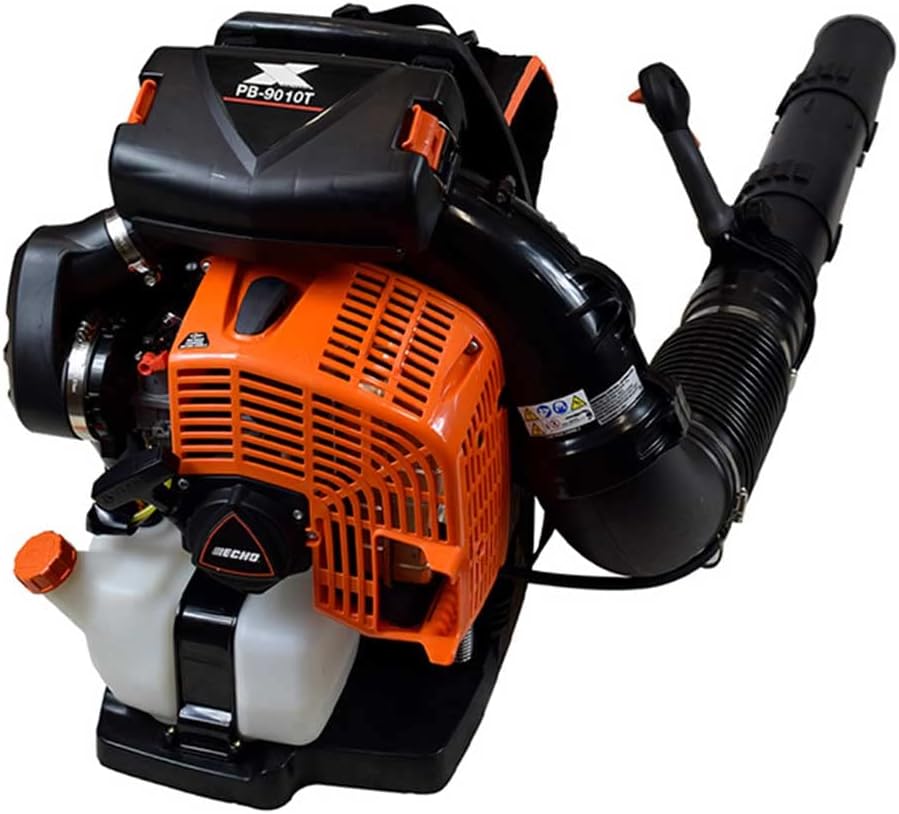
| Power Source | gasoline-powered |
|---|---|
| Form Factor | Backpack |
| Additional Features | Throttle Lock |
| Noise Level | 48 db |
| Maximum Speed | 220 miles_per_hour |
The ECHO PB-9010T X Series is a professional-style backpack blower built for heavy yard work and extended runs. Its 79.9 cc two-stroke engine produces up to 220 mph airspeed and a high airflow so you can move large piles of leaves, debris, and grass clippings quickly. The backpack form factor distributes the engine weight across the shoulders and hips for longer use than handheld units, and the tube-mounted throttle plus throttle lock help maintain a steady output during repetitive jobs. Practical benefits include strong clearing power for lawns, driveways, and beds and a design aimed at home users who need commercial-level performance. Limitations are the usual ones for gas backpack blowers: it requires fuel mixing and periodic engine maintenance, it is heavier and louder than electric alternatives, and it may be overkill for very small yards or infrequent light tasks.
Best for: Homeowners who need a reliable, high-power blower for frequent or large-area cleanup and who prioritize continuous performance over minimal maintenance.
Less Ideal for: Casual users with small yards, those who prefer low-maintenance electric equipment, or anyone seeking the quietest option for noise-sensitive neighborhoods.
- High reported maximum speed of 220 mph for strong clearing power
- Backpack form factor for longer, more comfortable operation than handheld blowers
- Tube-mounted throttle with throttle lock for steady speed control during extended use
- Gasoline power allows untethered operation and sustained output for large properties
- Requires fuel mixing and routine engine maintenance inherent to two-stroke gas engines
- Heavier and louder than electric or battery backpack models
- Likely more power than needed for very small yards or occasional use
Verdict: Buy this if you want a dependable, high-speed gas backpack blower that handles large yards and frequent heavy-duty cleanup.
HASANEN 850CFM Backpack Gas-Powered Leaf Blower (63CC, 2-Stroke)

| Power Source | Gas Powered |
|---|---|
| Form Factor | Backpack |
| Additional Features | Adjustable Speed |
| Noise Level | 101 db |
| Maximum Speed | 6800 rpm |
This HASANEN backpack leaf blower pairs a 63CC two-stroke engine with a backpack harness to deliver strong, continuous airflow for heavy clearing tasks. It is typically used for blowing leaves, grass clippings, light gravel, and even light snow across yards, driveways, and commercial grounds. Notable features include an adjustable nozzle angle for wider coverage, a large 0.47 gallon fuel tank for longer run times between refills, an adjustable throttle with a cruise/constant-speed switch, and breathable padded straps and backrest to reduce operator fatigue. Practical benefits are high clearing power and the ability to work longer stretches without frequent refueling, plus one-hand control that makes directional adjustments easier. Important limitations are the two-stroke gasoline engine that requires fuel mixing and produces noise around 101 dB, and a backpack form factor that is heavier to carry than handheld models and requires basic maintenance. For buyers focused on raw clearing performance on a budget, this unit gives strong power and useful features but comes with the usual maintenance and noise of gas engines.
Best for: Buyers who need a high-power, budget-friendly backpack blower for frequent heavy clearing on yards or commercial grounds and who are willing to handle basic gas-engine maintenance.
Less Ideal for: Those who prioritize quiet operation, zero-emissions use, or minimal maintenance should look at electric or battery models instead.
- High power 63CC two-stroke engine rated 2.7 kW for fast clearing of leaves and light debris
- Large 0.47 gallon fuel tank supports longer run time between refills
- Adjustable nozzle angle and hose make it easier to reach wider or awkward areas
- Backpack harness with padded straps and ventilated backrest reduces operator fatigue
- One-hand control with constant-speed switch simplifies sustained use
- Two-stroke gas engine requires fuel/oil mixing and routine maintenance
- Loud operation at about 101 dB makes hearing protection necessary
Verdict: If you want maximum clearing power on a budget, this backpack gas blower delivers strong airflow and long run time for heavy yard and commercial work.
RedMax EBZ9000-RH Backpack Blower

| Model Number | EBZ9000-RH |
|---|---|
| Brand Name | RedMax |
| Blow Force | 56 N |
| Runtime Benefit | Up to 25% longer runtime than competitors |
| Throttle Type | Tube-mounted throttle |
The RedMax EBZ9000-RH is a commercial-grade backpack blower designed to push large volumes of debris with industry-leading blow force. It uses a Strato-charged high-performance engine and an autotune-controlled carburetor to deliver strong, consistent airflow while the large fuel tank and efficient tuning extend runtime for long shifts. The tube-mounted throttle, adjustable right handle, padded harness with waist belt, ventilated back pad, and LowVib anti-vibration system make it comfortable to use for extended periods and reduce operator fatigue. Maintenance is easier thanks to an integrated service port and a commercial-grade air filter that should hold up under heavy use. This unit is clearly built for frequent, demanding jobs, but buyers should expect a professional tool-level price and belt/harness fit may require adjustment for different operators. It is most appropriate where raw power, runtime, and serviceability matter more than light recreational use.
Best for: Designed for landscape professionals and facilities crews who need dependable, high-power performance and longer runtimes for frequent large-area cleanup.
Less Ideal for: Not a good fit for occasional home users or small yards who would be better served by a lighter handheld or cordless model.
- Very high blow force suitable for heavy-duty cleanup
- Autotune carburetor and large fuel tank for longer, consistent runtime
- Comfort features including LowVib anti-vibration, padded harness, waist belt, and ventilated back pad
- Service-friendly design with integrated service port and commercial-grade air filter
- Professional-level tool with a higher upfront cost than consumer blowers
- Backpack format requires proper harness adjustment and occasional operator acclimation
Verdict: Choose the EBZ9000-RH when you need the most reliable, highest-power backpack blower for heavy commercial cleanup tasks.
PROYAMA 72cc Gas Backpack Leaf Blower (880 CFM, 275 MPH)
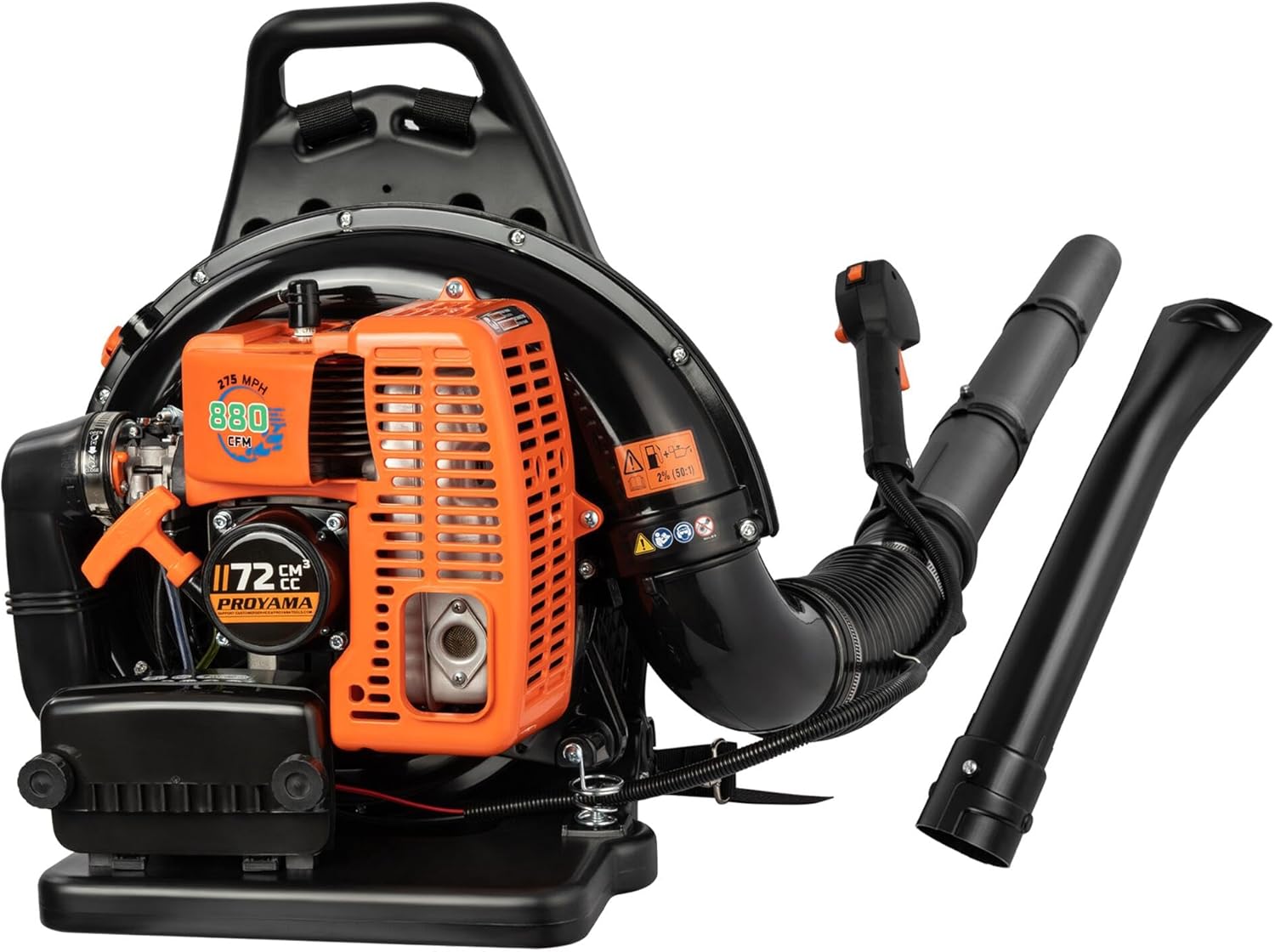
| Power Source | Gas Powered |
|---|---|
| Form Factor | Backpack |
| Air Flow Capacity | 880 cfm |
| Speed | 275 miles_per_hour |
The PROYAMA 72cc backpack leaf blower brings commercial-level airflow and a harnessed design that keeps long jobs manageable. Its 72cc two-cycle engine produces strong airflow (up to 880 CFM and 275 MPH) and a self-throttle lock with cruise control helps maintain a steady speed without constant trigger pressure. Two interchangeable nozzles, flat and round, make it easy to switch between concentrated blasts for stuck debris and wider coverage for loose leaves. The padded harness, hip belt, and ventilated backrest improve comfort during multi-hour use, while the variable speed control lets you dial power to the task to save fuel and reduce noise. Practical features include an accessible air filter and a low-vibration design that reduce operator fatigue and maintenance time. Downsides are typical of gas backpack units: there is engine noise and vibration compared with battery models and it requires fuel mixing and routine engine upkeep. For users who need sustained high power for large yards or commercial jobs, this unit delivers the capacity and endurance required.
Best for: Gardeners and landscapers who need sustained high power for large yards or commercial jobs and prioritize runtime and raw clearing performance over cordless convenience.
Less Ideal for: Small-plot owners, balcony gardeners, or noise-sensitive neighborhoods where an electric or battery blower would be quieter and lower maintenance.
- High airflow and speed (880 CFM, 275 MPH) for moving heavy or wet debris
- Backpack harness with padded straps, hip belt, and ventilated backrest for extended comfort
- Variable speed throttle with cruise control to maintain consistent output and reduce operator fatigue
- Two nozzles (flat and round) for focused or wide-area clearing and improved versatility
- Gas engine requires regular maintenance and fuel mixing
- Louder and higher vibration profile compared with battery-powered blowers
Verdict: Choose this PROYAMA backpack blower when you need continuous, commercial-grade blowing power and comfort for large-scale leaf and debris clearing.
Husqvarna 150BT 51cc Gas Backpack Leaf Blower

| Power Source | Gas Powered |
|---|---|
| Form Factor | Backpack |
| Air Flow Capacity | 765 cfm |
| Maximum Speed | 270 miles_per_hour |
| Additional Features | Adjustable Speed |
The Husqvarna 150BT is a gas-powered backpack leaf blower built for large yards and frequent clearing jobs. Its 51 cc 2-cycle engine produces up to 765 CFM and 270 MPH, which moves heavy or wet leaves quickly while the padded harness, hip belt, and weight-leveling system help distribute load for longer use. Variable speed throttle with cruise control lets you hold a steady speed without constant throttle input, and the air purge feature makes starting easier after refueling. In practice this blower is best for contractors or homeowners with many trees or large properties who need sustained blowing power and durability. Expect steady high performance and fewer passes on dense debris, but plan for routine maintenance typical of gas engines such as fuel mixing, spark plug checks, and quieter alternatives if noise or emissions are a concern. It comes with basic assembly items and a user manual so you can start using it right away.
Best for: Buyers who need sustained, professional-level blowing power for large yards or frequent heavy cleanups and who prioritize performance and durability over low-maintenance convenience.
Less Ideal for: Small-lot owners, noise-sensitive neighborhoods, or users who prefer low-emissions, low-maintenance electric or battery blowers.
- High clearing power: up to 765 CFM and 270 MPH for moving heavy or wet debris quickly.
- Ergonomic backpack harness with padded straps, hip belt, and weight-leveling for extended comfortable use.
- Variable speed throttle with cruise control for consistent operation without constant hand input.
- Air purge system to simplify starting after refueling and reduce pull-start issues.
- Gas engine requires regular fuel mixing and routine maintenance.
- Louder and higher-emission operation compared with electric or battery models.
Verdict: Choose the Husqvarna 150BT when you need professional backpack blower power and an ergonomic harness to clear large properties quickly.
Choosing the Right Industrial Leaf Blower: Key Factors to Consider
Airflow and Velocity
Airflow rating and air velocity determine how quickly a blower moves leaves, wet debris, and heavier garden waste. Higher cubic feet per minute moves more material, while higher velocity helps break piles apart and move damp clumps. For industrial work you want a unit with sustained airflow under load rather than brief peak numbers.
Look for clear published specs and, where possible, independent test data. Consider the type of debris you handle: large wet piles need more velocity, while scattered light material can be handled with higher volume at lower velocity.
Durability and Construction
Industrial blowers see long hours and rough handling, so materials and construction matter. Metal-reinforced housings, heavy-duty impellers, and sealed bearings extend service life compared with thin plastics. Fastener quality and protective grills also affect how well the unit survives frequent transport and commercial use.
Durability also ties to ingress protection against dust and moisture. If you work in salty coastal conditions or dusty job sites, choose a blower built to resist corrosion and with components that are easy to inspect and replace.
Operator Comfort and Ergonomics
When crews run blowers for hours, vibration damping, harness options, weight distribution, and throttle placement change fatigue levels dramatically. Padded straps, anti-vibration mounts on backpack models, and balanced center of gravity reduce strain on shoulders and back.
Noise control feeds into comfort as well. Lower-decibel machines still require hearing protection, but models engineered to reduce vibration and noise can cut overall crew fatigue and improve communication on site.
Serviceability and Parts Availability
Industrial equipment is a long-term investment; easy access to common service points shortens downtime. Design features like removable covers, straightforward carburetor or motor access, and common fastener sizes speed routine maintenance.
Check that replacement parts such as impellers, filters, belts, and starter components are available through professional channels. Units with clear service manuals and modular components typically cost less in labor over their service life.
Power Source and Fuel Efficiency
Industrial blowers come in gas, electric, or hybrid forms, and each has tradeoffs for runtime, refueling logistics, and emissions. Gas units often deliver higher sustained power for large jobs but require fuel management, more maintenance, and produce emissions. Electric or battery systems can reduce local emissions and maintenance but may need battery swaps or access to power for extended jobs.
Consider the typical duration and location of work. Sites without easy refueling or charging benefit from longer runtime options or hybrid workflows that allow quick battery swaps or portable generators.
Noise and Emissions Compliance
Many commercial sites have local noise ordinances or strict emissions rules for equipment. A blower that meets decibel limits and emission standards reduces the risk of citations and community complaints. Manufacturers sometimes provide measured sound output at operator position and emissions ratings for regulated engines.
If you operate in noise-sensitive areas, look for models with muffling design, lower RPM tuning, or electric options. Emissions controls and two- or four-stroke engine choices affect both compliance and long-term operating costs.
Matching Blower Type to Job Scope
Industrial options include backpack, handheld, and towable/standalone high-output units. Backpack models give mobility for spot-clearing and landscaped areas. Standalone or towable blowers fit large open grounds, airports, or municipal spaces where a single high-output source is needed.
- Backpack units trade raw peak power for movement flexibility and access to tight areas.
- Towable or skid-mounted blowers deliver the highest sustained CFM for large open spaces.
- Handheld high-power options work for sidewalks and smaller parking areas where crew maneuverability matters.
Routine Maintenance Tips for Longevity
Establish a short daily and a more detailed weekly checklist. Daily tasks should include air intake inspection, quick filter cleaning or replacement checks, and verifying fasteners and straps. Weekly or monthly tasks should cover spark plug inspection, impeller checks, and lubrication of accessible bearings where applicable.
- Keep a tool kit with common fastener sizes specific to the blower design.
- Label fuel lines and filters by service interval to reduce guesswork.
- Train staff on safe start and shut-down sequences to avoid premature wear.
Managing Noise and Neighbor Concerns
Plan loud tasks during times least likely to upset neighbors and use lower-noise settings when possible. For jobs in noise-sensitive zones, consider electric alternatives or engines with sound-damping designs. Portable acoustic barriers or strategic positioning can also reduce perceived noise on adjacent properties.
- Use controlled start sequences to avoid sudden loud bursts of sound.
- Rotate quieter tasks into morning shifts and reserve high-power clearing for midday.
Storage and Transport Best Practices
Secure the blower to prevent movement during transport and store in a dry, ventilated area to limit corrosion. Drain or stabilize fuel for long-term storage and follow the manufacturer guidance for battery storage to preserve cell life. For fleet management, assign serial numbers and log hours to predict maintenance windows.
- Keep spare impellers and common filters on hand for quick swaps.
- Store harnesses and straps laid flat to prevent creasing and wear.
Using Blow Techniques That Save Time
Work with wind direction and use staged passes: a low-power pass to loosen material followed by a higher-velocity pass to push debris into piles. For wet or compacted debris, break up material first with a rake or broom before using the blower to reduce strain on the machine and improve clearing time. Team workflows also speed large jobs: one operator concentrates on pile creation while another moves piles to collection points or debris bins.
- Avoid blasting at close range which can scatter debris and increase cleanup time.
- Use nozzle attachments or concentrators to boost velocity for stubborn patches.
How We Chose the Best Industrial Leaf Blower
We focused on tools designed for continuous, heavy-duty clearing rather than occasional homeowner models. Selection began with industrial-class units that list sustained high airflow and robust construction as core design goals. From that pool we prioritized machines with proven airflow ratings and construction materials suited to commercial use. Our evaluation emphasized measurable, gardener-relevant performance metrics: sustained airflow and velocity, overall durability and serviceability, operator comfort for extended shifts, and fuel or power efficiency under load. We excluded lightweight consumer-grade blowers, battery-only lawn models not rated for continuous commercial duty, and units lacking accessible service parts. We also considered noise and emissions where data were available, since these affect site compliance and crew comfort. Final picks balance raw clearing power with long-term maintainability and operator ergonomics to suit property managers, landscapers, and grounds crews.
FAQ
Which power source is best for continuous industrial use?
Gas engines usually provide the longest continuous runtime and highest sustained power, which suits large sites without charging infrastructure. Electric and battery systems reduce onsite emissions and noise but may require battery swaps or external charging for extended shifts.
How loud are industrial blowers and how can I reduce noise?
Industrial blowers can be quite loud, often requiring hearing protection. To reduce noise, choose models with muffling designs, run at lower RPM when possible, schedule noisy tasks thoughtfully, and consider electric options in noise-sensitive areas.
What maintenance tasks should be done daily?
Daily tasks include inspecting air intakes and filters, checking that fasteners and straps are secure, and doing a visual inspection of impellers and fuel lines. These quick checks prevent small issues from becoming service failures during jobs.
Can I use an industrial blower near planted beds or delicate landscaping?
Yes, but use lower-power settings and keep the nozzle angled away from soil and shallow-rooted plants. Work gradually and consider hand tools for areas with delicate plants to avoid uprooting or soil erosion.
How do I transport and store industrial blowers to prolong life?
Transport units securely to avoid impact damage and store in a dry, ventilated area. Drain or stabilize fuels for long storage and follow battery storage best practices. Regularly log usage hours to plan preventive maintenance.
Final Verdict
Choose an industrial leaf blower by matching the unit type and power source to the scale and duration of your work. Prioritize sustained airflow and durable construction for heavy cleanup, then factor in operator comfort and serviceability to lower long-term costs. Tradeoffs are inevitable: higher raw power often means more maintenance and noise, while quieter or electric choices may need more logistical support for runtime. Focus on the few criteria that matter most for your sites and crews to make a confident choice.
