

Note: This article contains affiliate links. If you click on these links and make a purchase, I may earn a small commission at no extra cost to you. This helps support my research and content. Read my full affiliate disclosure here.
A leaf blower for residential use can save hours of raking and make routine yard cleanup far faster. In a home setting you need a tool that balances enough blowing power to move wet leaves with low noise and easy handling for driveways, beds, and small lawns. This guide covers seven shortlisted options that fit typical residential needs and spaces. We evaluated each blower on real-world priorities like airflow and noise, plus ergonomics and durability. Below you will find practical notes to help you match a blower to the size of your yard and your local noise expectations before the product list.
Top Picks at a Glance
| Best Overall The best all-around choice for most situations | Greenworks 80V Cordless Axial Leaf Blower with 2.5Ah Battery and Charger |  |
| Best Quality Built to a higher standard if you want something more solid | DEWALT 20V MAX XR Cordless Handheld Leaf Blower (Tool Only, DCBL722B) |  |
| Best Value The sweet spot between price and what you get | WORX WG520 600 CFM Turbine Corded Electric Leaf Blower |  |
| Best Budget The cheapest option that still gets the job done reliably | Sun Joe SBJ597E Corded Electric Leaf Blower, 6-Amp |  |
| Highest Rated A top-rated pick with lots of positive feedback | KOVDON LP69 Cordless 21V Leaf Blower with Two Batteries and Fast Charger |  |
| Most Popular A crowd favorite that many people choose with confidence | BLACK+DECKER LB700 7-Amp Corded Handheld Leaf Blower |  |
| Best Seller A high-volume bestseller chosen again and again | VIBOGEN HG0645 21V Cordless Handheld Leaf Blower with Dual 4.0Ah Batteries |  |
Greenworks 80V Cordless Axial Leaf Blower with 2.5Ah Battery and Charger

| Power Source | Battery Powered |
|---|---|
| Voltage | 80 volts |
| Air Flow Capacity | 700 cfm |
| Noise Level | 74 db |
| Additional Features | Adjustable Speed, Turbo |
The Greenworks 80V Axial Blower aims to replace gas models by pairing a brushless 80V motor with an included 2.5Ah battery and rapid charger to deliver up to 700 CFM airflow and 170 MPH wind speed. It is used like a typical handheld blower for clearing leaves, light snow, driveway debris, and gutters, with variable speed, cruise control, and a Turbo mode that bumps power for stubborn, compacted material. The brushless motor and cordless design mean quieter operation and less maintenance than gas units, and compatibility with Greenworks 80V batteries gives flexibility if you own other tools in the ecosystem. Practical benefits include strong airflow for large yards, cruise control for less hand fatigue during long runs, and a tapered nozzle to focus air for targeted clearing. Limitations are expected runtime reductions at high power or Turbo mode on the 2.5Ah battery, and heavier users should plan to buy higher-capacity batteries for extended commercial-style work; it also remains a handheld tool, which can be tiring on very large properties compared with backpack blowers.
Best for: Homeowners who prioritize performance and want gas-level clearing power without the noise and maintenance of gas engines, especially for large yards and seasonal heavy leaf cleanup.
Less Ideal for: Buyers who need continuous, all-day commercial use without swapping batteries or those who prefer lighter-duty, infrequent yard care where lower-power cordless models would suffice.
- High airflow and speed: 700 CFM and 170 MPH handle dense debris and wet leaves effectively
- Brushless 80V motor: more torque and longer motor life compared with brushed designs
- Variable speed with cruise control and Turbo mode for precise control or extra power on demand
- Includes 2.5Ah battery and 4A rapid charger and is compatible with Greenworks 80V ecosystem
- 2.5Ah battery limits full-power runtime so heavier jobs may need additional batteries
- Handheld form can be tiring over very long sessions compared with backpack blowers
Verdict: If you want near-gas power in a cordless blower for serious home yard work, this 80V Greenworks delivers strong airflow, useful controls, and battery ecosystem flexibility.
DEWALT 20V MAX XR Cordless Handheld Leaf Blower (Tool Only, DCBL722B)

| Power Source | Battery Powered |
|---|---|
| Voltage | 20 volts |
| Air Flow Capacity | 450 cfm |
| Maximum Speed | 125 miles_per_hour |
| Noise Level | 66 db |
The DEWALT 20V MAX XR handheld blower is a lightweight cordless tool designed for routine homeowner cleanup like clearing leaves, grass clippings, and light debris from driveways, patios, and lawns. Its brushless motor and axial fan design deliver up to 450 CFM and 125 MPH with the concentrator nozzle, which gives strong directed airflow for moving wet or compacted debris. The variable-speed trigger and lock let you dial power to the task and preserve battery life when you do not need full blast. At roughly the size of other handheld 20V tools, it is easy to maneuver and causes less arm fatigue during short to medium sessions. Noise is relatively low for a blower of this class, making it better suited for suburban neighborhoods. Important limitations are that this listing is tool-only so you must supply a compatible 20V battery and charger, and runtime will depend on the battery chosen. For homeowners who want a reliable, easy-to-control cordless blower for everyday yard tasks, this model balances power and portability well.
Best for: Homeowners who prioritize a dependable, easy-to-use cordless blower for routine yard cleanup and who prefer a quieter, lightweight tool they can control precisely.
Less Ideal for: Property owners who need long continuous runtimes for large acreage or commercial landscapers who require integrated battery and charger packages.
- Strong airflow for a 20V handheld unit with up to 450 CFM and 125 MPH with concentrator nozzle
- Brushless motor for improved efficiency and longer motor life
- Variable-speed trigger with speed lock for precise power control and battery conservation
- Lightweight ergonomic design reduces arm fatigue during typical homeowner use
- Relatively low noise level for quieter operation in residential areas
- Sold as tool-only so battery and charger are not included
- Runtime varies by battery and may be limited for extended heavy-duty jobs
Verdict: A compact, easy-to-control cordless blower that delivers homeowner-grade power and quieter operation for everyday yard cleanup.
WORX WG520 600 CFM Turbine Corded Electric Leaf Blower

| Power Source | Corded Electric |
|---|---|
| Air Flow Capacity | 600 cfm |
| Maximum Speed | 110 miles_per_hour |
| Additional Features | Adjustable Speed, One-hand Operation |
The WORX WG520 is a corded, handheld leaf blower built for homeowners who want steady, no-fuss power for regular yard maintenance. Its 12 amp motor and TURBINE fan design produce up to 600 CFM and 110 MPH, which moves leaves, grass clippings, and light debris quickly across lawns, driveways, and patios. Two-speed variable control lets you dial back airflow for detail work near flowerbeds and boost it for open areas or larger piles. The tapered hyper-stream nozzle focuses airflow for stronger pushing power while the lightweight, one-hand design reduces fatigue during longer sessions. Because it is corded, you get continuous run time without battery swaps or gas maintenance, though the cord limits reach compared with cordless or gas models. It is quieter than many gas blowers and simple to start and maintain. If you need a reliable, high-airflow blower for routine seasonal cleanup and everyday yard tasks, the WG520 balances performance and ease of use effectively.
Best for: Buyers who prioritize dependable, high-airflow performance for regular yard cleanup and want a low-maintenance tool that runs continuously without charging or fuel.
Less Ideal for: Those who need cordless portability for large properties or professionals who require the extended range and run-time of gas-powered units.
- High maximum airflow (600 CFM) for fast clearing of leaves and debris.
- Two-speed variable control for precise low-speed work and high-power clearing.
- Continuous corded power avoids battery charging and gas maintenance.
- Hyper-stream tapered nozzle concentrates airflow for stronger pushing force.
- Lightweight one-hand design reduces user fatigue for longer tasks.
- Cord restricts reach and requires access to an outdoor outlet for extended areas.
- Not suitable where cordless portability or gas-level range is required.
- Heavier yard tasks like blowing very wet, heavy debris may require multiple passes.
Verdict: Choose the WG520 if you want a powerful, low-maintenance corded blower that clears leaves quickly with reliable continuous power.
Sun Joe SBJ597E Corded Electric Leaf Blower, 6-Amp

| Power Source | Corded Electric |
|---|---|
| Voltage | 120 volts |
| Air Flow Capacity | 260 cfm |
| Maximum Speed | 155 miles_per_hour |
| Form Factor | Handheld |
The Sun Joe SBJ597E is a compact corded electric leaf blower designed for quick, everyday outdoor cleanup. It is used primarily for sweeping leaves and light debris from patios, driveways, decks and small lawns. The 6-amp motor produces a maximum airspeed of 155 MPH and an airflow of 260 CFM, which is strong enough to move dry leaves and grass clippings without complicated setup. Its handheld form factor and 3.9 pound weight make it easy to carry and maneuver for short jobs, and the instant-start corded design means you do not worry about batteries or recharging. Notable features include an anti-vibration design and included front and rear blower tubes for focused airflow. Practical benefits are straightforward: low maintenance, consistent power for as long as you stay connected to an outlet, and fast cleanup for small- to medium-sized properties. Important limitations are its corded power source, which restricts range, and modest CFM that may struggle with heavy, wet debris or large yards where a higher-capacity machine would be faster.
Best for: Buyers who want an inexpensive, no-fuss blower for quick cleanup around patios, driveways and small yards and who prioritize low weight and steady corded power over long range.
Less Ideal for: Homeowners with large properties, heavy wet leaves, or who need cordless mobility should consider more powerful or battery/backpack models instead.
- Lightweight handheld design (3.9 lb) that reduces fatigue during short sessions
- Consistent corded power for unlimited run time while plugged in
- 260 CFM airflow and 155 MPH speed suitable for moving dry leaves and small debris
- Anti-vibration construction and instant-start operation for simple, comfortable use
- Corded operation limits reach and requires an extension cord for larger yards
- Airflow and power are modest compared with backpack or higher-amp models, so heavy or wet debris can be difficult to clear
Verdict: A lightweight, budget-friendly corded blower that delivers dependable power for routine small-yard cleanup.
KOVDON LP69 Cordless 21V Leaf Blower with Two Batteries and Fast Charger

| Power Source | Battery Powered |
|---|---|
| Voltage | 21 volts |
| Air Flow Capacity | 420 cfm |
| Noise Level | 85 db |
| Wattage | 36 watt-hours |
The KOVDON LP69 is a compact cordless leaf blower designed for quick, everyday yard and patio cleanup. It ships with two 21V 2.0Ah batteries and a fast charger so you have immediate backup power; each battery takes about an hour to charge and the pair deliver up to roughly 20 minutes of combined runtime in typical use. The blower produces up to 420 CFM and air speeds around 150 MPH, with a detachable long and short tube for reaching edges or working in tighter spots. At about 4 pounds it is comfortable for one-handed operation and the textured grip and simple tube connections make assembly and storage straightforward. Practical benefits include cordless convenience for driveways, decks, and walkways and the spare battery reduces downtime during multi-zone cleanup. Important limitations are the relatively short runtime for extended jobs and a plastic construction that is typical at this price point, so it is best for light-to-moderate seasonal tasks rather than heavy professional use.
Best for: Buyers who prioritize dependable, ready-to-use cordless cleanup for small-to-medium yards and value having a spare battery to keep short sessions moving without long downtime.
Less Ideal for: People who need long continuous runtime or professional-grade durability for large properties should consider higher-capacity or commercial units instead.
- Comes with two 21V 2.0Ah batteries and a fast charger for immediate backup power
- Delivers up to 420 CFM airflow and about 150 MPH air speed for effective leaf and light debris clearing
- Lightweight design at approximately 4 pounds enables comfortable one-handed use
- Detachable long and short tubes offer flexibility for open areas and tight spots
- Combined runtime of around 20 minutes is limited for larger yards or prolonged tasks
- Plastic construction and consumer-grade components are not intended for heavy professional use
Verdict: Includes two batteries and a fast charger so you can rely on quick, cordless cleanup for routine yard and patio tasks without long waits between uses.
BLACK+DECKER LB700 7-Amp Corded Handheld Leaf Blower

| Power Source | Corded Electric |
|---|---|
| Form Factor | Handheld |
| Air Flow Capacity | 180 cfm |
| Speed | 180 miles_per_hour |
| Included Components | (1) LB700 blower, (1) Blow tube |
The BLACK+DECKER LB700 is a compact, corded handheld leaf blower built for fast, one-handed cleanup around yards, driveways, and patios. Its 7-amp motor produces air speeds up to 180 mph and an airflow rating of 180 cfm, which powers away leaves, small twigs, and grass clippings without dragging out larger equipment. At about 4.4 pounds the unit is easy to maneuver for extended periods and the included blow tube focuses airflow for more effective clearing. Built-in cord retention helps avoid accidental unplugging during use. The corded design means continuous runtime and steady power but requires access to an outlet or extension cord and limits mobility compared with battery models. The blower is best for homeowners who want a reliable, lightweight tool for routine debris removal rather than heavy-duty property maintenance. Controls are straightforward and the simple construction keeps maintenance minimal, though users seeking variable speed or vacuum/mulch features will need a different model.
Best for: Buyers who prioritize a proven, easy-to-use blower for routine cleanup and want a lightweight tool backed by many user experiences and reliable performance.
Less Ideal for: Large properties or users who need cordless mobility, adjustable speeds, or a vacuum/mulch combination in a single machine.
- Lightweight 4.4 lb design makes one-handed use and longer sessions comfortable
- 7-amp motor with up to 180 mph and 180 cfm moves leaves and debris quickly
- Cord retention prevents accidental unplugging during use
- Simple, no-frills operation with minimal maintenance
- Corded power limits range and requires an extension cord for larger yards
- No variable speed control or vacuum/mulching function
Verdict: A light, well‑known corded blower that delivers strong airflow for fast, no‑frills yard cleanup.
VIBOGEN HG0645 21V Cordless Handheld Leaf Blower with Dual 4.0Ah Batteries
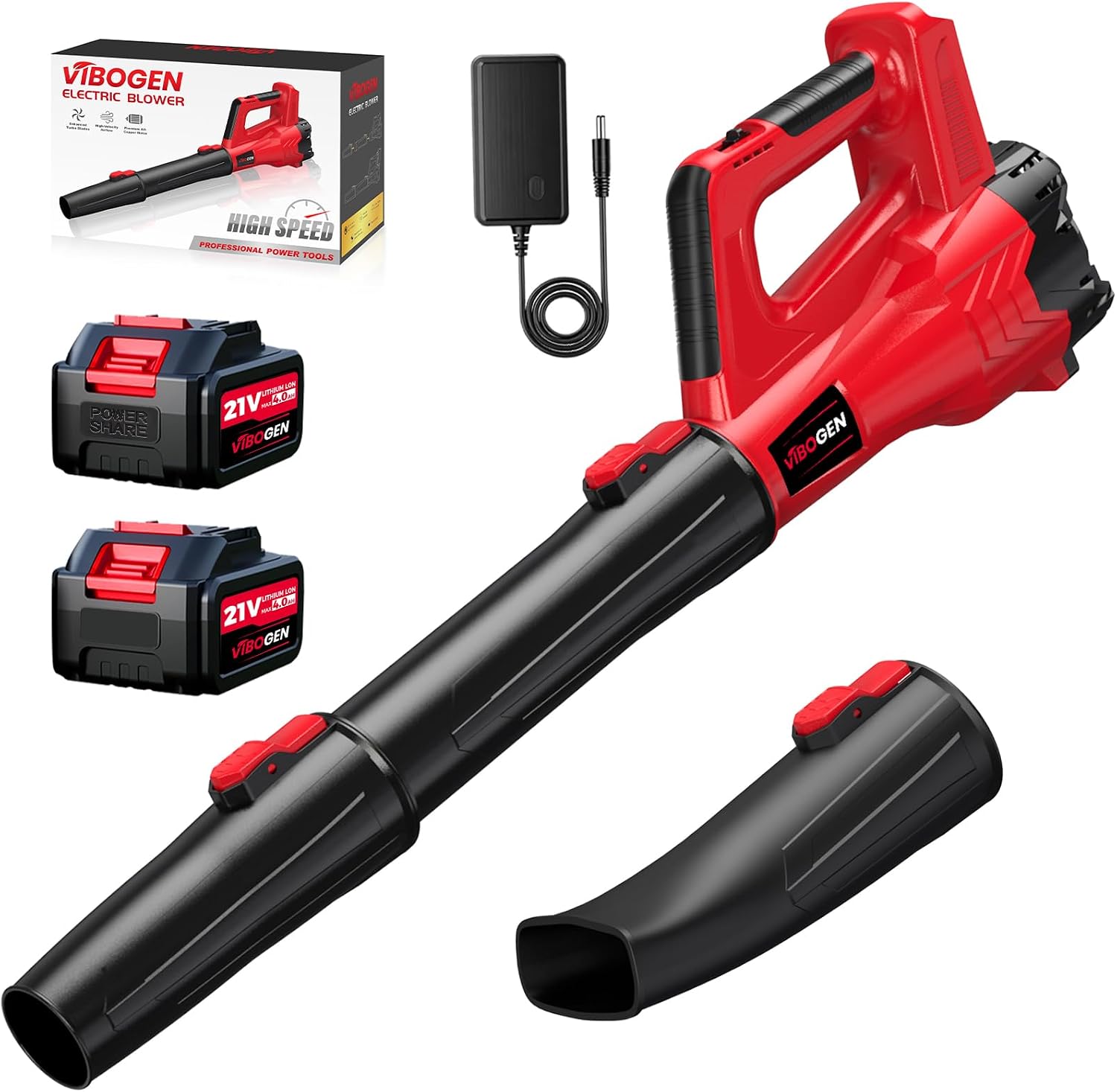
| Power Source | Battery Powered |
|---|---|
| Voltage | 21 volts_of_direct_current |
| Air Flow Capacity | 420 cfm |
| Noise Level | 75 db |
| Included Components | Battery, Charger, Extension Nozzle |
The VIBOGEN HG0645 is a compact cordless blower built for routine residential cleanup. It produces up to 420 CFM and 150 MPH, and offers two speed settings so you can switch between gentle dusting and stronger leaf removal. The kit includes two 21V 4.0Ah batteries and a charger, which extends runtime compared with single-battery kits and reduces interruptions during medium-length jobs. At roughly 2.7 pounds (tool only) it is easy to hold and maneuver around patios, driveways, decks, and cars, and the interchangeable round and flat nozzles help concentrate or widen airflow depending on the task. Noise is moderate at 75 dB on the specification sheet, so it is suitable for neighborhood use when used with hearing protection. Practical limits are runtime for heavy, prolonged clearing and performance on wet, matted leaves or large volumes—this unit is optimized for light-to-moderate residential use rather than commercial properties. Build materials are standard plastic, so treat the blower accordingly and store indoors when not in use.
Best for: A homeowner who wants a lightweight, easy-to-use cordless blower for regular yard maintenance and values reliability supported by many positive user reviews.
Less Ideal for: Landscapers or property owners with large lawns and frequent heavy blow-off needs should look at backpack or higher-capacity commercial blowers instead.
- Strong airflow for a handheld cordless unit at 420 CFM and 150 MPH for quick clearing of leaves and debris
- Two 21V 4.0Ah batteries included to extend runtime and reduce mid-job interruptions
- Lightweight handheld design that reduces arm fatigue for quick cleanup jobs
- Two speed settings and interchangeable nozzles provide flexibility for dusting or concentrated leaf removal
- Not designed for heavy commercial use or prolonged clearing of large yards
- Plastic construction requires careful storage to avoid weather damage
Verdict: A lightweight, easy-to-handle cordless blower with dual batteries and strong airflow that fits everyday residential cleanup needs.
Choosing the Right Leaf Blower for Residential Use: Key Factors to Consider
Airflow and Airspeed
Airflow and airspeed determine how effectively a blower moves different kinds of debris. Higher cubic feet per minute (CFM) helps cover wide areas quickly, while higher miles per hour (MPH) is better for loosening damp or compacted leaves. For residential yards, look for a balance: enough CFM to clear lawns and gutters without overspending on a machine designed for commercial loads.
Nozzle shape matters too. Concentrated nozzles increase airspeed for stubborn spots, while wider nozzles move more volume for open lawns. Consider whether you need variable power settings so you can dial back intensity for light cleanup and increase it for mornings after rain.
Noise Output and Vibration
Noise matters in neighborhoods and for personal comfort. Gas blowers typically run louder than electric models, and some battery blowers have designs that reduce perceived noise. Check published decibel ratings and favor models with lower measured dB at the operator position when quiet operation is important.
Vibration affects how long you can operate the blower without fatigue or numbness. Look for anti-vibration features and balanced designs. Lower vibration and quieter motors make it more likely you will use the blower regularly instead of avoiding it because it is unpleasant.
Power Source and Runtime
The power source determines runtime, refill or recharge habits, and everyday convenience. Corded electric models offer consistent power but restrict range and require an extension. Battery models give cordless convenience; check battery capacity and realistic runtime under load. For larger properties, runtime and fast-charging systems matter so you can finish tasks without long interruptions.
Gas models deliver continuous power for long jobs but need fuel, mixing in some two-stroke engines, and more maintenance. Consider how often you want to handle refueling and whether you have space to store fuel safely.
Ergonomics and Handling
How a blower feels in your hands affects control and fatigue. Weight distribution, grip shape, trigger placement, and the option for a shoulder strap or backpack configuration change how long you can comfortably use the tool. Lighter handheld units work well for small yards and tight spaces. For extended tasks, backpack or dual-handle designs reduce strain on wrists and shoulders.
Also check how easy it is to change between blowing modes or to attach accessories like vacuum kits or mulcher attachments. Controls that are reachable while operating let you adjust power quickly without stopping.
Maintenance and Build Quality
Maintenance frequency affects long-term ownership satisfaction. Gas models need spark plug and carburetor checks and air filter cleaning. Battery models require battery care, contact inspection, and occasional motor ventilation. Durable housings and sturdy nozzles resist cracking if the blower is used around patios and curbs.
Choose a blower with accessible service points and straightforward replacement parts. Models that require specialized tools or proprietary consumables will cost more in time and potentially money to keep running.
Attachments and Versatility
Attachments expand how you use the blower around a home. Mulching or vacuum kits turn a blower into a convenient leaf-collection tool. Concentrator nozzles, extension tubes, and variable-speed controls let you adapt the blower to gutters, tight beds, or open lawns.
Consider how easily attachments attach and detach, and whether they are included or available separately. Versatile systems reduce the number of tools you need to store and maintain.
Matching Blower Type to Yard Size
Small patios and tiny urban yards usually benefit from compact handheld or cordless models that are light and maneuverable. You trade some raw power for convenience, but you will use the tool more often if it is easy to lift and store.
Medium suburban yards often need a mid-range cordless or a lightweight gas unit that combines adequate airflow with manageable weight. Seek models that offer multiple speed settings so you can adjust for leaf volume and surface type.
Large properties or heavy leaf fall may justify backpack blowers for longer runtimes and sustained power. These are heavier to carry but reduce wrist strain and provide more consistent clearing capability across big areas.
- Handheld cordless: best for quick touch-ups and small lawns
- Corded electric: steady power for yard work near an outlet
- Backpack or gas: suited to large lawns and heavy debris
Quiet Operation Strategies
If noise is a concern, choose lower-decibel models and use lower power settings when possible. Sound levels drop significantly when you are a few yards away, so try to blow toward driveways rather than across property lines and schedule work during reasonable hours.
Maintain the blower and replace worn mufflers or vibration-damping parts as needed. Using a blower with a variable-speed trigger lets you avoid full power for light tasks, which reduces noise and conserves battery or fuel.
- Run on lower settings for light debris
- Do noisy tasks during daytime hours
- Keep the machine well maintained to prevent extra noise
Safety and Yard Care Best Practices
Wear eye protection and hearing protection when operating a blower. Loose debris can become projectiles and high-decibel noise can damage hearing over time. Gloves and sturdy footwear reduce the risk of slips when working on wet surfaces.
Avoid blowing leaves into storm drains or neighbor properties. Use the blower to consolidate leaves into piles for collection or to move them onto garden beds where they will not block drainage. Be mindful of fragile plants and avoid blasting directly at perennials or shallow-rooted shrubs.
- Use PPE: eye and hearing protection
- Direct debris toward safe collection areas
- Avoid prolonged blasting near plants and structures
Battery Care and Charging Tips
For battery-powered units, follow manufacturer guidelines for storage and charging to preserve battery life. Avoid leaving batteries fully discharged for long periods and store them in a cool, dry place. Fast chargers are convenient but repeated rapid charging can slightly shorten battery lifespan over many cycles.
Carry a spare battery if you have a larger yard or expect extended work sessions. Rotating batteries between use and storage keeps them at healthier charge levels and reduces interruptions during chores.
- Store batteries cool and dry
- Avoid long-term full discharge
- Consider carrying a spare for larger jobs
Using a Blower as Part of Yard Maintenance
A blower can be a useful seasonal tool beyond leaf cleanup. Use it to clear grass clippings from driveways after mowing, remove debris from patios before sealing, and clean gutters and downspouts when used with appropriate extensions. Treat the blower as one part of a broader maintenance routine.
Mulching leaves with a vacuum kit returns organic matter to beds and reduces waste. When mulching, work in thinner layers to avoid clogging and to produce a finer mulch that breaks down faster in the garden.
- Clear clippings and debris from hard surfaces
- Use vacuum/mulcher accessories for compostable output
- Employ extension tubes for gutters and tight spots
How We Chose the Best Leaf Blower for Residential Use
We focused on features that matter when choosing a leaf blower for residential use. Primary evaluation criteria included measured airflow and nozzle design to assess actual clearing capability across leaf types and lawn textures. Noise output and vibration were closely weighted because many homeowners must balance yard work with neighborhood noise limits and personal comfort. Battery runtime or fuel efficiency and recharge/refill practicality were important to ensure a model can complete typical residential chores without repeated interruptions. Ergonomics and weight affect how long you can operate the blower comfortably, so we considered handle shape, balance, and available shoulder or harness options. Durability and maintenance needs were checked to favor units that stand up to seasonal use and avoid frequent repairs. We excluded commercial-grade or heavy-duty landscape blowers that are oversized for home yards, plus any tools with poor safety features or unclear noise specifications. Models that required uncommon fuels or proprietary consumables were also filtered out. The final shortlist includes units that best match residential workflows across the listed criteria.
FAQ
Can a battery blower handle wet leaves?
Battery blowers can move damp leaves, but performance depends on airflow and battery power. Wet leaves need higher airspeed and more sustained power, so choose a unit with strong CFM and reserve battery capacity for tougher conditions.
Are corded electric blowers practical for residential yards?
Corded electric blowers are practical if your yard has good access to outlets and you can manage extension cords safely. They offer steady power without runtime limits but restrict how far you can reach from an outlet.
How loud is too loud for neighborhood use?
Acceptable noise depends on local ordinances and neighbor tolerance, but models with lower decibel ratings and adjustable power settings are easier to use without complaints. Aim for quieter options if you live close to neighbors or have noise restrictions.
When should I choose a backpack blower?
Choose a backpack blower if you regularly clear large areas or heavy leaf fall. They distribute weight across the shoulders and provide longer continuous power, which reduces fatigue compared with a heavy handheld unit for extended jobs.
Can blowers damage plants or soil?
High-powered air streams can displace mulch, loosen topsoil, or damage fragile plants if used improperly. Use lower settings near beds and point the nozzle to move debris away from root zones rather than blasting directly at plants.
Do leaf blowers require special maintenance?
Maintenance varies by power type. Gas models need periodic spark plug, filter, and carburetor checks. Electric and battery units require motor ventilation checks and battery care. Regular cleaning of air intakes and nozzles keeps performance consistent.
Final Verdict
When choosing a leaf blower for residential use, prioritize the combination of airflow and noise control that fits your yard and neighborhood. Smaller yards benefit from lightweight cordless or corded options that are easy to store and operate. For larger properties, focus on runtime and ergonomics to avoid fatigue during longer sessions. Balance the tradeoffs between raw power and convenience. Decide whether quieter operation or longer continuous use matters more for your routines, then pick a blower that matches those priorities and the maintenance commitment you are willing to make.
