

Note: This article contains affiliate links. If you click on these links and make a purchase, I may earn a small commission at no extra cost to you. This helps support my research and content. Read my full affiliate disclosure here.
When you need to apply compost, topdressing, or soil amendments evenly across a lawn or planting bed, the right dressing roller garden spreader makes the job faster and more consistent. Choosing the appropriate spreader affects how uniformly material is laid down, how much effort you expend, and whether delicate turf or seedlings are damaged by uneven application. This guide shortlists the top dressing roller garden spreaders and explains how we evaluated them for coverage, calibration ease, and durability. Use these picks and the evaluation notes to match a spreader to the size of your lawn, the type of dressing material, and how precise you need the application to be.
Top Picks at a Glance
| Best Quality Built to a higher standard if you want something more solid | Landzie 44-inch Compost Spreader Topdressing Roller |  |
| Best Value The sweet spot between price and what you get | VEVOR 24 in Compost and Peat Moss Spreader with Push/Tow Handle |  |
| Best Budget The cheapest option that still gets the job done reliably | 24" Compost Spreader Lawn Roller with 24-inch Steel Mesh Basket |  |
| Highest Rated A top-rated pick with lots of positive feedback | HAPPYGRILL 24" Compost Spreader with Height-Adjustable T-Handle |  |
| Most Popular A crowd favorite that many people choose with confidence | Landzie 36" Compost and Topdressing Spreader (Mesh Roller) |  |
| Best Seller A high-volume bestseller chosen again and again | Landzie 24" Compost and Peat Moss Spreader (Steel Mesh Roller) |  |
Landzie 44-inch Compost Spreader Topdressing Roller

| Capacity | 7.25 cubic feet |
|---|---|
| Material Type | Steel |
The Landzie 44-inch compost spreader is a walk-behind or towable topdressing roller built around a steel mesh drum that sifts and broadcasts compost, peat moss, topsoil, manure and similar materials. In use you load the hinged basket, clip in the long pole handle, then either push it across a lawn or hitch it to a mower or tractor for larger areas. The diamond-shaped mesh and tumbling action break up clumps and deliver consistent, uniform coverage so you avoid piles and reduce material waste. The powder-coated steel construction and double latch door make it feel sturdy and keep contents secure while turning. Practical benefits include much faster coverage than shoveling, reduced back strain, and an easy way to apply thin, even topdressing layers that improve seed contact and soil amendment distribution. Limitations are that very large bark nuggets or oversized debris will not pass the mesh and the unit is a manual device that still requires physical handling and occasional emptying for very large jobs.
Best for: Gardeners and lawn-care enthusiasts who prioritize efficient, even topdressing across medium to large lawns and want a durable tool that cuts spreading time compared with shoveling.
Less Ideal for: People needing to spread very coarse mulch or large bark pieces or those who want a fully motorized spreader that requires no manual handling.
- 44-inch mesh drum provides wide coverage for faster topdressing
- Diamond-shaped mesh and tumbling action break up clumps for uniform distribution
- Can be pushed by hand or towed behind a mower or tractor for flexible use
- Powder-coated steel construction and double latches keep the basket durable and secure
- Mesh size prevents very large chunks or coarse bark from passing through
- Requires manual loading and occasional stops to empty or clear material during long sessions
Verdict: Choose this spreader if you want a durable, wide 44-inch rotary roller that delivers fast, consistent topdressing by push or tow for performance-focused lawn care.
VEVOR 24 in Compost and Peat Moss Spreader with Push/Tow Handle

| Drum width | 24 inches |
|---|---|
| Capacity | 2.66 cu ft |
| Handle settings | 4 heights |
| Mesh hole size | 12 × 20 mm |
The VEVOR 24-inch compost spreader is designed to make topdressing and seeding faster on medium to large lawns and gardens. It can be pushed by hand for small or precise jobs or hooked to a trailer for faster coverage, and the four height settings help keep the handle comfortable during long runs. The 24-inch drum holds about 2.66 cubic feet, which cuts down on refills when spreading compost, peat moss, seed, fertilizer or sand. A precision mesh with small holes promotes even distribution and the powder-coated steel frame and thick handle aim to resist rust under normal outdoor use. Assembly is required and the unit is large enough that two people are recommended to put it together. It is a practical, no-frills tool that favors capacity and even spreading over lightweight portability, so expect a sturdy build but some effort to assemble and store.
Best for: Gardeners who prioritize getting topdressing and seeding done efficiently across medium to large lawns and who value capacity and even coverage over a lightweight, compact tool.
Less Ideal for: Those with very small yards, tight storage space, or anyone who needs an ultra-light, ready-to-use handheld spreader.
- Large 24-inch drum holds up to 2.66 cu ft to reduce refilling on big jobs
- Push or tow handle provides flexible use for precise or wide-area spreading
- Four adjustable handle heights improve ergonomics for different users
- Fine mesh with 12 × 20 mm holes delivers consistent, even material distribution
- Requires assembly that is easier with two people
- Sturdier steel construction makes it less compact and slightly heavier to maneuver
Verdict: Choose this spreader if you want a high-capacity, even‑spreading roller that speeds up topdressing and seeding on medium to large lawns.
24" Compost Spreader Lawn Roller with 24-inch Steel Mesh Basket
| Capacity | 2.7 cubic feet |
|---|---|
| Basket Length | 24 in |
| Material | Powder-coated steel |
| Handle Type | U-shaped ergonomic handle |
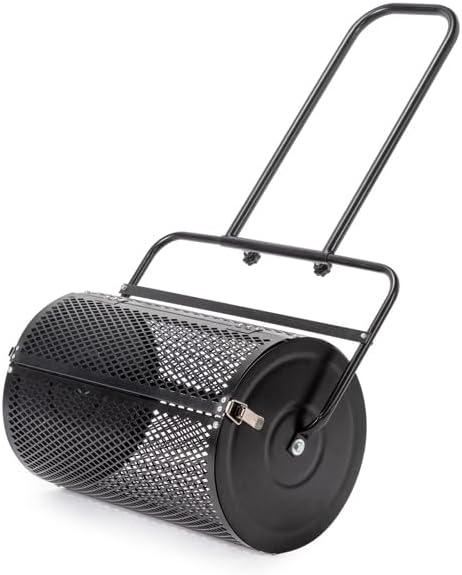
This 24-inch compost spreader is a simple, no-frills tool for topdressing and spreading compost, peat moss, seed, and similar materials. It uses a cylindrical steel mesh basket with 0.5 x 0.75 inch holes to meter material evenly as you push it by the ergonomic U-shaped handle or tow it behind a small trailer. The powder-coated steel construction and side latches aim to resist rust and keep the basket locked during rolling, while the hinged loading door and large 2.7 cubic foot capacity reduce refill trips on larger lawns. Assembly is straightforward and the unit breaks down with knobs for compact storage. Expect good coverage on level or moderately uneven turf, but the simple mesh metering means very fine or wet materials can clump or pass unevenly. It is a practical, budget-friendly option that trades advanced flow-control features for straightforward durability and a large load capacity.
Best for: Home gardeners and lawn owners wanting an affordable, hard-working spreader for routine topdressing and compost application across small to medium lawns.
Less Ideal for: Users who need precise, adjustable application rates for fertilizer or very fine seed mixes or who routinely work with excessively wet material should consider a spreader with calibrated flow controls.
- Large 2.7 cubic foot basket reduces the need for frequent refills
- Powder-coated steel mesh and frame resist rust and provide durability
- Dual push or tow-behind design adds flexibility for small or larger lawns
- Hinged filling door and side latches make loading and securing material easy
- Mesh metering can struggle with very fine or wet materials, causing clumping or inconsistent release
- Basic design lacks adjustable flow control for precise application rates
Verdict: A straightforward, budget-friendly 24-inch mesh roller that covers large areas quickly for topdressing and compost spreading.
HAPPYGRILL 24" Compost Spreader with Height-Adjustable T-Handle

| Capacity | 2.7 Cu.ft |
|---|---|
| Mesh opening size | 0.75" x 0.5" |
| Adjustable handle heights | 41", 43.5", 46.5" |
| Material | Metal |
This HAPPYGRILL compost spreader is built for straightforward, reliable topdressing of lawns, gardens, and small acreage. The 2.7 cu ft mesh basket and wide loading door let you fill with compost, peat, or topsoil and cover more ground between refills. As you roll, the 0.75" x 0.5" mesh helps break up clumps for consistent distribution, which reduces patchy spots and keeps applications even. The heavy-duty metal frame, triangular supports, and reinforced side latches give the unit a solid, durable feel during use and transport. The T-shaped handle adjusts to three heights and has an ergonomic, non-slip grip to reduce fatigue when treating larger areas. The handle is removable and stores inside the basket for compact storage. Expect assembly to be required and a relatively narrow product footprint when pushing over uneven ground; it is designed for spreading materials rather than broadcasting seed or granular fertilizer. For gardeners who want a stout, no-nonsense roller for regular topdressing, this spreader delivers consistent, low-maintenance performance.
Best for: Gardeners and homeowners who prioritize a dependable, sturdily built spreader for routine topdressing and soil amendment across lawns, beds, and small acreage.
Less Ideal for: People who need a spreader for broadcasting seed or very fine granular fertilizers or who want a motorized or tow-behind solution for large commercial properties.
- Large 2.7 cu ft basket reduces refill frequency for bigger jobs
- Fine metal mesh helps break clumps for even coverage
- Heavy-duty metal frame and triangular supports increase durability
- Adjustable T-handle with ergonomic grip improves comfort for different users
- Removable handle stores inside the basket for compact storage
- Designed for rolling/topdressing only and not for broadcasting fine granular fertilizers or seed
- May require assembly and regular maintenance to prevent rust with long-term outdoor exposure
Verdict: Choose this spreader when you want a simple, heavy-duty roller that delivers consistent, clump-free topdressing for reliable lawn and garden results.
Landzie 36" Compost and Topdressing Spreader (Mesh Roller)

| Material Type | Steel |
|---|---|
| Item Highlight | Metal Mesh Basket Spreader for Manure Mulch Topdressing |
| Brand Name | Landzie |
| Model Number | LNDZ-36-SPREADER |
The Landzie 36" compost spreader is a mesh-drum topdressing roller built for homeowners who need a faster, more consistent way to apply compost, peat moss, topsoil, manure and mulch. The cylindrical metal mesh basket tumbles material as you push or tow it, breaking up clumps and releasing a uniform layer through diamond-shaped slits. Practical features include a hinge-fill door with double locking clasps for easy loading and a powder-coated steel finish that resists corrosion. Use it as a solo walk-behind tool or attach it to a mower or small tractor to cover larger lawns quickly. In real-world use it significantly reduces the time and back strain of shoveling while producing a more even spread than hand scattering. Important limitations are that it is a manual-style spreader rather than motorized so very heavy loads require care when maneuvering, and very wet or oversized debris can still clog the mesh and need pre-screening. For home topdressing and light commercial patch work it provides a reliable, low-tech solution that focuses on even distribution and durability.
Best for: Buyers who want a dependable, low-tech way to spread compost and topdressing evenly across a lawn and prefer tools supported by user feedback and practical durability.
Less Ideal for: People who need a motorized or high-capacity commercial spreader for continuous heavy-duty use or those who frequently handle very wet, chunky materials without pre-processing.
- 36-inch mesh drum evenly distributes topdressing for consistent coverage
- Hinge-fill door and double locking clasps simplify loading and secure material
- Can be used as a walk-behind or towed behind a mower for flexible coverage
- Powder-coated steel construction improves durability and resists rust
- Manual operation can be heavy to push when fully loaded
- Mesh can clog with very wet or oversized chunks without pre-screening
Verdict: Choose this Landzie 36" mesh roller if you want a durable, user-tested tool that makes spreading compost and topdressing faster and far more even than hand scattering.
Landzie 24" Compost and Peat Moss Spreader (Steel Mesh Roller)

| Material Type | Steel |
|---|---|
| Item Highlight | Metal Mesh Basket Spreader for Manure Mulch Topdressing, Compact – Push or Tow Lawn & Garden |
| Item Weight | 23 pounds |
| Item Dimensions L x W x H | 24"L x 24"W x 24"H |
The Landzie 24" compost and peat moss spreader is a simple, manually pushed roller that holds loose topdressing in a 24-inch metal mesh barrel and disperses it evenly as you walk. It is typically used to topdress lawns with peat moss, compost, topsoil, manure, or mulch to improve soil and cover seed. Notable features include a mesh barrel that breaks up clumps and separates larger chunks, upgraded side clasps to secure the load, a hinged door for easy filling and emptying, and an adjustable clip-in handle for comfortable pushing or towing. In use the roller gives consistent coverage across wide swaths, reducing waste compared with hand spreading and speeding lawn renovation jobs. Because it is steel and heat-treated for rust resistance, it is durable for regular backyard use, though it is a manual tool so it requires some physical effort across larger areas. The spreader works best on relatively flat lawns and with materials that flow through the mesh; very wet heavy clumps or large chunks may need pre-breaking to avoid clogging.
Best for: A cautious homeowner who wants a dependable, low-complexity tool to evenly topdress small to medium lawns and prefers proven, durable equipment over novel features.
Less Ideal for: Not a good fit for someone managing many acres or who needs a powered or tow-behind spreader for large commercial properties.
- 24-inch metal mesh barrel provides wide, even topdressing coverage
- Mesh design and roller door help break up clumps and reduce waste
- Steel construction with heat treatment resists rust for long-term use
- Clip-in adjustable handle allows comfortable pushing or towing and quick assembly
- Manual operation can be tiring on large lawns compared with tow-behind powered spreaders
- Mesh basket can clog with very wet or oversized material unless pre-processed
Verdict: Choose this Landzie roller if you want a durable, easy-to-use steel spreader that delivers consistent, low-waste topdressing for small to medium lawns.
Choosing the Right Dressing Roller Garden Spreader: Key Factors to Consider
Spread Width and Pass Efficiency
How wide the roller spreads dressing per pass determines how many passes you must make to cover a lawn. Wider coverage reduces time on large areas but can make steering and precision around edges harder. Consider how the spread width matches typical areas you treat. A consistent, predictable spread width helps you plan overlap so you do not under- or over-apply material.
On small or irregular lawns, a narrower spread width gives better control around beds and barriers. For larger, open turf, wider rollers speed the job and reduce operator fatigue. Think about the tradeoff between speed and edge control when matching spread width to your property.
Calibration and Flow Control
Adjustable flow settings let you control how much dressing is released per pass, which matters when working with different materials such as fine compost, screened topsoil, or heavier sand mixes. Fine calibration capability is essential when overseeding or topdressing delicate turf so you avoid smothering seedlings or causing patchy application.
Clear markings, reliable metering mechanisms, and easy adjustments while standing are practical features. If you plan to switch materials often, look for spreaders that hold calibration under repeated use and provide positive, repeatable settings rather than vague low-to-high markings.
Roller Construction and Durability
The roller contacts soil and dressing constantly, so material and build quality determine lifespan. Robust rollers resist denting and keep a consistent profile that influences spread pattern. Bearings, axle connections, and frame rigidity also affect how the roller tracks and whether it develops wobble that leads to uneven application.
Choose rollers built from corrosion-resistant metals or heavy-duty polymers if you expect frequent contact with wet organic matter. Components that are easy to inspect and replace extend usable life and simplify repairs after winter storage or heavy seasons.
Clog Resistance and Maintenance
Damp compost and mixed topdressings can bridge across openings and stall flow. A good dressing roller garden spreader minimizes pinch points and uses hopper shapes and agitators that reduce bridging. Easy access for cleaning and the ability to clear blockages without tools keep downtime low.
Regular maintenance tasks include rinsing the hopper, checking and lubricating bearings, and clearing any trapped material around the metering mechanism. Consider how easy those tasks are given your storage and maintenance preferences.
Maneuverability and Work Comfort
How the spreader handles affects operator fatigue and application quality. A comfortable handle height, balanced weight distribution, and smooth-rolling wheels reduce strain during long runs. Maneuverability also matters when working around trees, flower beds, or narrow gates where quick turns are required.
Some rollers track straighter than others and resist veering when the turf surface is uneven. Consider wheel size and tread, handle ergonomics, and whether the unit is easy to lift into storage or onto a trailer if you move between sites often.
Choosing the Right Dressing Material
Different materials behave very differently through a dressing roller spreader. Fine screened compost and topsoil flow more freely than damp, coarse blends. Before you begin, test a small swath to confirm the spreader's calibration matches the material you plan to use.
Adjusting particle size by screening or drying wet material can improve consistency. For heavy mixes consider a slower walking pace and smaller flow settings to avoid clogging and to maintain even distribution.
- Screen or sieve large clods before loading
- Dry damp material slightly to reduce bridging
- Run a test pass to confirm application rate
Preparing the Lawn and Timing Application
Prepare the surface by mowing slightly shorter and raking out debris so the dressing contacts turf uniformly. Avoid applying to waterlogged ground where the spreader might sink or the material will compact rather than settle into the turf.
Timing matters. Apply topdressing when soil is receptive and grass is actively growing so amendments integrate quickly. For overseeding, combine light dressing with seed and keep the surface moist during germination.
- Mow and remove clippings before dressing
- Avoid working on saturated soil
- Coordinate dressing with seeding and irrigation schedules
Calibration Tricks for Consistent Coverage
Mark a measured strip on your lawn and run the spreader at your normal walking pace to calibrate how much material is released per pass. Weighing or measuring the material used over that strip helps translate dial settings into real application rates.
Keep a log of settings for common materials so you can reproduce results. Small changes in pace or hopper fullness affect output, so recalibrate if you change either variable.
- Use a measured test strip to record material used
- Note settings, pace, and hopper fill for future runs
- Recheck calibration when material or conditions change
Storage and Winter Care
After the season, clean out all remaining material and rinse the hopper and roller to prevent organic buildup. Remove or protect bearings and metal parts to avoid corrosion over winter. Storing the unit in a dry, sheltered spot preserves seals and metal finishes.
Before the next season, inspect parts for wear and replace any worn bearings or metering components. Simple preseason maintenance prevents mid-season failures and keeps spread patterns consistent.
- Fully empty and clean hopper before storage
- Apply light lubrication to bearings if recommended
- Inspect wear points before the first use each season
Adjusting Technique for Edges and Beds
Edges and planting beds need gentler handling to avoid over-application. Walk slightly off the edge and use overlap sparingly, or hand-finish narrow strips to avoid depositing too much material where it can smother plants.
When working around beds, reduce flow and take shorter passes close to borders. For narrow pathways, consider using a smaller spread width or a different tool entirely for precision work.
- Reduce flow near beds and borders
- Overlap minimally at edges
- Hand-finish tight spots for precision
How We Chose the Best Dressing Roller Garden Spreader
We focused on tools that consistently deliver even distribution of dressing materials across lawns, seedbeds, and garden plots. Key evaluation criteria were spread width and uniformity, calibration and flow control, build durability for abrasive materials, ease of use during long passes, and maintenance needs such as cleaning and part replacement. We prioritized mechanisms that allow fine adjustment of application rate and those that resist clogging with damp compost or mixed topdressings. Durability considerations included roller construction, bearings, and frame rigidity to hold alignment over repeated use. We excluded handheld drop spreaders and broadcast-only models that do not offer a rolling mechanism suitable for dressing applications. We also filtered out units lacking adjustable flow settings or with known reliability issues for heavier organic materials. Final selections represent a balance of even coverage, user control, and long-term serviceability for gardeners applying topdressing and soil amendments.
FAQ
What particle size works best in a dressing roller spreader?
Fine to medium screened compost and topsoil typically flow best. Large clumps and wet, sticky mixes are more likely to bridge or clog the metering mechanism, so screening or drying material first often improves performance.
How do I calibrate a spreader for consistent application rate?
Run a measured test strip at your normal walking pace, collect or weigh the material applied, and note the dial setting and hopper fill. Use that baseline to reproduce the same rate and recheck if conditions or material change.
Can I use a dressing roller spreader on uneven or hilly lawns?
You can, but expect some variation in distribution where the roller bounces or the unit tilts. Use smaller flow settings, walk at a steady pace, and consider shorter passes on steep slopes to maintain more even coverage.
How often should I clean and maintain the spreader?
Clean the hopper and roller after each use to prevent buildup, and inspect bearings and metering parts seasonally. Simple rinsing, clearing blockages, and light lubrication extend service life and preserve spread pattern accuracy.
Will a dressing roller spreader work for overseeding?
Yes. With careful calibration and reduced flow settings you can apply seed with a light topdressing. Test a small area first to ensure seed-to-soil contact and avoid burying seed too deeply under heavy dressing.
How do I prevent clogging with damp compost?
Dry the compost slightly before use or mix in drier material to improve flow. Use a hopper agitator if available and choose lower flow settings while walking steadily to reduce bridging and blockages.
Final Verdict
Prioritize spread width, calibration control, and roller durability when choosing a dressing roller garden spreader. Match the spreader's capacity and flow adjustability to the materials you plan to use and the size of the areas you maintain. Expect tradeoffs between faster coverage on large lawns and finer control around beds and edges. By testing a small strip, keeping materials consistent, and performing simple maintenance, you can achieve even topdressing and reliable results season after season.
