

Note: This article contains affiliate links. If you click on these links and make a purchase, I may earn a small commission at no extra cost to you. This helps support my research and content. Read my full affiliate disclosure here.
Getting the distribution right matters when you are applying fertilizer, lime, or granular soil amendments. A reliable granular garden spreader helps you cover lawns, beds, and larger planting areas without streaks, wasted product, or back strain. This guide covers six shortlisted Granular Garden Spreaders chosen for consistent spread patterns, hopper durability, and ease of use in real garden conditions. Below we explain the evaluation criteria and practical differences so you can match a spreader to your yard size, product types, and storage needs before you browse the options.
Top Picks at a Glance
| Best Overall The best all-around choice for most situations | Agri-Fab 45-0614 130 lb. Push Broadcast Spreader |  |
| Best Quality Built to a higher standard if you want something more solid | EarthWay 2150 Commercial 50 lb Broadcast Fertilizer Spreader |  |
| Best Value The sweet spot between price and what you get | VEVOR 15 lb Broadcast Push Spreader with 9.8 ft Spread Width |  |
| Best Budget The cheapest option that still gets the job done reliably | CHAPIN 8740A 64 oz Hand Shaker Spreader |  |
| Highest Rated A top-rated pick with lots of positive feedback | ZXJ Handheld Seed Shaker Hand Spreader — 90 oz Capacity |  |
| Most Popular A crowd favorite that many people choose with confidence | Scotts Whirl Hand-Powered Handheld Spreader |  |
Agri-Fab 45-0614 130 lb. Push Broadcast Spreader

| Hopper capacity | 130 lbs. |
|---|---|
| Coverage | About 1/2 acre (25,000 sq. ft.) |
| Spread width | 10-12 ft. |
| Wheels | 13" x 4" pneumatic tires |
The Agri-Fab 45-0614 is a robust push broadcast spreader built for routine lawn-care tasks across larger properties. Its 130 lb. hopper holds enough material to cover about half an acre, and the 10 to 12 foot spread width moves product quickly so you make fewer passes. The spreader uses a simple direct rod flow control lever for on-the-go rate adjustment and rides on 13 x 4 inch pneumatic tires that smooth rolling over typical turf. Practical details like a large hopper and wide spread pattern mean less refilling and faster application for fertilizer or seed, and the unit is engineered for season-to-season durability rather than light use. Expect basic assembly and manual push operation rather than motorized convenience, and accuracy at very low application rates can be less precise than a drop-style spreader. This is a work-focused tool that favors capacity and throughput for commercial or high-output residential use over fine-grain metering for small ornamental beds.
Best for: Best for buyers who need a durable, high-capacity spreader to cover large lawns or commercial turf quickly and who prioritize throughput and fewer refills over fingertip precision.
Less Ideal for: Not a good fit for gardeners who need very precise application on small ornamental beds or those who prefer motorized or tow-behind powered spreaders.
- Large 130 lb. hopper reduces refills for mid-to-large properties
- 10–12 ft. spread width covers wide swaths quickly
- Direct rod flow control allows real-time adjustment while walking
- Pneumatic 13 x 4 in. tires provide smoother rolling over uneven turf
- Built for multi-season durability rather than disposable construction
- Manual push design requires operator effort on very large sites
- Not intended for precise low-rate applications where spot accuracy matters
Verdict: Choose this Agri-Fab if you want a tough, high-capacity push spreader that speeds fertilizer and seed application across large lawns.
EarthWay 2150 Commercial 50 lb Broadcast Fertilizer Spreader

| Brand | EarthWay |
|---|---|
| Model Number | 2150 |
| Hopper Capacity | 50 lb |
| Tire Type | 13 inch pneumatic |
| Gearbox | Fully enclosed |
The EarthWay 2150 is a professional-grade broadcast spreader designed to deliver an even application of fertilizer, seed, or ice melt across turf. It is typically used as a push spreader for lawns where accuracy and durability matter. Notable features include EarthWay’s patented 3-hole drop shut off system and side-spread control for an approximately 50/50 spread pattern, a clog-free removable grate, an enclosed gearbox that resists moisture, and large 13 inch pneumatic tires that roll smoothly over uneven turf. The rustproof poly hopper is impact resistant and easy to wash down, and stainless-steel linkage replaces sticky cables for reliable operation. In practice this means fewer missed spots, less product waste, and consistent results across multiple passes. The unit is engineered for longevity with powder-coated steel and a sealed gearbox, but its commercial construction makes it heavier and bulkier than lightweight consumer models and requires storage space. Assembly and calibration take a bit more time up front, but the payoff is precise, repeatable spreading season after season.
Best for: Buyers who prioritize application accuracy and long-term durability for frequent or professional lawn care and who are willing to trade portability for performance.
Less Ideal for: Casual or infrequent users with very small yards who prefer a lightweight, compact spreader that is easier to store and transport.
- Patented 3-hole drop system plus side-spread control for a consistent, even spread pattern
- Fully enclosed gearbox allows use in moist or damp conditions and reduces maintenance
- Large 13 inch pneumatic tires provide smooth movement over rough or uneven lawns
- Rustproof poly hopper with removable grate is clog resistant and easy to clean
- Commercial-grade weight and size make it less convenient to move and store than lightweight spreaders
- Requires initial assembly and calibration to achieve optimal accuracy
Verdict: Choose the EarthWay 2150 when you need a durable, precision spreader that delivers consistent, professional results across uneven lawns.
VEVOR 15 lb Broadcast Push Spreader with 9.8 ft Spread Width

| Spreading width | 9.8 ft |
|---|---|
| Hopper capacity | 15 lbs |
| Settings | 30 adjustable settings |
| Tire size | 10 in |
The VEVOR push broadcast spreader is a no-frills tool for homeowners who want accurate, low-effort fertilizer and seed application. It spreads material up to about 9.8 feet wide with 30 adjustable settings so you can dial in coverage for grass seed, granular fertilizer, or ice melt. The 15 lb hopper and detachable handle make filling and storage simple, while the powder-coated steel frame and UV-resistant plastic hopper resist rust and weathering for seasonal use. Large 10 inch tires provide smooth rolling across turf, gravel, and light snow, and key parts arrive preassembled so setup is quick. Expect good control on small to medium lawns and straightforward maintenance, but this unit is built for lighter loads and homeowner use rather than heavy commercial work. If you need very large-capacity or motorized spreading, a tow-behind or larger pro model will be more efficient. For typical lawn fertilizer, seed, and seasonal treatments this spreader balances precision, portability, and cost-effectiveness.
Best for: Homeowners who want a practical, easy-to-use spreader to efficiently apply seed and granular fertilizer across small to medium lawns and prefer compact storage and simple setup.
Less Ideal for: Users who manage large properties, commercial landscapes, or who need motorized or tow-behind high-capacity spreading should consider larger professional models instead.
- Adjustable 30-setting spread control for precise coverage
- 9.8 ft broadcast width speeds up passes on small to medium lawns
- Powder-coated steel frame and UV-resistant hopper improve durability in outdoor conditions
- Large 10 inch tires roll smoothly over grass, gravel, and light snow
- Detachable handle and preassembled components simplify setup and storage
- 15 lb hopper is relatively small for very large yards requiring frequent refills
- Not designed for heavy commercial use or tow-behind capacity
Verdict: A compact, budget-friendly push spreader that delivers adjustable, reliable coverage for routine lawn seeding and fertilizing on small to medium yards.
CHAPIN 8740A 64 oz Hand Shaker Spreader

| Capacity | 1.8 kg |
|---|
The CHAPIN 8740A is a straightforward hand shaker that makes targeted spreading tasks quick and low-effort. Fill the 64-ounce poly bottle through a wide screw-top, select one of three lid openings by twisting for fine, medium, or wide flow, and apply product with one hand while walking small areas like sidewalks, steps, lawn patches or garden beds. The large handle and glove-friendly design make scooping and pouring easier in cold weather. Because it uses no motors or complex parts it is extremely durable and inexpensive to maintain, and it can stand upright on a shelf even with material inside. The trade-offs are its manual operation and limited reach compared with broadcast or wheeled push spreaders, so it is best for spot jobs rather than treating an entire lawn. Plastic construction keeps it lightweight but means it is less robust than metal tools for heavy-duty commercial use.
Best for: Small‑scale homeowners or renters who need an affordable, no-fuss tool for spot seeding, fertilizing, or deicing around walkways and small lawn areas.
Less Ideal for: Those who need to cover large lawns, commercial properties, or want a precise motorized broadcast spreader for even whole‑lawn applications.
- High 64-ounce capacity reduces refills for small jobs
- Three twist-select lid openings for fine, medium and wide distribution
- Large, glove-friendly handle that is easy to scoop and operate one-handed
- Simple, no-maintenance plastic design that stores upright with contents inside
- Manual operation limits speed and is inefficient for large yards
- Plastic construction is less durable under heavy commercial use
Verdict: A cheap, durable hand shaker perfect for budget-minded gardeners who need an easy, no-frills tool for spot spreading tasks.
ZXJ Handheld Seed Shaker Hand Spreader — 90 oz Capacity
| Capacity | 90 oz |
|---|---|
| Included accessory | Garden gloves |
| Material | Weather-resistant plastic |
| Adjustable openings | Three settings |
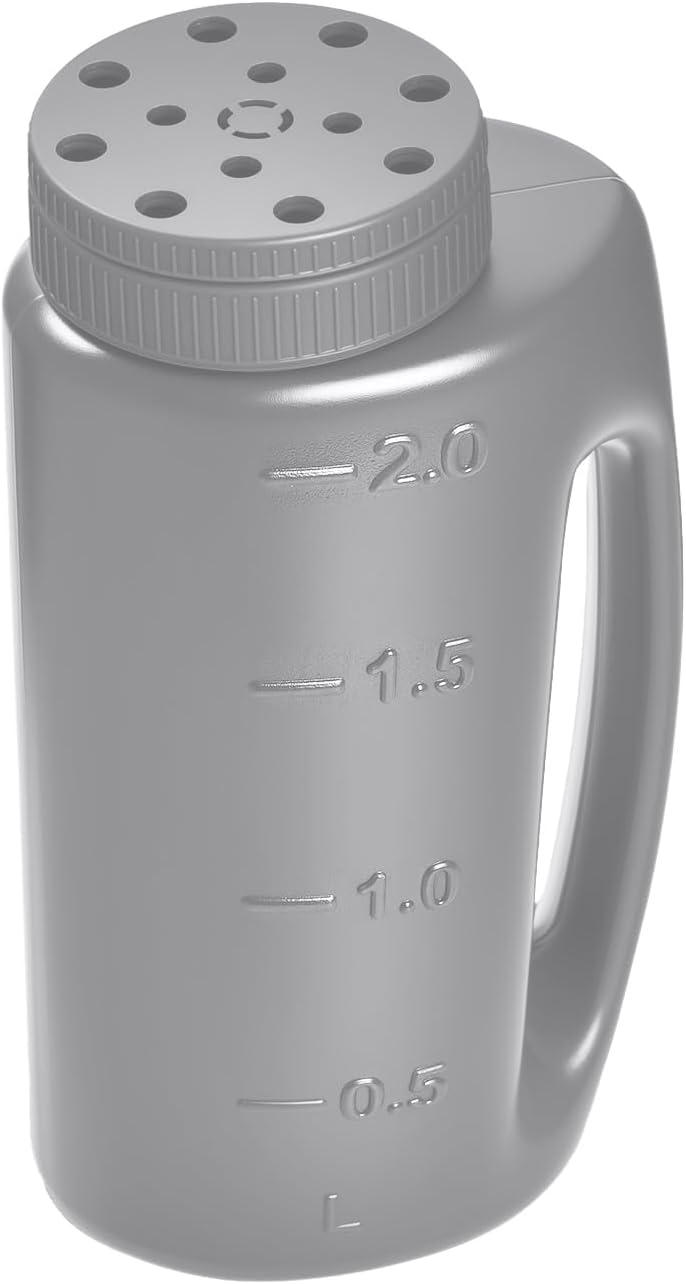
The ZXJ Handheld Seed Shaker is a compact broadcast spreader aimed at small to medium yard tasks. It uses a front-facing diffuser and three adjustable openings to control flow so you can switch between fine grass seed and coarser materials like ice melt. The 90 oz capacity reduces refills compared with tiny hand spreaders, and the included garden gloves and ergonomic handle make longer passes more comfortable. Built from weather-resistant plastic, it is lightweight and easy to rinse after use. Expect good uniformity on lawns and walkways when cranked to the right setting, but it lacks a motorized or hopper-agitation system so very damp or clumpy products may need pre-breaking. The unit is straightforward to operate and store, making it a practical, no-frills choice for routine lawn seeding, fertilizing small plots, or spreading salt in winter.
Best for: Homeowners who want an affordable, easy-to-use spreader for routine lawn seeding, fertilizing, and occasional ice-melt tasks and who prioritize simplicity and low maintenance.
Less Ideal for: Commercial landscapers or users who need to treat very large areas quickly or handle consistently wet, clumpy materials should choose a heavier-duty or motorized spreader.
- Large 90 oz hopper reduces trips to refill during small to medium jobs
- Three adjustable openings provide flow control for seeds, fertilizer, or ice melt
- Ergonomic handle and included gloves improve comfort during extended use
- Weather-resistant plastic construction is easy to clean and store
- No mechanical agitation or motor makes it less effective with damp or clumpy materials
- Lightweight plastic may feel less durable under heavy professional use
Verdict: A budget-friendly, easy-to-use handheld spreader that delivers good control and reduced refills for small to medium seasonal lawn and ice-melt tasks.
Scotts Whirl Hand-Powered Handheld Spreader

| Material Type | Poly |
|---|---|
| Capacity coverage | Up to 1,500 sq. ft. |
| Included Components | Scotts – 71060 |
The Scotts Whirl is a simple, hand-powered spreader designed for small yards and spot treatments. It delivers smooth, even coverage of grass seed, fertilizer, salt, or ice melt by turning a small spreader wheel as you walk. Its ergonomic, adjustable arm support makes repeated passes more comfortable than basic handheld scoops, and the unit arrives fully assembled so you can use it right away. With a capacity rated up to 1,500 square feet it is best for modest lawns, beds, and patch repairs rather than large properties. Construction is lightweight poly, which keeps it easy to carry and maneuver but means it is not as rugged as metal commercial units. The straightforward mechanical design keeps maintenance trivial and there are no batteries or power hooks to worry about. If you want a low-cost, low-effort tool to improve distribution and avoid clumping during seeding or fertilizing, this does the job well, but those needing heavy-duty durability or very large coverage will want a larger tow-behind or broadcast spreader.
Best for: Buyers who want a practical, no-frills tool to improve distribution for routine lawn care on small to medium yards and value ease of use and low maintenance.
Less Ideal for: Homeowners with large lawns, commercial landscapers, or anyone needing a heavy-duty, high-capacity spreader should consider larger tow-behind or broadcast models.
- Provides smooth, even coverage for seed, fertilizer, salt, and ice melt
- Ergonomic adjustable arm support for more comfortable use during extended passes
- Lightweight poly construction makes it easy to carry and maneuver
- Comes fully assembled so it is ready to use out of the box
- Poly construction is less durable than metal alternatives for heavy or commercial use
- Capacity is limited to small lawns and spot treatments, not appropriate for large properties
Verdict: A lightweight, ready-to-use handheld spreader that delivers even coverage for small lawns and routine spot treatments.
Choosing the Right Granular Garden Spreader: Key Factors to Consider
Spread Pattern Consistency
How uniformly a spreader lays down granules determines whether you get even feeding or streaks. A spreader that tosses product unevenly will create patches of over- and under-application that affect plant performance and can waste materials.
Pattern consistency depends on the distribution mechanism, the width of coverage per pass, and how sensitive output is to walking speed. For gardeners, look for models with adjustable deflectors or pattern control so you can narrow the throw when working close to beds and widen it on open turf. Consistent spread reduces the need for overlap, saving time and product.
Hopper Capacity and Access
Hopper size affects how often you need to refill and how heavy each load feels. For small lawns and beds a compact hopper limits top-weight and makes maneuvering easier. For larger areas a bigger hopper reduces interruptions.
Also consider how easy it is to pour into the hopper and whether the lid or top is wide enough to avoid spills. Hopper access matters for mixing or rinsing when you switch products. Look for corrosion-resistant finishes and simple drain or clean-out access if you plan to use gritty amendments that can cake or leave residue.
Calibration and Output Control
Accurate calibration ensures you apply the correct rate listed on product labels. Spreaders with clear, repeatable settings and simple adjustment mechanisms make it easier to match application charts for fertilizer, seed, or lime.
Some spreaders provide stepped settings, others use continuous dials. Consider whether the control is reachable while walking and if it holds position under vibration. Easy calibration reduces guesswork and helps prevent overapplication that can harm plants.
Durability Against Abrasion and Corrosion
Granular fertilizers are abrasive and often corrosive. Hopper materials, agitators, and metering plates should resist wear and rust to maintain consistent output over seasons.
Inspect for sturdy plastics rated for outdoor use or powder-coated metals and replaceable wear parts. Long-lived components save money and avoid abrupt changes in spread behavior as parts degrade.
Maneuverability and User Comfort
How a spreader handles affects control and fatigue during large jobs. Factors include handle height and grip shape, chassis weight distribution, and wheel size and tread for different surfaces.
Larger wheels roll more easily over uneven turf and over edges of beds. Ergonomic grips and simple brake or shut-off controls reduce wrist strain when making coastal passes or edging. Think about storage size and whether the frame folds or disassembles for winter put-away.
Compatibility with Product Types
Not all spreaders handle every granular material equally. Particle size, shape, and flowability vary between lawn fertilizers, rock dusts, and seed mixes.
Choose a spreader whose metering system and agitator design handle the kinds of products you plan to apply. Some spreaders include screens or pulse agitators to keep coarser materials from bridging, while others are optimized for fine fertilizers. Matching spreader capability to product types minimizes clogging and inconsistent coverage.
Matching Spreader Size to Yard Work
Pick a spreader capacity with the balance of fewer refills and manageable weight in mind. Small yards and tight beds favor compact units that are easy to steer; larger lawns benefit from higher-capacity hoppers so you spend less time refilling.
Consider wheel size and terrain too. If your property has slopes or rough turf, bigger wheels and a sturdier frame reduce jostle and help maintain a consistent walking speed, which in turn stabilizes output.
- Small hopper: better for tight spaces and light loads
- Large hopper: reduces refill frequency for big lawns
- Bigger wheels: smoother roll on uneven surfaces
Using Spreaders Safely and Accurately
Always calibrate your spreader with the product you will apply. Many labels include application charts that list recommended settings for a given spreader type and walking pace. Walk at a steady speed and overlap passes slightly to avoid gaps.
Avoid windy days to reduce drift and uneven application. Wear gloves and protective eyewear when handling granular fertilizers and clean the hopper after use to prevent cross-contamination between products.
- Calibrate with the actual product before treating the whole area
- Keep a steady walking pace and consistent stride width
- Rinse and dry hopper if switching materials
Storage and Maintenance Tips
Rinse residual product out of the hopper and metering area to prevent corrosion and clogging. Let the spreader dry fully before storing to minimize rust and caking.
Check moving parts seasonally, lubricate pivot points if recommended, and replace wear parts like agitators or metering plates when they show erosion. Proper winter storage extends the service life and keeps calibration predictable.
- Empty and rinse hopper after use
- Inspect and lubricate moving parts annually
- Store indoors or under cover to protect finishes
Adjusting Throw Width and Working Near Beds
Most broadcast spreaders throw product several feet to the side. Use deflectors or narrow settings when working next to planted beds to avoid accidentally applying fertilizer onto foliage.
When edging, overlap less and take slower passes so you can control the material. Some gardeners prefer to use a handheld applicator for tight ornamental beds, reserving the broadcast spreader for turf and open spaces.
- Use deflectors near sensitive plants
- Narrow settings reduce overspray onto beds
- Consider manual application for delicate areas
Environmental Considerations and Responsible Use
Correct application reduces runoff and nutrient loss. Apply only the amount recommended for soil tests and avoid treating wet surfaces where granules can dissolve and run off.
Do not apply before heavy rain. Sweep or remove granules that land on hard surfaces like driveways or paths to prevent them washing into storm drains.
- Follow soil test recommendations to avoid overapplication
- Avoid applying before forecasted heavy rain
- Clean granules from hard surfaces to prevent runoff
How We Chose the Best Granular Garden Spreader
We prioritized real-world handling and spread accuracy for typical home garden tasks. Key evaluation criteria were spread pattern consistency across speeds and feeds, hopper capacity relative to common application rates, and material durability against abrasion from mineral fertilizers. We also tested tactile controls and calibration ease to ensure gardeners can match label rates without guesswork, plus user comfort features that reduce fatigue during repeated passes. Excluded items included hand-held or rotary-only applicators that are unsuitable for covering turf or larger beds, and specialty spreaders designed only for seed rather than granular fertilizers and soil amendments. We focused on units that accept a range of granular particle sizes and that offer straightforward calibration, robust hopper construction, and predictable output across different walking speeds. These dimensions guided selection and align with the scoring metrics used in each product card.
FAQ
How do I calibrate a granular garden spreader?
Calibration usually involves measuring how much product is delivered at a given setting over a set distance. Use the product label chart as a starting point, catch output for a measured pass, then adjust the setting or walking speed until the volume matches the recommended rate.
Can one spreader handle both fertilizer and seed?
Many broadcast spreaders can handle both, but performance depends on particle size. Fine fertilizers and seed mixes may require different settings and occasional agitation to prevent bridging. For very small seeds or specialty mixes, a spreader with adjustable flow and an agitator works best.
How often should I clean my spreader?
Clean the hopper and metering area after every use that involves fertilizer or other corrosive materials. A quick rinse and full dry prevents residue buildup that leads to clogging and corrosion over time.
What walking speed should I use when spreading?
Use a steady, moderate walking pace that matches the spreader calibration. Many manufacturers provide charts correlating speed to settings. In practice, aim for a consistent rhythm rather than fast bursts to keep application uniform.
Are replacement parts common and worth checking before buying?
Yes. Check that common wear parts like agitators, metering plates, or deflectors are replaceable. Availability of spare parts makes maintenance easier and keeps output consistent as components wear.
Is a broadcast spreader or drop spreader better for small beds?
Broadcast spreaders cover more ground quickly but have a wider throw that can be hard to control near beds. Drop spreaders give very precise placement and are better for narrow or delicate plantings, while broadcast spreaders are efficient for lawns and larger areas.
Final Verdict
Choose a granular garden spreader by balancing coverage needs with control. Prioritize spread pattern consistency and the ability to calibrate to label rates if you want predictable application. Factor in hopper size, durability against abrasive fertilizers, and user comfort for the kind of work you do most often. If you value fewer refills for large lawns, pick a higher-capacity unit with rugged wheels. If you manage smaller beds or tight spaces, favor nimble designs with good deflectors and precise controls. Matching these tradeoffs to your yard and product types will give the best long-term results.
