

Note: This article contains affiliate links. If you click on these links and make a purchase, I may earn a small commission at no extra cost to you. This helps support my research and content. Read my full affiliate disclosure here.
Picking the right postemergence herbicide matters because these products act on actively growing weeds and interact directly with desirable plants. Choose the wrong formulation or timing and you can injure turf, ornamentals, or nearby crops. This guide narrows the field to the top shortlisted postemergence herbicides for common garden and lawn situations, explaining how they perform on broadleaf weeds, grassy weeds, and in sensitive plantings. We evaluated each option for real-world factors like application timing, spray safety, and expected control speed. Read on for practical notes to help you match a product to your garden situation before reviewing the individual picks.
Top Picks at a Glance
| Best Overall The best all-around choice for most situations | Roundup Quick Pro Powder Concentrate (makes 5 gallons) |  |
| Best Quality Built to a higher standard if you want something more solid | Syngenta Tenacity Turf Herbicide, 8 oz |  |
| Best Value The sweet spot between price and what you get | Spectracide Weed & Grass Killer Concentrate, 40 oz |  |
| Best Budget The cheapest option that still gets the job done reliably | Spectracide Weed Stop for Lawns Plus Crabgrass Killer Concentrate, 32 oz |  |
| Highest Rated A top-rated pick with lots of positive feedback | Cakok Prescott Herbicide, 1 gal (Post-emergence Broadleaf Weed Control) |  |
| Most Popular A crowd favorite that many people choose with confidence | Prime Source Celsius WG Post-Emerge Weed Control Easy Mix Packet |  |
| Best Seller A high-volume bestseller chosen again and again | Roundup Weed & Grass Killer4 Refill, 1.25 gal |  |
Roundup Quick Pro Powder Concentrate (makes 5 gallons)

| Unit Count | 8 Ounce |
|---|---|
| Item Form | Powder |
| Coverage | Makes 5 gallons |
| Active Ingredients | Glyphosate, Diquat |
Roundup Quick Pro is a powdered concentrate designed to mix into water to treat unwanted vegetation across lawns, beds, driveways, and other outdoor areas. It combines glyphosate for systemic control with diquat for faster contact action so weeds brown more quickly and are less likely to recover after treatment. Typical use is mixing the specified rate into a handheld or backpack sprayer and applying to actively growing weeds on a calm, dry day; the product covers up to five gallons of spray from one box. The notable benefits are broad-spectrum activity against both annuals and perennials and improved rain resistance from the diquat addition, which helps absorption before rainfall. Important limitations are that it is a nonselective herbicide so it will damage desirable plants on contact or via drift and requires careful mixing and protective handling. It is best for targeted patch treatments and general post-emergent use rather than selective weed control inside mixed plantings.
Best for: Buyers who want a reliable post-emergent herbicide for general-purpose weed control across yards and hardscapes and who are comfortable following label safety and mixing instructions.
Less Ideal for: Gardeners who need selective weed control inside flower beds or who prefer organic or nonchemical weed management methods should consider alternatives.
- Systemic plus contact action combines glyphosate and diquat for faster visible knockdown and longer control
- Powder concentrate that mixes to make up to five gallons of spray for treating multiple areas
- Broad-spectrum labeled for most annual and perennial weeds
- Formulation offers improved absorption before rain compared with glyphosate alone
- Nonselective formulation will damage or kill any desirable vegetation it contacts
- Requires careful mixing, protective gear, and attention to drift and re-entry intervals
Verdict: Choose Roundup Quick Pro when you need a fast‑acting, broad‑spectrum post‑emergent herbicide that combines systemic control with quick visible knockdown.
Syngenta Tenacity Turf Herbicide, 8 oz
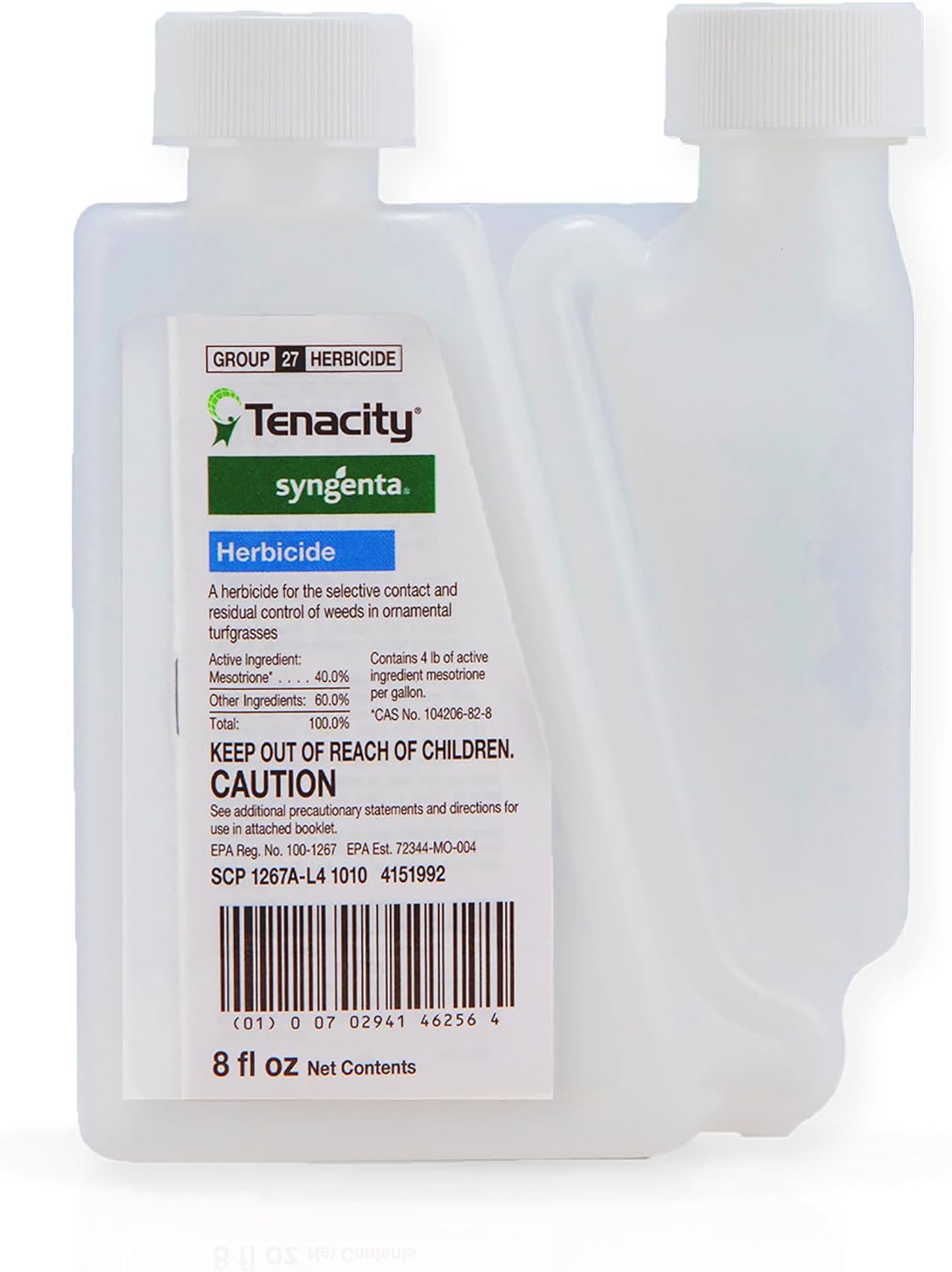
| Unit Count | 8 Fluid Ounces |
|---|---|
| Item Form | Liquid |
| Coverage | 2000 ft^2 per 1sp of product |
| Active Ingredients | Mesotrione |
Tenacity Turf Herbicide is a concentrated mesotrione-based liquid designed for both pre-emergent and post-emergent control of common lawn weeds including crabgrass, clover, chickweed and dandelions. You apply it diluted according to label rates with a handheld or hose-end sprayer to target problem areas or broadcast across the lawn; when used as a pre-emergent it is taken up as weeds emerge and when applied post-emergent it acts systemically for selective control. The product covers a large area per bottle and the active ingredient provides residual control so you can expect longer suppression than a contact-only herbicide. Important practical points are that it is turf-selective so follow the label for grass species and mixing instructions to avoid turf injury, and results can take several days to appear. Also this is a concentrated chemical intended for careful, measured application rather than spot-use by people who prefer non-chemical methods.
Best for: Gardeners focused on strong, reliable crabgrass and broadleaf weed control who are comfortable using concentrated herbicides and following label directions for turf safety.
Less Ideal for: People seeking organic, mechanical, or spot-only solutions or those unwilling to follow detailed mixing and application instructions should consider other options.
- Systemic mesotrione active ingredient controls both pre- and post-emergent weeds
- Selective to turf when used per label, allowing treatment without killing desirable grass species
- Concentrated 8 oz liquid provides wide coverage per bottle
- Provides residual suppression, reducing frequency of repeat applications
- Requires careful mixing and adherence to label for turf safety
- Not a non-chemical or organic option for weed control
Verdict: Choose Tenacity when you want a concentrated, turf-selective herbicide that delivers pre- and post-emergent control of crabgrass and other common lawn weeds.
Spectracide Weed & Grass Killer Concentrate, 40 oz

| Unit Count | 40 Fluid Ounces |
|---|---|
| Item Form | Spray |
| Coverage | 1200 square feet |
| Liquid Volume | 40 fluid ounces |
Spectracide Weed & Grass Killer Concentrate is a liquid herbicide you mix with water and apply with a tank sprayer to kill broadleaf weeds and grasses down to the root. It is intended for spot treatments on driveways, walkways, patios and around fences or foundations where you want to remove unwanted vegetation without tilling. The formula is rainproof in about 15 minutes and can show visible browning in as fast as three hours, allowing replanting of nonedible ornamentals after roughly one day. Key practical features include a concentrate format for multiple treatments from a single bottle and directions calibrated for coverage so you can treat up to the stated area when mixed correctly. Important limitations are that it is nonselective so it will damage desirable plants if it contacts them, it requires careful mixing and protected application to avoid drift, and label directions restrict use around edible food crops and limit applications per year. Proper PPE, shielding nearby plants, and applying in warm, calm conditions will get the best results.
Best for: For gardeners and homeowners who want an efficient, no-nonsense spot weed killer to clear unwanted vegetation from hardscapes and edges, and who prioritize fast, predictable results with controlled application.
Less Ideal for: Not a good choice for people who need selective weed control inside lawns or around edible gardens or for those who prefer ready-to-use sprayers instead of mixing concentrate.
- Concentrated formula lets you mix for multiple spot treatments.
- Fast-acting results with visible effects in about three hours.
- Rainproof within 15 minutes so light rain soon after application is less likely to reduce effectiveness.
- Suitable for hardscape and perimeter spot treatments where nonselective control is acceptable.
- Nonselective herbicide that will harm or kill desirable plants on contact.
- Requires mixing and a separate tank sprayer rather than an all-in-one applicator.
- Label restricts use near edible crops and limits annual applications to any area.
Verdict: A concentrated, fast-acting spot herbicide for homeowners who need reliable, no-frills removal of weeds and grasses from driveways, patios and other hardscape areas.
Spectracide Weed Stop for Lawns Plus Crabgrass Killer Concentrate, 32 oz
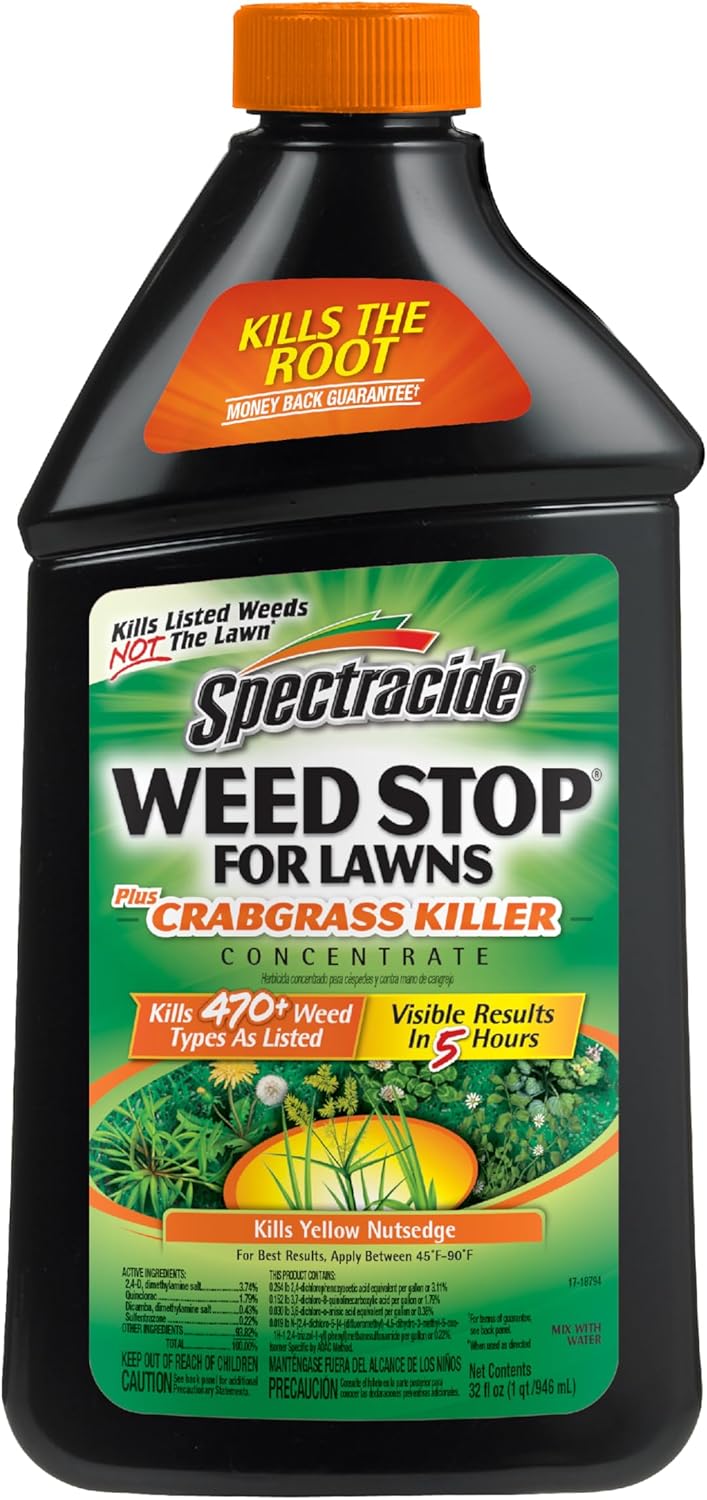
| Unit Count | 32 Ounce |
|---|---|
| Coverage | 5000 square_feet |
| Item Form | Liquid |
| Kills | 470+ listed weeds |
Spectracide Weed Stop Plus Crabgrass Killer is a ready-to-dilute concentrate designed to target grassy and broadleaf weeds across a typical yard. Mix and apply with a sprayer and the formula kills by contact down to the root with visible dieback in about 5 hours and becomes rainfast in roughly 3 hours. The 32 ounce bottle covers up to 5,000 square feet, making it a practical choice for treating whole lawns. Directions note best performance between 45 and 90 degrees daytime temperature and caution against treating Bermudagrass in very hot conditions to avoid temporary discoloration. Practical benefits include fast visible results, broad-spectrum control that includes dandelion and clover, and the convenience of a concentrated product that stretches across a larger area than ready-to-use sprays. Important limitations are the temperature restrictions for safe application, the need to let treated areas dry before people or pets return, and observing reseeding intervals after treatment. For routine crabgrass control on established lawns, this concentrate balances effectiveness and coverage for cost-conscious buyers.
Best for: Buyers who want an economical, concentrated treatment to control crabgrass and a wide range of weeds across a whole lawn and who are comfortable mixing and applying a spray product.
Less Ideal for: People with newly seeded lawns, very small patch treatments who prefer ready-to-use bottles, or those who cannot avoid applying during hotter daytime temperatures.
- Concentrated formula treats up to 5,000 sq ft from a 32 oz bottle
- Kills over 470 listed broadleaf and grassy weeds including crabgrass
- Visible results in about 5 hours and becomes rainfast in approximately 3 hours
- Designed to kill weeds down to the root when used as directed
- Must follow temperature limits to avoid lawn injury, particularly on Bermudagrass
- Requires mixing and a separate sprayer rather than being ready-to-use
Verdict: A budget-friendly concentrate that delivers fast, broad-spectrum crabgrass and weed control for established lawns while covering a large area per bottle.
Cakok Prescott Herbicide, 1 gal (Post-emergence Broadleaf Weed Control)

| Item Form | Liquid |
|---|---|
| Coverage | Broad-spectrum (Broadleaf Weeds) |
| Liquid Volume | 1 gallons |
Cakok Prescott Herbicide is a broad-spectrum post-emergence liquid designed to suppress and eliminate many common broadleaf weeds in rangeland, permanent grass pastures and non-crop sites such as fence rows, ditch banks and roadsides. It is applied directly to emerged weeds at the recommended rates and is intended for spot or broadcast treatments where grass tolerance is required. The formulation lists general herbicide active ingredients and includes clear safety guidance to wear protective clothing and avoid application in windy conditions. Practical benefits include wide species coverage (dandelion, ragweed, thistles, clover and many others) and suitability for large outdoor non-crop areas, which reduces repeated manual pulling. Important limitations are that specific active ingredient concentrations and application rates are not detailed on the product summary here and that it is intended only for post-emergence use on broadleaf weeds, so it will not control grass weeds or pre-emergent seedlings. Follow label directions and local regulations for safe use and disposal.
Best for: Buyers who prioritize a dependable, broad-spectrum post-emergence product for managing established broadleaf weeds across pastures, rangeland and other non-crop outdoor areas.
Less Ideal for: Home gardeners seeking a general-use lawn treatment or anyone needing control of grassy weeds or pre-emergent protection should consider other specialized products.
- Broad-spectrum control covering many common broadleaf weeds found in pastures and rangeland
- Formulated for post-emergence use so it targets actively growing weeds
- Suitable for non-crop areas and permanent grass pastures where grass tolerance is needed
- Comes in a 1-gallon liquid ready for dilution and application
- Product information does not list specific active ingredient concentrations or detailed application rates in the summary
- Not effective on grass weeds or for pre-emergent weed control
Verdict: A practical choice for reliably knocking back established broadleaf weeds across pastures and non-crop areas when you need a post-emergence solution.
Prime Source Celsius WG Post-Emerge Weed Control Easy Mix Packet

| Item Form | Powder |
|---|---|
| Coverage | broad-leaf weeds and grassy weeds |
| Active Ingredients | Dicamba 57.4%, Iodosulfuron-methyl-sodium 1.9%, Thiencarbazone-methyl 8.7% |
| Included Components | Easy Mix Packet, Product Label |
Celsius WG is a post-emergent foliar herbicide supplied as a small easy-mix powder packet intended for spot or broadcast applications on warm-season lawns. It combines three active ingredients to target more than 120 broadleaf and grassy weeds and works fastest when applied to actively growing weeds at daily averages above 60°F. Users typically empty a packet into compatible application equipment, spray evenly while avoiding drift, and expect visible symptoms within hours with plant death over one to four weeks. Practical benefits include the broad weed spectrum, convenient single-dose packaging that reduces measuring mistakes, and a formulation suited for turf types like Bermudagrass, St. Augustine, Zoysia, and Centipede. Important limitations are that it is not labeled for cool-season grasses, it can damage non-target plants if drift occurs, and effectiveness falls off when weeds are drought-stressed or when applied in heavy dew or rain. Follow the label safety instructions carefully and avoid applying near desirable plants or water features.
Best for: Homeowners and groundskeepers with warm-season lawns who want a reliable, ready-to-use post-emergent product and prioritize predictable, label-directed results.
Less Ideal for: Owners of cool-season grass lawns or gardeners who need herbicides safe for use near sensitive ornamentals or water features should consider other options.
- Controls a wide spectrum of broadleaf and grassy weeds in warm-season turf
- Easy-mix single-use packets reduce measuring errors and simplify application
- Fast symptom development with visible effects in hours under warm conditions
- Not labeled for use on cool-season grasses
- Toxic to non-target plants so spray drift must be avoided
- Performance reduced on drought-stressed weeds or when applied in wet/foggy conditions
Verdict: A convenient single-packet post-emergent herbicide that reliably kills a wide range of weeds in warm-season turf when applied according to the label.
Roundup Weed & Grass Killer4 Refill, 1.25 gal

| Unit Count | 160 Fluid Ounces |
|---|---|
| Coverage | 375 square feet |
| Item Form | Spray |
| Active Ingredients | Triclopyr, Fluazifop P-Butyl, Diquat Dibromide |
This 1.25 gallon Roundup Weed & Grass Killer4 refill is designed to be poured into an empty spray container to treat weeds and grassy weeds around beds, walkways, driveways, foundations, and other hardscape edges. It contains multiple active ingredients that attack broadleaf weeds and grasses to the root and promises visible wilting within hours and rainproofing in as fast as 30 minutes, which makes it convenient when weather windows are short. The refill covers about 375 square feet and is intended for use in and around established plantings when applied carefully to avoid drift onto desirable plants. Practical benefits include fast action, the ability to replant some areas within a specified wait period, and compatibility with the brand’s comfort wand refills so you avoid frequent repurchasing of small bottles. Important limitations are that it is a nonselective herbicide so it will damage desirable plants if misapplied and treated areas should be kept clear of people and pets until spray dries; follow label directions closely for safe use and replanting intervals.
Best for: Buyers who prioritize reliable, fast-acting weed control for routine maintenance of beds, edges, and hardscape areas and who follow label directions to minimize risk.
Less Ideal for: Gardeners who need selective control inside densely planted flower beds or who prefer organic or nonchemical weed management methods.
- Kills a broad range of weeds and grasses to the root, including dandelion and crabgrass
- Fast visible results in hours and becomes rainproof in about 30 minutes
- Large 1.25 gal refill reduces need for frequent repurchases and covers roughly 375 sq ft
- Formulated to refill compatible spray wand for easy application around beds and hardscapes
- Nonselective formula that will harm desirable plants if it drifts or is oversprayed
- Requires careful handling and adherence to label safety and replanting intervals
Verdict: Choose this refill if you want a fast, proven, large-format herbicide that quickly kills tough weeds and grasses and refills a compatible spray wand for area-wide maintenance.
Choosing the Right Postemergence Herbicide: Key Factors to Consider
Target Weed Spectrum
Know which weeds are active in your lawn or beds before choosing a product. Postemergence herbicides vary: some are formulated primarily for broadleaf weeds like dandelion and clover, while others target grassy weeds such as crabgrass and foxtail. Matching the herbicide's labeled spectrum to the species present improves the chance of successful control and reduces unnecessary chemical use.
Consider whether perennial weeds with deep roots or emerging seedlings are the main issue. Perennials often need systemic actives that translocate to roots, whereas young annual weeds are usually controlled by contact or short-residual actives. Accurate identification saves time and limits damage to desirable plants.
Timing and Weed Growth Stage
Postemergence products work on actively growing weeds, so application timing is critical. Most actives perform best when weeds are young, tender, and not under stress from drought or frost. Applying during the right growth stage improves uptake and reduces the need for repeat applications.
Also account for time of day and weather. Avoid spraying before heavy rain or on very hot afternoons, because wash-off or volatilization reduces efficacy and raises non-target risk. Read label windows for re-entry and mowing to plan maintenance around treatment.
Safety to Desirable Plants and Turf
Different herbicides have different selectivity profiles. Some are safe in established lawns but will damage bedding plants or newly seeded grass. Others require careful shielding of ornamentals or maintaining buffer distances. Choosing a herbicide with a safety margin appropriate for your planting reduces accidental injury.
Think about planting stage: newly transplanted shrubs and seedlings are more vulnerable. Also consider root uptake and soil activity; systemic actives can move and affect adjacent plants, so placement and application method matter.
Application Method and Equipment
How you apply a postemergence herbicide affects both effectiveness and risk. Handheld pump sprayers, hose-end sprayers, and larger backpack sprayers each influence droplet size and coverage. Nozzle choice and pressure determine drift potential and contact on weed foliage. Some products work well with spot treatments, while others are intended for broadcast spraying of large areas.
Gardeners should match product label instructions to their equipment and be prepared to calibrate sprayers. Proper protective gear and mixing protocols also reduce exposure and ensure the correct dose.
Environmental Persistence and Off-Target Risk
Consider how long residues remain active in soil and water and whether the active ingredient moves through soil or volatilizes. Short-residual contact products minimize long-term soil impact but may require repeat applications. Longer-residual systemic herbicides can control perennials but increase the chance of affecting subsequent plantings or adjacent vegetation through root uptake.
Evaluate proximity to water features, vegetable beds, and pollinator-attractive plants. Some actives require buffer zones to protect aquatic organisms or pollinators, so follow label directions to limit environmental impact.
Tank Mixes and Cultural Compatibility
Many gardeners use tank mixes to broaden control or add surfactant for better leaf coverage. Check whether a product allows common tank partners like surfactants, fertilizers, or compatible herbicides. Improper mixes can reduce effectiveness or increase plant injury.
Also consider how the herbicide fits with your cultural practices. If you plan to overseed, transplant, or plant vegetable seedlings soon after treatment, pick a product with an appropriate replant interval. Compatibility with mowing and irrigation schedules also matters for timing control and minimizing stress on desirable plants.
When To Use Spot Treatments Versus Broadcast Applications
Spot treatments concentrate herbicide on individual weeds or small patches and reduce total chemical used. Use spot applications for isolated patches of broadleaf weeds in lawns or around ornamentals to limit exposure to desirable plants.
Broadcast applications are appropriate when weeds are widespread and uniform across an area. When choosing broadcast use, adjust application rate and nozzle selection for even coverage and to avoid streaking or overapplication.
- Spot treatment benefits: lower volume, reduced drift, and quicker cleanup.
- Broadcast benefits: consistent coverage for large infestations and fewer repeated spot passes.
Protecting Pollinators and Beneficials
Many postemergence herbicides are not directly toxic to pollinators but can reduce forage by killing flowering weeds. Avoid spraying on bloom and maintain a buffer around flowering plants to preserve pollinator resources. Use mechanical removal or spot-treat nonflowering weeds near pollinator habitats when possible.
- Delay applications when flowers are present in the treatment area.
- Rinse equipment away from water features and flowering beds.
Managing Resistant Weeds
Repeated use of the same mode of action can select for resistance. Rotate between herbicides with different modes of action or combine cultural controls like mowing, hand-pulling, and improved turf vigor to reduce reliance on a single chemistry. For persistent perennials, integrate mechanical and chemical tactics rather than expecting one product to solve the problem alone.
- Alternate actives across seasons when possible.
- Record treatments and outcomes to identify shifts in control effectiveness.
Tank Mixing Basics and Surfactant Use
A surfactant can improve leaf coverage and penetration on waxy or hairy weeds, but not all formulations require added surfactant. Check the label for recommendations and approved surfactant types. Add surfactant only when instructed to avoid increased plant injury.
When combining two products, use a jar test for compatibility and follow label limits for maximum active ingredient rates per season. Add products to water in the order specified on labels to avoid precipitation and maintain spray stability.
- Perform a small-area trial when trying a new mix.
- Avoid mixing incompatible chemistries that can produce precipitates or reduce efficacy.
Application Weather and Best Practices
Pick calm, moderate-temperature windows for spraying. Wind increases drift risk and hot weather can stress plants, making them more susceptible to injury. Early morning or late afternoon on a dry day is often best for uptake without rapid evaporation.
Avoid spraying shortly before heavy rain to prevent wash-off. Follow label windows for irrigation and re-entry to protect people, pets, and non-target plants.
- Check the forecast for rain and high winds before treating.
- Calibrate sprayers and wear appropriate personal protective equipment.
How We Chose the Best Postemergence Herbicide
We focused on attributes that matter for gardeners using postemergence herbicides in lawns, beds, and around ornamentals. Key evaluation criteria included spectrum of control, meaning which common annual and perennial weeds the product controls and whether it targets broadleaf, grassy, or both. We judged safety to desirable plants based on label guidance for sensitive turf and common landscape species and on the likelihood of drift or root uptake that could harm nearby plantings. Speed of activity and visible control were considered because gardeners often need fast suppression of active weeds. Application flexibility was assessed by looking at allowed tank mixes, nozzle and pressure recommendations, and how forgiving the product is to timing and weather. Environmental persistence and soil mobility were weighed to understand risks to non-targets and future plantings. We excluded broadcast preemergent-only chemistries and selective products designed exclusively for agricultural row crops, focusing on options labeled for home lawn, garden, and ornamental use. Products lacking clear label instructions for common homeowner uses or with unusually restrictive buffer zones were also removed from consideration.
FAQ
Can I use postemergence herbicides on newly seeded turf?
It depends on the product. Many postemergence herbicides can injure young seedlings. Labels often specify a minimum establishment period for reseeding or overseeding. If in doubt, delay herbicide use until the new grass has developed several mowings and established a strong root system.
How long after application can I safely plant vegetables or ornamentals?
Replant intervals vary by active ingredient and formulation. Some products have short re-entry and planting windows, while systemic or persistent actives may require longer waits. Always follow the label's replanting guidance for specific intervals to avoid damage to newly planted species.
Will a postemergence herbicide control perennial weeds with deep roots?
Some systemic postemergence herbicides translocate to roots and can suppress many perennials, but results depend on timing, plant species, and application thoroughness. Very deep or woody-rooted perennials often need repeated treatments or a combination of mechanical removal and chemical control.
Are postemergence herbicides safe near water features?
Many active ingredients require buffer zones to protect aquatic life. The risk depends on soil mobility and label-specified setbacks. Do not apply directly to water and follow all label restrictions to minimize runoff into ponds or streams.
Should I add a surfactant to every spray mix?
Not always. Some formulations include a built-in surfactant and adding more can increase the risk of plant injury. Use a surfactant only when the label recommends it or when treating waxy-leaved species that resist uptake.
How can I reduce the chance of herbicide resistance in my garden?
Rotate modes of action across seasons, combine cultural practices like hand weeding and improved turf health, and avoid repeated applications of the same active ingredient. Keeping weeds from setting seed also reduces the selection pressure for resistant populations.
Final Verdict
Choose a postemergence herbicide by matching the product's control spectrum and timing to the weeds you have and to the sensitivity of nearby plants. Prioritize safety measures like appropriate application equipment, surfactant guidance, and weather windows to protect desirable vegetation and pollinators. Balance the need for fast visible control with environmental persistence and replanting timelines to pick the product that fits your maintenance plan.
