

Note: This article contains affiliate links. If you click on these links and make a purchase, I may earn a small commission at no extra cost to you. This helps support my research and content. Read my full affiliate disclosure here.
Choosing the right mulch for lilac bushes matters because it affects root temperature, soil moisture, and the soil chemistry that influences flowering. In a mature shrub or a newly planted specimen, the wrong material can hold too much moisture or alter pH and reduce bloom quality. This guide narrows the field to five top mulch options suited for lilac bushes and explains how each type behaves in a real garden. The picks that follow are shortlisted for common lilac planting situations and were evaluated on practical garden criteria like moisture management and impact on soil pH. Read on to understand which mulch style fits your site and maintenance preferences.
Top Picks at a Glance
| Best Overall The best all-around choice for most situations | BRUT Worm Farms Organic Aspen Mulch, 10 Quart |  |
| Best Quality Built to a higher standard if you want something more solid | Hull Farm Cocoa Bean Shell Mulch, 2 Cubic Feet |  |
| Best Value The sweet spot between price and what you get | Soil Sunrise Pine Bark Mulch Nuggets (12 Quarts) |  |
| Most Popular A crowd favorite that many people choose with confidence | Riare Organic Coco Coir Chips, 2-Pack Compressed Coconut Husk Bricks |  |
| Best Seller A high-volume bestseller chosen again and again | Wood Smith USA 100% Natural Cedar Shavings Mulch (16 Quart) |  |
BRUT Worm Farms Organic Aspen Mulch, 10 Quart

| Unit Count | 192 Ounce |
|---|---|
| Volume | 10 quarts |
| Style Name | Moisture-retaining |
| Certified Organic | OMRI-listed |
BRUT Organic Aspen Mulch is a fine-texture aspen bark mulch formulated to hold moisture, reduce weed pressure, and slowly add organic carbon to soil. It is applied as a top dressing around garden beds, pathways, or potted plants where you spread a thin layer to protect soil and conserve water. The product is OMRI-listed and described as odor-free and lightweight, which makes it convenient for indoor containers as well as outdoor borders. Its 30% carbon content supports beneficial microbes without drawing down nitrogen, so it helps long-term soil structure while decomposing slowly. Practical benefits include reduced watering frequency, a neater bed appearance, and gentle nutrient contribution that complements regular fertilizing. Important limitations are the small 10 quart volume per bag, which means multiple bags are needed for larger beds, and that it is primarily a surface mulch so it does not replace nutrient-rich soil amendments for heavy feeding tasks.
Best for: Gardeners who want a low-maintenance, organic mulch to conserve water, tidy beds, and slowly improve soil structure in small to medium beds or containers.
Less Ideal for: Large-scale landscapers or gardeners needing bulk mulch coverage or immediate high-nutrient soil amendments should consider larger-volume or nutrient-dense products.
- Odor-free fine aspen bark suitable for indoor and outdoor use
- High moisture retention reduces watering frequency
- OMRI-listed organic material that adds carbon to soil
- Lightweight and easy to spread for quick top-dressing
- Small 10 quart unit is insufficient for large beds without buying multiple bags
- Provides mainly carbon-rich mulch rather than concentrated nutrients
Verdict: A tidy, odor-free organic aspen mulch that conserves water and improves soil health best for small to medium garden beds and containers.
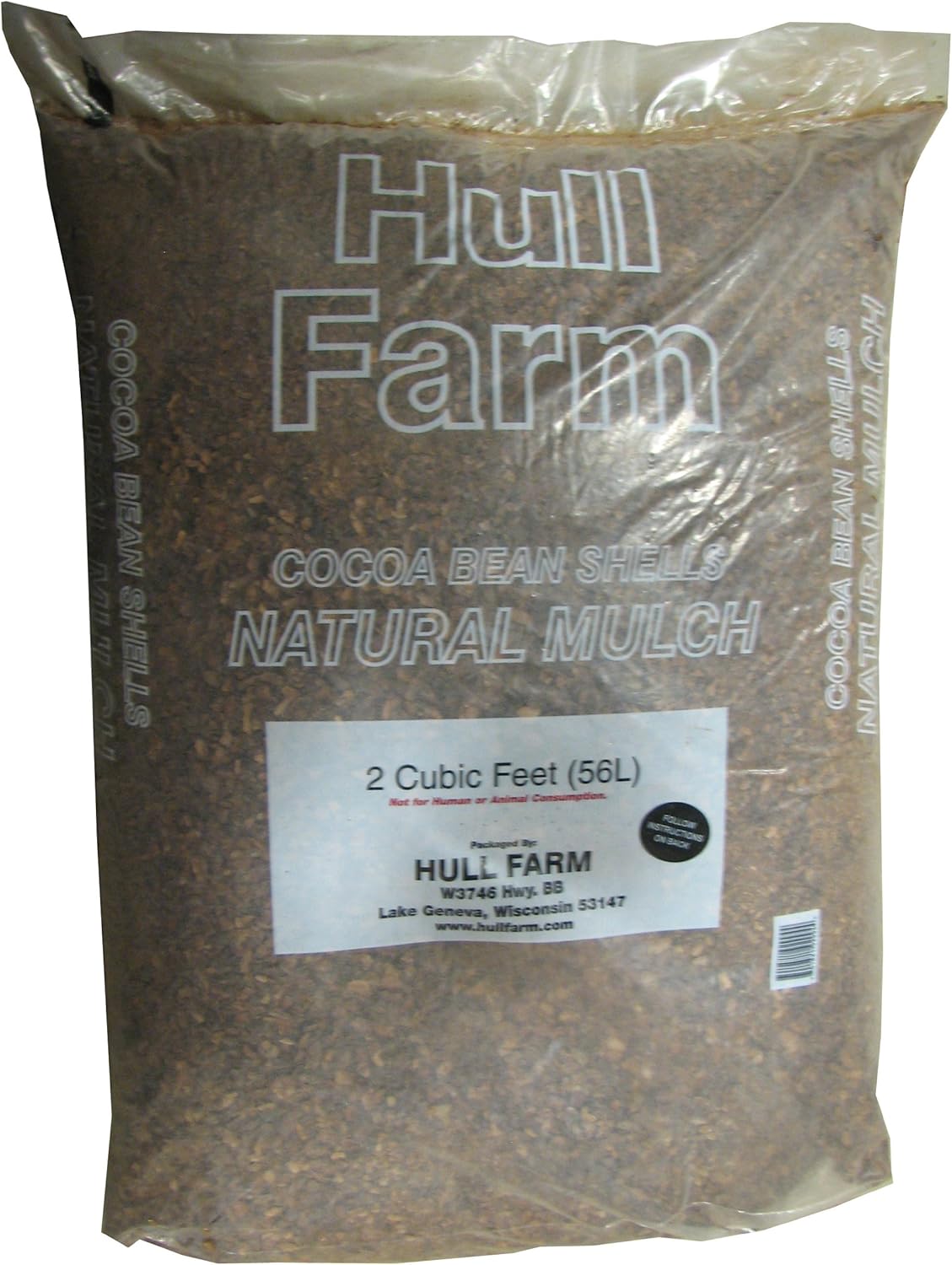
Hull Farm Cocoa Bean Shell Mulch, 2 Cubic Feet
| Brand Name | Hull Farm |
|---|---|
| Model Name | 50150 |
| Material | Plastic |
| Package Weight | 12.72 kg |
Hull Farm Cocoa Bean Shell Mulch is a bagged organic mulch made from cocoa bean shells marketed for landscape beds. It is typically applied as a 1 to 3 inch layer around ornamentals or edibles to suppress weeds, conserve soil moisture, and improve appearance; the shells also slowly break down and provide a small nutrient contribution with an approximate analysis near 2.5-1-3. The product is easy to spread from the 2 cubic foot bag and leaves a fine, attractive textured surface that is less likely to mat than some other fine mulches. Because it is organic it will decompose over time, so plan to replenish annually or as needed. Note that cocoa shell mulch can attract pets if they are tempted to eat it and should be used with care around animals and children; also its small particle size means it can compact in heavy rain and may require light fluffing. For gardeners looking for an attractive, nutrient-contributing mulch that supports moisture retention and weed suppression, this is a practical option for tomato beds when used correctly.
Best for: Gardeners who prioritize plant performance and want a decorative organic mulch that also contributes modest nutrients and conserves moisture for productive beds such as tomatoes.
Less Ideal for: Those with pets that scavenge mulch or gardeners who prefer an inert, longlasting inorganic mulch that will not decompose over a season.
- Adds a mild, slow-release nutrient contribution (approx. 2.5-1-3) as it breaks down
- Fine, attractive texture that spreads evenly and helps retain soil moisture
- Sold in a manageable 2 cubic foot bag for easy handling and targeted application
- Less likely to mat compared with very fine composts, maintaining surface airflow
- Can attract pets or wildlife that may chew or eat the shells
- Small particles can compact after heavy rain and may need occasional fluffing
Verdict: Choose this cocoa shell mulch when you want an attractive organic mulch that helps retain moisture and gives tomatoes a light nutrient boost as it decomposes.
Soil Sunrise Pine Bark Mulch Nuggets (12 Quarts)

| Unit Count | 1 Count |
|---|---|
| Item Type Name | Mulch |
| Style Name | Pine Bark |
| Volume | 12 quarts |
Soil Sunrise Pine Bark Mulch is a bagged, all-natural pine bark nugget product intended for use as a soil amendment and decorative top layer in pots, terrariums, and small garden containers. The half-inch nuggets are sized to improve airflow and drainage when mixed into potting mixes and to form a water-retaining top layer that reduces surface evaporation. It is especially suited to acid-loving plants and ornamentals where a coarse, long-lasting mulch is preferred. Practical benefits include improved root insulation, slower decomposition that contributes organic matter over time, and a tidy reddish-brown finish that masks bare soil. Because the product is coarse bark, it will not compact like fine mulches and can help prevent root rot in poorly draining mixes. Limitations are the small package volume for larger beds and the need to mix or top-dress thoughtfully around shallow-rooted shrubs to avoid creating a thick barrier to water penetration if applied too heavily.
Best for: Buyers who prioritize plant performance and root health for container-grown ornamentals and acid-loving shrubs and want a coarse mulch that improves drainage and retains moisture.
Less Ideal for: Not a great choice for gardeners planning to mulch large landscape beds or those who need a fine-textured mulch for immediate soil coverage across wide areas.
- 100% natural pine bark suitable for organic gardening
- Half-inch nuggets improve drainage and increase aeration in potting mixes
- Good moisture retention as a top layer to reduce surface evaporation
- Slow decomposition provides long-term soil health benefits
- Attractive reddish-brown finish that tidies pots and containers
- Small 12-quart volume limits usefulness for full-size landscape beds
- Coarse nuggets can form a surface layer that may divert water if applied too thickly
Verdict: A performance-focused pine bark nugget mulch that improves drainage and root health in containers and small plantings.
Riare Organic Coco Coir Chips, 2-Pack Compressed Coconut Husk Bricks

| Number of Packs | 2 |
|---|---|
| Item Type Name | Garden Soil |
| Material | Coco Chips |
| Volume | 7 gallons |
These Riare coco coir chips come as two compressed bricks that expand when soaked to create a loose, airy coconut-husk substrate used for potting mixes, orchid media, and surface mulch. Typical use is rehydrating a brick in water, squeezing excess, then mixing with soil, perlite, or using as a top mulch to protect roots and conserve moisture through colder months. Notable features include low electrical conductivity and a near-neutral pH that reduce fertilizer burn risk, high water retention combined with good drainage, and a porous structure that improves root aeration. Practically, the product reduces watering frequency and helps prevent waterlogging that can cause winter root rot while also improving soil structure when blended into beds. Limitations are that each brick must be hydrated and fluffed before use and the material provides little nutrient content on its own so feeding is still required for longer-term plant growth. For winter mulch applications it works well as an insulating, breathable layer but will slowly break down over seasons and may need reapplication.
Best for: Buyers who want a natural, low-risk winter mulch or soil amendment that conserves moisture and improves aeration without adding salts or harsh chemicals, especially for potted plants, orchids, and raised beds.
Less Ideal for: Gardeners who need an all-in-one fertilizing soil or a long-lasting decorative mulch that does not decompose for years should consider alternatives.
- Low EC and pH-balanced for safe contact with roots and seed germination
- High water retention while still providing good drainage to reduce root saturation
- Lightweight, highly porous structure that improves aeration and root development
- Compressed bricks are easy to store and expand to usable volume when needed
- Compressed bricks require soaking and manual breaking apart before use
- Offers minimal nutrients by itself so regular fertilization is still necessary
Verdict: A breathable, moisture-retaining organic coco coir brick that makes a low-salt, low-risk winter mulch and potting amendment when rehydrated and mixed into soil.
Wood Smith USA 100% Natural Cedar Shavings Mulch (16 Quart)

| Unit Count | 595.68 Ounce |
|---|---|
| Item Weight | 12 ounces |
| Material Features | Natural, Organic |
| Indoor Outdoor Usage | Indoor, Outdoor |
| Other Special Features of the Product | Pet Friendly |
This 16-quart bag of 100% natural cedar shavings is a lightweight, pet-friendly mulch you can use around container plants, hanging baskets, garden beds and animal bedding. It is typically applied as a top layer to help retain soil moisture, suppress small weed seedlings and add a fresh cedar aroma that also helps mask odors around pet areas. The product is organic and hand-packed, which means particle size varies and the loose shavings suit decorative mulch rings around shrubs like arborvitae or as a top dressing in planters. Because it is a loose, lightweight material it is easy to spread by hand but can blow around in high wind if not mounded or paired with heavier edging. It is not a substitute for coarse bark when long-term ground coverage or heavy erosion control is required, but for gardeners who want a natural-smelling, moisture-retaining top layer for young arborvitae or potted evergreens it is an effective, easy-to-use option.
Best for: Home gardeners who want a natural, easy-to-apply top dressing that adds moisture retention and a fresh cedar scent to containers, young shrubs and pet areas.
Less Ideal for: Those needing heavy-duty, long-lasting erosion control or a dense bark mulch for large landscape beds should consider coarser bark products instead.
- 100% natural cedar provides a subtle, pleasant aroma and helps mask odors
- Lightweight, easy to spread by hand for quick top-dressing of beds and planters
- Helps retain soil moisture around plant roots, useful for young arborvitae
- Pet friendly formulation suitable for use around animal bedding and litter
- Loose shavings can be blown away in windy sites unless secured
- Not as long-lasting as coarse bark for heavy-duty ground coverage
Verdict: A convenient, natural cedar mulch that is ideal for moistening and freshening up small beds, containers and young arborvitae.
Choosing the Right Mulch for Lilac Bushes: Key Factors to Consider
Moisture Retention and Drainage
Mulch affects how quickly water moves into and out of the root zone. A material that retains moderate moisture helps lilacs through dry spells without keeping roots waterlogged. In heavy soils, choose a mulch that allows better drainage to prevent root rot. In sandy or fast-draining sites, favor mulches that hold moisture longer to reduce irrigation frequency.
Placement depth matters as much as material. A two to three inch layer often balances moisture retention and aeration. Deeper layers can starve roots of oxygen and encourage pests or disease, especially near the crown.
Soil pH Impact
Lilac bushes typically perform best in near-neutral to slightly alkaline soil. Some mulches, especially acidic ones like fresh pine needles or certain wood chips, can slowly shift soil acidity over time. That change may reduce flowering or vigor if not offset with soil amendments.
Consider the long-term chemistry of the mulch you choose. If your soil is already acidic, avoid materials that will lower pH further. For neutral or alkaline soils, most organic mulches are fine, but monitor pH annually if you use acidic materials regularly.
Decomposition Rate and Nutrient Effects
Mulches break down at different speeds. Fast-decomposing materials add organic matter quickly but need more frequent replenishment. As they decompose, some mulches temporarily immobilize nitrogen near the surface, which can affect shallow-rooted plants.
Slow-decomposing mulches provide longer-lasting weed control and require less topping up. Think about whether you want a low-maintenance blanket or a soil-building approach that requires regular replenishment and occasional nitrogen supplementation.
Weed Suppression and Soil Temperature Moderation
A good mulch reduces weed seedlings and moderates soil temperature swings, protecting feeder roots during heat and cold. Dense mulches block light and make it harder for weeds to establish, lowering long-term maintenance.
However, overly compact or fine-textured mulches can form crusts that shed water. Choose materials that balance surface coverage with porosity to let water and air through while suppressing weeds effectively.
Practical Ease of Use
Consider how easy the mulch is to spread, keep away from the trunk, and replenish. Lightweight materials are easier for a single gardener to handle, while bulky or heavy options may require help to install. The ability to smooth, shape, and refresh the mulch without disturbing root flare is important for shrub health.
Also factor in how the mulch looks in the landscape and whether you need machinery or tools to manage it. Practicality can determine whether the mulch will be maintained correctly each season.
Mulch Depth and Application Best Practices
Apply mulch in a wide but shallow ring around each lilac rather than piling it against the trunk. Keep mulch several inches away from the base and stem to prevent moisture-trapped conditions that invite rot or rodent damage.
Aim for an even 2 to 3 inch layer for most organic mulches. In poor soils or drought-prone sites, slightly thicker coverage can help, but avoid layers thicker than 4 inches. Rake lightly each season to refresh and break any crust that limits water infiltration.
- Pull mulch 2-4 inches back from the trunk or crown.
- Refresh thin layers annually; top up fast-decomposing materials more often.
- Avoid firm mulch volcanoes that cover trunk flares.
Timing Mulch Installation and Seasonal Care
Install new mulch in spring after soil has warmed slightly, or in late fall to protect roots through winter. Avoid mulching in wet, cold conditions that can trap moisture against roots. Refresh in early spring to tidy beds and check for any disease or pest signs around the base.
Inspect mulch in late winter for compaction or matting. Loosen the surface to help spring rains penetrate and to encourage beneficial soil organisms.
- Spring and late fall are the most practical times to apply or refresh mulch.
- Loosen compacted layers before rainy seasons to improve infiltration.
Mulch and Soil Testing
Check soil pH and nutrient status before committing to an acidic or alkaline-prone mulch long term. A simple soil test will tell you if your site would tolerate mulches that gradually change pH or if corrective amendments are needed.
If you do use a mulch known to alter pH, monitor soil annually and adjust with lime or sulfur only when tests indicate a real shift, not based on assumptions.
- Test soil pH every one to three years.
- Adjust soil chemistry based on test results rather than mulch folklore.
Managing Mulch Around Newly Planted Versus Established Lilacs
Newly planted lilacs need a light, protective mulch to conserve moisture while roots establish. Keep mulch a bit farther from the stem and use finer-textured material that settles in without creating deep pockets.
Established shrubs tolerate broader mulch rings and benefit from slightly thicker coverage that suppresses weeds and moderates soil temperature. For older plants, choose a longer-lasting mulch to reduce annual work.
- For new plantings keep mulch thinner and away from stems.
- For established shrubs extend mulch to the dripline if practical for weed control.
Common Mulch Mistakes That Harm Lilacs
Piling mulch against the trunk is the most common error. It keeps the bark wet and invites rot, pests, and fungal infection. Always leave a clear gap at the crown.
Using very acidic mulch repeatedly without testing can slowly change soil chemistry and reduce bloom quality over seasons. Likewise, using heavy rock mulches in cold climates can keep soil colder in spring and delay flowering. Match mulch choice to climate and soil conditions rather than aesthetic preference alone.
- Never create a mulch volcano against the trunk.
- Avoid repeatedly using highly acidic materials without soil testing.
How We Chose the Best Mulch for Lilac Bushes
We focused on real-world garden performance for mulches used around lilac bushes. Key evaluation criteria included moisture retention and drainage to avoid root rot or drought stress; influence on soil pH because lilacs prefer near-neutral to slightly alkaline soil; decomposition rate since fast-breaking mulches require frequent top-up and can temporarily tie up nitrogen; weed suppression ability to reduce maintenance around the crown; and ease of application and long-term maintenance for typical home gardeners. We excluded materials that are primarily decorative and unsuitable for shrub root zones, such as heavy lava rock that impairs moisture exchange, and any products that release strong tannins or acids that would shift pH dramatically. We also filtered out mulches that consistently attract pests or hold excessive moisture in cold climates. Final selections emphasize steady performance in established beds and new plantings without creating care problems later.
FAQ
How close should mulch be to the trunk of a lilac?
Keep mulch pulled back 2 to 4 inches from the trunk or crown. Direct contact traps moisture against bark and encourages rot and pests. A clear gap lets the trunk dry and reduces stem disease risk.
Will mulching help my lilac during summer droughts?
Yes. A moderate mulch layer helps conserve soil moisture and keeps feeder roots cooler, which reduces stress during hot, dry periods. Ensure the mulch allows water to reach the soil and is not so compacted that it sheds rainfall.
Do lilacs prefer acidic or alkaline mulch?
Lilacs prefer neutral to slightly alkaline soil. Some mulches trend acidic as they decompose, so avoid repeatedly using strongly acidic materials on already acid soils. Test soil pH and pick materials that will not push pH out of the preferred range.
How often should I replenish mulch around lilac bushes?
Replenishment depends on the material. Fast-decomposing mulches may need topping once or twice a year. Slower, chunkier materials often only need annual or biennial topping. Monitor thickness and appearance, and refresh when coverage drops below about 2 inches.
Can mulch reduce disease or attract pests around lilacs?
Proper mulch can reduce crown diseases by moderating soil moisture and temperature, but improperly applied or overly thick mulch can harbor pests or fungal growth. Avoid contact with the trunk and keep layers breathable to limit pest habitat.
Final Verdict
Choose a mulch that balances moisture control with neutral pH impact and a decomposition rate that fits your maintenance plan. For compacted or clay soils prioritize materials that improve drainage while retaining some moisture; for sandy soils favor mulches that hold water longer. Keep mulch away from the trunk and refresh according to how quickly the material breaks down. Focus on site conditions and seasonal care when selecting mulch for lilac bushes. Prioritize moisture management and pH stability, and you will support stronger root health and better flowering over time.
