

Note: This article contains affiliate links. If you click on these links and make a purchase, I may earn a small commission at no extra cost to you. This helps support my research and content. Read my full affiliate disclosure here.
Centipede grass has a low-growing, slow-repair habit that makes it vulnerable to both broadleaf weeds and over-aggressive herbicides. Picking the right liquid weed killer for centipede grass matters because an ill-suited product or improper application can harm desirable turf or leave unsightly patches. This guide shortlists six top liquid options suited for centipede lawns and explains the practical differences you need to know. We evaluate each option for how selective it is on centipede, how easy it is to apply accurately, and how quickly it controls common weeds. Read on for a gardener-focused look at the features and tradeoffs that matter when treating centipede turf, plus guidance to match a product to your lawn conditions.
Top Picks at a Glance
| Best Overall The best all-around choice for most situations | Southern Ag Atrazine St. Augustine Grass Weed Killer, 1 Gallon |  |
| Best Quality Built to a higher standard if you want something more solid | Ortho WeedClear Lawn Weed Killer Concentrate, 1 gal. |  |
| Best Value The sweet spot between price and what you get | Scotts Turf Builder Liquid Lawn Food Plus Weed Control Refill, 32 fl. oz. |  |
| Best Budget The cheapest option that still gets the job done reliably | Ortho WeedClear Weed Killer for Lawns, Ready-to-Use, 1 gal. |  |
| Highest Rated A top-rated pick with lots of positive feedback | Hi-Yield Atrazine Selective Herbicide, 32 oz |  |
| Most Popular A crowd favorite that many people choose with confidence | Southern Ag Atrazine St. Augustine Weed Killer, 32 oz |  |
Southern Ag Atrazine St. Augustine Grass Weed Killer, 1 Gallon

| Unit Count | 128 Fluid Ounces |
|---|---|
| Item Form | Spray |
| Coverage | 500 square_feet |
| Active Ingredients | atrazine |
Southern Ag Atrazine is a ready-to-mix liquid herbicide designed to target many broadleaf weeds and provide suppression of crabgrass in lawns, and it is commonly used on St. Augustine and centipede grass. You apply it as a spray over the lawn following label directions; it controls emerged weeds and offers some pre- and post-emergent activity against certain species. The key feature is atrazine as the active ingredient, which is effective against a broad spectrum of common turf weeds and can reduce follow-up spot treatments. The product lists coverage of about 500 square feet per gallon, so a single jug is suitable for small to medium patches rather than very large lawns. Important limitations are that atrazine is restricted or regulated in some areas and can harm sensitive turf varieties and nearby desirable plants if misapplied, so careful adherence to safety and application instructions is necessary. For a cautious homeowner, this product works well when used precisely where centipede grass is listed as a labeled tolerant species.
Best for: Homeowners with centipede or St. Augustine lawns who want a targeted chemical option to control broadleaf weeds and suppress crabgrass and who will follow label directions carefully.
Less Ideal for: Gardeners who prefer non-chemical control methods, those with mixed or sensitive plantings near the lawn, or anyone in regions where atrazine use is restricted or banned.
- Contains atrazine, a proven active ingredient for controlling many broadleaf weeds in tolerant warm-season grasses
- Ready-to-mix liquid formulation suitable for spray application over established turf
- Labels centipede grass as a use case so it can be used where centipede is present
- Covers about 500 square feet per gallon, adequate for targeted spot or small-area treatments
- Atrazine is regulated in some regions and requires careful handling and strict adherence to label restrictions
- Not intended for all turf types and can damage sensitive plants if applied off-target
- Coverage per gallon is modest for large lawns, requiring multiple gallons for big areas
Verdict: A practical, label-approved atrazine spray for homeowners needing a targeted herbicide for centipede and St. Augustine lawns.
Ortho WeedClear Lawn Weed Killer Concentrate, 1 gal.

| Unit Count | 128 Fluid Ounces |
|---|---|
| Coverage | 64000 square_feet |
| Item Form | Spray |
| Active Ingredients | Herbicide |
Ortho WeedClear Concentrate is a tank- or hose-end mix intended for homeowners who want fast, broadleaf weed control across large lawns. You dilute the concentrate per label rates and apply with a tank sprayer or an Ortho hose-end applicator; the formula starts showing visible results in hours and becomes rainproof in about an hour. It targets more than 250 listed weeds, specifically calling out chickweed, dandelion and clover, and is labeled for many common lawn grasses so you can treat weeds without damaging the turf when directions are followed. The one-gallon jug covers a lot of ground, which is convenient for seasonal spot treatments or whole-lawn applications. Important practical limits are that you must mix and apply carefully, observe safety precautions, and wait for sprays to dry before reentry by people or pets. Also follow timing guidance for spring or fall and avoid use on unsupported grass varieties. For someone who wants a concentrated, fast-acting product for broadleaf weeds like chickweed, this does the job efficiently but requires responsible handling and proper application.
Best for: Homeowners who prefer efficient, no-nonsense weed control and need a concentrated solution to quickly eliminate chickweed and other broadleaf weeds across medium to large lawns.
Less Ideal for: Gardeners wanting an organic or non-chemical option or owners of lawns with grass varieties not listed on the label should look for alternative methods or products.
- Kills over 250 listed broadleaf weeds including chickweed, dandelion and clover
- Fast visible results in hours and rainproof in about one hour
- Concentrated one-gallon container treats up to 64,000 sq. ft., suitable for large lawns
- Labeled as safe for many common lawn grasses when used according to directions
- Requires mixing and correct application with a sprayer or hose-end applicator
- Not labeled for every grass variety so compatibility must be checked before use
Verdict: A concentrated, fast-acting weed killer designed to remove chickweed and many other broadleaf weeds across large lawns when applied correctly.
Scotts Turf Builder Liquid Lawn Food Plus Weed Control Refill, 32 fl. oz.

| Unit Count | 32 Fluid Ounces |
|---|---|
| Item Form | Liquid |
| Coverage | 2000 square foot |
| NPK | 29-0-0 |
This Scotts Turf Builder liquid refill combines a high‑nitrogen fertilizer with a contact weed‑control ingredient so you can spray and treat a small lawn in roughly 10 minutes. You attach a reusable hose‑end applicator to the translucent refill bottle, connect your garden hose, and spray evenly; the bottle’s translucence helps avoid overapplication. It is labeled for common cool‑ and warm‑season grasses and starts to curl listed weeds within days, with repeat treatment recommended for stubborn species. Practical benefits include quick coverage, dual action that thickens turf while reducing visible clover and dandelions, and a refill format that reduces disposable sprayer waste. Important limitations are its labeled grass list and timing restrictions: it is not for use on edible beds, you must apply only when listed grasses are actively growing, avoid watering for 48 hours after treatment, and it may cause temporary injury on some bermudagrass varieties. Also it is a small refill sized for about 2,000 sq ft, so larger lawns will need multiple bottles or a different coverage option.
Best for: Homeowners who want a quick, low‑effort way to feed and spot‑treat weeds on a small to medium lawn and prefer simple hose‑on application and lower ongoing cost per use.
Less Ideal for: People with large lawns who need high‑coverage products or gardeners who require a weed control labeled specifically for St. Augustine grass should consider alternatives.
- Fast application with hose‑end attachment covers 2,000 sq ft in about 10 minutes
- 2‑in‑1 formula feeds turf while controlling many listed broadleaf weeds
- Translucent refill bottle helps monitor application and reduce guesswork
- Refill format lets you reuse a spray applicator to cut down on plastic waste
- Not labeled for use on edible gardens or all grass types, limiting where it can be applied
- Small 32 fl. oz. volume means multiple bottles are required for larger lawns
Verdict: If you want a fast, low‑effort liquid refill that feeds turf and knocks back common broadleaf weeds on a ~2,000 sq ft lawn, this is a budget‑friendly, practical choice.
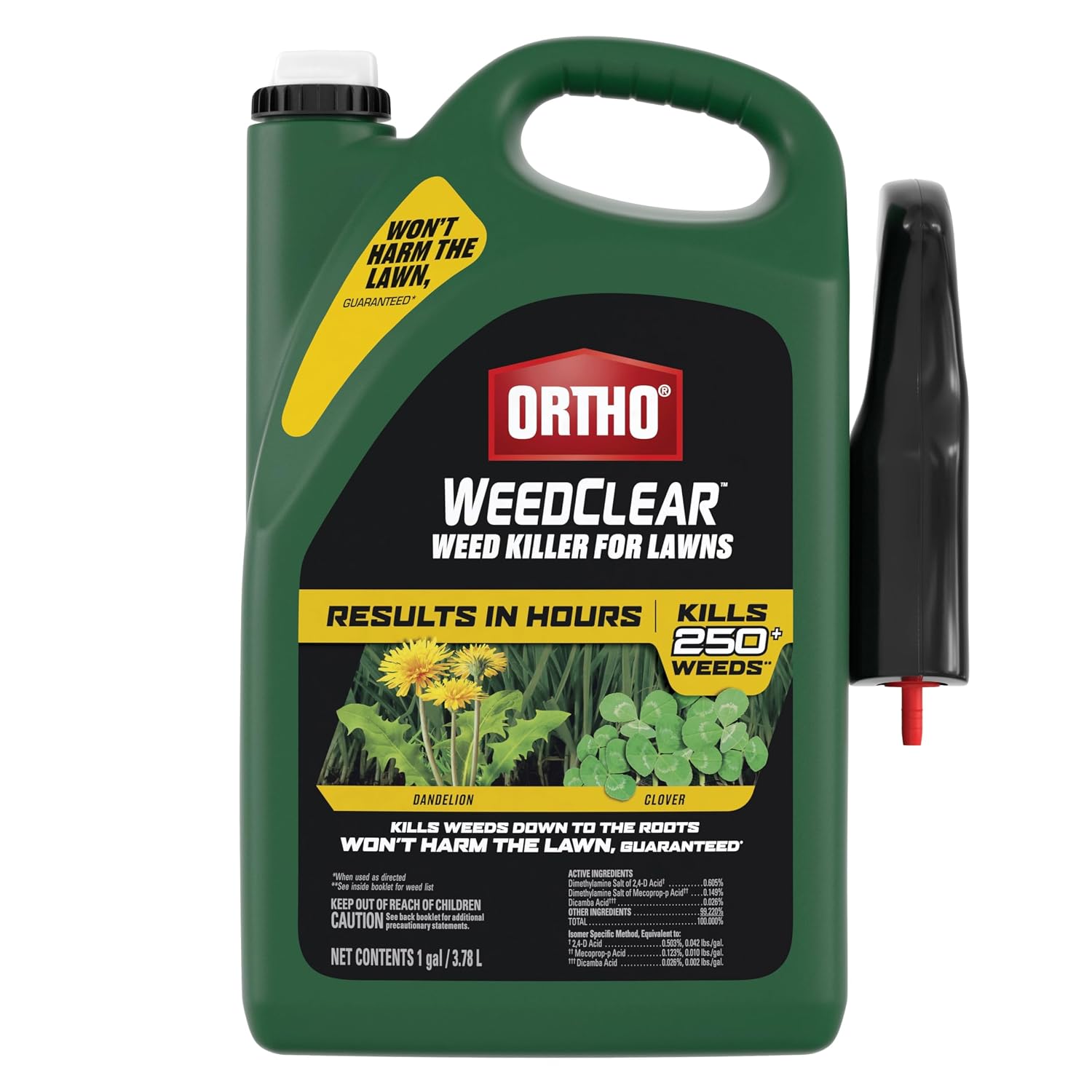
Ortho WeedClear Weed Killer for Lawns, Ready-to-Use, 1 gal.
| Unit Count | 128 Fluid Ounces |
|---|---|
| Item Form | Spray |
| Liquid Volume | 1 gallons |
| Active Ingredients | Herbicide |
Ortho WeedClear is a one-gallon ready-to-spray formula for spot-treating broadleaf lawn weeds like dandelion, clover, chickweed and oxalis. The bottle attaches to a trigger sprayer and lets you target individual weeds without treating the whole yard. It claims visible results in hours and becomes rainproof in about an hour, which helps when weather is unpredictable. The formula lists common herbicide actives and is labeled for use on many warm- and cool-season turfgrasses when directions are followed. Practical benefits include easy application with the attached trigger, coverage of over 250 listed weeds, and no need to mix concentrates for small jobs. Important limitations are that it is intended only for spot treatment rather than blanket lawn application and it contains synthetic herbicide ingredients so it does not meet organic standards; users must also avoid entry to treated areas until sprays dry and follow label safety directions. Best results come when weeds are small and actively growing in spring or fall and daytime temperatures are below 90°F.
Best for: Homeowners who want a straightforward, no-mix solution to remove individual broadleaf weeds quickly while preserving their lawn when used as directed.
Less Ideal for: People seeking an organic or all-natural weed control method or those who need long‑term, yardwide weed prevention should consider alternative products or approaches.
- Ready-to-use trigger sprayer for precise spot treatment
- Kills over 250 listed broadleaf weeds down to the root
- Rainproof after about one hour so treatments hold up to brief weather changes
- Visible results in hours for quick confirmation of effectiveness
- Contains synthetic herbicide actives and is not an organic product
- Designed for spot treatments only and not for treating entire lawns
Verdict: Choose Ortho WeedClear if you want an easy, ready-to-spray product for fast spot removal of common broadleaf weeds while keeping listed lawn grasses safe when used as directed.
Hi-Yield Atrazine Selective Herbicide, 32 oz

| Unit Count | 32 Ounce |
|---|---|
| Item Form | Liquid |
| Coverage | Full |
| Active Ingredients | atrazine |
This 32 oz Hi-Yield atrazine concentrate is a selective herbicide designed for St. Augustine and centipede grass. You dilute the concentrate per the label and apply it with a pump sprayer or watering can to treat up to about 3,720 sq ft, and the product is intended for early spring applications though it can be used in dormant or growing seasons. The formula targets common lawn weeds such as henbit, clover, and chickweed and is presented as a full-coverage liquid for even application. Practical benefits include a long coverage area from one bottle and clear directions for timing and application, which suit routine seasonal weed control. Important limitations are that it is grass-type specific and contains atrazine, so users must follow safety and storage instructions and check label restrictions for nearby plants and environmental considerations. Expect effective selective control when applied correctly, but confirm compatibility with your turf variety and local regulations before use.
Best for: Homeowners with St. Augustine or centipede lawns who prioritize efficient, season-based weed control and want a concentrate that covers a large area without specialty equipment.
Less Ideal for: Gardeners with different turf varieties, mixed ornamental beds, or those seeking an all-purpose or non-chemical weed solution should consider alternatives.
- Selective herbicide formulated specifically for St. Augustine and centipede grass
- Liquid concentrate treats up to roughly 3,720 square feet from one 32 oz bottle
- Clear label directions for dilution and timing make seasonal applications straightforward
- Effective on common broadleaf and grassy weeds like henbit, clover, and chickweed
- Contains atrazine which has application restrictions and environmental considerations
- Not suitable for turf types outside St. Augustine and centipede grass
Verdict: Choose this concentrate if you need a single, high-coverage selective herbicide specifically for managing weeds in St. Augustine or centipede lawns.
Southern Ag Atrazine St. Augustine Weed Killer, 32 oz

| Unit Count | 32 Fluid Ounces |
|---|---|
| Item Form | Spray |
| Coverage | 3,720 square_feet |
| Item Type Name | Specialty Herbicide |
Southern Ag Atrazine is a concentrated liquid herbicide made specifically for St. Augustine and centipede grasses. It is mixed into spray and applied across the lawn to suppress crabgrass and remove many common broadleaf and grassy weeds; one quart claims coverage of roughly 3,720 square feet when diluted at the recommended rate. The product is intended for targeted seasonal use, with best results from early spring applications and careful, overlap-free spraying. Practical benefits include a focused label for the two grass types and a coverage rate that stretches a single bottle across a medium-sized yard, which helps keep costs down. Important limitations are that it is a chemical herbicide requiring careful handling and strict label following, it is not recommended for hose-end sprayers, and it is not a fertilizer so it will not improve turf nutrition or overall lawn health by itself. Use protective gear and avoid off-target drift to protect desirable plants.
Best for: Buyers who need an affordable, targeted weed control for St. Augustine or centipede lawns and want a product that covers a medium-sized yard without repeated purchases.
Less Ideal for: Homeowners seeking an all-in-one lawn treatment for nutrition or for use on other grass types should choose a different product or combine this with appropriate fertilization.
- Formulated specifically for St. Augustine and centipede lawns for targeted control
- Concentrated formula with coverage up to about 3,720 sq ft per quart
- Controls a range of broadleaf and some grassy weeds including suppression of crabgrass
- Practical application instructions for spot or broadcast spray use in early spring
- Chemical herbicide that requires protective handling and careful application
- Not a fertilizer so it does not provide nutrients or improve turf vigor
Verdict: A cost-effective, concentrated herbicide for homeowners who need focused weed control on St. Augustine or centipede lawns.
Choosing the Right Liquid Weed Killer for Centipede Grass: Key Factors to Consider
Selectivity and Turf Safety
Centipede is more sensitive to some herbicide modes of action than other warm-season grasses. Prioritizing products labeled specifically for centipede reduces the risk of discoloration, thinning, or patching. Selectivity depends on the active ingredient and the formulation; systemic broadleaf options that are known to be safe on centipede are usually preferable for spot treatments.
Understanding label restrictions for mowing, irrigation, and re-entry intervals is part of turf safety. Even products labeled for centipede can cause stress if applied in hot, drought-stressed conditions, so timing and post-application care influence the real-world outcome as much as the chemical choice.
Target Weed Spectrum
Different liquid formulations control different types of weeds. Some focus on common broadleaves like clover, dollarweed, and plantain, while others include activity on sedges or young grassy weeds. Match the product to the weeds you see; a broad-spectrum liquid will reduce follow-up treatments for mixed infestations.
Also consider weed growth stage. Seedlings are usually easier to control than mature, deeply rooted perennial broadleaves. Product labels typically specify which life stages respond best, and that affects how quickly you should act when you spot new growth in the lawn.
Application Method and Equipment Compatibility
Liquid products vary in how they are applied: ready-to-use spray bottles, hose-end sprayers, or concentrates for pump sprayers and backpack units. For small lawns or isolated patches, a trigger bottle or spot sprayer gives precision and reduces product use. For larger areas, concentrates compatible with standard pump or tank sprayers are more efficient.
Check that the formulation mixes cleanly, does not clog nozzles, and that recommended spray volumes align with your equipment. Application flexibility also covers whether the label allows tank-mixing with surfactants, dyes, or fertilizer combinations for targeted use.
Timing and Environmental Conditions
Centipede lawns respond differently to herbicides depending on season and conditions. The best control often comes when weeds are actively growing and temperatures are moderate. Avoid treating during heatwaves, drought stress, or immediately after heavy rain when runoff risk is high.
Morning with dew burned off and calm wind is usually optimal for spray applications. Many labels also specify temperature ranges for safe application and conditions that increase volatilization or drift. Considering timing reduces turf stress and improves efficacy while limiting unintended impacts on nearby plants.
Residual Activity and Re-Treatment Needs
Some liquid herbicides provide residual control that prevents new weed seedlings for a period, while others act only as contact or systemic knockdown with little residual effect. Residual chemistry can lower the frequency of follow-up treatments but may also affect overseeding plans or nearby desirable plants.
Decide whether you need immediate knockdown, short-term suppression, or multi-week residual control based on your lawn management goals. Label guidance on re-seeding intervals and follow-up applications will determine whether a product fits your long-term maintenance plan.
Safety, Environmental Instructions, and Disposal
Liquid herbicides require careful handling to protect pets, people, and nearby garden beds. Favor products with clear personal protective equipment guidance, runoff precautions, and concrete disposal instructions for leftover concentrate.
Pay attention to buffer zone recommendations and restrictions around water features. Responsible use minimizes drift and runoff and reduces the chance of harming pollinators and ornamentals adjacent to the centipede turf.
When To Treat Centipede Lawns
Treat actively growing weeds rather than dormant patches. For centipede grass, the most effective windows are spring and early fall when weeds are metabolically active and the turf is not under extreme heat stress.
Avoid treatment during drought or heat waves and delay mowing a day or two before and after application to let the herbicide contact foliage and move systemically when appropriate.
- Spring and early fall are generally best for systemic broadleaf control
- Do not spray during extreme heat or drought
- Time applications when wind is light to reduce drift
Spot Treatment Vs Whole-Lawn Applications
Spot treating isolates product use and protects the rest of the lawn and adjacent plantings. Use a targeted spray or a wand with a shut-off to treat individual clumps or small patches.
Whole-lawn applications are appropriate when weeds are widespread. For broadcast use, choose concentrates that dilute accurately and follow label rates to avoid turf injury. Consider splitting large jobs into smaller sections to monitor centipede response.
- Spot treatment minimizes herbicide exposure to desirable turf
- Broadcast spraying requires careful calibration of sprayer and rate
- Look for products that allow both spot and broadcast use for flexibility
Managing Injury and Recovery
If you see temporary discoloration or slight thinning after application, monitor the lawn for a couple of weeks before taking corrective action. Centipede recovers relatively slowly, so avoid overlapping treatments unless the label advises it.
Support recovery with proper watering once the label allows and with light fertilization timed according to centipede's needs. Avoid reseeding until the label-specified re-seeding interval has passed to prevent chemical interference with new seedlings.
- Monitor affected areas for gradual recovery over 2 to 6 weeks
- Follow label intervals before reseeding or overseeding
- Use cultural practices to aid recovery rather than repeat chemical treatments
Mixing, Calibration, and Spray Techniques
Careful mixing and correct spray volume are essential to avoid under- or over-application. Use the label-specified water volume and sprayer settings. For pump sprayers, calibrate output per minute and measure area covered to match label rates.
Add surfactants only when the product label permits. For precision, use a spot wand with adjustable nozzles and mark recently treated areas to avoid double-spraying.
- Calibrate sprayers before application
- Measure treated area to calculate correct dilution
- Follow label guidance on additives like surfactants
Integrating Herbicide Use With Lawn Care
Herbicide use should be one part of an integrated lawn program that includes proper mowing height, irrigation, and soil fertility. A dense, healthy centipede stand naturally suppresses many weeds and reduces reliance on chemical control.
Correct mowing height and timing of fertilization can reduce weed pressure and improve herbicide effectiveness when treatment is needed. Use herbicides as a targeted corrective measure rather than the primary maintenance strategy.
- Maintain proper mowing height to reduce weed seed germination
- Water and fertilize according to centipede requirements for stronger turf
- Use herbicides selectively for spot control or heavy infestations
How We Chose the Best Liquid Weed Killer for Centipede Grass
We focused on products that offer reliable weed control while being compatible with centipede grass physiology and common lawn conditions. Selection prioritized formulations labeled for use on centipede, confirmed active ingredients known to control broadleaf weeds prevalent in warm-season lawns, and options that allow both spot and broadcast application depending on lawn size. We also considered application flexibility, such as spray concentration adjustments and compatibility with common spray equipment. Practical durability and re-treatment intervals mattered, as did clarity of instructions for water volume and timing to avoid turf injury. Safety and environmental guidance on the label were reviewed to favor products with clear use precautions and responsible disposal instructions. We excluded products explicitly labeled unsafe for centipede grass, granular-only formulations, and those without adequate label directions for spot application. The final shortlist balances selectivity, application ease, residual behavior, and label clarity.
FAQ
Can I use general-purpose lawn herbicides on centipede grass?
Often general-purpose products are labeled for several warm-season grasses, but not all are safe on centipede. Always check the label for centipede grass specifically. Using an unlabeled product can cause discoloration or turf injury.
How long after treatment will I see weed control results?
Results depend on the active ingredient and the weed species. Many broadleaf weeds show visible decline within a week, with full control over two to four weeks. Perennial weeds may take longer or require follow-up.
Is it safe to water my lawn after applying a liquid weed killer?
Most labels recommend avoiding heavy irrigation for a specified period after application to allow uptake. Light watering after the spray dries or following label instructions is usually acceptable, but check the product directions for exact timing.
Will liquid weed killers affect nearby flower beds or shrubs?
Drift and runoff can damage nearby ornamentals. Use low-drift nozzles, avoid spraying on windy days, and consider spot treating instead of broadcast applications near sensitive plants. Buffer zones on the label should be followed.
Can I overseed or reseed after using a liquid herbicide?
This depends on the herbicide's residual activity. Some products require waiting several weeks before reseeding. Check the label for re-seeding or overseeding intervals to avoid harming new seedlings.
How do I choose between a ready-to-use spray and a concentrate?
Choose ready-to-use for small lawns or isolated patches because it is convenient and reduces measuring errors. Concentrates are more economical for larger areas and allow precise calibration, but they require careful mixing and sprayer calibration.
Final Verdict
Focus on selectivity and application technique when choosing a liquid weed killer for centipede grass. Prioritize products labeled for centipede, match the active ingredient to the weeds you have, and pick an application method suited to the size of the job. Balance the need for residual control against restrictions for reseeding and environmental precautions. When in doubt, start with spot treatments, follow label directions precisely, and support treated areas with proper cultural practices. That approach minimizes turf risk while delivering effective weed control for healthy centipede lawns.
