

Note: This article contains affiliate links. If you click on these links and make a purchase, I may earn a small commission at no extra cost to you. This helps support my research and content. Read my full affiliate disclosure here.
A good pre emergent crabgrass preventer is the easiest way to stop crabgrass before it ever appears. Timing, coverage, and the right residual activity make the difference between a clean turf come summer and a seeding patch that needs constant repair. This guide shortlists five top options suited for common home lawns and explains how each meets the practical needs of seasonal pre-emergent use. We evaluated products on how well they distribute, how long they protect, and how they fit into standard lawn care schedules. Read on to understand the tradeoffs between coverage, timing, and post-application care so you can pick the right approach for your yard.
Top Picks at a Glance
| Best Quality Built to a higher standard if you want something more solid | Dimension DG Pro Granular Pre-Emergent Herbicide, 50 lb |  |
| Best Value The sweet spot between price and what you get | The Andersons Barricade 18-0-4 Granular Fertilizer with Pre-Emergent (18 lb, 5,000 sq ft) |  |
| Highest Rated A top-rated pick with lots of positive feedback | Quali-Pro Prodiamine Pre-Emergent Herbicide, 5 lb Granules |  |
| Most Popular A crowd favorite that many people choose with confidence | The Andersons Barricade Professional-Grade Granular Pre-Emergent Weed Control (40 lb) |  |
| Best Seller A high-volume bestseller chosen again and again | Scotts Halts Crabgrass & Grassy Weed Preventer, 10.06 lb. |  |
Dimension DG Pro Granular Pre-Emergent Herbicide, 50 lb

| Item Form | Granule |
|---|---|
| Coverage | 10000 square feet to 14000 square feet |
| Active Ingredients | Dithiopyr, Herbicide |
| Unit Count | 800 Ounce |
Dimension DG Pro is a professional-style granular pre-emergent that prevents germination of many annual grasses and broadleaf weeds and offers limited early post-emergent control of young crabgrass. It is applied by broadcasting across lawns, turf, and ornamental landscapes; one 50 lb bag treats roughly 10,000 to 14,000 sq ft depending on the application rate. Key features include a small-particle formulation for more even distribution and 0.25% dithiopyr active ingredient for season-long control of listed weeds such as crabgrass, chickweed, dandelion, and poa annua. Practically, the product reduces the need for repeated spot treatments during the growing season and is suitable for large yards, sports turf, and professional crews. Important limitations are that it is a preventative product so it will not remove established broadleaf weeds and safety precautions are required around children, pets, and desirable plants; follow label directions for rates and timing to avoid turf injury.
Best for: Buyers who prioritize strong pre-emergent performance for large lawns, sports turf, or professional maintenance crews and want a product that reduces repeat spot treatments during the season.
Less Ideal for: Casual gardeners with small yards who need a quick curative weed killer or those who prefer liquid or ready-to-use products for spot treatment.
- Large 50 lb supply treats a substantial area per application
- Small particle formulation promotes more even spread and product dispersibility
- Contains dithiopyr for season-long pre-emergent control and early crabgrass suppression
- Label lists control of over 40 grass and broadleaf weeds, useful for diverse turf problems
- Pre-emergent action will not kill established mature weeds
- Requires careful timing and correct application rate for effective control
Verdict: Choose Dimension DG Pro when you need a concentrated, season-long granular pre-emergent that covers large areas and delivers professional-strength prevention of common annual turf weeds.
The Andersons Barricade 18-0-4 Granular Fertilizer with Pre-Emergent (18 lb, 5,000 sq ft)

| Item Form | Granule |
|---|---|
| Coverage | 5,000 sq ft |
| Active Ingredients | Prodiamine |
| Unit Count | 288 Ounce |
The Andersons Barricade is a combined pre-emergent weed controller and fertilizer intended for preventive lawn care over roughly 5,000 square feet. You apply it in early spring or fall to establish a chemical barrier that stops weed seeds such as crabgrass, poa annua, and goosegrass from germinating, while the 18-0-4 formulation supplies nitrogen and potassium to promote thicker turf. The product uses a dispersible granule technology so particles dissolve quickly with watering and move into the soil where prodiamine works most effectively. Practical users will appreciate that it is designed specifically for prevention rather than post-emergent weed removal, so it should be part of a seasonal maintenance plan rather than a quick fix for existing infestations. Directions limit application timing to early spring and fall, and it will not kill established weeds, so expect to combine this with spot treatments or mechanical removal if you already have visible weeds. Overall it simplifies routine turf care by pairing nutrition and preventive weed control in one product for landscape-scale yards.
Best for: Homeowners who plan seasonal lawn maintenance and want to prevent weed emergence while supplying nitrogen to encourage thicker turf; good for those who schedule spring and fall treatments into their yard care routine.
Less Ideal for: People needing an immediate solution for visible or mature weed problems or those who require year-round weed control without seasonal applications.
- Combines pre-emergent herbicide and fertilizer so one application both feeds turf and prevents seeded weeds
- Covers up to 5,000 sq ft per bag, suitable for medium to large lawns
- Dispersible granule (DG) technology dissolves quickly and moves active ingredient into the soil after watering
- Targets a broad range of common grassy and broadleaf weeds including crabgrass and poa annua
- Does not control or remove existing weeds because it is a preventive product
- Application is season-limited to early spring and fall for best efficacy
Verdict: A convenient single-bag solution for preventive lawn care that pairs prodiamine weed prevention with 18-0-4 feeding to keep lawns thicker and reduce new weed pressure.
Quali-Pro Prodiamine Pre-Emergent Herbicide, 5 lb Granules

| Item Form | Granule |
|---|---|
| Coverage | Pre-emergent grass and broadleaf weed control, season long crabgrass control |
| Active Ingredients | Prodiamine 65% |
Quali-Pro Prodiamine is a granular pre-emergent herbicide designed to prevent germination of common annual grassy and broadleaf weeds across lawns and landscape beds. You apply it before weed seeds germinate in spring or as a fall treatment to build residual control through the growing season. The product contains 65% prodiamine, which is widely used for reliable, long-lasting control of crabgrass, annual bluegrass and several broadleaf weeds, and it mixes readily when tank-mixed with fertilizers or iron. In real-world use it offers predictable, season-long suppression when applied at the labeled rate and incorporated by irrigation or rainfall. Important practical limits are that it is preventive only and will not kill established weeds, and proper timing and rate are essential to avoid reduced effectiveness. For larger areas the 5 lb package covers moderate lawn acreage but may require multiple bags for extensive turf.
Best for: Homeowners and lawn care professionals who prioritize a dependable, season-long preventive solution to keep crabgrass and annual weeds from establishing in turf.
Less Ideal for: Gardeners needing a post-emergent solution for existing weeds or those who prefer liquid ready-to-use products for spot treatments.
- High active ingredient concentration (Prodiamine 65%) for long residual control
- Granular form allows easy broadcast application and tank mixing with fertilizers
- Effective season-long crabgrass and annual weed suppression when applied correctly
- Suitable for spring or fall applications to build preventive control
- Pre-emergent only and will not control established weeds
- 5 lb bag may be insufficient for large lawns without purchasing additional quantity
Verdict: Choose this prodiamine granule when you want a proven, season-long preventive herbicide to reliably stop crabgrass and other annual weeds before they start.
The Andersons Barricade Professional-Grade Granular Pre-Emergent Weed Control (40 lb)

| Item Form | Granule |
|---|---|
| Coverage | 12880 square_feet |
| Active Ingredients | Herbicide (prodiamine 0.48%) |
| Unit Count | 640 Ounce |
The Andersons Barricade is a granular pre-emergent designed to stop common weeds before they emerge rather than kill existing plants. It contains 0.48% prodiamine and uses a dispersible granule formulation that dissolves quickly with watering so the active ingredient moves into the soil where seeds germinate. Typical use is a broadcast application across established turf and ornamental beds in early spring or fall following label rates to cover up to the listed square footage. Notable features include small particle granules for broader coverage and a professional-strength active ingredient used to prevent crabgrass, poa annua, goosegrass and many broadleaf weeds. The practical benefits are long-lasting prevention when timed correctly and efficient coverage for larger yards thanks to the 40 lb bag. Limitations to plan for are that it will not remove existing weeds, it requires precise application timing and watering to activate, and safety precautions are necessary because the product is harmful if ingested or contacts skin.
Best for: Buyers who prioritize proven, professional-strength prevention for medium to large lawns and want a product backed by many user reviews and established performance.
Less Ideal for: Gardeners who need to eliminate established weeds, have very small yards where large-volume packaging is impractical, or prefer non-chemical weed control methods.
- Dispersible granule formula that dissolves quickly with water to move the active ingredient into the soil
- Professional-grade active ingredient prodiamine effective against common grassy and broadleaf weeds
- Small particle size for broader coverage per square inch
- Large 40 lb bag intended to cover a wide area without frequent repurchasing
- Does not control or kill existing weeds, only prevents new ones
- Requires correct timing and follow-up watering to be effective
- Contains herbicide active ingredients that require careful handling and adherence to safety directions
Verdict: Choose Barricade when you need a reliable, professional-strength pre-emergent to prevent common lawn weeds across a large area.
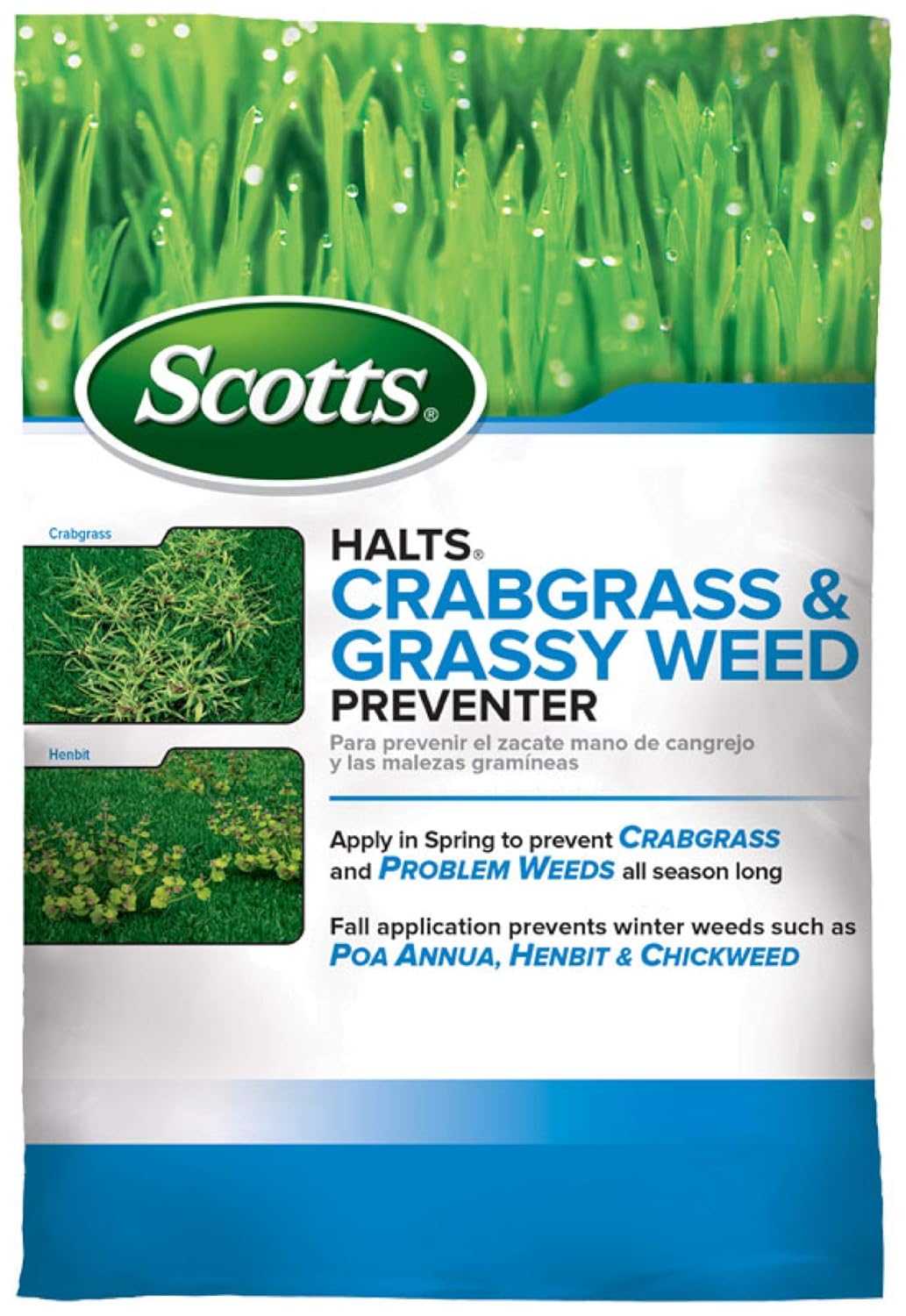
Scotts Halts Crabgrass & Grassy Weed Preventer, 10.06 lb.
| Item Form | Granule |
|---|---|
| Coverage | 5000 square_feet |
| Active Ingredients | Pendimethalin 1.71% |
Scotts Halts is a granular pre-emergent formulated to stop crabgrass and seeded grassy weeds from germinating across established lawns. You apply it dry with a broadcast spreader in early spring or fall, then water it in as directed; the active ingredient pendimethalin forms a soil barrier that prevents weed seedlings from emerging and is advertised as resistant to rain, snow, or freezing after application. This bag treats up to 5,000 square feet and is intended for use on most turf types except Dichondra and Bentgrass. The practical benefits are straightforward: a single timed application protects turf from several common annual weeds without needing spot herbicide treatments, and the granule form makes even coverage with a spreader easy. Important limitations are that it does not kill existing mature weeds and cannot be used on newly seeded or sprigged areas until months later, so timing and measuring lawn area matter. Also repeat applications for certain weeds like goosegrass may be necessary according to label instructions.
Best for: Homeowners who plan lawn care around seasonal timing and want a preventive, low-effort way to stop annual grassy weeds before they emerge.
Less Ideal for: People needing to remove existing weed infestations, those reseeding or establishing new turf within months, or gardeners who require immediate weed knockdown.
- Pre-emergent action prevents crabgrass and listed grassy weeds before they germinate
- Covers up to 5,000 sq ft per bag for single-application protection
- Granule form designed for even spreader application and easy watering activation
- Rain, snow, or freezing after application will not reduce effectiveness
- Does not control existing mature weeds so not useful for established infestations
- Not safe for newly seeded or freshly sprigged lawns for several months
Verdict: Use this granular pre-emergent if you want a seasonal, preventative barrier against crabgrass and common grassy weeds on an established lawn up to 5,000 sq ft.
Choosing the Right Pre Emergent Crabgrass Preventer: Key Factors to Consider
Application Timing
Timing determines whether a pre emergent works. Most crabgrass seeds germinate as soil temperatures reach a specific threshold in spring, so applying too early wastes product and applying too late lets seedlings emerge.
Gardeners should track local soil temperatures or use phenological cues such as forsythia bloom to time treatment. A single well-timed application often outperforms multiple poorly timed ones. Consider regional climate, typical last frost dates, and any planned soil disturbance that could bring dormant seed to the surface before scheduling application.
Coverage and Spread Pattern
Even distribution across the lawn is essential. Granular products require a calibrated spreader and consistent walking speed, while liquid applications depend on nozzle type and overlap to avoid streaks.
Uneven coverage creates gaps where crabgrass can establish. When choosing a product, think about the size and shape of the lawn and your preferred application method. For irregular lawns or areas with obstacles, choose a product and applicator that allow precise control of spread or spray pattern.
Residual Length and Reapplication Window
Residual activity is how long the pre emergent keeps crabgrass seed from germinating. Short residuals may require repeat applications to cover extended germination periods, while long residuals can protect through the vulnerable window but may affect overseeding.
Match the product's labeled control duration to local germination timing. If you plan to overseed or plant cool-season grass in fall, choose a product with a shorter residual or follow label instructions for reseeding intervals to avoid inhibiting desirable grass establishment.
Turf Compatibility and Plant Safety
Not every pre emergent is safe on all turf species or landscape plants. Some labels restrict use on newly established lawns, certain warm- or cool-season grasses, or near garden beds with annuals and vegetables.
Verify the label for your grass type and any adjacent plants. If you have mixed turf species, select a product with broad compatibility or treat areas separately according to instructions to prevent damage to desirable plants.
Ease of Application and Equipment Needs
The practical work of applying a pre emergent matters. Granular formulas usually need a broadcast spreader, while liquids need a tank sprayer and careful mixing. Ease of application affects accuracy and likelihood you'll follow label rates.
Consider how comfortable you are with calibration and cleanup. If you have a large lawn, look for products designed for mechanized spreaders. For small or oddly shaped yards, a sprayer with fine control or a hand spreader may be more practical to achieve uniform coverage.
Safety, Storage, and Environmental Considerations
Pre emergents include active ingredients that require safe handling, proper storage, and attention to nearby non-target plants. Labels specify protective equipment, re-entry intervals, and buffer distances from water features.
Store products in original containers, follow disposal guidance, and avoid application before heavy rain. Read environmental precautions carefully, especially if you have pollinator plantings, nearby water, or sensitive ornamentals, and choose application timing and placement to minimize off-target exposure.
When to Apply a Pre Emergent
Successful crabgrass prevention hinges on timing. Soil temperature monitoring is the most reliable guide; many regions use a soil thermometer to apply when the top 1 to 2 inches of soil reach roughly the target germination temperature for crabgrass. If you do not use a thermometer, seasonal plant indicators like early spring flowering shrubs provide a practical cue.
Also consider the weather forecast. Apply before sustained warm spells that trigger germination and avoid application just prior to heavy rain that could wash product off the target area. For longer protection windows, some products allow one application in spring and an optional follow-up later in the season per label instructions.
- Use soil temperature or local phenological cues to time application
- Avoid application immediately before heavy rainfall
- Follow label guidance on single versus split applications
Tools and Spreaders That Improve Coverage
Choosing the right applicator reduces waste and improves performance. For granular products, a broadcast spreader with adjustable settings gives the most consistent laydown across an entire lawn. Hand-held spreaders can work for small patches but require careful calibration and overlapping to prevent streaks.
For liquids, a well-maintained pump sprayer with an even nozzle pattern helps ensure consistent coverage. Rinse equipment after use and follow the product label for mixing rates and tank-cleaning procedures to avoid contamination of future mixes.
- Calibrate spreaders on a small test area before full application
- Maintain sprayers to prevent nozzle clogging and drift
- Wear recommended protective gear during mixing and application
Managing Overseeding and Lawn Renovation
If you plan to overseed or renovate, residual pre emergents can interfere with new grass seed germination. Read the label for the recommended wait time between application and seeding. Some products allow seeding after a specific number of weeks, while others require longer delays or alternative renovation strategies.
Timing renovation for early fall or late summer when residual activity has waned is often the safest approach. Where immediate seeding is necessary, choose a product with a short labeled residual or use mechanical removal and soil incorporation techniques to reduce residual effects locally.
- Check label for reseeding intervals
- Plan major renovations outside of residual windows when possible
- Consider spot treatments or soil preparation to remove residuals in small areas
Handling Rain, Irrigation, and Water Safety
Many pre emergents require light watering-in to move the active ingredient into the soil where it will form the barrier against seed germination. Follow the label for exact irrigation amounts and timing after application. Avoid overwatering which can move product beyond the target zone and under-watering which reduces effectiveness.
Protect nearby water bodies and avoid applying before heavy rain or when runoff is likely. Maintain buffer distances and follow any site-specific instructions to reduce off-target movement and environmental impact.
- Light irrigation often needed after application per label
- Avoid application before heavy rain to reduce runoff risk
- Respect buffer zones and environmental precautions
Integrating Pre Emergents Into an Annual Lawn Care Plan
Pre emergents are one component of a broader lawn care strategy that includes proper mowing, fertilization, and overseeding. Use a pre emergent in synchronization with fertilization schedules and cultural practices to improve overall turf health, which reduces the opportunity for crabgrass to invade.
Document application dates, weather conditions, and any observed results to refine timing year to year. Well-drained, well-fed turf is less prone to invasion, so pair chemical prevention with cultural improvements for the best long-term outcome.
- Coordinate applications with fertilization and mowing
- Record dates and conditions to optimize future timing
- Pair chemical control with cultural practices for durable results
How We Chose the Best Pre Emergent Crabgrass Preventer
To build this list we focused on attributes that matter in real lawns: uniform coverage across typical application methods, predictable residual control time that matches regional crabgrass germination windows, compatibility with common turfgrass species, and practical safety and re-entry guidance for home gardeners. We prioritized products that perform reliably when applied at recommended timing rather than ones that promise one-size-fits-all control. Our filters excluded materials intended only for spot treatment or for post-emergent control. We also excluded items lacking clear application rates or those with unusually complex timing requirements that are impractical for average homeowners. Key evaluation dimensions were spread uniformity, labeled residual length, turf compatibility, ease of application, and homeowner safety instructions. These criteria align with what gardeners need to prevent crabgrass proactively while protecting desirable grasses and landscape plants.
FAQ
Can I apply a pre emergent after I already see crabgrass seedlings?
Usually a pre emergent will not control established seedlings because it prevents germination rather than killing live plants. For visible seedlings, a post-emergent treatment or manual removal is typically needed. Consider using a pre emergent next season with adjusted timing to prevent recurrence.
How soon after applying can I mow or let pets on the lawn?
Label instructions vary, but many products allow normal mowing after the application and any required irrigation has dried. Pet re-entry times are also product specific. Always check the label for re-entry intervals and recommended drying or irrigation times before allowing foot or pet traffic.
Will a pre emergent affect flower beds or vegetable gardens nearby?
Pre emergents can move off-target through runoff or drift and may inhibit germination of desirable plants if they reach the beds. Maintain buffer distances and avoid spraying or spreading near garden soil where you plan to sow seeds. Use targeted application methods and follow environmental precautions on the label.
How often do I need to reapply a pre emergent in a single growing season?
It depends on the product's labeled residual length and your local germination window. Some products provide a single application that covers the full risk period, while others recommend a second application later in the season. Follow the label guidance and local extension recommendations for timing.
Can I overseed my lawn the same year I use a pre emergent?
Often you must wait a specified period between pre emergent application and seeding because residuals can prevent grass seed germination. If overseeding is planned, choose a product with an appropriate reseeding window or schedule overseeding when residual activity has subsided.
Final Verdict
Choosing the right pre emergent comes down to timing, coverage, and matching residual length to your local crabgrass germination pattern. Prioritize products that offer uniform application, clear label guidance for turf compatibility, and a residual duration that fits your lawn care calendar. Balance the need for long protection with plans to overseed or renovate. When in doubt, follow label instructions and local extension advice to protect desirable turf while preventing crabgrass before it starts.
