

Note: This article contains affiliate links. If you click on these links and make a purchase, I may earn a small commission at no extra cost to you. This helps support my research and content. Read my full affiliate disclosure here.
Spring is the critical window to restore color and build roots in St. Augustine turf. The right fertilizer applied at the correct time gives you faster green-up, reduces stress during summer heat, and helps the grass compete with weeds. This guide covers seven top-rated fertilizer options selected for St. Augustine grass in spring, each chosen because it suits common home lawn conditions and typical seasonal timing. We evaluated products using nutrient profile, release type, and ease of application so you can pick a formula that fits your maintenance plan. Below are practical notes on what matters and how to apply fertilizer safely and effectively for the season.
Top Picks at a Glance
| Best Overall The best all-around choice for most situations | The Andersons Professional PGF 16-0-8 Granular Lawn Fertilizer with Humic DG, 40 lb |  |
| Best Quality Built to a higher standard if you want something more solid | LESCO 50 lb. St. Augustine Grass Weed and Feed (Penoxsulam) |  |
| Best Value The sweet spot between price and what you get | PETRAMAX Neighbor’s Envy Liquid Lawn Fertilizer Concentrate (1 gal) |  |
| Best Budget The cheapest option that still gets the job done reliably | GreenView Lawn Food 22-0-4, 16 lb bag |  |
| Highest Rated A top-rated pick with lots of positive feedback | Emerald Lawn 10-0-20 Slow-Release Fertilizer, 18 lb |  |
| Most Popular A crowd favorite that many people choose with confidence | Scotts Turf Builder Southern Lawn Food, 14.06 lb |  |
| Best Seller A high-volume bestseller chosen again and again | Scotts Turf Builder Lawn Food, 12.5 lb |  |
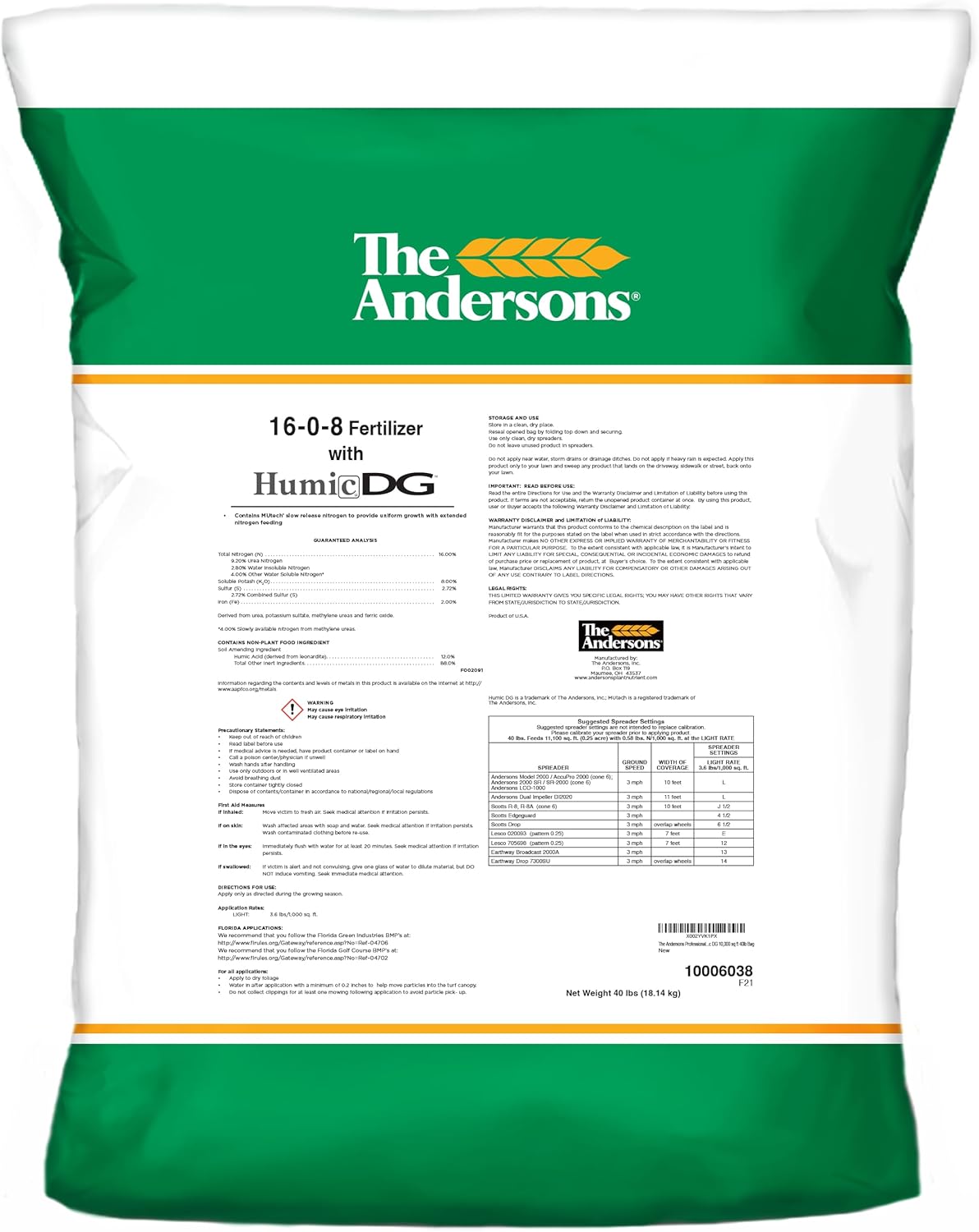
The Andersons Professional PGF 16-0-8 Granular Lawn Fertilizer with Humic DG, 40 lb
| Form | Granules |
|---|---|
| Specific Uses For Product | Lawns |
| Target Species | lawn grasses |
| Mixing Ratio | 1:4.5 |
The Andersons Professional PGF 16-0-8 is a granular lawn fertilizer designed to deliver both immediate and extended nitrogen feeding while adding humic DG and micronutrients. It is intended for broadcast spreader use on lawns and is applied at 3.6 pounds per 1,000 sq ft every 6 to 8 weeks. The super-fine granules promote even distribution, which helps avoid streaking and ensures more uniform green-up. Because the formula is phosphorus-free and includes iron and Humic DG, it supports turf color and soil health without adding phosphorus. Practical benefits include a mix of quick- and slow-release nitrogen for steady growth, clear directions for application rates, and a resealable bag for storage. Limitations to consider are that it is not labeled for use in some states and centipede lawns require a reduced rate, and like any granular fertilizer, correct spreader calibration and dry application conditions are important to avoid uneven results or runoff risk.
Best for: Buyers who want reliable, performance-focused feeding to green and maintain warm-season lawns like zoysia with predictable scheduling and steady growth.
Less Ideal for: Homeowners seeking a fertilizer to correct phosphorus deficiency or those who need a product approved for restricted states should look elsewhere.
- Blend of quick- and slow-release nitrogen for immediate color and up to eight weeks of feeding
- Super-fine granules for more even spread and reduced streaking
- Includes iron, micronutrients, and Humic DG to support turf color and soil biology
- Clear application rate and schedule guidance with a resealable bag for storage
- Phosphorus-free formula may not address phosphorus-deficient soils
- Not labeled for sale or use in certain states
Verdict: Choose this fertilizer when you want a performance-oriented, even-spreading granular feed that delivers immediate color and up to eight weeks of controlled nitrogen for warm-season lawns like zoysia.
LESCO 50 lb. St. Augustine Grass Weed and Feed (Penoxsulam)

| Item Form | Granules |
|---|---|
| Coverage | St. Augustine Grass (12,000 – 14,000 sq. ft.) |
| Target Species | St. Augustine Grass |
| Mixing Ratio | 1:0:1 |
This LESCO product is a granular weed-and-feed formulated for St. Augustine turf, packaged in a 50 lb bag to cover roughly 12,000 to 14,000 sq ft. It combines a balanced 17-0-17 fertilizer with 30% poly coated sulfur coated urea for slow release feeding up to eight weeks and includes penoxsulam for post-emergent broadleaf weed control in St. Augustine varieties including Floratam. Typical use is to apply when the turf is wet, let granules dry on the grass, and expect visible improvement within about two weeks. The slow-release nitrogen reduces the need for frequent reapplications and the specified coverage makes it practical for medium to large lawns. Limitations are that the formula and coverage are focused on St. Augustine only, so it is not suited for other turf types, and a single 50 lb bag is bulky to handle for small-yard users. Also, as with any weed-and-feed, timing and correct application rate matter to avoid turf stress or uneven results.
Best for: Homeowners with established St. Augustine lawns who want a combined slow-release fertilizer and weed control solution to reduce application frequency and maintain even feeding over weeks.
Less Ideal for: People with mixed-species lawns, small yards where a large bag is impractical, or those who need a pure fertilizer without herbicide active ingredients.
- Formulated specifically for St. Augustine grass, including Floratam.
- Balanced 17-0-17 fertilizer with 30% poly coated sulfur coated urea for up to 8 weeks slow feeding.
- Includes penoxsulam for post-emergent broadleaf weed control.
- Large 50 lb bag covers approximately 12,000–14,000 sq ft, suitable for medium to large lawns.
- Designed only for St. Augustine turf and may damage or be ineffective on other grass types.
- Large bag can be heavy and awkward for a single user to handle and spread manually.
Verdict: A convenient, slow‑release weed-and-feed tailored to St. Augustine lawns that supplies weeks of feeding while controlling broadleaf weeds.
PETRAMAX Neighbor’s Envy Liquid Lawn Fertilizer Concentrate (1 gal)

| Item Form | Liquid |
|---|---|
| Application Method | Spray |
| Coverage | 16000 |
| Target Species | Lawn Grass |
| Liquid Volume | 128 fluid ounces |
Neighbor’s Envy is a concentrated liquid fertilizer designed to deliver rapid greening and improved turf vigor when applied with a sprayer or hose-end applicator. It combines a high nitrogen content with iron, humic and fulvic acids, potassium, sulfur and sea kelp so you can feed for color, root strength and stress resistance in a single application. Use it on Zoysia and other warm- and cool-season turfs; dilution and spray application let you treat large areas without spreading granular product. Practical benefits include visible color improvement within days, soil-conditioning ingredients that support longer-term health, and pet-safe labeling for everyday yards. Limitations are that performance depends on correct mixing and even spray coverage, and a liquid concentrate requires a sprayer and careful measurement to avoid overapplication. For gardeners focused on efficient, repeatable lawn maintenance, this product simplifies multiple inputs into one bottle but still requires basic application skill to get consistent results.
Best for: Homeowners who want a time-saving, all-in-one liquid treatment to improve Zoysia color and vigor across medium to large lawns while minimizing separate products.
Less Ideal for: People who prefer granular slow-release programs or those unwilling to handle dilution and spray application should consider alternative formats.
- High nitrogen plus iron formula for quick, deep greening of turf
- Includes humic/fulvic acids and sea kelp to support soil health and stress tolerance
- Liquid concentrate covers up to 16,000 sq ft for efficient large-lawn applications
- Designed for spray application so it distributes evenly when applied correctly
- Requires accurate dilution and a sprayer to avoid uneven coverage or overfeeding
- No specific N-P-K breakdown beyond listed ingredients for precise nutrient planning
Verdict: A single, spray-applied concentrate that combines nitrogen, iron and soil conditioners to quickly green and strengthen Zoysia with one convenient product.
GreenView Lawn Food 22-0-4, 16 lb bag

| NPK | 22-0-4 |
|---|---|
| Form | Granules |
| Coverage | 5,000 sq. ft. |
| Application | Broadcast or drop spreader |
GreenView Lawn Food is a granular, broadcast-applied lawn fertilizer designed to boost root development, speed spring green-up, and maintain deeper green color through an eight-week controlled-release formula. You apply it with a broadcast or drop spreader over up to 5,000 sq. ft., and the MESA controlled-release nitrogen delivers both immediate and slow-release nutrition so you get quicker green-up without a surge of excessive top growth. The zero-phosphate 22-0-4 blend focuses on nitrogen and potassium to improve drought resistance and nutrient uptake in established turf. Practical benefits for summer care include longer feeding intervals, better water retention from improved root vigor, and fewer repeat applications compared with quick-release products. Limitations are that it is not a starter fertilizer for new seed because it contains no phosphorus and it requires a spreader for even coverage; hand spreading is discouraged. Also the 16 lb bag suits small to medium lawns rather than large properties where multiple bags would be needed.
Best for: Homeowners who want a low-maintenance summer feed that reduces how often you need to reapply and prioritizes steady green-up and root health.
Less Ideal for: Those establishing new lawns from seed or managing large commercial turf areas who need phosphorus or high-coverage bulk quantities.
- Controlled-release MESA nitrogen gives up to 8 weeks of feeding for fewer applications
- Applicable with common broadcast or drop spreaders for even coverage
- Zero-phosphate formula aligns with lawn-use restrictions and protects waterways
- 22-0-4 NPK focuses on root development and drought resilience
- Not suitable as a phosphorus-containing starter fertilizer for new seed
- 16 lb bag covers about 5,000 sq. ft. so larger lawns will need multiple bags
Verdict: A convenient, controlled-release summer lawn food that keeps small to mid-size lawns greener longer with fewer applications.
Emerald Lawn 10-0-20 Slow-Release Fertilizer, 18 lb

| NPK | 10-0-20 |
|---|---|
| Slow-release nitrogen | 45% of nitrogen |
| Net weight | 18lbs |
This 18 lb Emerald Lawn fertilizer is a granular 10-0-20 formula designed to feed lawns steadily for up to eight weeks. It combines 45% slow-release nitrogen with iron and a micronutrient package so you can darken turf color without forcing excessive top growth. The higher potassium level helps with drought and stress tolerance while micronutrients support overall turf metabolism. Typical use is broadcast application on centipede and other listed turf types at the recommended intervals in the growing season for even feeding and reduced nutrient loss. Practical benefits include fewer applications thanks to the slow-release fraction and targeted nutrient balance that supports both color and root strength. Limitations are that this product does not contain phosphorus and so is not suitable where phosphorus is needed, and timing matters—apply within the recommended windows for cool or warm season grasses to avoid suboptimal results.
Best for: A homeowner who wants reliable, low-maintenance fertilization to maintain darker, healthier centipede lawns with fewer feedings and attention to timing.
Less Ideal for: Lawns that need phosphorus correction or new sod/seed establishment where starter fertilizers with phosphorus are recommended.
- Slow-release nitrogen provides steady feeding for up to eight weeks
- Contains iron and micronutrients to improve turf color without excessive top growth
- Higher potassium content supports drought and stress resistance
- Granular form is easy to broadcast over established lawns
- No phosphorus in the NPK ratio, so not appropriate where phosphorus is required
Verdict: Choose this fertilizer if you want a steady, low-maintenance feeding that enhances centipede lawn color and stress tolerance with fewer applications.
Scotts Turf Builder Southern Lawn Food, 14.06 lb

| Item Form | Granules |
|---|---|
| Application Method | spreader |
| Coverage | 5,000 sq. ft. |
| Mixing Ratio | 32-0-10 |
| Target Species | Southern lawns, Southern grass |
Scotts Turf Builder Southern Lawn Food is a granular fertilizer made specifically for southern warm-season grasses such as Zoysia, St. Augustine, Bermuda, Bahia, and Centipede. It is designed for broadcast or drop spreader application and uses slow-release nitrogen in every granule so you can apply one feeding and expect up to six weeks of greening. Typical use is in the growing season—apply after the first spring mow or in recommended fall windows and follow spreader settings listed on the bag; light watering after application speeds results but is not required. Practical benefits include even coverage from all-in-one particles, deeper root development to help through heat and drought, and a known feeding schedule for repeat applications. Important limitations are that it contains phosphorus so local restrictions may apply and it is not a weed-and-feed product, so broadleaf weeds will not be controlled by this bag. The product is most useful when paired with a proper spreader and timing that matches Zoysia's fall growth window.
Best for: Homeowners who prioritize a reliable, low-risk fertilizer tailored to Zoysia and other southern warm-season lawns and who prefer predictable, infrequent feedings with measured spreader guidance.
Less Ideal for: Gardeners who need a fertilizer that also controls weeds or who must avoid phosphorus due to local restrictions should consider alternative weed-and-feed or phosphorus-free products.
- Formulated for warm-season southern grasses including Zoysia
- Slow-release nitrogen in each granule for up to six weeks of feeding
- All-in-one particles promote even distribution and consistent greening
- Builds deeper roots to help maintain color through heat and drought
- Contains phosphorus which may be restricted by local regulations
- Does not include weed control so separate weed treatment may be needed
Verdict: A dependable, slow-release granular feed designed to strengthen roots and keep Zoysia green with a single application lasting about six weeks.
Scotts Turf Builder Lawn Food, 12.5 lb

| Item Form | Powder |
|---|---|
| Specific Uses For Product | Lawn |
| Coverage | 5,000 sq. ft. |
| Mixing Ratio | 32:0:4 |
Scotts Turf Builder Lawn Food is a general-purpose granular fertilizer formulated for use on any grass type to thicken turf and improve root strength. You spread it with a broadcast or drop spreader (Scotts provides recommended settings) and can apply it to wet or dry lawns in spring, summer, or fall. The formula is pesticide-free and emphasizes building deeper roots so the lawn better absorbs water and nutrients, which helps turf resist stress over the season. One 12.5 lb bag covers about 5,000 sq. ft., making it a simple option for small to medium yards or spot treatments. Practical benefits include clear application guidance, compatibility with common spreaders, and the option to water in for faster greening. Limitations are that this single bag covers a modest area compared with larger homeowner bags and it does not include weed control or insect protection, so you may need additional products for comprehensive lawn care.
Best for: Buyers who want a reliable, easy-to-apply granular fertilizer to strengthen and green a small to medium lawn and prefer products with widespread user approval and clear instructions.
Less Ideal for: Homeowners needing one-step weed or pest control, or those with large properties who want a single bag to cover many thousands of square feet.
- Works on all common grass types so one product fits mixed lawns
- Builds stronger, deeper roots to improve water and nutrient uptake
- Clear spreader settings and can be applied to wet or dry turf for flexibility
- Pesticide-free formula suitable when you only want fertilization
- Covers only about 5,000 sq. ft. per bag, requiring multiple bags for larger yards
- Does not include weed or insect control so additional products may be needed
Verdict: A reliable, easy-to-use granular lawn food that builds stronger roots and is a solid choice for feeding small to medium lawns.
Choosing the Right Fertilizer for St. Augustine Grass in Spring: Key Factors to Consider
Nitrogen Timing and Form
Nitrogen is the primary driver of spring green-up for St. Augustine grass, but the timing and chemical form matter. In early to mid spring you want a mix that gives an initial boost without forcing too much succulent growth before temperatures stabilize. Fast-release nitrogen sources, such as urea or ammonium sulfate, provide quick color but increase burn risk and require more frequent mowing.
Slow-release or polymer-coated nitrogen reduces flush growth and supplies steady nutrition over several weeks, which aligns with gradual turf recovery. Look for fertilizers that list both water-soluble and slow-release nitrogen so you get an early lift followed by sustained feeding. The specific balance affects how often you need to reapply during the growing season.
Phosphorus and Root Development
Phosphorus supports root development, which is important in spring if your lawn was stressed over winter or if you are repairing thin patches. Many soils already have adequate phosphorus, so check a soil test before choosing a high-phosphorus fertilizer. A starter-type fertilizer with modest phosphorus can help new or recovering turf establish stronger roots without overapplication.
Excess phosphorus can cause algae problems in nearby water or be wasted if not needed, so prefer products that provide clear phosphorus percentages and application rates tied to soil test recommendations.
Potassium for Stress and Disease Resistance
Potassium helps St. Augustine grass tolerate heat, drought, and disease later in the season. A spring application that includes an adequate amount of potassium primes the turf for summer stress. Look at the guaranteed analysis to ensure potassium (K) is present in a meaningful quantity relative to nitrogen.
Potassium does not drive color the way nitrogen does, but it plays a vital role in overall plant health. For lawns with a history of fungal issues or summer scorch, choose a fertilizer formula that boosts potassium without sacrificing necessary nitrogen for green-up.
Micronutrients and Color Correction
Iron, manganese, and other micronutrients can correct early-season chlorosis and produce a deeper green without excess nitrogen. Iron chelates or iron sulfate are commonly listed on turf fertilizers and deliver visible color improvement quickly.
Micronutrients are most effective when soil pH and base nutrients are in balance. They are not a substitute for proper N-P-K management but are useful for targeted color correction. Choose products that state the form of micronutrients so you know whether they will be plant-available in your soil conditions.
Application Method and Equipment Compatibility
Granular and liquid fertilizers require different application gear and care. Granular formulas are commonly applied with broadcast or drop spreaders and are easier for most homeowners to handle. Liquid products can offer faster uptake and work well with hose-end sprayers or tank sprayers for spot treatments.
Consider how the product label matches your existing equipment and whether it provides straightforward spreader settings or mixing ratios. Uniform coverage reduces streaking and patchy growth, and clear instructions lower the chance of overapplication and turf burn.
Environmental Safety and Runoff Risk
Fertilizer applied in spring can drain into storm systems if overapplied or applied before heavy rain. Slow-release formulations and following label rates reduce the risk of nutrient runoff. Many labels also include guidance on buffer zones near water and recommended wait times before rainfall.
Choosing products with clear environmental instructions and using proper application techniques helps protect nearby plants and waterways. For properties with slopes or poor drainage, err on the side of slower-release formulas and split applications rather than a single heavy dose.
When to Fertilize St. Augustine in Spring
Aim to apply the first spring fertilizer when the grass has started active growth and soil temperatures are consistently above about 65 degrees Fahrenheit. Applying too early can stimulate growth during cold snaps, while waiting too long delays recovery and root strengthening.
For many regions that means mid to late spring. If you track soil temperature with a probe or local agricultural extension guidance, use 65°F as a practical benchmark for timing your first application.
- Check soil temperature rather than calendar date when possible
- Avoid fertilizing before a hard freeze or extended cold period
- If renovating thin areas, use a starter approach with modest phosphorus
Granular Versus Liquid Options
Granular fertilizers are convenient for whole-lawn applications and are forgiving when applied at the correct rate. They come in quick-release, slow-release, or blended forms and often include spreader settings on the bag.
Liquid fertilizers deliver faster color and can be useful for spot treatment or when you need immediate correction. They require more frequent applications and careful mixing to avoid uneven coverage. Your choice should match the size of the lawn, available equipment, and how quickly you want visible results.
- Choose granular for even coverage on larger lawns
- Choose liquid for targeted corrections or fast color
How to Read the Guaranteed Analysis
The guaranteed analysis lists percentages of nitrogen, phosphorus, and potassium in that order. For St. Augustine grass in spring you usually want higher nitrogen relative to phosphorus unless a soil test indicates low phosphorus.
Also look for details about the nitrogen sources and how much is slow-release. A label that breaks down water-soluble and slow-release nitrogen helps you predict green-up speed and longevity of the feed.
- N-P-K numbers show how each nutrient contributes to growth and root support
- Look for a clear breakdown of nitrogen forms for predictable results
Preparing the Lawn Before Application
Mow the lawn a few days before fertilizing so clippings do not trap granules and reduce contact with the soil. Remove excess thatch if it is thicker than about one half inch to improve fertilizer-to-soil contact and uptake.
Water lightly after applying most granular products to move nutrients into the root zone, but follow label guidance on timing. Overwatering immediately after application can increase runoff risk, so use measured irrigation based on product directions.
- Mow slightly shorter than usual a few days prior for better contact
- Dethatch if necessary to improve nutrient penetration
- Water according to label to avoid runoff and maximize uptake
Adjusting Rates for Soil and Lawn Condition
A soil test is the best way to determine exact nutrient needs and avoid unnecessary phosphorus or potassium. For lawns without a recent soil test, use conservative label rates and consider splitting the seasonal nitrogen into two or more lighter applications.
Thick, lush lawns may need less nitrogen to maintain health, while thin or recovering turf can benefit from a slightly higher nitrogen focus combined with phosphorus if soil tests show a deficiency.
- Use a soil test for precise nutrient planning
- Consider multiple light applications instead of one heavy dose
How We Chose the Best Fertilizer for St. Augustine Grass in Spring
We prioritized fertilizers that match the growth pattern and nutrient needs of St. Augustine grass during spring green-up. Key evaluation criteria included the ratio and form of nutrients, especially nitrogen timing and presence of potassium and iron for color; whether the nitrogen is slow-release or a fast-acting starter; application method compatibility with common spreaders or hose-end sprayers; and label guidance for warm-season turf so timing and rates are appropriate for spring use. We also assessed granular coating consistency and solubility for uniform distribution, plus ingredient transparency on the label so homeowners can verify guaranteed analysis. Ease of use and mixing instructions factored into the selection because correct application lowers the risk of burning and uneven growth. Products lacking clear turf-specific instructions, or those intended only for cool-season lawns, were excluded. Safety and environmental guidance on runoff reduction and watering recommendations were additional filters.
FAQ
How often should I fertilize St. Augustine grass in spring?
Often a single balanced spring application followed by one lighter application later in spring is sufficient. Frequency depends on the product's release type. Slow-release formulas may only need one application, while quick-release products often require repeat applications at recommended intervals.
Can I use a fertilizer labeled for general lawns on St. Augustine?
Usually you can, but make sure the label includes guidance for warm-season grasses and the nutrient ratios fit St. Augustine needs. Avoid cool-season formulas with high early-season nitrogen that can encourage weak winter growth patterns.
Will applying fertilizer in spring reduce summer water needs?
Fertilizer does not directly reduce water requirements, but improving root depth and health with proper potassium and gradual nitrogen can help turf tolerate heat and drought better. Stronger roots hold soil moisture more effectively than shallow, undernourished turf.
Is iron safe to use for quick greening in spring?
Iron is commonly used for quick green-up and is generally safe when applied per label directions. It darkens leaf color without driving excessive growth, but it can stain driveways and concrete, so rinse any overspray promptly.
Should I test my soil before choosing a spring fertilizer?
Usually yes. A soil test shows nutrient levels and pH so you can match fertilizer content to actual needs. This prevents unnecessary phosphorus application and helps you choose the right potassium and micronutrient support.
Final Verdict
Prioritize a fertilizer that matches spring timing, offers the right balance of nitrogen and supporting nutrients, and fits your application equipment. Slow-release nitrogen with adequate potassium and clear label instructions is the safest path to steady green-up and improved summer resilience. Balance immediate color needs with longer-term root building and choose application rates based on soil condition. Following these priorities will help you confidently select a spring fertilizer that sets your St. Augustine lawn up for a healthier season.
