

Note: This article contains affiliate links. If you click on these links and make a purchase, I may earn a small commission at no extra cost to you. This helps support my research and content. Read my full affiliate disclosure here.
If mosquitos are cutting your time outdoors short, the right mosquito trap can change evening routines and make patios, yards, and gardens more usable. You need a solution that covers the right area, runs reliably across warm months, and stays easy to maintain. This guide shortlists seven top mosquito traps that perform well in typical home outdoor settings and explains the practical tradeoffs that matter to gardeners and homeowners. We evaluated options for capture coverage, power source and runtime, bait and attractant systems, and ease of cleaning and upkeep. Read on to understand how these factors affect real-world effectiveness and maintenance so you can pick the best mosquito trap for your yard or patio.
Top Picks at a Glance
| Best Overall The best all-around choice for most situations | DynaTrap DT2030 1-Acre Outdoor Insect Trap |  |
| Best Quality Built to a higher standard if you want something more solid | OWLTRA MT2410 Upgraded Outdoor Mosquito Trap (Propane CO2 + UV Light) |  |
| Best Value The sweet spot between price and what you get | DynaTrap DT152 Indoor Insect Trap with StickyTech Glue Board |  |
| Best Budget The cheapest option that still gets the job done reliably | TIENBE Flying Insect Trap with Glue Cards and Night Light (1 Device + 6 Glue Cards) |  |
| Highest Rated A top-rated pick with lots of positive feedback | ZwrKing 4200V Electric Bug Zapper with Replaceable 15W UV LED Bulb |  |
DynaTrap DT2030 1-Acre Outdoor Insect Trap

| Target Species | Gnat |
|---|---|
| Power Source | ac |
| Maximum Range | 43560 feet |
| Material Type | Plastic |
The DynaTrap DT2030 is a plug-in outdoor insect trap designed to protect yards up to about one acre by attracting flying pests with a UV-LED bulb and pulling them into a catch basket with a quiet fan. Typical use is simple: place the unit 3 to 6 feet off the ground and 20 to 40 feet away from seating areas, plug it in, and run it continuously to break breeding cycles. Notable features include a weather-resistant plastic housing, a long-life LED that needs replacement far less often than fluorescent bulbs, and a push-button basket for easy emptying. In practice it reduces mosquitoes, gnats, flies, wasps, moths, and similar nuisance insects without relying on pesticides or loud zappers. Important limitations are that it works best as part of an overall control plan rather than eliminating every mosquito immediately and that it requires continuous power and periodic emptying. It is quiet and low-maintenance, but placement and patience affect how quickly you see results.
Best for: Homeowners who want a low-maintenance, pesticide-free way to reduce mosquitoes and other flying pests across a large yard and prefer a quiet, always-on solution.
Less Ideal for: People who need immediate knockdown of large mosquito populations overnight or who lack outdoor power access should consider alternative or supplemental control methods.
- Covers up to one acre when positioned as recommended
- UV-LED bulb with long lifespan reduces replacement frequency
- Quiet fan operation suitable for near-living areas
- Weather-resistant construction for continuous outdoor use
- Requires continuous AC power to be most effective
- Not an instant solution; effectiveness depends on placement and time
Verdict: A quiet, low-maintenance, pesticide-free trap that reliably reduces flying pests across large yards when placed and run continuously.
OWLTRA MT2410 Upgraded Outdoor Mosquito Trap (Propane CO2 + UV Light)

| Power Source | propane |
|---|---|
| Unit Count | 1 Count |
| Number of Pieces | 1 |
| UPC | 199874228471 |
The OWLTRA MT2410 is a performance-focused outdoor mosquito trap that combines propane-generated CO2, a heating element and a 5V blue-purple UV LED to mimic human presence and lure biting insects into a capture chamber. Designed for continuous, all-weather use, it runs quietly and odorless from a standard 20 or 30 lb propane tank and is intended to reduce local mosquito numbers within weeks when placed 20 to 40 feet from activity areas. The unit’s patented counterflow design helps distribute CO2 evenly and prevents escapes while trapped insects dehydrate in the collection box. Setup and routine upkeep are straightforward, with recommended maintenance about every 21 days to keep attractants and propane topped up. Important limitations are that it requires a propane supply and continuous operation for best results and will be most effective as part of a broader yard plan rather than as a single quick fix for immediate bites. For buyers focused on sustained reduction of biting insects, it delivers a strong, low-maintenance approach.
Best for: Gardeners and homeowners who prioritize measurable, continuous mosquito control across a yard and are willing to run and maintain a propane-powered unit for season-long performance.
Less Ideal for: People who need an instant or portable bite-free solution for small gatherings or who prefer devices that do not require fuel or continuous operation.
- Uses propane CO2 plus heat and UV LED to closely mimic human attractants for stronger capture rates
- Patented counterflow technology reduces escape and improves trapping efficiency
- Quiet and odorless operation suitable for continuous backyard use
- Designed for all-weather use with simple setup and low maintenance every 21 days
- Requires a separate 20 lb or 30 lb propane tank and ongoing fuel refills for continuous operation
- Not an immediate solution—population reduction typically appears after 7–10 days with best results after several weeks
Verdict: Choose the OWLTRA MT2410 if you want a high-performance, continuously operating propane trap that reduces biting insect populations across an entire yard over time.
DynaTrap DT152 Indoor Insect Trap with StickyTech Glue Board

| Item Type Name | DynaTrap DT152 Indoor Fly & Insect Trap – Protects up to 600 Sq Ft |
|---|---|
| Power Source | manual |
| Material Type | Glue Card,Mesh |
| Number of Pieces | 1 |
The DynaTrap DT152 is an indoor electric trap designed to attract and catch fruit flies, gnats, moths, mosquitoes, and other small flying insects. It combines horizontal UV-LED lighting with a titanium dioxide surface that helps produce a CO2-like lure, then pulls insects into a decorative basket with a whisper-quiet fan where they stick to a replaceable StickyTech glue card. Typical use is simple: plug it into AC or USB power, place near plant areas, doors, kitchens or pet zones, and replace the glue board about monthly or when full. Notable features are the multi-pronged attraction method, compact discreet design that blends with décor, and quiet operation so it can run continuously without drawing attention. Practical benefits include hands-off capture without sprays or zapping and hidden catchment so trapped insects are out of sight. Limitations are the need to buy replacement glue cards and that effectiveness depends on placement and continuous operation to maintain the CO2 lure and suction; very large or outdoor areas will need a different solution.
Best for: Buyers who want an easy, low-maintenance indoor solution to reduce flying pests around kitchens, houseplants, entryways, and living areas and who prioritize discreet continuous protection.
Less Ideal for: People who need heavy-duty outdoor mosquito control or a chemical-free long-range solution for large yards should consider more powerful outdoor traps instead.
- Multi-step attractant system (UV-LED plus CO2-mimicking surface) increases chance of catching a range of flying insects.
- Whisper-quiet fan allows continuous indoor use without noticeable noise.
- Compact, decorative design fits into living spaces without standing out.
- Uses replaceable glue cards for discreet, chemical-free capture.
- Requires regular purchase and replacement of StickyTech glue cards.
- Designed for indoor use and not suitable as a primary solution for large outdoor mosquito infestations.
Verdict: A discreet, quiet indoor trap that delivers continuous, hands-off control of gnats, fruit flies, and other small flying pests when maintained with replacement glue cards.
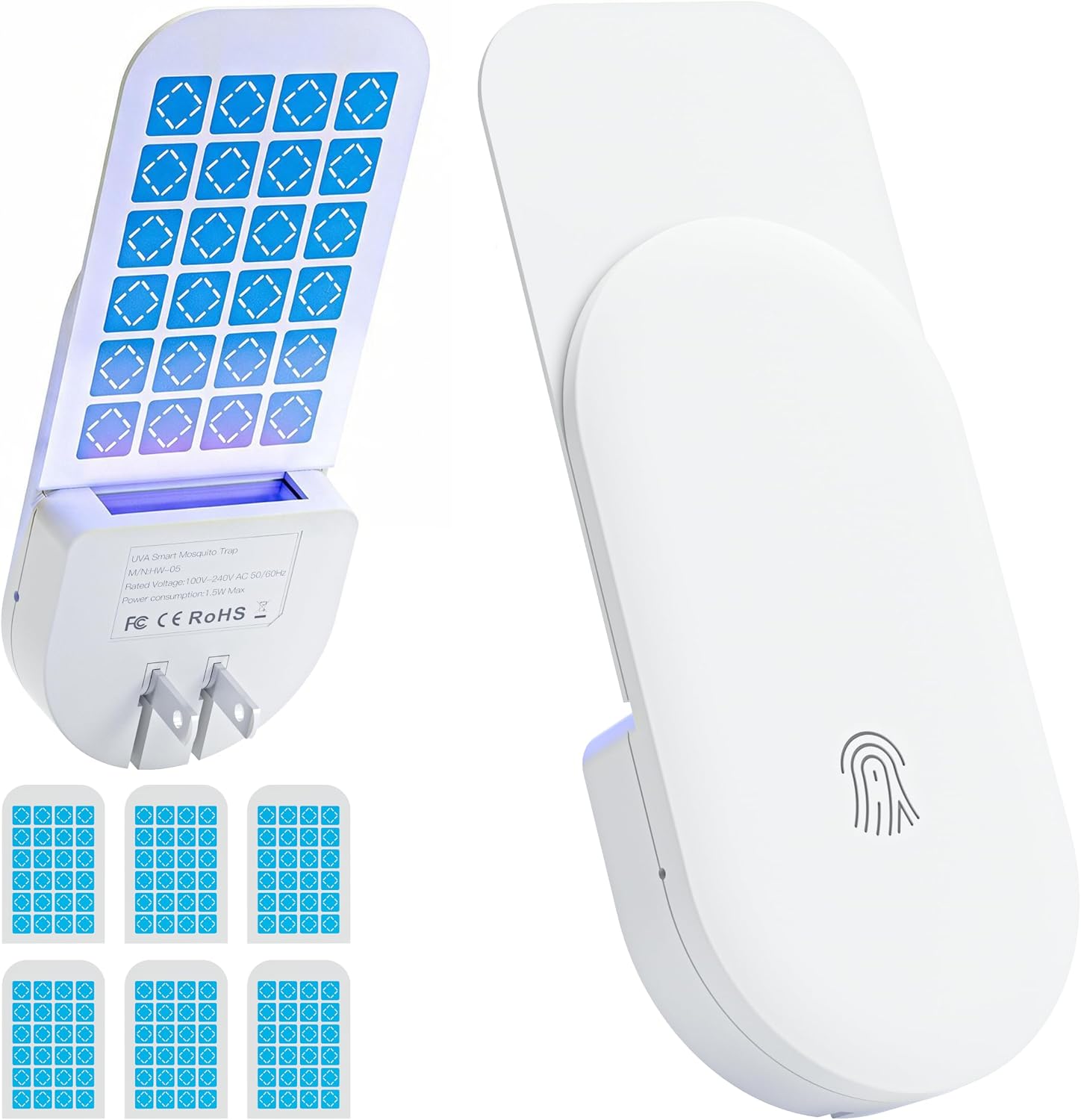
TIENBE Flying Insect Trap with Glue Cards and Night Light (1 Device + 6 Glue Cards)
| Brand Name | TIENBE |
|---|---|
| Unit Count | 7 Count |
| Target Species | Mosquito |
| Power Source | on |
The TIENBE Flying Insect Trap is a plug-in indoor unit that attracts flying pests with dual-wavelength UV LEDs and captures them on replaceable glue cards, while also offering a low-level night light. Typical use is simple: plug it into a bedroom, kitchen, or living area and insert a glue card; the smart mode senses ambient light and runs the attractant automatically, or you can keep the night light on continuously. Notable features include two UV wavelengths (365nm and 395nm) to increase attraction, six replaceable adhesive sheets included, and a silent, chemical-free capture method that avoids the buzzing and odors of electric zappers. Practical benefits are quiet operation, easy maintenance by swapping glue cards, and a small footprint that fits tight indoor spaces. Important limitations are that it is designed for indoor use and relies on adhesive boards so heavy infestations require frequent card changes and eventual replacement of consumables; it also does not actively kill insects electrically so it may be slower to reduce large populations compared with higher-power zappers or traps that use fan suction.
Best for: Buyers who want an inexpensive, low-noise indoor mosquito and fruit fly solution for bedrooms, kitchens, or small living spaces and prefer a chemical-free trap that is simple to maintain.
Less Ideal for: People needing high-capacity coverage for outdoor areas or whole-house solutions should consider more powerful traps or multi-unit strategies.
- Dual UV wavelengths (365nm and 395nm) to improve attraction of mosquitoes and fruit flies
- Includes six replaceable glue cards for immediate use and straightforward maintenance
- Silent, chemical-free capture method suitable for bedrooms and living areas
- Built-in night light and smart light sensing for automatic operation and low-level illumination
- Designed for indoor, localized use so it will not cover large outdoor areas
- Uses consumable glue cards that need regular replacement under heavy insect pressure
Verdict: A compact, budget-friendly indoor trap that quietly lures and captures mosquitoes and fruit flies with replaceable glue cards and a built-in night light.
ZwrKing 4200V Electric Bug Zapper with Replaceable 15W UV LED Bulb

| Target Species | Mosquitoes, Midges, Flies, Fruit Flies, Houseflies, Horse Flies, Moths and Wasps |
|---|---|
| Power Source | ac |
| Material Type | ABS Fireproof Plastic |
| Coverage | Up to 1/2 acre |
| Bulb | 15W UV LED (replaceable) |
This ZwrKing bug zapper is a plug-in unit intended for yard and home use that pairs a 15W UV LED (365–395 nm) with a 4200V high-voltage grid to attract and instantly dispatch mosquitoes and other flying pests. Typical use is hanging or placing the unit near activity areas using the built-in hook and the 6.6 foot cord; it is designed to run quietly overnight and is rated for indoor and outdoor spots such as porches, patios, balconies and kitchens. Notable features include a protective ABS fireproof shell and an outer safety grid to reduce accidental contact, plus a replaceable bulb so you do not need to replace the entire unit when brightness falls. Practical benefits are chemical-free operation, low noise, and wide coverage that can handle larger outdoor evenings. Important limitations are the need for a nearby AC outlet and best performance in darkness, and like all zappers it is most effective at reducing flying pests rather than eliminating all mosquitoes in a high-infestation area.
Best for: Buyers who prioritize a dependable, low-maintenance solution for routine mosquito and flying-insect control around the home and outdoor living spaces and who want a unit built for steady, long-term use.
Less Ideal for: Users who need a completely cordless or battery-powered trap or those seeking a device designed to eliminate very large, severe infestations on its own.
- Replaceable 15W UV LED bulb extends service life and lowers replacement cost
- 4200V high-voltage grid for rapid insect kill
- Protective ABS outer housing and safety net reduce accidental contact
- 6.6 ft power cord and hanging hook allow flexible placement
- Rated for indoor and outdoor use with quiet operation
- Requires AC power outlet nearby which limits placement
- Performance drops in bright daylight so best used at night
Verdict: A reliable, low-noise plug-in zapper with a replaceable UV bulb and safety housing that delivers chemical-free mosquito control for patios and home outdoor spaces.
Choosing the Right Mosquito Trap: Key Factors to Consider
Coverage Area Versus Yard Size
Match the trap's rated coverage area to how you use your outdoor space. A unit that lists a wide coverage radius is useful for open lawns and larger patios, but you may need several smaller units or strategic placement for dense vegetation, shaded corners, or multi-level porches.
Think about where mosquitos concentrate at dusk and after dark. Placing a trap near breeding habitats such as standing water or shaded vegetation increases catch rates. Overestimating a single unit's effective range is a common mistake; multiple modest traps often outperform one oversized unit if they can be positioned where mosquitos rest and move.
Attractant Type and Ongoing Supplies
Different traps use varying attractants: CO2 emission, heat, UV light, scent lures, or combinations. CO2 mimics human breath and often draws more females seeking a blood meal, but CO2 systems can need gas canisters or dry-ice-style refills. UV and heat units usually require less consumable upkeep but may be less selective and attract non-target insects.
Factor in ongoing costs and availability of attractant refills. If you prefer low-maintenance gear, choose traps with long-life lures or passive attractants. If you live near heavy mosquito pressure, a trap that accepts replaceable CO2 or specialty lures may give better seasonal results despite higher maintenance.
Power Source and Placement Flexibility
Consider whether you need mains-powered constant operation, battery-powered portability, or a hybrid option. Mains operation allows continuous use without battery changes but limits placement to areas with outlets or extension cords. Battery or rechargeable units give flexibility to move traps to hotspots and can be positioned away from power sources, but you must manage recharging and runtime.
Solar-assisted models reduce manual charging but perform poorly in long stretches of overcast weather. Also examine how quietly a unit runs if it uses fans; louder models may be intrusive near seating areas. Balance desired placement flexibility with the practical management of power and run time across mosquito season.
Ease of Cleaning and Maintenance
Traps collect insects in cups, nets, or reservoirs that require periodic emptying and cleaning. Look for designs that let you access collection chambers without tools, have washable components, and use materials resistant to odor and mold buildup. Units with disposable catch bags are convenient but create recurring costs and waste.
Regular maintenance matters for sustained performance. A clogged intake or a fouled lure reduces catch rates and can create sanitation issues. Evaluate how straightforward it is to disassemble, rinse, and reassemble components and whether replacement parts are standardized or proprietary.
Weather Resistance and Durability
Outdoor traps face sun, rain, humidity, and temperature swings. Durable UV-stable plastics, corrosion-resistant fasteners, and sealed electronics extend service life. Even weatherproof models can suffer from constant exposure, so inspect ingress protection details and whether the manufacturer recommends sheltered placement.
Consider winter storage and whether the trap needs full disassembly before cold months. Heavy-duty construction pays off if you want a device that stays outside for weeks at a time, while lighter models suit seasonal or occasional use but may require indoor storage after peak season.
Non-Target Insect Considerations
Some attractant systems draw a wide range of insects, including beneficial predators and pollinators. UV light and broad-spectrum lures are more likely to capture non-target species. If protecting pollinators is a priority, opt for traps tuned to mosquito attractants such as CO2 or species-specific scents or position traps away from flowering plants and pollinator activity.
Evaluate how selective the trap is reported to be and whether capture mechanisms are gentle or likely to damage trapped insects. Reducing bycatch protects beneficial insect populations and keeps your garden ecosystem healthier.
Where to Place a Mosquito Trap for Best Results
Placement determines how quickly a trap reduces local mosquito activity. Position units at the edge of seating areas, near shrub lines, and downwind from where people gather, since mosquitoes fly into the scent or CO2 plume. Avoid placing traps directly next to people or dining areas, which can draw insects closer to the group before capture.
Sheltered locations that are shaded and protected from heavy rain extend lure life and prevent flooding of collection chambers. For larger properties, deploy multiple traps at likely breeding or resting spots rather than relying on one centrally located unit.
- Place traps 1.5 to 3 meters above ground for many species
- Keep units 20 to 30 feet from high-traffic seating areas
- Avoid placing near flowering plants to reduce bycatch
Seasonal Use and Timing
Mosquito activity rises and falls with temperature and breeding cycles. Run traps continuously through peak-season evenings and reduce operation during cold snaps or dry spells. Many attractants are most effective at dusk and night when mosquitoes are actively seeking hosts.
Plan for periodic checks during peak season. Replace lures on the manufacturer-recommended schedule and empty collection chambers weekly or more often in high-pressure conditions.
- Start traps before peak season to reduce early breeding
- Increase monitoring after heavy rains and warm periods
- Store or winterize traps when sustained temperatures drop
Integrating Traps with Landscape Management
Mosquito traps work best as part of a broader strategy. Reducing standing water, keeping gutters clear, and pruning dense groundcover lowers local mosquito reproduction and resting sites. Traps can then focus on adult population reduction rather than compensating for continual breeding sources.
Use traps to protect activity zones while addressing breeding habitats elsewhere. This combined approach reduces the number of units needed and improves overall effectiveness.
- Eliminate small water sources and maintain pool and pond edges
- Keep grass and shrubs trimmed to reduce shaded resting spots
- Coordinate trap placement with landscape drainage patterns
Safety and Neighbor Considerations
Respect boundaries and shared spaces when placing traps. Some attractants may draw mosquitoes across property lines; discuss placement if you live close to neighbors or in multi-unit housing. Place units where pets and children cannot easily access collection chambers or lures.
Follow local regulations regarding outdoor insect control and avoid methods that rely on broad-spectrum sprays in shared green spaces.
- Position traps away from play areas and pet bowls
- Use signage if traps are placed in shared community spaces
- Check local guidance on CO2 or chemical lure use in gardens
Troubleshooting Low Capture Rates
If a trap is not catching many insects, start by checking placement, lure condition, and airflow. Clogged intake screens, expired lures, or positioning upwind from seating areas can all reduce effectiveness. Also confirm the unit is rated for your yard size and local mosquito species.
Consider temporary changes such as moving the trap closer to suspected breeding spots, replacing lures, or adding a second unit to cover shaded zones. Seasonal population dips can also explain low numbers; sustained low catch after adjustments suggests the trap may not match local species behavior.
- Inspect and clean the intake and collection chamber
- Replace lures and check power or battery levels
- Relocate trap to more sheltered or closer-to-breeding positions
How We Chose the Best Mosquito Trap
We focused on editorial filters that reflect how mosquito traps actually perform in home outdoor settings. Primary evaluation criteria were capture range and effective coverage, because a trap that cannot reach insects where they gather will not improve evenings or protect outdoor areas. We also assessed attractant systems and bait reliability, including how dependent each trap is on CO2, heat, light, or scent cartridges to draw mosquitoes. Power and runtime were weighed next, covering battery life, mains operation, and portability for placing traps in shaded or sheltered spots. Ease of cleaning and maintenance was another key filter, since sticky cups, collection nets, or liquid reservoirs that are hard to service reduce long-term use. Durability and weather resistance were checked to ensure units hold up to sun and rain when used outdoors. We excluded devices intended only for indoor use, novelty items without measurable capture data, and units that rely solely on contact insecticides rather than mechanical capture. The shortlisted traps demonstrate consistent capture behavior across documented coverage areas, manageable upkeep, sensible power options, and construction suited to outdoor exposure.
FAQ
Do mosquito traps work better than sprays or candles?
Traps target adult mosquitoes and can reduce local populations over time, while sprays and candles offer short-term repellency. Effectiveness depends on correct placement and consistent use. In many cases, traps combined with habitat reduction give longer-lasting relief than intermittent sprays.
How long should I run a trap each night?
Run traps continuously throughout dusk and overnight during peak season for best results, since many mosquito species are active at those times. In lower-pressure periods you can reduce runtime to the hours around sunset and early night.
Will a trap get rid of all mosquitos in my yard?
No single trap will eliminate every mosquito, especially if there are many breeding sites nearby. Traps reduce adult numbers and are most effective when paired with source reduction like eliminating standing water and maintaining vegetation.
Are traps safe for pets and children?
Most mechanical traps that use light, heat, or CO2 are safe when placed out of reach. Follow manufacturer guidance about lure chemicals and secure collection chambers. Keep units away from play areas and always store attractant cartridges safely.
How often do lures and parts need replacing?
Replacement frequency varies by attractant and environmental conditions. Lures may last several weeks to a few months, while collection cups should be emptied weekly in active seasons. Inspect components regularly and replace consumables on the schedule recommended for heavy use.
Can traps reduce biting insects other than mosquitos?
Some trap types capture a range of small flying insects depending on attractant and light spectrum. If bycatch is a concern, choose attractants tuned to mosquito behavior and position traps away from pollinator activity and flowering plants.
Final Verdict
Prioritize coverage, attractant type, and maintenance when choosing a mosquito trap for your yard. Match the trap's rated area to how you use outdoor spaces, pick an attractant system that fits your willingness to refill or replace lures, and select a power arrangement that suits placement flexibility. Expect tradeoffs between hands-off operation and maximum effectiveness. Combining traps with habitat reduction and proper placement gives the best chance of noticeably fewer bites and more comfortable outdoor time. Choose based on the coverage you need and the upkeep you will consistently perform.
