

Note: This article contains affiliate links. If you click on these links and make a purchase, I may earn a small commission at no extra cost to you. This helps support my research and content. Read my full affiliate disclosure here.
If you grow herbs, seedlings, or a few houseplants in a tight corner, the right small grow light makes a big difference. A compact fixture delivers focused light where natural sun is scarce, avoids overheating tiny spaces, and keeps energy bills down when used daily. This guide covers seven shortlisted small grow lights chosen for typical small-space uses like windowsill propagation, microherb racks, and single-pot supplemental lighting. We evaluate spectrum quality, energy efficiency, heat management, and ease of positioning to help you match a light to your setup. Read on for the compact options and what each one is best suited to in a small garden.
Top Picks at a Glance
| Best Overall The best all-around choice for most situations | LEOTER 4-Head LED Grow Light with Full Spectrum, Timer and 10-Level Dimming |  |
| Best Quality Built to a higher standard if you want something more solid | SANSI 36W Full-Spectrum LED Grow Light Bulb (E26) |  |
| Best Value The sweet spot between price and what you get | Juhefa 6000K Full Spectrum Gooseneck Plant Grow Light (40 White + 8 Red LEDs) |  |
| Best Budget The cheapest option that still gets the job done reliably | CFGROW SPL-01 Full-Spectrum LED Grow Light with Adjustable Height and Timer |  |
| Highest Rated A top-rated pick with lots of positive feedback | Sonamindary GL04 10W Full-Spectrum LED Grow Light (Single Head) |  |
| Most Popular A crowd favorite that many people choose with confidence | GooingTop HY-021 6000K Full-Spectrum Clip Grow Light |  |
| Best Seller A high-volume bestseller chosen again and again | Aokrean Halo 3.5in Full-Spectrum Indoor Plant Grow Light with Base |  |
LEOTER 4-Head LED Grow Light with Full Spectrum, Timer and 10-Level Dimming

| Light Source Type | LED |
|---|---|
| Number of Light Sources | 80 |
| Wattage | 80 watts |
| Control Method | Remote |
| Mounting Type | Clip On |
The LEOTER 4-head grow light is a USB-powered, clip-on lamp built for indoor plant care that combines full-spectrum and targeted red/blue diodes to support seedlings, vegetative growth and flowering. It uses 80 LEDs arranged across four adjustable heads on flexible goosenecks so you can position light over individual large plants or groupings. Notable features are three spectral modes (red+blue, warm/full spectrum, and combined), a circular memory timer with 3/9/12-hour presets, and ten brightness levels for fine control over intensity. The strong metal clip and flexible necks make it simple to aim light at tall foliage without permanent installation. Practical benefits include reduced need for supplemental natural light, convenient daily scheduling for busy users, and a compact footprint that suits shelves or plant stands. Important limitations are that the unit is described as a clip/desk lamp rather than a wide-panel fixture, so coverage for very large single specimens may require placing heads close to foliage or using multiple units, and the timer resets if unplugged so it needs occasional reprogramming after power loss.
Best for: Buyers who want a controllable, space-efficient grow light to supplement indoor sun for larger houseplants and prefer a proven, feature-rich unit with preset timers and adjustable heads.
Less Ideal for: Growers who need single-fixture coverage for floor-to-ceiling specimens or large multi-plant setups should consider full-size panel fixtures or multiple units instead.
- Full spectrum plus red and blue LEDs (80 total) to support all growth stages
- Ten dimming levels for precise intensity control
- Three timer presets with memory function for hands-off daily scheduling
- Adjustable 4-head design and flexible goosenecks for targeted placement
- Strong metal clip allows mounting on shelves, desks, or plant stands
- Designed as a clip-on lamp so single-unit coverage is limited for very large plants
- Timer settings must be reset after the light is unplugged
Verdict: A versatile, adjustable clip-on grow light that gives busy indoor gardeners precise control over spectrum, intensity and scheduling to boost large plant growth in compact spaces.
SANSI 36W Full-Spectrum LED Grow Light Bulb (E26)

| Wattage | 36 watts |
|---|---|
| Light Color | 4000K Daylight |
| PPF | 65.6 μmol/s |
| Light Source Operating Life | 25000 hours |
| Bulb Base | E26 |
The SANSI 36W grow light bulb is an E26-socket LED that provides full-spectrum, 4000K daylight meant to replace high-wattage incandescent bulbs for indoor plants. It is typically used screwed into household fixtures or lamp sockets above seedlings, potted houseplants, or small grow racks to provide consistent supplemental light. Notable features include a high CRI (95+), a reported PPF of 65.6 μmol/s and PPFD around 265.6 μmol/s/m² at 1 ft, ceramic Chip-on-Ceramic (COC) construction for improved heat transfer, and an ETL safety listing. In practice the lamp produces bright, natural-looking light that reduces the red-blue color bias of many grow lamps and helps you judge plant health by eye. The ceramic design and hollow heat-sink approach should improve reliability and longevity, and the 25,000-hour rated life keeps replacement frequency low. Limitations are that the bulb is not dimmable and its coverage area is relatively small, so multiple bulbs or close placement are required for larger setups or flowering-stage light demands.
Best for: Buyers who prioritize measurable light performance and reliable construction for small to medium indoor plant setups and want a neutral daylight spectrum for accurate plant assessment.
Less Ideal for: Growers who need wide-area coverage or variable intensity control for large flowering setups should consider multi-chip fixtures or dimmable lights instead.
- Full-spectrum 4000K output with CRI 95+ makes light easy to work under and close to natural sunlight
- High reported PPFD (≈265.6 μmol/s/m² @1 ft) and PPF 65.6 μmol/s support efficient photosynthesis for seedlings and foliage
- Ceramic Chip-on-Ceramic construction and hollow heat dissipation improve thermal management and long-term reliability
- ETL listed and rated for 25,000 hours, indicating safety and a long service life
- Not dimmable which limits fine control over light intensity for different growth stages
- Small effective coverage area, so multiple bulbs are needed for larger plant groups
Verdict: A performance-focused, full-spectrum E26 grow bulb that delivers high usable light and durable ceramic construction for reliable results with seedlings and small houseplant collections.
Juhefa 6000K Full Spectrum Gooseneck Plant Grow Light (40 White + 8 Red LEDs)

| Light Source Type | LED |
|---|---|
| Wattage | 5 watts |
| Light Source Special Features | dimmable |
| Mounting Type | Table Mount |
This Juhefa gooseneck grow light is designed for small-scale indoor growing and seed starting. It combines 40 white 6000K LEDs with 8 red 660nm LEDs to provide a broad spectrum useful across growth stages, and the flexible gooseneck lets you aim light precisely at seedlings or small pots. Setup is simple: plug in the USB power, position the lamp, and choose one of three auto timers (4, 8, or 12 hours) so plants get consistent daily cycles without manual switching. Five dimmable levels let you lower intensity for fragile seedlings or raise it for vegetative growth. The lamp is lightweight and clips or stands near plants on a desk, shelf, or plant stand. Practical benefits include low power draw, a high CRI for true color rendering, and built-in timing that helps when you are away. Limitations are its modest overall output for larger trays or deeper canopies and a single light bar that requires close placement for even coverage, so you may need multiple units for bigger seedling flats.
Best for: Buyers starting seeds or growing a few small indoor plants who want an inexpensive, easy-to-use lamp that provides timed, adjustable light without a complex setup.
Less Ideal for: Growers who need to light large trays, multiple shelves, or high-light greenhouse crops should choose higher-output fixtures or larger panels instead.
- Full-spectrum LED array with dedicated 660nm red diodes to support flowering and fruiting
- Built-in 4/8/12 hour auto timer keeps a consistent daily light cycle without manual intervention
- Five dimmable brightness levels allow tuning for seedlings through vegetative stages
- Flexible 360° gooseneck and long USB cable for precise positioning over small pots and trays
- Low wattage draw suitable for continuous use without high electricity cost
- Single light bar provides limited coverage so multiple units are needed for larger seedling flats
- Not powerful enough for deep canopies or high-light fruiting crops when used alone
Verdict: A budget-friendly, plug-and-play gooseneck grow light that gives seedlings reliable timed and dimmable full-spectrum illumination for small indoor setups.
CFGROW SPL-01 Full-Spectrum LED Grow Light with Adjustable Height and Timer

| Power Source | Corded Electric |
|---|---|
| Light Source | LED |
| Wattage | 15 watts |
| Brightness | 2000 lumen |
| Control Method | Remote |
The CFGROW SPL-01 is a tabletop freestanding LED grow light made for small indoor gardens and desktop plants. It supplies a full 380–800 nm spectrum across selectable red, blue, and white modes, and offers 10 brightness settings so you can tailor light intensity to seedlings, succulents, or mature houseplants. The unit includes a height-adjustable pole system and a removable stake so you can place the lamp above pots or insert it in soil for lower profiles. A circular memory timer with 3/9/12 hour options automates daily on/off cycles, which is useful when you cannot tend plants every day. At roughly 15 watts and about 2000 lumens, it is energy efficient for continuous use and claims long LED life. Practical limits are its small coverage area and nonwaterproof plastic construction, so it is best for individual pots or small clusters indoors rather than larger grow racks or humid greenhouse setups. The remote control and dimmer make fine tuning easy, but the timer must be reset after a power interruption.
Best for: Buyers looking for an affordable, energy-efficient grow light to keep a few desktop plants, succulents, or seedlings healthy with minimal fuss and automated lighting.
Less Ideal for: Growers who need wide area coverage, commercial-scale output, or a waterproof fixture for humid environments should look at larger, higher-powered alternatives.
- Full spectrum LEDs with three light modes for different growth stages
- Ten dimmable levels allow precise control of intensity
- Height-adjustable pole and removable stake for versatile placement
- Built-in memory timer with 3/9/12 hour auto on/off for hands-off scheduling
- Low wattage (15W) and high lumen output for energy-efficient operation
- Small coverage area limits use to single pots or small clusters indoors
- Plastic, nonwaterproof construction makes it unsuitable for humid or wet locations
Verdict: A budget-friendly, energy-efficient full-spectrum lamp that automates light schedules and is ideal for keeping a few small indoor plants healthy.
Sonamindary GL04 10W Full-Spectrum LED Grow Light (Single Head)

| Wattage | 10 watts |
|---|---|
| Color Temperature | 5000 Kelvin |
| Light Source | LED |
| Power Source | Corded Electric |
| Bulb Base | E26 |
The Sonamindary GL04 is a small, single-head grow light intended for desktop or shelf use where plants need a reliable supplemental light source. It delivers a 5000K full-spectrum output and claims a PPFD of about 375 μmol/m²/s at 6 inches, which is useful for seedlings, herbs, succulents, and foliage plants. The lamp uses an E26 bulb base and is corded electric with a built-in timer option, and the silicone-sleeved flexible arm makes it easy to position the beam over individual pots or grouped plants. For succulents the concentrated light and adjustable head let you direct intensity where plants stretch or need stronger light without moving pots. The light is not water resistant and is made of plastic, so it is best kept in dry indoor spots. Because it is a single-head, coverage is limited for larger collections and may require multiple units for racks or wide shelves. The GL04 is straightforward to set up and aims to give steady supplemental illumination for small indoor succulent displays.
Best for: Buyers who want a compact, dependable supplemental light for a few indoor succulents or a small shelf and who prioritize consistent, easy-to-position illumination.
Less Ideal for: Not a good fit for collectors with large plant racks or those needing waterproof fixtures for humid terrariums or greenhouse use.
- Full-spectrum 5000K LED designed for plant growth
- Flexible silicone-sleeved arm for precise positioning
- Compact desktop/table installation fits small indoor setups
- Timer feature for consistent daily light cycles
- E26 base and replaceable bulb type allow simple maintenance
- Single head limits effective coverage for multiple or large succulents
- Not water resistant so must be kept away from humidity or wettings
Verdict: A compact, easy-to-position full-spectrum LED that reliably provides focused supplemental light for small succulent collections.
GooingTop HY-021 6000K Full-Spectrum Clip Grow Light
| Power Source | Corded Electric |
|---|---|
| Color Temperature | 6000 Kelvin |
| Light Output Maximum | 2500 lumens |
| Light Source Special Features | Dimmable |
| Number of Light Sources | 84 |
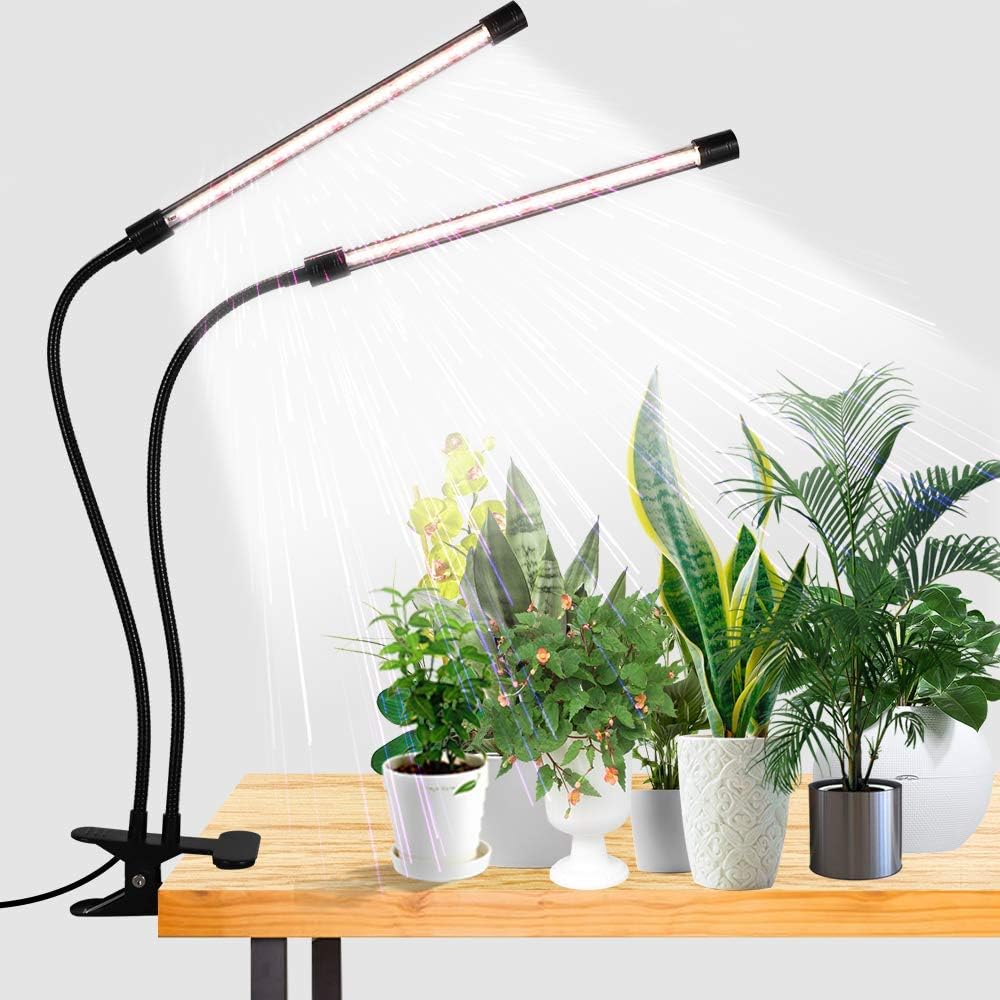
This GooingTop HY-021 is a compact clip-on grow light built for small houseplants, seedlings and shelf gardens. It uses 84 LEDs (white plus deep red) to deliver a 6000K full-spectrum output intended to mimic midday sun, with a high color-rendering output that also makes it pleasant as a reading lamp. Two flexible gooseneck heads and a strong clamp let you aim light precisely over pots and seed trays, while the attached remote provides 50%/100% dim levels and repeating timers at 4, 8 or 12 hours for hands-off scheduling. Practical benefits include low power draw (listed as roughly 10 W LED draw), a claimed 1 to 2 square meter coverage for seedlings, and an included timer that simplifies day/night cycles. Limitations are its design for small setups rather than large grow racks and the clip mounting limits placement compared with freestanding fixtures. The unit also relies on the corded remote instead of a smartphone app and the lifespan claim is typical of LEDs but not independently verifiable from the listing.
Best for: Buyers who want a simple, low-power, plug-and-play grow light to boost seedlings and a few houseplants on a desk or shelf and who value an easy-to-use timer and adjustable brightness.
Less Ideal for: Growers planning multi-shelf installations, larger vegetable grows, or who need networked or app-based control should consider larger bar lights or fixtures designed for commercial racks.
- Full-spectrum 6000K output with added 660 nm red LEDs to support vegetative growth and flowering
- Attached remote with dimming (50%/100%) and repeat timer settings (4/8/12 hours) for easy scheduling
- Flexible dual goosenecks and strong clamp enable precise positioning over small pots and seed trays
- High reported color rendering for comfortable viewing and accurate plant color assessment
- Low electrical draw around 10 W while covering small growing areas
- Clip-mount design and stated 1–2 m² coverage make it better suited to individual plants or small trays rather than large multi-shelf setups
- No smart app or wireless control option; remote is cord-attached which limits placement flexibility
Verdict: A compact, easy-to-use clip grow light that delivers full-spectrum light and convenient timer/dim controls for small indoor plant setups.
Aokrean Halo 3.5in Full-Spectrum Indoor Plant Grow Light with Base

| Wattage | 10 watts |
|---|---|
| LED count | 48 LEDs |
| Power source | Corded Electric (5 volts, USB) |
| Timer | 3/9/12H |
| Control method | Touch / Push Button |
This small Halo grow light is designed to give houseplants steady supplemental light without a complicated setup. It ships with a base and a stake so you can either place the pot on the base or insert the lamp into potting soil. The unit uses 48 LEDs and offers three spectrum modes plus ten brightness levels and a 3/9/12-hour timer, so you can match output to seedlings, foliage growth, or flowering. The pole telescopes up to 26 inches and pivots, which helps cover taller or multiple small plants on a windowsill or desk. Controls are touch-style with a simple push-button interface, and it runs from a USB/5V power adapter. Practical benefits include flexible mounting, programmable run times, and a compact footprint that doubles as a decorative accent. Limitations to note are its modest 10-watt power and single-lamp coverage, which makes it best for a few small pots rather than a larger grow rack, and the base relies on the pot to stabilize the stand.
Best for: Buyers who want a straightforward, low-risk supplemental light for a few houseplants or seedlings and prefer simple controls and a compact, decorative design.
Less Ideal for: Growers who need higher-output fixtures for multiple pots or a full multi-tier grow setup should look at larger, higher-wattage LEDs instead.
- Dual installation: stake into soil or sit in the included base for flexibility
- Full-spectrum LEDs with three modes and 10 brightness levels to match growth stages
- Telescoping pole up to 26 inches and 90-degree rotation to adjust coverage and angle
- Built-in timer with 3/9/12-hour cycling for hands-off daily schedules
- Low 10-watt output and single light source limit effective coverage to small or few plants
- Base stability depends on pressing down with the plant pot rather than a weighted design
Verdict: A compact, easy-to-use full-spectrum lamp that gives low-risk, adjustable supplemental light for a few small to medium indoor plants.
Choosing the Right Small Grow Light: Key Factors to Consider
Light Spectrum and Plant Stage
Spectrum matters because different growth stages need different wavelengths. Blue-rich light supports compact vegetative growth and robust seedlings, while a mix with red wavelengths becomes more important for flowering or stretching crops. For small-space use you usually prioritize a balanced spectrum that promotes leaf and stem development rather than heavy bloom optimization.
Choosing a light with clear spectrum information helps you match the fixture to the plants you grow. If you start seeds and then move plants to stronger sun, a predominantly blue-balanced small light may be ideal. For ongoing leaf crops like microgreens and herbs, a full-spectrum or broad white output typically gives better, more natural-looking results.
Power Draw and Running Cost
Small fixtures are chosen for compactness, but you still need to consider electricity use because lights often run 12 to 18 hours daily for seedlings and cuttings. Lower wattage reduces heat and energy cost, but too little power will force the fixture to be mounted extremely close to plants, which can create hotspots or uneven coverage.
Look for lights that deliver good PPFD relative to their wattage. That ratio tells you how efficiently the fixture converts electricity into usable plant light. Energy-efficient LEDs with strong optics usually give the best balance of light output and low ongoing cost.
Heat Output and Placement Safety
Heat is a greater concern in small spaces because it can quickly raise air temperatures and dry media. Fixtures with poor heat dissipation may need to be mounted farther away, which reduces effective light on seedlings. In enclosed spots like cabinets or small tents, pick a light with active or passive thermal management suited to the volume.
Also consider the materials around the fixture. Heat-resistant mounts and adequate clearance avoid scorch on leaves and reduce fire risk. A light with low surface temperature and efficient fans or heatsinks will make it easier to keep stable microclimates for delicate starts.
Physical Size and Mounting Options
The whole point of a small grow light is that it fits where larger fixtures cannot. Pay attention to the width and depth relative to your shelving or windowsill. Slim bar lights and compact panels usually work best for single shelves, while adjustable gooseneck or clip-style lamps are useful for individual pots.
Mounting flexibility affects how evenly you can light multiple pots. Lights with included hooks, ratchet hangers, or clips let you fine-tune height and angle. Consider the ease of moving or stowing the unit when you need the surface for other tasks.
Light Coverage and Beam Control
Coverage is about how evenly the fixture distributes usable light across the target area. Too narrow a beam forces multiple fixtures or frequent repositioning; too wide a beam wastes light outside the plant canopy. For small setups, aim for lights that concentrate useful PPFD over the footprint you actually use.
Good optics and lensing help focus light and reduce spill. Adjustable beam angle or diffusers let you tailor the distribution for a single deep pot versus a row of seed trays. Coverage specs plus real-world mounting distance guidelines make it easier to predict how many fixtures you need.
User Controls and Timers
Controls influence how convenient the light is for daily use. Simple on-off operation is fine for occasional use, but if you run lights many hours a day, built-in timers or dimming are very helpful. Dimming lets you dial back intensity for young seedlings or extend usage without increasing heat.
Look for intuitive controls and clear indicators of current settings. Smart features that integrate with home automation can be useful but are not required for most small-space growers. The goal is reliable timing and the ability to change intensity without moving the light.
Best Uses in Tiny Growing Areas
Small grow lights are ideal for windowsills, apartment balconies with limited sun, under-shelf propagation racks, and single-pot supplemental lighting. Their small footprint allows you to place a fixture inches above seedlings, creating a concentrated light field that encourages compact, sturdy growth.
For microgreens and herbs, a compact fixture often outperforms ambient room light because it supplies consistent PAR where it matters. When using a small light, plan mounting height and duration to prevent legginess without overheating the plants.
- Windowsill propagation: place 4 to 8 inches above seedlings depending on intensity
- Single-pot supplement: use directional fixtures or clip lamps to avoid lighting the whole room
- Under-shelf racks: stack slim bars for even coverage and easy access
Setting Up a Small Grow Light Safely
Mount the light so it is secure and provides even coverage across the target area. Ensure electrical cords are routed away from watering stations and that the fixture has proper ventilation in enclosed spaces. If the light has a fan, allow clearance for airflow and check periodically for dust buildup.
Use a timer to maintain stable daylengths and reduce the chance of human error. If you need to mount lights close to flammable surfaces, choose fixtures with low surface temperatures and follow the manufacturer clearance guidance.
- Measure canopy area before buying to match light coverage
- Keep a small thermometer nearby to monitor microclimate changes
- Use drip trays or waterproof surfaces under propagation areas to protect cords and surfaces
How to Position Lights for Different Plants
Seedlings require higher intensity but for shorter stretches; start with the fixture closer and then raise it as plants grow. Leafy herbs and microgreens do well under steady moderate intensity; position the light to cover the tray evenly. For single larger pots, concentrate light on the topmost foliage while avoiding leaf edge scorching.
Adjust height based on both light intensity and heat. Move lights a few inches higher if you notice leaf curling, tip burn, or rapid media drying. Keep records of height and duration for each crop so you can repeat successful setups.
- Seedlings: 4 to 8 inches above canopy, 14 to 16 hours daily
- Microgreens: 6 to 12 inches above canopy, 12 to 16 hours daily
- Established herbs: moderate height, 10 to 14 hours depending on ambient light
Maintenance and Longevity Tips
Clean lenses and reflectors every few months to maintain output. Dust and residue reduce effective light in small fixtures faster than you might expect because less total light is produced to start with. Inspect wiring and mounts periodically to ensure safety, especially in humid propagation areas.
Replace fixtures or components when output visibly drops or when spectral balance shifts in a way that affects growth. Many small LEDs last for years, but physical damage, fan failure, or water exposure can shorten useful life. Budget regular checks into your maintenance routine.
- Wipe lenses with a soft cloth and mild detergent if needed
- Run periodic full-day checks to ensure timers and dimmers operate correctly
- Keep spare hanging hardware or clips handy for quick repositioning
How We Chose the Best Small Grow Light
We prioritized products designed specifically for small growing situations and avoided full-size fixtures made for large tents or commercial racks. Selection focused on items that match the practical needs of home gardeners working with limited space: accurate spectrum for seedlings and leafy greens, compact footprint and mounting options, low power draw for frequent use, and manageable heat output for enclosed windowsills or cabinets. Evaluation criteria included spectrum balance and PPFD potential at typical mounting distances, measured or reported power consumption, thermal design and heat mitigation, physical size and mounting flexibility, and user-facing features like dimming or timers. We also considered build durability and ease of replacement for frequently moved fixtures. Exclusions applied to lights lacking clear spectrum information or those intended primarily for flowering and large canopy coverage, since they do not suit small-space seed-starting and microgreens. The final list favors practical, safe, and energy-conscious small grow lights that gardeners can deploy in cramped indoor or sheltered outdoor spots.
FAQ
How far should a small grow light sit above seedlings?
Distance depends on the fixture intensity and spectrum, but seedlings often do best with the light 4 to 8 inches above the canopy. Start higher if the fixture is very bright and watch for signs of heat stress or bleaching.
Can a small grow light support multiple seed trays?
Yes, but coverage matters. A single small fixture can light several shallow trays if its lens spreads light evenly. For rows of trays, slim bar lights mounted centrally or multiple small fixtures spaced evenly are better choices.
Will small grow lights raise room temperature significantly?
They can in very tight or poorly ventilated enclosures. Low-wattage LEDs typically add minimal heat, but higher output fixtures or multiple units will raise temperatures. Monitor the microclimate and use ventilation if needed.
Are timers and dimmers necessary for small grow lights?
They are not strictly necessary, but timers and dimmers make managing light schedules and intensity much easier, especially when you run lights many hours daily. Dimming also reduces heat and extends lamp life.
How do I know if the spectrum is right for my plants?
Look for fixtures that publish spectrum curves or describe a full or broad-spectrum white output. Blue-rich light supports compact, vegetative growth while a balanced white spectrum tends to suit herbs and microgreens.
Final Verdict
For small-space growing, prioritize spectrum suited to your plant stage, efficient power use, and a thermal design that suits confined environments. Physical size and mounting options determine how easily a light integrates into windowsills, shelves, or single-pot setups. Expect tradeoffs between raw output and compactness: higher PPFD often means more heat and power draw, while very small low-watt fixtures excel at targeted tasks but may not scale to larger trays. Choose based on the footprint you need to light and the typical daily run time to find a fixture that balances coverage, safety, and long-term operating cost.
