

Note: This article contains affiliate links. If you click on these links and make a purchase, I may earn a small commission at no extra cost to you. This helps support my research and content. Read my full affiliate disclosure here.
Getting the right insecticide for house flies matters because these pests can spread bacteria, annoy household members, and make indoor spaces unpleasant. You want a product that delivers quick knockdown without leaving strong lingering odors or posing unnecessary risk to people and pets. This guide covers seven top shortlisted insecticides for house flies, chosen to represent different application methods and safety profiles. Below we summarize how each option performs across speed of kill, indoor suitability, and ease of use so you can pick the best fit for your home and routines.
Top Picks at a Glance
| Best Overall The best all-around choice for most situations | BASF Alpine WSG Water-Soluble Insecticide Granules (Dinotefuran 40%) |  |
| Best Quality Built to a higher standard if you want something more solid | Talstar One Insecticide Concentrate, 1 Gallon |  |
| Best Value The sweet spot between price and what you get | HOT SHOT Flying Insect Killer Aerosol, 15 fl oz (3 pack) |  |
| Best Budget The cheapest option that still gets the job done reliably | Raid Flying Insect Killer Spray, 18 oz |  |
| Highest Rated A top-rated pick with lots of positive feedback | Elanco Agita 10 WG Insecticide for House Fly and Beetle Control, 2.2 lb |  |
| Most Popular A crowd favorite that many people choose with confidence | ZEVO Flying Insect Aerosol Spray, 30 fl oz |  |
| Best Seller A high-volume bestseller chosen again and again | EcoVenger All Purpose Insect Spray, Plant-Based 16 oz |  |
BASF Alpine WSG Water-Soluble Insecticide Granules (Dinotefuran 40%)

| Item Form | Granules |
|---|---|
| Target Species | Ants, cockroaches, bed bugs, beetles, fleas, flies, mosquitoes |
| Active Ingredients | Dinotefuran 40% |
| Specification Met | EPA |
BASF Alpine WSG is a concentrated water-soluble granule insecticide designed for fast, broad-spectrum control of ants, cockroaches, bed bugs, flies, mosquitoes and other common pests. The granules dissolve into a clear spray solution for targeted treatments around foundations, garages, attics, eaves, patios and other indoor or outdoor sites. Notable features include a high concentration of dinotefuran (40%) and reduced-risk EPA status for public health and food-handling settings. In practical use one gallon of finished dilution treats about 1,000 square feet, so small sachets can cover multiple spot treatments when mixed properly. Benefits include quick knockdown, non-repellent action that helps insects pick up and transfer the active ingredient, and an odorless, nonstaining finished solution when used as directed. Important limitations are that it is a pesticide requiring careful adherence to label directions, attention to pollinator safety and potential state restrictions, and it is not a ready-to-use spray so users need proper measuring and sprayer equipment.
Best for: Best for homeowners or pros who prioritize fast, effective chemical control of a broad range of pests and are comfortable mixing and applying concentrated formulations safely.
Less Ideal for: Not a good choice for gardeners seeking organic or nonchemical options or for casual users who prefer ready-to-use sprays without measuring and mixing.
- High-concentration active ingredient (Dinotefuran 40%) for rapid pest knockdown
- Water-soluble granules mix into a clear, nonstaining spray for versatile indoor and outdoor use
- Reduced-risk EPA designation suitable for public health and food-handling areas
- Effective against a wide range of pests including ants, cockroaches, bed bugs and mosquitoes
- Requires mixing and application equipment rather than being ready-to-use
- Must follow label restrictions to protect pollinators and comply with state rules
Verdict: Choose Alpine WSG when you need a concentrated, fast-acting professional-grade solution for broad indoor and outdoor pest control.
Talstar One Insecticide Concentrate, 1 Gallon

| Active ingredient | Bifenthrin 7.9% |
|---|---|
| Formulation | Concentrate, water-based |
| Coverage intent | Perimeter and structural applications |
| Pest range | Controls 75+ pests including ticks |
Talstar One is a professional-strength bifenthrin concentrate designed to provide broad-spectrum control of ants, spiders, roaches, fleas, ticks, mosquitoes, and many other pests. You mix the concentrate with water and apply it as a perimeter spray around foundations, doors, and windows or to targeted cracks and crevices indoors. Notable features include a water-based, low-odor formula that dries clear and a residual effect that reduces the need for frequent reapplications on lawns, ornamentals, shrubs, and structural surfaces. For yards with tick pressure, treating perimeters and vegetation provides a dependable barrier that helps reduce tick encounters when applied according to label directions. The product is concentrated so one gallon treats large areas, which makes it efficient for seasonal maintenance across multiple structures. Important limitations are that it is a pesticide that requires careful handling and strict adherence to label rates and application restrictions, and it is not a ready-to-use spray so you will need appropriate mixing and application equipment for safe, effective coverage.
Best for: Buyers who prioritize reliable, residual pest control for yards and perimeters and who are comfortable using concentrated pesticides with proper safety practices.
Less Ideal for: Casual users who want a ready-to-use product or those unwilling to follow pesticide label precautions and use appropriate application equipment.
- Broad-spectrum control that includes ticks and common yard pests
- Concentrated formula covers large areas and is cost-efficient for seasonal treatments
- Water-based, low-odor formula dries clear and is suitable for outdoor living spaces
- Suitable for both perimeter and targeted indoor/structural applications
- Concentrate requires proper mixing and application equipment for safe use
- Contains bifenthrin so users must follow label precautions to protect people, pets, and beneficial insects
Verdict: Choose Talstar One when you need a concentrated, long-lasting perimeter treatment that reliably reduces tick pressure across yards and structures.
HOT SHOT Flying Insect Killer Aerosol, 15 fl oz (3 pack)
| Unit Count | 45 Ounce |
|---|---|
| Included Components | 15 Fl Oz (3 Pack) |
| Item Form | Aerosol |
| Target Species | Insects |
| Active Ingredients | Permethrin (0.15%), Tetramethrin (0.15%) |
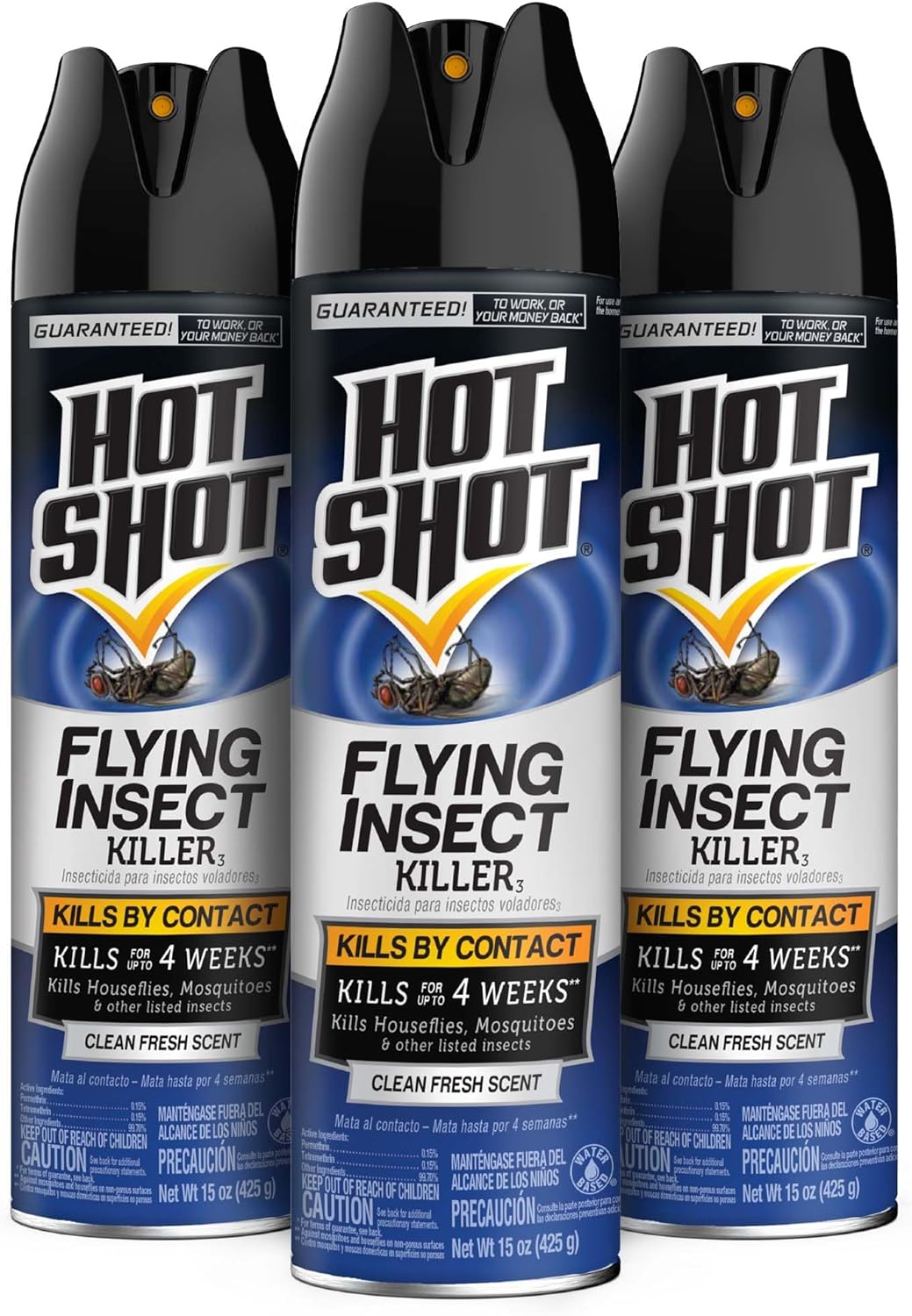
This HOT SHOT aerosol comes as a three-pack of 15 fl oz cans and is formulated to kill houseflies, mosquitoes and other listed flying insects by direct contact. You can use it indoors as a space spray to quickly knock down flies, gnats and moths by filling a room with mist and ventilating after 15 minutes, or apply it directly to nests, rafters and door frames outdoors where insects congregate. The formula lists permethrin and tetramethrin as active ingredients and the label says it leaves a clean, fresh scent rather than a strong chemical odor. Practical features include both immediate knockdown and a residual effect on nonporous surfaces for up to four weeks against certain pests, plus clear directions for timed room treatment and spot application. Important limitations are typical for pressurized aerosols: it is toxic to fish and should not be used near water, and precautions are needed to avoid skin contact and exposure to heat or flames. It is best used as a targeted control for nuisance flying insects rather than a broad landscape or aquatic application.
Best for: Buyers who want a convenient, ready-to-use spray for quick knockdown and short-term residual control of common indoor and porch/entryway flying pests.
Less Ideal for: People who need year-round landscape-wide pest control, aquatically sensitive sites, or low-toxicity solutions for homes with fish or heavily exposed outdoor wildlife should consider alternative methods.
- Kills a wide range of common flying nuisance insects on contact
- Provides residual control on nonporous surfaces for up to four weeks against mosquitoes and houseflies
- Clear label directions for indoor space-spray and targeted outdoor applications
- Aerosol format delivers quick knockdown and convenient spot treatment
- Contains pyrethroid active ingredients and is toxic to aquatic life
- Pressurized cans require careful storage and cannot be used near heat or open flame
Verdict: A practical, ready-to-use aerosol for fast knockdown and short-term residual control of common flying nuisance insects around the home.
Raid Flying Insect Killer Spray, 18 oz

| Unit Count | 18 Ounce |
|---|---|
| Item Form | Spray |
| Target Species | Insects |
| Specification Met | EPA |
| Active Ingredients | d-Phenothrin 0.125%, prallethrin 0.100% |
Raid Flying Insect Killer is an 18 oz aerosol spray designed to kill mosquitoes, flies, gnats, small moths, wasps and similar flying pests on contact and by misting treated areas for short-term residual control. For indoor use you close doors and windows, spray with a sweeping motion into the air about three feet from walls and fabrics, then leave the room to allow the mist to work before ventilating after two hours. Notable features include a water-based formula that dries without a greasy residue and an "Outdoor Fresh" scent that reduces strong chemical odor. The product is EPA-specified and includes active pyrethroid ingredients for rapid knockdown. Practical benefits are quick results when insects are present and the ability to treat entry points like screens and around doors for continued control. Important limitations are the required safety precautions: the spray is harmful if inhaled or contacted, contains flammable ingredients, and rooms must be vacated and ventilated for a set time after use, which makes it less convenient for frequent or casual indoor use around children, pets, or food preparation areas.
Best for: Buyers who need a fast, reliable indoor solution to eliminate mosquitoes and other flying pests and who are comfortable following strict safety and ventilation steps after treatment.
Less Ideal for: Households that need frequent quick-turnaround sprays around children, pets, food areas, or where leaving rooms closed for extended ventilation is impractical.
- Kills a wide range of flying insects on contact including mosquitoes and flies
- Mist application allows room treatment without having to target each insect
- Water-based formula that dries without a greasy residue and has milder scent
- EPA-specified formulation with fast-acting pyrethroid active ingredients
- Requires vacating treated area and two hours of ventilation before re-entry
- Contains flammable ingredients and chemicals that require careful handling
Verdict: Use this aerosol when you want fast, on-contact elimination of mosquitoes and other flying insects and can follow the required safety and ventilation steps.
Elanco Agita 10 WG Insecticide for House Fly and Beetle Control, 2.2 lb

| Net weight | 2.2 lb |
|---|
Agita 10 WG is designed for use around animal housing to reduce house fly and darkling beetle populations by mixing the granules with water and applying as a spray. The formulation includes a sugar-based attractant and (Z)-9-Tricosene to draw both male and female flies and thiamethoxam to deliver a quick lethal dose and residual control. Typical use is straightforward: dissolve the dispersible granules in lukewarm water and spray around barns, poultry houses, under feeders, and in bedding where beetles hide. The product is useful as part of a rotation strategy because it is a second-generation neonicotinoid, which can help manage resistance when alternated with other classes. Important limitations are that it is a targeted pesticide for livestock settings rather than general household use and it requires correct mixing and application around animals to be effective and safe. Users should follow label directions for application rates and safety precautions when using near animals.
Best for: Farmers, livestock and poultry caretakers who need a reliable, targeted insecticide to reduce fly and beetle pressure in and around animal housing and who prioritize dependable knockdown and rotation options.
Less Ideal for: Homeowners seeking an indoor or general household fly spray should consider products labeled for residential use instead.
- Attractant formulation draws both male and female house flies for effective control
- Contains thiamethoxam for a fast kill with residual activity
- Versatile application: mixable granules for spray use in barns, under feeders, and in bedding
- Provides an alternative insecticide class to help manage chemical resistance
- Intended for use around animal housing rather than indoor residential settings
- Requires careful mixing and adherence to label safety instructions when used near animals
Verdict: Choose Agita 10 WG when you need a dependable, attractant-based spray for rapid and residual control of house flies and darkling beetles in livestock environments.
ZEVO Flying Insect Aerosol Spray, 30 fl oz

| Item Volume | 30 fluid ounces |
|---|---|
| Target Species | Fly, Fruit Fly, Gnat, Mosquito |
| Included Components | Sprays |
| Brand Name | ZEVO |
ZEVO Flying Insect Aerosol is a ready-to-use spray designed to kill common flying pests on contact. You use it as a targeted aerosol: wait for the insect to land or spot it in flight, then spray directly until the insect is wet and wipe away any residue if needed. The formula uses rosemary and cornmint oils rather than a heavy synthetic odor, so it smells milder than many conventional aerosols while still delivering quick knockdown of flies, fruit flies, gnats, and mosquitoes. The product is intended for indoor and outdoor spot treatments around kitchens, bathrooms, living spaces, and patios and comes in a large 30 fl oz can that reduces the need for frequent repurchase. Important limitations are that it must be applied directly to visible insects to be effective and should not be used near food, electrical wiring, people, pets, or plants; surfaces may stain and ventilation is recommended. For someone who wants a fast, aromatic alternative to harsher sprays, this performs well when used as directed.
Best for: Buyers who prioritize quick, reliable knockdown of visible flying insects and prefer a less harsh-smelling aerosol for spot treatments in and around the home.
Less Ideal for: People seeking long-lasting residual protection, broad-area fogging, or a product they can safely apply around food prep surfaces or sensitive plants should consider other options.
- Fast-acting contact kill for flies, fruit flies, gnats, and mosquitoes
- Formula powered by rosemary and cornmint oils gives a milder scent than many conventional aerosols
- Suitable for indoor and outdoor spot treatments around living spaces
- Large 30 fl oz size reduces how often you need to replace the can
- Requires direct spray on visible insects to be effective rather than providing residual control
- Not safe for use on or around food, people, pets, or plants and can stain porous surfaces
Verdict: Choose this spray if you want fast, on‑contact elimination of indoor mosquitoes and other flying pests with a milder, plant‑oil based scent.
EcoVenger All Purpose Insect Spray, Plant-Based 16 oz

| Volume | 16 oz |
|---|---|
| Active ingredients | Geraniol, Cedarwood Oil, Citronella Oil, Sodium Lauryl Sulfate |
| Use | Indoor & outdoor ready-to-use spray |
| Kills on contact | Yes |
| Targets eggs | Yes |
EcoVenger All Purpose Insect Spray is a botanical, ready-to-use spray formulated to kill common household pests, including fruit flies, on contact while also disrupting eggs to reduce re-infestation. You use it the same way as any trigger-spray insecticide: shake, spray directly onto affected surfaces, entry points, and breeding areas, and let it dry. Key features are a plant-based active blend (geraniol, cedarwood, citronella) that gives a mild natural scent, non-staining formula safe for most surfaces, and claims of residual protection that lasts for days to weeks depending on conditions. For fruit fly control it is useful for treating countertops, drains, trash areas, and window frames where adults land and lay eggs, and the egg-targeting action helps break the life cycle. Limitations: as a non-synthetic formula it may act more slowly or require repeat applications versus stronger chemical insecticides for heavy infestations, and the nozzle is noted as delicate so treat it gently. Follow label directions and avoid eye contact.
Best for: Buyers who prioritize effective, plant-based pest control for kitchens and indoor spaces and want a product that targets adults and eggs without harsh chemical odors.
Less Ideal for: Those facing a large, established infestation who need the fastest-acting professional-strength chemical control should consider alternative options.
- Broad-spectrum list of target pests including fruit flies and their eggs
- Plant-based ingredients suitable for use around children and pets when used as directed
- Ready-to-use trigger spray for quick spot treatment
- Non-staining formula with a mild, natural scent
- Leaves a residual barrier to help prevent re-infestation for days to weeks
- May require repeated applications or longer to match the speed of stronger synthetic insecticides
- Nozzle described as delicate and can be damaged if handled roughly
Verdict: If you want a safer, plant-based spray that tackles fruit flies and their eggs while leaving a mild scent, this 16 oz ready-to-use formula is built for routine home use.
Choosing the Right Insecticide for House Flies: Key Factors to Consider
Knockdown Speed and Contact Efficacy
How quickly an insecticide incapacitates or kills house flies affects how fast you see results in the home. Products labeled for rapid knockdown reduce visible fly activity immediately, which matters when flies are a nuisance around eating or food-prep areas.
Contact efficacy also influences whether a product works on flies that only briefly land on treated surfaces. Faster-acting actives can lower the chance of repeated contamination and reduce overall fly stress in small indoor spaces.
Residual Control Duration
Residual control describes how long treated surfaces continue to affect flies after application. Longer residuals mean fewer repeat treatments, which is helpful for persistent problems near windowsills, doorways, and garbage areas.
However, longer residuals can increase exposure time for household members and pets, so balance longevity with your tolerance for ongoing presence of insecticidal residues in the home environment.
Indoor Safety and Label Restrictions
Safety labeling determines where and how you can use a product indoors. Look for clear directions about ventilation, re-entry intervals, and recommended personal protective equipment for mixing or spraying.
Products with lower acute toxicity and specific instructions for use around children, pets, and food areas reduce risk. Always follow label restrictions for application rates and avoid treatments on surfaces that contact food unless explicitly allowed.
Application Method and Placement
Different application formats suit different problems: spot sprays are good for resting sites, crack-and-crevice treatments reach hidden harborage, baits attract and reduce adult populations, and residual surface sprays help control entry points.
Choose formats that match where flies congregate in your home. Consider whether you need a portable aerosol for quick spot work or a surface spray that can be applied and left to work for weeks.
Odor, Residue, and Indoor Comfort
Indoor use calls for products that minimize offensive smells and visible residue. Strong odors can linger and cause discomfort, even when a product is effective against flies.
Likewise, sticky or dusty residues on countertops and furniture are undesirable. Preference often goes to low-odor formulations or baits that localize the active ingredient away from living spaces.
Non-Target Effects and Environmental Considerations
Consider the potential impact on beneficial insects and household pets. Some actives will affect other flying insects and can harm pollinators if used outdoors; indoor use reduces that risk but care is still needed near open windows or doors.
Dispose of unused product and empty containers according to label instructions to minimize environmental contamination. Choosing products with targeted modes of action or bait formulations can reduce non-target exposure.
Matching Treatment Type to the Problem
Spot sprays, residual surface treatments, and baits each serve different roles in house fly control. Spot sprays give immediate control at resting sites; residuals protect thresholds and surfaces where flies land; baits reduce adult populations by exploiting feeding behavior.
Pick the method that aligns with where flies are most active. For one-off incursions, a quick-contact spray may be sufficient. For persistent indoor pressure near trash or compost, a bait or surface treatment applied to nonfood areas is often more effective long term.
- Use baits in areas away from children and pets and where flies congregate to feed.
- Apply residual sprays to baseboards, door frames, and window sills rather than food-contact surfaces.
- Reserve foggers for severe infestations only and follow all ventilation guidance.
Preparing Indoor Areas Before Treatment
Clear food, utensils, and pet bowls from the immediate treatment zone and cover aquariums or remove pets from the room. Wipe crumbs and remove exposed organic matter that attracts flies so the treatment targets adult insects rather than being wasted on contaminated surfaces.
Open windows and doors briefly during and after application if the label allows it to improve ventilation. After the product has dried or the prescribed re-entry time has passed, return items to their places and clean treated surfaces if required by the label.
- Remove or cover food and dishes prior to indoor application.
- Turn off fans that could spread spray droplets beyond the target area.
- Follow label instructions for re-entry and surface cleaning.
Combining Sanitation with Chemical Control
Chemical treatments are most effective when paired with improved sanitation. House flies breed in decaying organic matter, garbage, and pet waste. Reducing these breeding sites diminishes the pressure and lowers the frequency of insecticide applications needed.
Regular garbage handling, tight-fitting lids, and cleaning of compost or pet areas reduce attractants. Use physical measures like screens and door sweeps to limit fly entry so treatments remain focused on internal hotspots.
- Maintain sealed trash bins and clean them regularly.
- Remove pet waste promptly and clean feeding areas.
- Repair screens and seal gaps around windows and doors.
Using Baits Safely and Effectively
Baits can be very effective because they target the feeding behavior of adult flies. Place baits in protected locations away from children and pets and follow label placement guidance so non-target animals are not exposed.
Rotate bait locations if flies stop responding, and replace bait according to label recommendations. Baits work best as part of an integrated plan with sanitation and exclusion measures.
- Position bait stations near fly pathways and away from high-traffic family areas.
- Check and refresh baits regularly to maintain attractiveness.
- Avoid placing baits on food-contact surfaces or where pets can reach them.
When to Rethink Your Approach
If flies return quickly after treatment or if you see continuous breeding signs, reassess sanitation, entry points, and whether a different application method is needed. Repeated short-term sprays can mask a deeper infestation source.
For persistent or large-scale indoor problems, consider integrated strategies that combine targeted residuals, baits, exclusion, and routine sanitation rather than repeated blanket applications.
- Monitor fly activity for several days after treatment to judge effectiveness.
- Document where you see flies to identify likely breeding or entry sites.
- Switch application types if a chosen method fails to reduce activity.
How We Chose the Best Insecticide for House Flies
We prioritized products that balance fast efficacy against house flies with realistic safety and usability in indoor environments. Evaluation criteria included knockdown speed, residual control, application method versatility, human and pet safety labeling, and odor or residue left after treatment. We favored products with clear label directions for indoor use and measurable documentation of fly reduction times. Excluded from consideration were outdoor-only formulations, products intended solely for livestock facilities, and aerosol or fogger products lacking clear indoor safety guidance. We also filtered out products with unclear active ingredient concentrations or labels that required specialized licensing. The shortlist emphasizes alternatives across spray, bait, and residual surface treatments so gardeners and homeowners can match a control method to their living situation. Performance in small enclosed spaces, ease of application, and labeled precautions informed placement on the list and the scoring metrics used in this review.
FAQ
Are indoor insecticides safe to use around children and pets?
Safety depends on the product label. Many indoor insecticides have specific instructions on re-entry time, ventilation, and whether children or pets should be removed during application. Choose lower-toxicity options and follow label directions to reduce exposure.
How long until I see results after applying an insecticide for house flies?
Results vary by formulation. Contact sprays can reduce visible fly activity within minutes to hours, while baits and residuals may take a few days to reduce the adult population considerably. Check the product label for expected knockdown information.
Can I use outdoor insecticides indoors to control house flies?
You should not use products labeled for outdoor-only use inside. Outdoor formulations may have higher volatility, stronger odors, or application rates unsuitable for enclosed spaces. Always follow label use sites and restrictions.
How often should I reapply residual surface treatments?
Reapplication frequency depends on the product's labeled residual duration and the level of fly pressure. Some residuals remain effective for weeks, while others require more frequent touch-ups. Follow the label and monitor activity to decide when to reapply.
Will insecticide sprays prevent flies from entering through open windows?
Sprays applied indoors will not stop entry through open windows. Physical barriers such as screens and door seals are more effective for exclusion. Use treatments on resting sites and thresholds to reduce indoor populations.
Are baits or sprays better for long-term fly control indoors?
Both have roles. Baits reduce adult populations by attracting feeding flies, while residual sprays protect high-contact landing surfaces. For long-term control, combining sanitation with targeted baits and residuals usually gives more sustained results.
Final Verdict
When selecting an insecticide for house flies, prioritize how quickly you need control, where you will apply the product, and the safety profile for household members and pets. Match the application type to the infestation pattern: use spot sprays for immediate knockdown, residuals for protected surfaces, and baits to reduce adult populations. Balance residual longevity with indoor comfort and follow label instructions closely. With good sanitation and targeted treatments, you can reduce fly numbers effectively while minimizing repeat applications and non-target exposure.
