

Note: This article contains affiliate links. If you click on these links and make a purchase, I may earn a small commission at no extra cost to you. This helps support my research and content. Read my full affiliate disclosure here.
If your lawn feels hard underfoot, that compacted soil is choking grassroots and slowing water and nutrient movement. A rolling lawn aerator loosens surface compaction across wide swaths, making it a practical choice for homeowners with medium to large lawns or those who prefer a quick push-and-tow approach. This guide covers seven shortlisted rolling aerators that excel in common yard tasks, and it explains the performance attributes that will matter in the garden. We evaluated each option for how well it penetrates different soil types, how durable the construction is, and how easy each unit is to use and maintain. Read on to understand which features matter most for your lawn and why these units made the list before moving on to detailed product entries.
Top Picks at a Glance
| Best Overall The best all-around choice for most situations | Hubiiett 24-inch Rolling Lawn Aerator with 42 Spikes and Adjustable Weight Chamber |  |
| Best Quality Built to a higher standard if you want something more solid | Landzie Rolling Core Lawn Aerator (Manual) |  |
| Best Value The sweet spot between price and what you get | Suchtale 18-Inch Push Spike Rolling Lawn Aerator |  |
| Best Budget The cheapest option that still gets the job done reliably | VEVOR 21-Inch Rolling Lawn Aerator with 33 Iron Spikes |  |
| Highest Rated A top-rated pick with lots of positive feedback | BILLROAD Rolling Lawn Core Aerator with Hollow Tines |  |
| Most Popular A crowd favorite that many people choose with confidence | SENVERT Rolling Lawn Aerator with Fillable Drum |  |
| Best Seller A high-volume bestseller chosen again and again | Walensee Rolling Lawn Aerator with 42 Heat‑Treated Spikes |  |
Hubiiett 24-inch Rolling Lawn Aerator with 42 Spikes and Adjustable Weight Chamber

| Wheel width | 24 inches |
|---|---|
| Spikes | 42 heat-treated 3-inch spikes |
| Empty weight | 31 pounds |
| Max weighted capacity | Up to 70 lbs with added sand |
This 24-inch rolling lawn aerator is a push/pull roller designed to speed up manual aeration on small to medium lawns. The wheel contains 42 heat-treated 3-inch spikes arranged in a spiral for smooth rolling and consistent hole placement, and the alloy steel drum accepts sand to raise the working weight from about 32 lbs to as much as 70 lbs for tougher soils. It assembles quickly and the adjustable T-handle plus tripod connection gives stable, wobble-free control while silicone pads improve grip. Auxiliary silicone transport wheels protect hard surfaces and make moving the unit to storage easier. In use, it covers more ground than a step-on fork and is gentler on the operator when pulled after adding weight. Important limitations are its manual operation, which still requires physical effort on compacted turf, and the spikes are fixed length so very hard or rocky soils may need multiple passes or a different powered tool.
Best for: Homeowners who want a more efficient manual aeration method for small to medium lawns and prefer a durable, adjustable tool they can use themselves without renting power equipment.
Less Ideal for: Property owners with very large lawns or consistently rock-filled, heavily compacted soils should consider tow-behind or powered aerators instead.
- Roller design with 42 spiral-mounted heat-treated spikes for smooth, even aeration
- Internal weight chamber lets you add sand to increase penetration up to 70 lbs
- Adjustable T-grip and tripod handle connection reduce wobble and back strain
- Durable alloy steel construction with anti-rust finish for outdoor durability
- Silicone transport wheels protect hard surfaces and simplify moving the unit
- Manual operation still requires physical effort on compacted or heavy soils
- Fixed 3-inch spike length may be less effective in very rocky or extremely hard ground
- At around 31–32 lbs empty, it can be bulky to lift for storage or loading
Verdict: A heavy-duty 24-inch roller aerator that gives homeowners an efficient, adjustable manual option for improving lawn drainage and root growth without power equipment.
Landzie Rolling Core Lawn Aerator (Manual)

| Manufacturer | Landzie |
|---|---|
| Tines | 7 hollow stainless steel tines |
| Material | Powder-coated steel |
| Item Weight | 50.8 pounds |
The Landzie Rolling Core Lawn Aerator is a push-style coring tool built to penetrate compacted lawns and pull clean plugs as you roll it across turf. Its 7 stainless steel hollow tines extract soil cores and eject them continuously to let air, water, and nutrients reach deeper roots, which speeds recovery and improves overall turf health. The powder-coated steel frame and replaceable tines give it a durable, serviceable feel for repeated seasonal use, and the rolling design makes forward and backward passes easier than spiked sandals or hand fork tools. Typical use is straightforward: assemble, roll across moist but not waterlogged lawn in overlapping passes, then remove or break up the plugs and follow with topdressing or overseeding. Expect solid performance on silt, sandy, and loamy soils; very hard clay or yard with lots of rocks will slow progress and may require extra effort or pre-soaking. At about 50 pounds assembled it has enough mass to punch into firm turf without extra ballast, but that weight also makes it less convenient to lift into a shed or vehicle compared with lighter handheld models.
Best for: A buyer who prioritizes aeration performance and durability for seasonal core aeration on established lawns and wants a tool that delivers deep, repeatable plugs with minimal clogging.
Less Ideal for: Not the best choice for someone who needs a very lightweight, ultra-portable aerator for occasional small lawns or for frequent lifting and transport.
- Seven hollow stainless steel tines remove and eject cores for continuous aeration
- Powder-coated heavy-duty steel frame resists rust and stands up to repeated use
- Replaceable tines extend tool life and simplify maintenance
- Rolling design reduces effort compared with handheld coring tools
- Heavy assembled weight makes carrying and storage less convenient
- May struggle or require pre-soaking on very hard clay or rocky soils
Verdict: Choose this Landzie rolling core aerator when you want a durable, high-performance manual tool that reliably pulls cores and improves root access for established lawns.
Suchtale 18-Inch Push Spike Rolling Lawn Aerator

| Material Type | Alloy Steel |
|---|---|
| Style Name | Rotary |
| Item Dimensions | 17 x 12 x 5.3 inches |
The Suchtale 18-inch push spike rolling aerator is a walk-behind tool that uses five-star steel tine wheels to punch holes up to about 2 inches deep as you push it across the lawn. It is assembled from powder-coated alloy steel with nylon spacers and sealed bearings so the star wheels rotate independently and resist bending while rolling. The unit includes a tray for adding weight to increase penetration and plastic rollers to help it roll on turf without bending over to operate. Typical use is on moist, not rock-hard, soil where repeated passes open compacted turf, allowing water, seed, and fertilizer to reach roots. Benefits include sturdy construction for repeated seasonal use, added weight capacity for deeper aeration, and a compact design that is easy to push and store. Limitations are that it is manual so it requires physical pushing and works best on softened soil, not on very dry, root-bound, or heavily compacted ground where a powered or hollow-tine machine would be more effective.
Best for: Homeowners who want a reliable, low-cost way to maintain lawn health by aerating small to medium yards themselves and who prioritize durability and adjustable penetration over motorized convenience.
Less Ideal for: Those with very large properties, persistent heavy compaction, or limited ability to do physical work should consider a powered or professional hollow-tine aerator instead.
- Independent five-star spike wheels penetrate compacted soil up to about 2 inches
- Alloy steel construction with powder-coat finish resists bending and rust
- Weight tray allows adding bricks or blocks to increase soil penetration
- Sealed bearings and nylon spacers improve wheel rotation and durability
- Manual push design requires physical effort and multiple passes for larger lawns
- Not effective on very hard, dry, or heavily compacted ground without prior watering
Verdict: A sturdy, manual rolling spike aerator that gives DIY gardeners an adjustable, low-tech way to open compacted lawns and improve water and nutrient uptake.
VEVOR 21-Inch Rolling Lawn Aerator with 33 Iron Spikes
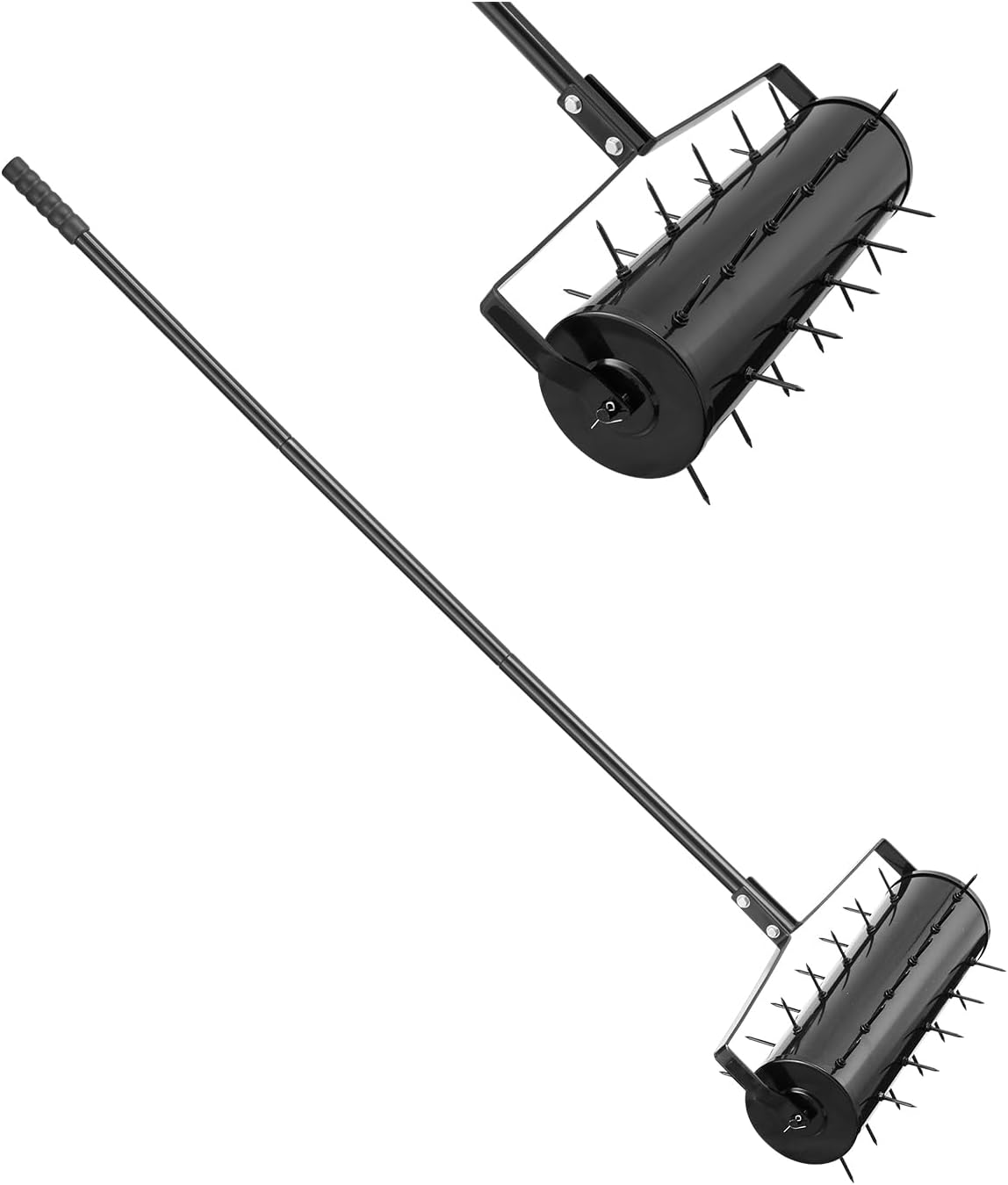
| Spike count | 33 spikes |
|---|---|
| Aerator width | 21 inches |
| Spike penetration | 2 inches |
| Handle length | 51.6 inches |
The VEVOR 21-inch rolling lawn aerator is a simple, manual tool that creates closely spaced 2-inch holes to relieve compaction and help water and nutrients reach grass roots. You push it across the lawn using the detachable 51.6-inch handle, and the 33 preinstalled iron spikes on the drum penetrate most sandy and loamy soils without bending. Notable features include a rust-resistant powder coating on the spikes, a spring-lock handle with three sections for adjustable reach, and quick assembly since spikes arrive preinstalled. In practice it covers ground quickly for small to medium yards, speeds up routine aeration compared with hand tools, and reduces strain because you do not need to bend over. The main limitations are that it is manual so it requires walking effort on tougher clay or heavily compacted areas and the 2-inch spike depth may be shallow for some heavy clay soils that need deeper aeration. For budget-minded gardeners who want straightforward mechanical aeration without renting power equipment this tool offers solid value.
Best for: Home gardeners looking for an inexpensive, walk-behind solution to relieve light to moderate lawn compaction and improve water and nutrient uptake without renting powered equipment.
Less Ideal for: Those with large properties, heavy clay soils, or who need deep core aeration should consider a tow-behind or powered aerator instead.
- 33 preinstalled iron spikes provide even, consistent aeration across a 21-inch drum
- Rust-resistant powder coating and reinforced spikes improve durability in wet conditions
- Detachable 51.6-inch handle with three sections assembles quickly and reduces bending
- Easy, fast assembly and included instruction manual let you start using it within minutes
- Manual operation requires physical effort and can be tiring on large or very compacted lawns
- Spike depth is about 2 inches which may be insufficient for deep clay compaction
Verdict: A budget-friendly manual rolling aerator that quickly treats small to medium lawns with evenly spaced 2-inch spikes for improved soil health.
BILLROAD Rolling Lawn Core Aerator with Hollow Tines

| Power Source | manual |
|---|---|
| Item Highlight | Sand-Filled Adds Weight-Save Labor,for Compacted & Clay Soil On Lawn & Yard |
| Item Weight | 29 pounds |
| Operation Mode | Manual |
The BILLROAD rolling lawn core aerator is a manual push tool designed to speed up coring aeration without renting powered equipment. It rolls like a cart while seven hollow tines punch plugs into the turf each revolution; the open-tube tines eject soil automatically so you rarely stop to clear jams. The drum accepts dry sand via the included funnel so you can add weight to match soil compaction and improve penetration on clay or hard ground. A set of external wheels protects the tines when crossing hard surfaces and the cart-style handle keeps the weight forward so you can push in an upright posture with less back strain. Practical benefits include faster coverage than a handheld plugger, easy maintenance of tine sharpness, and the ability to adjust downforce for different conditions. Important limitations are that it is manual so very large properties still require physical effort, and the product requires sand filling and occasional tine replacement for heavy use. Assembly and handling are straightforward but expect some exertion on heavily compacted sites.
Best for: Buyers who prioritize a dependable, low-maintenance tool for regular lawn care and want a durable manual aerator that consistently penetrates compacted yards without complicated mechanics.
Less Ideal for: People with very large commercial lawns or those who need a powered, high‑output machine should consider motorized or tow-behind aerators instead.
- Hollow, non-clogging tines eject cores automatically to minimize stoppages.
- Sand-fill drum lets you add adjustable weight for better penetration in compacted soil.
- Cart-style rolling design reduces bending and makes pushing easier over long runs.
- External wheels lift tines off hard surfaces to prevent damage and extend tine life.
- Manual operation still requires physical effort on large or extremely compacted lawns.
- Maximum sand fill limits how much downward force you can apply compared with motorized aerators.
Verdict: A reliable, easy-to-use rolling core aerator that delivers consistent, non-clogging coring and adjustable weight for dependable results on compacted home lawns.
SENVERT Rolling Lawn Aerator with Fillable Drum

| Manufacturer | Senvert |
|---|---|
| Item model number | JX-002 |
| Item Weight | 38.3 pounds |
This SENVERT rolling lawn aerator is a push-style tool that uses a spiked drum to perforate turf, improving air, water, and nutrient movement into the soil. It arrives mostly assembled and you only attach the handle before use, so setup is quick. The spiral-spike tread and 32-pound base let the unit roll smoothly while delivering consistent penetration, and the drum accepts sand or stones to raise the working weight up to about 55 pounds for tougher soil. Auxiliary TPR wheels make it simple to move the aerator on and off the lawn without dragging spikes over hard surfaces. Typical use is walking the aerator back and forth across a small to medium lawn in dry-to-damp conditions to create evenly spaced holes; it is faster and easier to control than spike shoes or step aerators. Limitations include its manual nature, which requires physical effort on larger properties, and the need to add ballast material for best results in compacted soils rather than relying on water fill.
Best for: Buyers who want a straightforward, walk-behind solution to improve lawn health on small to medium yards and who prefer a tool that is easy to set up and control.
Less Ideal for: Homeowners with large acreage or those seeking a motorized or tow-behind aerator for minimal physical effort should consider more powerful options.
- Fillable drum increases working weight up to 55 pounds for better spike penetration
- Spiral-spike tread rolls smoothly for controlled, even aeration
- Main body ships assembled so only the handle needs attaching
- Auxiliary TPR wheels protect hard surfaces and ease transport to storage
- Manual push operation requires noticeable effort on larger or very compacted lawns
- Manufacturer notes prohibit filling the drum with water, requiring heavier solid ballast for added weight
Verdict: A practical, heavier-than-average rolling aerator that lets you add ballast for deeper penetration, making it a solid choice for revitalizing small to medium lawns.
Walensee Rolling Lawn Aerator with 42 Heat‑Treated Spikes

| Spikes | 42 reinforced tine spikes |
|---|---|
| Spike treatment | Heat‑treated for hardness |
| Handle | Adjustable four‑piece stainless steel |
| Weight option | Roller can be filled with stones |
This Walensee rolling lawn aerator is a walk‑behind manual tool designed to relieve soil compaction by punching evenly spaced holes as you roll it across a lawn. It comes with 42 heat‑treated, reinforced tine spikes arranged in a spiral for smooth rolling and consistent penetration. The roller accepts added weight (stones only) so you can increase spike depth for firmer soils, and the handle breaks into four adjustable stainless steel sections with a rubber grip to reduce bending and improve comfort. Setup is straightforward since the spikes are preinstalled and the package includes the needed hardware. Practical benefits include improved air, water, and nutrient movement into the root zone and a stable rolling action that reduces jerking on uneven turf. Important limitations: it is a manual push tool so it requires physical effort over larger areas and it is not suitable for very hard, stony, or heavily rootbound soils without prewatering and added roller weight. Expect the best results on small to medium lawns with moist, workable soil.
Best for: Buyers who want a solid, no‑frills manual aerator for maintaining small to medium lawns and who prefer a durable, easy‑to‑operate tool over powered equipment.
Less Ideal for: Homeowners with very large properties, compacted clay that stays dry, or yards with many rocks and roots should consider motorized or specialist aeration options instead.
- 42 heat‑treated reinforced spikes for stronger, more durable penetration
- Spiral tine arrangement promotes smooth rolling and reduces vertical bounce
- Roller can be filled with stones to increase penetration depth as needed
- Adjustable four‑piece handle with rubber grip improves user comfort and storage
- Spikes come preinstalled for quicker setup
- Requires physical pushing effort and is impractical for large lawns
- Not effective on very hard, rocky, or root‑packed soils without prewatering and added weight
Verdict: A durable, user‑friendly rolling aerator that delivers consistent manual aeration for small to medium lawns with moist, workable soil.
Choosing the Right Rolling Lawn Aerator: Key Factors to Consider
Tine Type and Penetration Depth
Tine design determines how well a rolling aerator will penetrate compacted turf. Solid spike tines push holes into the soil and are straightforward, but hollow-core or slit-style tines remove plugs and can relieve compaction more effectively in heavy clay. Deeper penetration reaches roots better, but very deep tines require more power to operate and can be harder to tow or push.
When choosing, consider the typical firmness of your lawn and whether surface scalping or subsoil compaction is the main issue. An aerator with adjustable tine depth gives the most flexibility across seasons and soil conditions.
Frame Construction and Corrosion Resistance
A robust frame resists bending and keeps tine alignment consistent over repeated use. Look for welded steel or reinforced tubing for heavy jobs, and consider powder-coated or galvanized finishes for longer life in wet environments. Lighter frames are easier to maneuver but may flex under load, reducing penetration consistency.
Corrosion resistance matters because aerators spend time outdoors and contact moist soil. Poor finishes can lead to seized fasteners or weakened structural elements, making maintenance harder and shortening service life.
Working Width and Coverage
Working width directly affects how long it takes to aerate a yard. A wider drum or multiple tine rows covers more ground per pass, reducing time spent on larger lawns. Narrower tools are easier to steer in tight spaces and around landscape features but increase total passes required.
Balance width with your yard size and storage constraints. Consider whether a model folds or disassembles for storage if a wide working width would otherwise be awkward to store.
Tow or Push Compatibility and Maneuverability
Rolling aerators come in push, tow-behind, or hybrid formats. Tow-compatible units attach to a lawn tractor or ATV for fast coverage of larger properties, while push models give more control in smaller yards and on slopes. Maneuverability includes turning radius, handle height and angle, and how easily the unit tracks straight during operation.
Assess whether you already own towing equipment or prefer a manual machine. Tow models must have solid hitch points and stable balance to avoid scalloped passes.
Ease of Maintenance and Replaceable Parts
Regular maintenance keeps aerators functioning well year after year. Tine replacement, lubrication points, and accessible fasteners make upkeep straightforward. Machines that use common hardware and offer user-serviceable components reduce long-term hassles.
Also consider whether the design allows you to remove and clean tine drums, inspect bearings, or swap components without special tools. Ease of maintenance influences how often you will actually perform aeration and how long the unit will remain effective.
Storage Footprint and Portability
Storage needs are a practical concern for most gardeners. Some rolling aerators fold, detach, or have quick-release wheels to reduce footprint, while others require more shed space. Portability also matters if you transport the aerator between properties or need to move it seasonally.
Think about where you will keep the unit and whether you need lightweight latches or folding mechanisms. Heavy-duty locking systems are durable but may be harder to manipulate for a single person.
When to Aerate Your Lawn
Timing aeration for the right season makes the work far more effective. For cool-season grasses, early fall or early spring is best because roots are actively growing and can use the new air and nutrient access. Warm-season lawns benefit most from late spring to early summer when active growth can exploit improved soil conditions.
Avoid aerating when the ground is extremely wet or frozen. Excess moisture can cause smearing rather than clean holes, and frozen soil will damage tines and the machine. A light irrigation a day or two before aeration can soften firm soil and improve tine entry without making the surface muddy.
- Aerate during active root growth for your grass type
- Do not aerate on waterlogged or frozen ground
- Consider a light watering 24-48 hours before work if soil is very dry
Prep Steps Before Using a Rolling Aerator
Clear debris like sticks, toys, and large thatch clumps before you begin. Obstacles can bend tines and cause uneven passes. Mow to a slightly lower-than-normal height to reduce stress on the grass and improve tine contact with the soil.
Mark sprinkler heads, shallow utility lines, and delicate plantings to avoid accidental damage. If your yard has recently had soil amendments or topdressing applied, wait until those materials have settled to avoid clogging tine assemblies.
- Remove debris and lower mowing height
- Mark hazards and avoid utility lines
- Wait after topdressing before aerating
Combining Aeration With Overseeding and Topdressing
Aeration opens holes that help seed-to-soil contact and allow topdressing materials to work deeper. If you plan overseeding, spread seed immediately after aeration so it can settle into the newly created openings. Use a seed spreader or light rake to encourage distribution into the holes.
Topdressing with a compatible soil mix or compost after aeration can improve soil structure and nutrient availability. Apply thin layers to avoid smothering grass and choose material that matches your existing soil texture for best integration.
- Seed right after aeration for better germination
- Use thin, compatible topdressing layers
- Rake or roll lightly to help seed settle into holes
Safety and Care During Operation
Wear protective footwear and eye protection when operating or towing an aerator. Tines can dislodge small rocks or debris that become projectiles. Keep bystanders and pets at a safe distance while in use.
Inspect the unit after each session for bent tines, loose fasteners, or damaged bearings. Address small issues promptly to avoid bigger failures and maintain consistent tine engagement with the soil.
- Use basic PPE and keep people clear of work area
- Inspect machine frequently for wear and damage
- Tighten fasteners and replace bent tines promptly
Best Practices for Different Lawn Conditions
Sandy soils usually require lighter aeration because they drain well and are less prone to severe compaction. Use shallower tine settings to avoid creating excessively large holes. For clay soils, use multiple passes with moderate depth to gradually relieve compaction without tearing the turf.
If your lawn has high traffic areas or persistent compaction, consider annual aeration plus targeted spot aeration after heavy use. For slopes, work across the contour rather than straight up and down to maintain traction and reduce stress on the machine and operator.
- Sandy soils: shallower, gentler passes
- Clay soils: moderate depth, possible multiple passes
- High-traffic areas: annual or spot aeration
How We Chose the Best Rolling Lawn Aerator
We shortlisted models that demonstrate dependable soil penetration, durable construction, and practical usability in real-world lawn conditions. Evaluation focused on how well tines or spikes enter a range of soil types from sandy topsoils to compacted clay, because penetration depth and consistency determine the aerator's effectiveness. Durability and build quality were measured by frame material, tine attachment method, and resistance to bending or corrosion in outdoor use. Ease of use covered weight, handle ergonomics, towing compatibility, and how straightforward adjustments or maintenance tasks are. Coverage efficiency looked at working width and how quickly a homeowner can aerate a typical yard. Storage and transport considerations were included, especially for gardeners with limited shed space. We excluded specialty commercial units and niche accessories that require advanced machinery or professional installation. The final list prioritizes practical, homeowner-focused designs that balance penetration, longevity, and simple operation.
FAQ
How often should I use a rolling lawn aerator?
Frequency depends on soil type and lawn use. Most home lawns benefit from aerating once a year, while heavily compacted or high-traffic areas may need aeration every six to nine months. Lawns with loose soils may only need aeration every two to three years.
Can I tow a rolling aerator with a small lawn tractor?
Many rolling aerators are tow-compatible, but suitability depends on hitch type and the tractor's towing capacity. Tow models are excellent for covering large lawns quickly, though balance and secure attachment are essential for even penetration.
Will aeration damage my sprinkler system?
Aeration can contact shallow sprinkler lines if they are not buried deep enough. Mark heads and any known shallow utilities before you start. Avoid aggressive passes over marked areas and consider shallow tine settings near irrigation components.
Is core removal necessary with a rolling aerator?
Rolling aerators more commonly use spike tines that do not remove cores. Core removal can relieve compaction more effectively in some soils, but spikes still improve air and water movement, especially when used regularly. Choose based on your soil type and the level of compaction.
Should I fertilize after aerating?
Applying fertilizer after aeration makes sense because nutrients can reach roots more directly through the holes. Use a fertilizer appropriate for your grass type and follow label recommendations for timing and rates to avoid overapplication.
Final Verdict
A rolling lawn aerator is a practical tool for homeowners who need quick, wide coverage and reliable surface compaction relief. Prioritize tine design and penetration for your soil type, plus a durable frame and straightforward maintenance to keep the unit effective year after year. Consider how you will use the aerator, whether you will tow it, and how much storage space you have to choose a model that fits your routine. Weigh these tradeoffs-penetration versus ease of use, width versus maneuverability-to select the best unit for your lawn. Focus on the performance dimensions covered in this guide to make a confident choice that improves soil health and helps your turf thrive.
