

Note: This article contains affiliate links. If you click on these links and make a purchase, I may earn a small commission at no extra cost to you. This helps support my research and content. Read my full affiliate disclosure here.
When you need tight, tear-free cuts on trim, molding, or soft hardwood, a fine tooth hand saw makes the difference between a clean finish and extra sanding. This guide focuses on the best fine tooth hand saws for precision woodworking and finish carpentry. You will find our top shortlisted options that balance tooth geometry, blade stability, and handle comfort for repeated, controlled cuts. Below we explain how we evaluated each saw and what practical tradeoffs matter in a real workshop or on a job site, then present the top picks for different cutting needs.
Top Picks at a Glance
| Best Overall The best all-around choice for most situations | SUIZAN Flush Cut Saw 5" (Japanese Pull Saw) |  |
| Best Quality Built to a higher standard if you want something more solid | Silky GOMTARO Professional Hand Saw 300mm Fine Teeth (104-30) |  |
| Best Budget The cheapest option that still gets the job done reliably | VPQZUPG Japanese Pull Saw 6" SK5 Double-Edge, 14/17 TPI |  |
| Highest Rated A top-rated pick with lots of positive feedback | SUIZAN Ryoba 7" Double-Edge Japanese Pull Saw |  |
| Most Popular A crowd favorite that many people choose with confidence | SUIZAN Ryoba 9.5" Japanese Double-Edge Pull Saw |  |
SUIZAN Flush Cut Saw 5" (Japanese Pull Saw)

| Blade Material | Japanese Steel |
|---|---|
| Handle Material | Wood |
| Blade Length | 5 inches |
| Number of Teeth | 25 |
| Power Source | Hand Powered |
The SUIZAN 5" flush cut saw is a small Japanese pull saw built for precise trimming and finishing work. Its 0.012" thin blade is highly flexible so it can lie flat against a surface to trim dowels, plugs, tenon ends, and molding without scratching the surrounding wood. One edge is cut at 17 TPI for hardwood and the other at 25 TPI for softwood, letting you choose a finer or slightly faster cut without swapping tools. The blade has zero set teeth, which prevents marring when you trim flush, and the beech handle gives a controlled, comfortable grip for one-handed work in tight spots. Because the blade is fixed and very thin, the saw excels at delicate finish tasks and hobby or furniture repairs rather than heavy ripping or long crosscuts. Expect excellent surface quality and minimal kerf waste, but plan to use other saws for larger framing or stock removal. This is a practical, pro-grade tool for anyone who needs clean, accurate flush cuts and fine crosscutting in small parts.
Best for: Buyers who want a precise finishing saw for furniture repair, dowel and plug trimming, and small hobby projects where clean, scratch-free flush cuts matter.
Less Ideal for: Woodworkers who need a general-purpose saw for heavy stock removal, long crosscuts, or framing should choose a larger saw suited to those tasks.
- Very thin flexible blade for true flush cuts without surface damage
- Double-edged teeth (17 TPI and 25 TPI) for hardwood and softwood versatility
- Zero-set teeth reduce scratching when trimming plugs and dowels
- Compact overall length reaches tight spaces and one-handed tasks
- Made from Japanese steel with a traditional beech handle for a professional feel
- Blade is fixed and not replaceable, so blade life requires careful use and maintenance
- Not intended for heavy ripping or long crosscuts due to thin blade and short length
Verdict: Choose this saw when you need a compact, razor‑sharp flush cutter that produces clean, scratch-free finishes on dowels and small parts.
Silky GOMTARO Professional Hand Saw 300mm Fine Teeth (104-30)

| Blade Length | 300mm |
|---|---|
| Teeth per Inch | 11 tpi |
| Blade Material | Electroless Nickel Plated Steel |
| Blade Thickness | 1.2mm |
| Includes | Sheath |
The Silky GOMTARO 300mm fine-tooth hand saw is built for fast, smooth cuts on branches and finished lumber where a clean edge matters. Its 11 tpi (13 teeth per 30mm) blade with MIRAI-ME four-angle tooth geometry and impulse-hardened tips slices efficiently with minimal tearing, and the electroless nickel plating improves rust resistance and blade life. The thin 1.2mm blade and fine kerf make it easy to push through small-diameter branches and trim up to the listed cut capacity with less effort and a very neat finish. The non-slip cushioned rubber handle gives a secure grip during long sessions and the durable polypropylene sheath with belt clip keeps the blade protected on the job. Practical drawbacks are that the fixed straight blade favors precision pruning and finish work rather than heavy limb removal, and its length and fine teeth are not optimized for very large-diameter timber where coarser teeth cut faster. Users should also expect that delicate sharpening or replacement blades are needed to maintain peak performance over years of use.
Best for: Buyers who prioritize clean, precise cuts for pruning, finishing, or detailed woodworking and want a durable, long-lasting blade that stays sharp.
Less Ideal for: Not the best choice for users needing a compact folding saw for backpacking or for frequent cutting of very large limbs where a coarse-tooth blade is faster.
- Fine 11 tpi blade and MIRAI-ME tooth geometry for clean, smooth cuts.
- Impulse-hardened teeth and electroless nickel plating for longer edge life and rust resistance.
- Cushioned non-slip rubber handle for secure grip during prolonged use.
- Includes durable polypropylene sheath with belt clip for safe carry and storage.
- Fine-tooth, thin blade is less efficient on large-diameter or very hard timber.
- Fixed straight saw is less compact than folding alternatives for storage or carry.
Verdict: Choose the Silky GOMTARO 300mm fine-tooth saw when you need exceptionally clean, precise pruning and finish cuts from a durable professional-grade blade.
VPQZUPG Japanese Pull Saw 6" SK5 Double-Edge, 14/17 TPI

| Blade material | SK5 steel |
|---|---|
| Blade length | 6 inch |
| Tooth count | 14/17 TPI double edge |
This 6-inch Japanese pull saw is a budget-friendly option for fine woodworking, trimming, and small joinery tasks. The SK5 steel blade offers good edge retention for the price, and the double-edge 14/17 TPI gives you two cutting options: the coarser side for faster material removal and the finer side for cleaner, controlled cuts. Its pull-cut design reduces the force needed and helps you follow tight lines, which is especially useful when working on delicate pieces or in confined spaces. The simple wood handle is comfortable for short sessions and keeps the tool lightweight and easy to maneuver. Limitations include the short blade length, which is not suitable for large rip cuts, and the basic handle and finish that show this is an economical tool rather than a premium saw. For hobbyists and DIYers who need a capable fine-tooth hand saw without a large investment, this delivers effective performance for small to medium detail work.
Best for: Buyers who want an inexpensive, capable fine-tooth saw for detailed woodworking, trimming, and small shop or craft projects where control and precision matter more than long reach.
Less Ideal for: Woodworkers who regularly cut large boards or need a premium ergonomic saw for extended daily use should choose a longer or higher-end model instead.
- Double-edge 14/17 TPI blade offers both faster cutting and finer finish in one saw
- SK5 steel blade provides good hardness and edge retention for detailed work
- Pull-cut design improves control and requires less pushing force
- Compact 6-inch blade makes it easy to maneuver in tight spaces and for precision cuts
- Short blade limits usefulness for long rip cuts or large panels
- Basic wood handle lacks ergonomic features for extended use
Verdict: A low-cost, precise Japanese pull saw that gives hobbyists two tooth options and reliable control for detailed cutting tasks.
SUIZAN Ryoba 7" Double-Edge Japanese Pull Saw
| Blade Length | 7 inches |
|---|---|
| Blade Material | Japanese Steel |
| Blade Thickness | 0.02" (0.5mm) |
| Kerf Width | 0.03" (0.8mm) |
| TPI | 19 (crosscut) / 7-11 (rip) |
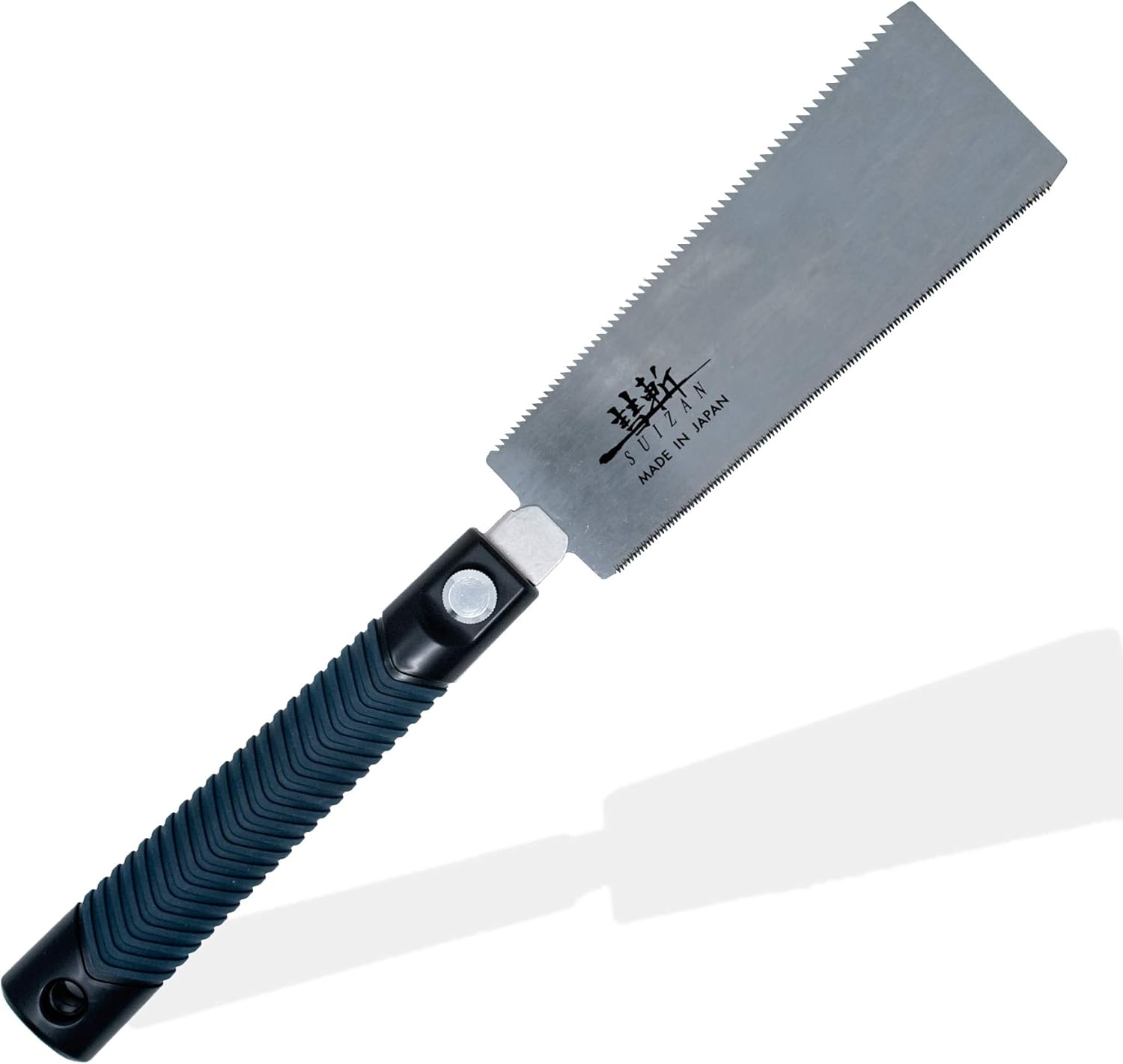
The SUIZAN Ryoba 7" is a traditional Japanese pull saw designed for clean, controlled cuts on small woodworking and trim tasks. It uses a very thin 0.02" blade that cuts on the pull stroke, producing a narrow 0.03" kerf that preserves material and yields smooth joinery and trim cuts. One edge has coarser rip teeth and the other a fine 19-TPI crosscut edge, so the same tool handles both along-grain and across-grain work. The elastomer handle gives a secure, non-slip grip and the blade is user-replaceable without tools, which keeps the saw useful over years of use. Because the blade is thin Japanese steel, cutting requires a light pulling technique rather than forceful pushing, which reduces fatigue during repetitive work. The saw is optimized for precision and finish rather than fast removal of large volumes of wood, so it is less efficient for heavy rough carpentry or demolition. If you value crisp edges and long-term edge quality, this Ryoba is a reliable, workshop-ready choice for fine handwork.
Best for: A buyer who needs a dependable hand saw for fine woodworking, joinery, trim and detail work and prefers a tool that stays sharp and serviceable over time.
Less Ideal for: Not a good fit for users who need a heavy-duty demolition saw or fast material removal on large framing tasks.
- Very thin 0.02" blade and 0.03" kerf for precise, low-waste cuts
- Double-edge Ryoba design combines rip and fine crosscut teeth in one tool
- Replaceable blade lets you restore performance without replacing the handle
- Made in Japan high-quality steel and crafted teeth deliver consistently sharp cuts
- Thin blade is designed for pull cutting and is not ideal for heavy demolition or fast stock removal
Verdict: Choose the SUIZAN 7" Ryoba when you want a compact, made-in-Japan pull saw that delivers precise, long-lasting cuts for fine woodworking.
SUIZAN Ryoba 9.5" Japanese Double-Edge Pull Saw

| Blade Material | Japanese Steel |
|---|---|
| Blade Length | 9.5 inches |
| Number of Teeth | 15 |
| Power Source | Hand Powered |
| Surface Recommendation | Wood |
The SUIZAN Ryoba 9.5" is a traditional Japanese pull saw built for precise woodworking tasks where a fine cut matters. It has two cutting edges—9 TPI rip teeth on one side and 15 TPI crosscut teeth on the other—so you can switch between ripping and crosscutting without changing tools. The 0.02" thin Japanese steel blade produces a narrow kerf and smooth surfaces, making it well suited to tenons, dovetails, trim work, and clean crosscuts in both hardwood and softwood. The wooden handle is hand-wrapped for grip comfort and the blade is replaceable with a simple screw, which keeps long-term maintenance straightforward. Because it cuts on the pull stroke, the saw offers better line control and requires less force than push saws, which helps reduce user fatigue during detailed work. Limitations to note are the thin blade’s relative fragility compared with thicker Western saws and the need to learn a pull-stroke technique for best results. The package includes a blade guard and a zippered bag for storage.
Best for: Buyers who prioritize precise, clean cuts and want a proven fine-tooth hand saw backed by strong user feedback; ideal for woodworkers doing joinery, trim, or detailed bench work who value cut quality over aggressive stock removal.
Less Ideal for: Not the best choice for heavy demolition, long rough ripping of large timbers, or users who need an immediately familiar Western push-saw feel.
- Double-edge Ryoba design provides both rip and crosscut teeth in one saw for versatile woodworking
- Very thin 0.02" Japanese steel blade gives a narrow kerf and clean, precise cuts
- Replaceable blade held by a single screw simplifies maintenance and extends tool life
- Traditional wood handle wrapped for a comfortable, controlled grip
- Includes blade guard and zippered bag for safe transport and storage
- Thin blade is more prone to bending or chipping than thicker Western saw blades
- Requires learning the pull-stroke technique for optimal control if you are used to push saws
Verdict: For fine woodworking where a narrow kerf and precise, controllable cuts matter, this Ryoba pull saw delivers professional-quality results in a single versatile tool.
Choosing the Right Fine Tooth Hand Saw: Key Factors to Consider
Tooth Geometry and Pitch
Tooth shape and number of teeth per inch determine how a fine tooth hand saw cuts. Finer pitches produce smoother, less splintered edges but cut more slowly, which matters when working with delicate trim or veneered surfaces.
Matching tooth geometry to the material is important. Crosscut-style teeth cut across grain and minimize tearout on finished faces, while rip-style teeth are faster along the grain but can leave rougher surfaces. For finish carpentry you will usually prefer a higher tooth count and crosscut geometry to preserve clean edges.
Blade Flatness and Thickness
A flat, stiff blade tracks straight and resists bending, which keeps narrow kerfs consistent and prevents the saw from veering off your mark. Thin blades require less force and make finer kerfs but can flex under pressure; thicker blades are stiffer but increase kerf width.
Consider the tradeoff between thinness for minimal waste and thickness for control. For precise joinery and miters, look for blades engineered to remain true when cutting long strokes, with minimal set unless intentionally designed for clearance.
Handle Shape and Comfort
Handle ergonomics affect control, fatigue, and cutting accuracy. A comfortable grip aligns your wrist and forearm so you can maintain steady strokes without excessive force. Look for contouring that supports different hand sizes and textures or materials that reduce slippage when your hands sweat or get dusty.
Open or pistol-grip styles change stroke mechanics. Some handle designs also let you alter hand position for push versus pull cutting. For repeated fine work, a well-shaped handle reduces vibration and helps you execute controlled, precise strokes.
Tooth Set and Sharpening Ease
Tooth set-the slight outward bend of alternate teeth-creates the kerf width and affects binding. Minimal, consistent set is preferable for fine cutting because it reduces tearout while still preventing the blade from pinching. Equally important is how easy the teeth are to resharpen or re-set if you plan to maintain the saw long-term.
Saws with hardenable tooth tips or complex impulse-hardened finishes can hold an edge longer but may be harder to file. If you expect to resharpen the saw yourself, choose a tooth profile and temper that match your maintenance abilities.
Blade Coating and Corrosion Resistance
Protective coatings reduce rust and grime buildup, keeping the blade sliding smoothly through wood and extending usable life. Corrosion not only damages appearance but can increase friction and cause the blade to stick in damp conditions.
When your saw is used outdoors or stored in a workshop without climate control, a corrosion-resistant finish or stainless option makes maintenance easier and preserves cutting consistency over time.
Cutting Purpose and Kerf Width
Think about the exact tasks you will use the fine tooth hand saw for. Trimming door jambs, cutting molding, and precise joinery each favor slightly different kerf widths and stroke styles. A narrow kerf saves material and produces less visible waste, but it demands steadier technique and may be slower.
Balance desired finish quality against speed: when working on visible trim, prioritize kerf and tooth count; for occasional behind-the-wall tasks, a more versatile compromise may be preferable.
Choosing the Right Tooth Count for Your Project
Tooth count is a practical lever for matching saw performance to the task. Higher teeth per inch create smoother cuts on thin or finished stock, while lower tooth counts remove material faster on thicker boards.
For precise trim and molding, aim for a finer tooth count to minimize tearout. If you need to cut rough lumber or make fast, deeper cuts, a coarser fine-tooth selection still provides control but improves throughput.
- High TPI for clean finishes and veneered surfaces
- Moderate TPI for general finish work with occasional rough cuts
- Lower TPI within the fine-tooth range for faster removal on thicker stock
Hand Techniques That Improve Cut Quality
A consistent, supported stroke produces straighter cuts than forcing speed. Set up the workpiece so you can keep the saw at a steady angle and use your off hand to stabilize the wood when safe.
Start cuts with short, light strokes to establish a kerf, then increase full strokes once the blade is tracking true. Use the whole forearm rather than just the wrist to keep strokes even and reduce fatigue.
- Begin with a light scoring motion to start the kerf
- Keep blade aligned with your eye line for a straight cut
- Use clamps or a vise to secure small trim pieces
Maintaining a Fine Tooth Hand Saw
Regular maintenance keeps cuts predictable. Wipe the blade after use, lightly oil or apply a rust inhibitor, and store the saw in a dry place. Periodic stropping or gentle filing preserves tooth profile for longer life.
When sharpening, follow the original tooth geometry and take small, consistent passes. If the blade has hardened teeth, consult guidance on compatible sharpening methods rather than aggressive filing that can damage temper.
- Clean and oil blade after use
- Resharpen to original tooth pattern
- Check handle fastenings and replace worn grips
When To Choose a Backed or Reinforced Blade
Backed or reinforced blades add stiffness for long, accurate cuts and reduce blade flex. They are especially useful for cutting tight miters and long pieces where tracking is critical.
A reinforced spine increases weight and rigidity. That extra control helps prevent wander on delicate joinery but increases the effort needed to start a cut and may widen the kerf slightly.
- Reinforced blades for long, straight cuts
- Unbacked thin blades for minimal kerf and fine detail
- Consider spine design when working on long moldings or long rip cuts
Selecting a Saw for Different Workshop Environments
Workshop conditions influence material choice. In a damp or outdoor setting, prioritize corrosion resistance and easy-clean finishes. For a controlled indoor shop, prioritize tooth geometry and blade finish for the best surface quality.
Consider whether you will be transporting the tool frequently. A rugged handle and blade protection are important for job-site use, while a comfortable, lighter saw benefits extended bench work.
- Outdoor job sites: rust-resistant finishes and protected storage
- Home shop: focus on cut quality and handle comfort
- Frequent transport: durable handle fastenings and blade guards
How We Chose the Best Fine Tooth Hand Saw
We started by defining the use cases where a fine tooth hand saw is the right tool: crosscutting finish lumber, trimming moldings, coping, and detailed joinery. From there we applied a set of concrete filters focused on attributes that directly affect cut quality and everyday handling. Key evaluation criteria included tooth geometry and pitch for cut smoothness and speed, blade flatness and thickness for straightness and resistance to bending, handle ergonomics and grip materials for control during long use, blade coating and corrosion resistance for longevity, and overall balance between tooth count and cutting efficiency. We excluded general-purpose coarse saws, powered saws, and specialty abrasive blades that do not rely on traditional tooth geometry. We also filtered out tools with poorly finished edges or imprecise manufacturing tolerances that cause wandering cuts. The final shortlist emphasizes saws that demonstrate predictable kerf, repeatable straight cuts, and comfortable hand positioning suitable for finish carpentry and fine woodworking.
FAQ
What tooth count is best for cutting trim and molding?
Higher tooth counts are usually better for trim and molding because they reduce splintering and leave a smoother edge. Exact TPI depends on material thickness, but finer pitches are preferred for visible surfaces.
Can I sharpen a fine tooth hand saw myself?
Often you can, depending on the tooth temper and profile. Simple crosscut patterns and soft-tempered teeth are straightforward to file. Hardened or impulse-treated teeth are more difficult and may need specialist sharpening.
How do I reduce tearout when cutting veneered boards?
Use a finer tooth count, score the cut line first, and cut with the veneered face up when possible. Supporting the cut with a sacrificial backing strip also helps prevent splintering at the exit.
Is a reinforced spine always better for fine cuts?
Not always. A reinforced spine improves straightness for long strokes but can increase kerf and weight. For very delicate detail work, a thin unbacked blade may provide the finest results.
How should I store a fine tooth hand saw to prevent damage?
Store the saw in a dry place, ideally hanging or in a protective sleeve to prevent nicks to the teeth. Lightly oiling the blade and keeping it away from moisture will extend its usable life.
Final Verdict
Choosing the right fine tooth hand saw comes down to balancing tooth count, blade stiffness, and handle comfort for the specific finish tasks you perform. Prioritize tooth geometry and blade flatness when surface quality and straightness matter most, and favor corrosion resistance and comfortable grips if you work in demanding environments. Decide which tradeoffs you can accept: faster cutting versus smoother finish, lighter blades versus added rigidity. With those priorities clarified, you can select a saw that consistently delivers the clean, precise cuts required for finish carpentry and fine woodworking.
