

Note: This article contains affiliate links. If you click on these links and make a purchase, I may earn a small commission at no extra cost to you. This helps support my research and content. Read my full affiliate disclosure here.
Cutting laminate flooring cleanly requires the right hand saw. Using the wrong blade or a tool that is hard to control leads to chipped edges, uneven ends, and wasted planks. This guide focuses on hand saws for laminate flooring and explains which features matter in a real installation, whether you are trimming end pieces, fitting door jambs, or making relief cuts. We shortlisted five top hand saws suited to laminate work and evaluated them for blade tooth geometry, control and ergonomics, and how they behave when cutting laminated and veneered surfaces. Below you will find concise reasons each style can be a good fit, plus practical guidance on setup, blade choice, and techniques for damage-free cuts.
Top Picks at a Glance
| Best Overall The best all-around choice for most situations | Fiskars Pro Hand Saw with PowerTooth 55 cm Blade |  |
| Best Quality Built to a higher standard if you want something more solid | Bahco SUP-20-LAM 20" Ergo Laminator Handsaw |  |
| Best Value The sweet spot between price and what you get | Spear & Jackson Predator Laminate Saw, 20" Blade, 14 TPI |  |
| Highest Rated A top-rated pick with lots of positive feedback | Jorgensen 15-Inch Hand Saw with 8 TPI Black-Coated Blade |  |
| Best Seller A high-volume bestseller chosen again and again | TOOLAN 8-in-1 Multi-Blade Manual Hand Saw with Quick-Change Handle |  |
Fiskars Pro Hand Saw with PowerTooth 55 cm Blade

| Power Source | Manual |
|---|---|
| Other Special Features of the Product | RapidStart-Technology, PowerTooth |
| Number of Teeth | 152 |
| Blade Material | High Speed Steel |
| Handle Material | Thermoplastic Elastomers |
The Fiskars Pro hand saw is a manual coarse-cut saw built for fast, controlled trimming of wood, laminate and PVC. It uses a triple-ground PowerTooth blade with RapidStart technology that concentrates more teeth toward the tip for easier plunge starts and reinforced, induction-hardened teeth for longer edge life. The oversized handle has a non-slip SoftGrip surface and a shaped top for two-handed cutting when more control is needed. Typical uses include trimming laminate planks, cutting undercut door casings and small rip or cross cuts on jobsite lumber. It ships with a snap-in blade guard that doubles as a pencil holder for layout work. Expect aggressive 7 TPI cutting that removes material quickly but leaves a coarse finish that may require sanding or a finer-tooth saw for finish cuts. The saw is ambidextrous and feels sturdy for repeated use, though its aggressive tooth geometry is more suited to rough and fast cuts than precision joinery.
Best for: Buyers who want a robust, easy-to-control hand saw for everyday installation and rough cutting tasks on laminate, PVC and construction lumber where speed matters as much as durability.
Less Ideal for: If you need fine, tear-free finish cuts or joinery-grade edges for visible edges, a finer-tooth saw or pull saw is a better choice.
- PowerTooth blade with RapidStart design for easier plunge starts and faster cutting
- Induction-hardened teeth for extended sharpness between resharpening
- Oversized SoftGrip handle with two-handed shape for controlled, ergonomic cutting
- Includes snap-in blade guard with pencil holder for safe transport and on-the-job marking
- 7 TPI coarse tooth pattern leaves a rougher cut finish that may need sanding or a finer saw for trim work
- Blade is optimized for fast cuts rather than fine precision work
Verdict: A tough, user-friendly hand saw that speeds up rough and installation cuts in laminate and similar materials while staying comfortable for extended use.
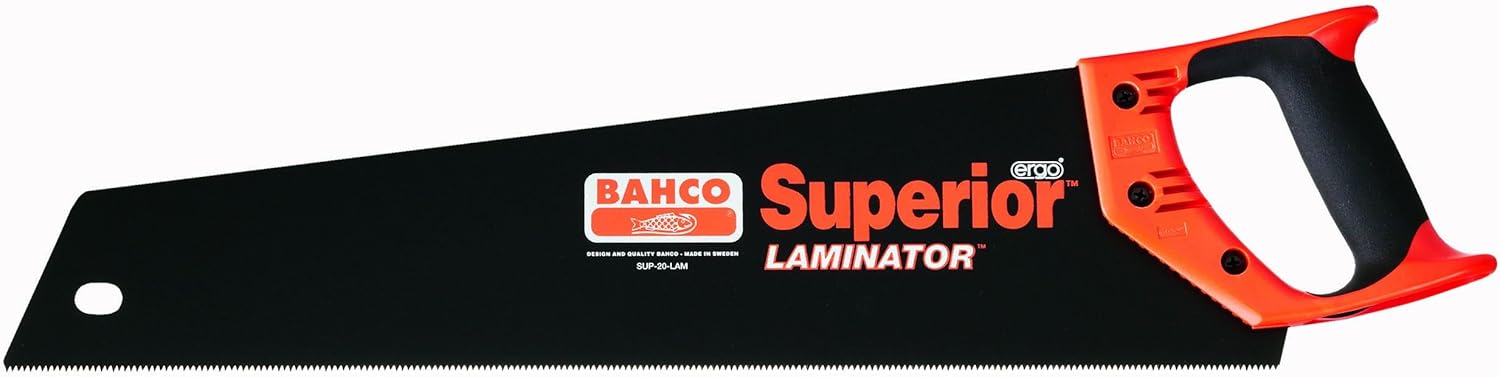
Bahco SUP-20-LAM 20" Ergo Laminator Handsaw
| Blade Length | 20 inches |
|---|---|
| Number of Teeth | 11/12 TPI |
| Blade Material | High Speed Steel |
| Power Source | Manual |
The Bahco SUP-20-LAM is a purpose-built 20-inch handsaw for cutting laminate and wooden flooring with a fine 11/12 TPI blade that delivers straight, controlled cuts. Its high-speed steel blade is bevel-ground for precision and is finished with a low-friction, rust-protective coating that helps the saw glide through material and resist corrosion. The one-piece two-component ergonomic handle is screwed on for stability and is shaped to favor pulling cuts, which improves control when trimming long boards. It ships with a reusable plastic tooth protector for safe storage. In practice this saw excels at accurate crosscuts and trimming in tight spaces where a powered tool is inconvenient, and the tooth count gives a smoother edge on laminate than coarser saws. Limitations are that it remains a manual tool so larger jobs require more effort and speed will not match power saws, and the plastic handle may feel less premium than metal-bodied alternatives for heavy daily use.
Best for: Buyers who prioritize clean, precise hand cuts for laminate or wood flooring and want a dedicated manual saw that emphasizes control and finish over speed.
Less Ideal for: Contractors or users who need to rip large volumes of flooring quickly or prefer power tools for high-efficiency production work.
- Fine 11/12 TPI blade produces smooth, accurate cuts in laminate and wood flooring
- High-speed steel blade with low-friction, rust-protective coating for durability and easier cutting
- Ergonomic two-component handle designed for stable pulling cuts and even power distribution
- Comes with a reusable plastic tooth protector for safe storage and transport
- Manual operation makes large jobs more physically demanding compared with power saws
- Plastic handle may feel less durable for heavy daily professional use
Verdict: Choose this Bahco 20" laminator saw when you want a precision, corrosion-resistant hand saw that delivers clean, controlled cuts in laminate and wood flooring.
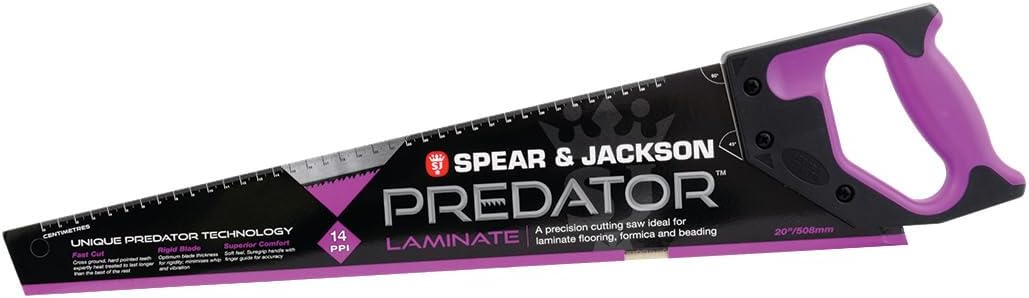
Spear & Jackson Predator Laminate Saw, 20" Blade, 14 TPI
| Blade Length | 20 inches |
|---|---|
| Number of Teeth | 14 |
| Blade Material | High Speed Steel |
| Power Source | Hand Powered |
The Spear & Jackson Predator Laminate Saw is a hand-powered hardpoint saw built for cutting laminate flooring, Formica and beading. Its 20-inch, heat-treated high-speed steel blade and 14 teeth-per-inch profile deliver a rapid, clean cutting action while the rigid blade reduces whip and vibration for straighter cuts. The ergonomic Suregrip handle and finger guide with 45/90 degree markings help with control and accuracy during long runs. In typical use it feels balanced for pushing long boards and the fine tooth count limits chipping on laminate edges when used with steady, even strokes. Important limitations are that it is a manual saw so cutting long runs takes more time and effort than a power tool, and the plastic handle is durable but less premium-feeling than wood or fully molded rubber options. For installers who prioritize precise, chip-free hand cuts and a blade that resists flex, this saw is a solid, workmanlike choice.
Best for: Installers and DIYers who want a reliable hand saw for precise, chip-minimizing cuts in laminate flooring and trim and who value control and accuracy over speed.
Less Ideal for: People who need to cut large areas quickly or prefer power tools for repeated heavy-duty ripping and crosscutting should consider an electric saw or jigsaw instead.
- Hardpoint high-speed steel blade provides fast, clean cuts with reduced chipping
- Rigid blade construction minimizes whip and vibration for straighter hand cuts
- Suregrip ergonomic handle and finger guide improve comfort and cutting accuracy
- 45/90 degree guide built into the saw aids quick angled cuts without measuring
- Manual sawing is slower and more tiring than power tools for large jobs
- Plastic handle feels less premium and may offer less long-term cushioning
Verdict: Choose this saw if you need a sturdy hand tool that produces fast, clean, chip-resistant cuts in laminate flooring with good control and accuracy.
Jorgensen 15-Inch Hand Saw with 8 TPI Black-Coated Blade

| Number of Teeth | 8 |
|---|---|
| Blade Material | Alloy Steel |
| Handle Material | Aluminum |
| Surface Recommendation | Plastic,Wood |
The Jorgensen 15-inch hand saw is a straightforward, heavy-cut handsaw aimed at general woodworking and outdoor trimming tasks. Its 8 TPI triple-ground teeth deliver aggressive, fast cuts through dimensional lumber and framing stock, while the SK5 high-carbon steel blade holds an edge and resists bending under regular use. The black Teflon-like coating reduces friction and helps keep sap and debris from building up on the blade. The reinforced aluminum frame and TPE/ABS ergonomic grip make it comfortable to hold for extended sessions and the handle includes 45° and 90° angle guides useful for marking cuts. Practical uses include rip and cross cuts on rough lumber, pruning thick branches, and cutting PVC or trim where speed matters more than ultra-fine finish. Limitations are inherent to the coarse 8 TPI: it is not intended for fine finish work or precise joinery and will leave a rougher cut on delicate stock. Also, being a fixed non-folding saw it requires safe storage with the included edge protector.
Best for: A buyer who wants a reliable, fast-cutting handsaw for general carpentry, framing, and heavier trimming tasks and values durability and comfort during frequent use.
Less Ideal for: Not the best choice for woodworkers focused on fine finish work, delicate trimming, or precision joinery who need higher-tooth-count saws.
- Aggressive 8 TPI triple-ground teeth for fast, efficient cutting of rough lumber
- SK5 high-carbon steel blade offers good edge retention and resists bending
- Black low-friction coating reduces material buildup and helps corrosion resistance
- Ergonomic aluminum-framed handle with TPE/ABS grip and built-in angle guides
- Coarse 8 TPI tooth pattern produces a rougher finish not suited to fine joinery
- Fixed blade requires careful storage and is less portable than folding saws
Verdict: Choose this saw if you want a durable, comfortable hand saw that makes fast, aggressive cuts for general carpentry and trimming.
TOOLAN 8-in-1 Multi-Blade Manual Hand Saw with Quick-Change Handle

| Power Source | Manual |
|---|---|
| Blade Material | Alloy Steel |
| Handle Material | Plastic |
| Included Components | 1 pcs handle, 8 pcs blade |
The TOOLAN 8-in-1 hand saw is a compact, manual cutting kit that uses a quick-change clamp to accept a range of reciprocating-style blades for different materials. Typical use is straightforward: select the appropriate blade from the eight included, lock it into the ergonomic TPR handle and saw by hand for short trim and plunge cuts. Notable features include a self-locking blade clamp for secure holding, an anti-slip ergonomic grip to reduce fatigue, and a set of blades intended for wood, drywall, metal, and plastic tasks. For laminate flooring work this saw can be useful for small cuts, notches, and plunge cuts where a powered tool is impractical or unavailable, and the thin blades let you make precise scoring or cutouts without large equipment. Important limitations are that it is fully manual so it takes more effort and time than a jigsaw or oscillating tool for long straight cuts, and the included blades are a mix of thicknesses so heavier-duty laminate or long rip cuts will still benefit from a dedicated laminate blade on a power saw.
Best for: Buyers who prioritize simplicity and low-risk tools for occasional floor trimming, patch cuts, or notch work and who prefer a mechanical, easy-to-understand solution over power tools.
Less Ideal for: Professionals or homeowners who need to cut long runs of laminate or make many rip cuts quickly should choose a jigsaw or oscillating multi-tool with dedicated laminate blades instead.
- Quick-change, self-locking clamp holds standard reciprocating blades securely
- Ergonomic TPR non-slip handle reduces hand fatigue during repeated cuts
- Includes eight blades suited to drywall, wood, metal and plastic for versatility
- Compact, lightweight design is easy to carry and store in a toolbox
- Manual operation makes long straight or many cuts slower and more tiring than power tools
- Included blades vary in thickness so some are better for light detail work than heavy-duty laminate rip cuts
Verdict: A compact, no-frills manual saw kit that is ideal for cautious DIYers who need a reliable, portable tool for occasional laminate flooring trim and small cutouts without using power tools.
Choosing the Right Hand Saw for Laminate Flooring: Key Factors to Consider
Blade Tooth Count and Geometry
Tooth count and tooth shape determine how the blade slices laminate rather than rips it. Higher TPI blades produce finer cuts and reduce chipping on thin laminated surfaces, while lower TPI blades cut faster but can tear the veneer. For laminate flooring you often need a balance: a moderately high tooth count for a smooth finish on the face, but a geometry that clears waste rather than compressing it.
Beyond raw TPI, the tooth profile matters. Ground, negative rake, or alternate-set teeth can slice cleaner through the wear layer and core material. Some blades are designed with micro-sets or thin kerfs to limit material removal, which helps maintain precise plank lengths when multiple cuts are required.
Cut Quality and Edge Cleanliness
A hand saw that leaves a clean edge minimizes finishing work and reduces the chance of visible chips along plank ends. Edge cleanliness affects how planks butt together and how well tongues engage in click-lock systems. If the cut edge is ragged you can end up with gaps, raised joints, or the need to sand and re-cut pieces.
Consider how the saw behaves when finishing the face side versus the substrate side. Flipping the plank and choosing which side faces up during the cut can make a practical difference, but the ideal saw will keep tear-out minimal regardless of orientation.
Control, Handle Comfort, and Stroke Stability
Laminate flooring work often requires long, straight cuts and controlled short trims near thresholds and doorways. The saw handle should allow a secure grip that aligns with the blade for a straight stroke. Handles that transfer vibration poorly or force an awkward wrist angle increase the chance of wandering cuts or fatigue over a long install.
Stability matters when making accurate crosscuts and coping near baseboards. Look for designs that balance the tool so the blade tracks predictably during push and pull strokes. Some handles also include features that help index the blade to the cut line for repeatable trims.
Blade Durability and Ease of Replacement
Laminate material and high tooth counts can dull blades faster than softwood. Blade longevity affects how often you need to replace or sharpen, which matters during a room-sized install. Easily replaceable blades or models that accept standard replacement blades keep downtime and cost predictable.
Also consider whether blades resist overheating and glazing when cutting long runs. Blades that hold their edge reduce binding and maintain cut quality as the job progresses, especially when cutting laminated core materials or dense backing layers.
Visibility and Layout Accuracy
Being able to see and follow a marked line is essential for tight-fitting flooring work. Blade thickness, tooth configuration, and the saw's physical shape affect sightlines to the cut line. A thin-kerf blade may hide less of the mark and make it easier to align the cut exactly where needed.
Good visibility reduces rework and helps with tasks like scribing to irregular thresholds or trimming small pieces to fit around pipes and jambs. Consider whether the saw lets you hold the plank steady and see the line from the installation position.
Types of Hand Saws Suitable for Laminate
Several hand saw styles can work for laminate flooring depending on the cut you need. A fine-tooth panel saw or crosscut saw often produces the cleanest face cuts on planks. Pull-action Japanese-style saws cut on the pull stroke and typically have thin kerfs and very fine teeth, offering excellent control and minimal tear-out on laminated surfaces.
Backsaws or tenon saws provide a stiff, short blade good for trimming ends and working near door casings, while flexible coping-style saws allow more reach into tight spots. Choose the style that matches the common cuts in your project: long rip or cross cuts across planks, short trims at thresholds, or detailed scribing.
- Pull saws: thin kerf and fine teeth for minimal splintering
- Fine-tooth panel saws: better for long straight cuts
- Backsaws: stiff and precise for short, square cuts
- Coping saws: access in tight or irregular spaces
Blade Preparation and Marking Techniques
Preparing the plank and marking the cut line reduces mistakes. Use a sharp pencil or a low-profile marking tool and mark from the finished face when you can. If you expect tear-out, orient the finish face down so the cutting action on the exposed side is smoother.
Clamp the plank when making longer cuts to prevent movement. For repeated identical cuts, create a simple stop block or jig so each piece comes out the same length without re-measuring. A thin straightedge helps guide your initial stroke to keep the saw from wandering.
- Face-down cuts often show less tear-out on the visible surface
- Use clamps or an edge guide for long crosscuts
- Create a stop block for repeated trims
Finishing and Repairing Minor Edge Damage
Even with a good saw, small chips occasionally occur. Light sanding with a fine-grit sanding block can blend minor tear-out. For visible end grains or damaged edges, color-matched edge filler or laminate repair kits can conceal chips and restore a neat appearance.
If a cut leaves a rough profile that affects joint fit, recut the end with a fresh blade or clamp the piece to a straight guide and re-trim a small amount. Avoid aggressive sanding that changes the plank width more than necessary.
- Use fine-grit sanding for tiny chips
- Re-cut with a fresh blade for poor fits
- Edge filler can hide cosmetic damage
Using Jigs and Guides to Improve Accuracy
A simple guide or jig can turn an ordinary hand saw into a precision tool. Use a straight board clamped to the workpiece as an edge guide to keep the blade tracking perfectly straight for long crosscuts. For repeat cuts, a fence with a stop reduces measuring errors and speed up work.
When cutting at thresholds or around obstacles, build a small template from scrap to mark complex scribe lines. Templates reduce the need for trial-and-error fitting and preserve expensive planks.
- Clamp a straight guide for long, square cuts
- Use a stop block for repeatable lengths
- Make templates for irregular scribing
Maintenance Tips to Keep Cuts Clean
Keep blades clean of resin and dust to maintain sharpness and reduce binding. Wipe blades periodically during long jobs and inspect teeth for damage. If a blade heats and gums up while cutting, let it cool and clean it with a mild solvent suitable for the blade material.
Store spare blades in a protective sleeve and replace them when you notice increased tear-out or roughness. Regularly check handle attachments and any screws or rivets so the blade remains true to the handle during use.
- Clean blades regularly to prevent glazing
- Replace blades showing wear to maintain cut quality
- Tighten handle fittings for steady tracking
How We Chose the Best Hand Saw for Laminate Flooring
We prioritized saws and configurations that produce clean laminate cuts with minimal chipping and consistent control. Our selection filters emphasized blade geometry that slices laminated surfaces rather than tears them, handle ergonomics for steady guided strokes, and a range of tooth-per-inch (TPI) options suited to different plank thicknesses. Durability of the blade and the ability to swap or sharpen blades were factored, since a dull or inappropriate blade causes the most installation issues. We also considered saw types that offer good visibility of the cut line and allow precise approach to door casings and trim without overcutting. Exclusions included tools intended strictly for rough carpentry, multi-blade powered saws, and specialty industrial cutters that are not practical for typical homeowner or small-contractor flooring work. Final decisions weighed slicing action, ease of control, blade serviceability, and how the saw performs on common laminate substrates and edge profiles.
FAQ
What tooth count works best for cutting laminate flooring?
A moderate to high tooth count usually works best. Higher TPI produces finer cuts and reduces chip-out on the laminate wear layer, though it cuts more slowly. Choose a blade that balances smoothness with cutting speed for the plank thickness you are using.
Should I cut with the laminate face up or face down?
Often cutting with the finish face down reduces visible tear-out because the blade leaves cleaner edges on the underside. However, the best approach depends on the saw and blade. Test on a scrap piece to confirm which orientation gives the cleanest finish.
Can I use a regular carpenter's saw for laminate?
You can, but not all carpenter saws are ideal. Look for a version with finer teeth and a thin kerf. Coarse, aggressive teeth designed for rough lumber are more likely to chip laminated surfaces and leave poor edges.
How often should I change or sharpen a blade when installing a full room?
Blade life depends on the blade quality and amount of cutting, but you will likely need to replace or sharpen blades more often than when cutting softwood. Monitor cut quality: increasing tear-out or roughness is a sign the blade needs service.
Are pull saws better than push saws for laminate?
Pull saws often have thinner blades and finer teeth, which can make cleaner cuts on laminate. They cut on the pull stroke, which some users find offers more control for delicate finish work. Performance depends on blade geometry more than action alone.
Final Verdict
Choosing the right hand saw for laminate flooring comes down to cut quality, control, and blade serviceability. Prioritize a blade with appropriate tooth count and geometry for slicing laminated surfaces, a comfortable handle that lets you guide long strokes, and the ability to replace or sharpen blades during a larger job. Accept tradeoffs between speed and finish: finer-tooth, thin-kerf blades take longer but give neater edges and less repair work. For most DIY and small-contractor installs, selecting a saw that emphasizes clean cuts and good visibility will save time and material in the long run.
