

Note: This article contains affiliate links. If you click on these links and make a purchase, I may earn a small commission at no extra cost to you. This helps support my research and content. Read my full affiliate disclosure here.
If you work with large timbers, the right hand saw changes how cleanly joints fit and how fast you can rough-cut beams onsite. A saw built for timber framing needs a blade and teeth geometry that can bite through hardwood and softwood without wandering, plus a handle and balance that let you control long crosscuts and rip cuts. This guide walks through six shortlisted hand saws chosen for durability, cut control, and usability in heavy-joinery work. Read on for practical notes about blade type, tooth pitch, and handling so you can pick the saw best suited to how you work on beams and framed structures.
Top Picks at a Glance
| Best Overall The best all-around choice for most situations | Silky BIGBOY 2000 Folding Saw 360mm XL Teeth (356-36) |  |
| Best Quality Built to a higher standard if you want something more solid | Silky Bigboy 2000 360mm Folding Handsaw Outback Edition |  |
| Best Value The sweet spot between price and what you get | KAKURI 14" Anahiki Timber Framing Pull Saw |  |
| Best Budget The cheapest option that still gets the job done reliably | HAUTMEC 22" Hand Saw with 9 TPI Coarse Teeth |  |
| Highest Rated A top-rated pick with lots of positive feedback | Silky Professional BIGBOY Folding Saw 360mm (Large Teeth, Model 354-36) |  |
| Best Seller A high-volume bestseller chosen again and again | Bahco PC-24-TIM 24-inch Professional Timber Saw |  |
Silky BIGBOY 2000 Folding Saw 360mm XL Teeth (356-36)

| Blade Length | 360mm (14.2 inches) |
|---|---|
| Blade Material | Hard Chrome Plated Steel |
| Teeth | XL teeth, 5.5 TPI (6.5 per 30mm), impulse-hardened |
| Cut Capacity | 7.1 inches |
| Handle Material | GOM rubberized two-handed handle |
The Silky BIGBOY 2000 is a heavy-duty folding handsaw built for extended reach and fast, smooth cutting of green or dry hardwood. It features a 360mm (14.2 in) taper-ground, hard chrome plated blade with impulse-hardened, non-set XL teeth that clear sawdust and resist clogging, which speeds through limbs and small trunks. The curved blade and two locking positions let you do flush and reach cuts while the non-slip two-handed rubberized handle gives a secure grip under load or in wet conditions. Typical uses include pruning, limb removal, and on-site timber work where a portable but powerful saw is needed. The saw is relatively lightweight for its length and folds for safer transport and storage. Limitations are that a folding saw of this size cannot replace a full crosscut or framing saw for very large timbers and repeated heavy structural ripping; for sustained framing work a dedicated larger handsaw or power tool will cut faster. Also the aggressive XL tooth pattern makes very rough cuts on fine joinery where a finer-tooth blade would be preferable.
Best for: A buyer who wants a portable, high-performance hand saw for pruning, limb removal, and occasional on-site timber work where reach and cutting speed matter more than millimetre-fine finish.
Less Ideal for: Not the best choice for carpenters who need a dedicated crosscut or panel saw for large-volume timber framing or for users who require very smooth finish cuts for joinery.
- Long 360mm curved blade for extended reach and flush cutting
- Impulse-hardened, non-set XL teeth that cut fast and resist clogging
- Two-handed GOM rubberized handle for a secure, low-vibration grip
- Folds and locks for safer transport and compact storage
- Hard chrome plating increases blade wear resistance and reduces friction
- Folding design and 360mm length still limit speed and efficiency on very large timbers compared with full-sized framing saws or power saws
- XL tooth spacing creates rougher cuts unsuitable for fine joinery
Verdict: Choose the Silky BIGBOY 2000 when you need a portable, razor-sharp folding saw that delivers fast, extended-reach cutting for heavy pruning and onsite timber tasks.
Silky Bigboy 2000 360mm Folding Handsaw Outback Edition

| Blade Length | 360mm/14.2 inches |
|---|---|
| Blade Material | Nickel/Tin Black Plated Steel |
| Blade thickness | 1.8mm |
| Teeth per Inch | 5.5 (XL) |
The Silky Bigboy 2000 is a professional folding handsaw built for demanding outdoor work. It folds into an arbor-composite handle for safe storage and includes a soft carrying case for transport. The 360mm (14.2 in) nickel/tin black-plated blade has impulse-hardened, taper-ground non-set teeth and Mirai-me four-angle geometry so it cuts quickly, stays sharp longer, and leaves a smooth finish across rip and cross cuts. The blade thickness and XL teeth make it capable of cutting large limbs and small trunks as well as heavier yard or light construction work. The arbor composite grip gives secure control in wet or cold conditions and the blade locks open for flush cutting. Expect professional cutting speed and durability, but note the saw is optimized for two-handed or high-effort use on thicker wood rather than delicate trimming or long-time lightweight pruning sessions. The included case and durable plating help keep the blade protected between uses.
Best for: Buyers who prioritize cutting performance and durability for heavy pruning, limb removal, or game processing and want a saw that holds an edge under frequent tough use.
Less Ideal for: If you mainly need a lightweight saw for frequent delicate shaping, hedge trimming, or low-effort garden pruning, a smaller fine-tooth saw or pruning shears would be a better fit.
- Long 360mm blade with impulse-hardened, taper-ground teeth for fast, durable cutting
- Nickel/tin black plating improves corrosion resistance and reduces reflection
- Arbor composite handle provides secure grip in wet, cold, or messy conditions
- Folding design with blade lock and storage case for safer transport and storage
- Large blade and aggressive teeth are heavier-handed and less suited to fine, delicate pruning tasks
Verdict: Choose the Silky Bigboy 2000 when you want a robust, high-performance folding saw that powers through large limbs and stays sharp under heavy use.
KAKURI 14" Anahiki Timber Framing Pull Saw

| Blade Length | 14 inches |
|---|---|
| Blade Material | Alloy Steel |
| Number of Teeth | 90 |
| Handle Material | Wood and PP Cane |
The KAKURI 14" Anahiki is a purpose-built Japanese pull saw for timber framing and rough woodworking. Its long, wide 14-inch alloy steel blade and coarse tooth pattern make fast work of crosscutting beams, logs, and large tree limbs using a pull stroke for better control. The blade is treated for rust resistance, which helps for outdoor use, and the PP-cane wrapped wooden handle gives a secure non-slip grip during extended cuts. Typical use is initial, rough crosscuts where speed and stroke length matter more than a fine finish. Because it is a large, coarse-toothed saw it excels on green or dry timbers but will leave a rougher cut than a finer-toothed saw, so follow-up planing may be needed for finish work. The saw is lightweight for its size, straightforward to use for experienced framers, and benefits from Japanese steel sharpness that keeps cutting efficient. It is not a folding saw or a multi-tool so storage and transport require a sheath or protective cover.
Best for: Practical builders and timber framers who prioritize fast, efficient rough crosscuts and a reliable, no-frills tool for preparing large beams and logs.
Less Ideal for: People who need a fine-finish handsaw for joinery or compact, multi-use saws for general yard tasks should consider other, finer-toothed or foldable options.
- Long 14-inch blade for fast, deep crosscuts in large timbers
- Razor-sharp Japanese alloy steel blade with rust-resistant treatment for outdoor use
- Coarse tooth pattern suited to cutting green and dry wood quickly
- PP cane wrapped wooden handle provides a secure non-slip grip during heavy use
- Coarse teeth produce rougher cuts that often require additional smoothing
- Not foldable or compact, so it needs a sheath or careful storage
Verdict: Choose this saw when you need a durable, long-bladed Japanese pull saw that delivers fast, controlled crosscuts on large timbers.
HAUTMEC 22" Hand Saw with 9 TPI Coarse Teeth
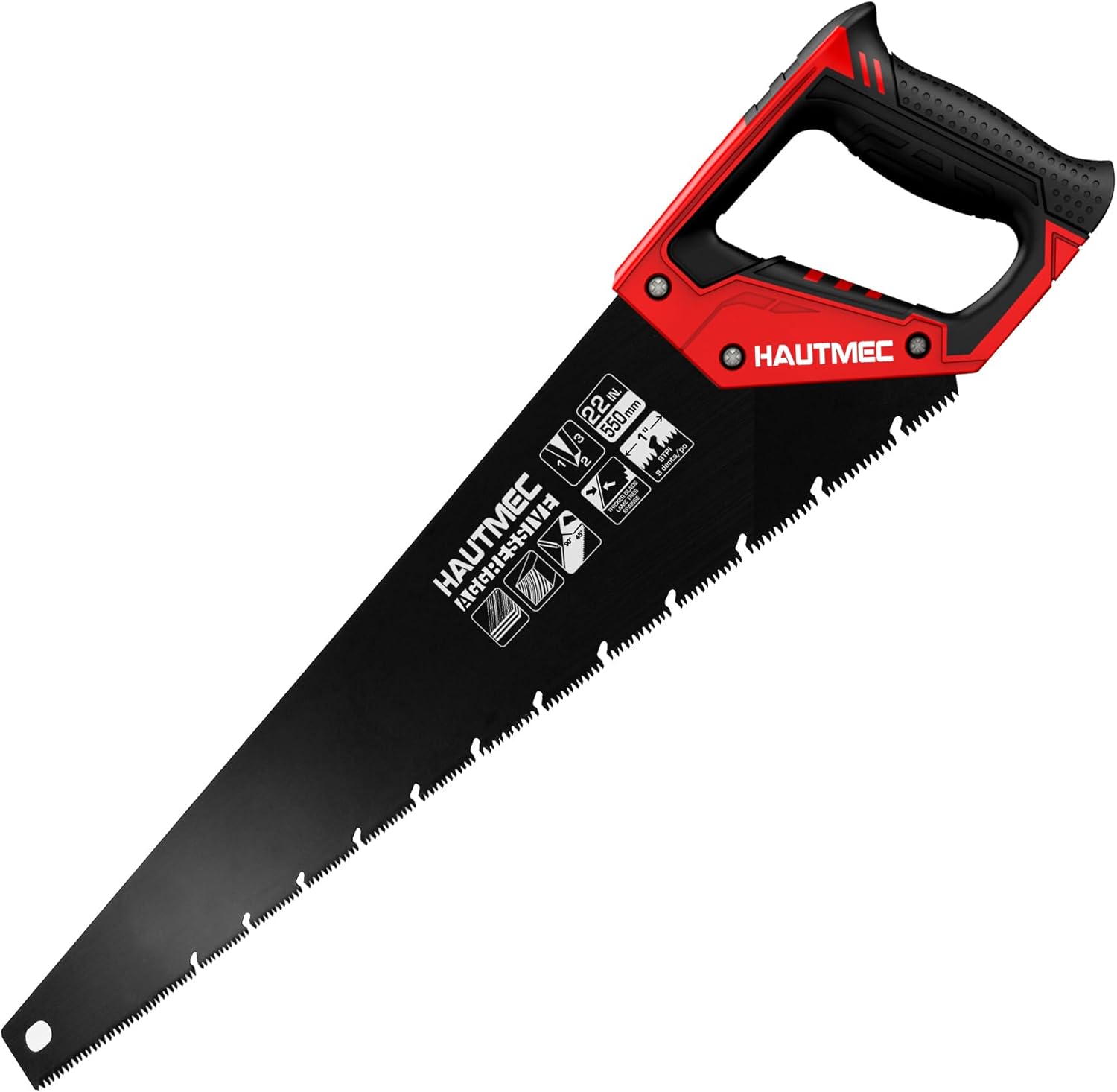
| Blade Material | High Carbon Steel |
|---|---|
| Number of Teeth | 9 |
| Blade Length | 22 inches |
| Handle Material | Thermoplastic Elastomers |
The HAUTMEC 22" hand saw is a straightforward, no-frills saw built for cutting lumber, branches, plywood and similar materials. Its 9 TPI triple-ground teeth and deep gullets make cutting fast and efficient and the thicker 1 mm high-carbon steel blade reduces vibration for straighter cuts. The low-friction black coating helps resist rust and improves stroke smoothness while the TPE-wrapped ergonomic handle gives a secure grip and includes angle guides for quick 45 and 90 degree marking. Typical use is ripping or crosscutting medium-size timbers, trimming branches, and general carpentry where a long stroke and aggressive bite speed the job. It is a good pick for hands-on framing tasks where a durable, sharp blade and comfortable handle keep work moving. Limitations are that the 9 TPI tooth count favors faster, rougher cuts rather than ultra-fine joinery and the manual saw requires more user effort than a powered alternative for heavy framing work.
Best for: Practical DIYers and budget-conscious carpenters who need a durable, fast-cutting hand saw for timber framing, rough carpentry, and yard work without paying for premium specialty blades.
Less Ideal for: Woodworkers who need precision finish cuts or contractors doing large-volume framing where a powered saw would save time and reduce fatigue.
- Aggressive 9 TPI triple-ground teeth for faster cutting and improved chip removal
- 1 mm high-carbon steel blade with low-friction coating reduces vibration and resists rust
- Ergonomic TPE-wrapped handle for a comfortable, non-slip grip and built-in angle guides
- Suitable for a wide range of materials including wet or dry wood, PVC pipe, and branches
- Coarse tooth count produces rougher cuts not ideal for fine joinery
- Manual operation requires significant physical effort for large or continuous framing cuts
Verdict: A tough, affordable 22-inch hand saw that delivers fast, aggressive cuts for timber framing and general carpentry work.
Silky Professional BIGBOY Folding Saw 360mm (Large Teeth, Model 354-36)

| Blade Length | 360mm / 14.2 inches |
|---|---|
| Teeth Configuration | Large teeth (5.9 TPI / 7 teeth per 30mm) |
| Cut Capacity | 7.1" |
| Blade Material | Hard Chrome Plated Steel |
| Handle Material | Rubber (GOM) |
The Silky BIGBOY folding saw is built for dependable, high-performance pruning and limb removal when you need a tool that lasts. Its 14.2-inch hard chrome plated blade uses Silky's taper-ground, non-set tooth design and Mirai-Me tooth geometry to cut quickly and stay sharp while resisting rust and resin. The blade locks in two positions for flush cutting and folds into the handle for safer transport and storage. A non-slip two-handed GOM rubber handle gives a secure, comfortable grip in wet or cold conditions and reduces vibration during aggressive cuts. In practice this saw excels at cutting green or dry hardwood up to its 7.1-inch cut capacity, making it suitable for tree work, heavy pruning, and clearing branches around a property. The main compromises are that it is a manual tool so large-diameter trunks require more time and effort than powered equipment and the rigid professional blade is less convenient for ultra-lightpacking situations. For anyone focused on a long-lasting, consistently sharp hand saw for serious tree and limb work, the BIGBOY is a reliable choice.
Best for: Buyers who prioritize a durable, consistently sharp hand saw for regular tree pruning and limb removal and who prefer a tool built to perform reliably over many seasons.
Less Ideal for: Casual gardeners who rarely cut branches or people who need an ultralight saw for backpacking and minimal gear scenarios.
- Hard chrome plated, taper-ground blade resists rust and reduces friction for longer life
- Mirai-Me precision teeth and non-set design deliver fast, clean cuts through green and dry wood
- Two-position locking blade allows flush cutting and safer storage when folded
- Non-slip two-handed rubberized handle provides secure, comfortable grip and reduced vibration
- Manual operation makes cutting very large trunks slow and physically demanding
- Heavier and less packable than small pocket saws for ultralight outdoor use
Verdict: Choose the Silky BIGBOY when you want a rugged, long-lasting folding saw that delivers fast, reliable cuts for tree pruning and limb work.
Bahco PC-24-TIM 24-inch Professional Timber Saw

| Blade length | 24 inches |
|---|---|
| Teeth per inch | 3.5 TPI |
| Tooth form | Three-sided ground |
The Bahco PC-24-TIM is a straightforward 24-inch timber saw built for cutting large sections of wood. Its 3.5 teeth-per-inch blade and three-sided ground tooth geometry are optimized for fast, aggressive ripping through timber while still producing clean, consistent cuts. The two-component handle gives a secure, ergonomic grip for longer sessions and helps control the saw when starting a stroke. In practice this saw is best used for framing, rough carpentry, and breaking down timbers where speed and chip clearance matter more than a super-fine finish. It is a simple, durable tool with few frills, making it easy to maintain and reliable on job sites. The limitation is that the coarser tooth pitch favors faster cuts over ultra-smooth crosscuts, so finish work will need a finer saw or sanding afterward. For buyers who prioritize predictable performance and a comfortable grip on heavy timbers, this delivers a sensible, no-nonsense solution.
Best for: Practical carpenters and timber framers who need a reliable handsaw for breaking down large timbers and framing work and who prefer a durable, easy-to-use tool over specialty saws.
Less Ideal for: Woodworkers focused on fine finish work, precise joinery, or delicate crosscuts should choose a finer-toothed saw or a dedicated crosscut tool instead.
- 24-inch blade length suitable for cutting large timbers and framing stock
- 3.5 TPI tooth pattern and three-sided ground teeth for fast, efficient ripping
- Ergonomic two-component handle improves grip and comfort during extended use
- Robust, simple design that is easy to maintain on a job site
- Coarser tooth pitch produces rougher cuts that may require follow-up finishing
- Not intended for fine joinery or precise crosscut work
Verdict: A dependable, ergonomically handled timber saw made to rip through large timbers quickly and reliably for framing and rough carpentry.
Choosing the Right Hand Saw for Timber Framing: Key Factors to Consider
Blade Material and Hardening
Blade material determines how long a saw will hold an edge when cutting dense timbers. High-carbon steel blades with proper heat treatment tend to be easier to sharpen and maintain a keen edge longer than softer steels. Some blades are treated or laminated for extra strength at the tooth line, which reduces chipping when cutting knots or hardwood sections.
Consider whether the blade can be resharpened on-site and whether replacement blades are available. For heavy framing work, a blade that takes and holds a sharp tooth profile will save time over the life of the tool and reduce the frequency of coarser follow-up work with planes or power tools.
Tooth Pitch and Type
Tooth pitch, measured in teeth per inch, affects how quickly and smoothly a saw cuts large cross sections. Coarser pitches remove material faster and are often preferred for ripping thick beams, while finer pitches give cleaner finishes but can clog and slow down in massive stock. Some timber-framing saws use a hybrid tooth pattern designed to perform acceptably for both rip and crosscut work.
Think about the typical cuts you make: if you routinely rough out tenons and shoulder cuts, a pitch that slices efficiently through growth rings and knots will reduce effort. Also consider whether the tooth configuration supports easy resharpening or requires specialist files.
Saw Length and Cutting Stroke
Longer saws provide longer cutting strokes that make fast, straight cuts through beams, while shorter saws offer more maneuverability in cramped framing conditions. A longer blade often reduces the number of strokes needed to complete a cut, which lowers user fatigue and improves line accuracy on long, straight cuts.
Balance the need for stroke length against job-site realities. If you often work inside partially framed structures or tight scaffolding, a mid-length saw may be a better compromise than a full-length rip saw.
Handle Design and Ergonomics
Handle shape and materials influence comfort and control during long cutting sessions. Traditional closed or pistol-style handles transfer leverage well and help guide a straight cut, while more open or minimal handles can be lighter but provide less stability. Grip materials that resist sweat and maintain traction when wet will be safer on outdoor jobs.
Also consider hand size and glove use. A handle that fits your grip and allows a natural wrist position reduces the chance of fatigue-related errors and keeps your cutting line truer over prolonged use.
Maintenance and Field Sharpening
Regular sharpening and tooth setting extend the useful life of a saw and preserve cutting performance. Some tooth profiles are easy to file and set with common files, while others need special jigs. Look for blades whose tooth geometry and steel hardness match the sharpening tools you have or can carry.
Think about whether you need a saw that can be maintained entirely on-site, or whether you prefer a blade you replace less often and service in a workshop. Accessibility of replacement blades and the ease of re-tensioning or straightening a warped blade also affects long-term ownership.
How Tooth Patterns Affect Joint Fit
Tooth patterns change the character of the kerf and the amount of tearout at shoulder lines. A pattern that produces a square, predictable kerf makes marking and fitting tenons and mortises simpler because the material removed matches your layout. For timber framing, the goal is often clean shoulder lines more than a glass-smooth surface, but excessive tearout still creates extra cleanup.
If you plan to fit tight joints, prioritize a tooth geometry that slices cleanly across grain changes and knots. In practice this reduces the amount of paring with chisels and keeps layout lines visible after sawing.
- Rip-oriented teeth remove waste quickly on long grain cuts
- Crosscut or hybrid teeth limit tearout on shoulder cuts
- Consistent kerf width matters for tight-fitting joinery
Using a Hand Saw on the Job Site
On a busy framing site you need a saw that stays serviceable and is easy to carry. A sturdy sheath or clip protects the teeth when the saw is tucked into a tool belt or hung from a framing nail. Consider how you will transport the saw between cuts and whether the design allows quick access without risking your work crew.
Worksite conditions also influence the saw you choose. If you often work in damp or cold conditions, a handle with a good grip and materials that do not get brittle is important. Keep a small sharpening kit nearby so you can maintain a usable edge during a workday.
- A robust sheath prevents accidental dulling during transit
- Easy-to-reach carry options speed up routine tasks
- Field sharpening extends on-site productivity
Sharpening and Setting Teeth for Framing Cuts
Learning to file and set teeth for the specific pitch and angle your framing work needs pays dividends. A slightly aggressive rake angle can speed ripping through older growth wood, while a more neutral angle helps control crosscuts and reduces splintering at shoulders. Use a file guide if you want consistent results quickly.
Regular checking of tooth set ensures the kerf clears waste rather than binding. Too little set will make the saw stall on heavy cuts, while too much set wastes material and increases the effort required for each stroke.
- Match file size to tooth pitch for consistent sharpening
- Use a setting tool to maintain even tooth spread
- Test cuts on scrap to verify angle and set before final cuts
Balancing Hand Tools With Power Options
Even craftsmen who rely on power saws value a good hand saw for site cleanups, fine joint work, and cuts where setup time for a power tool is impractical. A hand saw lets you pare shoulders and tweak tight fits without moving heavy timbers or bringing out bulky equipment.
Think about how you will use the hand saw alongside your power tools. If most rough cutting will be done with a circular saw or chainsaw, choose a hand saw optimized for final fitting and trimming. If you frequently make initial dimension cuts by hand, prioritize aggressive tooth patterns and robust blades.
- Hand saws excel at trimming and final joint fitting
- Use power tools for bulk waste removal when practical
- Choose tooth pattern based on your mix of hand and power use
Weather and Storage Considerations
Exposure to moisture and temperature swings affects both blade life and handle materials. Steel blades can rust if left unprotected, and wooden handles may swell or crack with repeated wet-dry cycles. Corrosion-resistant coatings and protective storage help extend the saw's service life when used outdoors.
For crews that leave tools in transport vehicles or secure site boxes, choose saws with corrosion-resistant finishes and replaceable handles if long-term durability is a priority.
- Wipe and oil blades after use to limit rust
- Consider synthetic handles for wet climates
- Store saws in sheaths or tool boxes between jobs
How We Chose the Best Hand Saw for Timber Framing
We focused on attributes that matter in real timber-framing work rather than marketing claims. Primary filters included blade durability and tooth geometry because those determine how well a saw maintains a sharp, square kerf in large timbers. We also prioritized cut control and balance since long, accurate cuts make joinery fit and reduce cleanup time. Handle comfort and grip materials were assessed for prolonged use on job sites and in varied weather. Portability and sheath or storage solutions were considered for framing crews moving around a site. We excluded lightweight trim saws and small pruning saws that are unsuited to heavy beams, plus any tools whose specs suggested they are intended only for finish carpentry. Final selections emphasize long-lasting blade steel, appropriate tooth pitch for ripping and crosscutting large sections, ergonomic handles that resist fatigue, and construction-friendly storage or guards.
FAQ
What tooth pitch works best for cutting large oak beams?
Coarser pitches generally cut faster through dense hardwoods because they remove more material per stroke. However, very coarse teeth increase tearout at shoulder lines. Many framers choose a moderate coarse pitch and maintain a sharp edge so cuts stay controlled while still being efficient.
Can I use a regular carpentry saw for timber framing?
Often a general carpentry saw will work for small framing tasks, but it may lack the blade thickness, tooth geometry, or durability needed for repeated work on large beams. For consistent heavy-joinery work, a saw designed for timber framing will hold an edge longer and produce more predictable kerfs.
How often should I sharpen a saw used daily on framing jobs?
Frequency depends on the wood species and how abrasive the stock is, but many framers touch up teeth daily and perform more thorough filing weekly or after several days of heavy use. Regular light maintenance keeps the saw efficient and prevents more time-consuming repairs later.
Is a replaceable blade system useful for timber framing?
Replaceable blades can be convenient if you prefer swapping a fresh blade quickly on-site rather than sharpening. They work well if compatible replacement blades are readily available and match the tooth geometry you need for framing cuts.
Should I choose a wooden or synthetic handle for outdoor framing?
Wood handles are traditional and comfortable, but they require more care in wet climates. Synthetic handles resist moisture and often provide better grip in damp conditions. The right choice depends on your climate and how much maintenance you want to perform.
Final Verdict
For timber framing, prioritize a saw that balances durable blade steel, the right tooth pitch for your common cuts, and a handle that supports long strokes without fatigue. Expect tradeoffs between aggressive cutting speed and shoulder-line cleanliness, and choose based on whether you use the saw mainly for roughing or final joint fitting. Focus on maintainability and field-sharpening options so the saw performs reliably on site.
