

Note: This article contains affiliate links. If you click on these links and make a purchase, I may earn a small commission at no extra cost to you. This helps support my research and content. Read my full affiliate disclosure here.
Ants can be helpful in the yard but become a real problem when they farm aphids, disturb roots, or tunnel in pots. Choosing the right ant killer for plants matters because some treatments are harsh on foliage, disrupt soil biology, or simply drive ants away without removing the colony. This guide examines six top ant control options suited for use around potted plants, raised beds, and garden containers. We focus on methods and products that minimize harm to foliage and beneficial soil life while still stopping ant activity. Below are vetted picks followed by the decision factors we used and practical advice to apply treatments safely.
Top Picks at a Glance
| Best Overall The best all-around choice for most situations | Bonide Captain Jack's Deadbug Brew Ready-to-Use Spray, 32 oz |  |
| Best Quality Built to a higher standard if you want something more solid | Spectracide Triazicide Insect Killer for Lawns & Landscapes, 32 oz |  |
| Best Value The sweet spot between price and what you get | Garden Safe Crawling Insect Killer Diatomaceous Earth, 4 lb |  |
| Best Budget The cheapest option that still gets the job done reliably | GardenTech Sevin Insect Killer Dust, 1 lb |  |
| Highest Rated A top-rated pick with lots of positive feedback | Sevin Insect Killer Dust, 3 lb |  |
| Most Popular A crowd favorite that many people choose with confidence | Bonide Captain Jack's Ready-to-Use Neem Oil Spray, 32 oz |  |
Bonide Captain Jack's Deadbug Brew Ready-to-Use Spray, 32 oz

| Item Form | Spray |
|---|---|
| Target Species | Insects |
| Liquid Volume | 32 fluid ounces |
| Active Ingredients | Spinosad 0.5% |
Bonide Captain Jack's Deadbug Brew is a 32 oz ready-to-use spinosad spray formulated for organic gardening and aimed at controlling chewing and some leaf-feeding insects. You use it like a typical foliar spray, shaking the bottle and applying thoroughly to the tops and undersides of leaves on vegetables, fruit trees, and ornamentals. The active ingredient spinosad is effective against caterpillars, beetles, loopers, thrips, and similar pests and is labeled to spare many predatory beneficial insects when used as directed, which helps maintain biological control in the garden. The built-in spray nozzle makes application quick for small to medium beds and container crops. Limitations are that it is a contact and stomach poison so thorough coverage is required and repeat applications may be necessary for heavy infestations; it is not systemic and will not protect new growth after application. Also users must follow safety directions and avoid use when pollinators are active.
Best for: Gardeners who prioritize practical, low-fuss pest control for vegetables and fruit and who want an organic-approved spray they can apply quickly without mixing.
Less Ideal for: Large acreage growers or those who need long-lasting systemic protection should look for professional or systemic options instead.
- Contains spinosad, an approved active ingredient for organic gardening that targets many chewing pests
- Ready-to-use spray with integrated nozzle for simple, no-mixing application
- Label supports use on a wide variety of vegetables and fruit crops
- Designed to have limited impact on many predatory beneficial insects when used properly
- Works by contact and ingestion so thorough coverage and repeat applications are necessary
- Not systemic, so new growth after treatment is unprotected
Verdict: A convenient, organic-approved spinosad spray that delivers effective contact control of common foliage-feeding pests on cucurbits and other garden crops.
Spectracide Triazicide Insect Killer for Lawns & Landscapes, 32 oz
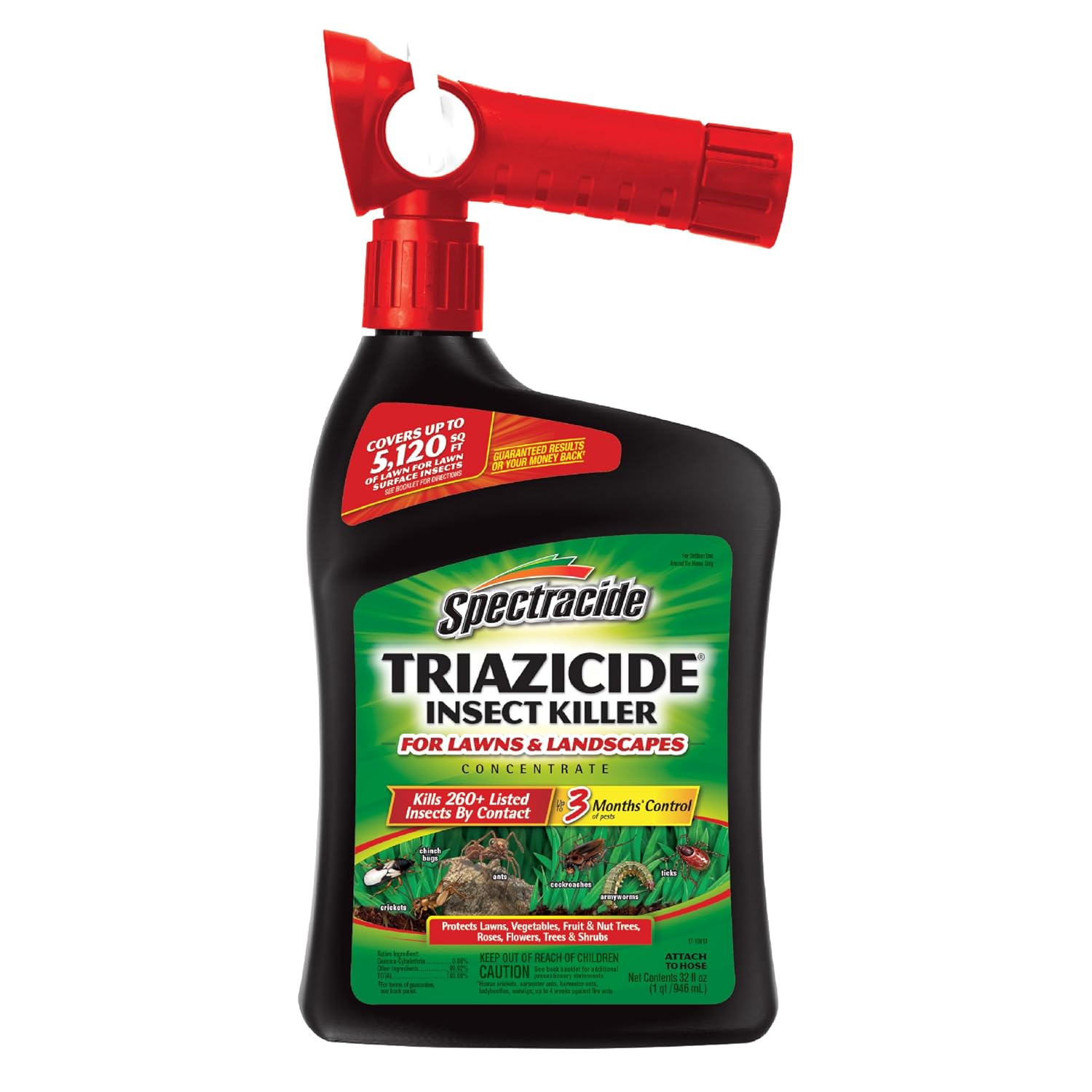
| Unit Count | 32 Ounce |
|---|---|
| Item Form | Spray |
| Target Species | Insects |
| Active Ingredients | Gamma-Cyhalothrin (0.08%) |
Spectracide Triazicide is a 32-ounce concentrate formulated to control more than 260 listed insects on lawns, flower beds, trees, shrubs and around vegetables. You mix the concentrate with water and apply it with a tank or hose-end sprayer; the ready-to-spray variant can attach to a garden hose for quicker application. The active ingredient, gamma-cyhalothrin, delivers fast contact kill for pests such as fleas, ticks, Japanese beetles and many surface insects, and the label claims protection for up to three months in some uses. It is non-staining when used as directed and can treat large areas, making it practical for whole-yard applications and targeted mound treatments like fire ants. Important limitations include toxicity to fish and bees, so it must not be applied near water or blooming plants, and the product requires careful handling and adherence to safety directions. Follow mixing rates and timing recommendations for best results and to minimize environmental risk.
Best for: Buyers who need an affordable, large-area solution to knock down common lawn and landscape pests and prefer a concentrate that stretches coverage when mixed.
Less Ideal for: People with small ornamental gardens near ponds, homeowners who prioritize pollinator-safe products, or those unwilling to follow pesticide safety precautions should consider gentler or targeted alternatives.
- Concentrate covers large areas so a single bottle treats many square feet when mixed correctly
- Fast-acting contact kill for a wide range of listed insects including fleas, ticks and Japanese beetles
- Versatile use on lawns, flower beds, trees, shrubs and around vegetables
- Non-staining when used as directed and available in hose-end ready-to-spray format for easier application
- Highly toxic to aquatic life and bees so it cannot be used near water or blooming plants
- Requires careful mixing and protective handling due to chemical toxicity
Verdict: A cost-effective, fast-acting concentrate for treating broad lawn and landscape pest problems when used with care and proper precautions.
Garden Safe Crawling Insect Killer Diatomaceous Earth, 4 lb

| Item Form | Powder |
|---|---|
| Target Species | Insects |
| Active Ingredients | Silicon Dioxide |
| Specification Met | EPA |
Garden Safe Crawling Insect Killer is a powdered diatomaceous earth formulation intended for outdoor, plant-side use to control crawling pests. It is applied as a thin dust to soil around plants or directly onto insects where the fine granules abrade and absorb oils from exoskeletons, causing dehydration and death. Typical uses include edging vegetable beds, dusting under potted plants, and treating areas where ants, fleas, cockroaches, beetles, and mealybugs are active. The product is labeled for organic gardening and meets EPA specification guidance, so it is a low-chemical option for routine garden pest control. Practical benefits are persistence in dry, calm conditions and a non-spray, hands-on application that targets contact exposures. Important limitations are that it must stay dry to remain effective, can be dusty to apply so ventilation and a mask are advised, and it is not effective against insects that are not contacted by the dust or for wood-destroying beetles and certain ant species listed on the label. Follow label directions and reapply after heavy rain or disturbance for continued protection.
Best for: Gardeners who prefer practical, low-chemical pest control and want a contact-based solution for crawling insects around plants and beds.
Less Ideal for: People seeking a fast-acting, systemic treatment for flying pests or infestations inside structures should consider other control methods.
- Works by physical action so no chemical insecticides are required
- Approved for use in organic gardening and meets EPA specification guidance
- Can be applied directly to soil and plants to target crawling pests
- Long-lasting when kept dry and undisturbed
- Ineffective if the treatment area becomes wet or is washed away
- Creates airborne dust during application so respiratory protection is recommended
Verdict: A practical, organic-friendly diatomaceous earth powder for gardeners who want a non-chemical contact treatment for crawling garden pests.
GardenTech Sevin Insect Killer Dust, 1 lb

| Item Form | Dust |
|---|---|
| Target Species | Insects |
| Active Ingredients | Bifenthrin |
| Unit Count | 1 Count |
Sevin Insect Killer Dust is a handheld dust formulation of bifenthrin for spot and perimeter treatment of garden pests, including Japanese beetles. You apply it by shaking a thin, uniform layer onto leaves, stems and around plants as a preventative or when you first see damage. The product kills by contact and lists more than 150 target insects, so it works across vegetables, fruit, ornamentals and turf. Practical features include a flip-open cap for easy dispensing and a 1 pound container sized for small-to-medium beds; the manufacturer states one pound treats about 2,000 sq. ft. The dust does not require mixing and settles quickly so treated areas can be reoccupied after it dries. Important limitations are typical for contact insecticides: it should not be applied to open blooms to protect pollinators and it provides little residual control if plants are watered or receive heavy rain within 24 hours of application. Users must follow label safety steps like avoiding the eyes and washing hands after use.
Best for: Gardeners who want a straightforward, no-mix contact treatment to quickly reduce visible beetle and chewing insect pressure in mixed vegetable, fruit and ornamental plantings.
Less Ideal for: People prioritizing pollinator-safe or long-residual biological controls should choose targeted or non-chemical methods instead.
- Kills by contact a wide range of garden pests including Japanese beetles and aphids
- Ready-to-use dust needs no mixing and is simple to apply with a flip-open cap
- Label lists use on vegetables, fruits, ornamentals and lawns so it fits mixed garden beds
- Contains bifenthrin which can harm beneficial insects if applied to open blooms or overused
Verdict: If you need a simple, ready-to-use contact treatment to quickly knock down Japanese beetles and other common garden pests, Sevin dust delivers fast, broad-spectrum control.
Sevin Insect Killer Dust, 3 lb

| Brand Name | Sevin |
|---|---|
| Model Name | Insect Killer Dust |
| Included Components | Sevin Insect Killer Dust 3LB |
| Target Species | Insects |
Sevin Insect Killer Dust is a simple ready-to-use dust for treating insect pests around garden beds, shrubs, lawns and edible plants. You apply it by flipping the cap and lightly shaking a thin, uniform layer of dust onto leaves, stems and soil or as a perimeter barrier. The formula kills pests by contact and lists more than 150 target insects including ants, aphids, Japanese beetles and flea beetles, and one 3 lb container covers roughly 6,000 sq. ft. when used at the recommended rate. Practical benefits include easy targeted application without mixing, compatibility with many fruits and vegetables when used as directed, and a long coverage area for one container. Important limitations are that dusts can be visible on foliage, should not be applied to open blooms to protect pollinators, and users must follow safety directions to avoid eye contact and wash hands after use. Expect straightforward, dependable pest control when used carefully and according to label instructions.
Best for: Gardeners who want a straightforward, no-mess pest control they can rely on for routine protection of beds, shrubs and vegetable plots, and who prioritize predictable, contact-based results.
Less Ideal for: Those seeking a pollinator-safe systemic solution or people who prefer entirely invisible, residue-free options for ornamental displays or flowering crops.
- Ready-to-use bottle that needs no mixing for fast application
- Kills more than 150 listed insect pests by contact, including ants
- Covers a large area—3 lb treats up to about 6,000 sq. ft. at labeled rates
- Safe for use on many fruits and vegetables when applied as directed
- Must avoid applying to open blooms to prevent harm to pollinators
- Dust can be visible on foliage and may require careful placement for neatness
Verdict: Choose this ready-to-use dust when you need dependable, contact kill of ants and other common garden insects with minimal prep.
Bonide Captain Jack's Ready-to-Use Neem Oil Spray, 32 oz

| Item Form | Liquid |
|---|---|
| Target Species | Insects |
| Liquid Volume | 32 fluid ounces |
| Active Ingredients | Clarified Hydrophobic Extract of Neem Oil |
This ready-to-use neem oil spray is a multipurpose garden treatment that kills insects at all life stages while also serving as a miticide and preventative fungicide. Packaged in a 32-ounce trigger bottle, it is applied by shaking and thoroughly spraying plant surfaces, including leaf undersides, at the first sign of pests or disease and reapplying every 7 to 14 days as needed. The active ingredient is a clarified hydrophobic extract of neem oil, which is approved for organic gardening and labeled safe to use on vegetables up to the day of harvest. Practical benefits include broad pest coverage (aphids, whiteflies, spider mites and others), disease suppression such as powdery mildew, and convenience from a ready-to-use sprayer. Important limitations are that results are slower than synthetic contact insecticides and application timing matters to avoid leaf burn in full sun; repeated applications may be needed for heavy infestations. Follow label safety directions and keep the product away from children and pets.
Best for: Gardeners who want a single, organic-approved product to manage common vegetable garden pests and fungal problems and who prefer products with strong user feedback.
Less Ideal for: Growers needing rapid knockdown of severe infestations or commercial producers who require fast-acting, high-throughput treatments.
- Kills multiple pest stages including eggs, larvae and adults for more complete control.
- Also acts as a fungicide and miticide so one product covers pests and common fungal issues.
- Ready-to-use trigger bottle requires no mixing and is easy to apply to leaves and undersides.
- Approved for organic gardening and can be used on vegetables up to day of harvest.
- Slower-acting than many synthetic contact insecticides, so it may take several applications to see control.
- Must avoid spraying in peak sunlight to reduce risk of leaf burn.
Verdict: A convenient, organic-approved all-in-one neem spray that controls common vegetable garden pests and fungal issues with minimal fuss.
Choosing the Right Ant Killer for Plants: Key Factors to Consider
Plant Safety and Phytotoxicity
Whether a treatment can be applied close to foliage or in potting mixes without burning leaves or harming roots matters a great deal. Many ant control options are formulated for structural use and can cause leaf spotting or root stress when used on plants. Look for labels or guidance that explicitly permit use around ornamentals, vegetables, and containers and follow dilution instructions. Testing on a single plant first reduces risk.
Consider timing as well. Applying products during cooler parts of the day and avoiding flowering periods reduces stress on plants and non-target pollinators. For systemic treatments, confirm the product is intended for use in soil near roots to avoid unexpected plant uptake.
Ability to Reach the Colony
Knocking down visible workers is only a short-term fix if the queen and brood remain protected. Effective ant control for plants requires baits or delivery methods that worker ants carry back to the nest to feed the colony or strategies that target nests directly when they are accessible.
Assess whether the product is attractive to the ant species present. Sweet baits work for sugar-feeding ants, while protein- or oil-based baits suit others. Understanding feeding preferences increases the chance of colony suppression rather than temporary displacement.
Residue Longevity and Soil Impact
Persistence is a double-edged sword. Longer-lasting materials reduce the need for repeated application but can leave residues that affect soil microbes, earthworms, and young plant roots. Shorter persistence may be safer for sensitive crops but require more frequent treatments.
Check guidance on reapplication intervals and whether the active ingredient binds tightly to soil or is mobile. For edible plants, consider pre-harvest intervals and follow label directions to minimize residue on produce.
Effect on Beneficial Insects and Soil Life
The garden ecosystem relies on predators, pollinators, and soil organisms. Some ant control methods are broadly toxic and can harm beneficial species when applied indiscriminately. Others, such as targeted baits or physical nest removal, have lower non-target impacts.
When treating near flowering plants, avoid broad-spectrum sprays during bloom times. Prefer treatments that limit exposure to non-targets or that can be placed in bait stations to reduce incidental contact.
Application Practicality for Gardeners
Practicality covers how easy the method is to apply safely in small spaces, whether it needs special tools, and how intrusive it is to plants and soil structure. Gardeners working with many pots or a busy vegetable patch need simple, repeatable techniques.
Consider whether the formulation comes in pre-measured baits, ready-to-use stations, or concentrates requiring dilution. Time investment for application and follow-up monitoring should factor into your choice, especially for seasonal gardens or container collections.
Safety Around Children and Pets
Many gardens are family spaces. Treatments placed in accessible pots or on soil can be reached by pets or children, so product safety and placement are critical. Use bait stations that lock, choose formulations with low acute toxicity, and place treated pots out of high-traffic areas when possible.
Read label warnings and first-aid instructions. When uncertain, favor mechanical or cultural controls and use chemical options as a last resort, applied where access is limited.
Identifying Ant Activity and What It Means
Not all ant activity requires elimination. Foraging trails may run across pots without nesting nearby, while other colonies establish nests inside mulch, soil, or under pot saucers. Look for consistent trails, small piles of soil indicating nest building, or repeated visits to aphid-infested plants.
Determining whether ants are farming sap-sucking pests like aphids or actually nesting in root zones helps you pick a treatment. If ants are tending pests, controlling those pests often reduces ant attraction; if a nest is in a pot, targeted nest control is the priority.
- Observe trails to find nest locations before treating.
- Check under pot saucers and inside saucers for nest entrances.
- Look for signs of honeydew-producing insects on stems and undersides of leaves.
Nonchemical and Cultural Controls
Before using chemicals, try cultural steps that make plant areas less attractive. Reduce excess moisture, clean spilled fertilizer or plant food, and replace overly compacted or contaminated potting mixes. Physical barriers like sticky tape on pot rims or diatomaceous earth around pot edges can deter some species.
Manual nest removal can work when nests are shallow and accessible. Carefully remove infested soil and replace it with fresh mix, then monitor. These approaches take more time but avoid residues and preserve beneficial organisms.
- Use clean, well-draining potting mix and keep soil surface free of debris.
- Install barriers around pot rims or under trays to stop trails.
- Remove and replace heavily infested potting media when feasible.
Using Baits Effectively
Baits are often the most practical way to eliminate the colony because worker ants transport bait back to the nest. Place baits where ants are actively foraging but not directly on foliage or in contact with roots unless the product allows it.
Rotate bait types if one formula is ignored; different species prefer sugar, protein, or oil-based food. Monitor stations and replace them as workers remove the material. Keep bait out of reach of pets and children and avoid applying during heavy rain or overhead watering.
- Place baits along active trails and near nest entrances, not on plants.
- Check bait attractiveness and switch formulations if uptake is low.
- Follow label guidance on allowable placements in containers and garden beds.
Applying Contact Treatments Safely
Contact sprays can reduce visible workers quickly but often do not reach the nest. Use these treatments to suppress heavy surface activity while pairing them with baiting or nest treatments for lasting control. Apply contact products carefully to avoid foliage burn and surface runoff into pots.
Use spot treatments rather than broadcast spraying. Shield blooms and avoid application when pollinators are active. For potted plants, protect saucers and drainage holes to prevent treated runoff into the soil when label instructions warn against it.
- Target visible trails and nest openings with spot applications.
- Avoid spraying flowers and moist soil surfaces during application.
- Rinse equipment and avoid contaminating tool handles or gloves used in plant care.
When to Replace Potting Mix or Repot
Persistent nesting inside containers often means repotting is the best long-term fix. If ants continually reappear, remove the plant from its pot, brush soil from the root ball, and inspect for nests or travel galleries. Replace most of the old medium with fresh, sterile potting mix and clean the pot before rehousing the plant.
Repotting reduces nest sites and can eliminate pests that depend on decaying organic matter. Do repot only when plants are not under severe stress and follow proper transplant care to minimize shock.
- Inspect root balls for ants before repotting to remove hidden nests.
- Clean pots and saucers thoroughly and use fresh, sterile mix.
- Avoid overwatering new repotted plants while they reestablish.
Monitoring and Follow-Up
Ant control is rarely a one-off job. Monitor treated areas daily for trail reformation and bait activity for at least two weeks after treatment. Be ready to replace baits, reapply targeted measures, or remove nests if workers persist.
Keep a garden log of treatments and outcomes to identify patterns. Some species are seasonal or respond differently to bait types, so tracking helps refine your approach over time.
- Check bait stations and treated pots frequently for uptake and new activity.
- Record dates and methods to assess what worked in your garden.
- Be patient; colony suppression can take several applications depending on species and nest location.
How We Chose the Best Ant Killer for Plants
We prioritized products and methods that control ants while protecting plant health and soil life. Our selection filters emphasized plant-safe chemistry, targeted delivery, and real-world usability in container and garden settings. We excluded broad outdoor-only treatments or options that require large-scale application patterns unsuitable for pots and small beds. Evaluation centered on concrete dimensions: plant safety under label directions, effectiveness at eliminating colonies rather than temporarily repelling workers, application flexibility for pots and raised beds, and persistence in the environment to balance control with minimal residue. We also considered ease of use for gardeners, such as whether a method needs special equipment or complex timing. Excluded items included treatments labeled only for structural pest control, products with unclear plant-use instructions, and approaches that rely solely on repellents without colony suppression. The final list reflects options that perform reliably for gardeners managing ants directly around plants.
FAQ
Are ant killers safe to use on vegetable pots and edible herbs?
It depends on the formulation. Some products are labeled for use around edibles with specified pre-harvest intervals or placement restrictions. Choose products labeled safe for edible plants or use physical and cultural controls to avoid residue concerns.
How long before I should expect to see a reduction in ant activity?
Visible reductions in foraging can occur within days when workers take effective baits, but full colony suppression often takes one to several weeks. Direct nest treatments may show faster local results but need follow-up to prevent reinfestation.
Will diatomaceous earth harm my plants or soil life?
Diatomaceous earth is abrasive to insects and generally safe for plants when used sparingly on the surface. Heavy or repeated applications can alter soil texture and may be disruptive to small soil organisms, so use it selectively and avoid burying it into root zones.
Can I use household remedies like vinegar or soapy water on potted plants?
Vinegar and strong soap solutions can harm foliage and beneficial microbes if applied directly to leaves or soil. Mild soapy water used as a spot spray on visible trails may knock down workers but will not eliminate a colony and can stress plants if overused.
How do I know which bait type to try first?
Observe whether the ants prefer sweet or protein foods. A simple test is to place a small amount of sugar water and a bit of tuna or peanut butter near trails and watch which is taken. Match the bait type to that preference for better uptake.
Should I treat the entire garden if ants are only in a few pots?
Treating only affected areas is usually sufficient. Broad treatments increase exposure risk to beneficials and residues. Focus baiting and nest-targeted measures where activity is highest and monitor surrounding plants for spread.
Final Verdict
Ant control around plants requires balancing effective colony suppression with plant and soil safety. Prioritize methods that reach the nest, such as appropriately placed baits, and limit broadcast or heavy-residue treatments near foliage and edible crops. Decide based on where ants are nesting, the sensitivity of nearby plants, and household considerations like pets and children. With targeted application and follow-up monitoring you can eliminate problem colonies while preserving a healthy garden ecosystem.
