

Note: This article contains affiliate links. If you click on these links and make a purchase, I may earn a small commission at no extra cost to you. This helps support my research and content. Read my full affiliate disclosure here.
When ants show up in a home where pets live, you need control that stops infestations without creating new hazards for animals. The right ant killer balances rapid suppression of trails and nests with low-toxicity ingredients or delivery methods that reduce accidental exposure for curious dogs and cats. This guide shortlists the six best ant killers that are pet safe and explains why each approach made the list. We evaluate products on how well they stop ants, how they keep pets protected, and how easy they are to use and maintain. Read on to match the safest control style to your household and infestation scenario.
Top Picks at a Glance
| Best Overall The best all-around choice for most situations | EcoVenger by EcoRaider Roach & Ant Killer, 64 oz |  |
| Best Quality Built to a higher standard if you want something more solid | EcoVenger Ant Killer & Nest Treatment, 32 oz |  |
| Best Value The sweet spot between price and what you get | Waspika Peppermint Oil Insect & Spider Repellent Spray, 16 oz |  |
| Best Budget The cheapest option that still gets the job done reliably | Safer Home Indoor Multi‑Insect Killer Aerosol (13.25 oz) |  |
| Highest Rated A top-rated pick with lots of positive feedback | NCSIFDD Ant Away Ant Repellent Gel, 6-Pack |  |
| Most Popular A crowd favorite that many people choose with confidence | STEM Plant-Based Bug Spray — Ants, Roaches & Spiders, 10 oz |  |
EcoVenger by EcoRaider Roach & Ant Killer, 64 oz

| Active ingredients | Geraniol, Cedarwood Oil, Peppermint Oil, Sodium Lauryl Sulfate |
|---|---|
| Volume | 64 oz |
| Residue protection | Up to 4 weeks |
| Formulation | Water‑based, botanical blend |
| Intended use | Indoor and outdoor crawling insects |
This EcoVenger spray is a large‑volume, plant‑derived insecticide designed to knock down roaches, ants and other crawling pests on contact and leave a short residual barrier. You spray directly where insects hide or travel to flush and kill individuals, or apply perimeter treatments to deter re‑entry for up to about four weeks. The formula lists botanical actives such as geraniol, cedarwood and peppermint oils and is water based, which helps reduce strong chemical odors and the risk of staining on typical household surfaces. Because it is non‑pyrethroid and has EPA‑authorized lab safety testing cited by the brand, it is suited to occupied homes and commercial spaces where minimizing toxic exposure is a priority. Practical limitations are that it is a spray, so it treats visible insects and treated surfaces rather than solving deep nest infestations on its own, and repeated applications may be needed for severe or hidden colonies. The nozzle mechanism should be handled carefully since the brand notes fragile parts and offers replacement if damaged.
Best for: Buyers who want an effective, low‑toxicity spray for everyday ant and roach control in homes with children or pets and who prefer a botanical, low‑odor alternative to conventional pesticides.
Less Ideal for: People facing large, established infestations that require baiting or professional exclusion work, or users who need a long‑term, hands‑off solution without repeat treatments.
- Plant‑derived active ingredients reduce reliance on synthetic pesticides
- Kills on contact and also provides several weeks of residual repellency
- Water‑based, low‑odor formula suitable for use in kitchens and occupied rooms
- Large 64 oz size is convenient for treating multiple rooms or perimeter applications
- Spray format treats surfaces and visible insects but does not replace baiting or professional nesting removal for deep infestations
- Nozzle contains delicate parts that can be damaged if handled roughly
Verdict: Choose this botanical, low‑odor spray if you want a pet‑safe, contact‑kill and short‑term repellent solution for routine ant and roach control.
EcoVenger Ant Killer & Nest Treatment, 32 oz

| Unit Count | 32 Fluid Ounces |
|---|---|
| Item Form | Spray |
| Target Species | Odorous House Ants, Fire Ants, Roaches, Fleas, Spiders |
| Active Ingredients | Citronella Oil, Geraniol, Cedarwood oil, Sodium Lauryl Sulfate |
EcoVenger Ant Killer is a plant-extract spray formulated to kill house ants on contact, treat fire ant mounds, and leave a residual barrier that deters re-entry for up to four weeks. You use it like a standard ready-to-use spray: spot-treat visible trails, spray around entry points and saturate mound tops or nest openings to reach the colony. Notable features include a citronella/cedarwood/geraniol active blend, a user-friendly trigger sprayer and claims of university testing and professional use. In practice the product offers fast knockdown for foraging ants and the ability to deliver treatment down tunnels using the spray wand, which helps target queens in mounds. The botanical formulation is marketed as non-staining and safe to use around pets and children when directions are followed, and the light citrus scent dissipates quickly. Limitations are that efficacy details beyond labeled target species rely on manufacturer testing and heavier infestations may need repeated treatments or perimeter work; the nozzle has delicate parts so care is needed when handling.
Best for: Homeowners who prioritize effective, fast-acting ant control but want a pet- and child-friendly botanical option for indoor and outdoor use.
Less Ideal for: People needing an industrial-strength chemical treatment for very large or persistent infestations or those who prefer products supported by multiple independent field trials.
- Kills odorous house ants on contact and eradicates fire ant mounds when applied to the colony
- Botanical active ingredients (citronella, geraniol, cedarwood) offer a lower-toxicity alternative to conventional pesticides
- Provides residual repellency for up to four weeks to help prevent re-entry
- Suitable for indoor and outdoor use and formulated to be non-staining on carpets and fabrics
- Nozzle contains delicate parts that can be damaged and may require careful handling
- Manufacturer efficacy claims are based on internal or cited studies rather than independent third-party field trials
Verdict: A fast-acting, plant-powered ant spray that balances quick colony knockdown with a formulation designed for use around pets and children.
Waspika Peppermint Oil Insect & Spider Repellent Spray, 16 oz

| Ingredients | Peppermint Oil; Geraniol |
|---|---|
| Net volume | 16 oz |
| Manufacturer | Waspika |
| Item model number | WSA-01 |
This peppermint oil spray is a plant-based, ready-to-use pest repellent aimed at routine home defense where pet safety is a priority. You use it like a standard spray: apply around baseboards, entryways, kitchens, patios and garages to create a peppermint-scented barrier that deters ants, spiders and roaches. The formula lists peppermint oil and geraniol as active ingredients and is promoted as non-staining with a fresh scent, so it doubles as a mild deodorizer while avoiding harsh chemical fumes. The 16 oz easy-spray bottle is comfortable to handle for spot treatments and repeat applications. Limitations: because it is a botanical repellent rather than a residual insecticide, effectiveness may require more frequent reapplication in high-traffic areas or after rain outdoors, and it likely will not eliminate large infestations on its own. Still, for everyday prevention in homes with pets and children, it provides a safer, low-odor alternative to conventional sprays.
Best for: Buyers who prioritize pet-safe, low-odor pest control and want a convenient spray for regular preventative use around the home and outdoor entry points.
Less Ideal for: People facing large, established ant or roach infestations who need fast knockdown and long-lasting residual control should consider professional treatment or targeted insecticides instead.
- Plant-based formula using peppermint oil and geraniol for a natural repellent action
- Ready-to-use 16 oz spray bottle suited for quick spot treatments
- Safe-for-pets positioning and low-odor, non-staining formulation for indoor use
- Versatile for indoor and outdoor perimeter use around doors, kitchens, patios and garages
- Likely requires frequent reapplication compared with synthetic residual insecticides
- Not intended as a standalone solution for large or established infestations
Verdict: Choose this peppermint oil spray when you need a pet-friendly, easy-to-use preventive repellent for everyday control of ants and spiders around the home.
Safer Home Indoor Multi‑Insect Killer Aerosol (13.25 oz)
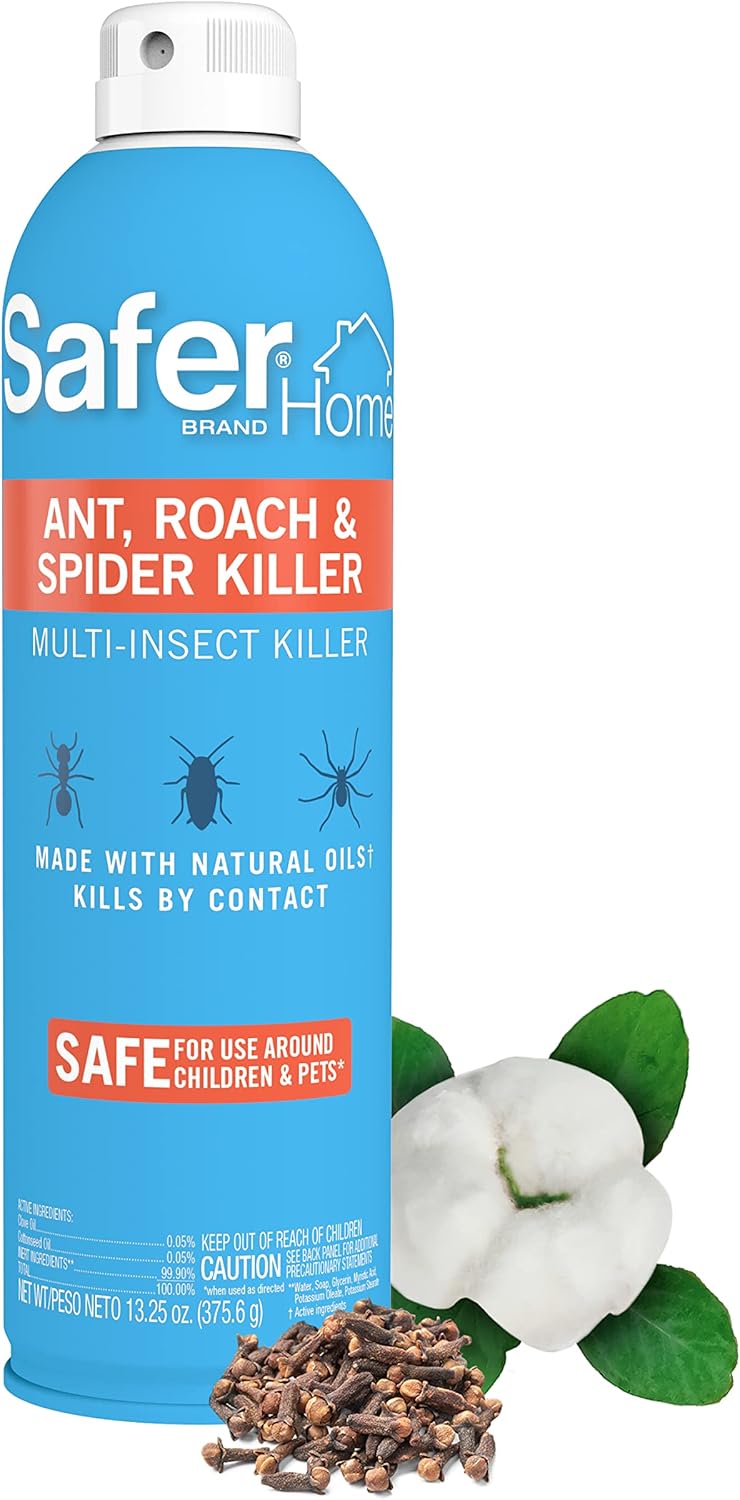
| Unit Count | 13.25 Ounce |
|---|---|
| Item Form | Aerosol |
| Target Species | Insects |
| Ingredients | Clove Oil 0.05%, Cottonseed Oil 0.05% |
This Safer Home aerosol is a multi‑insect contact spray formulated with naturally derived oils to kill ants, roaches, spiders, flies, silverfish and fleas indoors. You use it like a typical aerosol: shake, hold 8 to 12 inches from the target and spray until the pest is wet but not saturated. The manufacturer reports rapid knockdown, claiming 100% of ants, flies and roaches die within three minutes in lab tests. Because the active ingredients are low‑concentration clove oil and cottonseed oil rather than harsh synthetic pesticides, the product is positioned for use in homes with children and pets when directions are followed. Practical benefits include broad species coverage, no CFCs, and a formula that dries without leaving a residue so cleanup is minimal. Limitations are that it is a contact spray only so it requires direct application to visible pests and will not provide long‑term residual control or baiting for nests. For larger or hidden infestations you may still need complementary treatments or professional help.
Best for: Buyers who prioritize a pet‑ and child‑friendly indoor treatment and want a quick knockdown for occasional visible pests rather than a long‑term pest control strategy.
Less Ideal for: Homes dealing with recurring heavy infestations, large colonies, or pests hidden in wall voids where residual or baiting solutions are required.
- Made with naturally derived clove oil and cottonseed oil for a gentler active ingredient profile
- Fast contact kill reported for common pests such as ants, flies and roaches
- Aerosol dries without residue so treated surfaces require little or no cleanup
- Broad listed target range covers many common household insects
- Only provides contact kill and no long‑lasting residual action
- Low concentrations of active oils mean it is less effective against hidden infestations or large colonies
Verdict: A safe‑feeling, naturally derived aerosol that delivers fast contact kills for visible household pests and suits households prioritizing pet and child safety.
NCSIFDD Ant Away Ant Repellent Gel, 6-Pack

| Unit Count | 12 Count |
|---|---|
| Number of Pieces | 1 |
This ant repellent gel is a concentrated applicator product intended for targeted spot treatments around entry points, baseboards, window frames, and known ant trails. You remove the cap, attach the precision tip, and apply pea‑sized drops into crevices or along trails; the manufacturer notes it can take 3–5 days to work through a colony and helps keep ants away for up to 60 days in treated areas. Practical benefits include the narrow applicator for neat placement in tight gaps, suitability for both indoor and outdoor problem spots, and a formulation presented as family and pet safe when used as directed. Important limitations are that results are not instantaneous and multiple applications or placements may be needed to control larger or multiple colonies, and effectiveness depends on correctly locating trails and nest access points. For someone who wants a low‑mess, targeted solution rather than broad broadcast treatments, this gel is a convenient option.
Best for: Buyers who prioritize dependable, low‑mess spot treatment for recurring ant sightings and prefer a product they can place precisely where ants travel.
Less Ideal for: People needing rapid elimination of very large or widespread infestations or those who prefer broadcast sprays or professional colony eradication services.
- Precision applicator allows neat, pea‑sized placements in tight crevices and along ant trails
- Labeled for both indoor and outdoor use so the same product can treat kitchens, baseboards, and patios
- Formulation described as family and pet safe when used according to directions
- Single placements can provide protection in treated areas for up to 60 days
- Not an immediate knockdown—can take 3–5 days to affect a colony
- May require several placements and correct trail identification to fully control larger infestations
Verdict: Use this precision gel when you want a neat, family‑safe spot treatment that targets ant trails and entry points rather than a broad spray solution.
STEM Plant-Based Bug Spray — Ants, Roaches & Spiders, 10 oz

| Item Form | Aerosol |
|---|---|
| Target Species | Ants, Roaches, Spiders |
| Unit Count | 10 Ounce |
| Active Ingredients | Geraniol 6.0%, Lemongrass Oil 0.5% |
This STEM plant-based bug spray is an aerosol insecticide formulated with geraniol and lemongrass oil to kill ants, roaches, and spiders while avoiding strong chemical odors or added fragrances. It is used like a conventional spray: aim at visible insects, crevices, or likely harborages and apply short bursts for spot treatments inside or around entry points outdoors. The botanical active ingredients make it suitable for households looking to reduce synthetic pesticide exposure and the product is labeled for use around people and pets when directions are followed. Practical benefits include a fresh, low-odor application, entomologist testing noted by the brand, and a compact 10 oz size that is convenient to store in a utility closet. Limitations are that it is a spot-treatment aerosol rather than a long‑lasting residual solution and botanical actives can require more frequent reapplication than some conventional synthetic insecticides for ongoing control of heavy infestations.
Best for: Buyers who want an inexpensive, low-odor spray for quick indoor and perimeter spot treatments and prefer plant-based formulations over conventional chemicals.
Less Ideal for: Those facing a heavy or persistent infestation who need a long‑lasting professional‑strength residual treatment should consider alternative products or professional services.
- Plant-based active ingredients (geraniol and lemongrass oil) that reduce harsh chemical odors
- Suitable for indoor and outdoor spot treatments when used as directed
- Compact 10 oz aerosol is easy to store and handy for quick use
- Formulation is marketed as safe around people and pets when directions are followed
- Provides spot control rather than long-lasting residual protection
- May require more frequent applications than stronger synthetic insecticides
Verdict: A budget-friendly, low-odor plant-based aerosol for quick spot control of ants, roaches, and spiders around the home.
Choosing the Right Ant Killer That Is Pet Safe: Key Factors to Consider
Delivery Format and Pet Access
Delivery format dictates how likely a pet is to contact or ingest a control product. Enclosed bait stations and tamper-resistant dispensers are easier to keep out of reach and limit direct access, while loose granules or open liquid stations increase the risk of curious animals sampling the material.
Think about where ants are active and whether that zone is accessible to pets. For indoor use, wall void baits, sealed gel syringes, or station-based baits reduce accidental contact. Outdoors, granular baits placed in covered stations or in garden beds away from play areas minimize exposure. Proper format selection reduces handling risk and makes routine monitoring simpler.
Active Ingredient Toxicity and Mode of Action
Different active ingredients vary widely in mammal toxicity and how they affect ant colonies. Slow-acting transfer baits use small doses that worker ants carry back to the nest, which can be safer for larger mammals because the bait formulation and dose are minimized; however, ingestion still presents a risk if a pet eats enough bait directly.
Contact insecticides often act quickly but can be higher risk if pets touch treated surfaces before residues dry. Biological or botanical-based controls typically have lower mammal toxicity but may require repeated applications. Check ingredient profiles and choose products known for low acute oral toxicity to dogs and cats when household safety is paramount.
Placement Strategy and Household Layout
Where you put ant control is as important as what you use. High-traffic pet zones, feeding areas, and low furniture are places to avoid. Placing baits along ant trails but behind furniture, inside cabinets, or near baseboards where pets seldom reach reduces the chance of interference.
For multi-level homes, consider pet routines and reach. Outdoor placement should consider fenced yards, landscaping features, and where pets play or rest. A placement plan that accounts for pet behavior significantly reduces accidental exposures and improves the bait's chance to be carried into the colony.
Speed Versus Safety Tradeoff
Faster-acting options can provide immediate relief from visible ants but sometimes require broadcast sprays or higher concentrations that increase pet risk. Slower transfer baits can eliminate entire colonies with less immediate chemical exposure, but they take longer to show visible results and require patience.
Weigh how quickly you need control against the level of pet access in the area. In critical situations where pets are at risk from ant stings or large infestations, short-term physical barriers combined with targeted, low-toxicity controls may be the best compromise.
Durability and Environmental Conditions
Outdoors, rain, sun, and humidity affect how long a product remains effective and contained. Moisture can dissolve gels or spread granules, raising exposure risk to pets that explore treated areas after weather events. Choose formulations and placements designed to withstand local conditions.
Indoors, consider cleaning routines and foot traffic that can move or remove bait. Durable delivery systems and weather-resistant stations maintain effectiveness longer and reduce the need for frequent reapplication, lowering the chance pets will encounter replenishment events.
Label Instructions and Safety Guidance
Clear label directions that include pet-specific warnings and placement advice make safe use far easier. Good labeling tells you where to place the product, how long to keep stations in place, whether to remove food bowls during treatment, and what to do if a pet contacts the material.
Products lacking clear pet-safety instructions increase the risk of misuse. Always follow the label and consider additional physical barriers, such as cabinet doors or elevated placements, to add a layer of protection beyond the instructions.
Matching Control Approach to Infestation Size
Small trail sightings and scattered foragers usually respond well to targeted bait placements and careful monitoring. For these cases, choose enclosed baits or gels placed along the ant highways behind furniture or inside baseboards where pets do not normally access.
- Use bait stations near entry points rather than broad sprays.
- Monitor baits daily until foraging stops and then remove stations after a week of inactivity.
Safe Indoor Application Tips
Keep pets out of treated rooms until any liquid residues have dried and bait stations are secured. Move pet bowls and bedding away from treatment zones and consider using cabinet doors or baby gates to restrict access while baits are active.
- Record where you place each bait so you can check and remove it later.
- Wear gloves when handling baits and wash hands after application to avoid transferring residue to pets.
Outdoor Strategies Around Pets
For yards and patios, place granular baits in covered stations, under rocks, or in landscape edging away from play areas. If treating near garden beds, avoid broadcast applications where pets dig or sunbathe. Reseal or replace stations after heavy rain to prevent bait dispersal.
- Apply baits along foundation lines and ant runways, not in the middle of lawns.
- Retract or cover stations when pets are outdoors to prevent direct access.
Nonchemical and Physical Control Options
Physical methods reduce the need for chemical exposure. Regularly seal entry points, keep food and trash sealed, and eliminate moisture sources that attract ants. Diatomaceous earth and boiling water for visible nests are nonchemical tactics, but they require careful placement to avoid pet contact and may need repeat treatments.
- Maintain clean counters and promptly tidy crumbs to remove food attractants.
- Repair screens and caulking to limit new ant entry points.
Monitoring, Maintenance, and When to Remove Baits
Regularly check stations for activity and for any signs of tampering by pets. Once ant activity ceases, remove or securely store remaining bait to prevent accidental ingestion. Replace bait according to label guidance and inspect after severe weather to ensure outdoor stations remain intact.
- Keep a simple log of station checks to track progress over days.
- Replace spoiled or wet bait immediately and dispose of it safely out of pet reach.
How We Chose the Best Ant Killer That Is Pet Safe
Our selection process focused on real-world safety and effectiveness in homes with pets. We prioritized products and formats that reduce direct pet exposure, such as enclosed baits, nonvolatile granular options, and targeted gels. Effectiveness against common house-infesting ant species and the speed of colony suppression were essential filters because a slow or ineffective control increases the chance of pets encountering bait or repeatedly tracking ants through the house. We also assessed application safety: how easy it is to place the product out of paw reach, whether labels include pet-specific instructions, and whether the active ingredients are low in acute oral and dermal toxicity for common companion animals. Durability and resistance to moisture or sun mattered for outdoor-use items so pets are not re-exposed after weather events. Products that required risky spray patterns in pet-accessible areas or that relied on high-volatility neurotoxic aerosols were excluded. The final picks reflect a balance between ant suppression, reduced pet exposure, clear usage guidance, and practical deployment around homes and yards.
FAQ
Are all ant baits safe for dogs and cats?
No. Toxicity varies by active ingredient and formulation. Enclosed baits and low-dose transfer baits are generally lower risk than open granules or spray residues, but any product can be hazardous if a pet consumes a large amount. Always follow label directions and consult a veterinarian if exposure occurs.
Can I use natural or botanical ant controls to protect pets?
Many botanical and biological options have lower mammal toxicity, but they may be less effective or require repeated applications. They can be a reasonable choice in low-infestation situations or as a supplementary strategy while using targeted pet-safe baits for colony control.
How long should bait stations stay in place around pets?
Keep bait stations in place until foraging activity stops, typically several days to a few weeks depending on the product and infestation size. Remove or secure the stations afterward to prevent accidental access by pets.
What should I do if my pet eats ant bait?
If a pet eats bait, remove any remaining material and contact your veterinarian or an emergency clinic for guidance. Note the product label and amount consumed, and follow medical recommendations promptly. Monitor the animal for vomiting, lethargy, or other unusual signs.
Are sprays always more dangerous for pets than baits?
Sprays can pose higher immediate exposure risks because residues may contact fur and paws, but risk depends on the active ingredient, application method, and drying time. Targeted, low-toxicity sprays applied when pets are absent and surfaces allowed to dry can be part of a safe plan when used sparingly.
Can I combine physical barriers with pet-safe baits?
Yes. Combining exclusion methods like sealing cracks and using screens with enclosed baits reduces overall chemical use and speeds control. Physical barriers also limit pet access to bait stations and treated areas, improving safety and effectiveness.
Final Verdict
Prioritize a control approach that matches infestation severity and your pet's behavior. Enclosed bait stations and low-dose transfer baits typically offer the best balance of efficacy and reduced exposure risk, while targeted placement and weather-resistant stations help preserve safety outdoors. Accept that faster-acting options may increase handling precautions, and plan placement, monitoring, and removal to keep pets protected. With careful format choice and disciplined placement, you can eliminate ant problems while minimizing risk to household animals.
