

Note: This article contains affiliate links. If you click on these links and make a purchase, I may earn a small commission at no extra cost to you. This helps support my research and content. Read my full affiliate disclosure here.
Growing healthy Chinese cabbage depends as much on the soil feed as on spacing and water. The right fertilizer supplies the balance of nitrogen, phosphorus, potassium, and micronutrients that Chinese cabbage needs to form tight, crisp heads instead of loose, bitter leaves. This guide shortlists the top fertilizer choices for Chinese cabbage across common growing situations, from spring seedlings to late-season heads, and explains how each option performs in the garden. We assessed candidates on nutrient ratios, ease of application, and how they behave in vegetable beds and raised planters. Below are our top picks and practical guidance to help you match a fertilizer to your soil and planting schedule.
Top Picks at a Glance
| Best Overall The best all-around choice for most situations | YARDi Brassicas & Greens Liquid Plant Food 32 oz (8-3-3) |  |
| Best Quality Built to a higher standard if you want something more solid | Miracle-Gro Performance Organics All Purpose Plant Nutrition Granules, 2.5 lb |  |
| Best Value The sweet spot between price and what you get | Miracle-Gro Liquid All Purpose Plant Food Concentrate, 32 oz |  |
| Best Budget The cheapest option that still gets the job done reliably | Miracle-Gro Pour & Feed Singles Ready-to-Use Plant Food |  |
| Highest Rated A top-rated pick with lots of positive feedback | FoxFarm Grow Big Liquid Plant Food (16 fl oz) |  |
| Most Popular A crowd favorite that many people choose with confidence | Miracle-Gro Water Soluble All Purpose Plant Food, 1.5 lb |  |
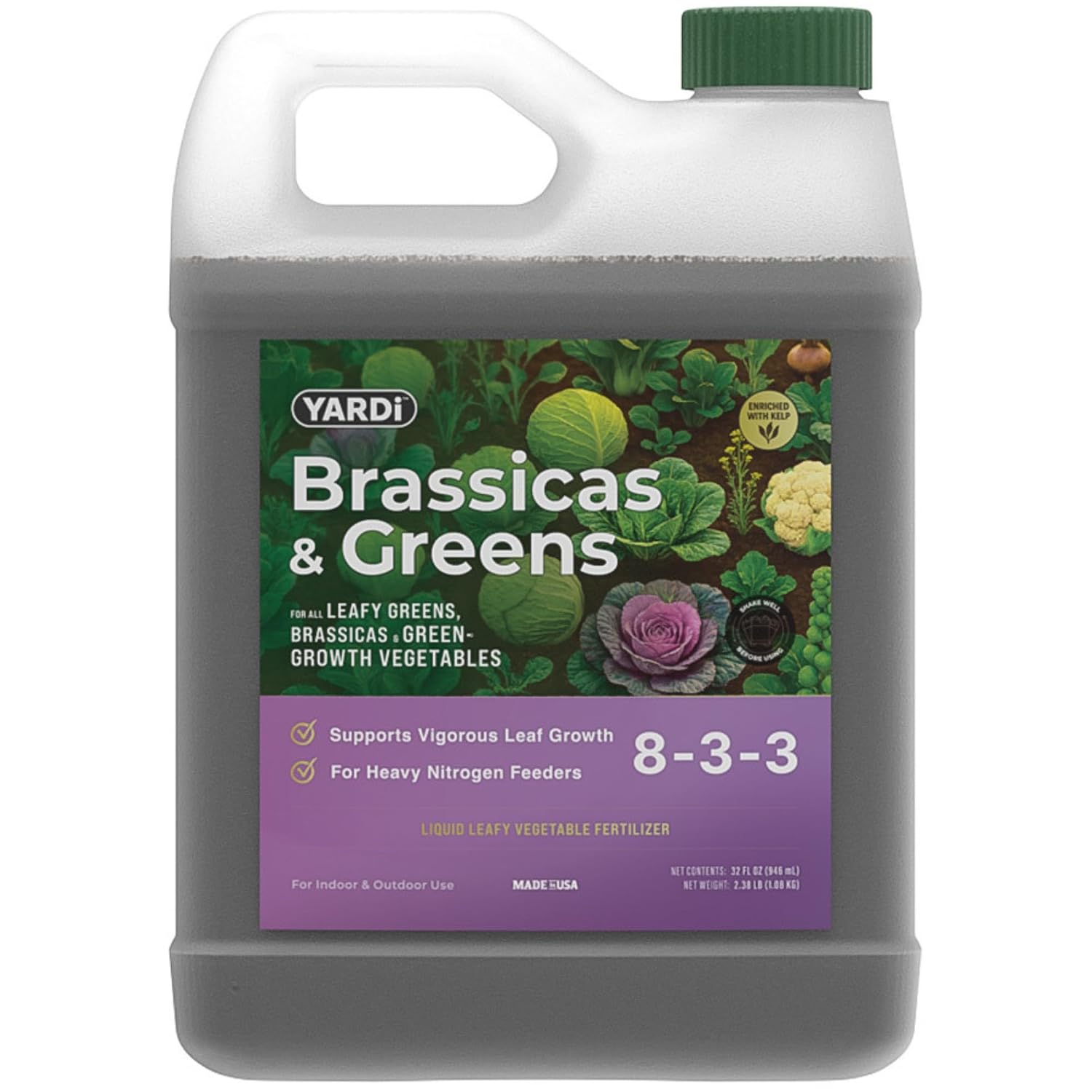
YARDi Brassicas & Greens Liquid Plant Food 32 oz (8-3-3)
| Item Form | Liquid |
|---|---|
| Specific Uses For Product | Leafy Greens |
| Target Species | Vegetables |
| Unit Count | 32 Fluid Ounces |
This 32-ounce YARDi liquid plant food is a nitrogen-forward 8-3-3 concentrate designed for outdoor brassicas and salad greens. It mixes easily with water (the label suggests 1–2 teaspoons per gallon) and can be applied as a soil drench, foliar spray, through drip irrigation, or with a hose-end applicator, making it flexible for beds, raised planters, and small-scale vegetable plots. The higher nitrogen ratio promotes lush, dark green foliage and sustained leafy growth in crops like kale, cabbage, broccoli, spinach and lettuce, and the formula includes micronutrients to support overall plant vigor. Practical benefits include straightforward dilution instructions and multiple application methods so you can feed regularly every 2–3 weeks during the growing season. Limitations are that the product is targeted to leafy vegetables and may be less appropriate for fruiting or flowering stages where balanced or phosphorus-heavy feeds are preferred, and frequent foliar or high-nitrogen use can require monitoring to avoid excess vegetative growth at the expense of yield.
Best for: Gardeners who prioritize big, healthy leaves on brassicas and salad greens and want a simple liquid feed they can use across beds and containers throughout the season.
Less Ideal for: Growers focused on flowering or fruiting crops or those who prefer granular slow-release fertilizers for low-maintenance feeding.
- High nitrogen 8-3-3 formula tailored for vigorous leafy growth
- Liquid concentrate that dilutes easily for foliar, soil drench, drip, or hose-end use
- Clear directions for regular feeding every 2–3 weeks during the season
- Includes micronutrients to support plant vigor beyond basic NPK
- Formulated specifically for leafy greens so not ideal as an all-purpose or bloom-promoting fertilizer
- Requires regular applications and careful dosing to avoid excessive leafy growth
Verdict: Choose this liquid 8-3-3 feed when your goal is consistently lush, vigorous leafy growth in brassicas and salad greens.
Miracle-Gro Performance Organics All Purpose Plant Nutrition Granules, 2.5 lb

| Item Form | Granules |
|---|---|
| Specific Uses For Product | Plant Food |
| Target Species | vegetables, flowers and herbs |
| Mixing Ratio | 11-3-8 |
This Miracle-Gro Performance Organics granular formula is an all-purpose plant food intended for both in-ground beds and container plants. It is applied dry to soil using the built-in shaker cap, worked in lightly, then watered; repeat applications every 4 to 6 weeks keep nutrients available. The product emphasizes natural ingredients and a nutrient profile suited to boosting blooms and overall vigor for vegetables, flowers, and herbs, promising visible improvements versus unfed plants within about a week. Practical benefits include easy, measured application from the shaker jug, compatibility with common garden crops, and an organic-focused ingredient list for gardeners who prefer natural inputs. Limitations are that it is a general-purpose nutrition granule rather than a crop-specific fertilizer, so growers seeking tailored NPK ratios for heavy-feeding leafy brassicas may need to supplement or choose a fertilizer formulated for high nitrogen uptake. Also, results depend on correct application and regular watering, and the 2.5 pound unit covers a modest area so frequent purchases may be needed for larger plots.
Best for: Gardeners focused on getting reliable, visible performance for mixed vegetable and flowering plantings who prefer a natural-feeling, easy-to-apply granular feed.
Less Ideal for: Commercial growers or gardeners managing large vegetable plots who need crop-specific high-rate nitrogen feeds or bulk coverage should consider concentrated or specialized fertilizers instead.
- Ready-to-use shaker jug simplifies measured, even application
- Suitable for both in-ground and container-grown vegetables, flowers, and herbs
- Promotes noticeable improvement in plant vigor and blooms within about seven days versus unfed plants
- Formulated with natural ingredients for gardeners who prefer organic options
- General all-purpose formula may not provide the high nitrogen proportion some leafy crops prefer
- 2.5 lb unit provides limited coverage for larger vegetable beds
Verdict: A convenient, organic-focused granular feed that delivers quick, visible improvements for mixed garden plantings when you want easy application and reliable performance.
Miracle-Gro Liquid All Purpose Plant Food Concentrate, 32 oz

| Item Form | Liquid |
|---|---|
| Specific Uses For Product | Plant Growth, Root Development |
| Application Method | Mix with water in a watering can |
| Mixing Ratio | 1:10 (concentrate to water, estimate) |
Miracle-Gro Liquid All Purpose is a water-soluble concentrate you mix into a watering can and apply every 1 to 2 weeks to container and in-ground plants. It is formulated for general plant growth and root development and is marketed for flowers, vegetables, shrubs and houseplants, so it works as a straightforward feed for flowering bulbs like calla lilies. The bottle’s mixing guidance (cap measures for garden application and 1 teaspoon per gallon for containers) makes it easy to dose for pots or small beds. Practical benefits include fast uptake through the soil when applied as directed and compatibility with routine watering schedules. Limitations to note are that it is an all-purpose formula rather than a bloom-focused or calcium-rich fertilizer tailored specifically to calla lilies, so growers seeking targeted bloom enhancement or specialty nutrition may want a supplement. Also, frequent use at higher-than-recommended strength can risk fertilizer burn, so follow the mixing directions and schedule.
Best for: Buyers who want an affordable, easy-to-use liquid fertilizer to keep calla lilies and other flowering plants regularly fed without fuss.
Less Ideal for: Growers seeking a specialist bloom-boost or a fertilizer formulated for specific micronutrient needs should consider a targeted or bloom-specific product instead.
- Concentrated liquid mixes easily with water for quick application
- Clear dosing instructions for both garden beds and container plants
- Suitable for a wide range of plant types including flowering bulbs and houseplants
- General all-purpose formula not specifically formulated for enhancing blooms of calla lilies
Verdict: A budget-friendly, easy-to-use liquid concentrate that reliably feeds calla lilies and other common garden plants on a regular schedule.
Miracle-Gro Pour & Feed Singles Ready-to-Use Plant Food

| Item Form | Liquid |
|---|---|
| Application Method | Pour |
| Coverage | Medium |
| Unit Count | 2 Ounce |
| Specific Uses For Product | Plant Food |
Miracle-Gro Pour & Feed Singles are single-use, pre-measured liquid doses that you snap open and pour onto the soil of container plants, so there is no mixing, measuring, or long-term storage. Each 2-ounce single is formulated for potted plants and is intended to feed 12 to 18-inch containers every 10 to 14 days, making it convenient for quick top-ups on vegetables grown in pots. The cap-measure instructions and pour application simplify regular feeding, and the ready-to-use format reduces the chance of over- or under-dosing. Practically, these work well for growers who rotate several small vegetable containers or need an easy solution when juggling many plants. Limitations are that the singles are sized for medium pots only, so very small or very large containers may need adjusted amounts or additional applications, and the format creates more single-use packaging than bulk concentrates. For gardeners prioritizing simplicity and predictable dosing, the product streamlines weekly feeding for container vegetables, but those managing large numbers of pots may prefer a concentrated liquid or granular option for lower per-application cost and less waste.
Best for: Ideal for hobby gardeners growing a few container vegetables who want a no-fuss, predictable feeding routine and value convenience over lowest cost.
Less Ideal for: Not the best choice for producers managing many pots or those focused on minimizing packaging waste or per-application cost.
- Ready-to-use pre-measured singles eliminate mixing and measuring
- Simple pour application designed for container plants
- Labels recommend a clear 10 to 14 day feeding schedule for consistency
- Portable single doses are convenient for spot feeding or travel
- Singles are sized for 12–18 inch pots and may not match very small or very large containers
- Single-use packaging generates more waste than concentrated formulas
Verdict: An easy, no-mix feeding solution that makes consistent fertilizing of medium container vegetables fast and foolproof.
FoxFarm Grow Big Liquid Plant Food (16 fl oz)

| NPK | 6-4-4 |
|---|---|
| Form | Liquid |
| Unit Count | 16 Fluid Ounces |
| Mixing Ratio | 2 teaspoons per 1 gallon |
FoxFarm Grow Big is a 6-4-4 liquid concentrate designed to boost vegetative size and structure for vegetables, roses and houseplants. Mix at the manufacturer recommendation (2 teaspoons per gallon) and apply as part of your watering or as an early-morning foliar spray; the low pH formula helps keep micronutrients stable for reliable uptake. For tomato growers it delivers a nitrogen-forward balance that supports leafy growth and strong vines during the pre-flowering and fruit-set stages, and the pint concentrate is easy to store and measure. Notable features include quick-soluble liquid delivery and clear feeding guidance so you can feed every other watering without extensive guesswork. Limits to consider are that this is a vegetative feed rather than a bloom/fruit-specific formula, so you will want to switch to a bloom or fruit-focused fertilizer at flowering to optimize fruit development, and a pint will require careful dilution for larger vegetable beds or multiple plants. Overall it is a dependable, easy-to-use vegetative booster when you want predictable growth before tomatoes set heavy fruit.
Best for: Gardeners who prioritize consistent, predictable vegetative growth for tomato plants and want a straightforward, low-fuss feeding routine. Ideal for growers who value reliable nutrient uptake and clear instructions over experimental blends.
Less Ideal for: Growers seeking an all-in-one bloom and fruit booster or those managing large-scale tomato plantings who need bulk quantities of fertilizer.
- Concentrated liquid formula for fast nutrient uptake and easy mixing.
- Low pH formulation that helps keep micronutrients stable and available.
- Clear mixing instructions and flexible application by watering or foliar spray.
- Nitrogen-focused NPK (6-4-4) that promotes robust vegetative growth and strong vines.
- Not formulated specifically for flowering or heavy fruiting stages so a bloom/fruit fertilizer is needed later.
- Pint size may be small for larger vegetable gardens and requires frequent repurchasing.
Verdict: A dependable, easy-to-use liquid concentrate that reliably promotes vigorous vegetative growth in tomatoes during the pre-flower stages.
Miracle-Gro Water Soluble All Purpose Plant Food, 1.5 lb

| Item Form | Powder |
|---|---|
| Application Method | Watering Can |
| Target Species | For all flowers, vegetables, trees, shrubs and houseplants |
| Mixing Ratio | 24-8-16 |
Miracle-Gro Water Soluble All Purpose Plant Food is a powder concentrate you mix with water to give a quick nutrient boost to flowers, vegetables, houseplants, shrubs and trees. It is typically dissolved in a watering can or used with a compatible garden feeder to soak soil at the base of plants, delivering nitrogen-heavy nutrition that shows effects faster than granular fertilizers. Notable features include an easy scooping method for indoor and outdoor dosing, compatibility with containers and in-ground planting, and clear directions for feeding every one to two weeks. In practice this makes the product a convenient option when you want visible growth and greener foliage quickly, and the 1.5 lb container covers roughly 600 sq. ft. Important limitations are that it is a fast-release, high-nitrogen formula best used as a regular quick feed rather than a long-term slow-release solution, and it requires careful measuring to avoid overfeeding. For routine maintenance combine with good watering and follow the label to avoid nutrient imbalance.
Best for: Buyers who prefer proven, easy-to-use feeding routines and want noticeable growth quickly for a variety of garden and houseplants, guided by established usage directions and broad user experience.
Less Ideal for: Gardeners seeking a single, long-term slow-release solution or those who prefer organic or low-nitrogen fertilizers for sensitive plantings should consider alternative products.
- Water-soluble powder starts working quickly at the roots when mixed and applied
- Clear, simple dosing for indoor and outdoor use with included scoop guidance
- Suitable for a wide range of plants including vegetables, flowers, shrubs and houseplants
- Covers a large area from a small container (about 600 sq. ft. per 1.5 lb)
- Fast-release formula means benefits are short-term compared with slow-release granular fertilizers
- Requires precise measuring and regular reapplication to avoid overfeeding
Verdict: A reliable, fast-acting water-soluble plant food for gardeners who want easy, repeatable feeding and quick visible results.
Choosing the Right Fertilizer for Chinese Cabbage: Key Factors to Consider
Nutrient Ratio and Timing
Chinese cabbage has distinct nutrient needs across its life cycle. Young transplants and early leaf production benefit from a feed higher in nitrogen to promote rapid leaf growth and canopy establishment. As heads begin to form, a slightly lower nitrogen level with adequate phosphorus and potassium helps firm the head and support root and stem strength.
Choose fertilizers with clear N-P-K labeling so you can adjust application timing and rates. Slow-release or controlled-release products can reduce the chance of nitrogen burn and give a steadier supply, while soluble feeds let you correct deficiencies quickly.
Release Pattern and Availability
How a fertilizer releases nutrients affects growth rhythm and management. Fast-acting soluble fertilizers deliver immediate nutrients and are useful for foliar feeds or quick corrections, but they can require more frequent applications and raise salt risk in dry soils. Slow-release or organic fertilizers supply nutrients more gradually, which reduces management frequency and helps maintain stable soil chemistry.
Consider the planting schedule and whether you want fewer applications or finer control. For successive sowings or continuous harvests, a combination of a base slow-release and supplemental liquid feed often works well.
Micronutrients and Calcium Needs
Micronutrients like calcium, magnesium, boron, and manganese play an outsized role in brassica quality. Calcium helps prevent tip burn and internal browning, while boron and magnesium influence head formation and leaf texture. Many general-purpose fertilizers omit some micronutrients, so check labels if your soil test shows a deficiency.
If your soil is low in calcium or prone to blossom disorders, choose a fertilizer or supplement that provides available calcium. Foliar applications can be used for quick correction of micronutrient deficiencies late in the season.
Salt Index and Seedling Safety
Young Chinese cabbage seedlings are sensitive to high soluble salt concentrations, which can cause root burn and poor establishment. Fertilizers with a high salt index or strong soluble salts should be avoided or heavily diluted for seed-starting and early transplant feeds.
Look for products labeled safe for seedlings, or use half-strength solutions for the first few weeks. Incorporating amendments like compost can buffer salt effects and improve root development.
Application Method and Garden Setup
How you plan to apply fertilizer will influence the type you choose. Raised beds and containers often require more frequent feeding because they dry out and leach nutrients faster than in-ground beds. Liquid feeds and water-soluble fertilizers are convenient for containers, while granular or controlled-release products are practical for in-ground rows and no-till beds.
Also consider whether you prefer foliar sprays for quick fixes or soil-applied feeds for longer-term supply. Clear application instructions and adaptable formats make day-to-day gardening easier.
Soil Testing and Adjustment
A soil test is the most reliable way to match fertilizer choice to actual needs. Soil pH affects nutrient availability for brassicas, and many micronutrients become less available in alkaline soils. Testing lets you target amendments rather than applying blanket feeds that may create imbalances.
Plan to test at least every two to three years, and use the results to choose a fertilizer that fills specific nutrient gaps. If you do not have a test, opt for balanced, low-salt formulations and monitor plant response closely.
When to Feed Chinese Cabbage
Timing feeds around the crop's growth stages gives the best results. Apply a balanced starter feed at transplanting to encourage root establishment, then follow with nitrogen-rich applications during early leaf expansion. Reduce heavy nitrogening as heads begin to form to avoid loose or elongated heads.
For quick-growing spring or fall crops, schedule lighter, more frequent feeds because these plants mature quickly and respond fast to available nutrients. For winter-grown varieties, steady, lower-rate feeding maintains head density without stimulating late-season bolting.
- Starter feed at transplant or seeding
- Nitrogen boost during early vegetative growth
- Reduce nitrogen when heading begins
- Use maintenance feeds to sustain soil fertility
Using Organic Vs Synthetic Fertilizers
Organic fertilizers, such as composted manures and fish-based feeds, release nutrients more slowly and improve soil structure over time. They are forgiving for seedlings and reduce salt risk, but they can be slower to correct acute deficiencies.
Synthetic fertilizers provide predictable nutrient ratios and quick availability, which is useful when you need to push growth or correct a deficiency. For Chinese cabbage, many gardeners use a hybrid approach: organic matter incorporated in the bed for baseline fertility and targeted soluble feeds when plants need a rapid response.
- Organics build long-term soil health
- Synthetics give rapid nutrient corrections
- Combine both for steady base fertility and targeted boosts
Application Rates and Safe Practices
Follow label directions and adjust rates according to plant size and soil fertility. Over-application can lead to excessive leaf growth with poor head formation or to salt damage. When in doubt, start with lower rates and observe plant response.
Watering after granular applications helps move nutrients into the root zone. For foliar sprays, apply in the cooler part of the day and avoid using concentrated solutions on young leaves to reduce burn risk.
- Start lower for seedlings and increase as plants grow
- Incorporate granular feeds into the topsoil to reduce loss
- Rinse foliar-applied nutrients if leaves burn or scorch
Addressing Common Nutrient Problems
Yellowing outer leaves often indicate a nitrogen shortage, while stunted growth with purpling may signal phosphorus deficiency. Calcium deficiencies tend to show as tip burn or internal browning in heads. Identifying symptoms early lets you choose the appropriate corrective feed.
A targeted foliar feed can quickly correct some micronutrient shortages, but long-term corrections often require soil amendments and pH adjustments to improve availability.
- Nitrogen deficiency: pale older leaves, slow growth
- Phosphorus deficiency: stunting, purpling of foliage
- Calcium deficiency: tip burn, internal browning of heads
Protecting Soil Health While Feeding
Avoid heavy, repeated use of high-salt synthetic feeds without organic inputs, as this can reduce microbial activity and soil structure. Regular additions of compost or well-rotted organic matter help retain moisture and buffer nutrient release, reducing the need for frequent synthetic supplements.
Rotate crops and use cover crops in off-seasons to rebuild fertility naturally, which reduces dependence on concentrated fertilizers over time.
- Add compost annually to maintain soil biology
- Use cover crops to restore nitrogen and organic matter
- Avoid excessive single-nutrient applications
How We Chose the Best Fertilizer for Chinese Cabbage
We selected fertilizers based on criteria that reflect real-world vegetable gardening needs for Chinese cabbage. Primary factors were nutrient balance and release pattern, since cabbage requires steady nitrogen early on and a balanced finish to form heads. We prioritized fertilizer formulations that provide measurable N-P-K ratios and a reliable source of micronutrients like calcium and magnesium to prevent tip burn and internal disorders. Application practicality was a major filter, favoring products that work in beds, raised planters, and containers and that can be applied as granular, liquid feed, or starter drench. Environmental behavior mattered: we favored options with low salt index and lower risk of root burn, and we considered organic nutrient sources where they offer steady availability. We also evaluated packaging and labeling for clear instructions so gardeners can match rates to soil tests and planting density. Excluded from consideration were products that lack clear N-P-K labeling, fertilizers intended only for lawns or ornamentals without vegetable directions, and mixes with excessively high salts that risk damaging young seedlings. The chosen criteria align with the scoring metrics used in each product card below.
FAQ
How often should I fertilize Chinese cabbage?
Frequency depends on the fertilizer type and planting system. Slow-release products may only need one application at planting, while soluble feeds are typically applied every 1 to 3 weeks during active growth. Monitor plant vigor and adjust accordingly.
Can I use general vegetable fertilizer for Chinese cabbage?
Yes, a balanced vegetable fertilizer usually works well if it provides adequate nitrogen early and moderate phosphorus and potassium later. Ensure the product has clear application rates for brassicas and check for essential micronutrients.
What is the best way to fix calcium deficiency in heads?
Correcting calcium often requires both soil and foliar approaches. Apply a calcium-containing soil amendment if tests show low levels, and use a foliar calcium spray for quick correction during heading. Improving soil organic matter also enhances calcium uptake.
Should I reduce nitrogen before heading?
Reducing nitrogen as heading begins is usually beneficial to avoid overly leafy, loose heads. Shift to a balanced feed with more phosphorus and potassium or reduce application rates to encourage denser head formation.
Are organic fertilizers effective for fast-growing cabbage varieties?
Organic fertilizers can be effective but often release nutrients more slowly than synthetics. For fast-growing varieties, combine organic soil amendments for baseline fertility with occasional soluble feeds to meet rapid nutrient demand.
Final Verdict
Choose a fertilizer that matches your soil test results and the crop stage. Prioritize clear N-P-K ratios, a release pattern that suits your watering and management style, and sufficient micronutrients-especially calcium-to ensure firm, defect-free heads. Balance the need for quick availability during early growth with a plan to reduce nitrogen as heads form. Gardeners who match fertilizer type and timing to soil conditions and planting schedules will consistently produce better, more uniform Chinese cabbage.
