

Note: This article contains affiliate links. If you click on these links and make a purchase, I may earn a small commission at no extra cost to you. This helps support my research and content. Read my full affiliate disclosure here.
If you want a uniformly green, dense lawn after installation or overseeding, picking the right liquid fertilizer for sod matters. Liquids deliver nutrients quickly, help reduce transplant shock, and let you target young turf with lower burn risk when applied correctly. This guide covers five well-vetted liquid fertilizer options shortlisted for sod use and evaluates them on key turf-care concerns like nutrient balance, safety for new sod, and ease of application. Read on to understand the tradeoffs and which product traits matter most for establishing and maintaining healthy sod.
Top Picks at a Glance
| Best Overall The best all-around choice for most situations | Covington ProLine 16-21-2 Liquid Starter Fertilizer (1 Gal) |  |
| Best Quality Built to a higher standard if you want something more solid | Simple Lawn Solutions 3-18-18 Liquid Lawn Food (32 oz) with Hose-End Sprayer |  |
| Highest Rated A top-rated pick with lots of positive feedback | EverLawn Lawn Starter Liquid Fertilizer 0-8-5, 32 oz |  |
| Most Popular A crowd favorite that many people choose with confidence | Simple Lawn Solutions Growth Booster Liquid Fertilizer (32 oz) with Humic Acid, Hose-End Sprayer |  |
| Best Seller A high-volume bestseller chosen again and again | Scotts Turf Builder Starter Food for New Grass Ready-Spray, 32 fl. oz. |  |
Covington ProLine 16-21-2 Liquid Starter Fertilizer (1 Gal)

| Item Form | Liquid |
|---|---|
| Specific Uses For Product | Lawn Care |
| Coverage | 8500 sq ft |
| Mixing Ratio | 7:1 |
This one-gallon concentrated liquid starter fertilizer is designed to kickstart new lawns and recently sodded areas by delivering a high-phosphorus 16-21-2 nutrient mix. You dilute it with water using the stated 7:1 mixing ratio and apply with a hose-end sprayer, pump sprayer, or watering can to cover up to about 8,500 square feet per gallon when mixed as directed. The liquid form makes it easy to coat new seed or sod evenly and the added micronutrients support early root establishment and faster green-up. Practical benefits include quick uptake compared with dry starters and flexible application methods for small to medium yards. Limitations are typical of concentrated liquids: you must measure and mix carefully to avoid overapplication, and repeated applications for longer-term feeding will require follow-up products. Also the formula is tailored for establishing turf rather than long-term maintenance, so plan to transition to a maintenance fertilizer after roots are established.
Best for: Homeowners installing new sod or overseeding in spring who want a straightforward liquid starter to accelerate root establishment and early green-up.
Less Ideal for: Gardeners who need a year-round feeding program or those unwilling to handle concentrated mixes should consider ready-to-use products or a complete multi-step system instead.
- High phosphorus 21% content to encourage strong root development in new seed and sod
- Liquid concentrate mixes with water for even coverage and faster nutrient uptake
- Broad application options including hose-end, pump sprayer, or watering can
- Covers up to 8,500 sq ft per gallon when applied at recommended dilution
- Concentrated formula requires accurate measuring and mixing to avoid burn or uneven application
- Focused on establishment stage so it is not a standalone seasonal maintenance fertilizer
Verdict: Choose this concentrated high-phosphorus liquid starter when you need a fast, easy-to-apply solution to establish new sod or seed and speed root development.
Simple Lawn Solutions 3-18-18 Liquid Lawn Food (32 oz) with Hose-End Sprayer

| Item Form | Liquid |
|---|---|
| Specific Uses For Product | Lawn |
| Application Method | Spray |
| Coverage | 3,200 square feet |
| Target Species | all grass types |
This 3-18-18 liquid lawn food is designed to boost root development and overall turf hardiness by delivering a high-phosphorus, high-potassium feed in a ready-to-apply hose-end format. You typically mix and spray it on actively growing lawns to help establish new turf, correct phosphorus or potassium deficiencies, or support lawns facing environmental stress. The included hose-end sprayer simplifies application and the stated coverage of 3,200 square feet per bottle makes it practical for medium-sized yards. Because the formula is low in nitrogen it will not drive excessive top growth, which is useful when you want roots and stress tolerance rather than rapid shoot development. Limitations to consider are that visible improvements from phosphorus and potassium can be subtle and slow to appear, and the product is intended for use only on actively growing grass so timing matters. For a long-term fertility program you will still want to use it alongside a regular lawn fertilizer schedule tailored to your soil test results.
Best for: Homeowners who prioritize strengthening roots and establishing new or stressed lawns and who want a simple, ready-to-use liquid treatment that fits into a practical lawn care routine.
Less Ideal for: Gardeners seeking a fast green-up or rapid top growth response or those who need an all-in-one high-nitrogen feeding for frequent mowing cycles.
- High phosphorus and potassium ratio supports root establishment and turf hardiness
- Comes with an attached hose-end sprayer for easy, even application
- Covers up to 3,200 square feet per bottle when applied with the included sprayer
- Low nitrogen formula reduces excessive top growth while focusing on root development
- Effects from phosphorus and potassium are often subtle and not immediately visible
- Intended for use only on actively growing turf so seasonal timing is important
Verdict: Choose this product if your main goal is to build stronger roots and improve turf establishment with a convenient hose-end liquid feed.
EverLawn Lawn Starter Liquid Fertilizer 0-8-5, 32 oz

| Item Form | Liquid |
|---|---|
| Target Species | Lawn Grass |
| Unit Count | 32 Fluid Ounces |
EverLawn Lawn Starter 0-8-5 is a liquid starter fertilizer designed for establishing new sod, overseeding and repairing bare patches. The 0-8-5 analysis emphasizes phosphorus to encourage early root development while keeping nitrogen low to reduce burn risk on young turf. You apply it with a hose-end or handheld sprayer to newly laid sod or seeded areas to give roots an early growth advantage and improve seedling vigor. Its concentrated liquid form makes coverage uniform and easy to meter compared with granular starters, and the low nitrogen content means you can safely use it in cooler seasons or when grass is tender. The formula is straightforward with no extra additives, which is good for buyers who want a reliable, purpose-built starter rather than a multiuse feed. Limitations are the single-purpose formulation and relatively small 32 ounce size, so larger jobs will require multiple bottles or repeat applications to cover an entire yard.
Best for: Homeowners installing new sod or overseeding small to medium lawns who prioritize a dependable, purpose-built starter to establish strong roots.
Less Ideal for: Gardeners looking for an all-in-one seasonal fertilizer program or those needing to feed large acreage without buying multiple bottles.
- High phosphorus 0-8-5 formula targeted to promote deep root development
- Liquid concentrate provides even coverage and easy application with a sprayer
- Low nitrogen reduces risk of burning young grass and suits cool-season use
- Formulated specifically for new sod, seed starts and patching thin spots
- Single-purpose starter formula lacks macro or micronutrient blends for ongoing feeding
- 32 oz bottle may not cover large lawns without multiple purchases
Verdict: Choose this concentrated, phosphorus-focused liquid starter when you want a straightforward, reliable product to help new sod and seed establish deep roots quickly.
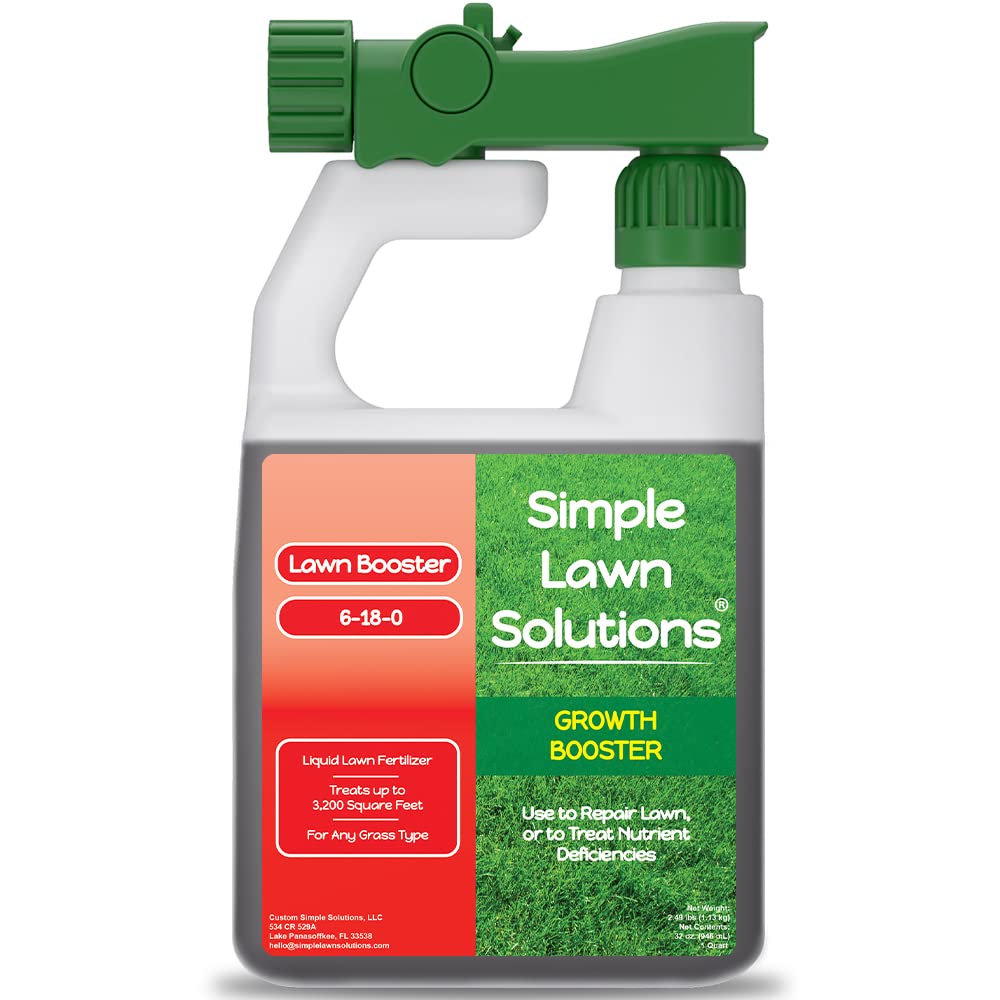
Simple Lawn Solutions Growth Booster Liquid Fertilizer (32 oz) with Humic Acid, Hose-End Sprayer
| Item Form | Liquid |
|---|---|
| Specific Uses For Product | Establishing lawn with sod or seed, Boosting vertical and lateral growth, Addressing phosphorus nutrient deficiencies |
| Application Method | Spray |
| Coverage | 3,200 square feet |
| Target Species | all grass types |
This ready-to-use growth booster is designed for establishing new lawns and encouraging faster vertical and lateral turf growth. It attaches to a hose-end sprayer and covers up to 3,200 square feet per bottle, so application is quick for medium-sized yards and for seeding or sodding jobs. The formula supplies nitrogen and a relatively high phosphorus percentage to promote seedling vigor and root development, while added humic acid helps improve nutrient availability in the soil. Practical benefits include easy hose connection, suitability for all common grass types, and a concentrate strength aimed at early-stage establishment. Limitations to note are that the product is focused on growth stimulation and phosphorus support rather than long-term balanced feeding, so it works best as a starter or boost rather than a standalone seasonal program. Users should follow the mixing directions carefully and pair this with a regular lawn food if longer-term fertility is needed.
Best for: Gardeners who want a simple, fast solution to establish new seed or sod and to accelerate early root and shoot growth without complex mixing or equipment.
Less Ideal for: Lawn owners seeking a full-season fertilizer program or those managing very large lawns where a concentrated bulk product and repeated coverage are needed.
- Ready-to-use hose-end sprayer for fast, even application over lawns
- High phosphorus content improves seedling vigor and root establishment
- Includes humic acid to enhance nutrient uptake and soil mineral availability
- Covers up to 3,200 square feet per bottle, suitable for medium yards
- Suitable for all common grass types and for both sod and seed
- Formulation is aimed at early growth and does not replace a complete seasonal fertilizer program
- Bottle volume may be small for larger properties requiring multiple applications
Verdict: A quick, hose-end starter booster that speeds root and seedling development for new lawns and repairs.
Scotts Turf Builder Starter Food for New Grass Ready-Spray, 32 fl. oz.

| Item Form | Liquid |
|---|---|
| Application Method | spray |
| Coverage | 600 |
| Target Species | Grass |
| Unit Count | 32 Fluid Ounces |
This hose-end liquid starter food is designed to help new grass establish faster by delivering fertilizer at the same time you water. You connect the 32 fl. oz. bottle to an outdoor hose, spray the seeded or sodded area evenly, and repeat two follow-up applications at one-week intervals as directed. The product is formulated for new grass and any grass type and advertises quicker and thicker growth versus unfed seedlings. Practical advantages include the convenience of spraying instead of mixing granules, even coverage over irregular areas, and a simple schedule that works well when establishing sod or repairing bare spots. Important limitations are the limited coverage per bottle—about 600 sq. ft. with three applications—so larger lawns will need multiple bottles, and hose-connection systems can clog if debris gets into the nozzle. Also this is a starter formula intended for early growth rather than long-term maintenance, so you will switch to a regular lawn food later. For risk-averse users it offers predictable application and clear instructions that reduce guesswork during the critical first weeks of establishment.
Best for: Homeowners installing new sod, overseeding small areas, or repairing bare spots who want an easy, low-risk way to feed seedlings without mixing or manual spreading.
Less Ideal for: Large properties or people who prefer granular fertilizers or precise nutrient control for ongoing lawn maintenance should consider other formats.
- Hose-end ready-to-use design makes application fast and mess-free
- Formulated specifically for new grass, sod, plugs and seedlings
- Works with any grass type and provides three recommended feedings
- Even wetting and feeding when watering reduces application errors
- Covers only about 600 sq. ft. per bottle with the recommended three applications
- Not intended as a long-term maintenance fertilizer
Verdict: A convenient hose-end starter fertilizer that makes establishing sod and new grass quick and low-effort for small to medium areas.
Choosing the Right Liquid Fertilizer for Sod: Key Factors to Consider
Nutrient Formulation and Ratios
The percentage and ratio of nitrogen, phosphorus, and potassium determine how a liquid fertilizer supports new sod. Higher nitrogen levels favor rapid top growth and greening, which helps newly laid turf recover from installation stress. Phosphorus supports root establishment, which is essential for sod to knit to the soil below. Too much nitrogen early can force excessive leaf growth at the expense of roots and may increase moisture needs.
Also consider secondary nutrients and micronutrients. Iron can improve color without pushing too much growth, while calcium and magnesium support root and cell health. Check product labels for soluble forms and clear N-P-K numbers so you can match the formulation to the specific stage of sod establishment you are targeting.
Application Safety and Burn Risk
Liquid fertilizers vary in concentration and salt index. High-salt or highly concentrated solutions increase the chance of foliar or root burn on fragile, newly laid sod. Products designed for sod often specify lower recommended rates or include warnings about watering in after application to reduce burn risk.
Application timing and weather also affect safety. Avoid applying in hot, sunny conditions or before drought stress; water the sod lightly after applying a product that recommends it. Look for clear label guidance on maximum concentration, recommended dilution, and safety margins for recently installed turf.
Mixing, Compatibility, and Ease of Use
How simple a product is to mix and whether it is compatible with common sprayer equipment affects accuracy and consistency. Pre-mixed or easy-to-measure concentrates reduce user error. Some liquids require agitation, filtration, or sequence steps when combined with pesticides or wetting agents.
If you plan to tank-mix with herbicides or fungicides later, confirm compatibility. Products that separate, gel, or clog nozzle screens will add time and frustration. Clear instructions on dilution ratios per 1,000 square feet help you achieve even application and avoid over- or under-feeding.
Coverage Efficiency and Spread
Coverage efficiency describes how far a given volume of concentrate will go at recommended rates. A product with good spread will treat more turf per container and allow you to calibrate sprayers to achieve uniform application without streaking. Even distribution matters for sod since uneven feeding can create patchy color and inconsistent rooting.
Consider the recommended application volume per square foot and whether the label gives guidance for common sprayer output settings. Products that work well with both handheld pump sprayers and push sprayers give greater flexibility for different lawn sizes.
Residual Feeding and Timing
Liquid fertilizers typically act quickly but may provide only short-term nutrient availability compared with slow-release granules. For sod, an initial quick-feed can be beneficial to reduce transplant shock, but you will also need a plan for follow-up nutrition. Know how long the liquid's effects last and whether it is suited as a starter feed only or as part of a regular liquid program.
Some liquids include compounds that release more slowly or bind to soil, extending effect. Understand recommended reapplication intervals and how the product interacts with mowing and irrigation schedules to avoid overlapping treatments.
Label Clarity and Turf-Specific Guidance
A clear label that specifies application rates for new sod, overseeding, and mature turf is essential. Good instructions reduce guesswork and lower the risk of misapplication. Look for products that list safe intervals between installation and first application, recommended water-in practices, and explicit advice for different grass types.
Label clarity also helps determine whether the product is intended for professional or consumer use. If instructions are overly technical without plain-language guidance, you will need more experience to apply it safely and effectively.
When to Apply Liquid Fertilizer After Laying Sod
Timing the first application influences how well sod establishes. Many turf-care plans recommend a light starter feed within the first one to two weeks if the sod shows signs of transplant stress, but exact timing depends on soil contact and moisture conditions. If the sod is firmly in contact with the soil and you are keeping it well watered, a gentle liquid feed can encourage root growth without over-stressing the turf.
Avoid applying concentrated feeds immediately after installation unless the product label explicitly allows it. If in doubt, wait until the sod has begun to knit to the soil and respond to regular watering, then apply a lower-rate liquid feed to support both leaves and roots.
- Water the sod thoroughly before and after applying products that recommend water-in.
- Delay feeds after extreme heat or drought to reduce burn risk.
- For overseeding after sod installation, time liquid applications to avoid washing out seed.
Application Methods and Equipment Tips
Handheld pump sprayers, backpack sprayers, and hose-end sprayers are common for liquid fertilizers. Calibrate your sprayer so you know how much solution is applied per 1,000 square feet. Accurate calibration prevents under-application that slows establishment or over-application that risks burn.
Clean nozzle screens and strain liquids if labels warn of particulate matter. Use fresh water for mixing and avoid reusing spray mix leftover from treated lawn areas unless the label allows it.
- Calibrate on a known area to measure sprayer output.
- Use even back-and-forth passes at a steady walk speed for uniform coverage.
- Rinse equipment after use to prevent clogging and corrosion.
Integrating Liquids Into a Sod Care Calendar
Think of liquid feeds as a fast-acting component of your overall turf program. Start with a starter feed when the sod is ready, then plan follow-up treatments or a transition to granular slow-release products depending on your maintenance goals. Liquids can be used for spot treatments, color touch-ups, or quick fixes between scheduled granular applications.
Coordinate liquid applications with mowing, irrigation, and pest control activities. Applying a liquid too close to herbicide treatments or heavy rain can reduce effectiveness or increase the chance of nutrient wash-off.
- Space liquid applications according to label reapplication intervals.
- Avoid mowing immediately before or after application unless the label permits it.
- Use liquids for targeted care rather than as the sole long-term feeding strategy.
Troubleshooting Common Issues
If you notice leaf yellowing after applying a liquid, first check application rate and dilution. Over-application or uneven coverage can cause scorch or streaking. Remediate by watering the area lightly to dilute surface salts, and adjust future spray concentrations.
Poor rooting after several weeks may indicate that the initial feed lacked phosphorus or that soil contact was inadequate. Reassess soil preparation and consider a follow-up application designed to support root growth rather than more top growth.
- Rinse affected turf with water if burn symptoms appear.
- Check soil moisture and avoid using additional inputs until turf recovers.
- If issues persist, consult soil test results to match nutrient needs precisely.
Safety and Environmental Considerations
Avoid applying liquids immediately before heavy rain to reduce nutrient runoff. Use buffer zones around water features and follow local guidelines on fertilizer application near bodies of water. Store concentrates out of sunlight and away from children and pets.
Wear basic protective gear when mixing and spraying, and clean up spills promptly. Choosing a lower-salt, turf-formulated liquid reduces environmental risks and makes it easier to follow best practices for responsible lawn care.
- Follow label disposal instructions for leftover concentrate.
- Prevent drift by spraying at low wind speeds and using coarse droplet settings.
- Consider soil testing to avoid unnecessary nutrient applications.
How We Chose the Best Liquid Fertilizer for Sod
We focused on attributes that directly affect sod establishment and early turf performance. Primary evaluation criteria included nutrient formulation and proportion, because the right balance of nitrogen, phosphorus, and potassium influences root development and leaf growth during the first weeks after laying sod. Application safety and burn risk were assessed next, since concentrated liquids can damage young turf if applied incorrectly. Coverage and dilution flexibility were examined to determine how easily a product adapts to different spreader or sprayer setups and lawn sizes. Ease of mixing and application rate clarity matter for homeowners and pros trying to get consistent results. Finally, residual feeding duration and compatibility with common lawn care programs were considered to judge how a liquid fits into a broader maintenance plan. We excluded granular-only products and slow-release formulations that are not designed for quick uptake or targeted early sod treatment. Products that lack transparent nutrient labeling or clear application instructions were also removed. The shortlist emphasizes liquids formulated for turf use, clear dosing guidance, and demonstrated suitability for new or recently laid sod.
FAQ
Can I apply liquid fertilizer immediately after laying sod?
Often a light starter feed is safe within the first one to two weeks if the sod has good soil contact and consistent moisture. However, avoid concentrated solutions right after installation unless the product label explicitly permits immediate application.
How much liquid fertilizer should I use per 1,000 square feet for new sod?
Recommended rates vary by product, but the label should give clear dilution instructions per 1,000 square feet. Use the lower end of recommended rates for newly laid sod and calibrate your sprayer to ensure even coverage.
Will liquid fertilizer burn my new sod?
It can if applied too concentrated or during hot, dry conditions. Choose turf-specific formulations, follow dilution guidance, water in when advised, and avoid applications during heat stress to reduce burn risk.
How soon after applying liquid fertilizer can I mow the sod?
Mowing intervals depend on product instructions. In many cases, wait until the turf has dried and avoid mowing immediately after an application to prevent clumping and uneven distribution. Check the label for any specific timing advice.
Can I tank-mix liquid fertilizer with other lawn products?
Tank-mixing depends on compatibility. Some liquids are formulated to mix with wetting agents or pesticides, while others are not. Always check label guidance and perform a small compatibility test before mixing full tank volumes.
How often should I reapply liquid fertilizer during the establishment phase?
Follow the product's recommended reapplication interval, which is often every 3 to 6 weeks for fast-acting liquids. Use shorter intervals at lower rates rather than a single heavy application to avoid burn and support steady root development.
Final Verdict
For establishing and maintaining healthy sod, prioritize a liquid fertilizer that balances quick nutrient availability with low burn risk. Focus on clear N-P-K ratios, straightforward dilution instructions, and a product that fits your sprayer equipment. Expect liquids to provide rapid green-up but plan follow-up feeds or transition to slower-release options for longer-term nutrition. Choose based on the specific needs of your turf stage, watering schedule, and the tradeoffs between immediate color and sustained root development.
