

Note: This article contains affiliate links. If you click on these links and make a purchase, I may earn a small commission at no extra cost to you. This helps support my research and content. Read my full affiliate disclosure here.
Picking the right wifi water irrigation controller changes how you manage landscapes, patios, and vegetable beds. The right controller automates watering based on weather, reduces waste, and makes seasonal adjustments so you do less manual editing of schedules. This guide covers seven shortlisted controllers well suited to a range of yards and garden setups, from compact urban plots to larger suburban lawns. We evaluated each option for how well it handles water-efficiency features, installation complexity, and everyday reliability. Below are practical notes that will help you match a controller to your wiring, zone count, and watering goals before you look at the individual product picks.
Top Picks at a Glance
| Best Overall The best all-around choice for most situations | Hunter X2 8-Station Sprinkler Controller (Wi‑Fi Upgrade Capable) |  |
| Best Quality Built to a higher standard if you want something more solid | Rain Bird ESP-ME3 4-Station Irrigation Controller (expandable) |  |
| Best Value The sweet spot between price and what you get | Orbit B-hyve Smart 6-Zone Indoor/Outdoor Sprinkler Controller |  |
| Best Budget The cheapest option that still gets the job done reliably | Insoma WiFi Hose Timer with Hub Support and Bluetooth |  |
| Highest Rated A top-rated pick with lots of positive feedback | HiOazo Outdoor Smart Sprinkler Controller, Wi‑Fi, 12‑Zone |  |
| Most Popular A crowd favorite that many people choose with confidence | Rachio 3 Smart Sprinkler Controller, 8-Zone |  |
| Best Seller A high-volume bestseller chosen again and again | Rachio 3 Smart Sprinkler Controller, 16-Zone |  |
Hunter X2 8-Station Sprinkler Controller (Wi‑Fi Upgrade Capable)

| Zones | 8 station |
|---|---|
| Programs | 3 programs |
| Start times | 4 start times per program |
| Display | LCD |
| Material Type | Plastic |
The Hunter X2 is an 8-station sprinkler controller built for reliable, flexible irrigation scheduling and future smart upgrades. It uses a familiar dial face for on-unit programming—three independent programs, four start times each, and interval, seasonal, and rain delay controls—so setting different run times and days is straightforward for everyday yard care. Built-in features like Cycle and Soak reduce runoff on slopes and clay soils, QuickCheck diagnostics help find wiring faults, and Easy Retrieve saves programs for power outages or maintenance. The X2 can remain a capable manual controller for users who want simplicity, or be upgraded with the optional WAND Wi‑Fi module to enable Hydrawise cloud features such as weather‑based adjustments, remote edits, and water‑use monitoring. The cabinet is weather resistant and the backlit LCD is easy to read outdoors, but true smart functionality requires purchasing the Wi‑Fi module separately and advanced remote features depend on the Hydrawise service. For most homeowners and light commercial sites the X2 strikes a good balance between dependable hardware and upgradeable smart controls.
Best for: Homeowners or small‑property managers who want a dependable, pro-grade controller now with the option to add smart, weather‑based remote control later.
Less Ideal for: Someone who needs built‑in Wi‑Fi and full app control out of the box or who wants a no‑extra‑hardware plug‑and‑play smart controller.
- Flexible scheduling with 3 programs, 4 start times each, and seasonal adjustments
- Cycle and Soak feature reduces runoff and promotes deeper watering
- QuickCheck diagnostics and Easy Retrieve memory simplify troubleshooting and recovery
- Weather-resistant cabinet and backlit LCD suitable for outdoor installation
- Upgradeable to Hydrawise Wi‑Fi for remote control and weather-based automation
- Wi‑Fi capability requires buying the separate WAND module
- Advanced remote features depend on using the Hydrawise cloud platform
Verdict: A reliable 8‑zone controller that gives balanced manual programming today with a straightforward upgrade path to Hydrawise smart, weather‑based remote management.
Rain Bird ESP-ME3 4-Station Irrigation Controller (expandable)

| Voltage | 120 volts |
|---|---|
| Display Type | LCD |
| Operating Temperature | 65 °C |
| Model | F55110 |
The Rain Bird ESP-ME3 is a straightforward programmable irrigation controller aimed at residential and light-commercial systems. It ships with four stations and allows expansion up to 22 stations using add-on modules, so it works for small yards now and larger systems later. The unit can plug in with the included power cord or be hardwired by removing the cord, and non-volatile memory preserves settings through power outages. Adding the optional LNK WiFi module lets you monitor and adjust schedules remotely and apply internet-based weather adjustments for smarter water use. The controller is compatible with optional flow and rain sensors for leak protection and water monitoring. Key practical benefits are its flexibility to grow with a system, simple local programming via an LCD, and the ability to add smart features without replacing the controller. Limitations to consider are that the WiFi and sensor capabilities require separate purchases and some installers may prefer factory-integrated smart models if they want an all-in-one out-of-the-box WiFi solution.
Best for: Gardeners and property owners who prioritize reliable performance and the ability to expand a conventional irrigation system now while adding smart controls later.
Less Ideal for: Buyers who want an all-in-one controller with built-in WiFi and sensors out of the box or who prefer a touchscreen smart controller with factory-integrated connectivity.
- Expandable from 4 to 22 stations using add-on modules for system growth
- Non-volatile memory preserves programming during power outages
- Plug-in power cord with option to hardwire for flexible installation
- Compatible with optional WiFi module for remote control and weather-based adjustments
- WiFi and flow/rain sensors are sold separately so smart features are not included
- Basic LCD interface lacks the integrated touchscreen convenience of some newer smart controllers
Verdict: Choose the ESP-ME3 if you want a dependable, expandable controller that can be upgraded with WiFi and sensors for smarter irrigation as needs grow.
Orbit B-hyve Smart 6-Zone Indoor/Outdoor Sprinkler Controller

| Item Type Name | B-hyve Smart 6-Zone Indoor/Outdoor Sprinkler Controller |
|---|---|
| Display Type | LCD or LED |
| Voltage | 110 volts |
| Operating Temperature | 75 °C |
The Orbit B-hyve Smart 6-Zone controller automates landscape watering for small to medium yards by letting you program schedules from a waterproof wall-mounted panel or the mobile app. It supports zone-by-zone scheduling so lawns, flower beds, and drip lines can have tailored run times, and its WeatherSense feature automatically adjusts watering based on local weather so you do not overwater after rain or under-water during dry spells. Setup is typical for an indoor/outdoor timer and connects to 2.4 GHz Wi-Fi for remote control and voice commands through smart assistants. Practical benefits include clear on-unit display, app access to start/stop or edit programs from anywhere, and multi-zone flexibility that improves water efficiency. Limitations are that it is a 6-zone model so larger systems will need a higher-zone controller or multiple units, and full smart features require a stable home Wi-Fi connection. For homeowners who want reliable automated watering without complex professional systems, the B-hyve is a straightforward, water-saving option.
Best for: Homeowners who want to optimize water use and simplify routine irrigation for a small to medium yard using automation and weather-based adjustments.
Less Ideal for: Owners of large properties with many irrigation zones or users who need a controller that works offline without Wi-Fi connectivity.
- WeatherSense automatically adjusts schedules based on local weather to reduce overwatering
- App and on-unit control allow remote scheduling and zone management
- Waterproof wall-mounted enclosure supports indoor or outdoor installation
- Zone-based programming for tailored irrigation across up to six zones
- Only supports six zones, which may be insufficient for larger properties
- Requires reliable 2.4 GHz Wi-Fi for full remote and smart features
Verdict: If you want a practical, weather-adaptive smart controller to cut wasted watering and manage a small to medium yard remotely, the Orbit B-hyve 6-zone delivers that capability simply and reliably.
Insoma WiFi Hose Timer with Hub Support and Bluetooth
| Number of settings | 20 |
|---|---|
| Material Type | Plastic |
| Manufacturer Warranty Description | 1 year manufacturer. |
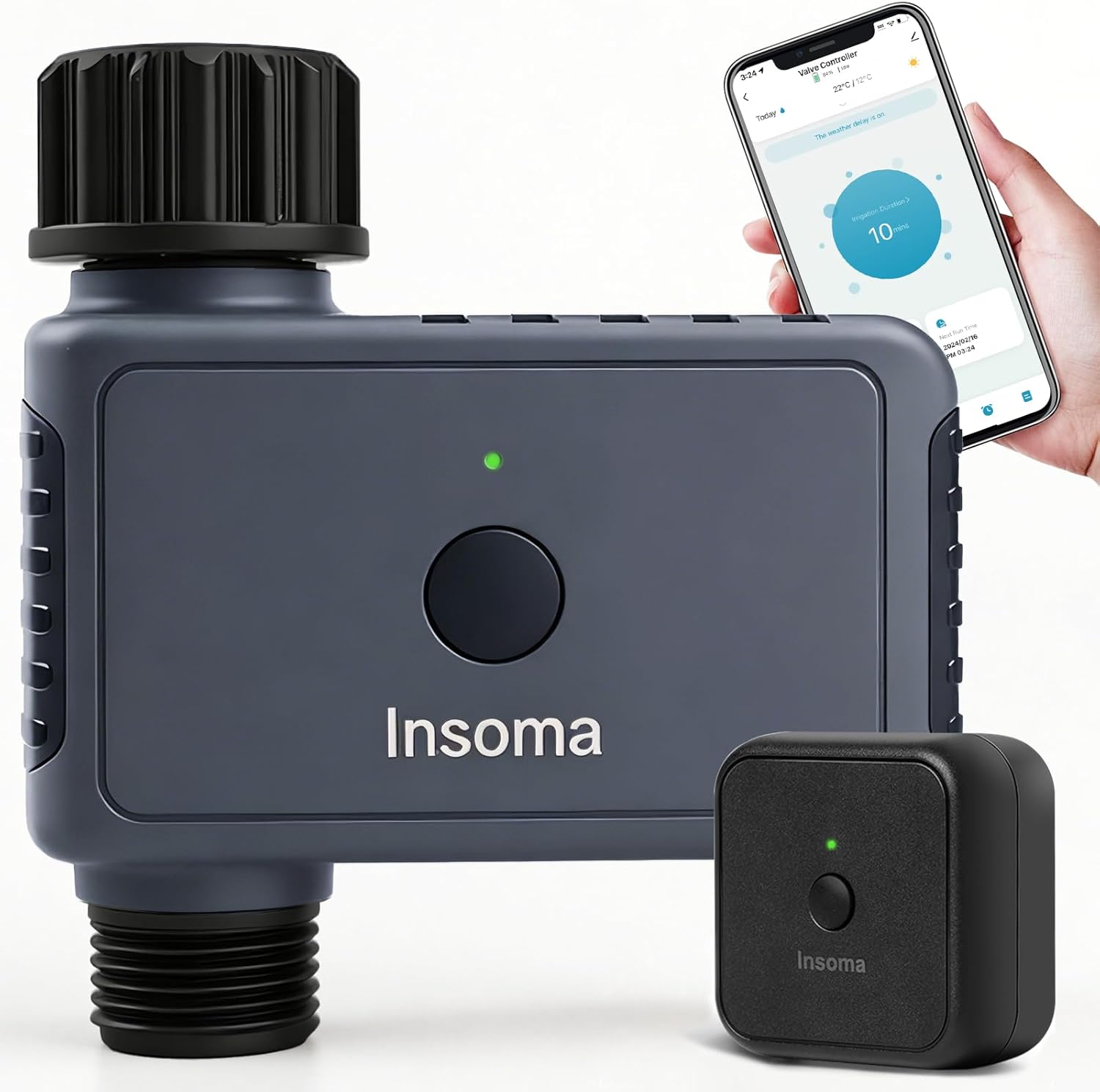
The Insoma WiFi hose timer is a compact smart watering controller designed to attach to a standard outdoor faucet and automate garden or lawn irrigation. It pairs with a 2.4 GHz WiFi hub to enable remote scheduling and voice control through Alexa or Google Assistant, while also offering direct Bluetooth control if the hub is unavailable. The unit supports up to 20 distinct irrigation programs, two irrigation modes for flexible timing, and a rain delay feature (24, 48, 72 hours) plus manual watering for on-demand use. Practical benefits include the ability to manage multiple timers from a single hub and share access with family members, which makes scaling a small smart system straightforward. Expect an easy mobile setup with the Smart Life app, though it requires a 2.4 GHz network and the hub for full-range WiFi functionality. The timer is plastic-bodied and lightweight, so it is convenient to handle but may feel less rugged than higher-end metal models. For gardeners on a budget who want basic smart scheduling and voice control, this delivers strong value, but those needing heavy-duty outdoor durability or advanced commercial features should look elsewhere.
Best for: Smart gardening beginners and budget-minded homeowners who want reliable app and voice-controlled irrigation for small to medium gardens without paying for premium commercial controllers.
Less Ideal for: Large properties or users who need industrial-grade weatherproofing, advanced zone control, or controllers that work on 5 GHz networks or without a proprietary hub.
- WiFi hub support plus Bluetooth fallback lets you control schedules remotely and locally
- Supports up to 20 separate irrigation schedules and two irrigation modes for flexible programming
- Compatible with Alexa and Google Assistant for voice commands
- Expandable system: one hub can manage up to 32 timers and share control with family members
- Requires a 2.4 GHz WiFi network and hub for full remote functionality
- Plastic construction is lightweight but less robust than metal housings
Verdict: A cost-conscious smart hose timer that gives reliable app and voice-controlled scheduling with Bluetooth backup, making it a practical choice for budget-focused home gardeners.
HiOazo Outdoor Smart Sprinkler Controller, Wi‑Fi, 12‑Zone

| Wi‑Fi frequency | 2.4GHz |
|---|---|
| Zones supported | 12 zones |
| Programmable plans | 16 plans |
| Irrigation modes | Standard and Soak |
The HiOazo Outdoor Smart Sprinkler Controller replaces a traditional timer with a cloud‑connected controller you manage from the HiOazo app over 2.4 GHz Wi‑Fi. It is typically installed at the irrigation control panel and used to schedule watering across multiple zones, with options for Standard or Soak irrigation modes. Notable features include support for up to 12 zones and 16 separate watering plans so you can tailor schedules for different plant beds, plus automatic skipping for rain, freeze, and wind to avoid unnecessary runs. The app control makes remote adjustments and monitoring straightforward, and the company advertises a quick DIY install that should fit most existing systems. Limitations to consider are dependence on 2.4 GHz Wi‑Fi and the app ecosystem for smart features, so local manual control is less convenient if your network is unreliable. The controller appears aimed at homeowners who want flexible, weather‑aware scheduling without professional setup, but expect connectivity and app reliance to be central to day‑to‑day use.
Best for: Homeowners who prioritize a dependable, weather‑smart irrigation schedule and want remote control to reduce overwatering without hiring a pro.
Less Ideal for: People with unreliable Wi‑Fi, those who need purely local/manual controllers, or users who prefer controllers that operate without any app dependency.
- Supports up to 12 irrigation zones and 16 separate watering plans for flexible scheduling
- Weather‑aware auto skip for rain, freeze, and wind helps conserve water and protect plants
- App control over 2.4 GHz Wi‑Fi lets you monitor and adjust schedules remotely
- Two irrigation modes (Standard and Soak) allow better soil absorption management
- Requires a 2.4 GHz Wi‑Fi network and app for full smart functionality
- Relies on cloud/app ecosystem so offline/manual operation is limited
Verdict: Choose this controller if you want a dependable, weather‑sensing Wi‑Fi system that simplifies hands‑off irrigation across many zones.
Rachio 3 Smart Sprinkler Controller, 8-Zone

| Item Highlight | 8 Zones, App Control, Rain Skips, Local Weather Scheduling |
|---|---|
| Voltage | 120 volts |
| Display Type | LED |
| Operating Temperature | 4 °F |
The Rachio 3 Smart Sprinkler Controller gives you app-first control of an existing 8-zone irrigation system and uses local weather data to adjust watering automatically. You set schedules in the Rachio app for iOS or Android, then let the controller skip runs for rain, freeze, wind or saturated soil and make seasonal adjustments so you do not overwater. Typical use is straightforward: mount the indoor unit, wire it to zone valves, connect Wi-Fi and configure zones in the app; Quick Run buttons let you manually water a zone from the controller when needed. Notable features include dual-band Wi-Fi, compatibility with Alexa, Google Home and IFTTT, LED status display and grow-in scheduling for new lawns. Practical benefits are reduced water use, simpler remote management, and easier setup compared with legacy dial timers. Limitations: the unit is indoor rated so outdoor installs require a weatherproof enclosure and some advanced setups such as well systems may need a pump for proper pressure. The controller also relies on the app for detailed schedule edits rather than full on-device programming.
Best for: Homeowners who want to reduce water use and move away from manual dial timers, and who prefer a proven smart-home controller with easy app-based setup and integrations.
Less Ideal for: People who need a fully outdoor-rated controller without adding an enclosure or who want complete on-device programming without using a smartphone app.
- Weather Intelligence automatically skips watering for rain, freeze, wind and saturation
- App-based scheduling with Quick Run and grow-in options simplifies remote control
- Works with voice assistants and IFTTT for smart-home integration
- Fast DIY install that fits most existing 8-zone systems
- Indoor-rated unit requires a separate weatherproof enclosure for outdoor mounting
- Relies on the mobile app for most scheduling tasks rather than full on-device controls
Verdict: Choose the Rachio 3 if you want a reliable, app-driven 8-zone controller that cuts wasted watering with automatic weather-aware schedules.
Rachio 3 Smart Sprinkler Controller, 16-Zone

| Zones supported | 16 |
|---|---|
| Voltage | 110 volts AC |
| Display type | LED |
| Operating temperature | 15 °C |
The Rachio 3 is a WiFi-enabled sprinkler controller designed to replace conventional dial timers and automate watering across up to 16 zones. It is typically wall-mounted indoors or placed in a weatherproof enclosure outdoors and is set up through the Rachio mobile app, which walks you through wiring, zone naming, and schedule creation. Key features include patented Weather Intelligence that skips runs for rain, freeze, wind and soil saturation, grow-in schedules for new grass, Quick Run buttons for manual zone activation, and compatibility with Alexa, Google Home and IFTTT. In practice this delivers consistent, hands-off watering, fewer unnecessary runs, and easier seasonal adjustments compared with manual timers. Installation is straightforward for anyone comfortable with basic wiring and the app makes troubleshooting and remote control simple. Limitations are that scheduling is primarily app-driven so basic on-device customization is limited, and systems on well pumps may need an additional pump start relay to work reliably. The controller is indoor rated unless you buy a separate weatherproof enclosure.
Best for: Homeowners who want a reliable, low-maintenance irrigation controller that reduces wasted water and simplifies seasonal scheduling without constant manual intervention.
Less Ideal for: Users who need full control from the device itself or who prefer a completely offline mechanical timer; those with specialized commercial irrigation needs should consider professional controllers.
- Local Weather Intelligence automatically adjusts and skips watering for rain, freeze, wind and saturation
- Supports large systems with up to 16 zones for flexible yard layouts
- Dual-band WiFi and wide smart-home compatibility for remote control and voice assistants
- Quick Run manual buttons let you run zones on demand without the app
- App-guided setup and grow-in schedules simplify installation and establishing new turf
- Most scheduling and advanced controls require the mobile app rather than on-device menus
- Indoor-rated unit requires a separate weatherproof enclosure for outdoor mounting
- May need an external pump start relay for some well systems
Verdict: If you want dependable, water-saving automatic irrigation for a typical home landscape, the Rachio 3 delivers smart weather-driven schedules and easy app control for up to 16 zones.
Choosing the Right Wifi Water Irrigation Controller: Key Factors to Consider
Zone Count and Expansion
Match the controller to the number of irrigation zones you currently run and leave room for future expansion. Each station controls one valve or zone; undersizing forces juggling programs or adding a second controller. If your landscape has separate drip zones, lawn areas, and planter beds, count each as a separate zone because they usually need different runtimes.
Plan for growth if you expect to add more beds, a new drip line, or a greenhouse. Some controllers support expansion modules or two-wire conversions that let you control more zones without complex additional wiring. Choosing a controller with straightforward expansion saves labor and avoids redoing valve runs later.
Weather-Based Scheduling and Local Sensors
Controllers that adjust watering based on local weather data or an on-site sensor can cut waste and prevent overwatering after rain. Integrated weather scheduling uses forecast or evapotranspiration inputs to reduce run times automatically. A local rain sensor or soil-moisture sensor provides on-the-ground feedback that forecasts cannot always catch, such as a sudden localized storm or microclimate.
Consider how the controller obtains weather data and whether it supports external sensors you already own. Some systems rely on cloud services for weather and may pause watering if the connection fails, while others will fall back to local schedules. For drought-sensitive regions, sensor compatibility and conservative weather offsets are especially valuable.
Installation and Wiring Requirements
Look at how the controller mounts and what wiring it requires. Many home controllers are wall-mounted for indoor garage or sheltered outdoor installation. Check whether the unit needs a dedicated 24 VAC transformer and whether you have a spare transformer or must replace the old one. Wiring that follows standard terminal blocks is easier for DIYers, while two-wire systems or proprietory power-stealing setups can complicate upgrades.
Also evaluate whether the controller includes clear diagrams, labeled terminals, and removable station screws. If you plan to install outdoors, confirm the enclosure rating and whether the transformer location will be protected from rain. Poor installation planning is the leading cause of later wiring problems and intermittent valve operation.
App Interface and Remote Controls
A clean, responsive mobile app makes scheduling, skipping cycles, and manual starts fast when you are out in the yard. Check for features like program cloning, per-station runtimes, seasonal adjust sliders, and easy manual station starts. An app that organizes zones by name and area avoids confusion when you have many stations.
Consider whether the controller supports multiple users or guest access if others will manage watering. Evaluate how the app reports last run time, next scheduled run, and recent alerts. Poor app design leads to accidental overwrites and missed irrigation events, so prioritize an interface that matches your level of comfort with smart controls.
Compatibility With Valves and Emitters
Confirm that the controller works with the common valve types and emitters in your system. Most controllers support standard solenoid irrigation valves, but some legacy or specialty valves have different electrical requirements. Drip systems, soaker hoses, and pop-up sprinklers need different run times even if they share the same controller, so per-station timing is essential.
Also think about whether the controller supports master valves or pump start relays if your setup uses a well or pump. Ensuring electrical compatibility prevents failures when you switch from an older controller and avoids the need for expensive valve replacements.
Durability and Outdoor Ratings
Controllers meant for outdoor mounting should have weatherproof enclosures and corrosion-resistant terminals. Even garage-mounted controllers need a degree of protection from humidity and temperature swings. UV exposure and condensation can degrade electronics and wire connections over time, so robust construction matters for long-term reliability.
Look for protective gaskets, labeled drainage paths, and secure snaps or screws on the housing. In climates with large temperature ranges, rated operating temperatures and thermal protection keep schedules consistent season to season.
Timing Strategies for Different Plant Types
Different plants need different watering logic. For lawns, shorter more frequent cycles early morning reduce evaporation and improve turf health. For established shrubs and trees, longer, less frequent soak cycles encourage deep root growth.
Drip-irrigated vegetable beds and container plants benefit from shorter runs more often because the root zone is shallower and the soil dries faster. Use separate programs for each plant type and avoid running all zones on the same schedule to prevent overwatering some areas while others remain dry.
- Lawns: short cycles, early morning
- Shrubs/trees: deep soak, less frequent
- Drip beds: shorter, more frequent runs
- Containers: daily or every-other-day checks during heat
Managing Water Restrictions and Seasonal Adjustments
Many municipalities impose watering restrictions during droughts or peak-season bans. A wifi controller with manual hold and flexible scheduling makes it easier to comply without reprogramming each station. Seasonal adjust sliders are useful when you need to quickly reduce overall run time across all programs.
During shoulder seasons, reduce frequency and rely on local sensor feedback. In winter months in frost-prone areas, use the controller's rain or freeze hold functions and physically shut off outdoor valves to prevent damage.
- Set global percentage adjustments for quick changes
- Use sensor-based holds during rain or freeze events
- Document local watering rules in the app notes for quick reference
Integrating Controllers With Smart Home Systems
If you use a smart home platform, check whether the controller supports common integrations. Voice control and routines can be useful for quick manual starts or pausing schedules when guests are using the yard. Integration also provides an additional layer of remote control if your primary app has outages.
However, avoid relying solely on third-party integrations for critical watering tasks. Ensure the controller itself can run schedules and respond to sensors without cloud dependencies so that local irrigation runs even if the smart home bridge goes offline.
- Verify compatibility with your existing smart hub
- Keep local scheduling as the primary fallback
- Use voice routines for manual starts and quick holds
Troubleshooting Common Installation Issues
Most installation problems stem from wiring mistakes, incorrect transformer voltage, or misconfigured zone assignments. Before swapping controllers, label wires at the valve manifold and take a photo of the old wiring for reference. Confirm the transformer output and terminal labeling against the new unit's instructions.
If a station will not activate, test the valve coil with a multimeter and confirm the controller is supplying the correct voltage. For connectivity problems, place the controller where it reliably sees your wifi or use a wired backhaul option when available.
- Label wires and photograph wiring before changes
- Check transformer voltage and fuse
- Use multimeter checks for valve coil resistance
- Relocate controller for better wifi if needed
Conserving Water With Scheduling Best Practices
Use shorter run times with multiple start times rather than a single long run to improve soil absorption and reduce runoff on sloped sites. Stagger start times across zones so the system does not exceed pump flow or produce low pressure that causes poor emitter performance.
Regularly review runtime logs and make small percentage adjustments based on plant appearance and soil moisture readings. Over time, refine runtimes rather than making large leaps; incremental changes reveal true plant needs without stressing vegetation.
- Use multiple short cycles to reduce runoff
- Stagger zones to manage flow and pressure
- Review logs and tweak runtimes incrementally
How We Chose the Best Wifi Water Irrigation Controller
We focused on attributes that matter most to gardeners installing or upgrading a wifi irrigation controller. Our selection filters favored controllers with dependable remote scheduling, clear weather-integration, and straightforward wiring for common two-wire and multi-zone systems. We prioritized controllers that supported adjustable station runtimes and seasonal shifts so users can tailor watering without frequent manual edits. We evaluated connectivity stability and app design because unreliable cloud links or confusing apps lead to missed water events. We also checked compatibility with common valves and sensors, plus local override options for manual watering when needed. Durability for outdoors or protected garage mounting and clear installation documentation were required for inclusion. Anything lacking basic weather-sensor support, that used proprietary or poorly rated connectivity, or that did not support at least three separate zones was excluded.
FAQ
Will a wifi controller work with my existing valves?
Often yes. Most wifi controllers support standard 24 VAC solenoid valves. Verify the controller's electrical ratings and terminal layout against your valve coil specifications. If you have a pump start relay or nonstandard valve, check for explicit support before installing.
How reliable are weather-based schedules?
Weather-based scheduling is usually effective for reducing unnecessary runs, but reliability depends on the data source and local microclimates. Local sensors provide the best feedback, while cloud-based forecasts are useful but can miss sudden localized events.
Can I control multiple controllers from one app?
Many controller apps let you manage multiple units under one account, which helps large properties or separate buildings. Confirm multi-controller support and how the app organizes devices so you can quickly find and edit each site's programs.
What happens if the wifi connection drops?
Most controllers will continue to run their last saved local schedule without wifi, but remote commands and weather updates will not work until the connection is restored. Choose a controller with robust local fallback behavior if connectivity is inconsistent.
Do I need a professional to install a wifi controller?
Many gardeners can install a controller themselves if they are comfortable with basic wiring and have labeled valve wires. Hire a professional if your system includes complex pump controls, a well, or nonstandard valve wiring.
Final Verdict
Choosing the right Wifi Water Irrigation Controller comes down to matching zone count, sensor support, and how you prefer to manage schedules. Prioritize controllers that provide stable connectivity, straightforward wiring, and weather or sensor-driven adjustments so watering becomes consistent and efficient. Accept tradeoffs between ease of installation and advanced automation features. If you value simple, reliable operation, pick a unit with clear installation guidance and solid local fallback behavior. If you want maximum water savings and fine-grained control, prioritize weather integration and sensor compatibility.
