

Note: This article contains affiliate links. If you click on these links and make a purchase, I may earn a small commission at no extra cost to you. This helps support my research and content. Read my full affiliate disclosure here.
If you want consistent green turf without running the sprinkler timer every week, a Wifi lawn irrigation controller can make a big difference. These controllers automate zone schedules, adjust for local weather, and free you from trips to the garage or basement to change settings. Choosing the right unit matters because controllers vary in how they handle weather data, ease of installation, and compatibility with existing valves and sensors. This guide covers seven well-regarded Wifi Lawn Irrigation Controllers shortlisted for reliable wireless control and sensible water management. We evaluated each option on how easy it is to set up and maintain, how well it responds to local weather, and how it fits typical residential irrigation systems. Read on to find a controller that matches your yard layout and maintenance style.
Top Picks at a Glance
| Best Overall The best all-around choice for most situations | Orbit B-hyve Smart Indoor/Outdoor 12-Zone Sprinkler Controller |  |
| Best Quality Built to a higher standard if you want something more solid | Hunter PRO‑HC 6‑Zone Wi‑Fi Smart Irrigation Controller (Hydrawise) |  |
| Best Value The sweet spot between price and what you get | Orbit B-hyve Smart 6-Zone Indoor/Outdoor Sprinkler Controller |  |
| Best Budget The cheapest option that still gets the job done reliably | HiOazo Smart Sprinkler Controller (4-Zone, App-Controlled) |  |
| Highest Rated A top-rated pick with lots of positive feedback | ImoLaza MINI 8-Zone Indoor Smart Sprinkler Controller (Wi‑Fi) |  |
| Most Popular A crowd favorite that many people choose with confidence | Rachio 3 Smart Sprinkler Controller, 8-Zone |  |
| Best Seller A high-volume bestseller chosen again and again | Rachio 3 Smart Sprinkler Controller, 16-Zone |  |
Orbit B-hyve Smart Indoor/Outdoor 12-Zone Sprinkler Controller

| Stations | 12 |
|---|---|
| Voltage | 110 volts |
| Display Type | LCD or LED |
| Operating Temperature | 70 °C |
The Orbit B-hyve 12-zone controller brings smart scheduling and remote control to a full-sized residential irrigation system. Install it on an indoor wall or mount it outdoors inside its weatherproof enclosure, wire up valves for up to twelve zones, then use the free mobile app to create custom programs, start or stop zones, and make on-the-fly adjustments from anywhere. The key feature is WeatherSense, which pulls local weather data to automatically reduce or increase watering so you do not overwater after rain or undersupply in dry spells. The LCD console provides a second way to program the controller on site. For practical homeowners this unit streamlines irrigation management across lawns, flower beds, vegetable patches, and drip lines and can be integrated with voice assistants. Limitations to note are that advanced commercial features are absent and setup requires basic wiring familiarity or a pro for complex systems. The plastic enclosure and typical interface keep installation and daily use straightforward while cutting water waste through automated, weather-aware scheduling.
Best for: Homeowners who want to optimize water use across a multi-zone yard with minimal daily intervention and who value remote control and weather-based automation.
Less Ideal for: Large commercial sites or installers needing enterprise features and advanced telemetry should consider controllers designed for professional irrigation systems.
- Supports up to 12 independent watering zones for flexible landscape layouts
- Wi-Fi and app control enable remote scheduling and manual operation from anywhere
- WeatherSense adjusts watering automatically using local weather data to save water
- Weatherproof indoor/outdoor enclosure allows outdoor mounting without extra housing
- Requires basic valve wiring and setup which can be challenging for beginners
- Controls and enclosure are plastic rather than heavy-duty materials preferred for harsh environments
Verdict: This controller is the practical choice for homeowners who want reliable multi-zone automation and water-saving weather intelligence with easy remote control.
Hunter PRO‑HC 6‑Zone Wi‑Fi Smart Irrigation Controller (Hydrawise)
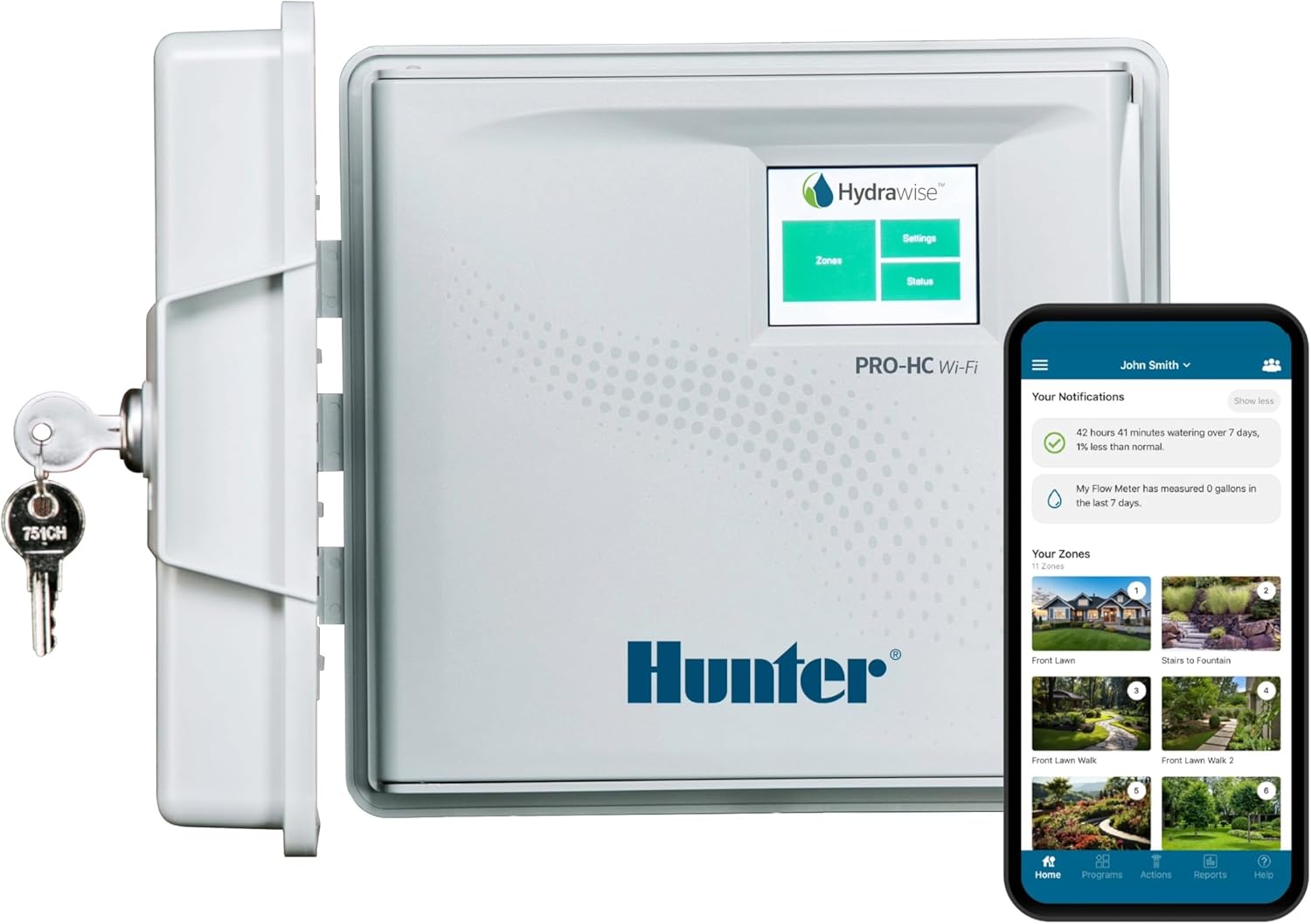
| Zones | 6 stations |
|---|---|
| Wi‑Fi | Built‑in 2.4 GHz |
| Display | 2.75 inch full‑color touchscreen |
| Sensor ports | Two sensor inputs |
| P/MV output | One pump/master valve output |
The Hunter PRO‑HC600 is a 6‑station smart irrigation controller built for reliable, water‑efficient landscape management. It connects to the Hydrawise platform over built‑in 2.4 GHz Wi‑Fi so you can monitor and adjust schedules from a phone, tablet, or desktop, while the full‑color 2.75 inch touchscreen lets you program and test zones at the panel without the app. Hydrawise applies predictive weather data and local station inputs to automatically change run times, and the system supports flow meters, Clik rain sensors, and a pump/master valve output for professional installs. The controller includes wiring diagnostics via a milliamp sensor to speed troubleshooting and an IP44‑rated UV resistant cabinet for indoor or outdoor mounting. For performance‑focused users this translates to precise zone control, fewer callbacks, and measurable water savings, though advanced features require time to configure and optional sensors to realize full leak detection and flow monitoring capability.
Best for: Buyers who prioritize efficient, professional‑level irrigation control and remote management for small to medium landscapes; ideal for contractors or committed homeowners who want precise, data‑driven watering.
Less Ideal for: Casual gardeners who want a simple plug‑and‑play timer without network setup or those who do not plan to add optional sensors for flow monitoring.
- Hydrawise weather‑based scheduling adjusts watering automatically for local conditions
- Built‑in Wi‑Fi and remote app control for on‑the‑go adjustments and monitoring
- Full‑color touchscreen enables quick on‑site programming and zone testing
- Supports flow meters and sensor inputs for leak detection and automated shutoff
- Milliamp wiring sensor provides continuous diagnostics to simplify maintenance
- Advanced features like flow monitoring and full leak protection require buying and installing optional sensors
Verdict: Choose the Hunter PRO‑HC600 if you want professional, weather‑driven irrigation control with on‑site touchscreen programming and full remote management via Hydrawise.
Orbit B-hyve Smart 6-Zone Indoor/Outdoor Sprinkler Controller

| Item Type Name | B-hyve Smart 6-Zone Indoor/Outdoor Sprinkler Controller |
|---|---|
| Display Type | LCD or LED |
| Voltage | 110 volts |
| Operating Temperature | 75 °C |
The Orbit B-hyve Smart 6-Zone controller automates landscape watering for small to medium yards by letting you program schedules from a waterproof wall-mounted panel or the mobile app. It supports zone-by-zone scheduling so lawns, flower beds, and drip lines can have tailored run times, and its WeatherSense feature automatically adjusts watering based on local weather so you do not overwater after rain or under-water during dry spells. Setup is typical for an indoor/outdoor timer and connects to 2.4 GHz Wi-Fi for remote control and voice commands through smart assistants. Practical benefits include clear on-unit display, app access to start/stop or edit programs from anywhere, and multi-zone flexibility that improves water efficiency. Limitations are that it is a 6-zone model so larger systems will need a higher-zone controller or multiple units, and full smart features require a stable home Wi-Fi connection. For homeowners who want reliable automated watering without complex professional systems, the B-hyve is a straightforward, water-saving option.
Best for: Homeowners who want to optimize water use and simplify routine irrigation for a small to medium yard using automation and weather-based adjustments.
Less Ideal for: Owners of large properties with many irrigation zones or users who need a controller that works offline without Wi-Fi connectivity.
- WeatherSense automatically adjusts schedules based on local weather to reduce overwatering
- App and on-unit control allow remote scheduling and zone management
- Waterproof wall-mounted enclosure supports indoor or outdoor installation
- Zone-based programming for tailored irrigation across up to six zones
- Only supports six zones, which may be insufficient for larger properties
- Requires reliable 2.4 GHz Wi-Fi for full remote and smart features
Verdict: If you want a practical, weather-adaptive smart controller to cut wasted watering and manage a small to medium yard remotely, the Orbit B-hyve 6-zone delivers that capability simply and reliably.
HiOazo Smart Sprinkler Controller (4-Zone, App-Controlled)

| Zones | 4 |
|---|---|
| Watering Plans | Up to 16 |
| Connectivity | 2.4 GHz WiFi |
| Power | 24VAC |
The HiOazo Smart Sprinkler Controller connects to 2.4 GHz WiFi and lets you run up to four zones from the companion app, with space for 16 distinct watering plans. It is designed for DIY replacement of an existing controller and claims a quick install in about 10 minutes using the included screws, wire connectors, and power adapter. The app-led display and schedule editor make daily, intermittent, or soak irrigation simple to set up, and automatic skip logic for rain, freeze, and high wind helps reduce wasted water. Practical benefits include remote control of schedules, multiple program presets for different plant needs, and weather-adaptive watering that can lower runoff and overwatering. Limitations are the 4-zone capacity, which is small for larger yards, and reliance on 2.4 GHz WiFi so homes with only 5 GHz networks will need a compatible router or extender; advanced users may miss granular flow or evapotranspiration integration. Overall this is a straightforward, budget-friendly smart controller for typical residential landscapes that need basic weather-aware automation.
Best for: Homeowners who want an inexpensive, easy-to-install smart controller to automate a small to medium yard and prioritize simple water savings and remote control.
Less Ideal for: Large properties with many irrigation zones or users who need advanced ET-based or flow-monitoring features should consider controllers with higher zone counts and more irrigation telemetry.
- App-based control for remote scheduling and real-time monitoring
- Automatic weather-based skip for rain, frost, and wind to conserve water
- Supports up to 16 distinct watering plans for flexible programming
- Quick DIY installation with included hardware and wide controller compatibility
- Only controls four zones which may be insufficient for larger properties
- Requires a 2.4 GHz WiFi network so it may need network adjustments in some homes
Verdict: A straightforward, budget-friendly 4-zone smart controller that adds remote app control and weather-aware watering to typical residential irrigation systems.
ImoLaza MINI 8-Zone Indoor Smart Sprinkler Controller (Wi‑Fi)

| Zones | 8 |
|---|---|
| Voltage | 120 volts |
| Display Type | LCD or LED |
| Material Type | Acrylonitrile Butadiene Styrene (ABS) |
| Warranty | 2-Year Manufacturer27s Warranty |
The ImoLaza MINI is a compact indoor smart sprinkler controller designed to replace a basic timer and bring reliable automated irrigation to an 8‑zone residential system. It connects to your home 2.4 GHz Wi‑Fi and is managed through the ImoLaza app or voice assistants, letting you set flexible programs, up to 16 simultaneous programs and numerous daily start times for precise watering. Notable features for dependable operation include automatic weather skips using dense local and national forecast data, smart cycle-and-soak to reduce runoff, surge protection, and fault detection that notifies you of solenoid shorts or leaks. The controller also logs history and water usage so you can monitor performance and spot problems early. Installation is aimed at DIYers with included mounting hardware and in‑app guidance, and the unit supports shared access for contractors or family members. Trade-offs are a focus on indoor mounting and reliance on the app and Wi‑Fi for many advanced functions, so those who prefer entirely local, non-networked controllers may find it heavier on cloud dependency.
Best for: Homeowners who prioritize a dependable, feature‑rich smart controller that reduces manual oversight and surfaces faults early, and who want precise, water‑saving schedules managed remotely via an app or voice assistant.
Less Ideal for: Users who need an outdoor-rated controller or who prefer a fully local, non‑cloud system with no dependence on Wi‑Fi and app services.
- Smart weather skips using dense real‑time data to avoid unnecessary watering
- Comprehensive scheduling with multiple programs and up to 24 daily start times for new grass
- Built‑in fault detection, surge protection, and alerts to surface problems quickly
- App and voice control with shared access and water usage reporting for easy monitoring
- Designed for indoor installation only, so outdoor mounting options are limited
- Relies on Wi‑Fi and the cloud app for many smart features which may be less ideal if network is unreliable
Verdict: Choose the ImoLaza MINI if you want an 8‑zone controller that combines robust fault protection and highly accurate weather‑based skips for consistently reliable, water‑smart irrigation.
Rachio 3 Smart Sprinkler Controller, 8-Zone

| Item Highlight | 8 Zones, App Control, Rain Skips, Local Weather Scheduling |
|---|---|
| Voltage | 120 volts |
| Display Type | LED |
| Operating Temperature | 4 °F |
The Rachio 3 Smart Sprinkler Controller gives you app-first control of an existing 8-zone irrigation system and uses local weather data to adjust watering automatically. You set schedules in the Rachio app for iOS or Android, then let the controller skip runs for rain, freeze, wind or saturated soil and make seasonal adjustments so you do not overwater. Typical use is straightforward: mount the indoor unit, wire it to zone valves, connect Wi-Fi and configure zones in the app; Quick Run buttons let you manually water a zone from the controller when needed. Notable features include dual-band Wi-Fi, compatibility with Alexa, Google Home and IFTTT, LED status display and grow-in scheduling for new lawns. Practical benefits are reduced water use, simpler remote management, and easier setup compared with legacy dial timers. Limitations: the unit is indoor rated so outdoor installs require a weatherproof enclosure and some advanced setups such as well systems may need a pump for proper pressure. The controller also relies on the app for detailed schedule edits rather than full on-device programming.
Best for: Homeowners who want to reduce water use and move away from manual dial timers, and who prefer a proven smart-home controller with easy app-based setup and integrations.
Less Ideal for: People who need a fully outdoor-rated controller without adding an enclosure or who want complete on-device programming without using a smartphone app.
- Weather Intelligence automatically skips watering for rain, freeze, wind and saturation
- App-based scheduling with Quick Run and grow-in options simplifies remote control
- Works with voice assistants and IFTTT for smart-home integration
- Fast DIY install that fits most existing 8-zone systems
- Indoor-rated unit requires a separate weatherproof enclosure for outdoor mounting
- Relies on the mobile app for most scheduling tasks rather than full on-device controls
Verdict: Choose the Rachio 3 if you want a reliable, app-driven 8-zone controller that cuts wasted watering with automatic weather-aware schedules.
Rachio 3 Smart Sprinkler Controller, 16-Zone

| Zones supported | 16 |
|---|---|
| Voltage | 110 volts AC |
| Display type | LED |
| Operating temperature | 15 °C |
The Rachio 3 is a WiFi-enabled sprinkler controller designed to replace conventional dial timers and automate watering across up to 16 zones. It is typically wall-mounted indoors or placed in a weatherproof enclosure outdoors and is set up through the Rachio mobile app, which walks you through wiring, zone naming, and schedule creation. Key features include patented Weather Intelligence that skips runs for rain, freeze, wind and soil saturation, grow-in schedules for new grass, Quick Run buttons for manual zone activation, and compatibility with Alexa, Google Home and IFTTT. In practice this delivers consistent, hands-off watering, fewer unnecessary runs, and easier seasonal adjustments compared with manual timers. Installation is straightforward for anyone comfortable with basic wiring and the app makes troubleshooting and remote control simple. Limitations are that scheduling is primarily app-driven so basic on-device customization is limited, and systems on well pumps may need an additional pump start relay to work reliably. The controller is indoor rated unless you buy a separate weatherproof enclosure.
Best for: Homeowners who want a reliable, low-maintenance irrigation controller that reduces wasted water and simplifies seasonal scheduling without constant manual intervention.
Less Ideal for: Users who need full control from the device itself or who prefer a completely offline mechanical timer; those with specialized commercial irrigation needs should consider professional controllers.
- Local Weather Intelligence automatically adjusts and skips watering for rain, freeze, wind and saturation
- Supports large systems with up to 16 zones for flexible yard layouts
- Dual-band WiFi and wide smart-home compatibility for remote control and voice assistants
- Quick Run manual buttons let you run zones on demand without the app
- App-guided setup and grow-in schedules simplify installation and establishing new turf
- Most scheduling and advanced controls require the mobile app rather than on-device menus
- Indoor-rated unit requires a separate weatherproof enclosure for outdoor mounting
- May need an external pump start relay for some well systems
Verdict: If you want dependable, water-saving automatic irrigation for a typical home landscape, the Rachio 3 delivers smart weather-driven schedules and easy app control for up to 16 zones.
Choosing the Right Wifi Lawn Irrigation Controller: Key Factors to Consider
Compatibility With Existing Valves and Zones
Confirm how many zones the controller supports and whether it matches the number of valves you already have. Many residential systems use four to eight zones, but larger lawns or separate landscape beds may need more. If the new controller supports fewer zones than your system, you will either need a second controller or to rewire and combine zones, which can reduce watering precision.
Also check whether the controller accepts common valve wiring conventions and voltage. Some smart controllers expect standard 24 VAC irrigation valves; others may need adapters or different wiring. Verifying compatibility ahead of purchase avoids extra trips to the control box and simplifies installation for DIYers or contractors.
Weather Data and Smart Adjustments
Look at how the controller obtains weather information. Top options pull local forecast data, use on-site sensors like rain or freeze detectors, or combine both. Weather-aware adjustments can reduce run times when rain is expected or pause watering during freeze conditions to protect turf and plants.
Consider whether the controller calculates evapotranspiration or simply applies simple rain delays. Controllers that offer adjustable sensitivity let you fine-tune how aggressively schedules are modified, which is useful in microclimates or transition seasons. Also check whether weather updates occur frequently enough to reflect sudden storms in your area.
Installation Complexity and App Usability
Evaluate how the controller mounts and connects to your existing wiring. Some units mount directly to the irrigation control box or a garage wall and require basic screw-in wiring; others need a separate hub or nonstandard mounting hardware. If you are installing yourself, clear wiring diagrams and labeled terminals make the process far easier.
App design matters for day-to-day management. A good app organizes programs and zones clearly, offers straightforward manual runs and skips, and presents watering history or recent adjustments. If multiple people need access, check whether the system supports additional users and how permissions are managed.
Power and Offline Behavior
Understand how the controller handles power interruptions and network outages. Some controllers retain full scheduling logic locally so watering continues even if the internet goes down. Others rely heavily on cloud services and may pause scheduled runs during an outage. Backup power options or battery-assisted memory can preserve schedules during brief power failures.
For areas with frequent outages, prioritize controllers that default to local schedule execution and clearly indicate offline status in the app. This prevents missed watering cycles during critical dry spells and reduces the need for manual intervention.
Sensor Integration and Physical Inputs
Controllers that accept external sensors give you more reliable protection against overwatering. Rain sensors, soil moisture probes, and freeze sensors provide direct, site-specific data that can override scheduled runs when conditions warrant. Confirm what types of sensors the controller supports and whether they are wired or wireless.
Think about future upgrades; if you plan to add soil moisture sensors or a dedicated rain sensor later, choose controllers with documented expansion paths. Proper sensor placement and calibration are also important to ensure the controller responds appropriately to localized weather events.
Program Flexibility and Manual Control
A flexible controller lets you build multiple programs and custom runtimes for different zones, accommodating lawn, flower beds, and shrubs with different water needs. Options such as cycle-and-soak, odd/even day scheduling, and seasonal adjustment percentages make it easier to tailor watering to plant type and slope.
Manual controls that let you run a single zone or full system from the app without changing the base schedule are helpful for spot-watering or post-fertilizer irrigation. Look for easy overrides, vacation hold features, and options to set temporary changes that revert automatically.
How Weather-Based Watering Saves Time and Water
Weather-aware controllers reduce unnecessary run time by pausing or shortening cycles when rain is expected or humidity is high. That reduces lawn stress from overwatering and lowers overall water use without constant user intervention.
Even small adjustments based on local forecast data can add up across a season. For gardeners who monitor water use or have watering restrictions, the ability to fine-tune weather sensitivity is particularly valuable.
- Forecast-based adjustments vs on-site sensors: both have benefits.
- Adjust sensitivity to match local microclimates.
- Frequent updates help react to sudden storms.
Wiring and Mounting Tips for a Smooth Installation
Before you remove the existing controller, label each valve wire and take a photo of the wiring layout. That simple step saves time when connecting to the new unit. Confirm that the new controller's terminal layout matches your wiring harness or plan how to reassign terminals cleanly.
Mounting location affects signal and convenience. Wall-mounted controllers inside a garage often offer easier wiring access, while outdoor enclosures reduce wire runs but may need weatherproofing. Keep the transformer within reach of a grounded outlet or use a model designed for direct connection to household power.
- Label wires before disconnecting the old controller.
- Keep the transformer accessible and protected from moisture.
- Use corrosion-resistant terminal screws for long-term reliability.
Using Sensors to Prevent Overwatering
Rain and moisture sensors act as a safety net to stop watering when conditions are already wet. Place rain sensors where they will receive direct rainfall without blockage from eaves or tree canopy. Soil moisture probes belong in the root zone of the plants you want to protect for the most accurate readings.
If your controller supports sensor zones, allocate sensors to representative areas rather than trying to cover the entire property. That keeps wiring manageable while giving reliable feedback for automatic adjustments.
- Position rain sensors for unobstructed exposure to rainfall.
- Install soil probes in the root zone of the most water-sensitive plants.
- Calibrate sensor thresholds to local soil type and plant needs.
Remote Management and Multi-User Access
Remote access is useful for weekenders and gardeners who manage multiple properties. Check how the system handles multiple users and whether changes are tracked or reversible. Some apps send notifications for offline status, sensor triggers, or manual runs, which helps you stay informed without opening the app constantly.
If others will need to water or adjust the system, look for role-based access or the ability to share limited controls so accidental changes are less likely.
- Confirm how many accounts or users the system supports.
- Look for notification options for key events like offline alerts.
- Prefer apps that log recent manual overrides for accountability.
Seasonal Adjustments and Local Water Restrictions
Seasonal adjustment features let you reduce or increase run times across the system quickly as plant needs change through spring, summer, and fall. This is often faster than editing individual zone runtimes. Some controllers offer percentage-based season adjustments that apply evenly to all zones.
Controllers that allow easy implementation of local watering restrictions by day or odd/even scheduling make it simpler to comply with municipal rules without rebuilding programs from scratch.
- Use seasonal percentage adjustments for quick, system-wide changes.
- Check for built-in odd/even or day-of-week scheduling options.
- Plan temporary overrides for heavy establishment or heat waves.
How We Chose the Best Wifi Lawn Irrigation Controller
We focused on practical, gardener-centered criteria that predict real-world performance and installation success. Primary evaluation factors included compatibility with common irrigation valve types and the number of supported zones, because those determine whether a controller will work with your existing system or require reconfiguring valves. We tested setup complexity in representative home scenarios, weighing available wiring options, mounting choices, and the clarity of mobile app workflows. Weather responsiveness was judged by how the controller ingests local forecast or sensor data and whether it automatically adjusts run times to reduce overwatering. Reliability and uptime considerations looked at offline behavior, whether schedules run locally if the cloud is unavailable, and firmware update practices. Usability and daily management addressed app organization, manual run options, and remote access for quick adjustments. We excluded controllers that only offered limited remote features, lacked basic zone control, or required proprietary hub hardware without clear benefit. Units that did not support at least four zones or had no way to integrate a rain sensor were also filtered out. The short list reflects products that balance easy installation with meaningful smart features useful in home lawn irrigation.
FAQ
Will a Wifi controller work if my irrigation box is already wired for a conventional timer?
Often yes. Most Wifi lawn controllers accept standard 24 VAC valve wiring and mount in place of conventional timers. Confirm terminal labeling and zone capacity to match your valve count before swapping units.
Do I need a separate hub for wireless connectivity?
It depends on the controller. Some models connect directly to your home Wi-Fi network, while others use a small hub to bridge between valves and the cloud. If a hub is required, plan for an indoor mounting location near your router.
Can I still water the lawn manually if the internet goes down?
Many controllers are designed to run schedules locally during internet outages, and they allow manual runs directly from the device or app. Verify the offline behavior before choosing a unit if your area has frequent connectivity issues.
How do soil moisture sensors change the way the controller waters?
Soil moisture sensors measure actual moisture in the root zone and can pause scheduled runs when thresholds are met. This prevents unnecessary cycles and targets watering to plant needs rather than relying solely on forecast data.
Are weather-based adjustments accurate for small yards or microclimates?
Forecast-based adjustments are a good baseline, but microclimates can differ from regional forecasts. Combining local sensors with forecast data gives the most accurate response for small yards near shade, pavement, or bodies of water.
What should I do if I plan to expand my irrigation zones later?
Choose controllers that support more zones than you currently need or that allow expansion through additional modules. Also consider wiring layout and conduit access so future valves can be added without extensive rewiring.
Final Verdict
When choosing a Wifi lawn irrigation controller, prioritize compatibility with your valve count and wiring, solid weather-sensing behavior, and dependable offline operation. Decide whether local sensors or forecast integration matter more in your yard, and pick a controller whose app and scheduling features fit how you actually manage watering. Tradeoffs are common: the most feature-rich systems can add complexity, while simpler controllers may be easier to install and maintain. Focus on the practical fit for your landscape layout and maintenance habits. A controller that balances straightforward installation, reliable local scheduling, and sensible weather adjustments will make seasonal lawn care easier and help conserve water without constant manual oversight.
