

Note: This article contains affiliate links. If you click on these links and make a purchase, I may earn a small commission at no extra cost to you. This helps support my research and content. Read my full affiliate disclosure here.
If you want to remove unwanted weeds without exposing your yard, garden beds, or pets to harsh chemicals, choosing a non toxic weed and grass killer matters. The right product will remove persistent plants while leaving desirable turf and ornamentals unharmed, and will fit the scale of your patch, patio, or driveway cracks. This guide walkthroughs six shortlisted options that performed well for home gardeners seeking low-toxicity control. We evaluate each pick on practical garden factors like speed of control, safety around pets and ornamentals, and ease of application so you can pick the approach that suits your yard. Read on for straightforward advice to match product type to problem and site conditions.
Top Picks at a Glance
| Best Overall The best all-around choice for most situations | Spruce Weed & Grass Killer Power Wand Kit with 64 oz Refill |  |
| Best Quality Built to a higher standard if you want something more solid | Natures Wisdom 20% Vinegar Weed & Grass Killer, 1 Gallon |  |
| Best Value The sweet spot between price and what you get | Pulverize Weed & Grass Killer, Ready-to-Use 1 Gallon (Messinas) |  |
| Best Budget The cheapest option that still gets the job done reliably | Earth's Ally Weed & Grass Killer Spray, 32 fl oz |  |
| Highest Rated A top-rated pick with lots of positive feedback | Calyptus 50% Concentrated Vinegar Cleaner, 2 Gallon (Two 1‑Gallon Jugs) |  |
| Most Popular A crowd favorite that many people choose with confidence | Natural Armor Weed & Grass Killer, 1 Gallon (128 oz) |  |
Spruce Weed & Grass Killer Power Wand Kit with 64 oz Refill

| Unit Count | 64 Fluid Ounces |
|---|---|
| Coverage | 1 bottle treats up to 400 weeds |
| Item Form | Multiple |
| Liquid Volume | 64 fluid ounces |
This kit combines a 64 oz ready-to-use herbicide with a battery-powered Power Wand for fast, targeted spot treatments. The formula is non-mixing and designed to work on contact, dehydrating leaves so you can see darkening or wilting within an hour and complete die-off by about 24 hours when used as directed. The wand is reusable and comes with two AA batteries so you can spray cracks, edges, mulch beds, driveways, and walkways without pouring or measuring. Practical benefits include ease of use, rainproofing within 10 minutes, and a formula advertised as safe around people, pets, and bees when directions are followed. Limitations are that it is non-selective so it must be applied carefully to avoid desirable plants and grass, it is intended for spot treatment rather than broadcast lawn application, and best results require spraying in dry, warm conditions above 60°F with no immediate rain forecast.
Best for: Buyers who want a fast, easy-to-use spot weed killer for driveways, cracks, mulch beds, and edges and who prioritize quick visible results and minimal setup.
Less Ideal for: Those needing large-area lawn herbicide or selective weed control within turf should look for products made for broadcast lawn treatments or selective formulas.
- Ready-to-use 64 oz refill eliminates measuring or mixing
- Visible results in about one hour and full effect around 24 hours
- Includes battery-powered reusable wand for precision spot treatments
- Rainproof within 10 minutes so light showers are less likely to wash it off
- Formulated for use around people, pets, and bees when directions are followed
- Non-selective formula can damage desirable plants if oversprayed
- Designed for spot treatments not for broadcasting over large lawns
- Performance depends on spraying in recommended weather conditions
Verdict: A convenient, no-mix spot-treatment kit that delivers fast visible weed kill with a reusable powered wand for precise, low-fuss applications.
Natures Wisdom 20% Vinegar Weed & Grass Killer, 1 Gallon

| Liquid Volume | 1 gallons |
|---|---|
| Item Form | Liquid |
| Active Ingredients | Herbicide, vinegar |
| Coverage | 1 gallon |
This 1 gallon bottle of Natures Wisdom 20% Vinegar Herbicide is a ready-to-use, non-glyphosate option for spot-treating unwanted weeds and grasses. It delivers a concentrated acetic acid formula intended to brown and desiccate foliage within hours and usually shows full effect in under 24 hours when applied in direct sunlight. Typical use is direct spraying with a single-nozzle sprayer or hand-gun applicator without dilution, making it straightforward for driveways, sidewalks, garden beds, and small agricultural patches. The product is certified organic and formulated from ethanol distilled from USA-grown corn, so it breaks down quickly in soil and avoids persistent chemical residues. It works well on a wide list of annual and perennial broadleaf weeds and many grasses, though tough perennial roots may require repeat applications. Users should avoid contact with desirable plants and follow safety guidance because the 20% acetic acid is harsh on skin and foliage. For someone prioritizing strong, fast performance from an organic herbicide, this is a practical, effective choice for spot control.
Best for: Buyers who want a fast-acting, organic alternative to synthetic herbicides for targeted spot treatments and who prioritize visible performance over convenience of broad broadcast use.
Less Ideal for: Those needing a long-term soil residual or a broadcast herbicide for very large lawns and fields should consider other solutions.
- High-strength 20% acetic acid formula acts quickly to desiccate foliage within hours
- Certified organic and glyphosate-free, formulated from USA-grown corn ethanol
- Ready-to-use liquid that requires no dilution for direct spot spraying
- Effective on a broad list of annual and perennial broadleaf weeds and many grasses
- May require repeated applications for deep-rooted perennial weeds
- Harsh on skin and non-target plants so careful application and PPE are required
Verdict: If you want a fast, organic spot-treatment that visibly kills weeds within a day without using glyphosate, this 20% vinegar formula delivers strong performance.
Pulverize Weed & Grass Killer, Ready-to-Use 1 Gallon (Messinas)

| Unit Count | 128 Fluid Ounces |
|---|---|
| Item Form | Spray |
| Liquid Volume | 1 gallons |
| Active Ingredients | Maleic hydrazide |
| Coverage | Up to 250 sq.ft. (Gallon Ready to Use) |
This ready-to-use Pulverize Weed & Grass Killer is designed for homeowners who need a fast, no-mix solution for weeds on patios, driveways, and garden edges. You spray directly onto foliage and the formula begins drying weeds within hours, making it useful for spot treatments and clearing hardscape cracks. The product is non-selective so it will kill any plant it contacts, and the label highlights control of common annual weeds, moss, algae, and lichens. The formula is described as made from naturally derived ingredients and approved for organic gardening, which reduces concerns about heavy synthetic chemicals and makes it easier to use around family areas once treated surfaces have dried. Important trade-offs are that it will damage desirable plants if oversprayed and that repeat applications every 2 to 3 weeks are recommended for new growth; rain within a few hours can require reapplication. For small to medium problem areas this gallon size gives broad coverage without mixing, but users should follow safety directions to avoid skin or eye contact.
Best for: Homeowners who need an affordable, easy-to-use herbicide for spot-treating driveways, patios, and edges and who prioritize friendlier, naturally derived ingredients around pets.
Less Ideal for: Gardeners wanting a selective lawn-safe product to preserve turf or those who need a systemic, long-term single-application control for deep perennial roots.
- Ready-to-use spray requires no measuring or mixing
- Fast-acting formula shows visible weed dieback within hours
- Naturally derived active ingredient intended for pet- and family-friendlier use once dry
- Effective on a broad range of annual weeds plus moss, algae, and lichens
- Non-selective formula will kill desirable plants if contacted
- May require repeat applications every 2–3 weeks for new growth
Verdict: A convenient, pet-friendlier ready-to-use herbicide for quickly clearing weeds and hardscape growth without mixing.
Earth's Ally Weed & Grass Killer Spray, 32 fl oz
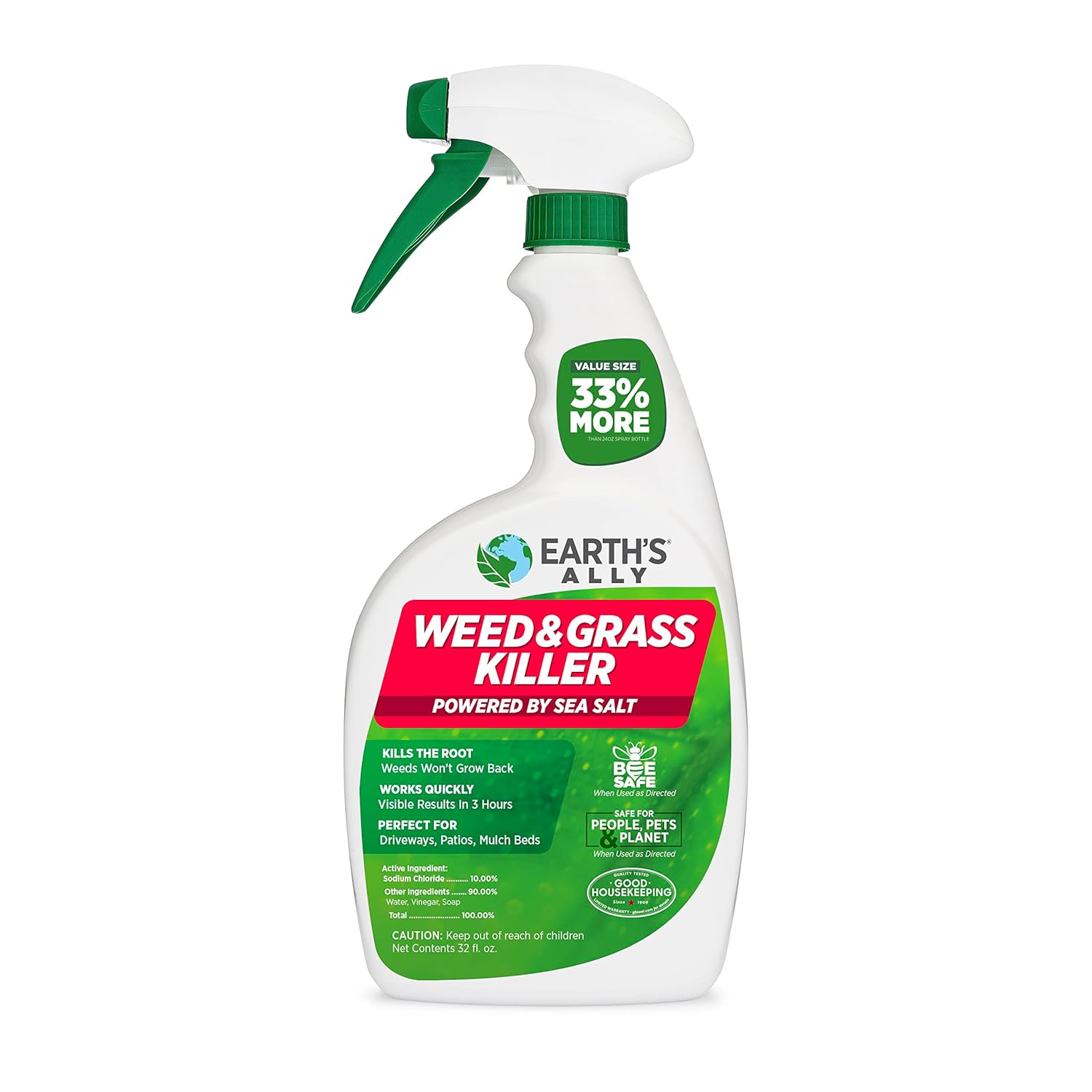
| Unit Count | 32 Fluid Ounces |
|---|---|
| Active Ingredient | Sodium Chloride (10.00%) |
| Item Form | Spray |
| OMRI Listed | Yes |
| Safe for Bees | Yes |
Earth's Ally Weed & Grass Killer is a ready-to-use spray that relies on sea salt, vinegar, and soap to kill common broadleaf and grassy weeds on contact and to the root when applied generously. It is typically used on hardscape and high-traffic areas such as patios, driveways and sidewalks; for larger beds the brand recommends mixing in a pump or backpack sprayer. Notable features include an OMRI-listed formulation, pet- and pollinator-safe testing when used as directed, and visible wilting often within a few hours. Practical benefits are straightforward: no mixing of toxic concentrates, safer handling around people and pets, and an easy spray application that requires saturating leaves and base to reach roots. Important limitations are that it is non-selective so it will damage desirable plants if oversprayed, it requires repeat saturating applications compared with synthetic herbicides, and results depend on dry, sunny conditions for best effect rather than working in wet or overcast weather.
Best for: Buyers who prioritize a safer, low-toxicity option for spot-treating weeds on patios, driveways, sidewalks and other high-traffic hardscape areas and who prefer convenience over industrial-strength persistence.
Less Ideal for: Gardeners who need a selective lawn herbicide or long-term residual control across large turf areas should consider products formulated for those specific uses.
- Ready-to-use spray requires no measuring or harsh concentrate handling
- Sea-salt based formula avoids glyphosate and other synthetic herbicides
- Shown to produce visible wilting within hours when applied on a sunny, dry day
- OMRI-listed and independently tested for pollinator and pet safety
- Non-selective formula will harm any plant it contacts so careful application is required
- Less persistent than some synthetic herbicides so repeated or saturated applications may be necessary
Verdict: Choose this product if you want an easy, ready-to-use weed killer that avoids harsh synthetics and is designed for safe spot treatment on hard surfaces.
Calyptus 50% Concentrated Vinegar Cleaner, 2 Gallon (Two 1‑Gallon Jugs)

| Ingredients | 50% Vinegar |
|---|---|
| Units | 256 Fluid Ounces |
| Manufacturer | Calyptus |
| Product Type | Technical‑grade vinegar concentrate |
Calyptus 50% concentrated vinegar is a technical‑grade acetic acid concentrate intended for heavy cleaning tasks that you dilute to typical household strength. The twin one‑gallon pack is designed to make dozens of gallons of cleaning solution for tackling limescale, mineral deposits, soap scum, grease and general grime both indoors and outdoors. It is marketed as septic safe and suitable for use around the home when diluted to the recommended acidity. Because it is a concentrated, nonfood grade product, users mix measured cups into water to reach roughly 5% acidity before applying, which keeps storage and transport efficient compared with buying many premixed bottles. Notable features include domestic manufacture, leak‑resistant jugs, and clear dilution guidance. Important limitations are that this is technical‑grade vinegar not meant for consumption and it requires careful dilution and handling to avoid skin or plant damage if misused as a weed‑killer or cleaner; it is stronger than household vinegar and should be used with gloves and eye protection.
Best for: Buyers who prioritize a reliable, high‑strength cleaning supply for repeated heavy‑duty tasks and who are comfortable measuring and diluting concentrates for home or outdoor use.
Less Ideal for: People seeking an off‑the‑shelf, ready‑to‑use household cleaner or anyone who prefers products safe for food contact without special handling.
- Very high concentration lets you dilute many gallons from each jug, reducing storage and repeated purchases
- Formulated for heavy‑duty descaling and grease removal that household vinegar struggles with
- Sold as technical‑grade with clear dilution instructions for making standard 5% solutions
- Septic safe and labeled for indoor and outdoor cleaning when used diluted
- Technical grade not intended for food use so it must be stored and handled as a chemical
- Requires accurate measuring and personal protective equipment when mixing and applying
Verdict: If you want a dependable, high‑strength concentrate to make many gallons of effective cleaning or nonfood weed‑control solution, this Calyptus 50% vinegar is a practical choice.
Natural Armor Weed & Grass Killer, 1 Gallon (128 oz)

| Unit Count | 128 Fluid Ounces |
|---|---|
| Item Form | Spray |
| Active Ingredients | Vinegar |
| Coverage | Hardscapes, beds, driveways, foundations and similar areas |
Natural Armor Weed & Grass Killer is a concentrated, vinegar-based herbicide supplied in a one-gallon ready-to-use bottle with a sprayer connection. It is intended for spot-treating unwanted vegetation around driveways, patios, mulch beds, gravel, foundations and other hardscape areas where you do not want plant growth. The product uses high-strength vinegar as the active ingredient so you get fast visible wilting often within an hour and broader dieback over the following days. Practical benefits include easy application with no mixing, a formula marketed as all-natural and glyphosate-free, and coverage recommendations that list many common outdoor use areas. Limitations are that it is non-selective so it will damage desirable plants on contact and may require repeat applications for persistent perennial weeds because vinegar-based products typically burn foliage but do not always kill deep roots. Also follow safety directions to keep children and pets away during use and avoid application around vegetation you want to keep.
Best for: Gardeners who want a non-glyphosate, easy-to-use herbicide for spot-treating driveways, patios and other areas where no vegetation is desired and who prioritize natural active ingredients over systemic control.
Less Ideal for: Homeowners who need selective weed control near ornamental plants or who require a systemic herbicide that reliably kills deep-rooted perennials across large turf areas.
- Ready-to-use formula requires no mixing and connects to a sprayer for straightforward application
- Vinegar-based, glyphosate-free formulation for buyers seeking non-synthetic active ingredients
- Fast-acting foliage burn with visible results often within an hour
- Large one-gallon volume reduces the need for frequent repurchase for larger yards
- Non-selective action will harm any plants it contacts rather than targeting weeds only
- May need multiple treatments to control deeply rooted perennial weeds
Verdict: A large ready-to-use, vinegar-based herbicide for buyers who want a fast, non-glyphosate option to spot-treat weeds on hardscapes and unwanted areas.
Choosing the Right Non Toxic Weed and Grass Killer: Key Factors to Consider
Mode of Action and Target Plants
Different non toxic weed and grass killers work in different ways. Some use high-concentration acids or acetic acid to burn foliage on contact, others use soap-based fatty acid formulations that disrupt plant cell membranes, and some rely on mechanical application methods that uproot or desiccate plants. Understanding mode of action matters because contact-only solutions often require thorough coverage of leaves and repeat applications for deep-rooted perennials, while desiccants can be faster on annuals and seedlings.
Match the product to the type of plants you need to control. For shallow-rooted annual weeds, contact foliar treatments are usually sufficient. For established perennial grasses or deep-rooted weeds, expect to apply treatments multiple times or combine with physical removal to prevent regrowth.
Safety for Pets, Pollinators, and Desirable Plants
Non toxic formulations reduce acute risks but vary in practical safety. Products that physically scorch foliage can still injure desirable plants if sprayed directly, and some bio-based actives can be harmful to pollinators while wet. Consider how soon people and pets access treated areas and whether beds contain newly planted seedlings or sensitive ornamentals.
Always follow re-entry intervals and rinse instructions when given. For pollinator protection, avoid spraying flowering plants and schedule applications for times when bees are less active. In areas where companion plants are close to weeds, use spot treatments, barriers, or targeted tools to limit exposure.
Application Method and Coverage Needs
Application format affects how easily you can treat cracks, borders, wide lawns, or container beds. Pump or trigger sprayers are convenient for small, targeted spots, while hose-end or backpack sprayers cover larger areas faster. Granular or gel products can offer more controlled placement in tight spaces but may require different safety handling.
Consider how uniform the infestation is. Patchy weeds are best handled with a trigger sprayer or hand tools to avoid waste and collateral damage. Large, uniform areas may be treated more efficiently with hose-end applicators, but those demand attention to dilution rates and spray patterns to avoid overapplication.
Persistence and Environmental Fate
A major advantage of many non toxic options is low persistence in soil and minimal leaching. Still, differences exist. Acid-based contact killers act on foliage and leave little lasting residue, while some bioactive compounds may bind to soil or require repeated use. Think about runoff and rain windows: products that wash off easily will be less effective if a heavy rain occurs soon after treatment.
If you are treating near storm drains, water features, or areas with frequent irrigation, choose formulations with low runoff potential and follow local guidance on applications before forecast rain. Reduced persistence often means more reapplications, so plan follow-up treatments for stubborn patches.
Speed of Results and Number of Applications
Gardeners often want quick, visible results, but non toxic options trade speed for safety. Some contact methods show leaf browning within hours, others need several days to visibly affect root systems and entire plants. Faster-acting solutions may damage only above-ground parts, leaving roots to regrow, so expect follow-up treatments for long-term control.
Factor in how patient you are and whether quick aesthetic improvement or durable suppression is more important. For seasonal cleanups you might accept multiple spot treatments; for long-term eradication you may need repeated applications across weeks combined with manual removal.
Fit to Site and Scale
Choose a format that suits the physical setting. Balcony or container gardeners will favor small-volume sprays or gels that avoid overspray; homeowners with driveways or gravel paths might prefer concentrated spray mixes or thickened formulations that stay put. For large lawns, look for options compatible with broadcast or hose-end systems to reduce labor.
Also consider storage, shelf life, and how often you will use the product. Small-quantity containers are fine for occasional spot work, but frequent users will appreciate refillable sprayers or concentrates that reduce waste and trips to the store.
When Non Toxic Control Is the Right Choice
Non toxic weed and grass killers are a smart option when you prioritize pet safety, protecting ornamental plantings, or avoiding runoff into sensitive areas. They are particularly useful in vegetable garden borders, playgrounds, and yards with heavy pet traffic where reducing chemical exposure is a priority.
These products are less suited to large acreages where systemic control is required quickly. For small to medium home settings, they allow targeted action with manageable environmental tradeoffs.
- Best for spot treatment, edging, and small beds
- Use around pets and children with short re-entry times
- Not a one-application cure for many perennial weeds
Application Timing and Weather Considerations
Timing is critical for success. Apply on calm, dry days with minimal wind to avoid drift and ensure thorough leaf coverage. Avoid treatments right before heavy rain; many contact solutions wash off and lose effectiveness.
Morning or late afternoon applications can reduce stress on desirable plants and avoid peak pollinator activity. For foliar desiccants, warmer temperatures often increase activity, but extreme heat can also stress plants and increase the chance of collateral damage.
- Avoid windy days to reduce drift
- Do not apply before heavy rain
- Avoid spraying flowering plants to protect pollinators
Spot Treatment Techniques for Sensitive Areas
When weeds are close to desirable plants, use targeted techniques to limit impact. Shield shrubs and ornamentals with a piece of cardboard or cloth during spray applications. Use small-capacity hand sprayers or wands that allow precise delivery rather than wide broadcast patterns.
For narrow cracks or border edges, consider gel or brush-on formulations that adhere to foliage and reduce runoff. Mechanical removal followed by a focused non toxic treatment on regrowth often yields the best long-term control with minimal exposure to nearby plants.
- Use barriers to protect nearby plants
- Prefer gel or brush-on for cracks and tight spaces
- Combine hand-pulling with spot treatment for tough perennials
Integrating Non Toxic Control Into an Ongoing Lawn Care Plan
Non toxic controls are most effective as one tool in a broader maintenance plan. Promote a dense, healthy turf through proper mowing, fertilizing, and overseeding to reduce weed establishment. When weeds do appear, early spot treatment prevents seed set and reduces future workloads.
For perennial problems, alternate physical removal and targeted non toxic treatments across the season. Keeping good records of when and where you treat will help identify patterns and reduce repeated infestations over time.
- Use as part of a cultural control program
- Treat early-season seedlings before they set seed
- Rotate approaches for persistent weed populations
Safety and Storage Best Practices
Even non toxic products require careful handling. Store containers away from children and pets and in original packaging with labels intact. Mix only what you need and follow any PPE guidance on the label to avoid skin or eye irritation.
Dispose of unused mixed solutions according to local guidelines. Keep application equipment clean to avoid cross-contamination with fertilizers or other garden chemicals that might interact with bio-based actives.
- Store in labeled containers out of reach
- Clean sprayers after each use
- Follow local disposal rules for leftover mixtures
How We Chose the Best Non Toxic Weed and Grass Killer
We shortlisted products that offer effective vegetation control while avoiding synthetic herbicides and persistent toxins. Our evaluation emphasized four to six concrete, garden-centered criteria: contact efficacy on common broadleaf weeds and grasses, selectivity for lawn versus beds, safety profile for pets and desirable plants, application method and coverage, and persistence in soil and runoff risk. We prioritized solutions proven in home and urban garden settings, including those based on acids, fatty acids, soaps, or mechanical delivery systems rather than persistent chemical residues. We excluded any formulations containing persistent synthetic herbicides or those with restricted-use labels. Lawn-care adjuvants that rely on unspecified chemical blends were also filtered out. Products had to offer clear labeled directions, common-sense safety data, and practical application methods suitable for small-plot gardeners. The criteria we applied align directly with the scoring metrics below and favor options that balance effectiveness with low environmental impact.
FAQ
How long after application is it safe for pets to enter treated areas?
It often depends on the formulation. Many non toxic sprays dry and become less risky within a few hours, but you should follow any label re-entry times. If no guidance is given, wait until spray residues are fully dry and ventilate covered areas before allowing pets back in.
Will a non toxic product kill grass as well as broadleaf weeds?
Some non toxic options are non-selective and will damage any plant they contact, including grass. Others are formulated or applied in ways that favor broadleaf removal when used as spot treatments. Check application guidance to avoid unwanted turf damage and use targeted techniques near lawns.
How many applications are usually needed to control perennial weeds?
Perennial weeds often require multiple treatments because contact methods affect only above-ground growth. Expect two to several applications spaced over weeks, possibly combined with manual removal of roots to achieve lasting control.
Are non toxic weed killers safe for vegetable gardens?
Many are appropriate for use in or near vegetable beds if applied carefully. Avoid spraying edible foliage and follow label guidance on pre-harvest intervals when provided. Use spot treatments and physical barriers to reduce drift onto vegetables.
Can I use these products right after mowing or watering?
Avoid applying immediately after mowing or heavy irrigation. Mowing removes leaf area needed for contact action, and wet foliage can dilute or wash off treatments. Wait until grass and weeds have recovered and are dry for better uptake.
Final Verdict
When choosing a non toxic weed and grass killer, prioritize safety profile and application method based on site sensitivity and the types of weeds you face. Expect contact-based options to require careful coverage and repeat treatments for perennials, and plan applications to avoid harm to pets and pollinators. Balance the need for quick aesthetic control with long-term suppression techniques like hand removal and cultural lawn care. By matching formulation and delivery to the scale and setting of the problem, you can effectively reduce unwanted plants while keeping your garden and family safer.
