

Note: This article contains affiliate links. If you click on these links and make a purchase, I may earn a small commission at no extra cost to you. This helps support my research and content. Read my full affiliate disclosure here.
Moss on paths and walkways makes surfaces slippery, attracts moisture, and looks unkempt. Choosing the right path moss killer matters because some treatments act fast but can stain or damage paving, while others are gentler but take longer to work. This guide covers seven shortlisted Path Moss Killers that are suited to common walkway materials and different garden priorities. We evaluated each option for how quickly it clears moss, how safe it is for surrounding plants and surfaces, and how easy it is to apply and maintain. Read on to find the type of treatment that fits the materials and risk tolerance in your yard or garden.
Top Picks at a Glance
| Best Overall The best all-around choice for most situations | Patio Black Spot Grean Boss Green Control Moss & Algae Remover, 5 L |  |
| Best Quality Built to a higher standard if you want something more solid | FireHawk Bioherbicide Ready-to-Use Spray + 1 Gallon Refill |  |
| Best Value The sweet spot between price and what you get | BioWorks Hoplite Moss Killer, 128 oz |  |
| Best Budget The cheapest option that still gets the job done reliably | Safer Brand Moss and Algae Killer and Surface Cleaner, 32 oz Hose Sprayer |  |
| Highest Rated A top-rated pick with lots of positive feedback | Lilly Miller Moss Out for Roofs and Walks, Ready-to-Spray 27 fl oz |  |
| Most Popular A crowd favorite that many people choose with confidence | 30 SECONDS Spray & Walk Away Hose-End Moss & Lichen Cleaner, 64 oz, 2-Pack |  |
| Best Seller A high-volume bestseller chosen again and again | Resolva Path & Drive Weedkiller RTU, 3 L |  |
Patio Black Spot Grean Boss Green Control Moss & Algae Remover, 5 L

| Unit Count | 169.07 Fluid Ounces |
|---|---|
| Liquid Volume | 5 liters |
| Item Form | Liquid |
Grean Boss is a ready-to-dilute liquid treatment for removing moss, algae and other green growth from hard exterior surfaces and roofs. You mix the concentrate with water according to the severity of growth and apply it with a sprayer to areas such as garden paths, tarmac, resin driveways and roof tiles; treated growth generally breaks down within about five days. The product is versatile in use, is biodegradable and acid free, and the directions include different dilution rates for heavy and light infestations so you can stretch a 5-liter pack over dozens of square metres. Practical benefits include easier, safer walking surfaces and reduced risk of blocked gutters from moss on roofs. Important limitations are that this is a biological control rather than a detergent so it will not remove dirt or stains, and results depend on weather and sunlight so shaded areas may need spot treatments later.
Best for: Homeowners who want a practical, maintenance-focused solution to remove and prevent moss and algae on paths, driveways and roof tiles and who plan routine seasonal treatments to keep surfaces safe.
Less Ideal for: Someone seeking an immediate deep clean for stained or dirty stonework or a one-off cosmetic power wash should consider a dedicated cleaner or pressure washer instead.
- Concentrated liquid that dilutes for light or heavy moss allowing flexible coverage
- Formulated for multiple hard surfaces including roofs, paths and driveways
- Biodegradable and acid free formula suitable for regular maintenance
- Produces visible breakdown of green growth within about five days
- Does not clean dirt or remove ingrained stains since it targets biological growth only
- Performance depends on weather and may require repeat spot treatment in shaded areas
Verdict: A concentrated, biodegradable moss and algae treatment designed to restore and protect hard exterior surfaces with flexible dilution for light or heavy infestations.
FireHawk Bioherbicide Ready-to-Use Spray + 1 Gallon Refill

| Item Form | Spray |
|---|
FireHawk Bioherbicide is a ready-to-use spray plus a one-gallon refill designed for quick spot treatments of unwanted vegetation on hard surfaces and landscape edges. It works on contact using nonanoic acid to cause rapid visible burndown of green, growing plant tissue, with effects often visible within hours in warm, sunny conditions. The package includes a trigger sprayer for immediate use and a gallon refill to top up the bottle for repeated treatments, which reduces the need for frequent purchasing. It is intended for driveways, sidewalks, patios, mulch beds, gravel and fence lines where moss, algae, weeds, and grasses are a nuisance. Because the formula is non-systemic it does not move through roots so you get fast aboveground control but may need follow-up treatments for regrowth from roots or persistent moss mats. People and pets can re-enter treated areas once the spray is dry when directions are followed. The refill format is practical for routine maintenance, while the contact-only action means this is best for spot control rather than long-term eradication of well-established perennial roots.
Best for: Buyers who prioritize fast visible results for routine spot treatments and want a practical refillable solution for ongoing path and hard-surface weed and moss control.
Less Ideal for: Those seeking a long-term systemic solution to eliminate deep-rooted perennial weeds or who need herbicide activity that moves through the root system.
- Fast contact burndown of moss, algae, weeds, and grasses often visible within hours in warm conditions
- Includes a ready-to-use trigger sprayer plus a one-gallon refill for multiple applications
- Non-systemic formula allows people and pets to re-enter areas once spray is dry
- Suitable for hard surfaces and tight areas like cracks, driveways, patios, and fence lines
- Non-systemic action means roots and persistent moss may require repeat treatments
- Effectiveness depends on weather conditions and may be reduced in cool or cloudy weather
Verdict: Choose FireHawk if you want a fast-acting, ready-to-use bioherbicide with a gallon refill for repeated, convenient spot control of moss and surface weeds.
BioWorks Hoplite Moss Killer, 128 oz

| Unit Count | 128 Fluid Ounces |
|---|---|
| Item Form | Liquid |
| Item Highlight | Moss, Alge and Lichen Control Potassium Salts of Fatty Acids |
BioWorks Hoplite is a one-gallon, liquid moss killer intended for treating moss, liverwort, algae, and lichens on outdoor surfaces. The active ingredient is potassium salts of fatty acids, which break down cell membranes and cause rapid desiccation so you see browning and yellowing soon after application. Because the formula contains no metal salts or alcohol and is biodegradable and non-staining, it is suited to patios, walkways, roofs, and other sensitive areas where residue or discoloration is a concern. Typical use is a spray application over affected areas followed by simple rinsing or brushing once growth has died back. The product comes in a convenient gallon size for treating medium to large problem areas without frequent refills. Limitations are that it is a contact, fast-acting control rather than a long-term preventive solution, so repeat treatments or complementary cultural controls may be needed to keep moss from returning in persistently shady or damp spots.
Best for: Gardeners and homeowners who want a fast, low-residue treatment to remove visible moss and similar growth from patios, roofs, and hardscapes and prefer biodegradable, non-staining products.
Less Ideal for: People seeking a long-term preventative chemical solution or those who need a systemic or residual herbicide to stop recurring moss without additional cultural changes.
- Fast visible results through membrane disruption that causes rapid desiccation
- Biodegradable, non-staining formula with no metal salts or alcohol for sensitive surfaces
- One-gallon liquid size reduces the need for frequent refills when treating medium to large areas
- Effective against multiple organisms including moss, liverwort, algae, and lichens
- Provides contact kill but does not offer long-term residual prevention
- Performance depends on thorough coverage and may require repeat applications in damp, shaded conditions
Verdict: Choose Hoplite when you need a fast, biodegradable, non-staining liquid to quickly knock back moss and similar growth on sensitive outdoor surfaces.
Safer Brand Moss and Algae Killer and Surface Cleaner, 32 oz Hose Sprayer

| Unit Count | 32 Fluid Ounces |
|---|---|
| Item Form | Spray |
| Coverage | 500 square feet |
This ready-to-use moss and algae killer connects to a garden hose and sprays a potassium-salts formula meant for roofs, decks, siding, walkways, lawns and other exterior surfaces. Typical use is simple: attach the bottle to a hose, apply to affected areas, wait for the product to kill visible growth, then rinse if desired. Notable features include the hose-sprayer delivery for quick coverage, OMRI listing for organic-compliant use, and a claimed coverage of about 500 square feet per 32 oz bottle. In practice the product is convenient for spot treatments and for users who want a chemical option that fits organic guidelines. Limitations are that it is a one-shot RTU volume that may not be enough for large roofs and it can irritate skin or eyes so protective gear is needed during application. Also, because it attaches to a hose the spray pattern and pressure depend on your water supply, so achieving even coverage on steep roof sections may require care.
Best for: Homeowners looking for an affordable, easy-to-apply solution to remove moss and algae on small roof areas or for spot treatments who prefer an OMRI-listed product and minimal prep work.
Less Ideal for: Those needing to treat large roof surfaces in a single application or professional roof cleaners who require concentrated formulations and higher-volume coverage.
- Ready-to-use hose sprayer makes application quick and does not require mixing
- OMRI listed formulation suitable for organic gardening contexts
- Covers up to 500 square feet from a single 32 oz bottle
- Effective active ingredient (potassium salts of fatty acids) targets moss and algae
- 32 oz volume may be insufficient for full roof treatments on medium to large homes
- Spray pattern and pressure vary with household water supply, affecting coverage consistency
- Can cause skin or eye irritation and requires protective equipment during use
Verdict: A budget-friendly, ready-to-use hose sprayer that makes spot and small-area roof moss removal fast while remaining OMRI-listed for organic use.
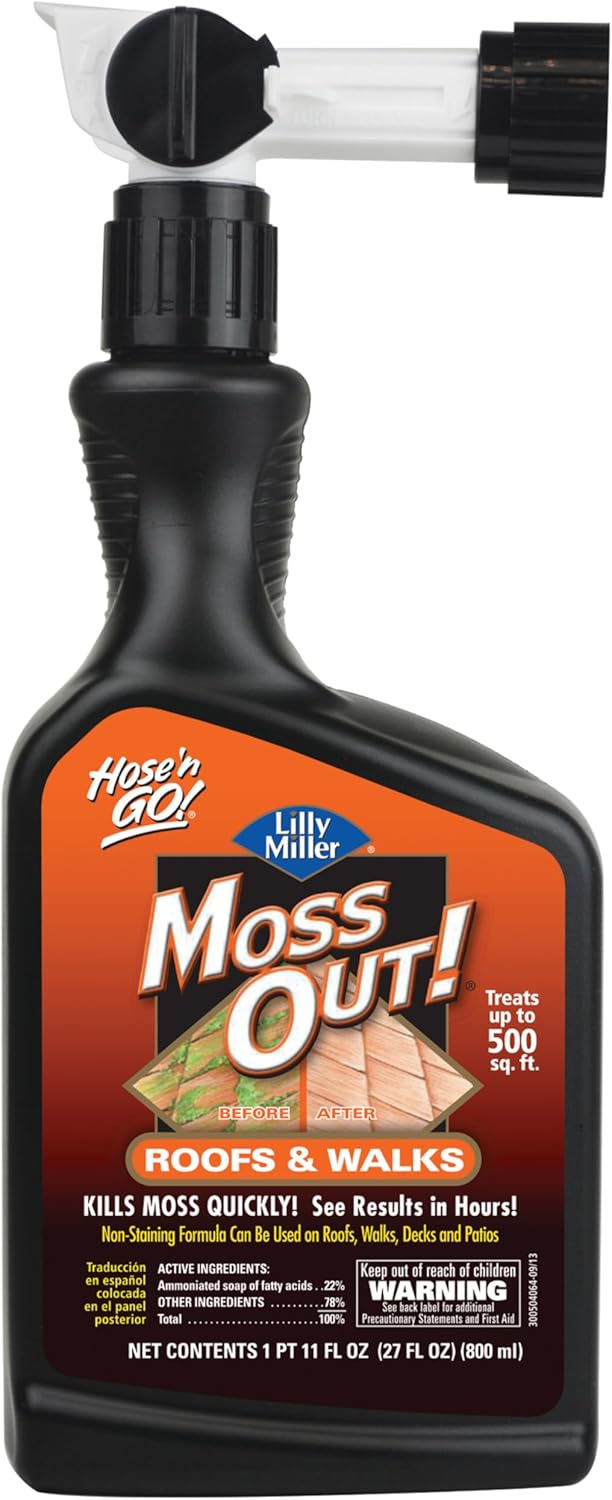
Lilly Miller Moss Out for Roofs and Walks, Ready-to-Spray 27 fl oz
| Unit Count | 27 Ounce |
|---|---|
| Item Form | Liquid |
| Coverage | 500 square feet |
| Spray Range | up to 25 feet |
Lilly Miller Moss Out is a ready-to-use hose-end moss killer designed to kill moss on contact across hard outdoor surfaces. You attach the included nozzle to a garden hose, spray treated areas up to about 25 feet away, and see moss die back in hours with dead material that can be brushed or hosed off. The formula is non-staining for shingles and masonry, specifically made for roofs, walks, patios and unpainted cement, and one application is claimed to last up to a year. Practical benefits include quick coverage without mixing, an easy hose connection for faster application over larger paved areas, and a labeled coverage of roughly 500 sq ft per bottle. Important limitations are safety precautions and runoff concerns around plants and lawns since it can harm vegetation, and treated surfaces may be slippery until rinsed. For heavy or deeply rooted moss on very large paved areas you may need multiple bottles or repeat treatments to maintain results.
Best for: Gardeners looking for a low-effort, no-mix solution to remove moss from paved surfaces and roofs who prioritize convenience and straightforward application.
Less Ideal for: Those who need a plant-safe or eco-friendly option for use near lawns, flower beds, or sensitive landscaping should choose a more targeted or non-chemical approach.
- Ready-to-use hose-end applicator for fast, no-mixing application
- Non-staining formula safe for shingles and common hard surfaces
- Covers up to 500 square feet per bottle for quick treatments
- Visible results in hours allowing easy removal of dead moss
- Can harm surrounding plants and lawns if it contacts vegetation
- Safety hazards require protective gear and careful handling
Verdict: A convenient ready-to-spray option that quickly kills moss on paved surfaces and roofs with minimal setup, making it a practical pick for budget-aware users who want fast results.
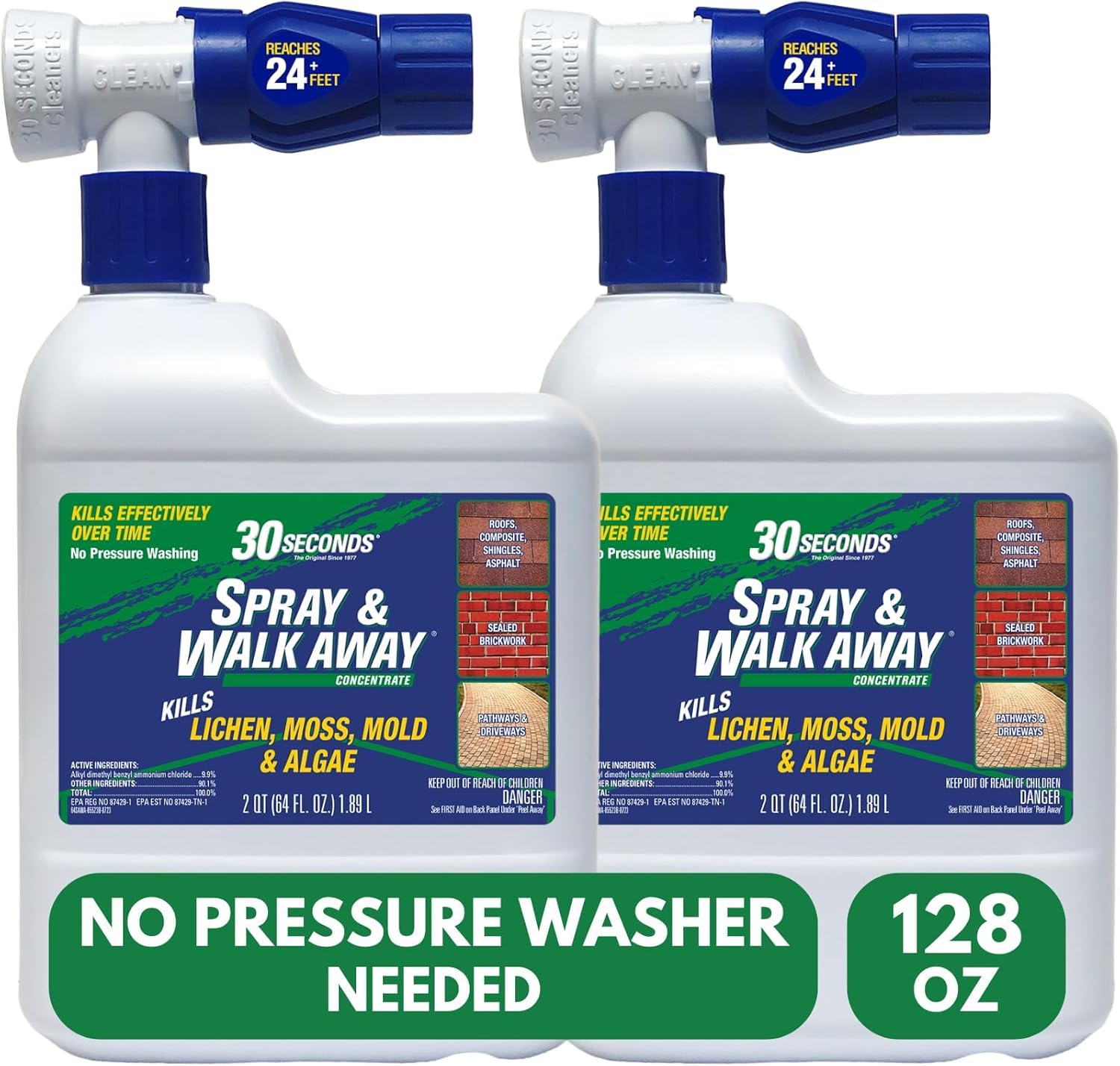
30 SECONDS Spray & Walk Away Hose-End Moss & Lichen Cleaner, 64 oz, 2-Pack
| Unit Count | 128 Ounce |
|---|---|
| Number of Packs | 2 |
| Item Form | Spray |
| Coverage | Various outdoor surfaces |
| Active Ingredients | Asphalt |
30 SECONDS Spray & Walk Away is a hose-end spray designed to treat moss, lichen and algae on pathways, driveways, roofs and other outdoor surfaces. You attach the bottle to a garden hose and spray; the formula works over time so you do not need to rinse, pressure wash, or scrub. The product is bleach- and phosphate-free and is intended for use on a broad range of surfaces including sealed concrete, asphalt, composite shingles, siding and wood decks. Because it is applied from the ground with a hose-end applicator it is convenient for large or hard-to-reach areas and reduces manual labor. Practical benefits include improved traction and curb appeal as moss and algae die back. Important limitations: results are gradual rather than immediate, so you should expect days to weeks for full effect, and treated surfaces may require follow-up applications for heavy infestations. As with any chemical treatment follow label precautions to protect plants, pets and runoff areas.
Best for: Homeowners who want a low-effort way to reduce moss and algae across paths, driveways or roofs and who prefer solutions supported by established product reviews and instructions.
Less Ideal for: People seeking an instant visual fix or a purely mechanical approach; also not the best choice for tiny, spot-only problems where a targeted manual removal would be simpler.
- Hose-end ready for fast application to large or high areas without ladders
- Works on many outdoor surfaces including roofs, sealed concrete, asphalt and siding
- Bleach-free and neutral pH formula reduces risk of surface damage
- No rinsing or scrubbing required which saves time and effort
- Acts gradually so multiple days or repeat applications may be needed for heavy growth
- Contains active chemical ingredients so careful application and runoff control are required
Verdict: A convenient hose-end treatment that lets you treat large path and roof areas without scrubbing, making moss control much easier for busy homeowners.
Resolva Path & Drive Weedkiller RTU, 3 L

| Unit Count | 101.44 Fluid Ounces |
|---|---|
| Item Type Name | Weedkiller |
| Item Form | Liquid |
| Coverage | Broad-spectrum coverage |
| Active Ingredients | Pelargonic acid |
Resolva Path & Drive is a ready-to-use, pelargonic-acid based weedkiller made for hard surfaces such as paths, drives, patios and gravel. It acts quickly with visible effects within hours and is labelled for use year-round on unwanted vegetation, algae and grasses. The spray instructions emphasise good coverage and avoidance of run-off; treated areas can be re-entered once the surface is dry. Practical benefits include a broad-spectrum action against moss and common weeds, simple RTU application without mixing, and clear dose limits for per-square-metre application and annual treatments. Important limitations are directional: it must not be applied near surface water, should not be used between 18 September and 1 April, and repeat treatments are sometimes needed because regrowth can occur. The product carries standard safety guidance to keep children and pets away until the spray dries and to follow label directions to reduce environmental risk. For anyone looking for a fast-acting, easy-to-use hard-surface moss and weed control, this is a straightforward option as long as you follow the safety and timing instructions.
Best for: A cautious homeowner who wants an easy, fast-acting product to clear moss and weeds from hard surfaces while following label directions to minimise environmental risk.
Less Ideal for: Those needing a solution for lawn weeds or vegetation where preservation of nearby plants or aquatic life is critical, or users who require a year-round application window.
- Ready-to-use liquid requires no dilution or measuring before application
- Fast visible results, often within hours of treatment
- Broad-spectrum activity that targets moss, weeds, algae and grasses
- Clear application guidelines for dose per m2 and maximum annual treatments
- Must not be applied near surface water and has seasonal use restrictions
- May require repeat applications because some weeds can re-emerge
Verdict: A fast-acting, ready-to-use non-glyphosate spray that reliably knocks back moss and weeds on paths and driveways when used according to label directions.
Choosing the Right Path Moss Killer: Key Factors to Consider
Active Ingredient and Mode of Action
Knowing the active ingredient tells you how quickly moss will die and how the treatment behaves on different surfaces. Chemical actives often work faster, producing visible browning within days, while physical methods and biologicals take longer but reduce the risk of staining. Active ingredients also determine restrictions around planting beds and watercourses, and some require rinsing after a set period.
Choose an approach that matches your urgency and sensitivity concerns. For high-traffic walkways where immediate clearance matters, a fast-acting formulation may be appropriate. In areas with delicate adjacent plants or porous stone, favor gentler options or be prepared to protect nearby vegetation during application.
Surface Material and Stain Risk
Different paving materials react differently to moss treatments. Porous natural stone and unsealed concrete can absorb fluids that cause discoloration, while glazed tiles and sealed surfaces are less vulnerable. Some moss killers leave visible residue or cause darkening as moss dies, which may be temporary but can be noticeable.
Assess the path material before applying anything. If you have historic stone, reclaimed brick, or light-colored concrete, test a small inconspicuous patch first and plan for rinsing or brushing to reduce staining. For gravel or shingle walks, choose products that will not bind particles or create muddy patches when wet.
Proximity to Plants and Water
Walkways often run alongside borders and lawns. Products that drift, splash, or leave runoff can harm desirable plants or pollute water features. Some treatments require keeping pets and people off the treated surface until dry, and others advise avoiding application before heavy rain.
When paths sit next to sensitive planting, select treatments labeled safe for use near ornamentals or plan temporary barriers to shield foliage. Consider the timing of application to avoid runoff into gutters or storm drains, and follow instructions for buffer distances from water bodies.
Application Method and Effort
Application methods range from simple spray bottles and watering-can mixes to granular spreads and power-sprayer applications. Ease of application affects how likely you are to apply repeat treatments and to treat awkward or narrow paths.
If you have a long stretch of walkways, choose an option that scales well and allows even coverage. For small patios or tight joints, a targeted brush-on or hand-spray method can be more efficient. Also consider cleanup time after application and whether rinsing or scrubbing is needed to remove dead moss.
Long-Term Control and Maintenance
Killing visible moss is only part of the job. Residual control, preventive measures, and maintenance determine how soon moss returns. Some treatments include residual activity that suppresses regrowth, while others remove moss quickly but offer little follow-up protection.
Pair an effective removal method with long-term strategies such as improving drainage, increasing sunlight to the path, and regular sweeping or joint maintenance. For heavily shaded or perpetually damp areas, expect more frequent applications and plan for ongoing upkeep.
Preparing Paths Before Treatment
Start by clearing loose debris and sweeping out joints so treatments contact the moss directly. Remove heavy leaf litter and quickly dry the surface when possible, because many products act best on exposed moss rather than under piled organic matter.
For stubborn, thick mats consider mechanically lifting as much moss as you can with a stiff broom or scraper before applying a chemical or biological treatment. This increases contact and speeds visible results while reducing the amount of product needed.
- Sweep and blow away leaves and loose moss
- Use a stiff brush or scraper on heavy patches
- Protect nearby plants with water or temporary shields
When to Apply Treatments
Apply treatments during a stretch of dry weather with temperatures within the product's recommended range. Many options work best when daytime temperatures are mild and there is little chance of heavy rain for at least 24 hours.
Early spring and autumn are common windows because moss is active and conditions are moist enough for it to absorb treatments. Avoid applying during heat waves or when nearby vegetation is under stress.
- Aim for mild, dry days with low wind
- Avoid immediate pre-rain application to reduce runoff
Safe Cleanup and Rinsing
After moss dies, dead biomass and residues can often be removed by brushing and rinsing. For porous surfaces prone to staining, a gentle pressure wash or careful scrubbing helps restore original color but test a small area first.
Dispose of rinsate and removed material according to local regulations. If a product label recommends waiting a period before rinsing, follow that guidance to allow the active ingredient to work.
- Brush and sweep dead moss into compostable bags if appropriate
- Rinse with low-pressure water for sensitive stone
Preventing Reappearance
Address the root causes of moss: shade, poor drainage, and compacted joints. Increasing light through selective pruning, improving surface drainage, and repairing or repointing joints reduces the conditions moss favors.
Routine maintenance such as regular sweeping, joint topping on paving, and seasonal spot treatments will reduce the frequency of heavy interventions.
- Improve light and airflow around paths
- Fix dips or pooling that keep surfaces damp
Tools and Safety Gear
Wear gloves, eye protection, and suitable clothing when handling moss treatments. Some products require respiratory protection if spray drift is possible.
Keep a supply of basic tools like stiff brooms, scrapers, watering cans, and a garden hose handy. These let you combine mechanical removal with chemical or biological approaches safely and efficiently.
- Gloves and eye protection are essential
- Stiff broom or scraper for mechanical removal
How We Chose the Best Path Moss Killer
We prioritized products and approaches that give reliable moss control on walking surfaces without causing avoidable damage to paving, edging, or adjacent plantings. Our evaluation focused on concrete, garden-relevant dimensions: speed of moss kill, surface compatibility (stone, concrete, brick, gravel), plant and soil safety for nearby vegetation, ease of application for homeowners, and persistence to delay re-growth. We examined product instructions, active ingredient profiles, and typical use patterns to assess how each option performs in real garden conditions. Excluded items were those formulated exclusively for lawns or indoor use, products that require professional-only equipment, and treatments with unclear surface-safety guidance. The result is a practical shortlist that reflects tradeoffs gardeners face when clearing moss from paths and walkways.
FAQ
How long after application will moss disappear?
It depends on the treatment. Fast-acting chemical options can show browning within a few days and full dieback in one to two weeks. Gentler or biological methods may take several weeks to show clear results.
Will moss treatments stain my paving?
Some treatments can darken or leave residues on porous surfaces while moss dies. Test a small, inconspicuous area first and be prepared to brush or rinse to reduce visible staining.
Can I use a Path Moss Killer near my flowerbeds?
Often, but with caution. Choose a formulation labeled safe for use near ornamentals or protect nearby plants during application. Avoid spraying on windy days and prevent runoff into planted beds.
How often should I reapply a moss treatment?
Frequency depends on surface conditions and product residual control. In damp, shaded areas you may need annual or biannual spot treatments, while better-drained, sunny paths typically require less frequent upkeep.
Is mechanical removal enough to stop moss returning?
Mechanical removal removes existing moss but does not change the environmental conditions that favor regrowth. Combine physical cleaning with improvements to drainage, light, and occasional treatments for longer-term control.
Final Verdict
Choose a Path Moss Killer that matches your surface material and tolerance for chemical strength. Prioritize surface compatibility and plant safety if you have porous paving or sensitive borders, and prioritize speed of action for high-traffic walkways. Pair any treatment with routine maintenance and environmental fixes like better drainage and more light to reduce repeat growth and keep paths safe and attractive.
