

Note: This article contains affiliate links. If you click on these links and make a purchase, I may earn a small commission at no extra cost to you. This helps support my research and content. Read my full affiliate disclosure here.
Moss on tarmac surfaces is more than an eyesore. It creates slippery patches, can trap moisture that accelerates surface wear, and makes driveways and paths unsafe in wet weather. The right Tarmac moss killer removes existing growth and reduces the chance of a quick rebound so you spend less time treating the same patch repeatedly. This guide covers six top-rated tarmac moss killers shortlisted for effectiveness, safety around nearby turf and plants, and how long they prevent regrowth. We evaluate items based on contact kill speed, residual action, application ease, and how they behave near lawns or planted borders. Read on for practical guidance that helps you pick the right product for your surface and maintenance routine.
Top Picks at a Glance
| Best Overall The best all-around choice for most situations | Patio Black Spot Grean Boss Green Control Moss Remover, 5 L |  |
| Best Quality Built to a higher standard if you want something more solid | Scotts MossEx 3-in-1 Ready-Spray, 32 fl. oz. |  |
| Best Value The sweet spot between price and what you get | BioAdvanced 2-in-1 Moss & Algae Killer and Cleaner, Ready-to-Spray, 32 oz |  |
| Best Budget The cheapest option that still gets the job done reliably | Generic Copper Sulfate Moss Killer 2-Pack (12 oz bags) |  |
| Highest Rated A top-rated pick with lots of positive feedback | Lilly Miller Moss Out! Granular Moss Killer for Roofs and Structures, 6 lb |  |
| Most Popular A crowd favorite that many people choose with confidence | Lilly Miller Moss Out for Roofs and Walks, Ready-to-Spray 27 fl oz |  |
Patio Black Spot Grean Boss Green Control Moss Remover, 5 L

| Unit Count | 169.07 Fluid Ounces |
|---|---|
| Included Components | 5L Green Control |
| Item Form | Liquid |
| Liquid Volume | 5 liters |
Grean Boss is a 5-liter liquid treatment formulated to remove green growth, moss and slippery algae from hard outdoor surfaces such as tarmac, resin driveways, garden paths and roof tiles. It is supplied as a concentrate that you dilute with water and apply with a sprayer; dilution recommendations are given for light and heavy infestations so you can tailor coverage. The product is designed to break down treated growth within days and then rely on weathering for longer-term clearance. Practical benefits include broad surface compatibility and straightforward mixing instructions that make spot treatments easy for shaded or north-facing areas where moss returns. Limitations are that it is not a general dirt cleaner and requires correct dilution and sprayer use to hit coverage claims, and re-treatment may be needed in persistent shaded locations. The formulation is presented as biodegradable and acid-free which is helpful for stone and paved surfaces, but users should still follow safety and runoff guidance during application.
Best for: Homeowners who want a practical, concentrated solution to remove moss and slippery green growth from tarmac and other hard outdoor surfaces and who are prepared to mix and spray the product themselves.
Less Ideal for: Buyers seeking a one-step cleaner for dirt and surface stains rather than biological growth or those who prefer ready-to-use aerosol or foam treatments instead of mixing a concentrate.
- Concentrated 5 L pack covers large areas when diluted according to instructions
- Suitable for multiple hard surfaces including tarmac, resin driveways, garden paths and roof tiles
- Formulation targets green growth and moss specifically and breaks it down within days
- Biodegradable and acid-free formulation intended to be gentler on stonework
- Not intended to remove dirt or stains unrelated to biological growth
- Requires correct dilution and a sprayer for effective, safe application
- May need repeat local treatments in persistently shaded or north-facing areas
Verdict: A concentrated, biodegradable liquid designed to clear moss and slippery green growth from tarmac and other hard surfaces when mixed and applied with a sprayer.
Scotts MossEx 3-in-1 Ready-Spray, 32 fl. oz.

| Unit Count | 32 Fluid Ounces |
|---|---|
| Coverage | 500 square feet |
| Item Form | Spray |
| Active Ingredients | Potassium Salts with Fatty acids |
Scotts MossEx 3-in-1 Ready-Spray is a hose-connected liquid moss killer designed for fast, broad-area treatment of lawns, roofs, patios, sidewalks, and other outdoor surfaces. You apply it by attaching the bottle to a garden hose and spraying while keeping the nozzle moving for even coverage. The active ingredients are potassium salts with fatty acids, and the formula is fast-acting with visible effect in hours and is labeled non-staining on concrete and similar surfaces. Its ready-to-use hose applicator makes large or awkward areas simple to treat without mixing, and one 32 fl. oz. bottle covers roughly 500 square feet, which suits spot treatments and small to medium patches. Limitations to note are application temperature recommendations and safety: do not use on lawns above 85°F and wear eye protection and gloves because it can irritate skin and eyes. Also, it will control moss and related organisms but does not replace cultural fixes such as improving drainage or shade management for long-term moss prevention.
Best for: Homeowners who want a straightforward, performance-focused kill of moss and surface algae without mixing chemicals and who need a product that treats medium-sized areas quickly.
Less Ideal for: Gardeners seeking a long-term cultural solution to moss caused by shade or drainage problems or those who prefer organic, non-chemical approaches.
- Hose-end ready formula for quick, no-mix application
- Fast-acting results with visible control within hours
- Non-staining formulation safe for concrete and many hard surfaces
- Covers up to about 500 sq. ft. from a single 32 fl. oz. bottle
- Contains irritants that require protective eyewear and gloves during application
- Not intended as a long-term solution for underlying lawn issues like poor drainage
Verdict: If you want a fast, no-mix hose-end treatment that quickly knocks back moss and algae on lawns and hard surfaces, this ready-spray delivers reliable, visible results.
BioAdvanced 2-in-1 Moss & Algae Killer and Cleaner, Ready-to-Spray, 32 oz

| Unit Count | 32 Fluid Ounces |
|---|---|
| Coverage | 500 square_feet |
| Item Form | Spray |
| Active Ingredients | fatty acid formula |
This ready-to-spray BioAdvanced formula is designed to kill moss and algae across lawns and hardscapes with minimal fuss. The bottle connects to a hose and sprays a potassium salts of fatty acids solution that the manufacturer says kills growth within hours and offers protection for months. It works on lawns plus patios, decks, roofs, fences, driveways and other exterior surfaces so you can treat multiple problem areas with one product. The no-odor, non-staining formula is convenient for visible surfaces and will turn moss yellow then brown, but dead moss typically needs to be raked or removed for a clean finish. Coverage is listed at about 500 sq ft from the 32 oz bottle, making it suitable for small to medium treatment areas; for larger lawns you will need additional bottles. The product is fast acting and simple to use, but results depend on thorough application and physical removal of thick patches after treatment.
Best for: Buyers who prioritize straightforward, evidence-backed solutions and want a single, easy-to-use product to treat moss and algae on lawns and nearby hard surfaces without complex mixing or specialized equipment.
Less Ideal for: Homeowners with large lawns or heavy, established moss infestations who need high-volume treatment or mechanical removal solutions should consider concentrated products or professional services.
- Kills moss, algae, lichen, mold and mildew with a single ready-to-spray formula
- No-odor and non-staining so it is suitable for visible hard surfaces and roofs
- Hose-attachment design makes application quick and easy for spot treatments
- Multi-surface use lets you treat lawns and hardscapes with one product
- 32 oz covers about 500 sq ft so larger properties require multiple bottles
- Does not remove dead moss mechanically so raking or cleaning is still required
Verdict: A convenient ready-to-spray option for quickly killing moss and algae across lawns and hard surfaces when you need a simple, low-odour treatment.
Generic Copper Sulfate Moss Killer 2-Pack (12 oz bags)

| Unit Count | 12 Ounce |
|---|---|
| Number of Packs | 2 |
| Included Components | copper sulfate |
| Item Form | Powder |
| Coverage | moss and algae |
This product is a basic copper sulfate powder sold as two 12-ounce bags that mixes with water to treat moss and algae on hard surfaces. You dissolve the powder at the recommended rate (about 1 ounce per gallon for roofs, 2 ounces per gallon for sidewalks and tarmac) and apply with a sprayer; browning of moss typically appears in 2 to 3 weeks and full control can take 4 to 5 weeks. The formula is simple and effective for spot treatments and larger runs when mixed into multiple gallons, and the small bags make storage and dosing straightforward. Because it is a pure chemical powder, it provides clear, measurable dilution and long-lasting contact on porous surfaces. Limitations are that it requires careful handling and proper protective gear, it is slow acting compared with some ready-to-use liquid treatments, and it can stain or harm nearby vegetation and metal if not rinsed or applied cautiously.
Best for: Buyers who need an economical, concentrated moss treatment for tarmac and hard surfaces and are comfortable mixing chemicals and applying them with a sprayer.
Less Ideal for: People who prefer ready-to-use, fast-acting liquids or who do not want to handle powdered chemicals or take precautions around plants and landscaping.
- Concentrated powder allows precise dilution for coverage and cost control
- Two 12 oz bags provide enough product to mix multiple gallons for larger tarmac areas
- Clear instructions for common dilution rates for roofs and sidewalks
- Effective against moss and algae with visible browning within a few weeks
- Requires careful handling and protective equipment due to chemical nature
- Slower to show full results compared with some liquid or ready-to-use options
- Can damage plants, metal, or cause staining if applied carelessly
Verdict: A low-cost, concentrated copper sulfate powder that gives budget-focused users a controllable way to treat moss on tarmac and other hard surfaces.
Lilly Miller Moss Out! Granular Moss Killer for Roofs and Structures, 6 lb

| Item Form | Granule |
|---|---|
| Coverage | 6000 square feet |
| Active Ingredients | Zinc Sulfate Monohydrate |
| Unit Count | 96 Ounce |
Lilly Miller Moss Out! is a zinc sulfate monohydrate granular formula designed to kill existing moss on roofs, patios, sidewalks, brick and unpainted cement. You can apply it dry from the container or dissolve it in water and spray, which makes it flexible for spot treatments or larger surfaces; the package directions recommend 6 lb per 6,000 sq ft or 6 lb mixed into about 20 gallons of water for spray application. The product is non-staining and described as non-corrosive to galvanized gutters, so it is suitable where runoff onto metal gutters is a concern. It works best when applied before a period of rain or during active moss growth and may require repeat treatments for heavy infestations. Safety instructions warn to protect plants below treated areas and to avoid contamination of lawns or shrubs. This is a straightforward, no-frills option for knocking back moss across hard surfaces, but it requires careful handling around plantings and attention to application timing for best results.
Best for: Buyers seeking a proven, simple-to-use treatment to remove moss from roofs and hard surfaces who prioritize predictable results and conservative, established approaches.
Less Ideal for: People who need an all-purpose lawn-safe moss treatment for turf or who prefer organic or non-chemical methods should consider other options.
- Works on a variety of hard surfaces including roofs, patios, sidewalks and unpainted cement
- Can be applied dry or mixed with water for spray application, offering flexible use
- Non-staining and reported non-corrosive to galvanized gutters
- Covers a large area when used at the recommended rate
- Contains zinc sulfate which requires care to avoid contact with desirable plants and runoff
- May need repeated applications for heavy or persistent moss growth
Verdict: A reliable granular zinc sulfate treatment for quickly reducing moss on roofs and hard surfaces when applied with care and proper timing.
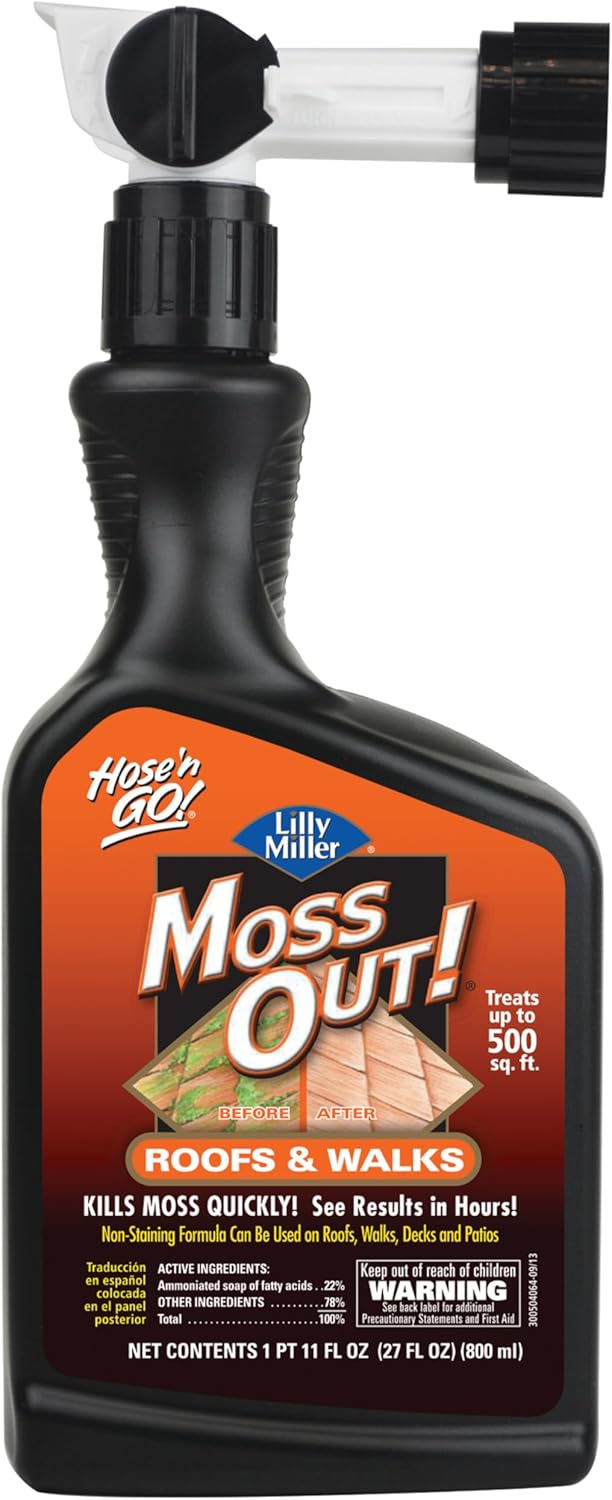
Lilly Miller Moss Out for Roofs and Walks, Ready-to-Spray 27 fl oz
| Unit Count | 27 Ounce |
|---|---|
| Item Form | Liquid |
| Coverage | 500 square feet |
| Spray Range | up to 25 feet |
Lilly Miller Moss Out is a ready-to-use hose-end moss killer designed to kill moss on contact across hard outdoor surfaces. You attach the included nozzle to a garden hose, spray treated areas up to about 25 feet away, and see moss die back in hours with dead material that can be brushed or hosed off. The formula is non-staining for shingles and masonry, specifically made for roofs, walks, patios and unpainted cement, and one application is claimed to last up to a year. Practical benefits include quick coverage without mixing, an easy hose connection for faster application over larger paved areas, and a labeled coverage of roughly 500 sq ft per bottle. Important limitations are safety precautions and runoff concerns around plants and lawns since it can harm vegetation, and treated surfaces may be slippery until rinsed. For heavy or deeply rooted moss on very large paved areas you may need multiple bottles or repeat treatments to maintain results.
Best for: Gardeners looking for a low-effort, no-mix solution to remove moss from paved surfaces and roofs who prioritize convenience and straightforward application.
Less Ideal for: Those who need a plant-safe or eco-friendly option for use near lawns, flower beds, or sensitive landscaping should choose a more targeted or non-chemical approach.
- Ready-to-use hose-end applicator for fast, no-mixing application
- Non-staining formula safe for shingles and common hard surfaces
- Covers up to 500 square feet per bottle for quick treatments
- Visible results in hours allowing easy removal of dead moss
- Can harm surrounding plants and lawns if it contacts vegetation
- Safety hazards require protective gear and careful handling
Verdict: A convenient ready-to-spray option that quickly kills moss on paved surfaces and roofs with minimal setup, making it a practical pick for budget-aware users who want fast results.
Choosing the Right Tarmac Moss Killer: Key Factors to Consider
Contact Kill Speed
How quickly a moss killer visibly destroys moss matters when safety and curb appeal are priorities. Fast-acting products will brown and desiccate moss within days, which is helpful on high-traffic driveways and paths where slipperiness is an immediate concern.
However, very rapid contact kill does not guarantee long-term control. Some formulations kill only what they touch and leave spores or roots intact, requiring follow-up. Consider whether you need immediate cosmetic improvement or longer suppression when weighing kill speed against other factors.
Residual Protection Duration
Residual action determines how long a treated area resists recolonization. Products with longer residual protection reduce the frequency of retreatment, cutting long-term maintenance time.
Residual strength depends on active ingredients and whether they leave a protective film on the surface. For heavily shaded or consistently damp locations, prioritize longer residual protection because conditions favor rapid regrowth.
Surface Compatibility
Tarmac can tolerate many treatments, but some chemicals stain or alter surface texture. Choose formulations specifically indicated for tarmac and hard surfaces to avoid discoloration or surface softening.
Also check whether a product requires dilution or post-application rinsing, since water uptake or incorrect rinsing can affect both the tarmac and adjacent substrates such as concrete kerbs.
Plant and Turf Safety
Many moss killers contain ingredients that are toxic to other plants. If the treated area sits next to a lawn, ornamental beds, or pots, consider drift risk and run-off. Apply carefully on calm days and use guard edges to limit overspray.
If maintaining nearby planting is a priority, look for options labeled safe for turf margins or that have low residual mobility. Even safe formulations can cause localized damage if they pool or are overapplied.
Application Ease
Application method affects how evenly and effectively you can treat tarmac. Ready-to-use spray bottles are convenient for small areas, whereas concentrate solutions and pump sprayers are more efficient for larger drives.
Also factor in preparation steps, drying time before foot traffic returns, and whether the product leaves a visible residue that needs rinsing. Tools, dilution measurements, and clear application windows make a product easier to use correctly.
Environmental Persistence and Runoff Risk
Consider how long active ingredients persist in the environment and whether they can wash into drains or planting beds. Persistent agents may offer longer control but increase the risk of affecting non-target organisms.
For sites that slope toward planting or drainage, select low-mobility formulations or plan containment measures during application to reduce runoff. Balance persistence with stewardship of nearby soil and water.
When to Treat Tarmac for Moss
Treat tarmac surfaces when moss is actively growing and when weather conditions favor uptake of the product. Early spring and autumn, when temperatures are cool and moisture is present, are common windows for effective treatment.
Avoid treating immediately before heavy rain, as runoff can reduce efficacy and move product into planting areas. For the best visual results, allow treated moss time to die back and brush or sweep away dead material once it is dry.
- Best timing: cool, damp periods without heavy rain forecast
- High-traffic areas should be treated promptly to reduce slip risk
- Follow local guidelines for disposal of swept-up moss debris
Application Tips for Even Coverage
Aim for uniform application across the entire affected area rather than spot treating only visible patches. Moss spreads from shaded, damp pockets, so treating margins and nearby shaded strips reduces quick recolonization.
Use a sprayer or applicator that produces a fine, even spray; avoid large droplets that run off. Keep wind conditions calm and wear appropriate protective gloves and eye protection as directed by the product label.
- Pre-wet surrounding plants slightly to reduce drift impacts
- Work from one edge toward an exit to avoid stepping on wet treated surface
- Rinse equipment thoroughly after use to prevent corrosion or contamination
Managing Recolonization After Treatment
After moss has died and been removed, reduce the conditions that support its return. Increase light by trimming overhanging branches, improve drainage where water pools, and repair low spots that trap moisture.
Regular sweeping and occasional power-brushing disrupts moss spores and immature growth before they establish. For persistent trouble spots, plan seasonal monitoring and touch-up treatments timed to active growth periods.
- Trim shade and increase sunlight exposure where practical
- Level or infill depressions that collect runoff
- Schedule inspections in damp seasons and treat early signs
Safety Precautions and Disposal
Follow label directions for PPE, contact times, and allowed application rates. Prevent runoff into storm drains and garden beds, and avoid applying near vulnerable ornamental planting if the product is not rated safe for such use.
Collect and dispose of dead moss and debris following municipal green-waste rules. Do not compost material if the product label advises against it; some active ingredients can persist and affect compost quality.
- Wear gloves and eye protection recommended on the label
- Avoid application during windy or rainy conditions
- Dispose of rinsate and debris according to local guidance
Tools That Help With Post-Treatment Cleanup
A stiff-bristled broom or mechanical brush sweeper makes removal of dead moss faster and more effective than hosing alone. For larger areas, consider a power brush attachment to restore surface texture without damaging tarmac.
Spot cleaning with a pressure washer can remove stubborn residue but use low-pressure settings to avoid surface abrasion. After cleaning, check for any discoloration or softening and allow time to dry before restoring traffic.
- Stiff broom or mechanical sweeper for routine cleanup
- Low-pressure washing for stubborn patches
- Inspect surface after cleaning for integrity
How We Chose the Best Tarmac Moss Killer
We focused on attributes that matter to gardeners and homeowners who treat paved surfaces. Key evaluation criteria included contact efficacy, measured by how quickly visible moss dies after application; residual protection, or how long product activity continues to suppress regrowth; surface compatibility, ensuring the formulation is appropriate for tarmac and will not leave damaging residues; safety around adjacent turf and plants, assessing the risk of drift or run-off that could harm vegetation; and ease of application, covering spray systems, dilution requirements, and clean-up. We excluded products formulated only for porous garden soils or indoor use, and we did not consider general-purpose herbicides that are primarily for broadleaf weeds rather than moss control. Products that required specialized safety equipment beyond typical homeowner PPE were deprioritized. Final selections favored reliable, straightforward treatments that balance fast visible results with reasonable residual control while minimizing risk to nearby planting.
FAQ
Will a moss killer damage tarmac?
Most products designed for hard surfaces are safe for tarmac when used according to label directions. Avoid formulations not intended for paved surfaces and do not exceed recommended concentrations to prevent staining or surface softening.
How soon can I walk on treated tarmac?
Drying and contact times vary, but many formulations allow light foot traffic once the applied liquid has dried. Check the product label for specific re-entry intervals and keep children and pets off the surface until it is fully dry.
Will a moss killer harm nearby lawn or plants?
It often depends on the active ingredient and application method. Drift or runoff can damage turf and ornamental plants, so avoid overspray, protect adjacent planting, and follow label precautions to minimize risk.
How often should I reapply moss treatment?
Frequency depends on residual protection and site conditions. In shaded, damp areas you may need seasonal touch-ups, while sunnier, drier spots can go longer between treatments. Choose a product with suitable residual duration for your site.
Can I remove dead moss with a pressure washer?
Yes, but use low to moderate pressure to avoid abrading the tarmac. Brushing and sweeping are gentler first steps. If using a washer, test a small area and allow the surface to dry before regular use.
Is it safe to apply after rain?
Applying immediately after heavy rain is not recommended because runoff will reduce efficacy and increase the chance of moving product into unwanted areas. Wait for a dry window and check that no more rain is forecast for the labeled contact period.
Final Verdict
Choosing the right Tarmac moss killer depends on balancing quick visible control with how long you want protection and how close treated areas are to lawns or beds. Prioritize products labeled for hard surfaces that match your need for fast contact kill or longer residual action. Address underlying site conditions such as shade and drainage along with chemical control to reduce repeat treatments. With the right application technique and post-treatment care, you can restore safe, clean tarmac and keep moss from coming back quickly.
