

Note: This article contains affiliate links. If you click on these links and make a purchase, I may earn a small commission at no extra cost to you. This helps support my research and content. Read my full affiliate disclosure here.
If you manage fields, orchards, or large vegetable plots, selecting the right neem oil for agriculture affects pest control, crop safety, and application efficiency. Neem-based products behave differently depending on formulation, active concentration, and how you spray and mix them. This guide covers six shortlisted options that fit commercial and small-farm uses and explains the practical tradeoffs. We evaluate products by concentration, coverage per volume, crop safety, and ease of mixing and application. Read on to understand which formulation and use pattern match your operation and growing system.
Top Picks at a Glance
| Best Overall The best all-around choice for most situations | Bonide Captain Jack's NeemMax Concentrated Cold Pressed Neem Oil, 16 oz |  |
| Best Quality Built to a higher standard if you want something more solid | Verdana Organic Pure Neem Oil, Cold Pressed, 1 Gallon |  |
| Best Value The sweet spot between price and what you get | Safer Brand Neem Oil Concentrate, 16 oz |  |
| Best Budget The cheapest option that still gets the job done reliably | Zuprime Nani's Pure Neem Oil Concentrate (8.5 fl oz) |  |
| Highest Rated A top-rated pick with lots of positive feedback | velona USDA Organic Neem Oil, Cold Pressed, 1 Gallon (128 fl oz) |  |
| Best Seller A high-volume bestseller chosen again and again | Best Naturals 100% Pure Cold-Pressed Neem Oil, 16 oz |  |
Bonide Captain Jack's NeemMax Concentrated Cold Pressed Neem Oil, 16 oz

| Item Form | Concentrate |
|---|---|
| Target Species | Multi-Purpose |
| Liquid Volume | 16 fluid ounces |
| Active Ingredients | Cold Pressed Neem |
Bonide Captain Jack's NeemMax is a concentrated neem oil designed for gardeners who want a single, plant-based product to tackle insects, fungal diseases, mites, and nematodes. Supplied as a concentrate, it is mixed into water and applied as a foliar spray for pests and diseases or as a soil drench to reduce nematode pressure. The formula includes a built-in surfactant so it disperses evenly and does not require adding dish soap. In practice NeemMax treats eggs through adults, helps prevent powdery mildew and botrytis, and can be used across ornamentals, vegetables, herbs and houseplants. Practical benefits include organic-compatible active ingredient, multi-target control, and flexibility of spray or drench applications. Limitations are that it must be mixed correctly and applied according to label directions, repeat treatments are typically needed for heavy infestations, and it is less selective than some insecticidal soaps so care around beneficial insects is advisable.
Best for: Gardeners who prioritize a practical, all-purpose organic treatment and want one concentrated product to manage multiple pest and disease problems across ornamentals and edibles.
Less Ideal for: Those seeking a single-application, fast-acting synthetic pesticide or growers who need products that spare beneficial insects in integrated pest management programs.
- Concentrated cold-pressed neem provides broad-spectrum botanical control of insects, fungi, mites, and nematodes.
- Built-in surfactant improves dispersal so it mixes and sprays evenly without adding soap.
- Can be applied as spray or soil drench for above- and below-ground pest control.
- Suitable for use on a wide range of plants including vegetables, ornamentals, and houseplants.
- Requires correct mixing and regular reapplication for effective control in heavy infestations.
- Non-selective action can impact beneficial insects if applied indiscriminately.
Verdict: Buy this if you want a single concentrated, cold-pressed neem product that handles insects, fungi, mites, and nematodes for organic gardening.
Verdana Organic Pure Neem Oil, Cold Pressed, 1 Gallon

| Volume | 128 fl oz |
|---|---|
| Processing | Cold pressed |
| Purity | Unrefined, 100% natural |
| Intended uses | Plant spray, cosmetics, soap making |
Verdana Organic Neem Oil is a 128 fl oz, cold-pressed neem oil sold in bulk for gardeners and small-scale producers who need a concentrated, multipurpose botanical oil. For agricultural or horticultural use it is typically diluted — the product directions suggest mixing with water and mild soap to spray foliage for shine and pest deterrence — and it can also be incorporated into shampoos, lotions, and handmade soaps as a nourishing base. Notable features are its large volume for repeat applications, its unrefined, additive-free processing, and a high oil concentration that preserves neem’s active compounds. In practice that means fewer refills when treating multiple plants or preparing larger batches of DIY formulations and consistent potency across uses. Important limitations are the strong earthy odor typical of unrefined neem and the need to measure and dilute carefully to avoid phytotoxicity on sensitive crops; this product is a raw input rather than a ready-to-use pesticide formulation.
Best for: Growers and small-batch producers who prioritize concentrated, unadulterated neem oil for regular agricultural or formulation use and who can handle dilution and mixing safely.
Less Ideal for: Casual gardeners who want a ready-to-use pest spray or anyone uncomfortable handling concentrated botanical oils and making their own dilutions.
- Cold-pressed and unrefined for higher retention of active compounds
- Large 128 fl oz volume reduces the need for frequent repurchases
- Versatile for plant sprays and DIY personal-care or soap-making formulations
- Strong natural odor that may be unpleasant during handling
- Sold as a concentrated raw oil requiring dilution and formulation knowledge
Verdict: Buy this if you need a high‑volume, cold‑pressed pure neem oil for repeat agricultural treatments or DIY formulation work.
Safer Brand Neem Oil Concentrate, 16 oz

| Unit Count | 16 Fluid Ounces |
|---|---|
| Item Form | Oil |
| Target Species | Fungus |
| Specification Met | OMRI |
| Active Ingredients | Clarified Hydrophobic Extract of Neem Oil 70% |
Safer Brand Neem Oil Concentrate is a biodegradable, OMRI-listed concentrate that you mix into water to make a broad‑spectrum fungicide, miticide, and insecticide for garden and lawn use. One 16 oz bottle claims to make up to 16 gallons of spray, letting you treat large areas or multiple applications across seasons. It targets fungal problems such as powdery mildew, black spot, rust and botrytis and also controls pest eggs, larvae and adults including aphids, whiteflies and mites. The concentrate format keeps storage compact and lets you tailor dilution for light scouting sprays or heavier outbreaks. Practical users will appreciate the multiple use cases—roses, vegetables, ornamentals, shrubs and lawns—and the OMRI listing for organic production. Expect to mix fresh batches as needed and follow label rates closely since strength and contact coverage determine effectiveness; it is not a systemic and requires thorough leaf coverage. Some users may need to pair it with additional cultural controls for persistent problems or heavy infestations.
Best for: Gardeners and small‑scale growers who want an organic‑compliant, versatile concentrate to treat both fungal diseases and a wide range of insect pests while optimizing cost and storage.
Less Ideal for: Large commercial operations that need systemic chemistries or single‑step ready‑to‑spray formulations for high‑volume applications should consider other product forms or professional options.
- Concentrated bottle makes up to 16 gallons of spray, reducing storage and purchase frequency
- OMRI listed so it fits organic gardening programs
- Broad activity as fungicide, miticide, and insecticide for many common garden pests and fungal diseases
- Biodegradable, plant‑derived oil that is safe for use on many ornamentals, vegetables, shrubs and lawns
- Requires correct dilution and thorough coverage since it is contact‑acting rather than systemic
- May need repeated applications and integration with cultural controls for severe infestations
Verdict: Buy this if you want a compact, OMRI‑listed neem concentrate that lets you cost‑effectively treat both fungal diseases and common insect pests across a home garden or lawn.
Zuprime Nani's Pure Neem Oil Concentrate (8.5 fl oz)

| Brand | Zuprime |
|---|---|
| Unit Count | 8.5 Fluid Ounces |
| Liquid Volume | 8.5 fluid ounces |
Zuprime Nani's Pure Neem Oil is a cold-pressed neem oil concentrate intended to be diluted and used as a botanical spray for plant health and pest control. You mix the concentrate with water and a mild emulsifier, then apply it to foliage to help manage common pests and improve leaf shine. The product emphasizes a simple, plant-based formulation without harsh chemicals, which makes it suitable for organic-minded gardeners. Its 8.5 fluid ounce size is convenient for small gardens, houseplants, or trial use before buying larger quantities. Because it is a concentrate, it stretches farther than ready-to-use sprays but requires measuring and mixing, so there is some prep work involved. Also, as with all neem oils, sensitive plants should be spot-tested and treatments avoided in hot sun to prevent leaf damage. For budget-minded growers looking for a natural, multipurpose plant oil, this product offers a cost-effective way to try neem-based care with straightforward application.
Best for: Gardeners who want an affordable, natural pest-control and foliar-care option to use on houseplants or small outdoor beds and who are comfortable measuring and mixing a concentrate.
Less Ideal for: Large-scale growers or users who prefer ready-to-spray products for instant use without mixing should consider a different option.
- Cold-pressed pure neem oil concentrate for botanical, chemical-free plant care
- Concentrated formula stretches further than ready-to-use sprays
- Suitable for both indoor and outdoor plants when diluted properly
- Simple ingredient profile that is family- and environment-friendly
- Requires dilution and an emulsifier which adds prep time before use
- Smaller 8.5 fl oz bottle may need frequent repurchasing for larger gardens
Verdict: A cost-conscious choice for trying a pure, cold-pressed neem oil concentrate on small gardens and houseplants.
velona USDA Organic Neem Oil, Cold Pressed, 1 Gallon (128 fl oz)

| Ingredients | 100% Neem Oil |
|---|---|
| Certification | USDA Organic |
| Extraction | Cold Pressed |
| Volume | 1 Gallon / 128 fl oz |
Velona USDA Organic Neem Oil is a 100% pure, cold-pressed neem oil supplied in a one-gallon jug for gardeners and DIY formulators who want an unadulterated base. It is most commonly diluted into water or carrier oils and applied as a foliar spray for home garden care or blended into creams, balms, and hair masks for topical use. Notable features include USDA organic certification, single-ingredient composition with no additives, and cold-pressed extraction that preserves natural constituents and scent. In practice that means it performs as a versatile concentrate you can tailor to pest control, fungal prevention, or personal-care recipes. The large gallon size suits frequent use or seasonal treatments, but it also requires careful storage and precise dilution since the product is potent and has a strong herbal aroma. Users should follow label directions for safe external use and rinsing of edible produce after application. For buyers prioritizing a reliable, minimally processed neem oil, this delivers consistent purity and straightforward usage, though the volume and scent may be more than casual users need.
Best for: Buyers who want a dependable, unadulterated neem oil for routine garden maintenance or regular DIY skincare formulations and prefer certified organic ingredients.
Less Ideal for: People who need a small, low-odor bottle for occasional use or those who want a pre-diluted, ready-to-spray neem product.
- 100% pure, single-ingredient neem oil with no additives
- USDA organic certification and cold-pressed extraction
- Sold in a large 1 gallon size suitable for regular garden or DIY use
- Bottled in the USA with minimal processing to preserve active compounds
- Strong herbal scent that may be off-putting for some indoor or cosmetic uses
- Large volume may be excessive for occasional users and requires careful storage
Verdict: Choose this product if you need a large, certified organic, cold-pressed neem oil you can rely on for regular garden treatments and DIY formulations.
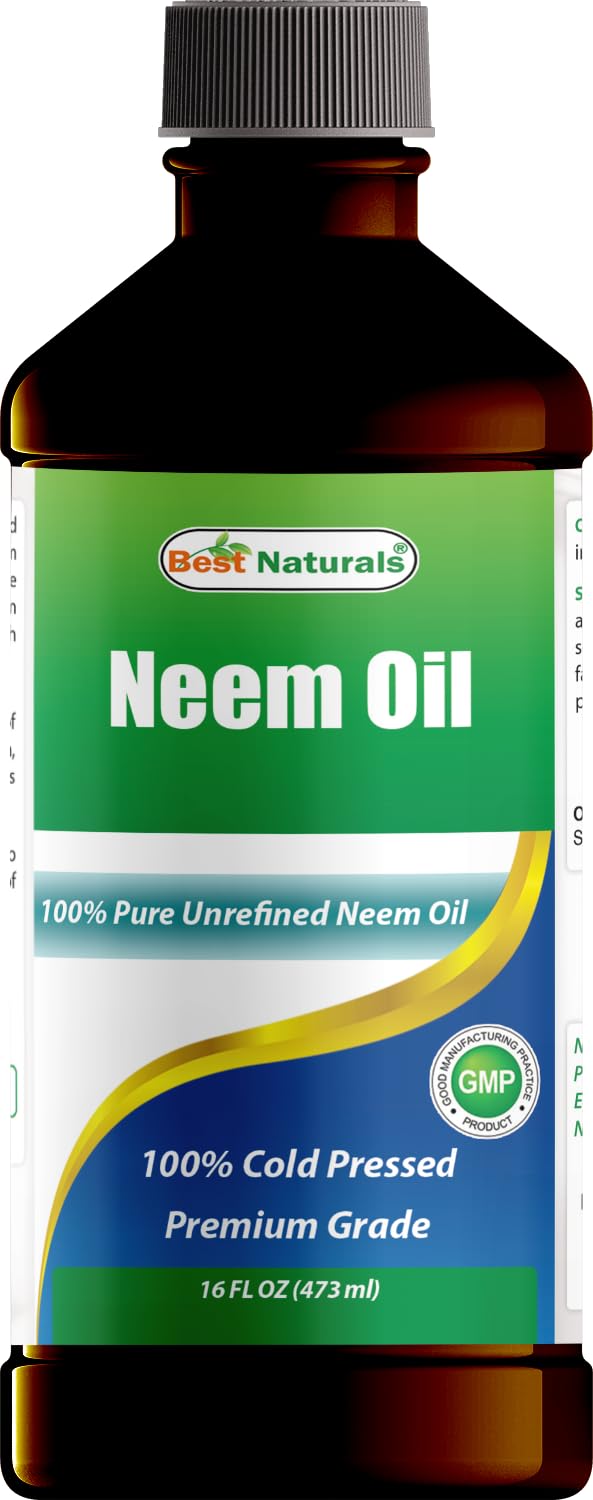
Best Naturals 100% Pure Cold-Pressed Neem Oil, 16 oz
| Ingredients | 100% Pure Neem Oil |
|---|---|
| Extraction | Cold Pressed |
| Form | Unrefined oil |
| Application | Gardening |
Best Naturals 100% Pure Neem Oil is a cold-pressed, unrefined botanical oil sold in a 16-ounce bottle and commonly used as a garden treatment or topical ingredient. For plants it is typically diluted in water with an emulsifier and applied as a foliar spray or soil drench to help manage common pests and fungal issues. The product is single-ingredient neem oil, which keeps the formulation simple and predictable for mixing and routine applications. Practical benefits include a large 16 oz supply that reduces the need for frequent repurchase and an unrefined extraction that preserves the oil’s active components. Important limitations are that it must be mixed correctly before use, can leave an odor, and may irritate skin or sensitive plants if used undiluted; the label advises patch testing and keeping out of reach of children. Overall this is a straightforward, no-frills neem oil for gardeners who want a pure source to dilute and apply themselves rather than a pre-mixed concentrate or multi-ingredient spray.
Best for: Gardeners who prefer a simple, pure botanical product to mix and apply themselves and who prioritize predictable ingredient lists and safety instructions.
Less Ideal for: Users who want ready-to-use sprays, scent-sensitive gardeners, or people unwilling to follow dilution and safety precautions should consider pre-mixed alternatives.
- 100% pure, single-ingredient neem oil makes dilution and mixing predictable
- Cold-pressed and unrefined to retain natural active compounds
- Generous 16 oz volume suitable for multiple garden treatments
- Labeled for gardening application so intended use is clear
- Requires correct dilution and emulsifier before spraying
- Strong natural odor that some users may find unpleasant
- Can cause skin irritation if handled without gloves
Verdict: A pure, cold-pressed neem oil in a 16 oz bottle that gives cautious gardeners a dependable base to dilute and use for pest and fungal control.
Choosing the Right Neem Oil for Agriculture: Key Factors to Consider
Concentration and Active Content
Neem products vary widely in the amount of active azadirachtin or clarified neem extract they contain. Higher concentrations can reduce the volume you need to carry and may lower labor and fuel costs per treated acre, but they also require careful dilution to avoid crop damage. Understanding the stated active content lets you calculate application rates that match your target pests and the spray equipment you use.
Always compare labeled active percentages and recommended application rates. For many agricultural use cases, mid-to-high concentrations provide more predictable pest suppression across multiple applications, while very low concentrations are better suited to supplemental foliar sprays rather than primary control.
Coverage Efficiency and Dilution Ratios
Coverage efficiency measures how much area a given volume of product will treat once mixed to label rates. Products with favorable dilution ratios reduce the frequency of refills and logistic handling in larger operations. Coverage also depends on emulsion quality and how well the oil disperses in water under agitation.
Consider your sprayer output per acre, typical water volumes, and nozzle selection. A product that emulsifies cleanly at the concentration you need will give more uniform coverage and better pest contact than one that separates or forms clumps.
Crop Safety and Phytotoxicity Risk
Although neem oil is generally plant-safe, some formulations and spray concentrations can cause leaf burn or spotting, especially under hot, sunny conditions or on sensitive crops. Crop safety instructions and tested crop lists on the label are crucial for agricultural use. Preharvest interval guidance and maximum seasonal application limits will affect how you schedule sprays around harvests.
Test new formulations on a small area and observe for 48 to 72 hours under the environmental conditions typical for your farm. When planning treatments, factor in temperature, humidity, and the presence of tender new growth because those increase risk of phytotoxic responses.
Compatibility with Spray Equipment
Mixing behavior and compatibility with common agricultural spray systems matters for operational reliability. Some neem oils are formulated to emulsify readily in water and pass through filters and nozzles without clogging. Others need additional agitation or a carrier adjuvant to maintain a stable suspension.
Consider the size of your tanks, agitation capabilities, and nozzle types. If you use high-volume airblast sprayers or tractor-mounted booms, choose a formulation that remains stable under those mixing and pressure conditions to avoid downtime and uneven application.
Formulation Stability and Shelf Life
Storage stability affects product performance across a season. Stabilized formulations resist separation, oxidation, or loss of active compounds when stored in typical farm conditions. Shelf-stable neem oils reduce waste and uncertainty about efficacy at the time of use.
Check label guidance on storage temperature, exposure to light, and recommended shelf life after opening. For larger operations, consider bulk handling and whether the product can be decanted and resealed without rapid degradation.
Label Directions and Legal Use
Clear, agriculture-specific label directions are essential. Labels should state target pests, crop lists, application rates, preharvest intervals, and any required personal protective equipment. Legal compliance requires following the label, so ambiguous or ornamental-only directions limit agricultural use.
Review the label for maximum seasonal use, compatibility notes with other pesticides, and environmental precautions. Labels that include guidance for integrated pest management and beneficial insect protection are especially useful for sustainable farm systems.
How Neem Oil Works in Field Crops
Neem oil contains compounds that disrupt insect feeding, development, and reproduction while also acting as a contact deterrent. In agricultural settings, it is often used as part of an integrated pest management program rather than a single-season cure. Its mode of action reduces pest pressure over repeated applications and can complement biological controls.
Timing and thorough coverage matter in the field. For sap-sucking insects, repeated foliar sprays timed to target vulnerable life stages produce the best suppression. For soil-applied uses or seed treatments, specific formulations and labels must be followed to achieve consistent results.
- Most effective when aimed at young insect stages and repeated on a schedule
- Works synergistically with biological controls when applied judiciously
- Requires even coverage to contact pests that hide under leaves or in canopy
Application Techniques for Large Acreage
Scaling neem oil to larger plots means planning dilution, tank agitation, and nozzle selection. Use proper agitation to keep the oil emulsified and select nozzle sizes that provide the droplet spectrum needed for the target pest and crop canopy. For dense orchards, airblast sprayers with fine to medium droplets often reach underside leaf surfaces where pests feed.
Calibration is critical. Measure output per acre and calculate the volume of product to add to each tank to match label rates. Account for re-entry intervals and worker safety when scheduling applications over many acres.
- Calibrate sprayers before the season to determine water per acre
- Use sufficient agitation and consider an approved adjuvant if label allows
- Avoid spraying during the hottest part of the day to reduce phytotoxic risk
Integrating Neem with IPM and Crop Rotations
Neem oil fits well into integrated pest management programs because it is compatible with many biological controls and has a lower residual impact than some synthetic pesticides. Rotate modes of action and use neem strategically to slow resistance development and protect beneficial insects when possible.
In crop-rotation systems, adjust timing so neem treatments do not coincide with activities that stress crops, such as transplanting or heavy fertilization. Combining cultural controls, such as sanitation and trap crops, with neem applications often improves long-term pest suppression.
- Use neem as part of a rotation of control methods to limit resistance
- Target treatments to reduce impacts on pollinators and beneficial insects
- Coordinate sprays with other cultural practices to avoid stressing plants
Safety, Personal Protective Equipment, and Environmental Notes
Although neem is a botanically derived product, agricultural labels still require personal protective equipment during mixing and application. Follow label PPE instructions and observe re-entry and preharvest intervals to protect workers and consumers.
Neem tends to break down in sunlight and has low persistence in soil, but runoff and drift can still affect non-target areas. Avoid application before heavy rain and use nozzles that minimize fine drift if sensitive crops or waterways are nearby.
- Wear label-recommended PPE during mixing and spraying
- Avoid spraying when wind speeds will cause drift to sensitive areas
- Respect preharvest intervals to minimize residues at harvest
Storage and Handling for Farm Supplies
Store neem oil in a cool, shaded area away from direct sunlight and extreme heat. Use labeled containers and keep original labeling intact to ensure instructions remain available. For bulk purchases, rotate stock so older containers are used first.
When decanting into smaller tanks for daily use, transfer only what you will apply soon to limit exposure and oxidation. Clean spray tanks and filters after use to avoid buildup of oil residues that can affect future mixes.
- Keep products sealed and out of direct sun to preserve shelf life
- Label any decanted containers with product and dilution information
- Flush tanks after use to prevent nozzle clogging
How We Chose the Best Neem Oil for Agriculture
We shortlisted neem oil options that are appropriate for agricultural use by applying filters that reflect real-farm priorities. Primary evaluation criteria included active azadirachtin or clarified neem extract concentration because that determines pest suppression and required application rates. Coverage efficiency and dilution ratios were reviewed to estimate how many acres a given volume would treat under typical spray setups. Crop safety and phytotoxicity risk on common field and orchard crops was another key filter, with attention to label directions for sensitive plants and preharvest intervals. We also considered formulation stability and ease of mixing in standard farm sprayers to reduce clogging and ensure consistent sprays. Packaging sizes and refillability were assessed for practical handling and storage at scale. Finally, we excluded products intended solely for small-container ornamental use or indoor houseplants because they do not scale to agricultural spray rigs. Excluded items included unlisted or unclear concentration labels, formulations lacking agricultural use directions, and blends with unknown adjuvant chemistry. The scoring criteria reflect these priorities and help gardeners and growers compare options on the dimensions that matter for field use.
FAQ
How often should neem oil be applied in agricultural settings?
Frequency depends on pest pressure, crop, and labeled rates. Applications are often repeated at intervals of 7 to 14 days during active pest outbreaks, but follow the label for maximum seasonal limits and preharvest intervals.
Can neem oil be tank-mixed with other pesticides or fertilizers?
Tank mixing depends on label compatibility. Many neem formulations are compatible with certain insecticides and fungicides, but you should perform a small jar test and follow label guidance to avoid antagonism or increased phytotoxicity.
Will neem oil harm beneficial insects and pollinators?
Neem is generally less disruptive than many broad-spectrum insecticides, but direct contact can still harm beneficials. Apply in the evening or when pollinators are less active, and avoid broad blanket sprays during bloom unless label permits targeted use.
What environmental conditions increase phytotoxic risk?
High temperatures, intense sunlight, and spraying on new tender growth raise the chance of leaf burn. Avoid applying during heat stress or when plants are water stressed to reduce phytotoxic reactions.
How should I store neem oil on the farm?
Store in a cool, shaded, and ventilated area in the original container. Keep lids tight and rotate stock so older supplies are used first. Avoid freezing or prolonged exposure to high heat to maintain stability.
Is neem oil effective against soil pests when applied as a foliar spray?
Foliar neem applications target aboveground pests primarily. For soil pests, use formulations and application methods labeled for soil incorporation or seed treatment. Always follow label directions for intended use and efficacy.
Final Verdict
When choosing neem oil for agriculture, prioritize active concentration, proven crop safety, and a formulation that mixes reliably in your spray system. Coverage efficiency and clear label directions determine how easily a product scales across acres and seasons. Balance the desire for strong pest suppression with the need to protect sensitive crops and beneficial organisms. Focus on products with agriculture-specific labels, predictable dilution ratios, and stable storage characteristics. That approach makes it practical to integrate neem into a broader pest-management plan and helps you choose a product that fits your operation rather than relying on one-size-fits-all claims.
