

Note: This article contains affiliate links. If you click on these links and make a purchase, I may earn a small commission at no extra cost to you. This helps support my research and content. Read my full affiliate disclosure here.
If insects are damaging your turf, choosing the right liquid insecticide for lawns matters for both control and grass recovery. Liquid formulations behave differently from granules: they coat foliage and soil, act quickly in many cases, and let you target treatment zones precisely. In this guide we shortlisted the top options for common lawn pests and situations, then evaluated them on knockdown speed, persistence, application flexibility, and safety for turf and beneficial insects. Read on to understand which characteristics matter for your yard and how these top picks match typical homeowner and maintenance needs.
Top Picks at a Glance
| Best Overall The best all-around choice for most situations | Atticus Talak 7.9% Indoor/Outdoor Bifenthrin Insecticide Concentrate (1 gal) |  |
| Best Value The sweet spot between price and what you get | Quali-Pro Bifenthrin I/T 7.9F Insecticide, 1 Gallon |  |
| Best Budget The cheapest option that still gets the job done reliably | Spectracide Triazicide Insect Killer for Lawns & Landscapes, 32 oz |  |
| Highest Rated A top-rated pick with lots of positive feedback | Envu Suspend SC Insecticide Concentrate, 16 oz |  |
| Most Popular A crowd favorite that many people choose with confidence | Atticus Talak 7.9% Bifenthrin Indoor/Outdoor Insecticide Concentrate, 32 oz |  |
Atticus Talak 7.9% Indoor/Outdoor Bifenthrin Insecticide Concentrate (1 gal)

| Active Ingredients | Bifenthrin |
|---|---|
| Formulation | Suspension Concentrate |
| Unit Count | 128 Fluid Ounces |
| Specification Met | EPA |
Talak 7.9% is a water-based bifenthrin concentrate meant as a flexible indoor and outdoor insect control product. You dilute the concentrate with water and apply it as a spray for perimeter barrier treatments, to turf, to ornamentals, or to interior baseboards and other problem areas. The label lists control of more than 75 pests including mosquitoes and ticks, and the formula is designed to kill on contact and provide residual control for up to three months. Practical benefits include a clear, odor-free spray that dries without staining and a bottle that allows easier small pours for accurate mixing. Important limitations are that mixed solutions should be used the same day and it is not approved for fogger use, so it is best for targeted spray applications rather than broadcast fogging. As with any bifenthrin product, users should follow label directions closely and consider nonchemical options for integrated mosquito management.
Best for: Buyers who want a single, versatile insecticide to treat both perimeter and landscape mosquito problems and prefer a product that delivers residual control without odors or visible residue.
Less Ideal for: People seeking a ready-to-use fogging or misting solution or those who need an insecticide they can pre-mix and store for later use.
- Broad-spectrum control listing more than 75 indoor and outdoor pests including mosquitoes and ticks.
- Water-based formula that dries clear, leaves no residue, and is odor-free for use around living areas.
- Long residual effect with label claim of up to three months of control per application.
- Mixes with water for adjustable application rates across lawns, landscapes, and surfaces.
- Bottle design supports easier small pours to reduce mess when measuring concentrate.
- Mixed spray cannot be stored and must be used the same day.
- Not approved for use in foggers, limiting application methods to direct sprays.
Verdict: A versatile, long-lasting bifenthrin concentrate that provides broad-spectrum mosquito and perimeter control for users who want one product for indoor and outdoor applications.
Quali-Pro Bifenthrin I/T 7.9F Insecticide, 1 Gallon

| Item Form | Spray |
|---|---|
| Target Species | Termites, Carpenter Ants |
| Liquid Volume | 1 gallons |
| Active Ingredients | Bifenthrin |
This one-gallon Quali-Pro Bifenthrin I/T 7.9F is a flowable pyrethroid designed for preventive and residual control of a broad range of pests in lawns and landscaped areas. It is typically mixed and applied as a spray to turf, ornamental beds, foundations and around structures to suppress termites, carpenter ants, fleas, ticks, mites and similar pests. Key features include a long-lasting residual, compatibility with many turf and ornamental tank-mix partners, and a no-odor, non-irritating formulation that dries without visible residue. In practice it provides dependable knockdown and weeks of protection when applied at recommended rates, making it suited for routine perimeter treatments and spot-control of persistent infestations. Important limitations are that it is a concentrated professional-style product requiring careful dilution, protective equipment, and adherence to label directions for safe use around people, pets and desirable plants. It is not a ready-to-use consumer spray and should be used only where labeled.
Best for: Buyers who prioritize a reliable, long-lasting perimeter or spot-treatment solution for recurring or hard-to-control outdoor pests and who are comfortable following label directions and using concentrated products.
Less Ideal for: Casual users who want a simple ready-to-use spray for occasional bug bites or very small lawns should consider consumer-grade aerosols or hose-end products instead.
- Long-lasting residual control effective against termites, carpenter ants and other pests
- Compatible with herbicides, fungicides, insecticides and liquid fertilizers for tank mixes
- No-odor, non-irritating formula that dries with no visible residue
- Available in a one-gallon concentrated flowable for multiple applications
- Concentrated product requires dilution and protective equipment for safe handling
- Not intended as a ready-to-use consumer spray and may be overkill for very small yards
Verdict: Choose this product when you need a dependable, long-lasting concentrated insecticide for routine perimeter and spot treatments in lawns and ornamentals.
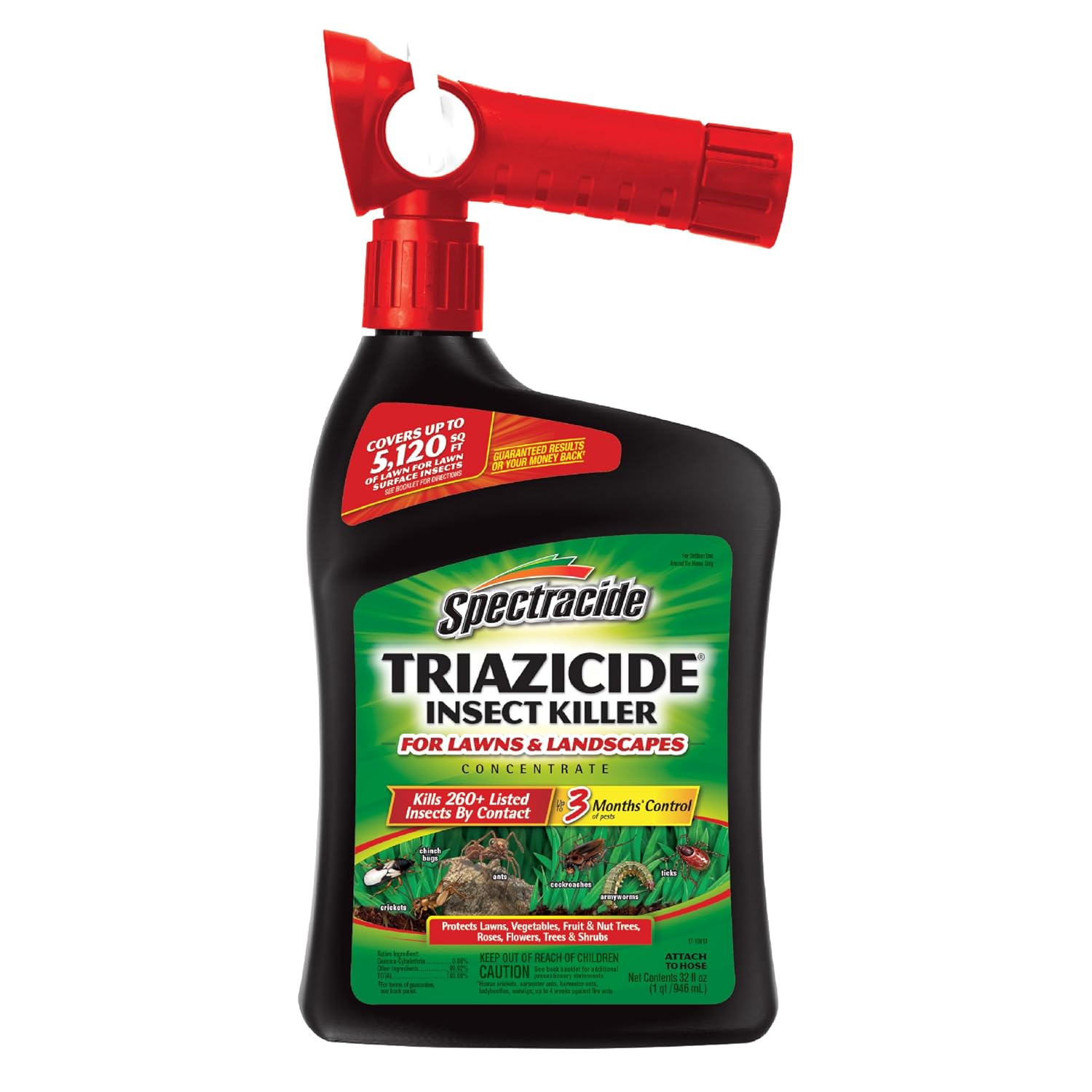
Spectracide Triazicide Insect Killer for Lawns & Landscapes, 32 oz
| Unit Count | 32 Ounce |
|---|---|
| Item Form | Spray |
| Target Species | Insects |
| Active Ingredients | Gamma-Cyhalothrin (0.08%) |
Spectracide Triazicide is a 32-ounce concentrate formulated to control more than 260 listed insects on lawns, flower beds, trees, shrubs and around vegetables. You mix the concentrate with water and apply it with a tank or hose-end sprayer; the ready-to-spray variant can attach to a garden hose for quicker application. The active ingredient, gamma-cyhalothrin, delivers fast contact kill for pests such as fleas, ticks, Japanese beetles and many surface insects, and the label claims protection for up to three months in some uses. It is non-staining when used as directed and can treat large areas, making it practical for whole-yard applications and targeted mound treatments like fire ants. Important limitations include toxicity to fish and bees, so it must not be applied near water or blooming plants, and the product requires careful handling and adherence to safety directions. Follow mixing rates and timing recommendations for best results and to minimize environmental risk.
Best for: Buyers who need an affordable, large-area solution to knock down common lawn and landscape pests and prefer a concentrate that stretches coverage when mixed.
Less Ideal for: People with small ornamental gardens near ponds, homeowners who prioritize pollinator-safe products, or those unwilling to follow pesticide safety precautions should consider gentler or targeted alternatives.
- Concentrate covers large areas so a single bottle treats many square feet when mixed correctly
- Fast-acting contact kill for a wide range of listed insects including fleas, ticks and Japanese beetles
- Versatile use on lawns, flower beds, trees, shrubs and around vegetables
- Non-staining when used as directed and available in hose-end ready-to-spray format for easier application
- Highly toxic to aquatic life and bees so it cannot be used near water or blooming plants
- Requires careful mixing and protective handling due to chemical toxicity
Verdict: A cost-effective, fast-acting concentrate for treating broad lawn and landscape pest problems when used with care and proper precautions.
Envu Suspend SC Insecticide Concentrate, 16 oz

| Item Form | Spray |
|---|---|
| Target Species | Ants, Bed Bugs, Cockroaches, Fleas, Mosquitoes, Scorpions, Spiders, Ticks, Wasps, Yellow Jackets |
| Liquid Volume | 16 fluid ounces |
| Specification Met | EPA |
| Active Ingredients | Deltamethrin |
Suspend SC is a concentrated deltamethrin suspension concentrate designed for perimeter, crack-and-crevice and spot treatments to stop crawling pests before they enter structures. Mixed with water, the concentrate covers large areas around foundations, doors, windows, patios and landscaping and can also be used in garages, basements and crawl spaces. Its low-odor, water-based formulation and label flexibility allow indoor spot applications in tight areas and on some fabrics when used exactly as directed. The main practical benefit is the long residual control on treated surfaces, which reduces the need for frequent reapplication compared with short‑acting knockdown sprays. Because it targets a broad list of crawling pests, it fits into routine prevention programs aimed at cockroaches, ants, spiders and similar pests. Important limitations are that this is a professional‑strength insecticide that requires careful dilution and label-following for safe indoor use and that it does not provide immediate broad-area aerosol knockdown like ready-to-use sprays.
Best for: Buyers who prioritize reliable, long-lasting perimeter control and are willing to mix and apply a concentrated product correctly for ongoing cockroach prevention.
Less Ideal for: People who want simple ready-to-use aerosols or need instant knockdown across large indoor living spaces should consider alternative formulations.
- Concentrated formulation mixes with water to treat large perimeter and exterior areas
- Contains deltamethrin for long residual control on treated surfaces
- Low-odor, water-based formula suitable for indoor crack-and-crevice and spot use when label directions are followed
- Broad-spectrum efficacy against common crawling pests including cockroaches, ants and spiders
- Requires dilution and careful handling, so it is less convenient than ready-to-use sprays
- Not intended as an immediate aerosol knockdown product for open-area spraying
Verdict: Choose Suspend SC if you want a concentrated, long‑residual deltamethrin treatment to reliably protect perimeters and reduce repeat applications against cockroaches.
Atticus Talak 7.9% Bifenthrin Indoor/Outdoor Insecticide Concentrate, 32 oz

| Active Ingredient | Bifenthrin |
|---|---|
| Formulation | Suspension Concentrate |
| Liquid Volume | 32 fluid ounces |
| Length of Control | Up to three months |
| Target Species | Insects |
Talak 7.9% is a liquid concentrate for treating lawns, landscaping, outdoor living areas and indoor perimeter spots like baseboards and cabinets. You dilute the concentrate with water to create a spray for barrier treatments, spot applications or lawn mixes; label rates explain how much to mix per gallon depending on the use. The product uses bifenthrin, a proven broad-spectrum active ingredient, and the manufacturer states it controls over 75 species and can give residual control for as long as three months. Its water-based formula dries clear, leaves no odor or visible residue, and is not phytotoxic on plants when used per label. Practical benefits include flexible indoor and outdoor use, clear drying, and a bottle designed for easier pouring. Important limitations are that solutions should be mixed only for same-day use, it is not registered for sale in a few states, and it is not approved for fogger application, so professional-style misting methods are not appropriate.
Best for: Buyers who want a single, reliable product to protect yards, patios and building perimeters from a wide range of common pests and prefer conservative, label-driven application practices.
Less Ideal for: People seeking ready-to-use sprays or fogger-compatible products or those in states where this formulation is not registered should look at alternatives.
- Broad-spectrum control listed for 75+ indoor and outdoor pest species
- Water-based formula that dries clear and leaves no odor or residue
- Flexible label directions for lawns, landscapes, hardscapes and indoor perimeter treatments
- Long residual activity up to three months when applied at recommended rates
- Mixed spray solutions cannot be stored and must be used the same day
- Not approved for fogger application and not available for sale in some states
Verdict: A versatile, water-based bifenthrin concentrate that delivers long-lasting, broad-spectrum outdoor (and perimeter indoor) control when used according to the label.
Choosing the Right Liquid Insecticide for Lawns: Key Factors to Consider
Target Pest Spectrum
Different liquid insecticides control different sets of pests. Some formulations are broad-spectrum and will affect chewing and sucking pests, while others are optimized for specific targets like grubs, chinch bugs, or sod webworms. Knowing the likely pest and life stage present lets you choose a product with the right active ingredient and label claims.
Choosing a product with the right spectrum limits unnecessary applications that can harm non-target insects and reduces the chance of treatment failure. If you do not have a confirmed pest ID, consider products labeled for multiple lawn pests and pair treatment with monitoring to confirm effectiveness.
Knockdown Versus Residual Activity
Knockdown speed refers to how quickly visible pest activity declines after application. Rapid knockdown is useful for acute infestations or high visible damage, but these products sometimes have short residual life. Residual activity is how long the product remains active in the turf and soil, protecting against reinfestation.
Balance immediate control needs with the desired duration of protection. For a short outbreak, a fast-acting product may be enough, while persistent problems or heavy pest pressure often benefit from longer residual control, remembering that longer persistence can also increase non-target exposure.
Turf Safety and Phytotoxicity Risk
Not all liquid insecticides are equally safe on every grass type. Factors that influence turf safety include formulation concentration, application rate, environmental stress on the lawn (drought, recent fertilization), and timing of application relative to high heat.
Read label directions for temperature limits and recommended watering intervals. When treating sensitive turf or recently sodded areas, choose products with a wide margin of safety and consider spot testing a small area first to avoid scorch or discoloration.
Application Method and Equipment
Liquid insecticides are applied in different ways: ready-to-use hose-end spray, spark the concentrate into a pump sprayer, or pour-and-mix for broadcast sprayers. Application method affects coverage, convenience, and the ability to treat large lawns versus small patches.
Consider the equipment you have and whether the product sprays evenly at low water volumes, mixes easily, and labels allow the spray pressure and droplet sizes you need. Ease of mixing and clear dilution instructions reduce the risk of over- or under-applying.
Environmental Impact and Non-target Safety
Many liquid insecticides can affect pollinators, earthworms, and aquatic life if misapplied. Look for products with timing guidance to avoid applying during pollinator activity, and pay close attention to buffer zones near water features.
Choosing products labeled for lower risk to beneficial insects or using targeted spot treatments reduces broader ecosystem impacts. Also consider how runoff and irrigation timing can move actives offsite and plan applications to minimize that risk.
Label Restrictions and Reentry Intervals
Labels include legal and safety restrictions such as reentry intervals, mowing and irrigation restrictions, and maximum seasonal application rates. These constraints affect how soon people can use treated areas and whether you need to adjust lawn care routines after treatment.
Check the label for guidance on mowing, watering, and how many applications are allowed per season. If you maintain high-traffic turf like play areas, pick products with shorter reentry times and clear instructions for safe use around people and pets.
Identifying the Pest Before You Spray
A confident pest ID makes the difference between a successful treatment and wasted effort. Inspect turf for feeding signs, lawn thinning patterns, or frass and look at roots and crowns for grubs. Time of year and the type of damage narrow down likely culprits.
If you are unsure, use a simple sampling technique such as cutting a turf square and examining soil and roots, or set up monitoring traps. Correct identification reduces unnecessary broad-spectrum sprays and improves long-term control.
- Look for patchy brown areas with larvae in soil for grub problems
- Surface-active insects often leave visible crawling adults or windowpane damage
- Survey at different times of day; some pests are primarily nocturnal
Best Timing and Weather for Application
Timing affects both efficacy and turf safety. Apply during calm conditions to reduce drift and avoid rain for several hours after treatment unless the label allows watering to move contact actives into the thatch. Early morning or late evening applications reduce exposure to pollinators and high heat stress on grass.
Consider pest life cycles. Treating larvae is often more effective than targeting adults. For soil-feeding pests, applications timed when larvae are active near the surface give better contact and uptake.
- Avoid application during midday heat above label temperature limits
- Do not spray when wind could carry droplets onto flower beds
- Follow label rainfastness recommendations to avoid wash-off
Mixing, Coverage, and Water Volume
Coverage is critical. Too little water can leave untreated patches, while too much may run off and waste product. Labels specify target water volumes and spray widths for different equipment; follow those to get consistent results.
Mixing concentrates requires careful measurement and proper agitation. Rinse sprayers and measure cylinders after use to avoid residue buildup and cross-contamination with other garden chemicals.
- Measure and calibrate sprayers before treatment
- Use recommended water rates for even coverage
- Clean equipment thoroughly between uses
Spot Treatment and Integrated Pest Management
Spot treating reduces chemical exposure and preserves beneficial insects. Use liquids for targeted application where damage is concentrated and combine with cultural practices such as proper mowing height, irrigation management, and aeration to reduce pest susceptibility.
An IPM approach includes monitoring, thresholds for action, and combining nonchemical tactics with targeted liquid applications to keep pest populations below damaging levels.
- Treat only where damage exceeds aesthetic or functional thresholds
- Combine chemical control with cultural and biological methods
- Record treatments and monitor outcomes to refine future choices
Safety Around People, Pets, and Water
Keep treated areas off-limits during reentry intervals and follow label guidance for pets. Many liquid products require a short wait before allowing foot traffic or pet access. Use caution when applying near ponds or drains and observe buffer zone directions.
Store concentrates securely and dispose of unused diluted spray according to the label. Personal protective equipment recommendations on the label ensure safe handling during mixing and application.
- Observe reentry intervals and post-application watering advice
- Avoid spraying toward water bodies and storm drains
- Wear protective gear recommended by the label
How We Chose the Best Liquid Insecticide for Lawns
We focused on formulations and performance traits that matter to people treating turf, not ornamental beds. Selection prioritized products known to work on common lawn pests, consistent application behavior across turf types, and a reasonable range of labeled uses for spot and broadcast applications. Key criteria we used were knockdown speed, residual activity, turf safety and phytotoxicity risk, application flexibility including hose-end or concentrate options, and compatibility with integrated pest management practices like spot treating and timing around irrigation. We excluded treatments intended only for indoor or structural pest control, products labeled solely for ornamental plants, and formulations that lack clear turf use instructions. We also filtered out products with unusually restrictive application windows that make them impractical for typical homeowners. The remaining entries passed label checks for common turf pests and included a balance of short-term knockdown and longer residual control where appropriate.
FAQ
When is the best time to apply a liquid insecticide to a lawn?
Application timing depends on the pest life stage. Many turf pests are most vulnerable as larvae, so time applications when larvae are active near the surface. Also choose calm, cooler parts of the day to reduce drift and turf stress.
Can I use the same liquid insecticide on all grass types?
Not always. Labels list turf species and application rates. Some formulations are safe across many grass types, while others have restrictions. Check the label for your grass variety to avoid phytotoxicity.
How soon can I water or mow after applying a liquid insecticide?
That varies by product. Many labels allow light watering after a set rainfast period to move contact actives into thatch, while others advise waiting to avoid wash-off. Mowing timing is also label-dependent; follow directions to avoid reducing efficacy or causing turf stress.
Are liquid insecticides safe for pollinators in lawns?
Some actives pose higher risks to pollinators than others. To reduce exposure, avoid spraying flowering plants, apply during low pollinator activity times, and use targeted spot treatments instead of broad broadcast applications when possible.
Can I mix liquid insecticides with fertilizers or other lawn chemicals?
Compatibility depends on the specific products involved. Labels sometimes allow tank-mixing with certain fertilizers or adjuvants but may prohibit mixes with herbicides or other pesticides. When in doubt, perform a small jar test or consult label guidance.
How often can I reapply a liquid insecticide during the season?
Reapplication intervals are set on the label and often limit the number of applications per season. These limits prevent overuse and reduce the risk of resistance. Follow label intervals and seasonal maximums to stay within safe limits.
Final Verdict
Choosing a liquid insecticide for lawns means balancing quick control with turf safety and environmental considerations. Prioritize a product that targets the pests you actually have, times applications for vulnerable life stages, and fits with the watering and mowing schedule of your lawn. For most yards, targeted spot treatments plus cultural practices reduce chemical use without sacrificing control. Use the evaluation criteria above to match a product to your turf type and pest pressure so you get effective results with minimal collateral impact.
