

Note: This article contains affiliate links. If you click on these links and make a purchase, I may earn a small commission at no extra cost to you. This helps support my research and content. Read my full affiliate disclosure here.
Choosing a potent insecticide matters when you need reliable control of damaging pests in vegetable beds, ornamentals, container plants, or greenhouse crops. The right product stops feeding and reproduction quickly while fitting into your overall pest-management plan. This guide highlights five shortlisted options that perform well across typical garden scenarios and explains the practical tradeoffs between speed, persistence, and user safety. We evaluate each option for how quickly it knocks down target pests, how long protection lasts, and how safely it can be used around desirable insects and edible plants. Read on for the factors that should drive your choice and concise guidance to match a potent insecticide to your garden situation.
Top Picks at a Glance
| Best Overall The best all-around choice for most situations | Talstar One Insecticide Concentrate, 1 Gallon |  |
| Best Quality Built to a higher standard if you want something more solid | Demon Max Insecticide 16 oz |  |
| Best Value The sweet spot between price and what you get | Compare-N-Save Bifenthrin Concentrate Indoor & Outdoor Insect Control, 16 fl oz |  |
| Most Popular A crowd favorite that many people choose with confidence | Ortho Home Defense Insect Killer for Indoor & Perimeter, 1.33 gal. with Comfort Wand |  |
| Best Seller A high-volume bestseller chosen again and again | Atticus Talak 7.9% Bifenthrin Indoor/Outdoor Insecticide Concentrate, 32 oz |  |
Talstar One Insecticide Concentrate, 1 Gallon

| Active ingredient | Bifenthrin 7.9% |
|---|---|
| Formulation | Concentrate, water-based |
| Coverage intent | Perimeter and structural applications |
| Pest range | Controls 75+ pests including ticks |
Talstar One is a professional-strength bifenthrin concentrate designed to provide broad-spectrum control of ants, spiders, roaches, fleas, ticks, mosquitoes, and many other pests. You mix the concentrate with water and apply it as a perimeter spray around foundations, doors, and windows or to targeted cracks and crevices indoors. Notable features include a water-based, low-odor formula that dries clear and a residual effect that reduces the need for frequent reapplications on lawns, ornamentals, shrubs, and structural surfaces. For yards with tick pressure, treating perimeters and vegetation provides a dependable barrier that helps reduce tick encounters when applied according to label directions. The product is concentrated so one gallon treats large areas, which makes it efficient for seasonal maintenance across multiple structures. Important limitations are that it is a pesticide that requires careful handling and strict adherence to label rates and application restrictions, and it is not a ready-to-use spray so you will need appropriate mixing and application equipment for safe, effective coverage.
Best for: Buyers who prioritize reliable, residual pest control for yards and perimeters and who are comfortable using concentrated pesticides with proper safety practices.
Less Ideal for: Casual users who want a ready-to-use product or those unwilling to follow pesticide label precautions and use appropriate application equipment.
- Broad-spectrum control that includes ticks and common yard pests
- Concentrated formula covers large areas and is cost-efficient for seasonal treatments
- Water-based, low-odor formula dries clear and is suitable for outdoor living spaces
- Suitable for both perimeter and targeted indoor/structural applications
- Concentrate requires proper mixing and application equipment for safe use
- Contains bifenthrin so users must follow label precautions to protect people, pets, and beneficial insects
Verdict: Choose Talstar One when you need a concentrated, long-lasting perimeter treatment that reliably reduces tick pressure across yards and structures.
Demon Max Insecticide 16 oz
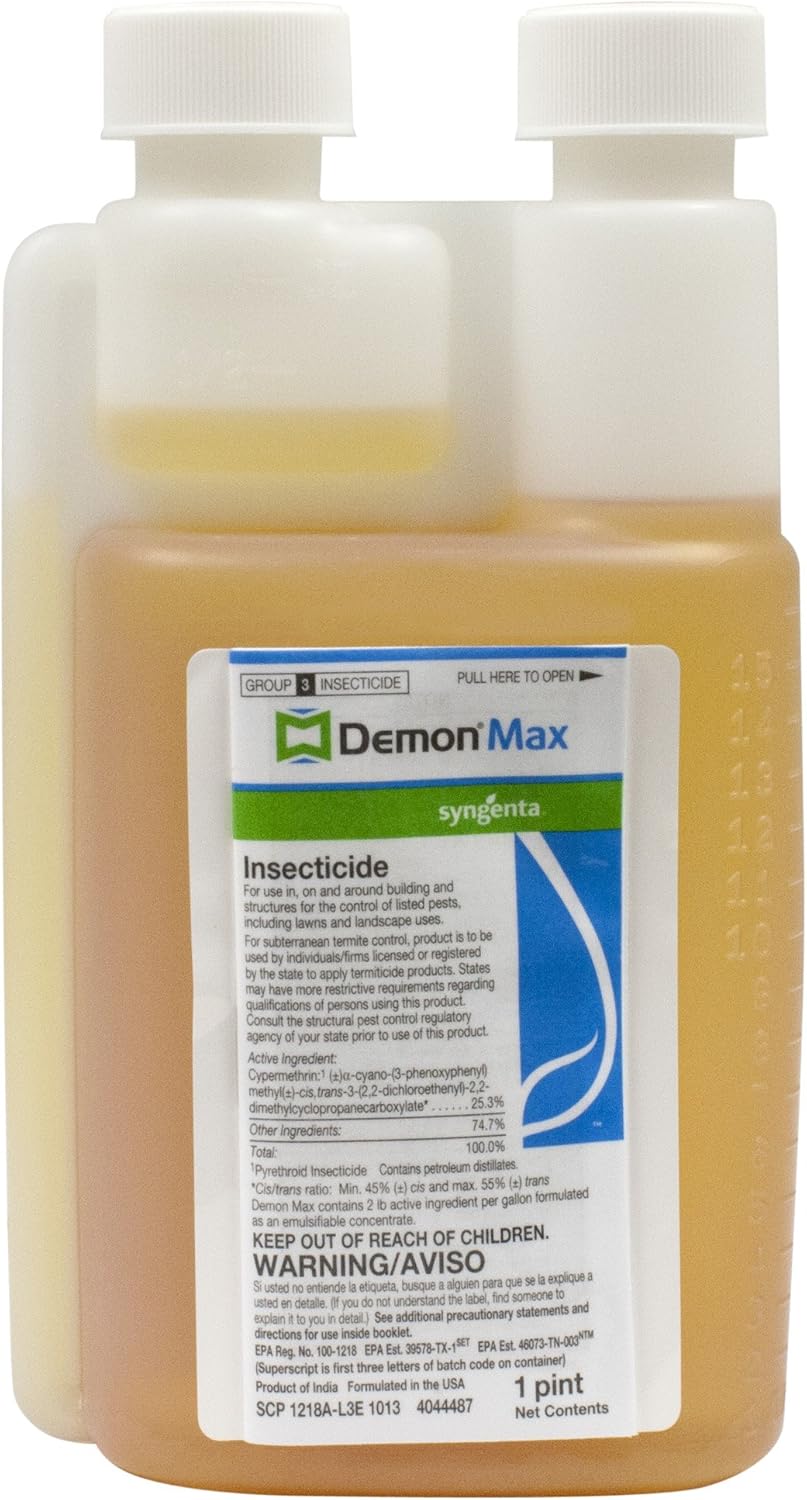
| Unit Count | 16 Ounce |
|---|---|
| Item Form | Liquid |
| Target Species | Insects |
| Active Ingredients | Cypermethrin |
Demon Max is a concentrated 16 ounce liquid insecticide designed for both quick knockdown and lasting residual control of more than 30 insect pests, making it suitable for spot, crack-and-crevice, and perimeter treatments. It is typically mixed in a hand-pump or compressed sprayer and applied around foundations, on lawns and vegetation, and in and around structures where pest activity is observed. The product lists cypermethrin as the active ingredient, which delivers fast contact mortality and residual protection when applied according to label directions. Practical benefits include flexible application options across multiple surfaces and economical coverage from a small concentrate. Important limitations are the need to measure and mix correctly for the treatment area and to follow safety precautions, including keeping it away from children and avoiding application on unintended plants or areas. This is a professional-strength, pesticide-focused option for users who want effective, long-lasting roach and general insect control when applied responsibly.
Best for: Buyers who prioritize strong, long-lasting pest control results and are comfortable mixing and applying a concentrated insecticide for targeted indoor and outdoor treatments.
Less Ideal for: Casual users seeking ready-to-use sprays or nonchemical options should consider simpler consumer products or mechanical controls instead.
- Fast knockdown and residual control against a wide range of insect pests
- Versatile use for crack-and-crevice, spot treatments, lawns, vegetation, and building perimeters
- Concentrated liquid formula that can be mixed to cover varied square footage
- Contains cypermethrin, a proven synthetic pyrethroid active ingredient
- Requires careful measuring and mixing for correct coverage and safety
- Labeled for professional-style applications and may need precautions for use near ornamentals and non-target areas
Verdict: Choose Demon Max when you need a concentrated, professional-strength liquid that delivers fast knockdown and lasting residual control of roaches and other insects.
Compare-N-Save Bifenthrin Concentrate Indoor & Outdoor Insect Control, 16 fl oz

| Unit Count | 16 Fluid Ounces |
|---|---|
| Item Type Name | Insecticide |
| Active Ingredients | Bifenthrin |
| Specification Met | Epa 84009-32 |
This Compare-N-Save concentrate is a high-strength bifenthrin insecticide intended for both indoor and outdoor use and is formulated to be diluted into ready-to-use spray. Typical use is mixing the concentrate with water in a pump sprayer or tank to treat baseboards, entry points, crawl spaces and perimeter areas where spiders, ants, cockroaches and fleas travel. Notable features include a 7.9 percent active ingredient, compatibility with tank-mixing other pesticides or insect growth regulators, and stated coverage that converts the bottle into many gallons of ready-to-use spray for large areas. Practical benefits are cost-efficiency for homeowners or pros who need to treat many square feet and the versatility to protect ornamentals, trees and shrubs as well as indoor harborage sites. Important limitations are that this is a concentrated pesticide requiring correct dilution and protective handling, it is not a ready-to-spray aerosol for spot treatments, and care is needed when applying indoors around people and pets.
Best for: Buyers who prioritize economical, large-area spider and general pest control and are comfortable mixing concentrates and using a pump sprayer for perimeter and indoor treatments.
Less Ideal for: People who want a ready-to-use or aerosol product for quick spot treatments or those who prefer pesticide-free approaches.
- High active ingredient (bifenthrin 7.9%) for effective knockdown and residual control
- Concentrate converts to many gallons of ready-to-use spray for treating large areas
- Label allows tank mixing with other pesticides and insect growth regulators
- Suitable for both indoor perimeter treatments and outdoor ornamental/tree use
- Requires careful dilution and personal protective equipment for safe use
- Not convenient for quick spot treatments because it must be mixed before use
Verdict: If you need an economical, high-strength concentrate to treat large indoor perimeters and outdoor areas for spiders, this bifenthrin product delivers broad residual control when mixed and applied correctly.
Ortho Home Defense Insect Killer for Indoor & Perimeter, 1.33 gal. with Comfort Wand

| Item Form | Spray |
|---|---|
| Target Species | Insects |
| Liquid Volume | 1.33 gallons |
| Active Ingredients | Bifenthrin 0.05%, Zeta-Cypermethrin 0.0125% |
This 1.33 gallon Ortho Home Defense spray is designed to treat both indoor problem spots and the outdoor perimeter of a home to reduce ants, roaches, spiders and many other crawling and flying insects. It comes with a battery-powered Comfort Wand that delivers a continuous spray so you can apply a uniform band around foundations, patios and entry points without bending or pumping. The formula with bifenthrin and zeta-cypermethrin is intended to kill on contact and establish a barrier that the manufacturer says lasts up to 12 months for ants, roaches and spiders on non-porous indoor surfaces. In real-world use that means fewer repeat treatments in busy yard perimeters and around doors and windows. The spray dries clear with minimal fumes which helps for indoor use near kitchens and living areas. Limitations are that this is a chemical insecticide so users should follow safety directions around children, pets and plants and it is not a specific solution for pests not listed on the label. For homeowners focused on strong, perimeter-level protection this product simplifies application and covers a large area per container.
Best for: Homeowners who want a performance-focused perimeter treatment to reduce recurring yard and entry-point insect problems and prefer a ready-to-use product that is easy to apply.
Less Ideal for: People seeking organic or non-chemical control methods or those who need a targeted solution for pests not listed on the label should consider alternative products.
- Includes battery-powered Comfort Wand for continuous, fatigue-free application
- Ready-to-use 1.33 gallon container covers large perimeters without mixing
- Formula creates a barrier claimed to provide up to 12 months protection against ants, roaches and spiders on non-porous indoor surfaces
- Dries clear and gives off minimal fumes, making indoor use more practical
- Contains synthetic insecticides so precautions are required around children, pets and ornamentals
- Protection claims are specific to certain species and surfaces so results vary by pest and conditions
Verdict: A powerful, ready-to-use perimeter and indoor spray for homeowners who want long-lasting, performance-oriented protection against common yard and household insects.
Atticus Talak 7.9% Bifenthrin Indoor/Outdoor Insecticide Concentrate, 32 oz

| Active Ingredient | Bifenthrin |
|---|---|
| Formulation | Suspension Concentrate |
| Liquid Volume | 32 fluid ounces |
| Length of Control | Up to three months |
| Target Species | Insects |
Talak 7.9% is a liquid concentrate for treating lawns, landscaping, outdoor living areas and indoor perimeter spots like baseboards and cabinets. You dilute the concentrate with water to create a spray for barrier treatments, spot applications or lawn mixes; label rates explain how much to mix per gallon depending on the use. The product uses bifenthrin, a proven broad-spectrum active ingredient, and the manufacturer states it controls over 75 species and can give residual control for as long as three months. Its water-based formula dries clear, leaves no odor or visible residue, and is not phytotoxic on plants when used per label. Practical benefits include flexible indoor and outdoor use, clear drying, and a bottle designed for easier pouring. Important limitations are that solutions should be mixed only for same-day use, it is not registered for sale in a few states, and it is not approved for fogger application, so professional-style misting methods are not appropriate.
Best for: Buyers who want a single, reliable product to protect yards, patios and building perimeters from a wide range of common pests and prefer conservative, label-driven application practices.
Less Ideal for: People seeking ready-to-use sprays or fogger-compatible products or those in states where this formulation is not registered should look at alternatives.
- Broad-spectrum control listed for 75+ indoor and outdoor pest species
- Water-based formula that dries clear and leaves no odor or residue
- Flexible label directions for lawns, landscapes, hardscapes and indoor perimeter treatments
- Long residual activity up to three months when applied at recommended rates
- Mixed spray solutions cannot be stored and must be used the same day
- Not approved for fogger application and not available for sale in some states
Verdict: A versatile, water-based bifenthrin concentrate that delivers long-lasting, broad-spectrum outdoor (and perimeter indoor) control when used according to the label.
Choosing the Right Potent Insecticide: Key Factors to Consider
Mode of Action and Target Pest
Understanding an insecticide's mode of action helps match it to the pests you face and reduces the risk of resistance developing in local populations. Some active ingredients interfere with insect nervous systems and provide rapid knockdown, while others disrupt growth or feeding for longer-term suppression.
Pick a product whose labeled targets list the insects you see in your garden. If you have mixed pest pressure, favor broad-spectrum options only when you also plan to protect beneficials. Rotating products with different modes of action across growing seasons can preserve effectiveness.
Residual Activity and Reapplication Interval
Residual activity determines how long treated foliage remains protected and influences how often you need to reapply. Products with a longer residual reduce labor but can increase exposure risk to non-targets if not applied carefully.
Check the label for stated reapplication intervals and expected residual on foliage under typical sunlight and rainfall. In high-rainfall or irrigated beds, expect shorter residuals and plan for more frequent treatments or use of more rainfast formulations.
Safety for Edible Crops and Pollinators
If you treat vegetables, herbs, or flowering ornamentals, the product's safety profile is critical. Labels list preharvest intervals and whether application is allowed on food crops. Pollinator toxicity and recommended application timing to protect bees should shape when and where you spray.
Avoid spraying during bloom or choose products with low contact toxicity to pollinators. For edible crops, follow preharvest intervals exactly to ensure residues are within safe limits for harvest.
Formulation and Application Method
Formulations such as ready-to-use sprays, concentrates, dusts, or systemic drenches behave differently in the garden. Concentrates allow flexible mixing rates and economic coverage but require careful measuring. Systemic products move inside the plant and can protect new growth, while contact sprays only affect insects present at application.
Consider the sprayer or applicator you own and choose a formulation that matches your equipment and comfort level with mixing. Also evaluate how rainfast a formulation is if your garden is exposed to sudden showers.
Compatibility With Integrated Pest Management
A potent insecticide should fit into an integrated pest management approach rather than replace it. Use it alongside cultural controls, habitat for beneficials, and monitoring to reduce overall chemical reliance. Spot treatments or targeted applications often preserve beneficial insects more effectively than blanket sprays.
Plan treatments based on scouting thresholds and pest life stages so you use the most appropriate timing and reduce unnecessary applications.
Residue Persistence and Environmental Fate
How an active ingredient breaks down in soil and on foliage affects both efficacy and environmental risk. Some compounds bind tightly to soil and persist, while others degrade quickly in sunlight. Persistence influences groundwater movement and impacts on soil organisms.
Choose products with a persistence profile compatible with your site. For containers and raised beds, leaching risk is lower, while in-ground beds next to water features call for low-mobility options.
When to Use a Potent Insecticide in Your Garden
Reserve a potent insecticide for clear outbreaks or when pests are causing economic or aesthetic damage that other controls cannot stop. Routine low-level presence of pests is often manageable with cultural practices and biological controls.
Use scouting to confirm pest identity and life stage. Treating at the wrong stage can waste product and harm beneficial insects. For fast-feeding chewing pests and sap-sucking insects at high densities, a potent option can prevent large-scale loss.
- Targeted spot sprays reduce non-target exposure.
- Treat early in the morning or late evening to avoid pollinators.
Application Timing and Weather Considerations
Apply when plants are dry and wind is low to maximize coverage and minimize drift. Avoid spraying if rain is expected within the window the label calls out for rainfastness.
Temperature can affect both efficacy and phytotoxicity. Hot conditions sometimes increase plant sensitivity, so follow label guidance on temperature ranges and avoid midday applications on tender foliage.
- Check forecast for at least 24 hours before application.
- Avoid spraying during active bloom to protect pollinators.
Protecting Beneficials and Natural Predators
Beneficial insects like lacewings, parasitic wasps, and predatory beetles keep many pest populations in check. Choose application methods that spare these allies: spot treatments, bait stations, or systemic options that reduce contact exposure.
Planting habitat and using selective products when possible lowers the need for repeated broad-spectrum sprays and supports long-term biological control in the garden.
- Time sprays for evenings when pollinators are less active.
- Consider barrier or physical controls before chemical options.
Mixing, Dosage, and Equipment Tips
Follow label mixing rates precisely. More concentrate does not always mean better control and can increase plant injury or residues. Use clean, calibrated sprayers to ensure consistent coverage and avoid overapplication.
Wear recommended personal protective equipment and mix outside or in well-ventilated areas. Rinse equipment thoroughly after use and dispose of rinse water according to local regulations and label instructions.
- Calibrate sprayer to deliver the recommended volume per area.
- Start with a lower labeled rate on sensitive plants and test a small area if unsure.
Storage, Shelf Life, and Safe Disposal
Store insecticides in their original containers, tightly sealed, and away from children and pets. Keep them in a cool, dry place out of direct sunlight to preserve potency.
Follow label instructions for expired product disposal. Never dump concentrated material into drains or soil. Use community hazardous-waste programs when available to dispose of unused or old product safely.
- Record purchase date on the container to track shelf life.
- Keep liquids upright and in secondary containment to avoid spills.
How We Chose the Best Potent Insecticide
We started by screening products that offer clear, labeled control for common garden pests such as aphids, caterpillars, beetles, and whiteflies. Only formulations intended for home and small-acreage garden use were considered; professional-only or restricted-use compounds were excluded. Selection emphasized measurable performance attributes: speed of knockdown, residual activity on foliage, spectrum of pests controlled, and compatibility with ornamentals and vegetable crops. Safety and application practicality were assessed by looking at labeled re-entry and preharvest intervals, PPE recommendations, and how easily the product can be applied with common garden sprayers. Environmental exposure factors such as pollinator toxicity and runoff potential were considered to prioritize options that balance potency with lower off-target risk. We also checked formulation stability and shelf life so gardeners can store and use what they buy. The result is a shortlist of products that balance immediate control with real-world safety and handling demands.
FAQ
How soon will I see results after applying a potent insecticide?
Results often appear within hours for fast-acting contact insecticides and within days for growth regulators or systemic products. The exact timeframe depends on the active ingredient and pest life stage.
Can I use potent insecticides on edible plants?
Many products are labeled for edible crops but carry specific preharvest intervals. Always follow label directions on crop application and harvest timing to avoid unsafe residues.
How can I reduce risks to pollinators when using a potent insecticide?
Avoid spraying during bloom and apply in the evening when bees are less active. Choose formulations with lower contact toxicity and use targeted applications rather than blanket sprays to limit exposure.
Will a potent insecticide prevent pest resistance?
Using a potent product alone can speed resistance development. Rotate modes of action and integrate nonchemical controls to reduce selection pressure on pest populations.
Is it better to use a systemic or contact insecticide for persistent pests?
Systemic products protect new growth and can be useful for sucking pests, while contact sprays kill insects present at application. The choice depends on pest behavior, plant type, and whether you need immediate knockdown or lasting protection.
Final Verdict
Choosing the right potent insecticide means balancing rapid control with the safety of plants, pollinators, and people. Prioritize products whose mode of action matches your common pests, check residual times to plan reapplications, and follow label safety directions closely. Use potent insecticides as part of an integrated approach that includes cultural, biological, and mechanical controls. When you match the product to your garden situation and apply thoughtfully, a potent insecticide can be an effective tool without undermining long-term garden health.
