

Note: This article contains affiliate links. If you click on these links and make a purchase, I may earn a small commission at no extra cost to you. This helps support my research and content. Read my full affiliate disclosure here.
If you are facing recurring roach activity in a kitchen, bathroom, or basement, the right roach insecticide makes the difference between a one-off spray and a lasting reduction in pests. This guide focuses on products suitable for typical home and apartment infestations, covering options that act quickly and those that leave a protective residue. We shortlisted seven top products that represent the range of active ingredients and formulations gardeners and homeowners use indoors and around foundations. Below we outline how they were evaluated, then explain the tradeoffs so you can pick the approach that matches your situation and tolerance for reapplication.
Top Picks at a Glance
| Best Overall The best all-around choice for most situations | Combat Max 12-Month Roach Killing Bait Stations, 18 Count |  |
| Best Quality Built to a higher standard if you want something more solid | Syngenta Advion Cockroach Gel Bait, 4 x 30 g Tubes |  |
| Best Value The sweet spot between price and what you get | Combat Max Roach Killing Gel, 2.1 oz Syringe |  |
| Best Budget The cheapest option that still gets the job done reliably | HARRIS Boric Acid Roach and Silverfish Killer Powder (16 oz) |  |
| Highest Rated A top-rated pick with lots of positive feedback | Alpine WSG Insecticide — 5 × 10 g Packets with Chemical-Resistant Gloves and Pest ID Card |  |
| Most Popular A crowd favorite that many people choose with confidence | Ortho Home Defense Insect Killer for Indoor & Perimeter, 1.33 gal. with Comfort Wand |  |
| Best Seller A high-volume bestseller chosen again and again | Atticus Talak 7.9% Bifenthrin Indoor/Outdoor Insecticide Concentrate, 32 oz |  |
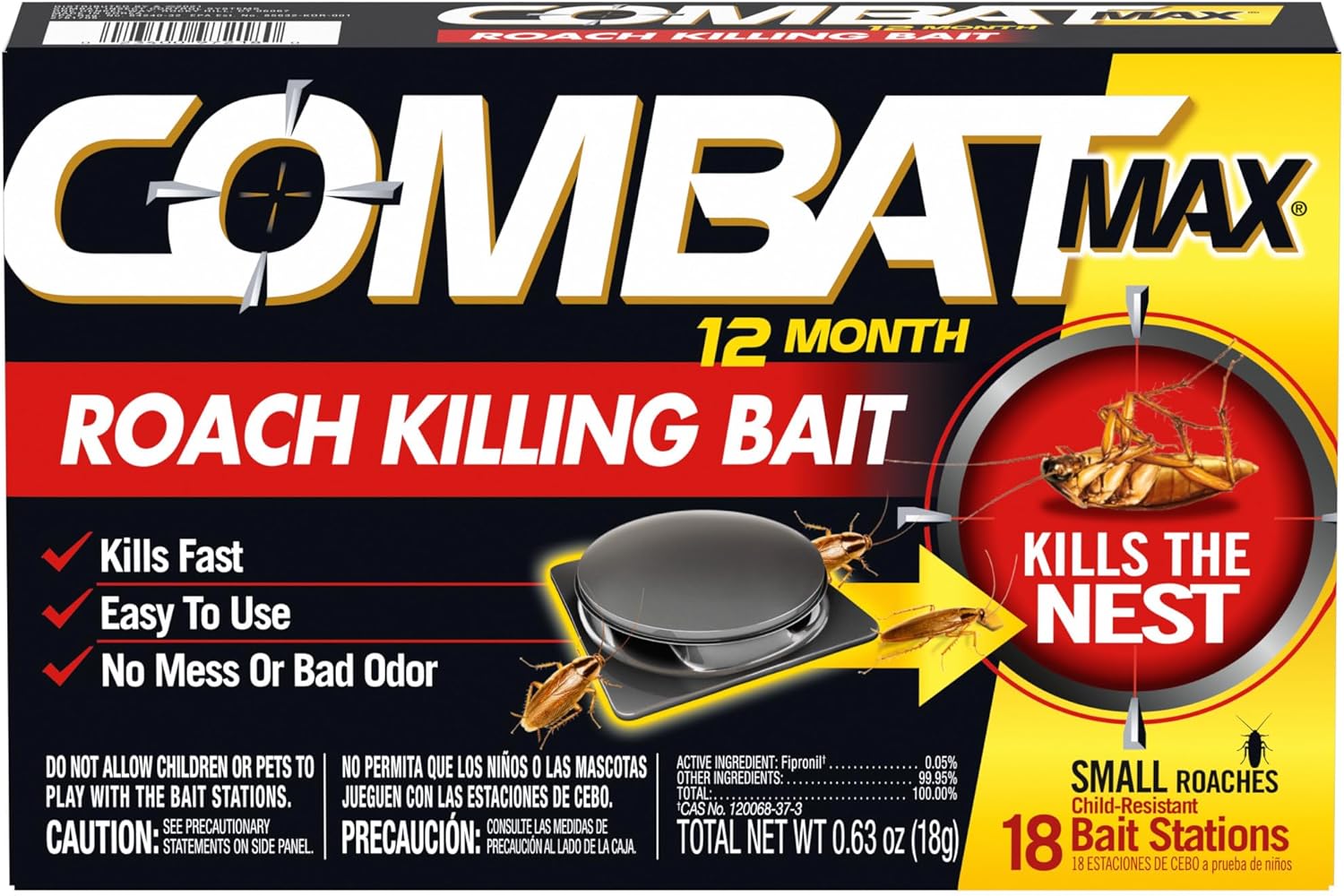
Combat Max 12-Month Roach Killing Bait Stations, 18 Count
| Item model number | 234005196204 |
|---|---|
| Manufacturer | Combat |
| Active ingredient | Fipronil |
| Quantity | 18 bait stations |
| Intended duration | Up to 12 months per station |
Combat Max 12-Month Roach Killing Bait uses fipronil in compact, child-resistant stations to lure small roaches, let them feed, and carry the bait back to the nest to spread the kill. Typical use is simple: place the prefilled stations in warm, dark, moist areas such as under sinks, behind appliances, and inside cabinets where roaches forage. The product promises quick knockdown within hours and continuous residual action for up to a year, so you can set and leave the stations rather than reapplying frequently. The bait is odorless and mess-free, which makes it suitable for kitchens and living areas, and the small entry holes help limit access to children and pets. Limitations are that it targets small roaches specifically and requires complete placement in all infestation hotspots to be most effective; heavy or widespread infestations may still need complementary methods. You should also replace stations annually to maintain protection.
Best for: Buyers who want a low-effort, long-lasting roach control solution they can place and forget around kitchens, bathrooms, and utility areas to reduce re-infestation risk.
Less Ideal for: Those facing large heavy infestations across many rooms or needing immediate control of large roach species should consider professional treatment or additional contact sprays and baits.
- Ready-to-use, mess-free bait stations require no activation
- Fast-acting fipronil formula begins working within hours
- Long residual protection up to 12 months per station
- Child-resistant design with small entry holes for safer placement
- Odorless and vapor-free so suitable for indoor living areas
- Formulated for small roaches so may be less effective against larger species
- Requires placing stations in all key harborages to achieve the ripple-effect elimination
Verdict: A set-and-forget indoor roach bait that delivers fast kill and up to a year of residual protection, ideal for pragmatic homeowners seeking low-maintenance control.
Syngenta Advion Cockroach Gel Bait, 4 x 30 g Tubes

| Item Form | Gel |
|---|---|
| Target Species | Insects |
| Active Ingredients | Carboxylate / Indoxacarb 0.6% |
Syngenta Advion Cockroach Gel Bait is a ready-to-use gel designed for targeted crack-and-crevice applications to eliminate common cockroach species, including German, American, and brown-banded roaches. You dispense small spots of gel into hiding places or along runways using the tube tip, which makes it suitable for homes, commercial kitchens, and industrial sites where discreet placement matters. The active ingredient (indoxacarb 0.6%) is incorporated into a high-performing bait matrix that remains attractive to bait-averse roaches, so you can expect faster knockdown in many infestations compared with simple insecticide sprays. It is labeled for use in food handling areas when applied as directed and can be applied both indoors and outdoors. Limitations include the need for careful spot placement for effectiveness and adherence to label directions to keep pets and children safe. This product treats infestations through baiting rather than broad residual contact, so it works best as part of a sanitation and exclusion plan rather than as a sole long-term barrier treatment.
Best for: Homeowners or facility managers who want a targeted, professional-grade bait to reduce active cockroach populations while integrating with sanitation and exclusion practices.
Less Ideal for: People seeking an instant area-wide spray or long-lasting surface barrier should consider alternative control methods or combined treatments rather than a spot-applied gel alone.
- Formulated gel matrix attracts even bait-averse roaches for higher uptake
- Designed for precise crack-and-crevice placement indoors and outdoors
- Labeled for use in food handling areas when applied according to directions
- Includes professional-strength active ingredient (indoxacarb 0.6%)
- Requires correct placement and periodic reapplication to maintain effectiveness
- Not a surface residual barrier so sanitation and exclusion are still necessary
Verdict: Choose this gel bait when you need a professional, spot-applied solution that attracts and controls bait-averse cockroaches in targeted indoor or outdoor locations.
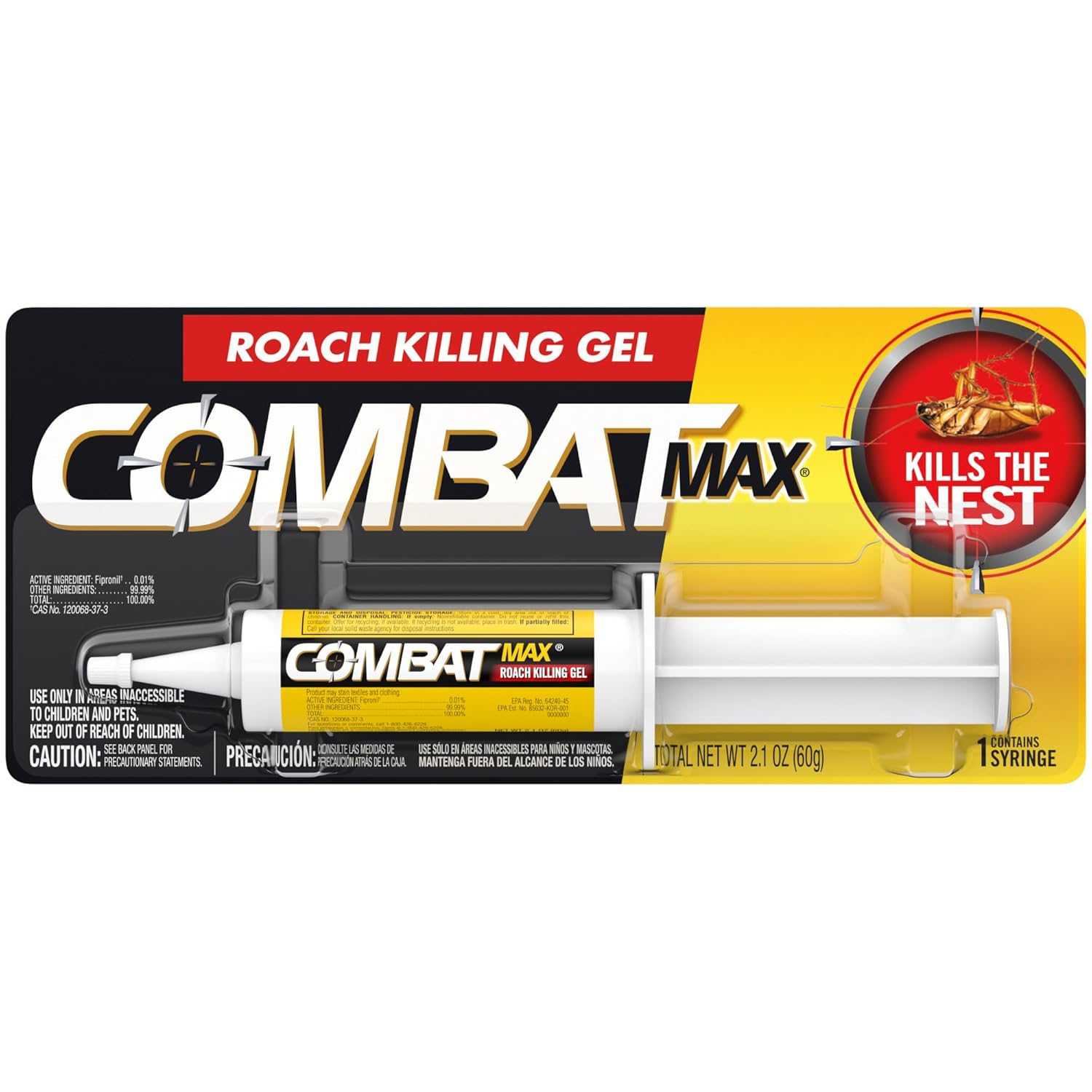
Combat Max Roach Killing Gel, 2.1 oz Syringe
| Unit Count | 2.1 Ounce |
|---|---|
| Item Form | Gel |
| Active Ingredients | Fipronil |
| Special Features | Fast control; for cracks and crevices |
Combat Max Roach Killing Gel is a syringe-applied bait intended for spot treatment of roach activity indoors and in protected outdoor areas. You apply dime-sized spots or short lines of the odorless gel in cracks, crevices, along baseboards and other hiding places; roaches consume the bait, return to the nest, and spread the active ingredient so the infestation is reduced at the source. The formula contains fipronil and is described as fast-acting with residual control up to about three months when kept out of direct sunlight and water. The syringe applicator makes precise placement easy and minimizes mess, and the gel is fume-free so it can be used in kitchens and living areas if applied away from food prep surfaces. Important limitations are that the product requires regular inspection and reapplication when the gel is no longer visible and that outdoor effectiveness drops where sunlight or moisture reach the bait. As with any insecticide, follow safety directions to avoid contaminating food or utensils.
Best for: Buyers who want a proven, targeted gel bait to tackle existing roach problems and prefer solutions that act quickly and provide measurable results backed by widespread use.
Less Ideal for: Those seeking a single, no-maintenance cure or a broad outdoor perimeter treatment exposed to weather should consider alternative methods or professional services.
- Targeted syringe applicator for precise placement in cracks and crevices
- Fipronil-based formula that begins acting within hours and claims long residual control
- Odorless and fume-free so it can be used in occupied spaces when applied correctly
- Requires periodic inspection and reapplication every few months to maintain effectiveness
- Less effective outdoors if exposed to direct sunlight or water which reduces residual action
Verdict: Choose this gel when you need a precise, fast-acting bait that eliminates roaches at the nest and delivers sustained control for up to three months.
HARRIS Boric Acid Roach and Silverfish Killer Powder (16 oz)

| Item Form | Powder |
|---|---|
| Target Species | Insects |
| Active Ingredients | boric acid |
| Unit Count | 1 Count |
This 16 oz HARRIS boric acid powder is a straightforward, no-frills roach and silverfish killer that pairs an attractant lure with a dry powder that continues working as long as it stays dry. You apply it from the puffer-style bottle to cracks, baseboards, behind appliances, and other hard-to-reach hiding spots where insects travel. The lure draws insects to the powder, and affected pests typically die within a few days after contact; the residue can remain effective for weeks in dry locations. Notable features are the built-in food-grade lure, EPA registration for household use, and a compact applicator that makes spot treatments quick. Limitations are inherent to boric acid powder: it must remain dry to work, it is not an immediate knockdown, and extra care is required to keep it away from children and pets. For widespread heavy infestations you will likely need repeated treatments or a complementary baiting strategy to reach deep harborage sites.
Best for: Buyers looking for a low-cost, easy-to-apply solution to reduce roach and silverfish activity in localized areas of the home and who prefer a product that provides lasting residue when applied correctly.
Less Ideal for: Homes needing immediate elimination of a heavy, widespread infestation or users who cannot safely restrict access to treated areas from children or pets.
- Contains a food-grade lure to attract insects to the powder
- Long-lasting residual effect when applied in dry areas
- Puffer applicator allows targeted application into cracks and tight spaces
- EPA registered for use in homes
- Requires dry placement to remain effective and will fail if disturbed or wetted
- Not an instant knockdown—pests can take up to 72 hours to die
Verdict: A budget-friendly, EPA-registered boric acid powder that provides an easy, long-lasting spot treatment for household roaches and silverfish.
Alpine WSG Insecticide — 5 × 10 g Packets with Chemical-Resistant Gloves and Pest ID Card

| Package contents | 5 x 10 g packets, gloves, pest ID card |
|---|---|
| Formulation | Water-soluble granules (WSG) |
| Intended use | Indoor and outdoor pest control |
Alpine WSG comes as concentrated 10 g packets of water-soluble granules that you mix for spot or perimeter treatments, and the package here includes chemical-resistant gloves and a pest identification card. In practice it is used to create ready-to-use sprays for cracks, crevices and baseboards where German roaches hide, or as a perimeter treatment around structures. The included gloves help reduce exposure when handling concentrates and the pest card is a handy quick reference for identifying common household insects. Because it is a granular WSG formulation it offers flexible dilution rates for higher or lower intensity treatments depending on infestation severity. Limitations are that it requires correct mixing and careful application to avoid contact with surfaces where people or pets may be exposed, and it does not include an applicator so you will need a spray bottle or pump sprayer. For buyers prioritizing dependable roach control, the packet format and protective gloves make this a practical option when used with proper safety precautions.
Best for: Best for homeowners or pest-control-minded users who want a reliable, concentrated roach treatment they can mix to match infestation severity and who follow safety procedures when handling insecticides.
Less Ideal for: Not a good fit for users who need a ready-to-use product or who prefer non-chemical control methods.
- Concentrated water-soluble granules allow flexible dilution for spot treatments or broader perimeter applications
- Includes chemical-resistant gloves to reduce exposure when handling concentrate
- Pest identification card helps confirm target species before treatment
- Packet format is easy to store and measure for consistent mixing
- Requires mixing and separate spray equipment which adds setup time
- No applicator included so an appropriate sprayer must be purchased or supplied
Verdict: A concentrated, packeted WSG insecticide with gloves and a pest ID card that gives reliable, flexible treatment options for German roach control when mixed and applied correctly.
Ortho Home Defense Insect Killer for Indoor & Perimeter, 1.33 gal. with Comfort Wand

| Item Form | Spray |
|---|---|
| Target Species | Insects |
| Liquid Volume | 1.33 gallons |
| Active Ingredients | Bifenthrin 0.05%, Zeta-Cypermethrin 0.0125% |
This 1.33 gallon Ortho Home Defense spray is designed to treat both indoor problem spots and the outdoor perimeter of a home to reduce ants, roaches, spiders and many other crawling and flying insects. It comes with a battery-powered Comfort Wand that delivers a continuous spray so you can apply a uniform band around foundations, patios and entry points without bending or pumping. The formula with bifenthrin and zeta-cypermethrin is intended to kill on contact and establish a barrier that the manufacturer says lasts up to 12 months for ants, roaches and spiders on non-porous indoor surfaces. In real-world use that means fewer repeat treatments in busy yard perimeters and around doors and windows. The spray dries clear with minimal fumes which helps for indoor use near kitchens and living areas. Limitations are that this is a chemical insecticide so users should follow safety directions around children, pets and plants and it is not a specific solution for pests not listed on the label. For homeowners focused on strong, perimeter-level protection this product simplifies application and covers a large area per container.
Best for: Homeowners who want a performance-focused perimeter treatment to reduce recurring yard and entry-point insect problems and prefer a ready-to-use product that is easy to apply.
Less Ideal for: People seeking organic or non-chemical control methods or those who need a targeted solution for pests not listed on the label should consider alternative products.
- Includes battery-powered Comfort Wand for continuous, fatigue-free application
- Ready-to-use 1.33 gallon container covers large perimeters without mixing
- Formula creates a barrier claimed to provide up to 12 months protection against ants, roaches and spiders on non-porous indoor surfaces
- Dries clear and gives off minimal fumes, making indoor use more practical
- Contains synthetic insecticides so precautions are required around children, pets and ornamentals
- Protection claims are specific to certain species and surfaces so results vary by pest and conditions
Verdict: A powerful, ready-to-use perimeter and indoor spray for homeowners who want long-lasting, performance-oriented protection against common yard and household insects.
Atticus Talak 7.9% Bifenthrin Indoor/Outdoor Insecticide Concentrate, 32 oz

| Active Ingredient | Bifenthrin |
|---|---|
| Formulation | Suspension Concentrate |
| Liquid Volume | 32 fluid ounces |
| Length of Control | Up to three months |
| Target Species | Insects |
Talak 7.9% is a liquid concentrate for treating lawns, landscaping, outdoor living areas and indoor perimeter spots like baseboards and cabinets. You dilute the concentrate with water to create a spray for barrier treatments, spot applications or lawn mixes; label rates explain how much to mix per gallon depending on the use. The product uses bifenthrin, a proven broad-spectrum active ingredient, and the manufacturer states it controls over 75 species and can give residual control for as long as three months. Its water-based formula dries clear, leaves no odor or visible residue, and is not phytotoxic on plants when used per label. Practical benefits include flexible indoor and outdoor use, clear drying, and a bottle designed for easier pouring. Important limitations are that solutions should be mixed only for same-day use, it is not registered for sale in a few states, and it is not approved for fogger application, so professional-style misting methods are not appropriate.
Best for: Buyers who want a single, reliable product to protect yards, patios and building perimeters from a wide range of common pests and prefer conservative, label-driven application practices.
Less Ideal for: People seeking ready-to-use sprays or fogger-compatible products or those in states where this formulation is not registered should look at alternatives.
- Broad-spectrum control listed for 75+ indoor and outdoor pest species
- Water-based formula that dries clear and leaves no odor or residue
- Flexible label directions for lawns, landscapes, hardscapes and indoor perimeter treatments
- Long residual activity up to three months when applied at recommended rates
- Mixed spray solutions cannot be stored and must be used the same day
- Not approved for fogger application and not available for sale in some states
Verdict: A versatile, water-based bifenthrin concentrate that delivers long-lasting, broad-spectrum outdoor (and perimeter indoor) control when used according to the label.
Choosing the Right Roach Insecticide: Key Factors to Consider
Active Ingredient and Mode of Action
Different active ingredients work in different ways and that affects both immediate results and long-term population control. Fast-acting neurotoxins produce quick visible knockdown but may not affect hidden colonies, while growth regulators or slow-acting baits interrupt reproduction and colony sustainability over time.
Knowing the mode of action helps you choose a product that matches your immediate and follow-up goals. For severe, visible infestations you might prioritize quick knockdown combined with a residual barrier. For chronic problems, incorporating baits or insect growth regulators will reduce future generations and lower the need for frequent reapplication.
Formulation and Application Sites
Roach insecticides come as ready-to-use sprays, concentrated sprays to mix, gel baits, dusts, and aerosol foggers. Each format behaves differently on surfaces and in gaps. Gel baits are valuable inside cabinets and under appliances where roaches forage. Dusts reach voids and wall cavities but require careful placement to avoid exposure to humans and pets. Residual sprays create a protective film on baseboards and entry points but can be less effective if surfaces are frequently cleaned.
Consider where roaches have been seen and choose a formulation suited to that habitat. For example, gel baits are better for kitchens and bathrooms, while perimeter sprays and dusts are better for wall voids and exterior foundation gaps.
Residual Longevity and Reapplication
Residual longevity determines how often you must retreat. Some residual sprays maintain efficacy for weeks on protected surfaces; others break down rapidly under UV light, moisture, or repeated cleaning. Baits typically remain attractive until consumed, but their effective life ends when the bait dries out or is contaminated by food debris.
Factor in the expected cleaning frequency and environmental exposure where you plan to apply treatment. Heavy-traffic areas may need more frequent attention, while protected application sites like crack-and-crevice areas will hold residuals longer.
Safety, Label Restrictions, and Household Compatibility
Safety considerations are critical when applying insecticide inside homes. Labels specify where a product may be used, required protective equipment, re-entry intervals, and any restrictions around food preparation areas, pets, and children. Some products are formulated for indoor use only, others are for outdoor perimeter use, and a few are acceptable for both with specified precautions.
Always follow the label, as it is the legal guidance and provides real-world instructions on keeping occupants safe. When pets or small children are present, prefer baits in tamper-resistant stations or place dusts and sprays out of reach to reduce exposure risk.
Resistance and Integrated Approach
Cockroach populations can develop resistance to certain active ingredients where those chemistries are used repeatedly. Rotating modes of action and combining non-chemical controls reduces selection pressure. Sanitation, exclusion of entry points, and elimination of food and water sources remain essential complements to insecticide use.
Think of insecticide as one component of an integrated pest management approach. Address moisture issues, seal gaps, reduce clutter, and use trapping or monitoring to assess whether treatments are achieving the desired population decline.
Application Ease and Required Equipment
How easy a product is to apply affects whether homeowners will use it correctly. Ready-to-use sprays and consumer gel syringes require little equipment, while concentrated liquids need measuring and mixing. Dust applicators and aerosol carts can place product in voids but may be unfamiliar to casual users.
Choose products that match your comfort level with tools and with the time you can dedicate to follow-up treatments. Easier products reduce the chance of incorrect application, which can lead to ineffective control and wasted product.
When to Use Baits Versus Sprays
Baits and sprays serve different roles in a control plan. Gel baits target foraging roaches and are useful inside cabinets, under appliances, and along baseboards where insects feed. They work quietly and often without visible carcasses, which is useful in sensitive indoor settings.
Residual sprays create a treated barrier on surfaces where roaches travel and can cut off movement between harborages. Use sprays for perimeter treatments, gaps, and baseboards, but avoid contaminating food-contact surfaces. Dusts are best for wall voids and tight spaces where sprays cannot penetrate.
- Use baits for targeted indoor control and population knockdown over time.
- Use residual sprays to protect entry points and treat visible runways.
- Use dusts for inaccessible voids and crevices; exercise caution around pets.
Safe Application Practices for Indoor Use
Read and follow label directions every time. Labels list allowable indoor sites, personal protective equipment, and re-entry instructions. Avoid spraying food preparation surfaces directly and remove or cover utensils, pet bowls, and food before application.
When using baits, place them in tamper-resistant stations or behind appliances to reduce accidental contact. For dusts, apply sparingly and only in voids or cracks where dust will not be disturbed. Keep treated areas ventilated and wash hands after handling any product.
- Wear gloves and avoid inhaling sprays or dusts.
- Keep children and pets away from freshly treated areas until label-specified times have passed.
Monitoring Results and When to Reapply
After initial treatment, monitor activity with sticky traps and visual checks. Expect to see reductions within days with effective baiting, though complete elimination of a colony can take weeks. Residual sprays should be checked monthly in high-traffic areas and after heavy cleaning.
If activity persists, reassess sanitation, hiding spots, and potential reinfestation sources such as neighboring units or exterior populations. Alternate modes of action if repeated treatments with the same chemistry show diminishing returns.
- Use traps to gauge population decline rather than relying on anecdotal sightings.
- Plan follow-up treatments based on observed activity and label reapplication intervals.
Combining Chemical and Nonchemical Controls
Chemical tools are more effective when combined with nonchemical measures. Seal cracks and gaps, fix plumbing leaks, and reduce food and water availability to make treated bait and residuals more effective. Roaches thrive in clutter and moisture, so structural fixes reduce long-term dependence on insecticides.
Consider mechanical exclusion and targeted sanitation as first steps in newly identified infestations. Use chemical products strategically to reduce population pressure while you complete longer-term repairs and cleaning.
- Seal entry points and eliminate water sources.
- Clean up spilled food and store food in sealed containers to improve bait uptake.
Legal and Environmental Considerations
Many insecticides have specific legal labels governing where and how they may be used. Indoor residential labels differ from agricultural or industrial labels. Follow federal and local regulations and read label language about allowable uses and disposal instructions.
Consider environmental exposure when applying outdoors. Avoid runoff into storm drains and apply perimeter treatments at recommended distances from flowering plants to protect pollinators. Use targeted applications rather than broad broadcast spraying to limit non-target impacts.
- Dispose of unused product and containers as directed on the label.
- Avoid treating areas that will drain into natural waterways or that support pollinators.
How We Chose the Best Roach Insecticide
We prioritized practical, measurable attributes that matter for controlling roach populations in and around homes. Key evaluation criteria included knockdown speed to assess how quickly visible insects are immobilized, residual effectiveness to estimate how long treated surfaces remain protective, and safety profile for household use including labeled indoor applications and restrictions. We also evaluated formulation suitability, distinguishing spray, gel bait, and dust formats for common treatment sites such as cracks, crevices, under appliances, and perimeter soil. Ease of application and reapplication frequency were considered to reflect how much ongoing effort a homeowner should expect. Label clarity and recommended use sites were reviewed to ensure safe and effective real-world deployment. Excluded items included general pest sprays not labeled for cockroach control and products intended only for agricultural or industrial settings. We did not consider brand popularity alone; instead we focused on concrete, specifiable performance and safety details that a typical homeowner can verify and use.
FAQ
How long before I should expect to see fewer roaches after treatment?
You can often see fewer visible roaches within a few days when using effective baits or fast-acting sprays. Complete control of a colony can take several weeks, especially if eggs are present or if there are hidden harborages.
Is it safe to use residual sprays in kitchens?
Some residual sprays are labeled for indoor use around baseboards and cracks but not on food-contact surfaces. Always follow the label, remove or cover food and utensils during application, and ventilate treated areas as directed.
Should I use baits and sprays at the same time?
Yes, combining baits and targeted residuals is a common strategy. Use baits where roaches forage and apply residuals to travel paths and entry points. Avoid contaminating bait stations with spray residues so baits remain attractive.
Can I rely only on traps to control roaches?
Traps are useful monitoring tools and can remove some insects, but they rarely eliminate an established infestation. Traps should be part of an integrated approach that includes sanitation, exclusion, and appropriate insecticide use.
How do I avoid resistance issues?
Rotate products with different modes of action and combine chemical measures with nonchemical controls. Avoid repeated heavy reliance on a single active ingredient in the same area to reduce selection pressure.
Final Verdict
Choose a roach insecticide strategy that matches the infestation pattern and your household constraints. Prioritize a combination of timely knockdown and a longer-lasting residual or bait to address both visible insects and hidden colonies. Give extra weight to label safety, formulation suitability for the treatment site, and integration with sanitation and exclusion measures. When in doubt, start with targeted baits and nonchemical fixes, then add residual barrier treatments in inspection-identified runways. That approach balances immediate reduction with longer-term suppression and minimizes unnecessary exposure.
