

Note: This article contains affiliate links. If you click on these links and make a purchase, I may earn a small commission at no extra cost to you. This helps support my research and content. Read my full affiliate disclosure here.
Choosing the right 12 station irrigation controller matters because it determines how evenly and efficiently your lawn, garden beds, and shrubs get water through the season. A controller that is easy to program and durable in outdoor conditions reduces wasted water, prevents plant stress, and saves you time on manual adjustments. This guide covers our top shortlisted 12 station irrigation controllers for the stated scope. We evaluated each option for setup and programming, outdoor durability, and how well it integrates with moisture-based or smart scheduling tools. Read on to find a controller that matches your irrigation layout and maintenance preferences.
Top Picks at a Glance
| Best Overall The best all-around choice for most situations | ImoLaza Ultra 12-Zone Wi‑Fi Smart Sprinkler Controller |  |
| Best Quality Built to a higher standard if you want something more solid | Hunter PRO-HC PHC-1200 12-Station Wi‑Fi Irrigation Controller with Hydrawise |  |
| Best Value The sweet spot between price and what you get | ImoLaza ET Master 12-Zone Wi‑Fi Smart Sprinkler Controller |  |
| Best Budget The cheapest option that still gets the job done reliably | Orbit Easy Set Logic 12-Station Indoor/Outdoor Sprinkler Timer (Model 57900) |  |
| Highest Rated A top-rated pick with lots of positive feedback | HiOazo Outdoor Smart Sprinkler Controller, Wi‑Fi, 12‑Zone |  |
| Most Popular A crowd favorite that many people choose with confidence | Orbit B-hyve Smart Indoor/Outdoor 12-Zone Sprinkler Controller |  |
| Best Seller A high-volume bestseller chosen again and again | Hunter PRO‑HC WiFi Smart Sprinkler Controller, 12‑Zone |  |
ImoLaza Ultra 12-Zone Wi‑Fi Smart Sprinkler Controller

| Zones | 12 |
|---|---|
| Voltage | 120 volts |
| Display Type | LED |
| Operating Temperature | 140 °F |
| Material Type | Acrylonitrile Butadiene Styrene (ABS) |
The ImoLaza Ultra is a full‑featured smart sprinkler controller built for reliable, automated watering across up to 12 zones. It connects to Wi‑Fi and the ImoLaza app to create and run customized schedules, or it can continue operating from its internal real‑time clock if the network or power goes down. Key features include weather‑based and evapotranspiration adjustments, saturation skip per zone, smart cycle‑and‑soak, pump start delay, surge protection, and fault detection with app alerts. Those features translate to less manual scheduling, reduced runoff, and quick notices if a short or leak is detected. The unit supports flow and rain sensors and offers shared access and water‑use reports for monitoring. Trade‑offs to consider are that advanced setup (plant/nozzle/soil parameters and multiple program modes) takes time to configure and that full benefit depends on using the app and network features even though basic operation continues offline. For large residential yards or light commercial sites that need dependable, automated irrigation and protection from electrical faults, the Ultra delivers robust performance.
Best for: Buyers who prioritize a dependable, hands‑off irrigation system for a larger yard or light commercial site and want automated, weather‑adjusting control with system safeguards.
Less Ideal for: People who want a very simple, no‑app controller for a tiny yard or who prefer only mechanical timers without smart features.
- Weather‑aware scheduling with ET and smart weather skip reduces unnecessary watering.
- Per‑zone saturation skip and cycle‑and‑soak improve absorption and cut runoff.
- Built‑in fault detection, surge protection, and RTC keep the system running and alert you to problems.
- Supports sensors and pump start delay for compatibility with wells and commercial setups.
- Shared access, voice control, and water‑use reports simplify monitoring and multi‑user management.
- Advanced customization requires time in the app to input plant, soil, and nozzle parameters.
- Relies on the app for the easiest experience so users who avoid apps lose some convenience.
Verdict: If you need a robust, weather‑smart controller that continues running during outages and actively alerts you to faults, the ImoLaza Ultra is a reliable choice for larger residential or light commercial irrigation.
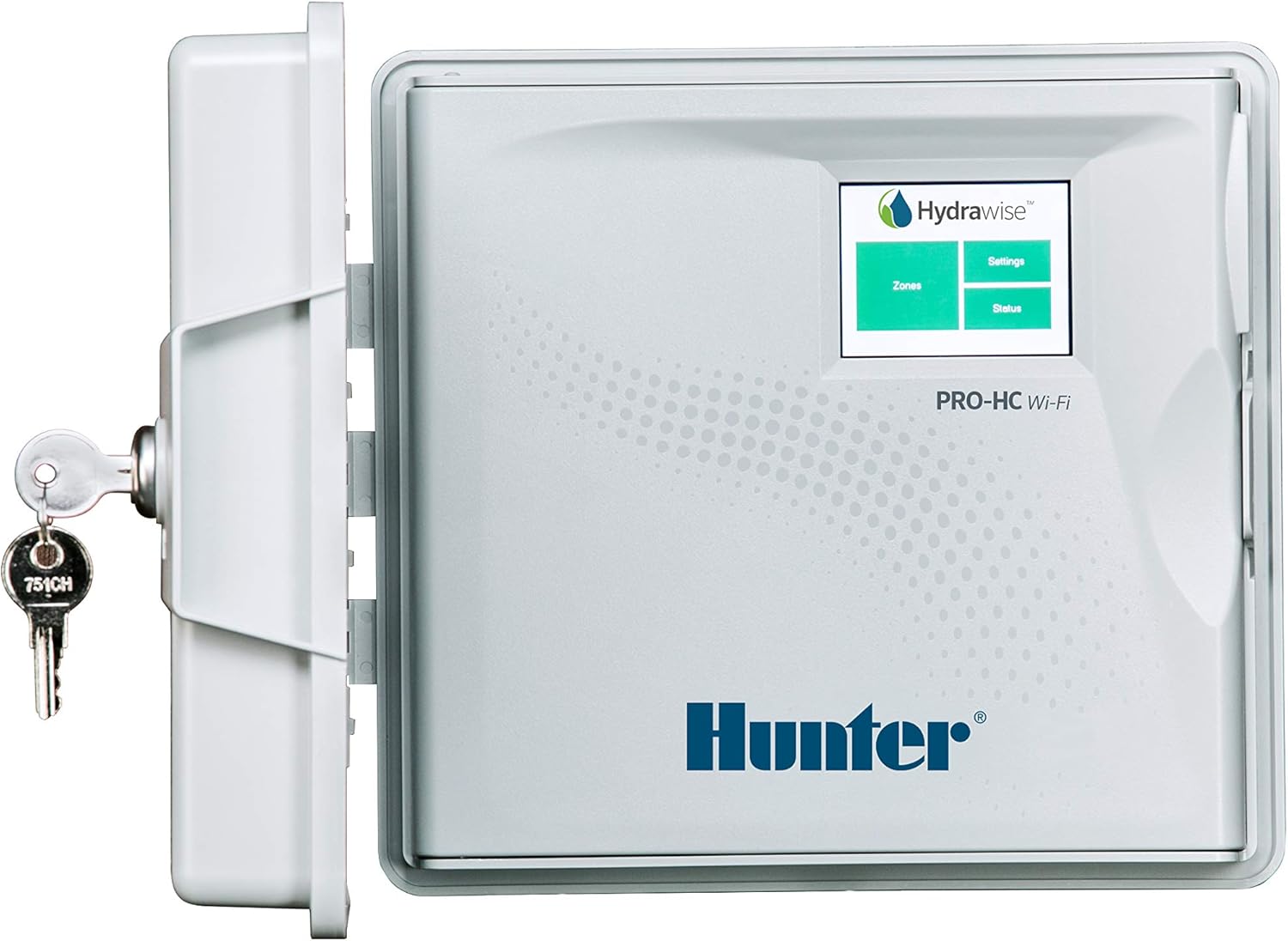
Hunter PRO-HC PHC-1200 12-Station Wi‑Fi Irrigation Controller with Hydrawise
| Unit Count | 12 Count |
|---|---|
| Voltage | 120 volts |
| Display Type | LCD or LED |
| Material Type | Plastic |
The Hunter PRO-HC PHC-1200 is a professional-grade 12-station Wi‑Fi irrigation controller designed for reliable residential use. It connects to Hunter's Hydrawise web-based platform so you can create and adjust schedules remotely, monitor run times, and receive system warnings. The unit installs in place of a standard controller and provides an LCD display for local programming plus automatic seasonal adjustments when linked to weather data. Build quality is typical of Hunter equipment with a plastic enclosure and standard 120V power. Practical benefits include centralized control of multiple zones, reduced manual visits to the timer, and the ability to fine-tune watering based on weather forecasts. Limitations are that this model is focused on automated scheduling rather than advanced on-site diagnostics and it requires a stable Wi‑Fi connection and account setup to access the cloud features. It is best for users who prioritize dependable, remote-managed irrigation rather than ultra-simple analog timers.
Best for: Homeowners who need a dependable multi-zone controller and want to manage watering remotely using weather-based schedules and a web interface.
Less Ideal for: People who want a completely offline or ultra-simple mechanical timer or those without stable home Wi‑Fi who cannot use cloud features.
- Controls up to 12 irrigation stations for multi-zone yards
- Wi‑Fi connectivity with Hydrawise web software for remote scheduling and seasonal adjustments
- LCD display for clear local programming and status
- Standard 120V power compatibility for residential electrical systems
- Requires a reliable Wi‑Fi connection and Hydrawise account to access full remote features
- Plastic enclosure offers less ruggedness than metal weatherproof housings
Verdict: Buy this if you want a reliable 12‑station Wi‑Fi controller that puts remote, weather‑aware scheduling and centralized zone control at the center of your irrigation system.
ImoLaza ET Master 12-Zone Wi‑Fi Smart Sprinkler Controller

| Zones | 12 Count |
|---|---|
| Voltage | 120 volts |
| Display Type | LCD or LED |
| Operating Temperature | 140 °F |
The ImoLaza ET Master is a feature-rich 12-zone Wi‑Fi sprinkler controller built to replace a traditional timer and automate watering with minimal fuss. It installs as a DIY upgrade in roughly 15–30 minutes using the included screws, screwdriver and pre-labeled wire terminals, then connects to your home 2.4 GHz network and the ImoLaza app for remote control. The controller’s real-time ET algorithm and built-in weather intelligence automatically adjusts run times daily and will skip cycles for rain, high wind, freeze or saturated soil so you only water when needed. The app supports flexible scheduling including many start times per zone and voice control through Alexa or Google Assistant. Practical benefits include reduced water use, fewer manual schedule changes and alerts for abnormal system conditions. Limitations to note are the need for a 2.4 GHz Wi‑Fi network and basic comfort with wiring a controller replacement; advanced users expecting integrated soil or rain sensors can still add them but they are not required. This unit is well suited to homeowners who want large-zone smart watering and frequent automatic adjustments to save water and time.
Best for: Homeowners managing a larger yard who want to cut water use and hands-on schedule tweaking by letting an automated, weather-driven system handle daily adjustments.
Less Ideal for: People without reliable 2.4 GHz Wi‑Fi at the controller location or those who prefer a plug-and-play device that requires no wiring or setup.
- Real-time ET algorithm and hyperlocal weather intelligence automatically adjust watering and skip unnecessary cycles
- Built-in 2.4 GHz Wi‑Fi and free app provide remote scheduling and voice control without subscription
- Supports 12 independent zones for larger yards or complex landscapes
- Fast DIY installation with pre-labeled wires and included mounting hardware
- Requires a 2.4 GHz Wi‑Fi connection so remote features may be limited where Wi‑Fi is weak
- Basic electrical wiring and controller replacement skills are needed for installation
Verdict: If you need a 12-zone controller that intelligently reduces water use and largely automates scheduling, the ImoLaza ET Master delivers practical, weather-driven irrigation control without a subscription.
Orbit Easy Set Logic 12-Station Indoor/Outdoor Sprinkler Timer (Model 57900)

| Stations | 12 |
|---|---|
| Voltage | 24 volts |
| Programs | 3 programs, 4 start times per program |
| Run time | 1–240 minutes per zone |
The Orbit Easy Set Logic 12‑station timer provides a simple, dependable way to automate a medium to large residential irrigation system. It mounts indoors or outdoors in a locking weatherproof cabinet and uses a swing panel with push‑wire terminals to make wiring and zone setup quick for a DIY installer or contractor. Programming follows Orbit’s Easy‑Set logic with three independent programs, four start times per program, and per‑zone run times from 1 to 240 minutes, which supports cycle‑and‑soak scheduling and stacking of runtimes to avoid simultaneous valve draws. The unit includes battery backup to preserve programming, a rain delay and sensor relay, and a pump/main valve relay for systems that need a pump start. Practical benefits are straightforward: dependable basic automation, easy installation, and features that conserve water like rain delay and multiple start times. Limitations are that it is not a smart/wifi model so you cannot control or monitor it remotely, and it lacks auto‑weather adjustment found on modern smart controllers. For buyers prioritizing simplicity and low cost, it covers core needs without extra connectivity complexity.
Best for: Homeowners or installers who want an affordable, reliable 12‑zone controller that handles full manual scheduling and basic water‑saving features without the complexity of smart systems.
Less Ideal for: Users who want app control, cloud-based scheduling, or automatic weather‑based adjustments should choose a modern smart controller instead.
- Supports up to 12 independent stations with three programs and four start times per program for flexible scheduling
- Weatherproof locking cabinet with two keys allows indoor or outdoor mounting and tamper protection
- Easy wiring via swing panel and push‑wire terminals speeds installation and maintenance
- Battery backup preserves programming during power outages and surge protection helps protect the transformer
- Includes rain delay and relay for freeze/rain sensor plus pump/main valve start capability
- No Wi‑Fi or smart features for remote control or automatic weather adjustments
- Basic LCD interface and programming require manual changes for seasonal adjustments
Verdict: A budget‑friendly, no‑frills 12‑station controller that delivers reliable, easy‑to‑install irrigation scheduling for homeowners who do not need smart features.
HiOazo Outdoor Smart Sprinkler Controller, Wi‑Fi, 12‑Zone

| Wi‑Fi frequency | 2.4GHz |
|---|---|
| Zones supported | 12 zones |
| Programmable plans | 16 plans |
| Irrigation modes | Standard and Soak |
The HiOazo Outdoor Smart Sprinkler Controller replaces a traditional timer with a cloud‑connected controller you manage from the HiOazo app over 2.4 GHz Wi‑Fi. It is typically installed at the irrigation control panel and used to schedule watering across multiple zones, with options for Standard or Soak irrigation modes. Notable features include support for up to 12 zones and 16 separate watering plans so you can tailor schedules for different plant beds, plus automatic skipping for rain, freeze, and wind to avoid unnecessary runs. The app control makes remote adjustments and monitoring straightforward, and the company advertises a quick DIY install that should fit most existing systems. Limitations to consider are dependence on 2.4 GHz Wi‑Fi and the app ecosystem for smart features, so local manual control is less convenient if your network is unreliable. The controller appears aimed at homeowners who want flexible, weather‑aware scheduling without professional setup, but expect connectivity and app reliance to be central to day‑to‑day use.
Best for: Homeowners who prioritize a dependable, weather‑smart irrigation schedule and want remote control to reduce overwatering without hiring a pro.
Less Ideal for: People with unreliable Wi‑Fi, those who need purely local/manual controllers, or users who prefer controllers that operate without any app dependency.
- Supports up to 12 irrigation zones and 16 separate watering plans for flexible scheduling
- Weather‑aware auto skip for rain, freeze, and wind helps conserve water and protect plants
- App control over 2.4 GHz Wi‑Fi lets you monitor and adjust schedules remotely
- Two irrigation modes (Standard and Soak) allow better soil absorption management
- Requires a 2.4 GHz Wi‑Fi network and app for full smart functionality
- Relies on cloud/app ecosystem so offline/manual operation is limited
Verdict: Choose this controller if you want a dependable, weather‑sensing Wi‑Fi system that simplifies hands‑off irrigation across many zones.
Orbit B-hyve Smart Indoor/Outdoor 12-Zone Sprinkler Controller

| Stations | 12 |
|---|---|
| Voltage | 110 volts |
| Display Type | LCD or LED |
| Operating Temperature | 70 °C |
The Orbit B-hyve 12-zone controller brings smart scheduling and remote control to a full-sized residential irrigation system. Install it on an indoor wall or mount it outdoors inside its weatherproof enclosure, wire up valves for up to twelve zones, then use the free mobile app to create custom programs, start or stop zones, and make on-the-fly adjustments from anywhere. The key feature is WeatherSense, which pulls local weather data to automatically reduce or increase watering so you do not overwater after rain or undersupply in dry spells. The LCD console provides a second way to program the controller on site. For practical homeowners this unit streamlines irrigation management across lawns, flower beds, vegetable patches, and drip lines and can be integrated with voice assistants. Limitations to note are that advanced commercial features are absent and setup requires basic wiring familiarity or a pro for complex systems. The plastic enclosure and typical interface keep installation and daily use straightforward while cutting water waste through automated, weather-aware scheduling.
Best for: Homeowners who want to optimize water use across a multi-zone yard with minimal daily intervention and who value remote control and weather-based automation.
Less Ideal for: Large commercial sites or installers needing enterprise features and advanced telemetry should consider controllers designed for professional irrigation systems.
- Supports up to 12 independent watering zones for flexible landscape layouts
- Wi-Fi and app control enable remote scheduling and manual operation from anywhere
- WeatherSense adjusts watering automatically using local weather data to save water
- Weatherproof indoor/outdoor enclosure allows outdoor mounting without extra housing
- Requires basic valve wiring and setup which can be challenging for beginners
- Controls and enclosure are plastic rather than heavy-duty materials preferred for harsh environments
Verdict: This controller is the practical choice for homeowners who want reliable multi-zone automation and water-saving weather intelligence with easy remote control.
Hunter PRO‑HC WiFi Smart Sprinkler Controller, 12‑Zone

| Zones | 12 station |
|---|---|
| Connectivity | WiFi (Hydrawise) |
| Display | Full‑color touchscreen |
| Sensor support | Rain, flow meter, sensor inputs |
The Hunter PRO‑HC is a professional‑grade 12‑zone irrigation controller aimed at homeowners or property managers who want precise, water‑saving automation. It pairs a full‑color touchscreen for fast on‑site setup with WiFi and the Hydrawise app for remote scheduling, alerts, and system monitoring. The controller uses predictive weather‑based adjustments that factor in rainfall, temperature, wind, and humidity so run times are reduced when conditions require less water. It also supports sensors, a flow meter, master valve output, and built‑in wire fault detection for more reliable operation and proactive maintenance. Typical use is mounting outdoors or indoors near the irrigation manifold, programming zones locally or in the app, then letting Hydrawise fine‑tune durations daily. The main limitations are that it is optimized for users who want a robust, expandable system rather than a minimal plug‑and‑play timer and installation typically requires basic wiring familiarity or contractor help for more complex setups.
Best for: Buyers who want a reliable, water‑saving smart controller that can manage a full yard or small commercial landscape and who value remote management and expandability.
Less Ideal for: People who need a very simple plug‑and‑play sprinkler timer for one or two zones or who prefer a basic mechanical controller without WiFi features.
- Smart, weather‑based scheduling that adjusts run times using local forecast and conditions
- WiFi with Hydrawise app for remote control, alerts, and monitoring
- Full‑color touchscreen for easy local programming without the app
- Supports flow meters, sensors, and master valve output for expanded monitoring and safety
- Installation and wiring for multi‑zone systems can be complex for novice DIYers
Verdict: Choose the PRO‑HC if you want a 12‑zone, app‑driven controller that saves water with predictive weather scheduling and professional expansion options.
Choosing the Right 12 Station Irrigation Controller: Key Factors to Consider
Programming Flexibility
How many independent programs, start times, and run intervals the controller supports determines whether you can fine-tune watering for lawns, drip beds, and shrubs separately. Look for controllers that let you set multiple start times per program and adjust run durations per station so you can water slow-drip zones without overwatering turf.
Flexible programming also helps with seasonal changes. Being able to set different weekday and weekend schedules or quick seasonal adjustments cuts down on manual intervention and reduces stress on plants during heat waves or extended wet periods.
Outdoor Durability and Enclosure Quality
A controller mounted outdoors must resist rain, sun, and temperature swings. Watertight seals, UV-stable plastics, and a well-designed gasket protect internal electronics from corrosion and failure. Metal cabinets can offer better long-term protection but may require rust-resistant finishes.
Consider the mounting location in your yard. If the unit will be exposed to direct sunlight or frequent spray from sprinklers, a higher-grade enclosure and a protective hood or recessed installation will extend service life and reduce electronic faults.
Sensor Integration and Smart Features
Compatibility with rain sensors, soil moisture probes, and weather-based controllers matters for water conservation and plant health. Basic sensor inputs let you stop watering during rain or suspend schedules when soil moisture is adequate. Advanced smart integration with Wi-Fi or smart-home systems can allow remote adjustments and weather-based automatic schedule changes.
Decide how much automation you want. Simple sensor support offers reliability and low maintenance, while smart features add convenience and remote diagnostics but may require network setup and occasional firmware updates.
Wiring, Terminal Accessibility, and Expansion
Clear, durable terminals and organized wiring layouts make installation and future maintenance easier. Terminals that accept multiple conductor sizes or include labeled rows save time during hookup of multiple valves and sensors. Removable terminal blocks or easy-access panels are helpful for troubleshooting without dismantling the whole unit.
Also consider whether the controller supports future expansion through add-on modules or spare relay capacity. If you expect to add zones, pumps, or master valve control later, choose a unit with flexible wiring options and clear documentation.
Backup Power and Schedule Retention
Losing programmed schedules after a power outage can create intermittent under- or over-watering. Controllers with non-volatile memory or battery backup preserve programming and clock settings. Some have supercapacitors or small coin cells to retain time and settings for extended outages.
Reliable power handling also includes surge protection and proper fuse design. Controllers that isolate valve circuits from control electronics reduce the chance of damage during electrical faults.
Typical 12 Station System Layouts
A 12 station controller can manage a variety of landscape arrangements. Common setups include dividing a medium lawn into multiple zones by slope or exposure, assigning separate drip zones for beds and containers, and controlling separate shrub or tree watering circuits. Grouping similar hydrozones helps you set efficient run times and prevents one zone from dictating the entire schedule.
When planning wiring and valve placement, position valves near the hydraulic layout to minimize long runs of small-diameter tubing. Use a schematic to label each station by area and typical runtime so programming is straightforward during installation.
- Lawns: multiple turf zones based on slope and sun exposure
- Beds: low-volume drip zones that need longer runtimes
- Trees and shrubs: infrequent deep soaking cycles
- Auxiliary: master valve or pump start for well systems
Mounting and Location Tips
Mount the controller where it is sheltered from direct spray and not exposed to standing water. A wall with an overhang, inside an equipment box, or under a small protective hood reduces UV and water exposure. Keep the unit within reach of where valve wiring converges to minimize conduit runs.
Ensure the chosen location has a stable power source and, if applicable, a reliable Wi-Fi signal. For controllers that rely on wireless features, test network performance before final mounting. Also position sensor wiring routes so they do not run parallel to high-voltage lines to reduce interference.
- Avoid direct sprinkler spray and prolonged sun exposure
- Place near valve manifold to shorten wiring
- Check Wi-Fi signal if using smart features
- Use conduit or protected cable runs for durability
Integrating Rain and Soil Sensors
Simple rain or freeze sensors provide a reliable failsafe to stop scheduled runs during unsuitable weather. Soil moisture sensors are better for precision irrigation because they respond to actual root-zone conditions rather than just surface rainfall. Decide whether you want an interrupting sensor that halts all stations or a per-zone moisture control system that makes finer adjustments.
When wiring sensors, use shielded cable if runs are long and avoid routing next to high-current lines. Test sensor operation after installation and calibrate soil probes according to your soil type to avoid false triggers.
- Rain sensors stop watering during precipitation
- Soil probes measure root-zone moisture for precision
- Consider per-zone moisture control for mixed plantings
- Calibrate sensors to local soil conditions
Hydraulic Considerations and Master Valves
If your irrigation uses a pump or has a master valve, ensure the controller provides a dedicated relay or common output for pump start or master valve control. This coordination prevents incorrect sequences that could damage pumps or cause low-pressure issues across zones. Controllers that can delay station starts to allow pump spin-up are preferable.
Also check whether the controller supports flow sensors or alerts for abnormal run times. Even without manufacturer-specific features, you can design the system with flow switches and an interlock to protect plumbing and detect broken heads.
- Use pump/master valve outputs when required
- Allow delay for pump start before valve activation
- Implement flow sensing for leak detection
- Match valve surge characteristics to controller capacity
Maintenance and Troubleshooting Basics
Regular maintenance includes checking terminals and wire insulation, testing sensor operation, and exercising valves periodically. Winterizing irrigation in cold climates is critical: drain controllers where required and protect exposed wiring and valves from freeze damage. For controllers with removable modules, inspect connectors for corrosion.
When troubleshooting, start with power and fuse checks, then confirm clock accuracy and program retention. Swap suspected sensor or valve wiring to isolate faults before replacing components.
- Inspect wiring and terminals annually
- Exercise valves to prevent sticking
- Protect or drain systems for freeze-prone climates
- Start diagnostics with power and clock checks
How We Chose the Best 12 Station Irrigation Controller
We focused on features and performance that matter most to gardeners and landscape stewards using a 12 station irrigation controller. Primary evaluation criteria included setup and programming flexibility, coverage and scheduling capability for multi-zone systems, outdoor durability and weather sealing, and compatibility with sensors and smart home or moisture-sensing add-ons. We also considered wiring and terminal design for straightforward installation, and the robustness of backup and power protection features to avoid schedule loss. To build the list we filtered out controllers intended only for small domestic systems with fewer than 12 zones, indoor-only units without proper outdoor enclosures, and controllers lacking basic seasonal adjustment or sensor inputs. We prioritized options that balance practical installation details and long-term reliability rather than speculative features that do not affect daily watering performance. The final picks represent devices that are likely to meet the needs of medium to large residential landscapes and small commercial plots.
FAQ
Can a 12 station controller run drip and sprinkler zones on the same schedule?
Often you should avoid identical schedules because drip systems usually need longer, lower-volume runs while sprinklers need shorter, higher-flow cycles. Use separate programs or start times so each zone gets the correct run length and avoid overlapping high-demand runs on the same supply line.
How do I protect my controller from power outages and surges?
Look for controllers with non-volatile memory or battery backup for schedule retention, and install a basic surge protector on the circuit feeding the unit. Regularly check fuses and ground connections, and avoid mounting the controller where water intrusion can reach electrical components.
Is wireless or Wi-Fi control worth it for a residential 12 station system?
Wireless control adds convenience for remote adjustments and weather-based scheduling, which can save water. It does require reliable network access and occasional updates. If you prefer simple, low-maintenance operation, a robust wired controller with sensor inputs may be sufficient.
Do I need a professional to install a 12 station controller?
Many homeowners can install a controller if they are comfortable with basic wiring and follow the manufacturer's wiring diagrams. However, complex hydraulic setups, pump start circuits, or local electrical code requirements may justify professional help to ensure safety and correct operation.
How should I size transformer capacity for a 12 station controller?
Transformer sizing depends on the inrush and hold current of your valve solenoids and the number of valves you may operate simultaneously. Choose a transformer with sufficient VA rating to handle simultaneous valve activation and follow the controller documentation for recommended transformer specifications.
Final Verdict
A 12 station irrigation controller gives you the flexibility to manage medium to large landscapes with separate programs for turf, beds, and specialty zones. Prioritize controllers that make programming straightforward, protect electronics from outdoor exposure, and integrate with the sensors or smart features you plan to use. Consider wiring convenience and backup options when choosing a unit so installation and seasonal maintenance are uncomplicated. Balance your need for automation against simplicity. If you want low maintenance and high reliability, favor durable enclosures and proven sensor compatibility. If remote access and weather-based scheduling matter most, make sure the controller you choose supports those integrations reliably.
