

Note: This article contains affiliate links. If you click on these links and make a purchase, I may earn a small commission at no extra cost to you. This helps support my research and content. Read my full affiliate disclosure here.
If you are trying to keep spiders out of living spaces, storage areas, or outdoor sitting areas, the right insect repellent can make routine maintenance much easier. This guide focuses specifically on insect repellents for spiders and looks at products that balance lasting protection with safe, usable application around a garden, patio, and home envelope. We shortlisted seven top options that perform well for the typical chores gardeners and homeowners face, and evaluated them on factors like how long they last and how they interact with building surfaces and plants. Read on to find which repellent type and features match your situation and application style.
Top Picks at a Glance
| Best Overall The best all-around choice for most situations | Ortho Home Defense Max Indoor Insect Barrier, 1 gal. (Wand Ready) |  |
| Best Quality Built to a higher standard if you want something more solid | Terro T2302 Spider and Insect Killer Aerosol, 16 oz, 2-Pack |  |
| Best Value The sweet spot between price and what you get | Mighty Mint Peppermint Oil Insect Repellent Spray, 16 oz |  |
| Best Budget The cheapest option that still gets the job done reliably | STEM Plant-Based Bug Spray for Ants, Roaches & Spiders, 10 oz |  |
| Highest Rated A top-rated pick with lots of positive feedback | Cvtayn Ultrasonic Indoor Pest Repeller, 6-Pack |  |
| Most Popular A crowd favorite that many people choose with confidence | Ortho Home Defense Insect Killer for Indoor & Perimeter, 1.33 gal. |  |
| Best Seller A high-volume bestseller chosen again and again | Jqely Ultrasonic Indoor Pest Repeller, 10-Pack |  |
Ortho Home Defense Max Indoor Insect Barrier, 1 gal. (Wand Ready)

| Unit Count | 128 Fluid Ounces |
|---|---|
| Item Form | Spray |
| Target Species | Insects |
| Liquid Volume | 1 gallons |
| Active Ingredients | bifenthrin 0.05% |
Ortho Home Defense Max is a one-gallon, ready-to-use indoor insect spray that creates a barrier to kill and prevent common household pests including spiders, ants, roaches and more. It is applied using the included Extended Reach Comfort Wand so you can treat baseboards, doorframes and hard-to-reach corners without bending. The formula is fast-drying, advertised as non-staining and low-odor so treated rooms are usable once surfaces dry. For indoor spider control it works as both a spot treatment where you see activity and as a preventative band along entry points; outdoor perimeter applications are also recommended every three months to reduce re-entry. The active ingredient is bifenthrin 0.05%, a standard synthetic pyrethroid effective on crawling insects. Important limitations are that it is for nonporous indoor surfaces and perimeter use only and it requires following label safety instructions around children and pets until dry. Expect reliable seasonal suppression rather than complete elimination of all spiders in heavily infested structures.
Best for: Homeowners who want a straightforward, long-lasting indoor perimeter treatment to reduce spider activity without frequent reapplication and who prefer an easy-to-use wand for spot and barrier treatments.
Less Ideal for: People seeking an organic or insecticide-free option or those needing rapid knockdown for very heavy indoor infestations should consider alternative products or professional services.
- Ready-to-use gallon with an Extended Reach Comfort Wand for easier application in corners and along baseboards
- Fast-drying, low-odor formula that claims no stains so rooms can be reoccupied soon after treatment
- Provides up to 12 months of protection against ants, roaches and spiders on treated nonporous indoor surfaces when used as directed
- Contains bifenthrin so it is a synthetic insecticide and must be used with care around children, pets and sensitive areas
- Not formulated for porous surfaces or as a direct fogging solution for heavy indoor infestations
Verdict: A convenient, wand-ready indoor barrier spray that delivers long-lasting, low-odor protection against spiders and other common household insects.
Terro T2302 Spider and Insect Killer Aerosol, 16 oz, 2-Pack

| Item model number | T2302-2 |
|---|---|
| Active ingredients | Pyrethrins and deltamethrin |
| Net contents | 16 oz per aerosol (2 pack) |
The Terro T2302 aerosol delivers fast knockdown of spiders and many common crawling pests using a dual active formulation of pyrethrins and deltamethrin. It is designed for spot, surface, and crack-and-crevice treatments around foundations, entryways, basements and inside closets or garages. The spray kills on contact and the deltamethrin component provides longer residual control on treated surfaces, so you get both immediate reduction and a period of ongoing activity. Its aerosol format makes it easy to reach into gaps and along baseboards without mixing or special equipment. Limitations are typical of consumer aerosols: coverage is best for targeted spots rather than large-area perimeter treatments and repeated applications may be needed where heavy infestations or weather exposure reduce residual effectiveness. Use with normal safety precautions and keep away from food, pets, and open water.
Best for: Buyers who prioritize quick, reliable reduction of spiders and other crawling pests and want a convenient ready-to-use spray for targeted indoors and outdoors treatments.
Less Ideal for: People who need broad, long-lasting perimeter protection for large yards or who prefer non-chemical or professional bulk-application solutions.
- Fast knockdown on contact for spiders and common crawling insects
- Dual actives provide both immediate kill and extended residual activity on treated surfaces
- Aerosol can reach cracks and crevices for spot treatments without mixing
- Labeled for indoor and outdoor use so it is versatile for perimeter and interior problem spots
- Aerosol format is intended for spot control and is not efficient for treating large perimeter areas
- Residual effectiveness can be reduced by rain, heavy cleaning, or high-traffic surfaces
Verdict: Choose this aerosol when you need a fast, easy-to-use spray that knocks down spiders on contact and leaves a short-term residual on treated surfaces.
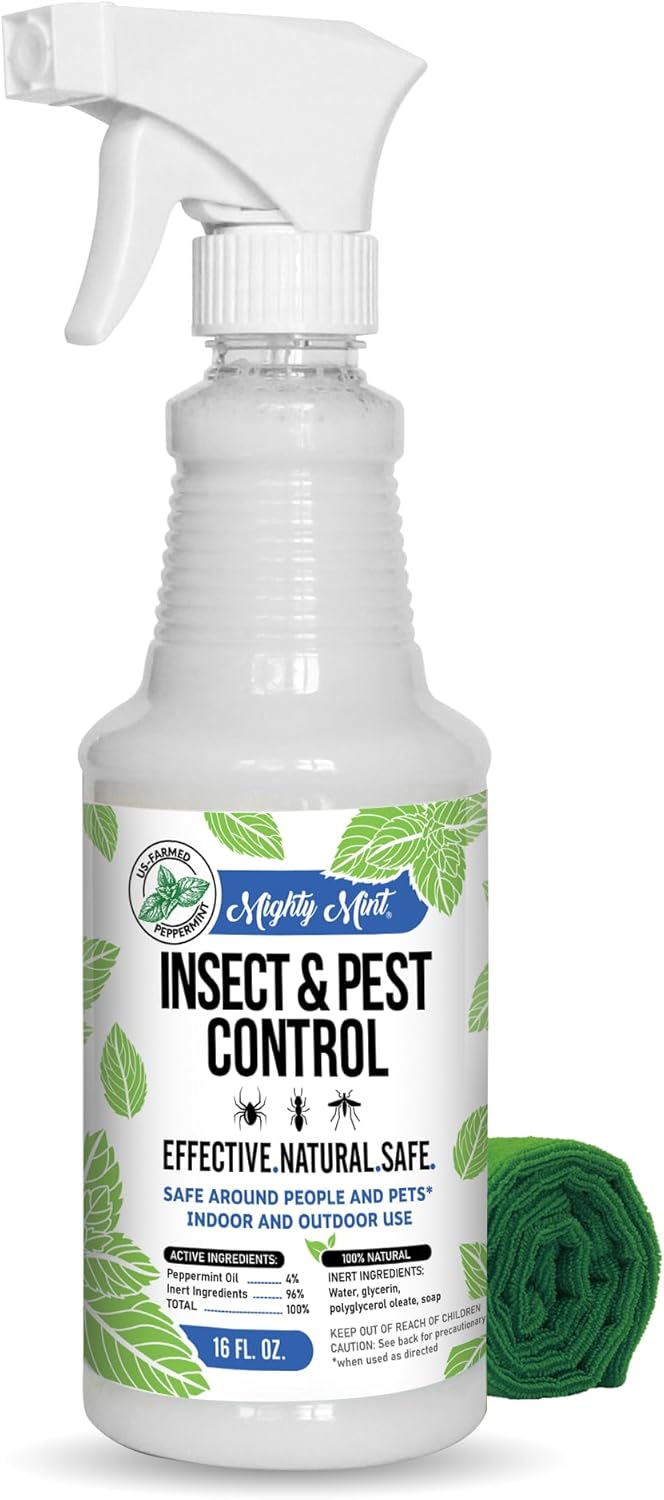
Mighty Mint Peppermint Oil Insect Repellent Spray, 16 oz
| Volume | 16 oz |
|---|---|
| Ingredients | Water, Glycerine, Polyglycerol oleate, Soap, Peppermint oil |
| Use areas | Indoor / Outdoor |
| Pests | Spiders, ants, roaches, other common insects |
Mighty Mint is a 16 oz ready-to-use peppermint oil spray intended to deter spiders and other common household insects both inside and outside the home. You use it by shaking and spraying targeted areas such as baseboards, entryways, patios and storage spaces until surfaces are covered, and repeating treatments a few times per week for best results. The formula is plant-based and free of synthetic fragrances, so it leaves a fresh mint scent rather than harsh chemical fumes and is marketed for use around pets and children when applied and dried as directed. Practical benefits include quick targeted application from the spray bottle, versatility for indoor or outdoor spots, and a non-staining, surface-safe formulation for most materials. Important limitations are that it is a repellent rather than an exterminator so results depend on consistent reapplication, it can irritate people sensitive to strong peppermint concentrations, and you should avoid spraying when pollinators are present or applying directly to skin.
Best for: Buyers who want a low-odor, plant-based spider deterrent for targeted indoor and outdoor trouble spots and who prefer easy, quick treatments over broad chemical control.
Less Ideal for: People facing large active infestations who need a lethal pesticide or those who require a fragrance-free product for severe scent sensitivities.
- Plant-based peppermint oil formula effective as a natural deterrent for spiders and common insects
- Ready-to-use 16 oz spray allows easy, targeted application to baseboards, entryways and outdoor thresholds
- Suitable for indoor and outdoor use and formulated to avoid staining most surfaces
- Milder scent profile compared with synthetic repellents, useful for scent-sensitive households
- Not a lethal insecticide so requires frequent reapplication to maintain protection
- Contains concentrated peppermint oil that can irritate eyes or sensitive people if contacted
- Should not be applied when pollinators are present, limiting use near flowering plants
Verdict: A convenient, plant-based peppermint spray that provides an easy, low-odor way to deter spiders and other common household insects with targeted, repeatable applications.
STEM Plant-Based Bug Spray for Ants, Roaches & Spiders, 10 oz

| Item Form | Aerosol |
|---|---|
| Target Species | Ants, Roaches, Spiders |
| Liquid Volume | 10 fluid ounces |
| Active Ingredients | Geraniol 6.0%, Lemongrass Oil 0.5% |
This STEM plant-based bug spray is an aerosol insecticide formulated to kill ants, roaches, and spiders using botanical actives such as geraniol and lemongrass oil. It is designed for spot treatments around the home and on exterior eaves, entry points, and crawlspaces where spiders and other pests hide. The formula has no added dye or strong chemical fragrance and is marketed as safe for use around people and pets when directions are followed, which makes it appealing for indoor use. Practical benefits include an easy-to-use spray delivery that gives quick contact kill on visible pests and the reduced-odor botanical formulation that is less intrusive than conventional synthetic sprays. Important limitations are that it is an aerosol spot treatment rather than a residual perimeter system, so repeated applications may be needed for ongoing spider control, and botanical active ingredients can be less persistent than conventional insecticides under heavy infestation pressure. For routine maintenance or quick knockdown of spiders in and around living spaces, this is a workable low-odor option; for severe or large-scale infestations a longer-lasting professional product may be more effective.
Best for: Buyers who want a low-odor, plant-based spray to quickly knock down occasional spiders and crawling insects around the home while prioritizing gentler ingredients.
Less Ideal for: Homeowners facing heavy or chronic spider infestations who need a long-lasting residual treatment or professional-strength control.
- Plant-based active ingredients (geraniol, lemongrass oil) reduce harsh chemical odors
- Aerosol spray provides quick contact kill for visible spiders and crawling insects
- Formulated for indoor and outdoor spot use and labeled safe around people and pets when used as directed
- No added dye or fragrance for less lingering scent after application
- Botanical actives are typically less persistent than synthetic insecticides, so repeat treatments may be required
- Aerosol spot treatment does not provide long-term perimeter residual control
Verdict: A convenient low-odor plant-based aerosol for quick knockdown of spiders and other crawling insects around the home.
Cvtayn Ultrasonic Indoor Pest Repeller, 6-Pack

| Unit Count | 6 Count |
|---|---|
| Frequency Range | 10kHz–65kHz |
| Coverage | Up to 1600 square feet |
| Power Consumption | 3–5W |
This six-pack of Cvtayn ultrasonic repellers is a chemical-free, plug-in solution intended to reduce indoor pest activity across multiple rooms. Each unit offers three modes with different frequency ranges so you can target common insects like spiders, ants, mosquitoes and heavier pests such as roaches and rodents. Installation is simple: plug a unit in vertically about 10 to 50 inches from the floor and select the mode that matches the infestation level. The manufacturer quotes coverage up to 1,600 square feet per unit and low power draw of 3 to 5W, which makes running several units inexpensive. Notable features include the three-mode frequency ranges (10–65 kHz) and a silent mode for use around people and pets. Important limitations are that ultrasonic devices work best as part of an integrated pest plan rather than a guaranteed stand-alone fix, performance can vary with room layout and clutter, and the highest mode produces audible noise so it should not be used when people or pets are present. For spider control this offers a low-maintenance, safe option to try in bedrooms, basements, and garages, but expect results to take a few weeks and to be inconsistent in complex environments.
Best for: Homeowners who prioritize a low-maintenance, chemical-free approach and want multiple plug-in units to monitor and deter common indoor pests across several rooms.
Less Ideal for: People needing immediate, guaranteed elimination of large or established infestations or those seeking a single reliable solution for outdoor or structural pest entry points.
- Three selectable frequency modes to target different pest types from small insects to rodents
- Low energy consumption (3–5W) suitable for continuous use
- Sold as a six-pack to cover multiple rooms or larger spaces
- Plug-and-play setup with vertical installation guidance for wall outlets
- Effectiveness varies by room layout and may take 2–3 weeks to notice results
- Highest mode can be audible and should not be used when people or pets are present
Verdict: A convenient, low-energy six-pack of ultrasonic plug-ins that offers a safe, chemical-free way to reduce spiders and other indoor pests across multiple rooms.
Ortho Home Defense Insect Killer for Indoor & Perimeter, 1.33 gal.

| Item Form | Spray |
|---|---|
| Target Species | Insects |
| Liquid Volume | 1.33 gallons |
| Active Ingredients | Bifenthrin 0.05%, Zeta-Cypermethrin 0.0125% |
Ortho Home Defense is a large ready-to-use insect spray designed for both indoor spot treatments and outdoor perimeter barriers. It comes with a continuous-spray Comfort Wand that makes applying a consistent band around foundations, doors, windows and baseboards easier without bending or pumping. The formula lists bifenthrin and zeta-cypermethrin as active ingredients and claims up to 12 months protection against ants, roaches and spiders on non-porous indoor surfaces when applied as directed. In practice this product is useful for preventative perimeter treatments and targeted indoor use where you want a long-lasting invisible barrier that dries quickly and gives off minimal odor. Limitations to note are that it is a broad-spectrum chemical insecticide rather than a spider-specific remedy and it must be applied according to safety directions around children and pets. For homes with recurring perimeter or indoor spider activity it provides a straightforward, professional-strength option, but users should follow label instructions and avoid overapplication.
Best for: Homeowners who want a proven, easy-to-apply spray to reduce recurring indoor and perimeter spider activity and who prefer a long-lasting barrier treatment backed by wide user adoption.
Less Ideal for: People seeking a non-chemical or species-specific spider control method or those unwilling to follow pesticide safety directions should consider alternative approaches.
- Includes a battery-powered Comfort Wand for continuous, low-effort application
- Ready-to-use 1.33 gal container covers indoor and outdoor perimeter treatments
- Formula creates a barrier with up to 12 months protection on non-porous indoor surfaces
- Dries clear and is formulated to give off minimal fumes for indoor use
- Not spider-specific since it is a general broad-spectrum insecticide
- Contains synthetic active ingredients that require careful handling around people and pets
Verdict: A hands-off, long-lasting spray solution for homeowners who want a proven perimeter and indoor barrier to reduce recurring spider problems.
Jqely Ultrasonic Indoor Pest Repeller, 10-Pack

| Unit Count | 10 Count |
|---|---|
| Item Form | Plastic |
| Scent Name | Unscented |
| Power Consumption | 3-5W |
This Jqely ultrasonic repeller is a plug-in device intended to reduce indoor pest activity without traps or chemicals. It offers three modes that emit different ultrasonic frequency ranges to target smaller insects like mosquitoes and fruit flies, crawling pests such as ants and cockroaches, and larger pests including mice and rats. In practice you place units around living areas and bedrooms and leave them operating continuously; the manufacturer recommends one unit per room because walls and furniture limit ultrasonic coverage. Notable features include simple one-button operation, low power use (3–5W), and a stated coverage up to 1600 sq ft in open space. Practical benefits are mess-free operation and quiet modes suitable for homes with pets or overnight use. Important limitations are that the highest-intensity mode can produce audible or uncomfortable noise so it should only be used when people and pets are absent, and ultrasonic effectiveness varies with room layout and pest species so results may be inconsistent without complementary controls.
Best for: Buyers who prefer a low-maintenance, chemical-free approach to reduce indoor spiders and common household pests and who prioritize quiet daytime/evening operation.
Less Ideal for: People needing immediate elimination of an active infestation or users who require guaranteed results in complex multiroom layouts should consider more direct control methods.
- Three selectable ultrasonic modes to target different pest sizes and behaviors
- Plug-and-play operation with low continuous power consumption
- Chemical-free, mess-free alternative to traps or sprays
- Stated wide indoor coverage suitable for multiple room use
- Effectiveness can be inconsistent in rooms with walls or large furniture because ultrasonic waves do not pass barriers well
- High-intensity mode can be audible or uncomfortable and must not be used around people or pets
Verdict: A low-maintenance, chemical-free ultrasonic option for buyers who want a quiet, continuous way to reduce spiders and other common indoor pests.
Choosing the Right Insect Repellent for Spiders: Key Factors to Consider
Longevity and Weather Resistance
How long a repellent stays effective after application is central to cost and labor. Treatments exposed to sun, rain, or dust break down at different rates, so a product that advertises longer residual activity will reduce the number of reapplications you need.
Consider where you will use the repellent. Outdoor eaves, porch ceilings, and foundation lines face weather more than interior closets or basements. For exterior zones prioritize formulations with proven resistance to UV and light rain. For indoor or sheltered areas, shorter residuals may be acceptable if the product has low odor and minimal residue.
Surface Compatibility and Material Safety
Different repellents interact with building materials and finishes in varied ways. Solvent-based sprays can discolor or strip paint, stain wood, or leave a sticky film on masonry. Granular products may be messy on paved surfaces, while liquid barriers could saturate soil near plant roots if misapplied.
Match the product to the surface: choose gentle water-based sprays around painted trim and plant pots, and select barrier treatments rated for masonry and untreated wood where staining would matter. Always follow label directions for distance and drying time to avoid inadvertent damage to ornamentals or finishes.
Application Method and Practicality
How you apply the repellent affects coverage, accuracy, and the time the job takes. Hand-spray bottles are good for spot treatments and indoor surfaces. Hose-end applicators and larger pressurized containers speed up coverage for eaves and foundation perimeter treatments outdoors.
Consider ergonomics if you will treat high or awkward areas regularly. Lightweight, variable-spray hand tools can reduce fatigue for repeated spot applications. Also consider formulation thickness and clog risk; thicker emulsions can block nozzles and complicate application in cooler weather.
Safety Profile Around People, Pets, and Plants
Safety matters when applying repellents near play areas, patios, or edible gardens. Some active ingredients are more toxic to pets or beneficial insects than others. Products with low inhalation odor and quick drying times reduce short-term exposure for people and animals.
Check label directions on reentry time and pet access. For treatments near pollinator plantings, avoid broad-contact materials that could harm bees. Favor products with clear, conservative safety instructions and required personal protective equipment that match your planned use.
Residue, Odor, and Cleanability
Residue left after application affects aesthetics and ongoing upkeep. Sticky or oily residues attract dust and debris and may require solvent cleaning. Strong chemical odors can be annoying on patios and in enclosed spaces and may limit where you can apply a given product.
If treating visible areas, choose sprays that dry clear and have low scent profiles. For garage interiors or storage spaces, residue may be less important than durability. Consider how easy it will be to remove or neutralize the product in case of accidental over-application.
Target Spider Behavior and Placement Strategy
Understanding where spiders build webs and hunt helps you place repellents effectively. Many species favor corners, eaves, foundation lines, and cluttered storage spaces. Treating likely entry points and sheltered web sites provides outsized benefits compared with random spraying.
Plan treatments for high-risk microhabitats rather than broad, frequent coverage. Combine repellents with physical maintenance like sealing gaps, reducing outdoor clutter, and minimizing outdoor lighting that attracts prey insects.
Types of Repellent Formulations and How They Work
Repellents come as ready-to-use sprays, concentrate liquids for dilution, granules, and occasionally polymer barrier products. Each formulation has tradeoffs: sprays and aerosols give quick coverage for cracks and corners, while concentrates and hose-end mixes provide economical coverage for perimeter treatments. Granules are useful for ground-level barrier work but are less precise for eaves and ceilings.
Some products act by masking chemical cues spiders use to locate prey or by creating a physical surface barrier spiders avoid. Others rely on active ingredients that are irritating to spiders. Match the formulation to the application area and the access you need to treat.
- Ready-to-use sprays: precise spot treatment, quick-drying variants available
- Concentrates: economical for large perimeters when diluted
- Granules: good for foundation lines and mulch beds
- Barrier polymers: longer-lasting but may require professional-style application
Where to Apply for Best Results
Focus on dark, sheltered locations where spiders anchor webs and hide: eaves, corners of porches, basement windows, garage rafters, and under overhangs. For indoor spaces, treat high corners, behind storage, and any gaps around doors and window frames.
Treat perimeter lines along foundations and around door thresholds to reduce immigration from the yard. Avoid blanket spraying over ornamental plantings; spot-treat nearby sheltered plant supports or storage areas instead.
- Eaves and porch ceilings: treat along the junction with the wall
- Foundation lines: band treatments at ground level
- Indoor corners and storage nooks: spot-spray as needed
- Garage rafters and sheds: target sheltered web sites
Integrating Repellents with Cultural Controls
Repellents are most effective when combined with basic maintenance. Reducing clutter, keeping storage off the floor, trimming back vegetation that touches walls, and sealing cracks all reduce spider harborages and entry points. Good sanitation reduces prey insects, which makes the treated area less attractive to spiders.
Use repellents as part of a seasonal regimen rather than as the only tactic. For example, a spring perimeter treatment can reduce summer webbing when paired with periodic spot treatments and regular cleaning of eaves and corners.
- Seal gaps and weatherstrip doors and windows
- Minimize outdoor lighting that attracts prey insects
- Store items in sealed containers rather than open cartons
- Keep vegetation trimmed away from building walls
Application Safety and Personal Protective Measures
Always read and follow product directions for protective equipment and reentry intervals. Use gloves and eye protection for spray mixing or concentrated applications. Avoid applying treatments on windy days to prevent drift onto unintended surfaces or nearby plantings.
Keep pets and children away from treated areas until the surface is dry and the product's label allows reentry. Rinse equipment after use and dispose of any leftover dilutions according to the label.
- Wear gloves and safety glasses when mixing concentrates
- Avoid application near open water features or edible plantings
- Store repellents securely out of reach of children and pets
- Rinse and dry application tools after each use
Timing Treatments for Seasonal Spider Activity
Spider activity often peaks in late summer and early fall when juveniles disperse and adults build more webs. Plan preventative perimeter treatments in spring or early summer to reduce the number that settle on building surfaces. Spot treatments can be used during peak months to address problem spots.
After heavy rain or strong winds, recheck treated exterior spots, as runoff and debris may reduce effectiveness. For shelters like garages and sheds, a mid-season maintenance spray can reduce late-season webbing.
- Spring perimeter treatment for prevention
- Mid-summer spot checks and touch-ups
- Post-storm inspections for degraded barriers
- Fall cleanup to remove webs and reduce overwintering sites
How We Chose the Best Insect Repellent for Spiders
We evaluated products against a focused set of practical, garden-facing criteria that matter when controlling spiders around homes, sheds, patios, and plant beds. Longevity under weather and dust exposure was prioritized because treatments that decay quickly need frequent reapplication and create more work. Surface compatibility was examined to ensure sprays, granules, or barriers are safe for wood, painted trim, masonry, and common plant foliage when applied as directed. Application method and ease of use were considered for gardeners who prefer hand-pump sprays, hose-end treatments, or ready-to-use cans. Safety and toxicity profile assessed real-world exposure risks for people, pets, and garden plants, favoring lower-risk formulations when effective. Residue and cleanup evaluated whether treatments leave staining, sticky film, or require surface scrubbing. We excluded products intended only for inert traps or mechanical capture, as well as treatments labeled solely for crawling insect monitoring without repellency claims. The final list emphasizes practical performance, predictable durability, and manageable safety for home and garden use.
FAQ
Are insect repellents for spiders safe to use around vegetable gardens?
It depends on the formulation. Many repellents are not intended for direct application to edible crops. For areas adjacent to vegetables, choose products labeled safe for use near plants or use targeted treatments on structures and foundation lines rather than spraying plant foliage.
How often should I reapply a spider repellent outdoors?
Reapplication frequency varies by product and exposure. Some barrier treatments last several weeks to months, while others need monthly touch-ups. Expect to reapply more often after heavy rain or in high-traffic dusty areas.
Will repellents eliminate spider infestations on their own?
Repellents reduce activity and discourage web building but seldom eliminate an established infestation by themselves. Combine repellents with sanitation, exclusion, and habitat reduction for the best control.
Can I use the same repellent indoors and outdoors?
Not always. Some outdoor concentrates are too strong or have long reentry times for indoor use. Use products labeled for indoor application in enclosed spaces and follow dose and ventilation guidance closely.
Do repellents harm beneficial insects like pollinators?
Some broad-spectrum materials can affect non-target insects. Avoid spraying flowering plants and treat only sheltered surfaces when pollinators are active. Choose lower-risk formulations when treating areas that attract beneficials.
What should I do if a treated surface shows staining or residue?
Refer to the product label for cleanup instructions. For minor staining, gentle detergent wash and rinsing often remove residues. For solvent-sensitive finishes, test a small inconspicuous area before larger applications.
Final Verdict
When selecting an insect repellent for spiders, prioritize the features that match how and where you will use it. Longevity and surface compatibility determine how often you need to reapply and whether the treatment will harm finishes or plantings. Balance application convenience and safety to limit exposure for people and pets while treating likely spider harborages. Use repellents as one part of an integrated approach that includes sealing entry points, reducing clutter, and routine maintenance to keep spider activity manageable.
