

Note: This article contains affiliate links. If you click on these links and make a purchase, I may earn a small commission at no extra cost to you. This helps support my research and content. Read my full affiliate disclosure here.
If you mow turf that sits over sandy soil or you frequently encounter gritty fill on your lawn, the blade you choose has a direct effect on cut quality and how often you sharpen or replace parts. A blade built for sand resists abrasion, maintains a sharper edge longer, and helps prevent excessive vibration that can stress deck spindles and belts. This guide shortlists the top options for sand-prone lawns and explains the construction and features that matter most. We evaluated durability, edge retention, and fitment to help you pick a blade that keeps grass healthy and mowing predictable.
Top Picks at a Glance
| Best Overall The best all-around choice for most situations | CUB CADET 50" Low‑Lift Sand Blade Set (490-110-F182) |  |
| Best Quality Built to a higher standard if you want something more solid | CUB CADET 490-110-F199 46" Low Lift S-Shaped Sand Blade Set |  |
| Best Value The sweet spot between price and what you get | CUB CADET 490-110-F180 42-inch Low-Lift Sand Blade Set |  |
| Best Budget The cheapest option that still gets the job done reliably | Stens Sand Blade 340-440 (21") Replacement for AYP/Husqvarna 134149 |  |
| Highest Rated A top-rated pick with lots of positive feedback | CUB CADET 490-110-F183 54" Low-Lift Sand Blade Set |  |
| Most Popular A crowd favorite that many people choose with confidence | CUB CADET 50" Low-Lift Sand Blade Set (490-110-C182) |  |
| Best Seller A high-volume bestseller chosen again and again | CUB CADET FastAttach Low-Lift Sand Blade 50" Deck (3-Pack) |  |
CUB CADET 50" Low‑Lift Sand Blade Set (490-110-F182)

| Manufacturer | CUB CADET |
|---|---|
| Item model number | 490-110-F182 |
| Item Weight | 5.45 pounds |
This OEM Cub Cadet low-lift blade set is a direct replacement designed for 50-inch decks on a range of Cub Cadet zero-turns and tractors. Low-lift blades create less suction than high-lift designs, which helps reduce how much sand and grit are thrown into the deck and discharge chute and lowers the load on the engine when turf is sandy or thin. Typical use is straightforward: remove the old blades and install these factory-fit parts to restore cutting geometry and balance for your compatible models. Being genuine OEM parts means the bolt pattern and mounting style match the original, which simplifies installation and helps maintain manufacturer-intended cut quality. The practical benefits are reduced clogging and slightly gentler grass discharge when working on sandy sites and reliable fitment across listed models. Limitations are that low-lift blades trade some clipping lift and bagging performance for gentler suction, so they are not ideal if you need strong mulch or bagging efficiency, and compatibility must be checked against your mower model.
Best for: Owners of compatible Cub Cadet 50-inch decks who want a straightforward factory-fit replacement that minimizes sand circulation and deck clogging when mowing sandy or worn turf.
Less Ideal for: People who prioritize maximum bagging, strong suction for mulch, or who have non-Cub Cadet models not listed in the compatibility notes.
- OEM Cub Cadet part ensures correct bolt pattern and fit for listed 50-inch models
- Low-lift profile reduces suction and helps limit sand and grit circulation under the deck
- Factory replacement restores original cutting geometry and balance
- Durable stamped steel construction suited to regular replacement on sandy lawns
- Low-lift design reduces bagging and mulching efficiency compared with high-lift blades
Verdict: Choose this OEM low-lift blade set if you need a direct-fit Cub Cadet replacement that reduces sand circulation and deck clogging on 50-inch mowers.
CUB CADET 490-110-F199 46" Low Lift S-Shaped Sand Blade Set

| Manufacturer | CUB CADET |
|---|---|
| Item model number | 490-110-F199 |
| Item Weight | 5.3 pounds |
This Cub Cadet OEM 490-110-F199 blade set is a direct-replacement 46-inch low-lift S-shaped design intended for select Cub Cadet tractors and zero-turn mowers. It is typically used by swapping the worn factory blades for these matching OEM parts to restore cutting performance and blade balance. The S-shaped profile and low-lift geometry help keep clippings close to the deck, which is useful when mowing sandy or dry turf where high lift can throw abrasive material into the spindle and deck. Being a factory part means bolt patterns and fitment match the listed Cub Cadet models so installation is straightforward for anyone comfortable removing a blade and torquing to spec. Limitations are that this blade is model-specific so it will not fit all 46-inch decks, and the low-lift design sacrifices some bagging and discharge distance compared with high-lift or mulching blades. For a performance-minded owner focused on protecting deck components and maintaining a consistent cut in sandy conditions, these OEM blades are a practical choice.
Best for: Owners of the listed Cub Cadet 46-inch tractors and zero-turn mowers who prioritize factory-correct performance and want to minimize sand and debris impact on the deck and spindles.
Less Ideal for: Users who need universal blades for multiple mower brands or who prioritize aggressive high-lift pickup and maximum bagging performance.
- OEM fitment ensures direct compatibility with listed Cub Cadet models
- Low-lift S-shaped profile keeps clippings close to the deck to reduce sand and debris thrown into components
- Factory replacement helps restore original balance and cutting geometry
- Sturdy single-piece construction suitable for regular mowing and replacement schedules
- Model-specific fit limits use to certain Cub Cadet tractors and zero-turns
- Low-lift design reduces discharge distance and is less effective for bagging
Verdict: Choose these OEM low-lift S-shaped blades when you want factory-correct fit and better protection of deck components while mowing sandy turf.
CUB CADET 490-110-F180 42-inch Low-Lift Sand Blade Set

| Manufacturer | CUB CADET |
|---|---|
| Item model number | 490-110-F180 |
| Item Weight | 3.95 pounds |
| Product Dimensions | 23 x 3 x 2 inches |
This OEM Cub Cadet 42-inch low-lift blade set replaces several prior part numbers and is made to fit a range of Cub Cadet tractors and zero-turn mowers. It is intended as a direct replacement for worn or damaged factory blades and is typically installed on decks listed in the compatibility information. The low-lift profile helps move clippings efficiently at lower deck heights and reduces turf disturbance, which can be useful when mowing sandy areas where aggressive lift would throw sand and debris. Because these are factory parts, fit and hole pattern match the specified models for straightforward bolt-on replacement. Limitations: the blade set is model-specific so you must verify compatibility with your owner manual, and low-lift blades are not optimized for high-thatch or heavy-wet grass where higher lift would improve discharge and mulch performance. Expect typical metal blade care such as balancing and occasional sharpening to maintain cut quality.
Best for: Buyers who want a hassle-free, factory-fit replacement blade for a compatible Cub Cadet tractor and prefer a low-lift profile to minimize sand and debris thrown while mowing.
Less Ideal for: Do not choose this if you have a different mower brand or need high-lift blades for heavy, wet, or high-thatch lawns where stronger suction and discharge are required.
- OEM part ensures correct hole pattern and fit for listed Cub Cadet models
- Low-lift design reduces turf disturbance and lowers how much sand is thrown while mowing
- Direct replacement for multiple prior MPNs so it updates older decks with factory-spec blades
- Durable stamped steel construction typical of factory blades for everyday mowing use
- Only compatible with the specific Cub Cadet models listed so not universal
- Low-lift profile is less effective for tall, wet, or heavy-thatch conditions
Verdict: Choose this OEM Cub Cadet low-lift 42-inch blade set when you need a precise factory-fit replacement that keeps sanding and turf disturbance to a minimum.
Stens Sand Blade 340-440 (21") Replacement for AYP/Husqvarna 134149

| Model | 340-440 |
|---|---|
| Part Number | 340-440 |
| Grit Type | sand |
| Included Components | Blade |
This Stens sand blade is a direct-replacement 21-inch mowing blade made to fit certain AYP and Husqvarna decks that require two blades for a 42-inch deck. It is marketed as a sand-type blade, meaning the cutting edge and material are intended to handle abrasive conditions where sand shortens blade life. Typical use is swapping it in for worn or damaged blades on compatible machines; the star-shaped center hole and listed OEM numbers make fitment straightforward when matched correctly. The practical benefit is a blade built with sand-resistant characteristics that can extend service life compared with standard blades when you mow sandy turf or coastal lawns. Because it is a single replacement piece, buyers should expect to buy two for 42-inch decks. The blade is a basic OEM-style part without bundled hardware or protective coatings noted, so while it offers value for budget-focused buyers, it does not include premium corrosion treatments or multi-blade kits that could further reduce maintenance in salty or very abrasive environments.
Best for: A budget-minded mower owner who needs a straightforward OEM-compatible replacement blade that tolerates sandy turf and prefers buying only what is needed rather than bundled kits.
Less Ideal for: Those who want premium coated blades, full two-blade kits, or advanced anti-corrosion features for salt-exposed lawns should consider higher-end alternatives.
- Made to match specific AYP and Husqvarna OEM part numbers for easier fit verification
- 21-inch size suitable for common mower decks that require this diameter
- Designed as a sand-type blade to better resist abrasion in sandy conditions
- Sold individually for low up-front cost and flexible replacement planning
- Sold as a single blade so two are required for many 42-inch decks
- No mention of specialized corrosion-resistant coating for salty or high-moisture environments
- Limited included components or accessories beyond the blade itself
Verdict: A cost-conscious, OEM-compatible 21-inch sand blade that extends blade life in abrasive turf conditions without adding extra frills.
CUB CADET 490-110-F183 54" Low-Lift Sand Blade Set

| Manufacturer | CUB CADET |
|---|---|
| Item model number | 490-110-F183 |
| Item Weight | 5.8 pounds |
This Cub Cadet OEM 54-inch low-lift blade set is a direct-replacement package intended for Cub Cadet zero-turn and riding mower decks listed as compatible. Low-lift blades are built to reduce the amount of dust and debris kicked up while mowing in sandy conditions, and the OEM fit helps ensure secure mounting and consistent blade balance. Typical use is seasonal replacement for worn or damaged blades or switching from high-lift blades when working in sandy or dry lawns where reduced airflow helps limit dust and scalping. Notable features include the 6-point star mounting pattern for correct alignment and the factory part number compatibility list that simplifies verifying fit. Practical benefits are reliable fitment, consistent cut performance when matched to the correct deck, and reduced airborne sand compared with high-lift designs. Limitations are that this is a specialized low-lift blade so it will produce less clippings lift and may not bag or mulch as aggressively as high-lift or mulching blades, and it must be confirmed against your mower model before purchase.
Best for: A homeowner or groundskeeper who prioritizes dependable, factory-fit replacement parts and frequently mows sandy or dusty turf where minimizing airborne grit is important.
Less Ideal for: People who need maximum lift for heavy thatch removal, aggressive bagging, or mulching should choose a high-lift or dedicated mulching blade instead.
- OEM Cub Cadet part for direct, secure fit on listed mower models
- Low-lift profile reduces airborne dust and sand when mowing dry or sandy turf
- 6-point star mount ensures proper alignment and balance
- Factory replacement minimizes fitment guesswork and preserves deck performance
- Lower suction means less effective bagging and reduced mulch circulation compared with high-lift blades
- Compatibility limited to specific Cub Cadet models so verification is required before installation
Verdict: Choose this OEM low-lift Cub Cadet blade set when you need a reliable factory-fit replacement that reduces dust and sand while mowing.
CUB CADET 50" Low-Lift Sand Blade Set (490-110-C182)

| Manufacturer | CUB CADET |
|---|---|
| Item model number | 490-110-C182 |
| Item Weight | 4.94 pounds |
| Product Dimensions | 18 x 2.5 x 1.5 inches |
| Includes | 3 Blades |
This Cub Cadet OEM blade set supplies three low-lift replacement blades made to fit 50-inch decks on a range of Cub Cadet residential and garden tractors. Intended for sandy or dusty conditions, the low-lift profile reduces airflow and turf disturbance so fine sand and dust are less likely to be pulled up and spread while mowing. Installation is straightforward for anyone comfortable changing mower blades and using the correct torque and safety steps. Because these are factory OEM parts, they match original mounting patterns and balance, which helps limit vibration and maintains cutting geometry for a clean finish. The practical benefit is a more controlled cut and less dust clouding when mowing sandy turf areas. Limitations are inherent to low-lift blades: they move less clippings and that can make bagging slower and reduce mulching efficiency compared with high-lift designs, and they are optimized for specific Cub Cadet models so fit must be confirmed against your owner's manual before purchase.
Best for: Buyers who value factory-fit parts and want to minimize dust and turf disturbance when mowing sandy lawns, and who prefer a direct replacement that maintains original mower balance.
Less Ideal for: Gardeners who need aggressive vacuuming of clippings, fast bagging, or heavy-duty mulching should consider high-lift or specialty mulching blades instead.
- OEM fit for Cub Cadet 50-inch decks ensures correct mounting and balance
- Low-lift profile reduces dust and turf disturbance when mowing sandy areas
- Includes three blades so you replace the whole set for balanced performance
- Low-lift design reduces suction so bagging and mulching performance is diminished compared with high-lift blades
Verdict: Choose this OEM low-lift blade set when you want a factory-fit replacement that reduces dust and turf disturbance while mowing sandy lawns.
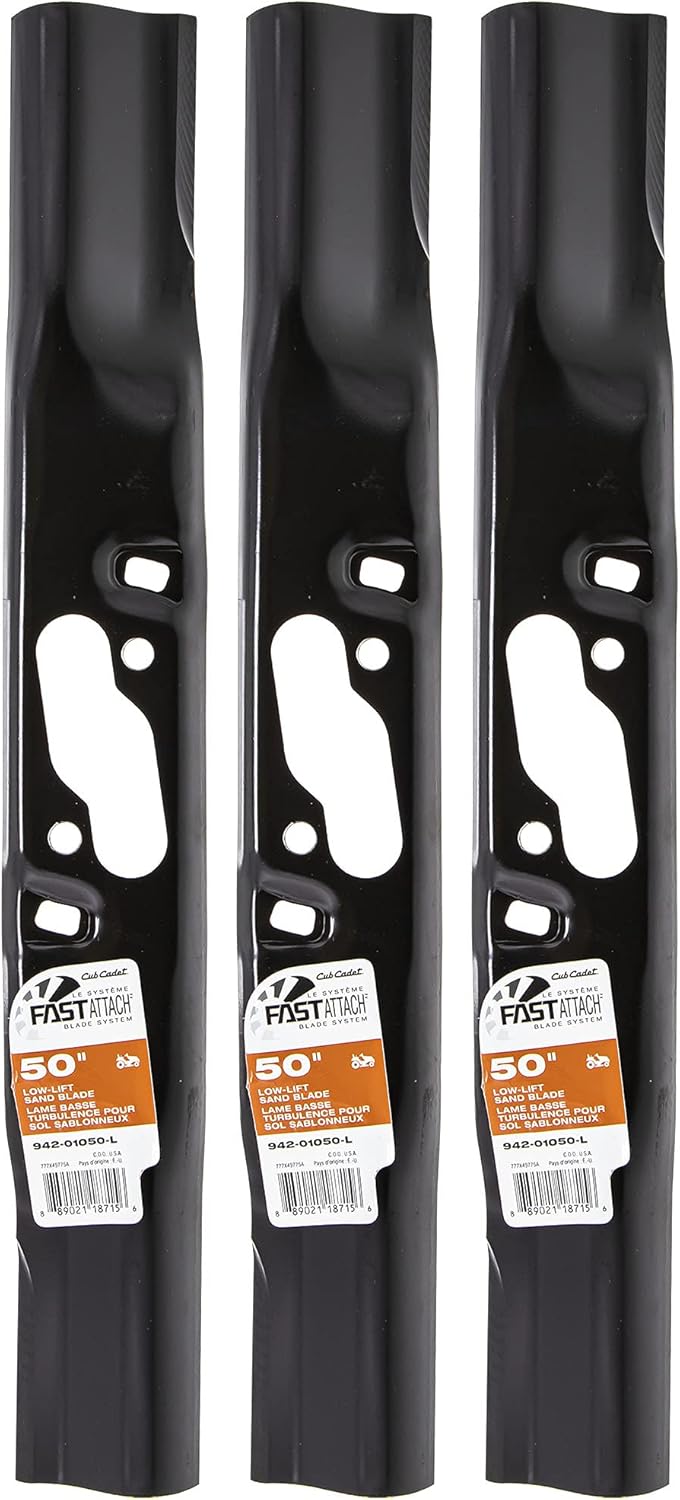
CUB CADET FastAttach Low-Lift Sand Blade 50" Deck (3-Pack)
| Manufacturer | CUB CADET |
|---|---|
| Item model number | 942-01050-L |
| ASIN | B094497QMG |
These are OEM-style low-lift blades sold by Cub Cadet for 50-inch decks, supplied as a three-pack that replaces part number 742-01050-L. They are intended for use on specified XT2 tractor models and attach with the FastAttach system for straightforward installation. Low-lift blades service sand-prone turf by reducing lift and clumping, which helps limit sand and dust being thrown into the air and keeps cut material close to the deck for cleaner discharge. The pack gives you spare blades so you can rotate replacements without downtime. Because these are model-specific OEM parts, they fit and perform predictably when matched to the listed Cub Cadet machines, but they will not fit unrelated mowers and they are purpose-built for low-lift cutting rather than producing the highest lift for bagging or fine clipping. If you need exact compatibility, check your tractor manual before ordering.
Best for: Buyers who want a dependable, factory-matching blade set for Cub Cadet XT2 tractors and prefer predictable fit and performance when mowing sandy or dusty lawns.
Less Ideal for: Owners of non-Cub Cadet mowers or users who need high-lift blades for bagging or very fine mulching should look for blades designed for those purposes.
- OEM part designed to match Cub Cadet XT2 models for reliable fit
- Low-lift profile reduces lift and airborne sand when mowing sandy turf
- Three-blade pack provides immediate spares for routine replacement
- FastAttach compatibility simplifies installation and reduces service time
- Made specifically for certain Cub Cadet models and not universally compatible
- Low-lift design is not optimized for bagging or producing strong clippings lift
Verdict: If you run a compatible Cub Cadet XT2 tractor and need a reliable OEM low-lift blade set to reduce sand and dust while mowing, this three-pack delivers a direct-fit, no-surprise replacement.
Choosing the Right Lawn Mower Blade for Sand: Key Factors to Consider
Steel Grade and Heat Treatment
The alloy composition and how the steel is heat treated determine how well a blade resists the constant micro‑abrasion from sand. Harder, properly heat‑treated steels keep a sharp edge longer but can be more brittle; manufacturers that call out hardened edges or special high-carbon blends usually produce blades that tolerate gritty conditions. Pay attention to whether the blade has a hardened cutting edge or through‑hardening because those treatments slow the rate at which sand dulls the blade.
Higher hardness reduces the frequency of regrinding, which matters when sand would otherwise force repeated edge maintenance. At the same time, extreme hardness without proper toughness increases the chance of chipping if the blade hits a concealed rock or sod edge, so the best choices balance hardness and impact resistance.
Edge Geometry and Grind Style
Edge profile and grind angle affect the cut quality and how quickly abrasive particles wear the edge. A thicker bevel with a slightly steeper angle will stand up better to sand but may require more engine power and can tear fine grass more than a finer edge. Some blades use a reinforced or laminated cutting lip to provide a resilient surface that can be reprofiled several times before the blade becomes unusable.
Consider blades with an edge design intended for durability rather than maximum initial sharpness. The grind method also influences how easy the blade is to resharpen in the field and whether it can be restored to a good cutting profile after repeated sanding.
Abrasion-Resistant Coatings and Surface Finishes
Coatings and surface treatments can slightly slow wear from sand by reducing direct metal‑to‑particle contact and helping debris slide off the blade. Black oxide, phosphate, or tougher proprietary coatings will not make a soft steel behave like a hardened alloy, but they do add incremental protection and can prevent corrosion that weakens a blade after its edge is compromised.
If you store a mower in damp conditions or mow salt‑containing soils near coastal areas, a protective finish becomes more important. For sand-specific use, prioritize actual edge hardness first, then look for coatings that extend service life between regrinds.
Balance, Vibration, and Deck Stress
Sand abrades one side of a blade faster than the other and can accelerate imbalance. A balanced blade reduces vibration transmitted to the deck, bearings, and mounting hardware. Excess vibration accelerates wear on belts, spindles, and fasteners and can lead to torn grass instead of clean cuts. Blades that come factory balanced or are easy to balance after installation will keep the mower running smoother for longer.
When replacing blades for sandy conditions, check tolerances and the ability to rebalance after sharpening. Some tougher blades resist uneven wear better and maintain balance across multiple resharpen cycles.
Fitment, Mounting Type, and Compatibility
Fitment matters because incorrect bolt patterns, center holes, or rise/offset angles alter blade position and cutting geometry, which can increase drag and accelerate wear. Choose blades that match your mower's mounting type and recommended blade rise so the blade does not contact the deck or change discharge flow. Easy installation and clear fitment guidance reduce the chance of improper mounting which in abrasive conditions can quickly reveal itself as accelerated component wear.
Adapters, spacers, or nonstandard mounting hardware may be needed for older machines, so verify compatibility before assuming a blade will work without modification.
Sharpening Frequency and Serviceability
Sand forces more frequent edge maintenance, so serviceability is an important buying consideration. Blades that are easy to resharpen with standard shop files or bench grinders and those with simple profiles that tolerate multiple regrinds will lower long‑term maintenance. Some blade designs allow you to reprofile the edge several times before reaching the mounting holes or losing structural strength.
Also consider whether the blade's finish or coating complicates sharpening and whether the blade requires professional heat treating after multiple regrinds. A blade that can be maintained affordably at home is often the most practical choice for sand‑prone lawns.
Why Sand Changes How Blades Wear
Sand behaves as a microscopic abrasive that grinds away metal at the cutting lip with every pass. Even if the sand content in the soil seems low, repeated mowing drives gritty particles against the blade edge and deck surfaces, turning routine use into accelerated wear.
Over time this extra abrasion dulls the edge much faster than mowing loam or clay, increases the need for sharpening, and can produce more vibration and uneven cutting. Understanding that mechanism helps you choose blades and maintenance schedules that counteract the effect.
- Microscopic abrasion removes metal from the cutting edge
- Uneven wear causes imbalance and vibration
- More frequent regrinds or hardened edges are common solutions
Blade Styles Suitable For Abrasive Conditions
There are several common blade styles-standard lift, high lift, mulching, and specialty hardened edges. For sandy conditions, blades with simpler, thicker cutting lips and reinforced edges usually outlast finer profiles. Mulching blades often have additional bends and thin secondary cutting surfaces that wear quickly in abrasive soils.
A straightforward, reinforced cutting lip that can be resharpened multiple times is typically the most durable choice for sand. High lift shapes help airflow but may be less forgiving if the edge dulls and the blade becomes unbalanced.
- Prefer reinforced lips over intricate mulching profiles when sand is present
- High lift helps collection and discharge but needs stronger edges
- Simpler profiles are easier to resharpen and balance
Maintenance Routine For Sandy Lawns
Expect to check and touch up blades more often. A quick visual inspection after every few mowings will reveal whether the edge has become rounded or chipped. Keeping a spare sharpened blade on hand reduces downtime if a sharpening session is required.
When sharpening, remove only the minimum metal needed to restore a clean bevel and rebalance the blade afterward. Also inspect the deck and spindle for sand buildup and clean abrasive deposits to reduce ongoing damage.
- Inspect edges every few mowings
- Sharpen minimally and rebalance
- Clean deck and spindles to remove abrasive buildup
Installation Tips To Reduce Wear
Torque mounting bolts to the mower maker's specifications and ensure the blade is seated flat against the spindle flange. A slightly canted or loose blade accelerates wear and increases the risk of damage when abrasive particles are present.
Check center hole alignment and use any recommended washers or spacers. Proper clearance between blade tip and deck reduces the chance of contact with hidden obstacles that can chip an already stressed edge.
- Use correct torque and seating to prevent wobble
- Confirm center hole and rise/offset alignment
- Maintain recommended clearance from deck and deflectors
When To Replace Instead Of Sharpening
Repeated sanding and regrinding eventually reduce blade thickness and can move the sharp bevel too close to mounting features. Replace a blade when the edge cannot be restored without compromising structural integrity or when cracks and chips appear near the mounting holes.
If a blade shows persistent imbalance after sharpening or if vibration continues, replacement is the safer choice to protect the mower's mechanical components.
- Replace when regrinds approach mounting features
- Look for cracks or chips near the center hole
- Persistent vibration after balancing indicates replacement
How We Chose the Best Lawn Mower Blade for Sand
We focused on real-world durability and fitment factors that matter when blades are used over sandy ground. Primary evaluation criteria included blade steel and heat treatment, edge geometry, and abrasion resistance because sand accelerates wear. We also assessed balance and vibration characteristics since an imbalanced blade transfers shock into the deck and spindle. Fitment breadth and ease of installation were considered so a chosen blade works with common mower makes and reduces the risk of incorrect mounting. Finally, we looked at maintenance needs such as how often resharpening is required and how straightforward the edge is to service. Items excluded were blades designed only for mulching ornamentals or specialty finishes that sacrifice edge toughness for appearance. We prioritized blades with measurable construction details and real-world durability features over cosmetic traits.
FAQ
How often should I sharpen blades used on sandy lawns?
It often depends on sand content and mowing frequency but expect to inspect edges every few mowings and sharpen more frequently than with cleaner soils. Many gardeners sharpen every 5 to 10 hours of mowing under abrasive conditions.
Does a harder blade always last longer in sand?
Hardness helps slow abrasion, but too much hardness can make a blade brittle and prone to chipping. The best blades balance hardness and toughness and include hardened cutting lips or laminated edges designed for repeated resharpening.
Are mulching blades a bad choice for sandy turf?
Mulching blades often have thinner secondary edges and extra bends that wear faster in abrasive conditions. If sand is present, a simpler reinforced edge is usually more durable than a complex mulching profile.
Will coatings protect a blade in sandy conditions?
Coatings can reduce corrosion and slightly slow surface wear, but they do not substitute for a properly hardened edge. Use coatings as a supplemental benefit rather than the primary defense against abrasion.
How do I know if a blade is balanced after sharpening?
After sharpening, mount the blade on a balancing tool or hang it by the center hole to see whether one side drops. Remove small amounts of metal from the heavier side and recheck until the blade remains level. Persistent imbalance may indicate uneven wear that requires replacement.
Final Verdict
For sand‑prone lawns, prioritize blades with durable steel and hardened edge treatments that extend service between sharpenings. Balance and fitment matter as much as edge materials because vibration and improper mounting accelerate wear and damage. Expect a maintenance tradeoff: a tougher blade costs little more in effort but saves time by reducing how often you resharpen or replace parts. Choose a blade that matches your mower's mounting style, can be serviced readily, and tolerates multiple regrinds to get the best combination of longevity and clean cuts.
