

Note: This article contains affiliate links. If you click on these links and make a purchase, I may earn a small commission at no extra cost to you. This helps support my research and content. Read my full affiliate disclosure here.
If you grow vegetables, houseplants, or seedlings, the right vermiculite can make a visible difference in soil structure and moisture control. Vermiculite helps retain water without turning media into a swamp, holds nutrients near roots, and improves mix aeration when combined with compost or potting soil. This guide looks at seven shortlisted vermiculite options that garden users rely on and explains the practical differences between grades, particle sizes, and purity levels. We focused on the features that matter in a real garden: how a product behaves in potting mixes, seed starting, and raised beds. Read on to understand the tradeoffs and pick the vermiculite that suits your growing setup.
Top Picks at a Glance
| Best Overall The best all-around choice for most situations | PVP Industries Medium Vermiculite, 4 Cubic Feet (Medium Granule) |  |
| Best Quality Built to a higher standard if you want something more solid | FarmTek Horticultural Vermiculite, Coarse A-3 Grade, 4 Cubic Feet |  |
| Best Value The sweet spot between price and what you get | Back to the Roots Organic Horticultural Vermiculite, 24 Quart (3 x 8 qt) |  |
| Best Budget The cheapest option that still gets the job done reliably | Sukh Organic Vermiculite, 14.6 oz (Fine 1–3 mm) |  |
| Highest Rated A top-rated pick with lots of positive feedback | Espoma Horticultural Vermiculite, 8 Quart |  |
| Most Popular A crowd favorite that many people choose with confidence | Perfect Plants Organic Vermiculite, 8 qt |  |
| Best Seller A high-volume bestseller chosen again and again | Plantonix Vermiculite Bliss — Coarse Vermiculite (8 qt) |  |
PVP Industries Medium Vermiculite, 4 Cubic Feet (Medium Granule)

| Brand Name | PVP Industries, Inc |
|---|---|
| Unit Count | 4 Count |
| Included Components | PVP Medium Vermiculite – 4 Cubic Foot |
| Item Highlight | Professional Grade Additive for Soil Conditioner and Rooting |
PVP Industries Medium Vermiculite is a sterile, pH‑neutral amendment intended for seed germination, cutting propagation, and improving container and raised‑bed mixes. Gardeners typically blend it with seed starting mix, peat, composted bark, or potting soil to increase water retention and aeration while reducing compaction. Notable features include medium granule size suited to a range of applications, the ability to absorb several times its weight in water, and natural cation exchange that helps retain ammonium, potassium, calcium, and magnesium for steady nutrient availability. In practice it speeds root establishment and lowers the frequency of watering in containers and passive hydroponic setups. The product is clean and mold resistant, which makes it convenient for indoor seed trays and transplants. Limitations to note are that vermiculite itself does not supply significant nutrients or structure long term, so it works best as a component of a balanced potting mix rather than a standalone growing medium, and the bagged volume can be bulky to store for small‑space gardeners.
Best for: Gardeners who want a reliable, low‑maintenance amendment for seed starting, cuttings, and container mixes and who prioritize easier watering and faster root establishment.
Less Ideal for: Large‑scale growers needing bulk structural substrates or users seeking a complete, nutrient‑rich soil replacement rather than an additive.
- High water retention useful for seed starting and container plants
- Medium granule size works across seed trays, potting mixes, and propagation
- Sterile and pH neutral so it integrates safely into indoor and outdoor mixes
- Supports aeration and reduces soil compaction to encourage faster root growth
- Does not provide long‑term structural support or complete nutrition on its own
Verdict: A versatile, professional‑grade vermiculite that reliably improves moisture retention and root development when mixed into seed starting and potting media.
FarmTek Horticultural Vermiculite, Coarse A-3 Grade, 4 Cubic Feet

| Brand Name | FarmTek |
|---|---|
| Unit Count | 3830.03 Fluid Ounces |
| Included Components | FarmTek Horticultural Coarse Vermiculite – 4 Cubic Feet |
| Item Type Name | FarmTek Horticultural Coarse Vermiculite – 4 Cubic Feet |
| Volume | 4 cubic feet |
FarmTek's 4 cu ft coarse vermiculite is a straightforward, performance-focused soil amendment for gardeners and growers who need consistent moisture management and improved root aeration. The coarse A-3 grade provides open pore space that helps mix into potting media without compacting, making it useful for seed starting trays, potting mixes and raised beds. Because vermiculite holds water and nutrients near roots, it reduces how often you need to water and helps maintain steady moisture for sensitive seedlings. The bag is described as largely debris-free and pH neutral, so it will not alter soil chemistry or introduce organic contaminants. Limitations are that vermiculite does not supply fertility or structure on its own, so it works best blended with compost or potting soil rather than as a standalone growing medium. Also, it is lightweight and voluminous, so storage and handling are considerations for large quantities. For anyone focused on reliable moisture control and root aeration, this product delivers predictable, professional-grade results when incorporated into mixes.
Best for: Buyers who prioritize predictable growing performance and want a reliable amendment to improve moisture control and root aeration for seedlings, container plants or large garden beds.
Less Ideal for: Gardeners looking for an all-in-one potting mix or those who need a fertilizer-rich amendment should consider blended soils rather than a pure mineral additive.
- Coarse A-3 grade delivers open pore space for improved aeration and reduced compaction.
- Strong moisture retention that slowly releases water to the root zone, aiding seed germination and transplant recovery.
- pH-neutral and largely debris-free, so it will not alter soil chemistry or introduce contaminants.
- Large 4 cubic foot volume suitable for greenhouse, raised bed or bulk garden projects.
- Does not provide nutrients or organic matter so must be mixed with compost or fertilizer for plant nutrition.
- Bulky volume requires space for storage and can be awkward to handle in large quantities.
Verdict: Choose this coarse 4 cu ft vermiculite when you need dependable moisture retention and improved root-zone aeration for seed starting and bulk growing projects.
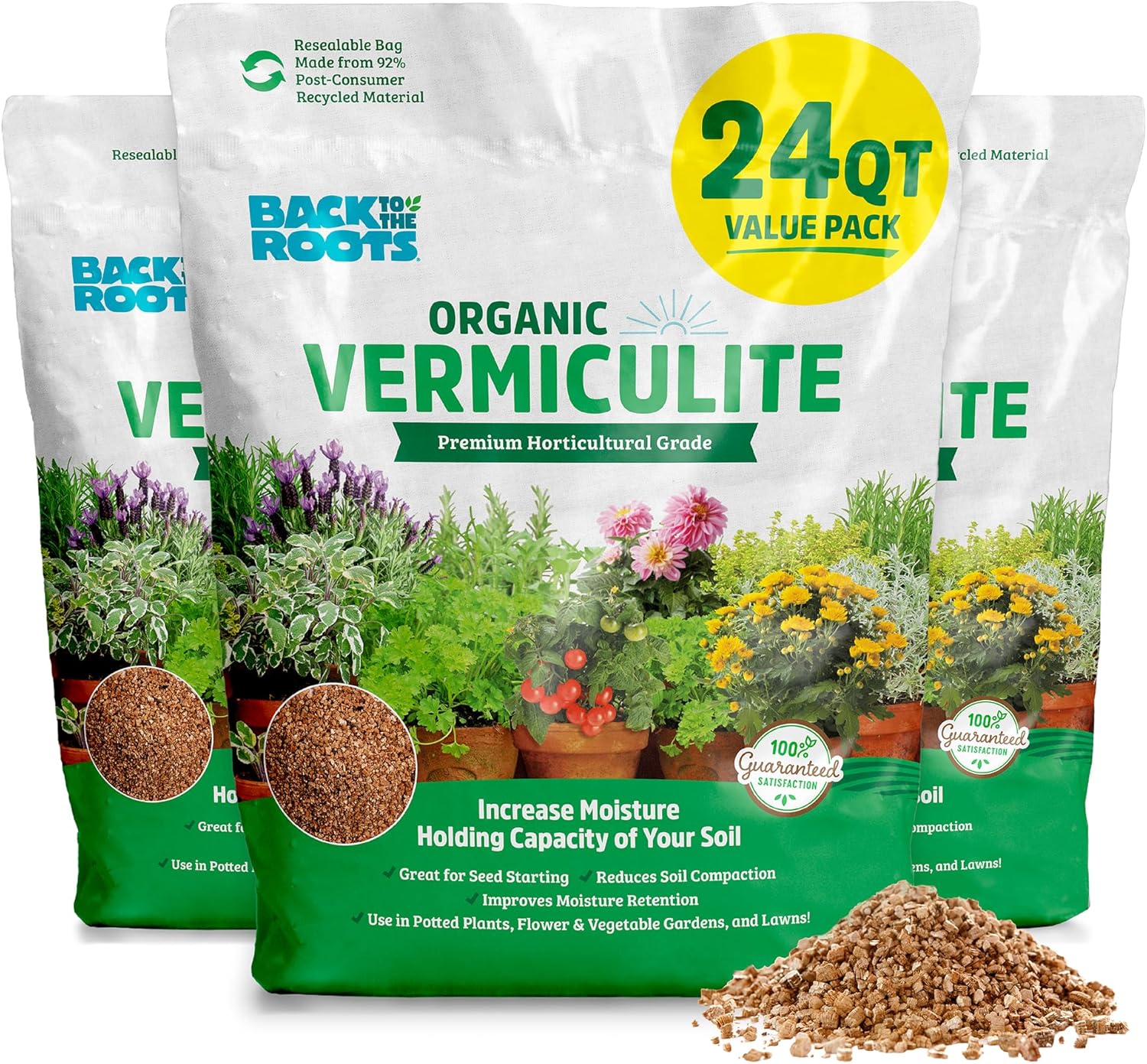
Back to the Roots Organic Horticultural Vermiculite, 24 Quart (3 x 8 qt)
| Item Form | Granules |
|---|---|
| Liquid Volume | 24 quarts |
| Coverage | 6100 sq ft. |
| Mixing Ratio | 1:1:5 |
This three-pack of Back to the Roots organic vermiculite is a straightforward soil conditioner for seed starting, potting mixes, and amending garden beds. It holds moisture while improving aeration, which helps roots access water and nutrients more consistently and reduces the frequency of watering. Use it mixed into potting medium or garden soil according to the suggested 1:1:5 mixing ratio for seed trays and starter mixes, or incorporate it as a top dressing to improve existing soil structure. The product is horticultural grade granules supplied in three 8-quart bags, so it is convenient for small to medium projects and trial mixes. Limitations are that vermiculite does not add organic nutrients or structure like compost and can compact if overused on heavy clay soils, so it is best combined with coir, perlite, or compost for balanced mixes. Coverage claims are broad, but real coverage depends on application depth and soil condition.
Best for: Gardeners who want a practical, no-fuss amendment to retain moisture and improve aeration for seedlings, containers, and small garden beds and who prefer mixing their own potting blends.
Less Ideal for: Gardeners seeking a nutrient-rich soil amendment or those working exclusively with heavy clay who need structural amendments rather than moisture-only conditioners.
- Improves moisture retention to reduce watering frequency
- Enhances soil aeration for healthier root development
- Convenient three-pack provides enough volume for multiple small projects
- Suitable for seed starting and mixing into potting or garden soils
- Does not provide nutrients or organic matter on its own
- Can compact in heavy clay if not mixed with lighter amendments
Verdict: Buy this if you need an easy-to-use vermiculite value pack to improve moisture retention and aeration in seed starting and potting mixes.
Sukh Organic Vermiculite, 14.6 oz (Fine 1–3 mm)

| Unit Count | 14.6 Ounce |
|---|---|
| Granule Size | 1-3MM |
| Volume | 14.6 quarts |
| Item Highlight | Soil Amendment for Seed Starting, Indoor Potting, Gardening |
This small bag of fine (1–3 mm) vermiculite is a straightforward soil amendment for seed starting, propagation and improving container or garden soil. Gardeners typically mix a scoop into seed-starting mixes or potting media to hold moisture around delicate roots while still improving aeration compared with straight soil. The product is stable and does not break down quickly, so it helps loosen dense soils and retain water between waterings without becoming compacted. It also mixes well with perlite, coco coir, peat, or potting soil to tune moisture and drainage for seedlings, cuttings, bonsai and potted vegetables. Important limitations are the small pack size and light weight, which means frequent repurchases for active gardeners or larger beds, and the product can irritate skin or eyes so basic precautions are advised when handling. For budget-focused gardeners this offers a low-cost way to test vermiculite in mixes before buying larger quantities.
Best for: Buyers who want an inexpensive way to improve seed starting and container mixes and who prefer trying small quantities before committing to bulk amendments.
Less Ideal for: Large-scale gardeners or landscapers who need bulk volumes for beds and raised planters should choose larger commercial bags instead.
- Fine 1–3 mm granule size suited for seed starting and propagation
- Improves moisture retention while adding aeration to potting mixes
- Stable material that resists rapid breakdown in soil
- Versatile: mixes easily with perlite, coco coir, peat, or potting soil
- Small 14.6 oz package may be insufficient for larger gardens or repeated use
- Can cause skin and eye irritation if handled without protection
Verdict: An affordable small-pack vermiculite that lets budget-minded gardeners boost seed starting and container mixes without buying bulk.
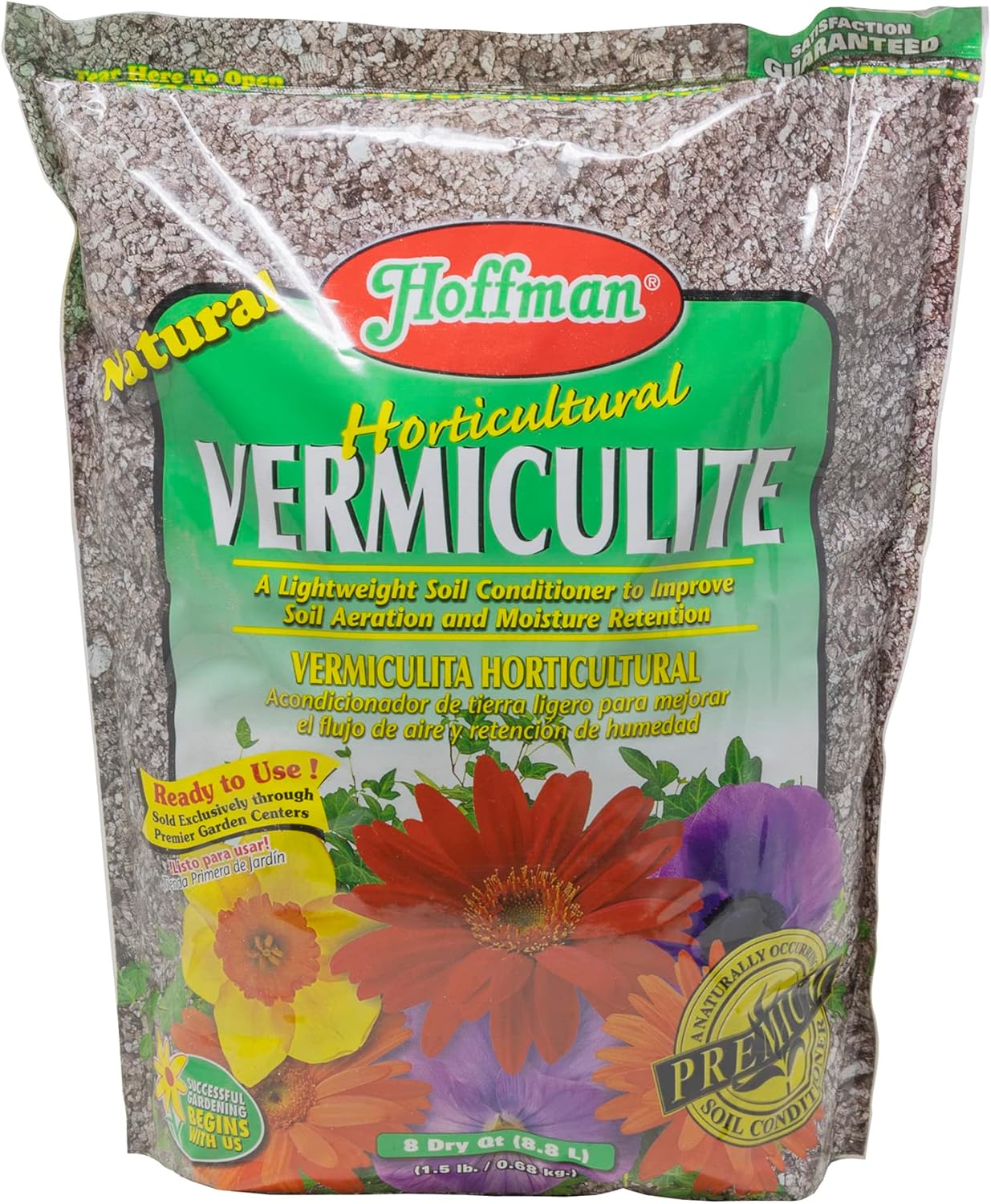
Espoma Horticultural Vermiculite, 8 Quart
| Brand Name | Espoma |
|---|---|
| Unit Count | 297.86 Ounce |
| Volume | 8 quarts |
| Item Type Name | SOIL |
Espoma Horticultural Vermiculite is a lightweight soil conditioner designed to loosen compacted soil, increase aeration, and hold moisture where plant roots can access it. Gardeners typically mix it with potting media, peat moss, or perlite to create soilless mixes, use it alone for starting seeds and propagating cuttings, or apply it around bulbs for storage. Notable features include its fine horticultural grade and an 8 quart volume that fits small-plot and container tasks. In practice it helps reduce overwatering stress by retaining water while keeping the medium airy, so roots get oxygen as well as moisture. The product is simple to use, inert and stable in mixes, and requires no special handling beyond standard potting procedures. Limitations are intrinsic to vermiculite: it does not supply nutrients, so regular fertilization is needed, and an 8 quart bag only covers modest projects so larger beds will need additional purchases.
Best for: Gardeners who prioritize a dependable, easy-to-use soil amendment for reliable seed starting, cuttings, and container mixes and who prefer predictable, stable media performance.
Less Ideal for: People looking for an all-in-one potting soil that supplies nutrients or those who need large quantities for big in-ground garden beds.
- Improves soil aeration and loosens compacted media for healthier root growth
- Retains moisture to reduce watering frequency during seed starting and propagation
- Fine horticultural grade suitable for seeds, cuttings, bulbs, and container mixes
- Inert and stable in mixes so it does not alter pH or introduce nutrients
- Does not provide nutrients so plants need separate fertilization
- 8 quart volume is small for larger garden beds or multiple containers
Verdict: Choose this vermiculite when you want a reliable, easy-to-use soil conditioner that improves aeration and moisture retention for seed starting and container gardening.
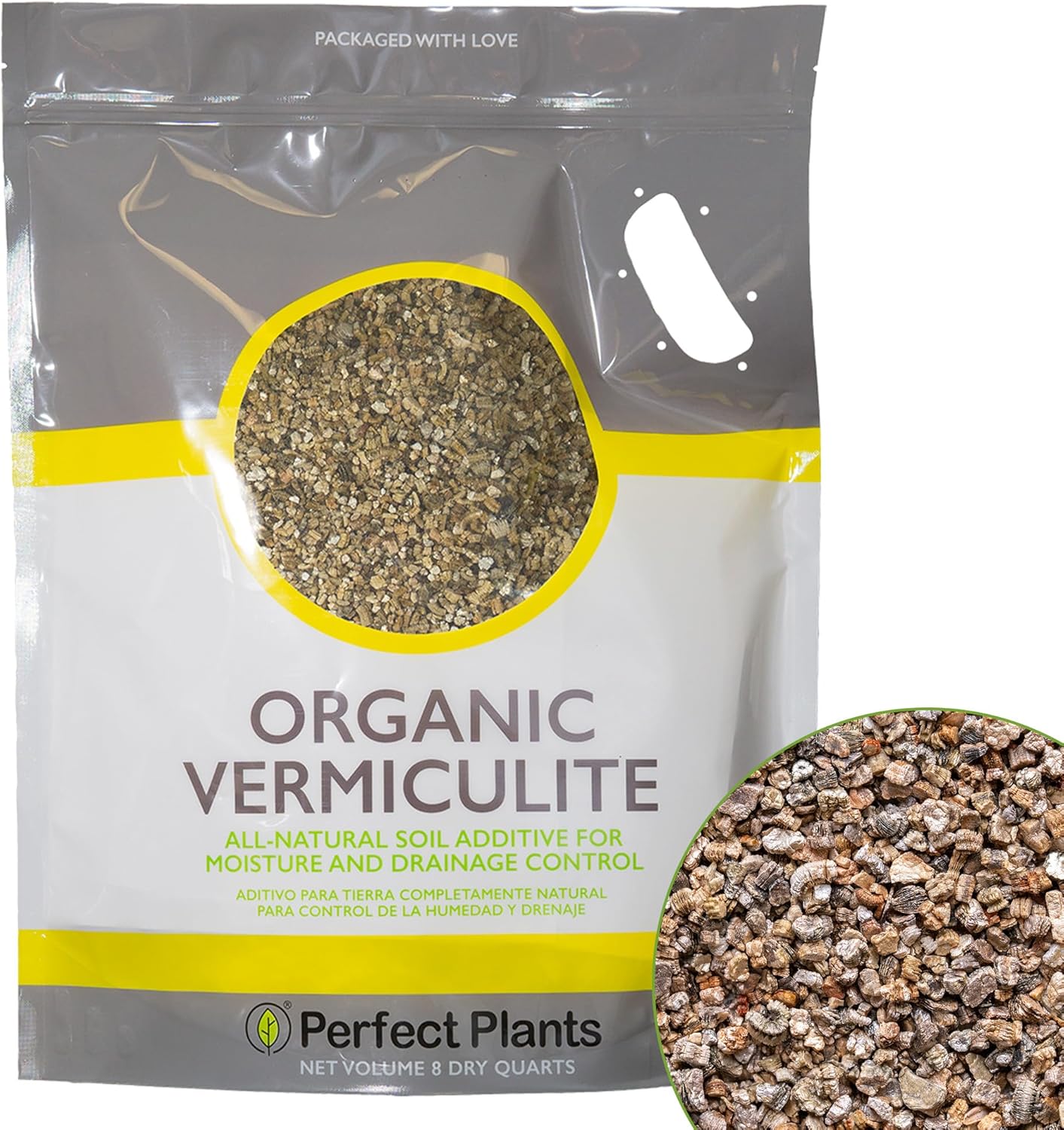
Perfect Plants Organic Vermiculite, 8 qt
| Brand Name | PERFECT PLANTS |
|---|---|
| Item Type Name | Vermiculite 8qt |
| Unit Count | 297.81 Ounce |
Perfect Plants Organic Vermiculite is a lightweight mineral additive for potting soil and container gardens that helps aerate mixes, retain plant-available moisture, and hold nutrients near roots. It is typically blended into potting mixes at about 1:4 vermiculite to soil for seed starting, propagation, potted ornamentals, and hydroponic starts. The product comes in a resealable heavy-duty bag and is described as a medium grade that will not decompose, so it remains effective in long-term container use. In practice it improves drainage while keeping the root zone evenly moist, reduces compaction, and can help protect young roots from temperature swings. The limitations are that vermiculite does not supply fertilizer or organic matter, so you still need a quality potting mix and regular feeding for most plants, and very water-sensitive species may prefer a coarser amendment. Also it can be dusty when pouring so basic respiratory protection and avoiding eye contact are sensible precautions.
Best for: Gardeners who want a reliable soil amendment to improve container drainage and moisture retention for seed starting and potted plants and who prefer products with consistent performance and visible user feedback.
Less Ideal for: Growers seeking a complete potting mix or an organic nutrient source should choose a finished potting soil or compost instead.
- Improves soil aeration and reduces compaction in potting mixes
- Holds moisture and nutrients where roots can access them
- Medium grade that does not decompose, suitable for long-term container use
- Comes in a resealable heavy-duty bag for convenient storage
- Does not provide nutrients or organic matter on its own
- Can be dusty when pouring, requiring care to avoid inhalation or eye contact
Verdict: A dependable medium-grade vermiculite that improves aeration and moisture retention in container mixes, making it a smart add-in for seed starting and potted plants.
Plantonix Vermiculite Bliss — Coarse Vermiculite (8 qt)

| Brand Name | plantonix |
|---|---|
| Unit Count | 256 Ounce |
| Volume | 8 quarts |
This 8‑quart bag of Plantonix Vermiculite Bliss is a medium‑coarse horticultural vermiculite designed as a soil amendment for seed starting, container plants, and garden beds. It is sterile and odorless, so you can mix it straight into potting soil, coco coir, or compost without introducing pathogens. The coarse grade holds water and nutrients while improving aeration and drainage, which helps prevent waterlogging and reduces frequent watering. Typical uses include blending a portion into seed starting mixes, loosening heavy garden soil, or mixing with perlite for balanced moisture control in containers. Practical benefits are easier seed germination, steadier moisture for houseplants, and improved nutrient retention to boost plant uptake. Important limitations are the small 8‑quart volume for larger projects and the need to combine vermiculite with other media for structure and long‑term drainage; it is not a complete potting soil on its own. Also follow basic safety: avoid inhaling dust and wash hands after handling.
Best for: Buyers who prioritize low‑risk, reliable soil amendments for seed starting and everyday container gardening and who want a sterile, easy‑to‑mix product that stabilizes moisture and nutrient availability.
Less Ideal for: Gardeners tackling large raised beds or bulk soil conditioning who need larger volumes or a complete potting mix should consider bulk vermiculite or full premixed soils instead.
- Sterile and odorless, safe to use for seed starting and indoor plants
- Coarse grade retains moisture and nutrients to reduce watering frequency
- Improves soil aeration and drainage when mixed into potting or garden soil
- Only an 8‑quart bag, so multiple bags are needed for larger containers or beds
Verdict: A small, sterile coarse vermiculite bag that reliably boosts moisture retention and aeration for seed starting and container gardening.
Choosing the Right Vermiculite: Key Factors to Consider
Particle Size and Grade
Particle size controls how vermiculite holds and releases water. Fine grades retain moisture close to seedling roots and are excellent for seed starting and small plugs. Medium and coarse grades improve aeration and drainage when mixed into potting soil or raised beds.
Matching grade to purpose matters because too-fine vermiculite in deep containers can hold excessive moisture, raising damping-off risk for seedlings. Conversely, using coarse grades for tiny seed trays can leave roots too dry. Look for labeled grades and think about the container depth and plant type when choosing a size.
Water Retention and Release
Vermiculite soaks up water like a sponge and releases it gradually. How much it retains and how quickly it gives water back depends on grade and particle porosity. For thirsty transplants or long-summer containers, a mix with more vermiculite can reduce watering frequency without waterlogging roots.
Consider how often you can water. If you prefer low-maintenance containers or are frequently away, a higher-retention mix helps. For plants that dislike constant moisture, balance vermiculite with coarse components such as grit or perlite to maintain aeration.
Purity and Contaminant Risk
Horticultural vermiculite should be screened and processed to remove dust and undesirable minerals. Contaminants can introduce heavy metals or affect pH and nutrient interactions. Dust also makes mixing messy and can compact media, reducing aerobic pore space.
Choose products labeled for horticultural use and check product literature for screening or washing steps. For seed starting, a cleaner, lower-dust product reduces the chance of pathogens establishing in compacted, fine material.
Compatibility With Potting Mixes and Soil Types
Vermiculite behaves differently when combined with compost, peat, coir, or mineral soils. In organic-rich mixes, vermiculite improves moisture consistency and nutrient holding by adsorbing cations. In mineral-heavy garden soil, it helps break up clay and improve root penetration.
Think about the base medium you use. If you grow in peat or coir, vermiculite can stabilize moisture. If you amend heavy clay beds, coarse vermiculite can help with structure but may require larger volumes to show an effect.
Handling, Storage, and Packaging
Packaging size matters for gardeners who use vermiculite occasionally versus as a daily potting component. Smaller bags are easier to store and reduce long-term exposure to humidity but increase per-use handling. Bulk sacks are cost-effective when you will amend many beds but require dry storage to prevent moisture pickup.
Look for resealable bags, sturdy liners, and clear storage guidance. Also consider whether the product is dusty; low-dust formulations are easier to measure and mix without protective gear.
Longevity and Physical Stability
Over multiple wet-dry cycles vermiculite can break down or collapse into finer particles, changing its performance. Stable grades retain structure so aeration and drainage remain predictable season after season. Breakdown is more likely in fine grades under mechanical mixing or heavy traffic.
If you re-use potting mixes or want consistent behavior in long-term containers, prefer vermiculite types with documented stability. Expect that any amendment will slowly integrate with organic matter and alter mix properties over years.
How Vermiculite Helps Seedlings and Cuttings
Vermiculite creates a consistently moist environment around delicate roots without saturating the surrounding media. Fine grades are excellent for direct seeding and rooting cuttings because they hold small pockets of water that seedlings can access while still allowing oxygen to reach the radicle. The neutral chemical behavior of most horticultural vermiculite means it will not supply high nutrient levels, so seedlings rely on a light feed schedule once true leaves appear.
- Fine vermiculite for seed trays and propagation plugs
- Use a sterile, low-organic base for best disease control
- Top-dress with a thin layer to maintain surface moisture
Using Vermiculite in Container Mixes
In containers, vermiculite improves moisture retention and nutrient holding capacity. Replace a portion of your potting mix with vermiculite to reduce watering frequency, especially in shallow containers that dry quickly. Combine vermiculite with coarser components if you grow plants that need good drainage, such as succulents or Mediterranean herbs.
- Replace 10 to 30 percent of potting media by volume depending on retention needs
- Mix thoroughly to avoid pockets of pure vermiculite that stay overly wet
- Monitor plants after the first watering cycles to adjust the ratio
Amending Raised Beds and Garden Soil
For in-ground beds, vermiculite helps lighten heavy soils and retain water in sandy soils. Coarse grades mixed into clay can improve root penetration and reduce compaction over time. Because vermiculite holds nutrients, it can help retain applied fertilizers in sandy sites, reducing leaching after rain events.
- Incorporate vermiculite to a depth of several inches when preparing beds
- Use larger volumes in sandy soils to have a meaningful effect on moisture retention
- Combine with organic matter for best long-term soil structure benefits
Safe Handling and Best Practices
Although horticultural vermiculite is generally safe to handle, avoid breathing dust during mixing. Work outdoors or in a well-ventilated area and consider using a mask when handling loose bags. Wear gloves if you have sensitive skin and dampen very dusty vermiculite slightly to reduce airborne particles while mixing. Store vermiculite in a dry area and keep bags sealed. If vermiculite absorbs moisture in storage it can cake and lose the texture gardeners rely on. Label containers with the purchase date and intended use if you keep different grades separately.
- Work in a ventilated space and avoid creating dust clouds
- Use gloves and eye protection if mixing large volumes
- Store in sealed, dry containers away from direct sunlight
Sustainability and Disposal Considerations
Vermiculite is a mined mineral and has a different environmental profile than organic amendments. Use it where its physical benefits are most needed, such as seed starting or improving very sandy or clayey soils, rather than as a wholesale replacement for compost. When disposing of old potting mixes that contain vermiculite, mix them into garden beds where the mineral can continue to improve structure rather than sending media to landfill. If sustainability is a priority, balance vermiculite use with increased organic matter to build long-term soil biology and carbon storage.
- Prefer targeted use in problem areas rather than blanket application
- Recycle spent mixes into garden beds to retain physical benefits
- Pair vermiculite with compost to support soil life
How We Chose the Best Vermiculite
We focused on attributes that directly affect how vermiculite performs in home and small-scale garden settings. Selection began with widely used grades and particle sizes appropriate for seed starting, container mixes, soil amendment, and bulk garden incorporation. We prioritized product purity to avoid contaminants and dust, and we checked sourcing information when available to confirm mineral origin and processing methods. Evaluation criteria emphasized particle size distribution because it determines water retention and aeration. Absorption capacity and water-release behavior were key to predicting performance with seedlings and in containers. Physical cleanliness and dust content were assessed because fine dust can compact mixes and create handling issues. We also considered packaging options and available bag sizes since storage and frequent access affect long-term usability. Longevity and stability in media rounds out the criteria, focusing on whether vermiculite breaks down or compacts over repeated wet-dry cycles. Items excluded from consideration included untreated industrial vermiculite not labeled for horticultural use, products with unclear mineral sourcing, and mixes blended with fertilizers or wetting agents that confound pure vermiculite performance. The selection favors straight horticultural vermiculite suitable for gardeners mixing their own potting soil or amending in place.
FAQ
Is vermiculite the same as perlite?
No. Vermiculite and perlite are different minerals with different properties. Vermiculite holds water and nutrients and improves moisture retention, while perlite is primarily used to increase drainage and aeration. Garden mixes often use both to balance moisture and airflow.
Which vermiculite grade is best for seed starting?
Fine-grade vermiculite is usually best for seed starting and rooting cuttings because it retains moisture near tiny roots without compacting when kept sterile and loosely packed. Medium grades are more common in general potting mixes.
Can vermiculite be mixed with compost or fertilizer?
Yes. Vermiculite is chemically inert in most cases and works well with compost and slow-release fertilizers by retaining water and adsorbing nutrients. For seedlings use light feeding; for mature plants follow crop-specific fertilizer guidance.
How much vermiculite should I add to potting soil?
A common starting point is 10 to 30 percent vermiculite by volume depending on desired water retention. Start at the lower end for larger, deeper containers and increase retention for shallow pots or when you need less frequent watering.
Will vermiculite change soil pH?
Most horticultural vermiculite is neutral to slightly alkaline and does not substantially change soil pH at typical amendment rates. If you rely on precise pH for acid-loving plants, monitor soil pH after major amendments and adjust as needed.
Can I reuse vermiculite from old potting mix?
You can reuse vermiculite, but its structure may break down over repeated wet-dry cycles and mixing. Screen out decomposed organic debris and supplement with fresh vermiculite to restore desired texture and retention.
Final Verdict
Choose vermiculite based on the specific role you need it to play. Use fine grades for seed starting and propagation where gentle moisture retention is critical, and medium or coarse grades when improving aeration and structure in containers or beds. Prioritize horticultural-grade, low-dust products and consider packaging size relative to how often you amend soil. Balancing vermiculite with organic matter and coarser mineral components will help you achieve predictable watering and root health across different garden situations.
