

Note: This article contains affiliate links. If you click on these links and make a purchase, I may earn a small commission at no extra cost to you. This helps support my research and content. Read my full affiliate disclosure here.
A heavy aphid infestation can stunt growth, spread disease, and leave leaves sticky with honeydew. Choosing the right aphids pesticide matters because some options deliver quick knockdown while others prioritize plant safety and minimal impact on beneficial insects. This guide covers seven shortlisted products suited to home gardens and patio containers, with practical notes on speed of control, residual activity, and how gentle each option is on foliage. Below we summarize each top-rated choice and explain the criteria used to evaluate them so you can pick the best fit for your growing space and pest pressure.
Top Picks at a Glance
| Best Overall The best all-around choice for most situations | BioAdvanced 3-in-1 Insect, Disease & Mite Control Concentrate, 32 oz |  |
| Best Quality Built to a higher standard if you want something more solid | AgroMagen GrowSafe Organic Miticide & Fungicide (33.8 fl oz) |  |
| Best Value The sweet spot between price and what you get | Garden Safe Insecticidal Soap Ready-to-Use Spray, 32 oz |  |
| Best Budget The cheapest option that still gets the job done reliably | BioAdvanced Rose & Flower Insect Killer Spray, 24 oz |  |
| Highest Rated A top-rated pick with lots of positive feedback | ferti-lome Tree & Shrub Drench Systemic Insecticide, 1 gal |  |
| Most Popular A crowd favorite that many people choose with confidence | Bonide Captain Jack's Ready-to-Use Neem Oil Spray, 32 oz |  |
| Best Seller A high-volume bestseller chosen again and again | Atticus Talak 7.9% Bifenthrin Indoor/Outdoor Insecticide Concentrate, 32 oz |  |
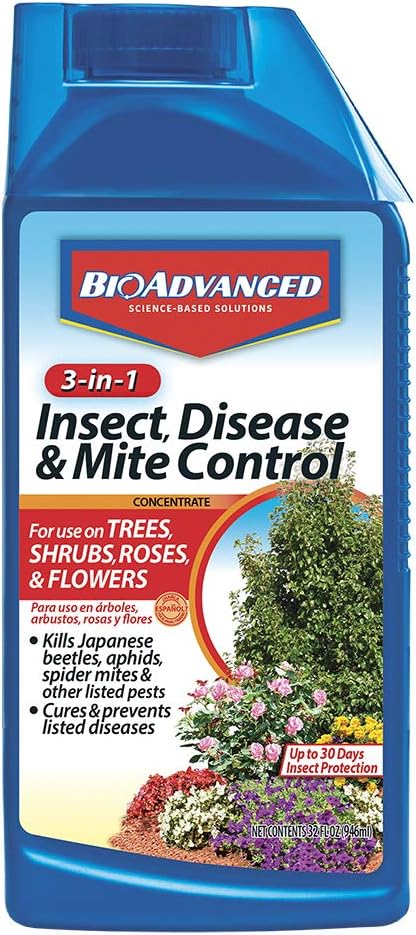
BioAdvanced 3-in-1 Insect, Disease & Mite Control Concentrate, 32 oz
| Unit Count | 32 Fluid Ounces |
|---|---|
| Item Type Name | Concentrate |
| Liquid Volume | 32 fluid ounces |
| Active Ingredients | Imidacloprid, Tau-fluvalinate, Tebuconazole |
| Specification Met | EPA |
This BioAdvanced concentrate is designed as an all-purpose plant treatment that kills listed insects on contact, controls common fungal diseases, and suppresses spider mites in one product. You mix the concentrate with water to make spray solution (it yields up to about 12 gallons), then apply to roses, flowers, shrubs, trees, and other ornamentals. Key active ingredients—imidacloprid, tau-fluvalinate, and tebuconazole—deliver systemic, rainproof protection that the label says can last up to 30 days. For mite control specifically, the miticide component gives both suppression and residual activity, so it is useful for follow-up sprays during an outbreak. Practical benefits include fewer separate products to buy and the convenience of treating multiple problems with one application. Important limitations are regulatory restrictions that make it unavailable in several states and the need to follow label safety precautions because it contains systemic insecticide active ingredients that can affect non-target insects if misused.
Best for: Gardeners who want a single, practical product to manage insect pests, fungal diseases, and spider mites on roses and ornamentals and who prefer a preventive residual treatment.
Less Ideal for: Organic gardeners or those managing pollinator-attractive plantings who avoid systemic insecticides should choose non-systemic or organic miticide and fungicide options instead.
- Combines insecticide, fungicide, and miticide in one concentrate for fewer products to store and apply
- Systemic formulation with rainproof protection that can last up to 30 days after application
- Makes up to 12 gallons of spray from a 32 fl oz bottle, suitable for treating multiple plants or repeat applications
- Active ingredients target a broad list of pests including aphids, spider mites, Japanese beetles and common foliar diseases
- Not available for sale in several U.S. states, limiting where it can be used
- Contains systemic insecticides that require careful adherence to label directions to avoid harming beneficial insects
Verdict: If you want one dependable product to both kill spider mites and prevent common foliar diseases across roses and ornamentals, this 3-in-1 concentrate simplifies treatment with a month-long systemic residual.
AgroMagen GrowSafe Organic Miticide & Fungicide (33.8 fl oz)

| Item Form | Oil |
|---|---|
| Target Species | spider mites, whiteflies, aphids, powdery mildew, downy mildew |
| Liquid Volume | 8.5 fluid ounces |
| Active Ingredients | Corn Oil, Soybean Oil |
GrowSafe is a plant-based oil formulation designed for season-long pest and powdery mildew control in vegetable gardens and indoor plants. You mix the concentrate with water and apply as a foliar spray to treat spider mites, whiteflies, aphids and fungal spots on tomatoes, peppers, greens and herbs as well as ornamentals. The product’s corn and soybean oil base is formulated to mix stably with water, which helps reduce leaf burn and stomatal clogging compared with some horticultural oils. It is labeled safe for use on food crops through harvest and is described as low-toxicity for people, pets and beneficial insects when used as directed. Practical benefits include suitability for seedling through harvest, indoor and greenhouse use, and being a gentler neem alternative with less odor and residue. Limitations are that it is an oil-based contact treatment so it works best on direct spray coverage and may require repeat applications for severe infestations; it does not provide systemic protection or long residual control against new incoming pests.
Best for: Vegetable gardeners and small-scale growers who prioritize organic, low-toxicity pest and disease control and want a product they can use safely on edible crops throughout the season.
Less Ideal for: Large-scale growers seeking long-lasting systemic control or single-application knockdown for severe outbreaks should consider professional or systemic alternatives.
- Made from food-grade, plant-based oils suitable for edible crops
- Formulated to mix stably with water to reduce leaf burn and residue
- Effective contact control for mites, whiteflies, aphids and powdery/downy mildew
- Safe for use around people, pets and many beneficial insects when used as directed
- Works by contact so full coverage and repeat applications are needed for heavy infestations
- Not systemic so it will not protect new growth once applied
Verdict: Choose GrowSafe when you need a food-safe, plant-based foliar spray for organic, season-long contact control of mites and powdery mildew in vegetable gardens.
Garden Safe Insecticidal Soap Ready-to-Use Spray, 32 oz

| Item Form | Spray |
|---|---|
| Target Species | Insects |
| Liquid Volume | 32 fluid ounces |
| Active Ingredients | Potassium Salts Of Fatty Acids |
Garden Safe Insecticidal Soap is a ready-to-use contact spray formulated with potassium salts of fatty acids to control aphids, mealybugs, mites, whiteflies and similar soft-bodied pests. You use it like a normal garden spray: thoroughly coat insects and all plant surfaces including undersides of leaves, ideally in calm weather and not in full sun. It is safe for use on vegetables, fruit trees, ornamentals, shrubs, flowers and in greenhouses and may be applied to edibles up to the day of harvest, which simplifies timing for vegetable growers. The spray works on direct contact so thorough coverage is essential and multiple applications may be needed for heavy infestations. The product is convenient because no mixing is required, but it can be washed off by rain and is hazardous to aquatic invertebrates so care is needed to avoid runoff into water. For routine control of common garden pests this soap is a practical, low-toxicity option when used as part of an integrated pest management approach.
Best for: Gardeners who prioritize practical, low-toxicity pest control and want a ready-made spray that can be used on edible crops without pre-harvest delays.
Less Ideal for: People needing a long-residual or systemic pesticide for heavy infestations or for pests hidden inside plant tissues should consider other control methods.
- Ready-to-use formula requires no mixing for quick spot treatments
- Labeled for use on vegetables and may be applied up to the day of harvest
- Controls a broad list of soft-bodied pests including aphids, mites and whiteflies
- Plant-safe when used as directed and usable indoors, outdoors and in greenhouses
- Only kills pests by direct contact so it has limited residual or systemic activity
- Can be washed off by rain and must be reapplied after watering or heavy rainfall
- Harmful to aquatic invertebrates so it requires careful application near water
Verdict: A convenient, low-toxicity ready-to-use soap spray that gives effective contact control of common soft-bodied garden pests and is safe to use up to harvest.
BioAdvanced Rose & Flower Insect Killer Spray, 24 oz

| Unit Count | 24 Fluid Ounces |
|---|---|
| Item Form | Spray |
| Target Species | Insects |
| Active Ingredients | Cyfluthrin |
| Specification Met | EPA |
This ready-to-use BioAdvanced spray is designed for quick spot treatment of roses, flowers, shrubs and vegetable gardens. The bottle delivers a fast-acting cyfluthrin formula that kills common pests such as aphids, whiteflies, Japanese beetles and caterpillars on contact, and the label claims protection for up to 14 days after application. Typical use is a direct spray to foliage until leaves are coated but not dripping, making it convenient for spot treatments or treating individual plants without mixing. The product is easy to apply and covers many common garden pests, which is helpful when you want an immediate reduction in visible damage. Important limitations are that it is a chemical insecticide with a synthetic active ingredient and is formulated for above-ground pests only, so it does not target soil-dwelling stages and should be used according to label precautions around beneficial insects and flowering pollinators. For gardeners needing occasional, effective knockdown of common pests, this is a practical ready-to-use option.
Best for: Gardeners who want an affordable, no-mix spray to quickly knock down visible pests on roses and ornamental plants and who prioritize convenience and immediate results.
Less Ideal for: People looking for organic or pollinator-safe options or those needing systemic or soil-targeted pest control should consider alternatives.
- Ready-to-use sprayer for easy spot application
- Kills a wide range of listed pests on contact
- Provides up to 14 days of residual protection as stated on the label
- Contains a synthetic pyrethroid active ingredient which can harm beneficial insects if applied to blooms
- Not intended for control of soil-dwelling pests or grubs
Verdict: A convenient, budget-friendly ready-to-use spray for rapidly reducing common above-ground garden pests on roses and flowers.
ferti-lome Tree & Shrub Drench Systemic Insecticide, 1 gal

| Item Form | Liquid |
|---|---|
| Target Species | Insects |
| Liquid Volume | 128 fluid ounces |
This ferti-lome Tree & Shrub Drench is a one‑gallon liquid concentrate designed to protect woody plants by moving through the roots and into the vascular system where it controls insects such as aphids and psyllids. Typical use is simple: mix the recommended dose with water and pour the drench around the base of trees or shrubs in early spring or early fall. The systemic action gives season‑long protection so most users need only one application per year. Practical benefits include broad coverage of root uptake for multi‑year established plants, straightforward dilution instructions on the label, and a concentrated form that treats multiple specimens from one container. Important limitations are that application rates vary by trunk diameter or shrub height so accurate measuring is required and the product is formulated for outdoor woody plants not for herbaceous perennials or edible crops; always follow label safety directions. It is best used as part of an integrated pest program rather than as a lone fix for severe outbreaks.
Best for: Gardeners who prioritize long‑lasting, low‑frequency pest control for established woody ornamentals and want a product that protects from the roots upward.
Less Ideal for: People seeking insecticides for herbaceous flowering plants like annuals or for vegetable gardens should choose a product labeled for those uses.
- Systemic formula provides up to 12 months of protection after one application
- Concentrated 1 gallon pack treats multiple trees and shrubs
- Easy to apply by diluting and pouring around root zone
- Effective against common sap‑feeding pests like aphids and psyllids
- Not labeled for use on herbaceous plants or edible crops so limited to trees and shrubs
- Requires careful measuring and dilution to match label rates
Verdict: Choose this drench if you want a single, season‑long systemic treatment to protect azaleas and other woody shrubs with one annual application.
Bonide Captain Jack's Ready-to-Use Neem Oil Spray, 32 oz

| Item Form | Liquid |
|---|---|
| Target Species | Insects |
| Liquid Volume | 32 fluid ounces |
| Active Ingredients | Clarified Hydrophobic Extract of Neem Oil |
This ready-to-use neem oil spray is a multipurpose garden treatment that kills insects at all life stages while also serving as a miticide and preventative fungicide. Packaged in a 32-ounce trigger bottle, it is applied by shaking and thoroughly spraying plant surfaces, including leaf undersides, at the first sign of pests or disease and reapplying every 7 to 14 days as needed. The active ingredient is a clarified hydrophobic extract of neem oil, which is approved for organic gardening and labeled safe to use on vegetables up to the day of harvest. Practical benefits include broad pest coverage (aphids, whiteflies, spider mites and others), disease suppression such as powdery mildew, and convenience from a ready-to-use sprayer. Important limitations are that results are slower than synthetic contact insecticides and application timing matters to avoid leaf burn in full sun; repeated applications may be needed for heavy infestations. Follow label safety directions and keep the product away from children and pets.
Best for: Gardeners who want a single, organic-approved product to manage common vegetable garden pests and fungal problems and who prefer products with strong user feedback.
Less Ideal for: Growers needing rapid knockdown of severe infestations or commercial producers who require fast-acting, high-throughput treatments.
- Kills multiple pest stages including eggs, larvae and adults for more complete control.
- Also acts as a fungicide and miticide so one product covers pests and common fungal issues.
- Ready-to-use trigger bottle requires no mixing and is easy to apply to leaves and undersides.
- Approved for organic gardening and can be used on vegetables up to day of harvest.
- Slower-acting than many synthetic contact insecticides, so it may take several applications to see control.
- Must avoid spraying in peak sunlight to reduce risk of leaf burn.
Verdict: A convenient, organic-approved all-in-one neem spray that controls common vegetable garden pests and fungal issues with minimal fuss.
Atticus Talak 7.9% Bifenthrin Indoor/Outdoor Insecticide Concentrate, 32 oz

| Active Ingredient | Bifenthrin |
|---|---|
| Formulation | Suspension Concentrate |
| Liquid Volume | 32 fluid ounces |
| Length of Control | Up to three months |
| Target Species | Insects |
Talak 7.9% is a liquid concentrate for treating lawns, landscaping, outdoor living areas and indoor perimeter spots like baseboards and cabinets. You dilute the concentrate with water to create a spray for barrier treatments, spot applications or lawn mixes; label rates explain how much to mix per gallon depending on the use. The product uses bifenthrin, a proven broad-spectrum active ingredient, and the manufacturer states it controls over 75 species and can give residual control for as long as three months. Its water-based formula dries clear, leaves no odor or visible residue, and is not phytotoxic on plants when used per label. Practical benefits include flexible indoor and outdoor use, clear drying, and a bottle designed for easier pouring. Important limitations are that solutions should be mixed only for same-day use, it is not registered for sale in a few states, and it is not approved for fogger application, so professional-style misting methods are not appropriate.
Best for: Buyers who want a single, reliable product to protect yards, patios and building perimeters from a wide range of common pests and prefer conservative, label-driven application practices.
Less Ideal for: People seeking ready-to-use sprays or fogger-compatible products or those in states where this formulation is not registered should look at alternatives.
- Broad-spectrum control listed for 75+ indoor and outdoor pest species
- Water-based formula that dries clear and leaves no odor or residue
- Flexible label directions for lawns, landscapes, hardscapes and indoor perimeter treatments
- Long residual activity up to three months when applied at recommended rates
- Mixed spray solutions cannot be stored and must be used the same day
- Not approved for fogger application and not available for sale in some states
Verdict: A versatile, water-based bifenthrin concentrate that delivers long-lasting, broad-spectrum outdoor (and perimeter indoor) control when used according to the label.
Choosing the Right Aphids Pesticide: Key Factors to Consider
Mode of Action
Understanding whether a pesticide works by contact, ingestion, or systemically helps set expectations for how quickly aphids will die and which plant parts will be protected. Contact products typically kill on contact and produce fast visible results, but they require thorough coverage of foliage and new growth. Systemic products move through the plant and can protect new growth, but they usually take longer to show results and may not stop heavy adult populations immediately.
Knowing the mode of action also helps integrate the product with other pest control methods and avoid repeated use of products with the same mode that can lead to resistance. For edible plants, consider whether systemic uptake will affect harvest intervals.
Plant Safety and Phytotoxicity
Different formulations interact with plant tissues in different ways. Oils and high-strength soaps can be effective but may cause leaf burn on tender seedlings, heat-stressed plants, or broadleaf ornamentals in hot sun. Always check label directions about temperatures, dilution rates, and whether the product is safe on specific crops. For container-grown plants and small raised beds, residues can concentrate more easily, so use gentler formulations or lower rates when growing young transplants.
Phototoxicity risk is higher with some botanicals or surfactant-heavy mixes. Test any new product on a small area of the plant before treating the whole specimen, and avoid spraying in full sun or during heat waves to reduce the chance of damage.
Spectrum and Impact on Beneficial Insects
Aphid control is most sustainable when beneficial insects such as lady beetles, lacewings, and parasitic wasps remain active in the garden. Broad-spectrum pesticides can quickly reduce non-target predator and pollinator populations, increasing the chance of secondary pest outbreaks. Look for products labeled as selective or with lower toxicity to beneficials, and apply in a way that reduces exposure such as targeting only infested plants or spraying in the evening when pollinators are less active.
When beneficial insects are an important part of your integrated pest management plan, favor contact products with short residual action or physical controls that spare predators.
Residual Activity and Weather Stability
Residual activity determines how long a product continues to protect the plant after application. Longer residuals can reduce the number of repeat treatments needed but may also extend exposure risk to beneficials and delay harvest on edible crops. Short-residual options require more frequent applications but allow more precise timing and lower cumulative exposure.
Weather stability is also critical because rain can wash off contact products before they act. Some formulations are rainfast after a short drying period, while others need reapplication after heavy rain. Choose a product whose residual profile fits your watering and weather patterns.
Application Method and Ease of Use
Practical application needs influence choice: ready-to-use sprays are simple for small patios and few plants, while concentrates allow precise dosing for larger gardens. Consider whether you need a hose-end applicator, pump sprayer, or hand sprayer and whether the product mixes cleanly without clogging nozzles. Products that require frequent re-mixing or carry complex PPE requirements increase the time and effort needed.
Also think about coverage: aphids hide on new growth and the undersides of leaves, so a product that produces good leaf coverage or is systemic may give more reliable results for dense plants.
Pre-harvest Interval and Edible Safety
If you grow vegetables or herbs, harvest restrictions and labeled food-plant approvals are essential. Some pesticides are cleared for use on ornamentals only and should not be used on edible crops. Even when labeled for food plants, observe the pre-harvest interval to avoid residues on produce. For container herbs and close-to-harvest greens, prefer options with short or no required waiting period and follow label directions for application rates and the number of permitted treatments.
Organic gardeners should check for allowed organic inputs and understand that natural products can still require withholding periods.
When to Treat Versus When to Watch
Not every aphid presence requires immediate chemical control. Small, localized colonies can often be managed with pruning, strong water sprays, or insecticidal soaps applied directly. Treat when populations are expanding rapidly, multiple plants are affected, or when you spot sooty mold, distorted growth, or ants farming the aphids.
If beneficial predators are active and numbers seem to hold aphids in check, monitoring may be the best option. Treating too early can disrupt natural control and lead to rebound infestations.
- Consider threshold: visible plant damage or sticky honeydew indicates action is needed
- Target treatment to infested plants to preserve beneficials
- Respray only if new growth becomes infested after initial control
Application Tips for Effective Coverage
Aphids hide on the undersides of leaves and in new growth, so aim spray at these areas. For foliar contact products, full coverage is the difference between control and persistence. Use a fine fan nozzle for even distribution and apply during calm weather to reduce drift.
Follow label dilution rates carefully. Overdiluting reduces efficacy and underdosing increases phytotoxic risk and resistance pressure. Rinse sprayers thoroughly between products to avoid damaging plants with residue mixes.
- Spray in the morning or evening to reduce exposure to pollinators
- Test spray on a small area first if plants are stressed or it is very hot
- Combine physical removal and targeted spraying for heavy infestations
Integrating Pesticides with Cultural Controls
A chemical or botanical control works best alongside cultural practices that reduce aphid habitat and reproduction. Keep plants healthy with appropriate watering and nutrition, remove heavily infested shoots, and avoid excess nitrogen which can encourage aphid population booms.
Encourage beneficial species by planting nectar sources and avoiding unnecessary broad-spectrum sprays. Sticky traps and reflective mulches can also deter early-season colonization on some crops.
- Rotate crops and maintain plant diversity to disrupt aphid host chains
- Introduce or conserve predators rather than relying solely on repeated sprays
- Inspect new transplants before adding them to the garden
Safety and Personal Protective Measures
Read label instructions for required gloves, eye protection, and application distances. Even low-toxicity botanicals can irritate skin or eyes if concentrated. Use protective clothing when mixing concentrates and avoid inhaling spray mist.
Store pesticides in childproof containers away from pets and water sources. Clean equipment after use to prevent accidental exposure and to keep formulations effective for future treatments.
- Avoid spray drift onto neighboring food crops not listed on the label
- Wait the recommended interval before allowing pets into treated areas if specified
- Dispose of leftover mix according to local guidance to protect waterways
Timing Treatments for Minimal Pollinator Impact
Apply products in the evening or early morning when pollinators are least active. Avoid spraying flowering plants unless the product label specifically permits it and notes low toxicity to bees. When treating target plants that produce nectar, prefer spot applications to reduce exposure.
For systemic products, consider how long nectar or pollen might carry residues and choose options with shorter persistence if pollinator access is frequent.
- Cover or move potted flowering plants when treating adjacent foliage
- Record treatment dates to avoid overlap with flowering periods
- Use selective products when pollinators are present
How We Chose the Best Aphids Pesticide
We prioritized products that combine reliable aphid control with safe use on ornamental and edible plants commonly found in home gardens. Evaluation focused on efficacy against common aphid species, contact versus systemic action, and expected speed of knockdown in real garden conditions. Plant safety was a key filter: we excluded options known to cause foliage burn on tender seedlings or to leave long-lasting residues that restrict harvest times. Formulation and application flexibility were considered next, including availability of ready-to-use sprays, concentrates for foliar application, and options safe for use in greenhouses or on container plants. Environmental impact and effect on beneficial insects were reviewed by looking at labeled precautions and known selectivity. Ease of use and clear dosing instructions mattered because inaccurate mixing or application increases risk to plants. We also considered persistence on foliage and rainfastness, since gardeners need solutions that hold up to weather. We excluded products that are restricted to commercial applicators or require specialized equipment. The final list favors practical, accessible options gardeners can use confidently in mixed-plant beds and edible plantings.
FAQ
How quickly will I see aphids die after applying a pesticide?
Many contact formulations show visible knockdown within hours, while systemics can take several days to reduce populations on new growth. Speed depends on product mode of action, coverage, and infestation severity.
Can I use aphids pesticides on vegetables and herbs?
It depends on the product labeling. Some are approved for use on edible crops with specified pre-harvest intervals, while others are labeled for ornamentals only. Always follow label directions to ensure crop safety.
Will pesticides kill beneficial insects too?
Some will, especially broad-spectrum options with long residuals. Using spot treatments, low-residual contact products, and evening application times can reduce impacts on lady beetles, lacewings, and pollinators.
How many treatments are usually needed to control an aphid outbreak?
Often one thorough treatment reduces numbers substantially, but follow-up sprays may be necessary to address new nymphs or missed colonies. The number of treatments depends on residual activity, reinfestation pressure, and whether cultural controls are used.
Are organic aphid control products effective?
Many organic or botanical options can control aphids when applied correctly, but they may require more frequent application and excellent coverage. They are often gentler on beneficials but still must be used according to label instructions.
Can I mix aphid pesticides with other garden sprays?
Mixing is possible with compatible products but not always safe. Check label compatibility and perform a small jar test or spot test on plants to avoid phytotoxicity. When in doubt, use separate applications spaced by several days.
Final Verdict
Choose an aphids pesticide based on how quickly you need control, how many plants are affected, and whether you must protect beneficial insects and nearby edible crops. Fast-contact options give rapid knockdown but require full coverage and may need repeat applications. Systemic or longer-residual choices reduce the frequency of sprays and protect new growth but may have longer exposure windows for non-target species. Prioritize plant safety, proper timing, and careful application technique. Combining a targeted pesticide with cultural controls and predator conservation delivers the most reliable long-term outcomes in vegetable beds, container plantings, and mixed ornamental borders.
