

Note: This article contains affiliate links. If you click on these links and make a purchase, I may earn a small commission at no extra cost to you. This helps support my research and content. Read my full affiliate disclosure here.
If ants are turning your lawn, garden beds, or patio into a pathway, the right outdoor ant pesticide can stop infestations before they reach structures or damage plants. You need products that perform outside under sun, rain, and irrigation and that match your tolerance for reapplication and pet exposure. This guide shortlists the best options gardeners use for yards and patios and explains the practical tradeoffs between speed of colony knockdown, residual protection, and safety around children and pets. Below are our top picks and the criteria we used to evaluate them so you can pick the solution that fits your outdoor space and pest pressure.
Top Picks at a Glance
| Best Overall The best all-around choice for most situations | Amdro Ant Killer for Outdoor Home Perimeter, 12 oz |  |
| Best Quality Built to a higher standard if you want something more solid | Talstar One Insecticide Concentrate, 1 Gallon |  |
| Best Value The sweet spot between price and what you get | Terro Outdoor Liquid Ant Bait Stakes, 12-Pack |  |
| Best Budget The cheapest option that still gets the job done reliably | Combat Max Ant Killing Gel, 27 g Syringe |  |
| Highest Rated A top-rated pick with lots of positive feedback | ROUTADE 48-Pack Slow-Acting Ant Gel Bait Stations |  |
| Most Popular A crowd favorite that many people choose with confidence | TERRO Ant Killer Plus Granules, 3 lb Shaker Bag |  |
| Best Seller A high-volume bestseller chosen again and again | Atticus Talak 7.9% Bifenthrin Indoor/Outdoor Insecticide Concentrate, 32 oz |  |
Amdro Ant Killer for Outdoor Home Perimeter, 12 oz

| Unit Count | 12 Ounce |
|---|---|
| Item Form | Granules |
| Target Species | Ant |
| Special Features | Ant Killer for Outdoor Home Perimeter |
Amdro Ant Killer for Outdoor Home Perimeter is a granular bait you shake around a building to create a 1-foot protective band that attracts worker ants and carries the poison back to the colony. It is typically used on lawns, around foundations and in landscaped beds during the spring and summer when ants are active. The formulation claims to work on 25 common ant species and continues to be effective for up to three months, which reduces how often you need to reapply. Practical benefits include easy application with no equipment, visible reduction in ant activity within a week, and suitability for broad perimeter treatment of larger yards. Limitations are that it must be applied to dry ground and not before rain or freezing temperatures, and it targets outdoor activity only so indoor infestations may require separate treatment. This product is best treated as a preventive or colony-control solution for routine lawn maintenance rather than a rapid indoor knockdown.
Best for: Homeowners who want an affordable, low-effort way to reduce ant pressure around lawns and landscaped perimeters and prefer a preventive, long-lasting perimeter treatment.
Less Ideal for: People needing immediate indoor ant control, emergency knockdown, or solutions for wet or shaded yards where repeated wetting makes granular application impractical.
- Granular bait that workers carry back to the colony to target queens and nests
- Claims control of up to 25 ant species common in lawns and landscapes
- Long residual action up to three months reduces reapplication frequency
- Simple shake-on application requires no special tools
- Must be applied to dry ground and avoided before rain or when temperatures are below 50°F
- Designed for outdoor perimeter use only and will not treat interior infestations directly
Verdict: Amdro provides a budget-friendly, long-lasting granular perimeter bait that makes routine lawn and foundation ant control simple and low maintenance.
Talstar One Insecticide Concentrate, 1 Gallon

| Active ingredient | Bifenthrin 7.9% |
|---|---|
| Formulation | Concentrate, water-based |
| Coverage intent | Perimeter and structural applications |
| Pest range | Controls 75+ pests including ticks |
Talstar One is a professional-strength bifenthrin concentrate designed to provide broad-spectrum control of ants, spiders, roaches, fleas, ticks, mosquitoes, and many other pests. You mix the concentrate with water and apply it as a perimeter spray around foundations, doors, and windows or to targeted cracks and crevices indoors. Notable features include a water-based, low-odor formula that dries clear and a residual effect that reduces the need for frequent reapplications on lawns, ornamentals, shrubs, and structural surfaces. For yards with tick pressure, treating perimeters and vegetation provides a dependable barrier that helps reduce tick encounters when applied according to label directions. The product is concentrated so one gallon treats large areas, which makes it efficient for seasonal maintenance across multiple structures. Important limitations are that it is a pesticide that requires careful handling and strict adherence to label rates and application restrictions, and it is not a ready-to-use spray so you will need appropriate mixing and application equipment for safe, effective coverage.
Best for: Buyers who prioritize reliable, residual pest control for yards and perimeters and who are comfortable using concentrated pesticides with proper safety practices.
Less Ideal for: Casual users who want a ready-to-use product or those unwilling to follow pesticide label precautions and use appropriate application equipment.
- Broad-spectrum control that includes ticks and common yard pests
- Concentrated formula covers large areas and is cost-efficient for seasonal treatments
- Water-based, low-odor formula dries clear and is suitable for outdoor living spaces
- Suitable for both perimeter and targeted indoor/structural applications
- Concentrate requires proper mixing and application equipment for safe use
- Contains bifenthrin so users must follow label precautions to protect people, pets, and beneficial insects
Verdict: Choose Talstar One when you need a concentrated, long-lasting perimeter treatment that reliably reduces tick pressure across yards and structures.
Terro Outdoor Liquid Ant Bait Stakes, 12-Pack

| Unit Count | 12 Count |
|---|---|
| Material Type | Plastic |
| Target Species | Ant |
| Power Source | manual |
These Terro Outdoor Liquid Ant Bait Stakes are simple, low-effort bait stations designed to intercept ant colonies outdoors before they reach the house. Each stake contains a sweet liquid bait with borax that worker ants feed on and carry back to the nest, which can eliminate the queen and much of the colony over a 2 to 4 week period. They are weather-resistant, see-through so you can monitor bait consumption, and install by cutting a tab and pushing the stake into soil or mulch near ant trails. For homeowners dealing with small common species such as little black, odorous house, pavement, and ghost ants, the stakes provide targeted perimeter protection without sprays or direct contact. Limitations are that baiting takes days to weeks to fully work and you may see increased ant activity at first as foragers discover the bait. Also they must be placed where children and pets cannot access them and replaced periodically to maintain protection.
Best for: Homeowners who want a low-effort, evidence-based way to stop small common outdoor ants at the source and prefer baiting over sprays, using visual confirmation of activity before replacing units.
Less Ideal for: People needing an immediate knockdown or single-visit solution for heavy indoor infestations or those who cannot place bait stations out of reach of children and pets.
- Colony-level control via borax bait that foraging ants share with the nest
- Ready-to-use stakes are easy to deploy by cutting the tab and inserting in soil
- See-through design lets you monitor bait consumption and know when to replace
- Weather-resistant stations suitable for yards, patios, and garden perimeters
- Works gradually and can take 2–4 weeks for complete colony control
- Not child- or pet-proof if placed in accessible areas and requires careful placement
Verdict: A practical, easy-to-use baiting solution that stops small outdoor ant colonies by getting worker ants to carry borax bait back to the nest.
Combat Max Ant Killing Gel, 27 g Syringe

| Active ingredient | Fipronil 0.001% |
|---|---|
| Net weight | 27 gram (0.95 oz) |
| Application | Indoor and outdoor use |
| Form | Ready-to-use gel in syringe |
Combat Max Ant Killing Gel is a syringe-applied bait that targets foraging ants and carries a fipronil-based formulation back to the nest to eliminate the queen, larvae, and workers. It is used by placing small dots of gel where ants travel or enter structures—along trails, in cracks, and near suspected nests—so foragers feed and transfer the bait to the colony. Notable features include a precise syringe applicator for tight spaces, an odorless, vapor-free gel suitable for kitchens and living areas, and a high water-content formula that encourages quick feeding and colony impact within three to five days. The product is effective on a range of common species including little black ants and odorous house ants. Important limitations are the small 27 gram syringe size, which may require reapplication or multiple tubes for larger infestations, and the need to avoid placement on areas that are routinely washed or where food contact can occur. Follow label directions to prevent contamination and do not use on electrical equipment.
Best for: Buyers who want a targeted, low-odor solution to control small black ants and other common household species by placing bait directly on trails and entry points and who prefer precise, spot treatments over broad sprays.
Less Ideal for: People facing large outdoor mound infestations or who need long-lasting perimeter protection should consider larger-capacity baits or complementary control methods.
- Syringe applicator allows precise placement in cracks, crevices, and other hard-to-reach ant pathways
- Fipronil-based formula begins working within hours and is designed to eliminate entire colonies via forager transfer
- Odorless and vapor-free gel suitable for use in kitchens, bedrooms, and living areas
- High water content encourages faster feeding by ants, speeding colony control
- Small 27 gram (0.95 oz) syringe may be insufficient for large or widespread infestations
- Must avoid areas that are routinely washed or where food is prepared, limiting placement options
Verdict: A precise, low-odor gel bait that quickly attracts and kills foraging small black ants and their colonies when applied directly to trails and entry points.
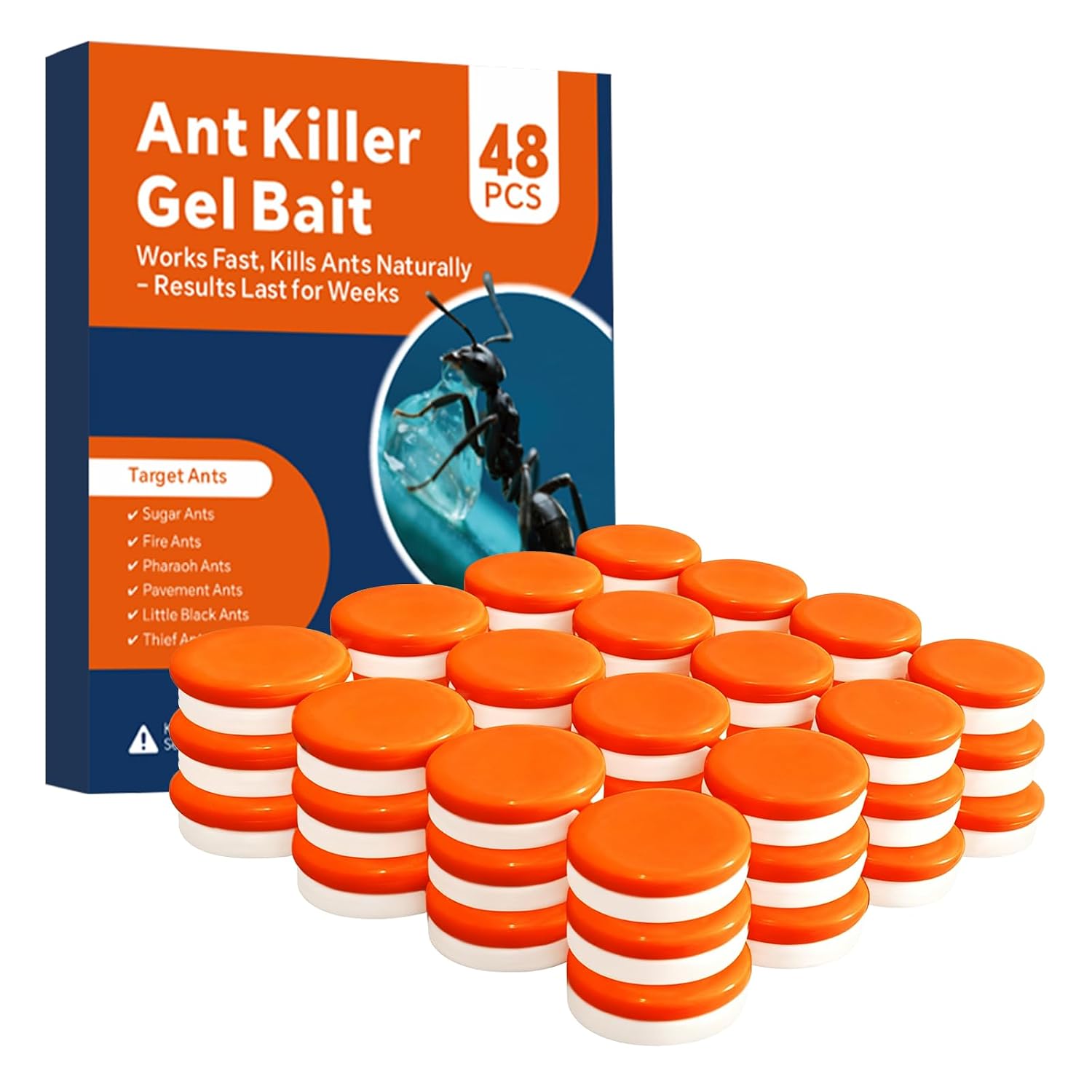
ROUTADE 48-Pack Slow-Acting Ant Gel Bait Stations
| Unit Count | 48 Count |
|---|---|
| Item Form | Gel |
| Target Species | Ants |
| Included Components | Ant gel bait |
This 48-pack of ROUTADE slow-acting ant gel bait stations is built for systematic, long-term ant control in and around the kitchen. Each station contains a gel formula that worker ants consume and carry back to the nest, which helps reduce the entire colony rather than only visible foragers. The product is supplied in ready-to-use stations with adhesive tape so you can place them along baseboards, in cabinets, near sinks, and on entry thresholds without messy sprays or frequent repositioning. The large pack lets you deploy multiple stations in high-traffic areas and replace them over time for continuous coverage. Because the formula is slow-acting, it is effective against a range of common household species including carpenter ants and sugar ants, but it requires several days to weeks to knock down a colony and will not give instant removal of visible ants. Also the stations are small and contain gel rather than a tamper-resistant hard block, so keep them away from children and pets. For someone wanting a low-maintenance, colony-focused approach to kitchen ant problems, this kit makes it easy to set and forget while the bait works.
Best for: Homeowners who prioritize reliable, long-term elimination of ant colonies in kitchens and want a low-maintenance bait they can deploy across multiple hotspots.
Less Ideal for: People who need an immediate knockdown of visible ants or who require childproof solid bait stations should consider alternatives.
- Slow-acting gel designed for worker ants to carry bait back to the nest for colony-level control
- Ready-to-use bait stations with adhesive for easy placement along baseboards and in cabinets
- 48-count pack provides broad coverage around a kitchen and enough replacements for extended use
- Versatile for indoor and outdoor placement to block entry points and high-traffic ant routes
- Slow-acting formula takes days to weeks to eliminate a colony so visible results are not immediate
- Gel in small stations may require careful placement to keep away from children and pets
Verdict: A practical, deploy-and-forget gel bait kit for reliable colony-level control of kitchen ant infestations.
TERRO Ant Killer Plus Granules, 3 lb Shaker Bag

| Item Form | Granules |
|---|---|
| Target Species | Insects |
| Active Ingredients | Lambda-cyhalothri (0.04%) |
| Specification Met | Epa Standards |
TERRO Ant Killer Plus is an outdoor granule insecticide designed for perimeter and spot treatments on lawns and around foundations. The product is applied directly from a resealable shaker bag so you can create a 3 to 10 foot barrier around a house, scatter over ant hills, or treat fire ant mounds with a measured amount and then water it in gently. Its active ingredient, lambda-cyhalothrin at 0.04%, works quickly on contact and offers short-term residual control to reduce reinfestation. Practical benefits include no need for a separate spreader, clear instructions for treating different mound types, and a compact 3 lb size that is easy to store and handle. Important limitations are that it is for outdoor, non-edible-use only, requires careful watering to be effective, and has buffer restrictions near water or sensitive habitats that you must follow for safety and compliance.
Best for: Buyers who want a straightforward, proven outdoor insecticide to reduce ant activity around a home and value easy application and clear usage guidance.
Less Ideal for: People needing an indoor solution, those treating edible gardens or near ponds and streams, or buyers who prefer non-chemical or organic pest control methods.
- Ready-to-use shaker bag simplifies application without a spreader
- Fast-acting formula that claims kill within 24 hours on contact
- Suitable for perimeter, lawn spot treatments, and targeted ant mound control
- Includes clear, specific instructions for fire ant and ant hill treatments
- Contains a synthetic pyrethroid active ingredient requiring careful handling and adherence to safety distances near water
- Not approved for use on edible crops or in/near aquatic habitats
Verdict: A compact, easy-to-apply granule treatment for homeowners who want a quick, visible reduction of outdoor ant populations around foundations and lawns.
Atticus Talak 7.9% Bifenthrin Indoor/Outdoor Insecticide Concentrate, 32 oz

| Active Ingredient | Bifenthrin |
|---|---|
| Formulation | Suspension Concentrate |
| Liquid Volume | 32 fluid ounces |
| Length of Control | Up to three months |
| Target Species | Insects |
Talak 7.9% is a liquid concentrate for treating lawns, landscaping, outdoor living areas and indoor perimeter spots like baseboards and cabinets. You dilute the concentrate with water to create a spray for barrier treatments, spot applications or lawn mixes; label rates explain how much to mix per gallon depending on the use. The product uses bifenthrin, a proven broad-spectrum active ingredient, and the manufacturer states it controls over 75 species and can give residual control for as long as three months. Its water-based formula dries clear, leaves no odor or visible residue, and is not phytotoxic on plants when used per label. Practical benefits include flexible indoor and outdoor use, clear drying, and a bottle designed for easier pouring. Important limitations are that solutions should be mixed only for same-day use, it is not registered for sale in a few states, and it is not approved for fogger application, so professional-style misting methods are not appropriate.
Best for: Buyers who want a single, reliable product to protect yards, patios and building perimeters from a wide range of common pests and prefer conservative, label-driven application practices.
Less Ideal for: People seeking ready-to-use sprays or fogger-compatible products or those in states where this formulation is not registered should look at alternatives.
- Broad-spectrum control listed for 75+ indoor and outdoor pest species
- Water-based formula that dries clear and leaves no odor or residue
- Flexible label directions for lawns, landscapes, hardscapes and indoor perimeter treatments
- Long residual activity up to three months when applied at recommended rates
- Mixed spray solutions cannot be stored and must be used the same day
- Not approved for fogger application and not available for sale in some states
Verdict: A versatile, water-based bifenthrin concentrate that delivers long-lasting, broad-spectrum outdoor (and perimeter indoor) control when used according to the label.
Choosing the Right Outdoor Ant Pesticide: Key Factors to Consider
Formulation Type and How It Works
Different active ingredients and formulations behave very differently outdoors. Granules can be spread across turf and in garden beds for a contact or residual effect, while liquid concentrates and ready-to-use sprays often create a perimeter barrier or allow targeted spot treatments. Baits are useful when you can attract foragers back to the colony, but many baits designed for indoor use do not hold up in rain or high humidity.
Understanding whether a product is contact-based, residual, or bait-based drives how you will apply it and what results to expect. Choose formulations labeled specifically for outdoor use to ensure the active ingredient retains effectiveness when exposed to sun, soil, and irrigation.
Residual Longevity in Landscape Conditions
Residual longevity tells you how long the treated area will continue to repel or kill foraging ants after application. In outdoor settings, ultraviolet light, heat, and rain can reduce residual activity quickly. Lawn treatments and perimeter barriers face regular mowing, irrigation, and foot traffic that shorten effective life.
Consider how often you are willing to reapply. A product with a strong residual rating can reduce visits over the season, but may not be ideal if you need to minimize chemical persistence. Look for labels that specify expected residual duration under typical outdoor conditions and follow irrigation restrictions to preserve effectiveness.
Speed of Action and Visible Results
How quickly you see fewer ants matters when they are invading an entertaining patio or chewing through seedlings. Fast-acting contact sprays can provide immediate visible knockdown but may not reach the nest. Slower-acting baits that workers carry back to the colony can deliver deeper control of the nest over days to weeks.
Match the speed of action to the situation: use fast-contact options for immediate relief and baits or residual barriers for longer-term suppression. Be realistic about timelines: colony-level suppression often takes several days even with effective products.
Non-target and Pet Safety
Pets, pollinators, and beneficial soil organisms share the outdoor environment with treated areas. Labels vary widely on precautions, required reentry intervals, and restrictions near edible plants. Some active ingredients are formulated to minimize exposure risk to mammals when used as directed, while others carry stronger warnings.
Read and follow application instructions carefully, keep pets and children away from treated areas for the recommended time, and consider application methods that limit drift and off-target contact, such as granular placement rather than broadcast spraying.
Application Method and Equipment Needs
Your choice should match the equipment you have and the area you need to treat. Granular spreaders, hose-end sprayers, pump-up sprayers, and trigger bottles all deliver different coverage patterns and rates. Large yards often require broadcast spreaders or hose-end applicators to be practical, while small beds and patios can be handled with ready-to-use sprays or pump sprayers.
Also consider mixing complexity and cleanup. Concentrates require safe measuring and rinsing; pre-mixed containers trade cost for convenience. Choose a method you can apply evenly and safely across the intended treatment zones to avoid missed spots or overuse.
Label Restrictions and Environmental Considerations
Labels are legal documents that determine where and how a product can be used. Some products are restricted from use near edible crops, while others permit application up to the day of harvest. Local regulations may impose additional limits for waterways and treated runoff.
Factor in proximity to storm drains, vegetable gardens, and pollinator-attractive flowers before selecting a product. Opt for labeled options that align with your environmental priorities, and always follow buffer and runoff instructions to protect water and non-target species.
When to Use Baits Versus Contact Treatments
Baits work by exploiting worker foraging behavior: ants pick up slow-acting food-based formulations and carry them to the nest, reducing the colony over days to weeks. Baits are best when you can place them along visible trails and keep them dry from rain and irrigation.
Contact sprays and residual barrier products kill or repel workers on contact and provide faster visible results. They are useful for patios, foundation lines, and quick spot treatments but often require repeat applications to affect nest-level populations.
- Use baits for long-term colony suppression when trails are obvious and dry conditions are expected.
- Use contact sprays for immediate knockdown or when you need to treat high-traffic hardscape areas.
- Combine methods when rapid relief and longer protection are both needed, following label guidance.
Application Timing and Seasonal Considerations
Ant activity peaks at different times depending on species and climate. Apply treatments when foragers are active so baits will be collected and perimeter products intercept workers leaving and returning to the colony. Early morning or evening applications reduce ultraviolet degradation and drift on hot, sunny days.
Avoid applications immediately before heavy rain or scheduled irrigation. Many products require a window without rain for the active ingredient to bind to soil or remain palatable in baits.
- Target applications during moderate temperatures for best uptake by foraging ants.
- Check local weather and irrigation schedules to avoid rinsing products away.
Safe Use Around Edible Gardens and Pollinators
If you have vegetable beds or flowering plants near treatment zones, choose options with clear label directions for use near food crops, or focus treatments on hardscape and perimeter lines rather than broadcast spraying over planted beds.
Avoid treating flowering plants directly to protect pollinators. Place baits and granulars in locations that minimize access by bees and beneficial insects, such as under stones or along foundation edges rather than on open flowers.
- Keep treated areas away from pollinator foraging routes when possible.
- Follow pre-harvest intervals and wash any edible produce as recommended on the label.
Managing Reinfestation and Long-Term Control
Even effective treatments can be followed by reinfestation if landscape conditions continue to attract ants. Address landscape features that provide food and shelter, such as mulch piled against foundations, exposed pet food, and crumb-prone outdoor eating areas.
Regular monitoring and targeted follow-up applications often maintain control better than large, infrequent treatments. For persistent problems, rotating active ingredient classes and changing bait types can reduce the chance of bait shyness or localized tolerance.
- Eliminate food sources and reduce ground cover where possible to make treatments more effective.
- Inspect treated zones weekly for activity and spot-treat as needed according to the label.
Safe Storage and Disposal
Store pesticides in their original labeled containers in a cool, dry, locked area away from children and pets. Keep liquids upright and avoid exposure to extreme temperatures that can degrade the active ingredient or container integrity.
Dispose of empty containers and unused product according to label instructions and local hazardous waste regulations. Never pour leftover concentrates down drains or onto bare soil where runoff could enter waterways.
- Keep application records and remaining product amounts to avoid unnecessary repurchases.
- Clean application equipment away from water sources and follow rinsate disposal guidance on the label.
How We Chose the Best Outdoor Ant Pesticide
We focused on formulations and delivery methods that work reliably in outdoor landscapes. Key evaluation criteria included residual efficacy in outdoor conditions, speed of action on foraging workers, safety profile around pets and irrigation, ease of application across common garden settings, and formulation durability against rain and sun. We prioritized products with clear labeled uses for lawns, garden beds, patios, and foundations and assessed whether directions supported spot treatments, perimeter barriers, or broadcast use. Excluded items included indoor-only sprays, baits without outdoor-labeled instructions, and products that require professional-only application. Our selection emphasized options that balance quick control with lasting protection, minimize non-target exposure, and keep reapplication needs reasonable for typical gardeners.
FAQ
Can I use indoor ant baits outside?
Usually indoor baits are not labeled for outdoor conditions and may fail when exposed to moisture or high temperatures. Use products labeled for outdoor use to ensure bait palatability and durability.
How long before I can let pets back into a treated area?
Reentry intervals vary by product. Many outdoor formulations permit pet access after spray residues are dry, while some granular or concentrated products ask that pets stay off treated areas for a specific number of hours. Always follow the label directions for reentry.
Will treating the yard prevent ants from entering the house?
A well-applied perimeter barrier or targeted baiting around foundation lines can reduce the number of ants moving indoors, but eliminating attractants inside and sealing entry points are also important for preventing house infestations.
How often should I reapply treatments?
Reapplication depends on the product's residual claim, weather, and infestation pressure. Some products are designed for monthly reapplication, while others can last longer. Inspect activity and follow label intervals rather than guessing.
Are there non-chemical options that help reduce ant problems?
Cultural practices such as removing food debris, storing pet food indoors, reducing excessive mulch near foundations, and fixing moisture problems can make treated areas less attractive to ants and improve the effectiveness of chemical controls.
Final Verdict
When choosing an outdoor ant pesticide, balance the need for quick relief with the desire for lasting protection and minimal non-target impact. Prioritize products labeled for outdoor use, match the formulation to your treatment zone and equipment, and account for weather and pet safety when planning applications. For persistent or widespread infestations, integrate baiting and residual barrier approaches alongside cultural controls to reduce reinfestation risk and maintain long-term yard health.
