

Note: This article contains affiliate links. If you click on these links and make a purchase, I may earn a small commission at no extra cost to you. This helps support my research and content. Read my full affiliate disclosure here.
Grasshopper outbreaks can quickly defoliate lawns, ornamental beds, and vegetable plots. Choosing the right pesticide for grasshoppers matters because products differ in how fast they act, how long they protect, and how they affect beneficial insects and turf. This guide reviews six shortlisted options suited for grasshopper control in yards and small acreage, and it explains the practical tradeoffs you should expect when treating infested areas. We evaluated products on knockdown speed, residual activity, and non-target safety so you can pick a solution that matches your site and stewardship priorities. Read on to understand the factors that should drive your selection and how different product types behave in a real garden setting.
Top Picks at a Glance
| Best Overall The best all-around choice for most situations | Hi-Yield Bug Blaster Lambda Cy Ready-to-Use, 32 oz |  |
| Best Quality Built to a higher standard if you want something more solid | Eco Bran Grasshopper Bait (7.5 lb) |  |
| Best Budget The cheapest option that still gets the job done reliably | Bonide Diatomaceous Earth Crawling Insect Killer, 1.3 lb |  |
| Highest Rated A top-rated pick with lots of positive feedback | Eco Bran Grasshopper Bait 44 lb |  |
| Most Popular A crowd favorite that many people choose with confidence | Bonide Diatomaceous Earth Crawling Insect Killer, 5 lb |  |
| Best Seller A high-volume bestseller chosen again and again | Eco Bran Grasshopper Bait (Liquid, 2 lb) |  |
Hi-Yield Bug Blaster Lambda Cy Ready-to-Use, 32 oz

| Unit Count | 32 Fluid Ounces |
|---|---|
| Item Form | Liquid |
| Target Species | Insects |
| Manufacturer | Hi-Yield |
Hi-Yield Bug Blaster Lambda Cy is a 32-ounce ready-to-use spray formulated to control more than 130 listed insects, including spotted lanternfly, stink bugs, grasshoppers and Japanese beetles. It is applied directly to affected plants, shrubs, trees and other outdoor surfaces for spot treatments or broader coverage. The product acts on contact to knock down insects and leaves a residual that the label says protects above and below the surface for up to two months, so it can both remove active infestations and help prevent re‑infestation. Practical strengths include a broad target spectrum and a convenient RTU formulation that requires no mixing for quick application. It is labeled safe for use on vegetables, fruits, roses and ornamentals when directions are followed. Limitations are that it is a general contact/residual insecticide rather than a systemic product, so thorough coverage is needed for best results, and label directions and safety precautions must be observed when using around edible plants and beneficial insects.
Best for: Gardeners and property owners who need a practical, performance-focused spray to quickly reduce pest populations and maintain short-term protection on outdoor plants.
Less Ideal for: Large commercial operations that need concentrated product for large-area treatments or users who prefer systemic, long‑lasting solutions that require less frequent reapplication.
- Ready-to-use liquid for immediate application with no mixing
- Kills on contact and provides residual control for ongoing protection
- Label covers a broad list of garden pests including spotted lanternfly and Japanese beetle
- Labeled for use on vegetables, fruits, roses, flowers and ornamentals
- Not systemic so requires thorough coverage to reach hidden pests
- RTU size may require multiple bottles for large landscapes
Verdict: A convenient ready-to-use spray that delivers fast contact kill plus short-term residual control against spotted lanternfly and many other garden pests.
Eco Bran Grasshopper Bait (7.5 lb)

| Item Form | Powder |
|---|---|
| Target Species | Insects (grasshoppers, locusts, Mormon crickets) |
| Active Ingredients | Carbaryl 2.0% |
| Included Components | one 7.5lb bag |
Eco Bran Grasshopper Bait is a bran-based insecticide designed to be eaten by grasshoppers rather than sprayed on plants. You apply the powdered bait to fields, pastures, or border areas where grasshoppers congregate and feed, and the carbaryl-infused bran delivers a toxic dose when ingested. The product is non-contact and intended to reduce impacts on non-chewing insects and birds compared with broadcast spraying. A practical advantage is that the bran formulation is easy to spread by hand or with a spreader and targets feeding insects directly. Important limitations are that it must be consumed to work so dense vegetation or uneven bait coverage can reduce effectiveness, and it contains carbaryl which requires careful handling and adherence to label safety instructions. For balanced, routine control of grasshopper populations on small to medium acreage this bait is a straightforward option, but results depend on correct placement and timing relative to hopper activity.
Best for: Gardeners and small acreage landowners looking for a targeted, ingestible control for grasshoppers who want a straightforward bait they can apply themselves and monitor.
Less Ideal for: People who need immediate contact knockdown for non-feeding pests or those unwilling to handle chemical insecticides should consider alternative control methods.
- Bran formulation targets feeding grasshoppers and is simple to apply by hand or spreader
- Non-contact approach reduces direct exposure to non-chewing insects and birds compared with broad spraying
- Contains 2.0% carbaryl for effective mortality when ingested
- Can be used against multiple pest types including locusts and Mormon crickets
- Requires ingestion so poor coverage or heavy vegetation can limit control
- Contains a chemical insecticide that requires careful handling and following label safety directions
Verdict: Buy this if you want an easy-to-apply, ingestible bran bait that targets grasshoppers and related pests on small to medium acreage.
Bonide Diatomaceous Earth Crawling Insect Killer, 1.3 lb

| Unit Count | 20.8 Ounce |
|---|---|
| Item Type Name | Bonide Diatomaceous Earth Dust, 1.3 lbs |
| Item Form | Spray |
| Target Species | Insects |
Bonide Diatomaceous Earth is a straightforward, nonchemical insect dust that works by contact and ingestion to desiccate crawling pests within about 48 hours. It is applied as a dry dust around foundations, in cracks, along garden borders, or mixed into a slurry for spray application when wider coverage is needed. The product lists many target pests including ants, cockroaches, beetles, slugs and grasshoppers, and is labeled safe to use around crops and livestock when directions are followed, making it suitable for mixed-use yards and small farms. Because it is a physical insecticide with no chemical resistance, it remains effective over time when kept dry. Important limitations are that it must remain dry to work, it only affects insects that contact or ingest the powder, and application can be dusty so protective gear and careful placement are advisable. For budget-minded gardeners looking for a broad simple control option, this product is practical for perimeter and spot treatments against grasshoppers and other crawling pests.
Best for: Gardeners and small‑acre owners who need an economical, nonchemical option for controlling crawling pests around yards, gardens, and livestock areas and who are comfortable doing spot or perimeter dusting.
Less Ideal for: People who need rapid knockdown for large flying pest outbreaks or who require a wet-weather solution; not ideal for those who cannot avoid dusty applications or need systemic control.
- Physical mode of action that pests cannot develop resistance to
- Can be used indoors or outdoors and is labeled for use around crops and livestock when directions are followed
- Versatile application as a dry dust or mixed into a slurry for spraying
- Loses effectiveness when wet and must remain dry to work
- Only affects pests that directly contact or ingest the powder
- Application can create dust requiring protective gear and careful placement
Verdict: A low-cost, nonchemical dust that provides reliable contact control of crawling pests like grasshoppers when applied dry and in targeted areas.
Eco Bran Grasshopper Bait 44 lb

| Included Components | One 44lb bag of Eco Bran |
|---|---|
| Manufacturer | Peacock Industries – Can |
| Item Form | Liquid |
| Target Species | Insects |
Eco Bran Grasshopper Bait is a bran-based bait treated with carbaryl intended for targeted control of grasshoppers, locusts, and Mormon crickets. You apply the product as a non-contact bait so insects must ingest it, which reduces risk to non-chewing insects and birds compared with broadcast sprays. Typical use is spreading the bait across affected fields, edges, or around garden areas where grasshoppers are feeding; the 44 pound bag supplies enough material for larger infested areas. The formulation emphasizes reduced liquid pesticide content while keeping an effective active ingredient, which supports reliable results against the common damaging species named in the product description. Limitations to consider are that it relies on grasshoppers finding and eating the bait so it is less effective for instant knockdown and it is intended for chewing insects only. Users should follow label directions for placement and timing to get consistent control and to minimize exposure to non-target animals.
Best for: Buyers who prioritize a dependable, ingestion-based solution for recurring or widespread grasshopper infestations and who plan treatments over larger outdoor areas.
Less Ideal for: Gardeners needing fast knockdown of a heavy, visible outbreak or anyone targeting non-chewing pests should consider other control methods.
- Bran bait formulation targets grasshoppers through ingestion, reducing non-contact exposure
- Contains carbaryl, a proven active ingredient for chewing insect control
- Large 44 lb bag suitable for treating extensive infested areas
- Described reduction in liquid pesticide percentage lowers overall chemical load compared with some liquid applications
- Requires grasshoppers to feed on the bait so results are not immediate
- Not effective for non-chewing pests or for situations needing rapid knockdown
Verdict: Choose this bran bait when you want a reliable, ingestion-based treatment to control grasshoppers across larger outdoor areas.
Bonide Diatomaceous Earth Crawling Insect Killer, 5 lb

| Unit Count | 80 Ounce |
|---|---|
| Item Form | Spray |
| Target Species | Insects |
| Specification Met | USDA |
Bonide Diatomaceous Earth is a pesticide-grade silica dust that kills crawling insects by damaging their exoskeletons on contact and after ingestion. It is used dry as a dust around foundations, garden beds, and barn or stable floors, or mixed into a slurry for spraying. Notable features include broad activity against many crawling pests, USDA specification, and suitability for use around crops and livestock when label directions are followed. Practical benefits are that insects cannot develop resistance to the physical mode of action and that it can be applied in areas where liquid insecticides are undesirable. Important limitations are that it targets crawling insects rather than foliar or flying pests like adult grasshoppers, it works more slowly than chemical sprays (up to 48 hours), and dust can be messy and requires reapplication after heavy rain or irrigation.
Best for: Gardeners and small-scale farmers who prioritize low-resistance, nonchemical control for crawling pests and need a product safe to use near livestock or crops when applied per label.
Less Ideal for: Homeowners seeking a fast-acting solution for large grasshopper outbreaks or for controlling flying insects should consider insecticides formulated for foliar or contact knockdown instead.
- Physical mode of action that insects cannot develop resistance to
- Approved to use around crops and livestock when label directions are followed
- Versatile application options: apply as a dry dust or mix into a slurry for spraying
- Effective against a wide range of crawling pests including ants, cockroaches, slugs and beetles
- Not effective against adult grasshoppers and other flying pests
- Slower kill time compared with chemical insecticides, up to 48 hours
- Dust can be messy and will wash away with rain or heavy irrigation
Verdict: Buy this if you need a nonchemical, broad-spectrum dust that safely controls crawling pests around gardens and livestock where resistance is a concern.
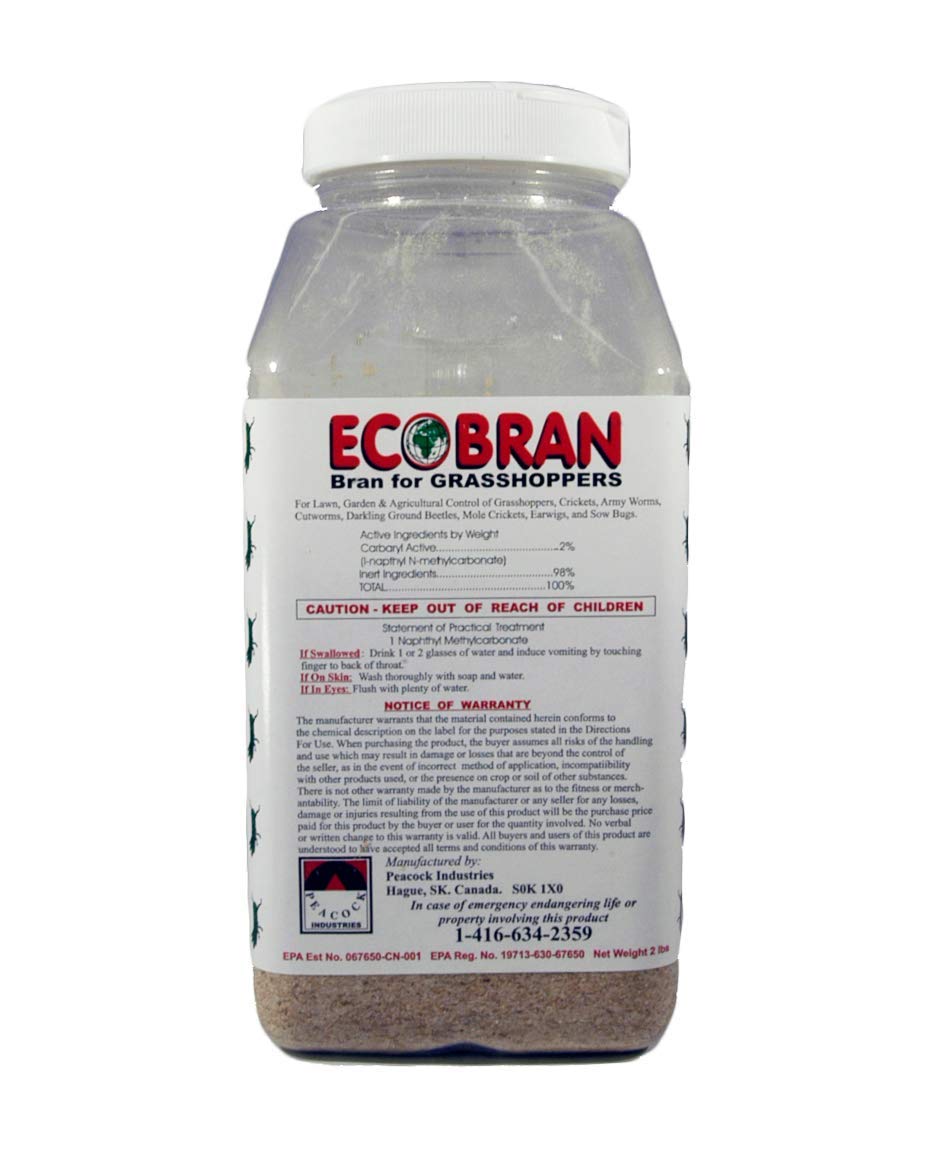
Eco Bran Grasshopper Bait (Liquid, 2 lb)
| Item Form | Liquid |
|---|---|
| Target Species | Grasshopper |
| Unit Count | 1 Count |
Eco Bran Grasshopper Bait is a liquid bait formulation intended to control grasshoppers, locusts, and Mormon crickets by encouraging ingestion of a carbaryl-treated wheat bran. You apply it as a broadcast bait in infested fields, pastures, or around vulnerable garden areas where grasshoppers are feeding; because it is a noncontact product it targets chewing pests that eat the bait rather than relying on spray coverage. The product description emphasizes a greatly reduced chemical percentage in the liquid carrier, which can lower non-target exposure compared with wide-area sprays, and the bran matrix makes it attractive to grasshoppers. Practical benefits include straightforward application and effectiveness against a broad list of pest species that commonly damage crops. Important limitations are the active ingredient (carbaryl), which some users avoid for environmental or pollinator-safety reasons, and the need for the pests to consume the bait for control to occur so results depend on feeding behavior and placement. This is best used where you can place bait selectively and follow label precautions.
Best for: Gardeners and land managers who prioritize targeted, ingestion-based control and want a bait option for treating grasshopper hotspots while minimizing spray drift.
Less Ideal for: People who need an organic or pollinator-safe solution or who cannot control bait placement should consider alternative methods.
- Noncontact baiting reduces need for broadcast sprays and drift
- Formulation uses wheat bran to attract grasshoppers for ingestion
- Supports control of many common North American grasshopper species including locusts and Mormon crickets
- Liquid delivery reduces bulk and can be easier to apply evenly than dry pellets
- Contains carbaryl which may be unsuitable near pollinator habitat or where chemical restrictions apply
- Effectiveness depends on grasshoppers actually consuming the bait rather than feeding on other vegetation
Verdict: Choose this bait when you need a targeted, ingestion-based product to reduce grasshopper populations without broad broadcast spraying.
Choosing the Right Pesticide for Grasshoppers: Key Factors to Consider
Speed of Knockdown
How quickly a product immobilizes or kills grasshoppers affects how much visible damage continues after treatment. Fast-acting contact sprays can stop feeding within hours, which is useful during active outbreaks, while slower systemic or ingestion-based options may take a day or more to reduce damage.
Faster products may require fewer immediate follow-up applications but can be harsher on beneficial arthropods present during spraying. Consider the infestation intensity and how much immediate damage you must prevent before selecting a fast-acting versus slower-acting option.
Residual Activity on Treated Surfaces
Residual control refers to how long a treated surface continues to affect grasshoppers after application. A longer residual means less frequent reapplication and better protection for vulnerable plants, but it also increases the window when non-target insects may be exposed.
Think about how long grasshopper pressure typically lasts in your area and whether you can time treatments to match peak activity. In high-pressure seasons, a product with a dependable residual can prevent repeated damage; in low-pressure situations, minimal residual reduces environmental footprint.
Risk to Pollinators and Beneficials
Many pesticides that control grasshoppers also pose some risk to pollinators, predatory insects, and soil invertebrates. The application method, timing, and whether product residues remain on flowering plants all influence that risk.
Plan treatments to avoid blooming ornamentals, spray early morning or late evening when pollinators are less active, and prefer formulations or application patterns that minimize drift and flower contact when pollinator protection is a priority.
Application Method and Ease
Pesticides come as ready-to-use sprays, concentrates, granules, or baits. Each format changes how easy the product is to apply and how effectively it reaches grasshopper feeding zones. Granules are convenient for large turf areas and reduce drift; sprays offer more precise coverage for plants and borders; baits rely on insect feeding behavior and can spare non-target foliage.
Assess your comfort with mixing and spray equipment, the size of the treated area, and whether spot treatments or broadcast applications will be needed before choosing a format.
Safety Around People and Pets
Home-use pesticides vary in their required reentry intervals and precautions. Some require keeping people and pets off treated areas until residues dry, while others have longer wait times or more stringent safety directions.
Read label directions carefully and select products that fit your household routine. For areas where children or pets frequently play, favor options with short reentry periods or that can be applied in ways to reduce contact risk.
Compatibility With Turf and Ornamentals
Not all pesticide formulations are safe on every grass type or plant species. Certain chemistries can cause leaf burn or stress when applied in hot weather or at the wrong dilution.
Check label restrictions for turf species and ornamentals in your landscape, and avoid treating sensitive plants during heat stress. Matching product choice to plant tolerance helps prevent treatment-caused damage and preserves landscape appearance.
When to Treat for Grasshoppers
Treating at the right time reduces insect damage and limits unnecessary applications. Begin monitoring in late spring and early summer when nymphs hatch and are smaller and easier to control than adults. Early season spot treatments often stop population growth before it becomes a larger problem.
If you see significant active feeding, treat promptly but try to avoid spraying when flowers are open. Timing drives both efficacy and environmental risk, so base decisions on visible activity rather than the calendar alone.
- Target nymph stages for higher success and lower product use
- Treat early morning or late evening to reduce pollinator exposure
- Spot-treat known hotspots to reduce overall pesticide footprint
Application Tips for Best Results
Coverage matters. For contact sprays, thorough coverage of plant foliage and low vegetation is necessary because grasshoppers feed on leaf surfaces. Use equipment that delivers even spray patterns and avoid overapplication that can runoff onto non-target areas.
For granules or baits, follow label spread rates and apply evenly across the target area. Watering after granular application can activate some residues, but not all products require irrigation. Read label guidance to know whether light watering improves efficacy or causes residue loss.
- Calibrate equipment to match label rates
- Avoid applying in windy conditions to reduce drift
- Keep treated areas dry until sprays have dried unless label indicates watering helps
Nonchemical Alternatives and Integration
Cultural and mechanical tactics can reduce grasshopper damage and lower the need for chemical controls. Maintaining dense, vigorous turf reduces available feeding sites. Removing weedy edges and tall grasses that harbor nymphs and adults limits local populations.
Physical barriers such as row covers can protect small vegetable plots during peak activity. Encouraging natural predators and providing habitat for birds and predatory insects can help, though these measures rarely control heavy outbreaks by themselves. Integrating nonchemical measures with targeted pesticide use gives the best long-term results.
- Mow and manage field margins to reduce habitat
- Use exclusion netting for high-value plants
- Combine scouting with targeted treatments to minimize pesticide use
Protecting Pollinators During Treatments
Pollinator safety is an essential consideration when treating for grasshoppers. Avoid spraying blooming plants and apply when pollinator activity is lowest. Where possible, choose formulations and application methods that reduce residues on flowers and nectar sources.
If you must treat near flowering plants, consider spot treatment of foliage rather than broadcast sprays and provide untreated floral resources nearby to support pollinators.
- Check bloom stages before treatment
- Use targeted application to avoid flower contact
- Postpone treatments during active foraging times
Managing Resistance and Rotational Use
Repeated use of the same active ingredient can select for resistant grasshopper populations over time. Rotate products with different modes of action where label directions and local regulations permit. This reduces the chance of diminished efficacy in subsequent seasons.
Keep records of what was applied and when, and combine chemical rotations with cultural controls to reduce selection pressure and maintain options for future seasons.
- Rotate chemistries across seasons when possible
- Combine nonchemical practices to lower selection pressure
- Document applications to guide future decisions
How We Chose the Best Pesticide for Grasshoppers
We focused on products formulated and labeled for grasshopper control and evaluated entries against criteria that matter to backyard and small acreage gardeners. Primary filters included labeled use on turf and ornamental areas, documented efficacy against grasshoppers or chewing orthopterans, and application formats appropriate for home use such as sprays, granulars, and bait formulations. We prioritized products that offer a clear balance between rapid knockdown and usable residual protection, since short-lived treatments often require repeat applications while long-residual chemistries can increase non-target exposure. Editorial review excluded products restricted to commercial or agricultural applicators and any pesticide without straightforward homeowner directions. We also excluded options lacking clear environmental precautions. Final selection emphasized measurable decision dimensions: speed of action, residual control, application flexibility, and risk to pollinators and pets. These same dimensions form the basis for our scoring and guided the shortlist.
FAQ
How long after applying a pesticide will grasshoppers stop feeding?
It depends on the product. Contact sprays can reduce feeding within hours, while ingestion-based or slower-acting options may take one to several days. Expect variable timing and follow label guidance for reapplication intervals.
Can I treat my entire lawn or should I spot-treat?
Spot-treating known hotspots is often effective for small or early infestations and reduces non-target exposure. For widespread heavy infestations, broader applications may be necessary. Choose the method that matches infestation extent and stewardship objectives.
Will treating for grasshoppers harm pollinators in my yard?
Treatments can harm pollinators if they contact wet residues on flowers or if long-residual products remain on nectar sources. Avoid spraying blooms, apply during low pollinator activity, and prefer application methods that minimize flower contact to reduce risk.
Are granules better than sprays for large turf areas?
Granules are often easier to apply over large turf and reduce drift compared with sprays. They can provide uniform coverage and are less likely to contact flowering plants, but efficacy depends on product formulation and whether irrigation is needed to activate residues.
Do I need special equipment to apply these pesticides?
Home gardeners can use handheld sprayers, pump sprayers, or broadcast spreaders depending on product type. Proper calibration and following label mixing instructions are important for safe and effective application. Some concentrated products require more careful handling and protective equipment.
How can I avoid resistance when using chemical controls?
Rotate active ingredients with different modes of action across seasons, avoid repeated applications of the same chemistry, and integrate cultural controls. Keeping good records of treatments helps plan rotations and reduces selection pressure.
Final Verdict
Selecting the right pesticide for grasshoppers requires balancing immediate control, how long protection lasts, and the risks to pollinators, pets, and desirable plants. Prioritize the decision factors that match your site: use fast-acting products for active outbreaks, choose longer residuals when pressure is prolonged, and prefer targeted application methods to limit non-target exposure. Adopt an integrated approach that combines cultural controls, timing, and careful product selection to keep grasshopper damage manageable while protecting the wider garden ecosystem.
