

Note: This article contains affiliate links. If you click on these links and make a purchase, I may earn a small commission at no extra cost to you. This helps support my research and content. Read my full affiliate disclosure here.
If you grow seedlings on a windowsill, in flats, or under lights, the right watering can makes a big difference in how well those tiny plants establish. A watering can built for seeds delivers a fine, even stream that wets soil without dislodging seeds or compacting delicate root zones. In this guide we shortlisted the top options suited specifically for seed-starting and pint-sized containers. Each pick was evaluated on real gardener concerns like pour control, spout reach, and durability so you can pick a tool that matches your propagation setup. Read on to see the factors we used to evaluate and which features matter most for growing healthy seedlings.
Top Picks at a Glance
| Best Overall The best all-around choice for most situations | Fiskars 40 oz Indoor Watering Can with Long Reach Spout |  |
| Best Quality Built to a higher standard if you want something more solid | LTSUMI 35 oz (1000 ml) Stainless Steel Watering Can with Long Spout and Wooden Handle |  |
| Best Value The sweet spot between price and what you get | ONEDONE 34 oz Stainless Steel Indoor Watering Can with Long Spout (3‑Piece Set) |  |
| Best Budget The cheapest option that still gets the job done reliably | BEADNOVA 250ml Squeeze Plant Watering Bottle |  |
| Highest Rated A top-rated pick with lots of positive feedback | Nuanchova Mini Stainless Steel Gooseneck Watering Can (250 ml) |  |
| Most Popular A crowd favorite that many people choose with confidence | Qilebi 1.8L (0.48 gal) Small Plastic Watering Can with Long Spout and Detachable Shower Head |  |
| Best Seller A high-volume bestseller chosen again and again | AORAKI 1L Small Watering Can with Long Spout and Measuring Marks |  |
Fiskars 40 oz Indoor Watering Can with Long Reach Spout

| Capacity | 40 oz (1.2 L) |
|---|---|
| Indoor Outdoor Usage | Indoor |
| Material Type | Plastic |
| Recycled Content | 30% post-consumer recycled plastic |
The Fiskars 40 oz indoor watering can is built for precise, mess-free care of small pots and grouped houseplants. Its long, narrow spout reaches through dense foliage to deposit water at the soil line so leaves stay dry and rot risk is reduced. The translucent spout includes clear volume markings for measuring water or diluted fertilizer, and the anti-drip tip keeps shelves and floors clean during and after pouring. The contoured, lightweight body (made with 30% post-consumer recycled plastic) feels comfortable to hold and is easy to carry when watering several plants in one session. The easy-fill top and click-in spout make refilling and assembly straightforward. Limitations are its modest 40 oz capacity, which means more frequent refills for larger collections, and the plastic body may not appeal to buyers who prefer metal or ceramic options for display value.
Best for: Ideal for plant owners who want precise, low-mess watering for small to medium indoor collections and who value ease of use and measured dosing.
Less Ideal for: Not a good choice for gardeners who need a high-capacity can for many large pots or who prefer heavier metal or decorative watering cans for display.
- Long, slender spout delivers water directly to the root zone for targeted watering
- Translucent nozzle with volume markings for accurate dosing of water and fertilizers
- Anti-drip tip reduces spills and keeps surfaces clean
- Ergonomic contoured body is lightweight and comfortable to hold
- Constructed with 30% post-consumer recycled plastic for durability and sustainability
- 40 oz capacity requires refills for larger plant collections
- Plastic construction may show scratches over time and lacks the weight or finish of metal cans
Verdict: Buy this if you want a lightweight, precise indoor watering can that reaches into dense foliage and prevents drips for neat, controlled plant care.
LTSUMI 35 oz (1000 ml) Stainless Steel Watering Can with Long Spout and Wooden Handle

| Capacity | 1000 ml |
|---|---|
| Material Type | Stainless Steel,Wooden,Metal |
| Brand Name | LTSUMI |
This LTSUMI watering can is built for accurate, everyday plant care. The long, thin spout lets you direct water precisely into pots and bonsai without splashing soil or wetting nearby surfaces, and the open top makes refilling quick. Its stainless steel body resists rust and scratches, while the rounded wooden handle improves grip and comfort during repeated use. At 1000 ml capacity it holds enough water for several small to medium pots but stays easy to lift when full. The can also has a simple decorative look that works on a shelf or plant stand. Limitations to note are the single spout type with no detachable rose for a gentler spray and the metal finish can show water spots if not wiped dry. For users who need large-volume watering or adjustable spray patterns, a different tool would be better, but for precise indoor and container watering this performs well and feels durable.
Best for: Buyers who prioritize precise, clean watering for indoor plants, bonsai, and container gardening and want a durable, attractive can for daily use.
Less Ideal for: People who need to water large beds or want multiple spray settings and interchangeable nozzles should consider a larger bucket or a can with a rose attachment instead.
- Long, narrow spout provides precise, spill-free watering into small pots and bonsai
- Stainless steel body is corrosion and scratch resistant for long-term use
- Comfortable round wooden handle reduces hand strain during repeated use
- No detachable rose or alternative nozzle for a gentler spray
- Shows water spots and may require drying to maintain appearance
Verdict: Choose this stainless steel watering can if you need precise, durable indoor watering with a comfortable handle and a long spout.
ONEDONE 34 oz Stainless Steel Indoor Watering Can with Long Spout (3‑Piece Set)
| Material Type | Stainless Steel |
|---|---|
| Capacity | 34 oz |
| Number of Items | 3 |
| Indoor Outdoor Usage | Indoor |
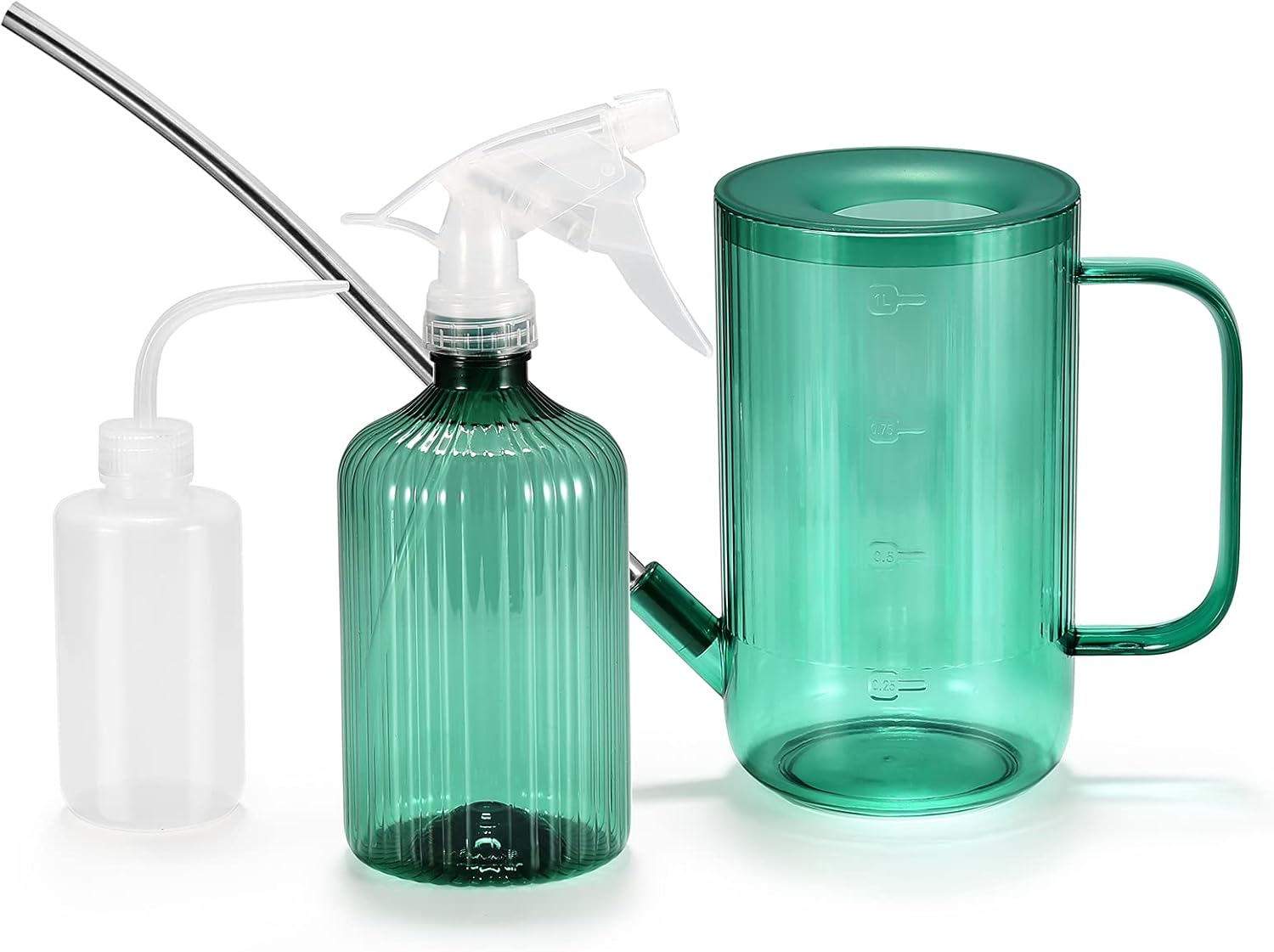
This ONEDONE set is built around a slim 34 oz stainless steel watering can with a detachable long spout plus a 16 oz mister and an 8 oz squeeze bottle for targeted watering. The long thin spout reaches into crowded pots and seed trays so you can deliver water directly to the root zone without splashing the soil or disturbing seeds. The translucent body has measurement marks so you can control small volumes, and the wide top makes refilling and cleaning straightforward. The included mister is useful for raising humidity around delicate seedlings and the squeeze bottle lets you give tiny pots or individual seedlings gentle, precise drips. Because the can is lightweight and ergonomically handled it is easy to use for frequent, small pours. Limitations are that capacity is modest for larger beds and the set is aimed at indoor or container use rather than heavy outdoor watering tasks. For seed starting and close-up care this set emphasizes control and neat, low-impact watering.
Best for: Gardeners who prioritize careful, measured watering for seed starting and container seedlings and want a compact set that offers both misting and pinpoint delivery.
Less Ideal for: People who need to water large outdoor beds, several hundred seedlings at once, or who want a high-capacity, heavy-duty outdoor watering can.
- Long detachable spout allows precise watering into seed trays and root zones without splashing
- Translucent body with measurement marks helps control small volumes and avoid overwatering
- Includes mister and squeeze bottle for humidity control and ultra-precise watering of seedlings
- Wide opening and ergonomic handle make filling and cleaning easy
- 34 oz capacity is small for larger outdoor beds or long watering sessions
- Designed primarily for indoor/container use rather than heavy-duty outdoor watering
Verdict: A compact, control-focused watering set that makes precise seedling and small-pot watering easy and neat.
BEADNOVA 250ml Squeeze Plant Watering Bottle

| Capacity | 250 ml |
|---|---|
| Material Type | Plastic |
| Bottle Type | Squeeze Bottle |
| Reusability | Reusable |
This small squeeze watering bottle is built for precise, low-volume plant care. Made from flexible polyethylene, the 250 ml bottle is hand-squeezed to deliver water directly to the potting mix through a narrow bent spout, which helps avoid wetting leaves and overwatering. A visible scale on the body makes it easy to measure how much liquid you are giving and the cap seals to prevent leaks when stored. The spout can be trimmed to increase flow if you need a faster pour or to use slightly larger pots. It is lightweight and reusable, so it is handy for succulents, African violets, orchids, and other small pots in a tight indoor setup. Limitations include the small capacity, which means more frequent refills for multiple plants, and the plastic construction, which is less durable than metal and can become misshapen if overstressed by aggressive squeezing.
Best for: Shoppers who want an inexpensive, precise tool for watering a few small indoor plants and who prefer low-cost, reusable solutions over decorative or heavy-duty gear.
Less Ideal for: People who need to water large collections or larger pots without frequent refilling or who prefer long-lasting metal watering cans for heavy use.
- Narrow bent spout for accurate, base-level watering without wetting foliage
- Transparent body with measurement scale to track dispense volume
- Lightweight flexible plastic that is easy to squeeze and refill
- Leak-resistant cap for tidy storage and transport
- 250 ml capacity requires frequent refills when caring for many plants
- Plastic build is less robust than metal alternatives and can deform with heavy use
Verdict: A low-cost, precise squeeze bottle that makes controlled watering of small houseplants quick and mess-free.
Nuanchova Mini Stainless Steel Gooseneck Watering Can (250 ml)

| Capacity | 10 fluid ounces |
|---|---|
| Material Type | Metal, Stainless Steel |
| Indoor Outdoor Usage | Indoor, Outdoor |
This Nuanchova mini watering can is built around a 4 mm swan-neck spout that delivers a narrow, vertical stream ideal for controlled watering of seedlings, succulents, and moss without disturbing soil. Made from food-grade 304 stainless steel with a PTFE exterior coating, it resists rust and scratches and includes internal volume markings up to 250 ml for accurate dosing of water or diluted fertilizer. Its small, palm-friendly shape is easy to maneuver around tiny pots and seed trays and the fine spout gives excellent drip control for slow, targeted applications. Because it is compact, it is best used for small-scale tasks rather than large beds or many seedlings at once. The metal construction is more durable than thin plastic mini cans and the measurement scale reduces guesswork, but you will need to refill more often for multiple seedlings and it lacks a removable filter or lid for easy filling in some setups.
Best for: Buyers who prioritize dependable, durable tools for slow, precise watering of individual seedlings, tiny pots, or desktop plantings and who value accurate dosing when mixing liquids.
Less Ideal for: Not a good fit for gardeners who need to water large numbers of seedlings, bigger containers, or outdoor beds without frequent refills.
- Very fine 4 mm gooseneck spout provides precise, vertical low-flow watering
- Food-grade 304 stainless steel construction with PTFE coating for corrosion resistance
- Internal scale markings up to 250 ml allow accurate measuring of water or fertilizer
- Compact, lightweight design is easy to handle for small pots and tight spaces
- 250 ml capacity requires frequent refilling for multiple seedlings
- Small opening and non-removable parts can make some filling or cleaning setups awkward
Verdict: Choose this mini gooseneck can when you need reliable, rust-resistant, ultra-precise low-flow watering for seeds and tiny pots.
Qilebi 1.8L (0.48 gal) Small Plastic Watering Can with Long Spout and Detachable Shower Head

| Capacity | 1.8 liters |
|---|---|
| Material Type | Plastic |
| Item Highlight | Long spout, detachable shower head |
| Unit Count | 1 Count |
This Qilebi watering can is designed for routine care of indoor pots and a few balcony planters. It holds 1.8 liters, an amount that lets you water several small containers between refills while remaining easy to lift. The long spout delivers water directly to the soil so you can avoid wetting foliage or splashing, and the detachable shower head switches between a focused stream and a gentler spray for seedlings or delicate flowers. The semi-open inlet makes filling simple and the ergonomic handle aids control when pouring. Made from thicker plastic, it resists everyday knocks and should hold up to regular household use. Because it is a small, plastic can it is not intended for large gardens or heavy-duty outdoor tasks and the capacity means more frequent refills if you water many pots. The twist-tight joint on the spout helps reduce leaks so you waste less water while targeting roots precisely.
Best for: Buyers who want a reliable, easy-to-use can for regular indoor plant care or a few balcony pots and who prioritize precise watering and proven features over heavy-duty capacity.
Less Ideal for: Gardeners with many large outdoor beds or those who prefer metal, high-capacity cans for heavy-duty outdoor watering should look elsewhere.
- Long spout allows precise watering to the soil without splashing
- Detachable shower head offers both direct stream and soft spray modes
- 1.8 L capacity balances fewer refills with easy handling
- Thick-walled plastic construction resists everyday knocks and aging
- Small overall capacity makes it unsuitable for large gardens
- Plastic construction is less premium-feeling than metal alternatives
Verdict: A compact, durable plastic watering can that gives precise, flexible watering for indoor plants and small patios.
AORAKI 1L Small Watering Can with Long Spout and Measuring Marks

| Capacity | 1 liters |
|---|---|
| Material Type | Plastic |
| Item Highlight | Long Spout, With Plant Mister Spray Bottle |
This AORAKI 1‑liter watering can is built for careful indoor watering where control matters, such as seeds, seedlings, bonsai, and small potted plants. The long spout delivers a precise, narrow stream that makes it easy to water soil without disturbing seeds or young roots. The translucent body with measurement marks helps you monitor how much water you use, which is useful when following seedling watering schedules. A wide top opening simplifies filling from a faucet, and the simple grip handle keeps the can easy to hold while pouring. It is lightweight and compact, so it stores neatly and is manageable for gentle, repeat watering sessions. The can is molded plastic, so it is inexpensive and easy to clean, but not as durable as metal options and may crack if dropped or left in harsh outdoor conditions. The included 10 oz mister is handy for misting seedlings, though it is a small accessory and not a replacement for a dedicated sprayer for larger tasks.
Best for: Buyers who prioritize careful, measured watering for seeds and young plants and want an easy-to-handle, low-risk tool for indoor or small patio use.
Less Ideal for: People who need a heavy-duty, large-capacity can for watering many containers or for rugged outdoor use should consider sturdier, higher-capacity alternatives.
- Long narrow spout provides controlled, precise watering ideal for seeds and seedlings
- Transparent body with measurement marks makes it easy to track water volume
- Wide top opening for quick, spill-free filling
- Lightweight and compact for easy handling and storage
- Includes a 10 oz mister useful for gentle misting of young plants
- Made of plastic so it is less impact-resistant and durable than metal cans
- 1 liter capacity requires frequent refills for multiple pots or larger trays
Verdict: A precise, easy-to-use 1‑liter plastic can that helps deliver controlled watering for seeds and seedlings without overcomplicating the task.
Choosing the Right Watering Can for Seeds: Key Factors to Consider
Pour Control and Flow
A fine, consistent pour is essential when watering seeds because a strong stream can displace seeds, create uneven germination, or compact the top layer of potting mix. Look for designs that produce a diffuse, rainlike flow or that offer interchangeable rose heads so you can choose the gentlest setting for tiny seedlings.
Control also affects how often you need to bottom-water versus surface-water. A can with predictable flow helps you add the right amount of water slowly, avoiding oversaturation that leads to damping-off or root rot.
Spout Reach and Precision
Spout length and angle determine whether you can reach into flats, propagation trays, or crowded seed beds without leaning over and disturbing plants. Thin, tapered spouts let you place water exactly where it is needed, while longer gooseneck shapes give you clearance over foliage and heat mats.
Precision matters for small pots and divided trays where splashing can spread disease or mix soil between cells. Consider whether the spout can access the tray geometry you use most often.
Material and Build Durability
Materials range from lightweight plastics to galvanized metal and painted steel. For seed-starting, resistance to cracking, rust, and UV degradation matters because cans are often used indoors, on benches, and sometimes outdoors for quick transplanting tasks. A durable can will keep its spout alignment and sealing surfaces intact so leaks and wobble do not develop over time.
Also think about the lining and finish if you plan to use diluted fertilizers or organic teas; some finishes tolerate nutrient solutions better than others and are easier to rinse clean.
Weight, Balance, and Ergonomics
Even when small, a filled watering can can be awkward to lift repeatedly during a long propagation session. The handle placement and grip shape determine whether you can control pour speed comfortably without tipping the can or straining your wrist.
Ergonomics also affect how steady your hand remains when giving light misting versus a slow stream. For gardeners with limited grip strength, a can with two handles or a low center of gravity can be a big advantage.
Ease of Filling and Cleaning
Seed-starting often involves frequent refills and occasional use of diluted nutrients, so wide mouths and removable roses simplify both filling and cleaning. Narrow-neck cans that are hard to rinse will collect algae and residue, which can harbor pathogens that harm seedlings.
A design that allows you to remove the rose or access the interior will save time and keep seed trays healthier over a season.
Capacity and Intended Use
Choose a capacity that matches how you water. Smaller cans reduce weight and improve control for working with flats and cell packs, while slightly larger cans cut down on refills if you manage many trays. For indoor propagation, a can that holds just enough for a bench session is usually preferable to a large outdoor-style can.
Think about whether you will use the can for bottom-watering flats or surface misting and pick a size that keeps each trip efficient without sacrificing steady control.
Why Gentle Watering Matters for Seedlings
Seeds and young seedlings have fragile stems and very fine root hairs. A strong splash or concentrated stream can bury seeds too deep, wash away the nutrient-rich top layer, or bruise emerging stems. Gentle, even moisture encourages consistent germination and reduces early losses from damping-off and transplant shock.
- Even soil moisture improves radicle development
- Less disturbance means more uniform germination
- Reduces risk of compacting light seed-starting mixes
Spout Types Explained
Manufacturers use several spout styles tailored to different tasks. Gooseneck spouts give precise reach and are ideal for narrow rows and tight flats. Tapered narrow spouts focus flow for direct application to specific cells. Removable roses disperse water into a shower-like pattern for broadcast finishing without strong jets.
- Gooseneck: precision and reach
- Tapered spout: direct placement
- Removable rose: diffuse, rainlike spray
Indoor Vs Outdoor Seed-Starting Considerations
Indoor propagation prioritizes compact size, ease of storage, and control to avoid wetting lights, shelves, or soil surfaces excessively. Outdoor seed-starting may tolerate larger capacities and more robust materials to withstand weather and rougher handling. Choose finishes and materials that match your environment to avoid corrosion or damage.
- Indoor: lightweight, low splash, compact capacity
- Outdoor: sturdier builds, weather-resistant finishes
Maintaining Your Watering Can
Rinse and dry your can after use, especially when you apply nutrient solutions or organic teas. Periodically remove roses and soak them to clear mineral deposits. Inspect spouts and seals for cracks or clogs that change flow rate, and store cans upside-down or on their side to prevent water pooling that breeds algae.
- Rinse after fertilizer use
- Soak and clear rose heads monthly
- Store to avoid standing water
Alternatives and Complementary Tools
For some propagation tasks, a spray bottle or syringe can offer even more control than a small watering can. Bottom-watering trays and capillary mats reduce surface disturbance by allowing seedlings to draw moisture upward. Use these methods together with a gentle watering can for occasional top-water needs and foliar applications.
- Spray bottles for delicate misting
- Bottom-watering for uniform moisture
- Syringes for targeted cell watering
How We Chose the Best Watering Can for Seeds
We focused on attributes that matter in everyday seed-starting and propagation tasks. First, pour control and spout precision had to allow a gentle, steady flow to avoid washing away seeds or disturbing fine potting mixes. Second, spout length and shape were evaluated for reach into flats, cell trays, and narrow pots without stretching or tipping. Durability and materials were assessed because cans used around potting benches and damp greenhouses need to resist corrosion, cracking, or brittle breaks. Weight and balance were checked to ensure a full can is still easy to lift for repeated watering sessions. Ease of filling and cleaning mattered for gardeners who mix additives or need to rinse out algae-prone cans. We excluded large, decorative outdoor cans and options aimed only at heavy garden watering; this list is for tools suited to seeding and propagation. Final choices reflect a blend of pour accuracy, practical ergonomics, and build resilience that gardeners rely on during the critical seedling stage.
FAQ
How often should I water newly sown seeds?
Frequency depends on mix and environment. Seeds need consistently moist but not waterlogged surface conditions, so check daily. In a warm, dry room you may mist once or twice daily; in cooler, humid setups less often.
Can I use tap water for seed-starting?
Usually yes. Tap water is fine for most seed-starting tasks, though very hard or chlorinated water may benefit from settling or mild aeration. If your water is heavily mineralized, flush containers occasionally to prevent buildup.
Is a rose attachment necessary for seed-starting?
A rose helps create a rainlike dispersion that reduces surface disturbance, but it is not strictly necessary. Many growers prefer a narrow spout or gooseneck for targeted watering; removable roses add versatility when you also water larger pots.
What capacity is best for a seed-starting watering can?
Smaller capacities, typically 1 to 2 liters, work best for bench-top propagation because they are easier to control and reduce repetitive strain. If you water many trays at once, a slightly larger can may be more efficient but watch for awkward balance.
How do I prevent spreading disease when using a watering can?
Rinse and dry the can between uses, especially if moving between trays. Avoid splashing from infected soil onto healthy seedlings and disinfect the rose or spout occasionally with a mild solution if you notice recurring issues.
Final Verdict
Prioritize pour control, spout precision, and comfortable balance when choosing a watering can for seed-starting. Small ergonomic cans with either a fine rose or a tapered gooseneck give the control you need to keep soil surface moisture even without disturbing seeds. Tradeoffs are mainly between capacity and manageability: pick the smallest can that still covers your bench session to reduce strain while maintaining consistent watering. Focus on durable materials and easy cleaning so the tool stays reliable across propagation cycles. With those priorities, you can choose confidently and give seedlings the gentle start they need.
