

Note: This article contains affiliate links. If you click on these links and make a purchase, I may earn a small commission at no extra cost to you. This helps support my research and content. Read my full affiliate disclosure here.
A reliable Bluetooth watering timer makes routine irrigation simpler and prevents overwatering while saving time. If you manage a small lawn, container garden, or raised beds, the right timer helps you automate schedules, adapt to changing weather, and control multiple zones from your phone. This guide looks at the top shortlisted Bluetooth watering timers chosen for home and urban gardens. We evaluated each option for key gardening needs like battery life, app ease of use, valve compatibility, and weather handling. Read on for clear, practical guidance that will help you choose the right smart timer for your setup.
Top Picks at a Glance
| Best Overall The best all-around choice for most situations | Orbit B-hyve XD 2‑Port Smart Hose Watering Timer |  |
| Best Quality Built to a higher standard if you want something more solid | Hunter BTT Bluetooth Hose Timer, 1-Zone Tap Timer |  |
| Best Value The sweet spot between price and what you get | GoveeLife H5901 Bluetooth Smart Sprinkler Timer |  |
| Best Budget The cheapest option that still gets the job done reliably | Orbit B-hyve XD 1-Port Smart Hose Watering Timer |  |
| Highest Rated A top-rated pick with lots of positive feedback | RAINPOINT Bluetooth 2‑Outlet Garden Hose Water Timer (No Hub) |  |
| Most Popular A crowd favorite that many people choose with confidence | Melnor Bluetooth 1-Zone Programmable Hose Timer (Quick Connect Bundle) |  |
Orbit B-hyve XD 2‑Port Smart Hose Watering Timer

| Brand Name | Orbit |
|---|---|
| Item Type Name | Sprinkler Timer |
| Item Highlight | Dual Outlet Irrigation Control, App Controlled, Weatherproof |
| Number of settings | 5 |
The Orbit B-hyve XD 2-Port Smart Hose Watering Timer automates outdoor watering for two separate hose lines, letting you run independent schedules for different garden zones. It is typically attached to an outdoor faucet and either programmed directly on the device or via the B-hyve mobile app over Bluetooth, with additional remote smart features unlocked when paired to Orbit’s Wi‑Fi hub. Key features include dual outlets for simultaneous but independent watering, WeatherSense weather-based adjustments that reduce unnecessary watering, and an IPX5 weatherproof housing suited to outdoor use. In practice this means less manual watering and smarter timing that responds to rainfall and local drought alerts. The unit is battery powered for easy installation and has a simple app workflow for scheduling. Important limitations are that full remote control and some WaterSense benefits require purchasing Orbit’s separate Wi‑Fi hub, and advanced users who need multi-zone central irrigation support should consider larger zone controllers instead.
Best for: Homeowners who want a straightforward, weather-aware smart timer to automate watering for a couple of distinct garden areas without running wires or complex controllers.
Less Ideal for: People managing large, multi-zone irrigation systems or those who need built-in Wi‑Fi remote control without buying an additional hub.
- Dual independent outlets let you water two areas with separate schedules
- WeatherSense automatically adjusts run times based on local weather data
- Bluetooth app control for local programming with optional Wi‑Fi hub for remote access
- IPX5 weatherproof design suitable for outdoor installation
- Full smart, remote features require a separately sold Wi‑Fi hub
- Limited to two outlets so not ideal for larger multi-zone irrigation systems
Verdict: A practical two-outlet smart hose timer that saves water with weather-aware scheduling and easy app control for typical home gardens.
Hunter BTT Bluetooth Hose Timer, 1-Zone Tap Timer

| Battery Type | Alkaline |
|---|---|
| Number of settings | 2 |
| Item Type Name | Irrigation Controller |
| Model Number | BTT100 |
The Hunter BTT is a compact Bluetooth-enabled hose timer built to automate watering from any standard outdoor faucet. It pairs with the Hunter BTT app so you can set two start times, program run durations from 1 minute to 6 hours, and add rain delays or cycling mode for seed germination and drip systems. Installation is tool-free and battery powered, which makes it quick to move between faucets or use in off-grid locations like greenhouses and raised beds. Practical features include an onboard manual-start button for one-hour watering and a cycling mode to repeat short soak intervals, both useful for sensitive plants or uneven soil. Because it uses Bluetooth only, remote control works within about 32 feet and requires your phone to be nearby; there is no cloud access or WiFi integration for remote-from-home scheduling. The unit is weather-resistant and straightforward to operate, making it a good choice for gardeners who want precise, local control without complicated setup.
Best for: Gardeners and homeowners who prioritize reliable, local control and precise scheduling for a single faucet or small irrigation run and want a compact, no-wires solution.
Less Ideal for: People who need multi-zone automatic watering across a larger property or who require remote cloud access and control from away from home.
- Bluetooth app control for easy programming from a smartphone without wiring
- Battery operation allows placement at remote taps or off-grid locations
- Cycling mode and run times down to 1 minute support seed starting and drip systems
- Tool-free, quick installation on any standard hose faucet
- Bluetooth range is limited to about 32 feet so you must be nearby to control schedules
- Only a single zone with two start times limits complex multi-zone watering setups
Verdict: Choose the Hunter BTT when you want a simple, durable Bluetooth tap timer that gives precise local scheduling and battery-powered flexibility for one faucet.
GoveeLife H5901 Bluetooth Smart Sprinkler Timer

| Material Type | Brass, Plastic |
|---|---|
| Number of settings | 10 |
| Battery Life | 2 years |
| IP Rating | IP67 |
The GoveeLife H5901 is a Bluetooth sprinkler timer that mounts to a faucet and lets you schedule and monitor watering from your phone within about 229 feet of open air. It offers three watering modes—continuous, intermittent and custom—and supports up to 10 separate schedules so you can run different programs for lawns, flower beds, seedlings or container plants. The unit uses brass inlet and outlet fittings to resist crushing and corrosion and an IP67-rated housing to tolerate spray and brief submersion. In practice the app gives simple charts of run time and water usage so you can compare schedules and refine how much you water. Expect very long battery life when you enable the app’s low-power mode. Important limitations are that it only connects via Bluetooth unless you add Govee’s H5044 gateway for Wi-Fi access, and it requires adequate inlet pressure to operate reliably. For straightforward, app-driven control around a typical yard this timer is solid; if you need remote cloud control without extra hardware consider a Wi‑Fi native unit instead.
Best for: Buyers who want a reliable, app-driven hose timer to optimize watering across different beds and schedules without needing cloud‑native control; suited to homeowners focused on efficiency and measurable water use.
Less Ideal for: Those who need native remote cloud control from anywhere without adding a gateway or users with extremely low-pressure water supplies or commercial irrigation demands.
- Bluetooth range up to about 229 ft for convenient mobile control
- Brass inlet and outlet reduce risk of leaks, rust and crushing
- IP67 waterproof rating for exposure to spray and brief submersion
- Three watering modes plus up to 10 programmable schedules for flexible irrigation planning
- App provides watering charts and usage insights to refine schedules
- Bluetooth-only connection by default; Wi-Fi requires purchasing and installing the separate gateway
- Performance depends on sufficient water pressure so very low-pressure supplies may not operate reliably
Verdict: A practical Bluetooth sprinkler timer that combines durable brass fittings and smart scheduling to cut waste and simplify backyard watering.
Orbit B-hyve XD 1-Port Smart Hose Watering Timer
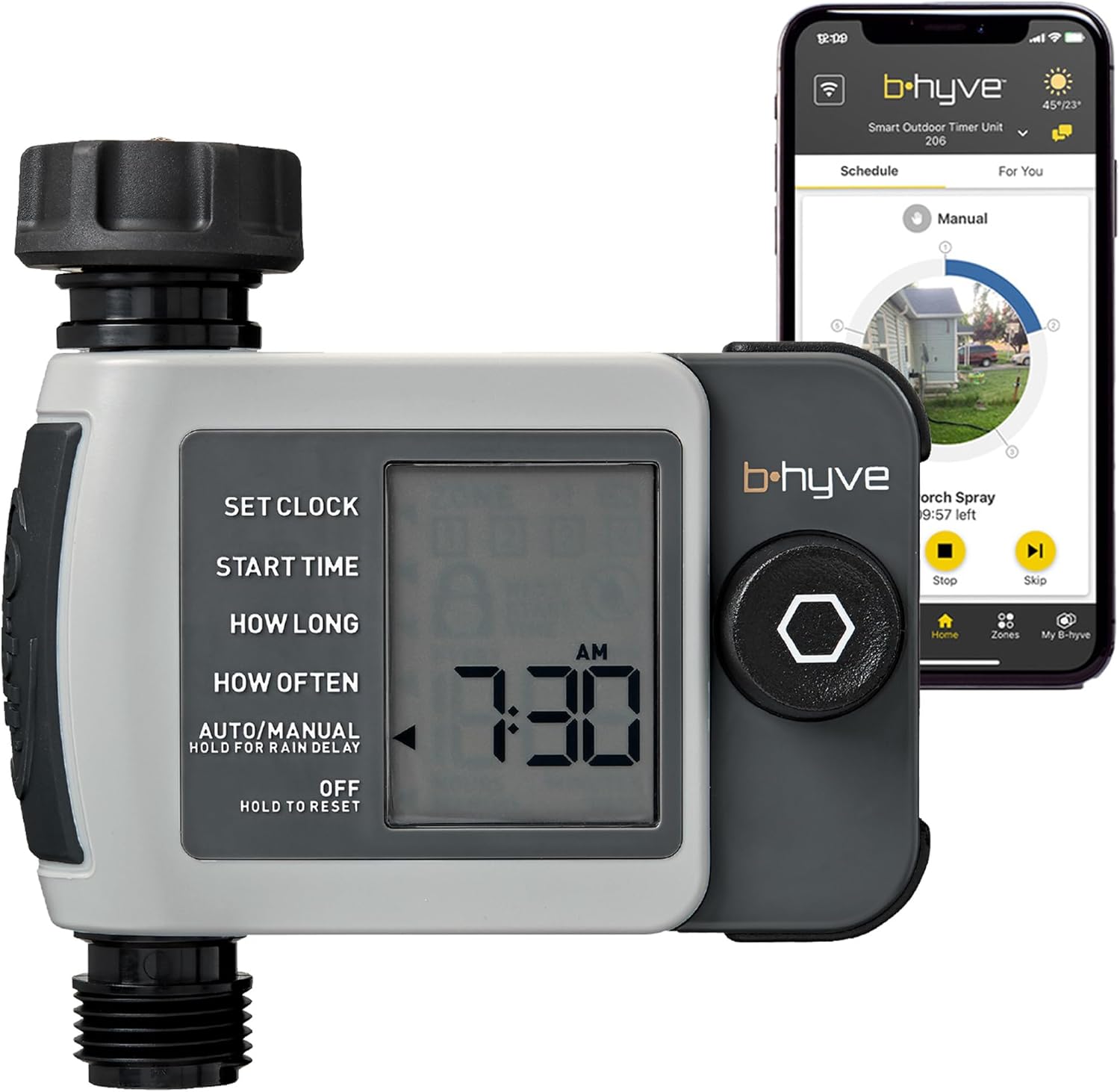
| Item Highlight | App Controlled Single Outlet Irrigation Timer, Smart WeatherSense Auto Watering, Weatherproof Battery Powered |
|---|---|
| Material Type | Plastic or Rubber |
| Number of settings | 5 |
| IP Rating | IPX-5 waterproof protection |
The Orbit B-hyve XD is a single-outlet smart hose timer designed to automate routine watering with local weather adjustments. It installs at a faucet and can be programmed directly on the unit, over Bluetooth, or remotely when you add the optional Wi‑Fi Hub to unlock full smart features. WeatherSense uses hyper-local data and drought-level information to reduce overwatering and help comply with local restrictions, and pairing with the hub makes the timer EPA WaterSense compliant. The unit is IPX-5 rated so it tolerates outdoor exposure to spray and rain, and the battery-powered design keeps it independent of mains power. Practical benefits include reliable basic scheduling from the device itself, automatic adjustments for changing conditions when connected to Wi‑Fi, and a compact single-outlet form for small yards or container gardens. Limitations are that advanced remote control and the WaterSense certification require purchasing and installing the Wi‑Fi Hub, and this model only controls one outlet so larger multi-zone systems need a different controller.
Best for: Buyers who want a simple, dependable smart hose timer that reduces watering guesswork and prioritizes conservative, water-conscious operation for a single faucet or small yard.
Less Ideal for: Homeowners needing multi-zone control or those who want full remote features without adding a separate Wi‑Fi hub should consider other controllers.
- App and local programming options let you control schedules from the device, by Bluetooth, or remotely with a hub.
- WeatherSense automatically adjusts watering using high-precision local weather and drought data.
- IPX-5 waterproof rating designed for outdoor use and resistance to spray and rain.
- Battery-powered operation avoids needing electrical hookups and keeps installation simple.
- Remote smart functions and EPA WaterSense compliance require purchasing the separate Wi‑Fi Hub.
- Only a single outlet so it is not suitable for multi-zone irrigation without additional controllers.
Verdict: If you want a low-risk, weather-adjusting smart hose timer for a single faucet, the Orbit B-hyve XD delivers reliable automatic watering with simple local controls and optional remote automation.
RAINPOINT Bluetooth 2‑Outlet Garden Hose Water Timer (No Hub)
| Material Type | Brass |
|---|---|
| Number of settings | 12 |
| Number of Packs | 1 |
| Unit Count | 1 Count |
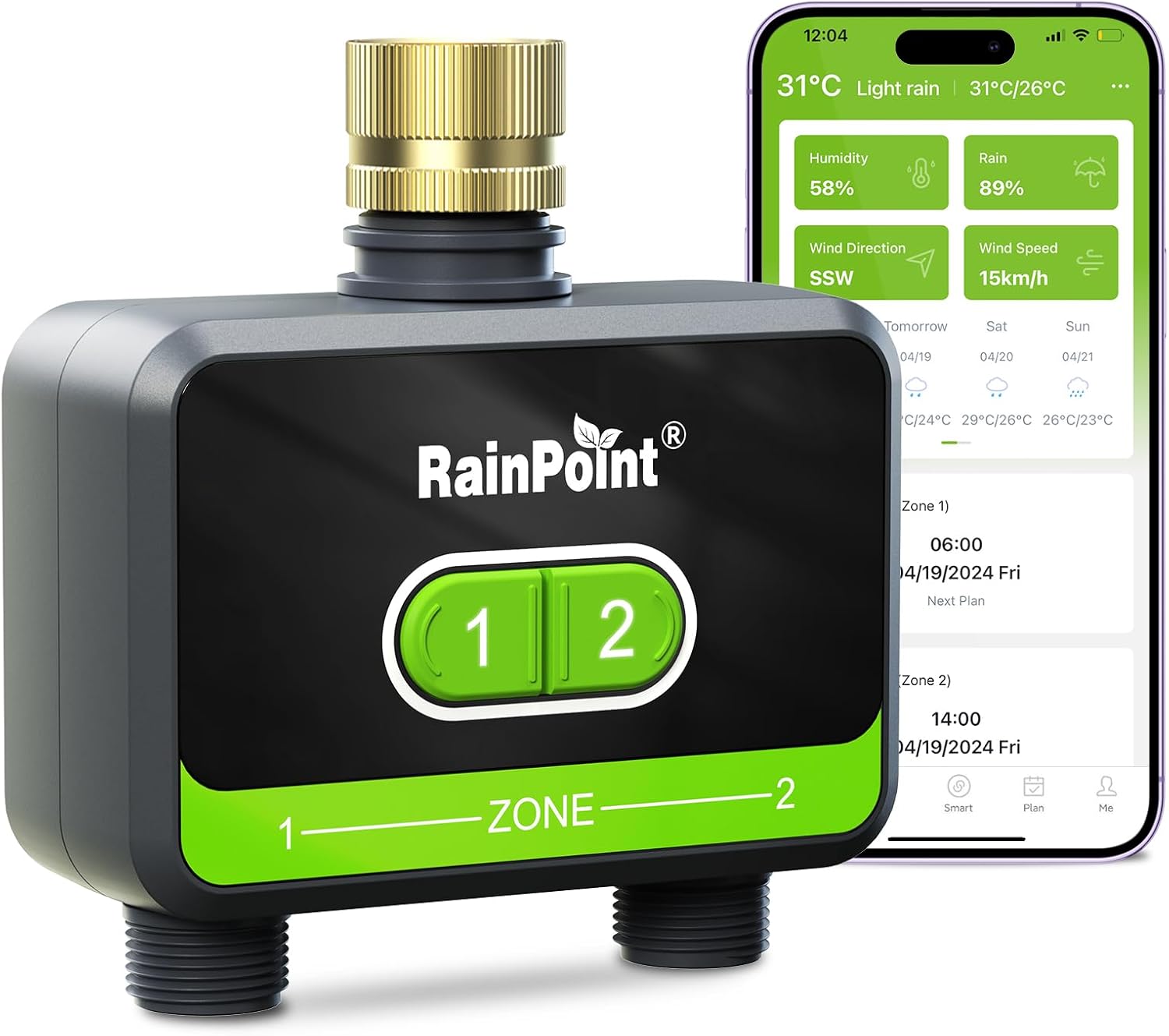
This RAINPOINT Bluetooth water timer mounts on a garden faucet and controls two independent hose outlets from the RainPoint Home app without requiring a hub. It schedules watering in three modes—normal irrigation, interval, and cycle & soak—with flexible run lengths and five frequency options (daily, weekly, odd/even days, or custom intervals). The app connection uses Bluetooth for direct control up to about 196 feet and the timer supports a seasonal adjustment percentage to scale run times through the year; it can also be linked to a separate RainPoint hub later for Wi‑Fi and multi-device integration. Brass inlet and outlet fittings and a programmable rain delay add practical reliability for routine lawn and garden use. Limitations to note are the Bluetooth-only direct connection (hub needed for remote Wi‑Fi control) and a reliance on the companion app for most advanced setup and changes.
Best for: Gardeners who want a dependable, app‑driven timer to automate two watering zones and prefer a simple local Bluetooth setup with the option to expand to Wi‑Fi later.
Less Ideal for: Users who need full remote control out of the box or who prefer hardware‑only programming without a smartphone app.
- Two independently controlled outlets for running separate zones or a hose plus soaker line
- Brass inlet and outlet fittings for durability at the connection points
- Multiple irrigation modes and flexible frequency options to handle lawns, flower beds, or soaker hoses
- Seasonal adjustment feature simplifies month‑to‑month runtime changes
- Bluetooth pairing provides quick local setup without additional wiring or network configuration
- Direct Bluetooth control limits remote access unless paired with a separate RainPoint hub
- Advanced scheduling and changes require using the RainPoint Home app rather than full local controls
Verdict: Buy this if you want a dependable two‑zone Bluetooth hose timer with brass fittings and flexible, app‑driven scheduling that can be expanded to Wi‑Fi with a hub.
Melnor Bluetooth 1-Zone Programmable Hose Timer (Quick Connect Bundle)

| Connectivity | Bluetooth 4.0 (30 ft range) |
|---|---|
| Zone count | 1 valve |
| Start times | Up to 12 per day |
| Power | 4 x AA batteries (not included) |
The Melnor Bluetooth 1-zone hose timer provides simple local smart control for garden or lawn watering without using Wi-Fi. You pair it with the Melnor app within roughly 30 feet and create schedules by day of week or by repeating intervals, with up to 12 start times per day for the single valve. The quick-connect bundle makes installation fast on a standard spigot and it runs on four AA batteries so it will keep working during internet outages. Practical benefits include fine-grained daily scheduling, separate start-time programming for the single zone, and straightforward setup for users who prefer phone control over manual knobs. Important limitations are that it only supports one zone and Bluetooth range is limited, so you must be near the unit to make changes; it also lacks remote cloud access and requires periodic battery replacement. For someone who wants a reliable, locally controlled smart timer for a single faucet, this is an efficient option, but households needing multi-zone remote control should consider more advanced controllers.
Best for: Buyers who want a simple, smartphone-controlled solution for a single faucet and prioritize reliable local control and easy installation over remote cloud management.
Less Ideal for: Users who need to manage multiple irrigation zones remotely or who require cloud-based scheduling and off-site access.
- Bluetooth app control allows scheduling from a smartphone within about 30 ft
- Flexible scheduling with up to 12 start times per day and day-of-week or interval options
- Quick-connect bundle simplifies installation on a standard spigot
- Battery power keeps the timer operational during power or internet outages
- Single-zone operation limits use to one faucet or requires multiple units for more zones
- No cloud or remote access beyond Bluetooth range so adjustments must be made on site
Verdict: A straightforward Bluetooth-controlled single-zone timer that delivers easy local scheduling and quick installation for users who need reliable on-site watering control.
Choosing the Right Bluetooth Watering Timer: Key Factors to Consider
Battery Life and Power Options
Battery life affects how often you need to access the unit and whether it remains reliable through a growing season. Many Bluetooth watering timers use AA or AA-sized batteries, while others offer rechargeable packs or optional solar trickle charging. Longer battery life reduces maintenance visits, especially for timers mounted away from easy access points. Consider units with low-battery alerts in the app so you can replace cells before a schedule fails.
Also think about winter storage and whether the battery compartment seals against moisture. Rechargeable options reduce waste but may require occasional removal and charging. If your garden is remote from outlets, prioritize models with extended disposable battery life or integrated solar charging.
App Usability and Local Bluetooth Reliability
The mobile app is where you create schedules, start manual runs, and monitor battery and valve status. An intuitive app saves time and avoids mistakes when setting irregular schedules for containers or seasonal changes. Look for straightforward schedule templates, easy zone naming, and clear feedback when a command is sent over Bluetooth.
Bluetooth range matters because you will often pair at the hose bib or while walking the garden. Bluetooth is usually reliable at short range, but obstructions and metal fixtures can reduce performance. Timers that provide on-unit controls or local physical overrides are helpful when the phone connection drops.
Valve and Hose Compatibility
Compatibility with common hose fittings and valve standards ensures the timer installs cleanly on existing outdoor faucets and inline systems. Many residential setups use 3/4-inch hose threads or standard quick-connect fittings. Adapters can help, but every extra connection is a potential leak point. Consider materials, gasket quality, and whether the unit supports both threaded spigots and inline irrigation valves.
If you plan to attach the timer to a pressure-regulated drip manifold or use it with a solenoid valve, verify mechanical and electrical compatibility before purchase. Robust seals and corrosion-resistant materials improve long-term reliability in outdoor conditions.
Number of Zones and Expandability
How many separate watering circuits you need depends on plant types, sun exposure, and irrigation layout. Some Bluetooth timers control only a single faucet while others manage multiple independent zones or allow linking several units under the same app account. Single-zone timers are fine for a dedicated drip line or container grouping, but mixed landscapes with lawn and beds usually benefit from multi-zone control.
Check whether the system supports staggering start times, short manual runs, and customized durations per zone. Expandability matters if you plan to scale the irrigation system later.
Weather Handling and Scheduling Flexibility
Timers should help you avoid watering during rain and adapt to seasonal shifts. While Bluetooth units may not have built-in advanced weather sensors, many integrate weather-aware scheduling via the phone app or allow suspension of schedules when you know rain is imminent. Flexible scheduling options such as weekday/weekend differences, alternate-day cycles, and custom run durations let you match irrigation to plant needs and local climate.
Also consider physical durability: splash resistance, UV-stable plastics, and secure mounting options prevent failure from routine outdoor exposure.
Installation and On-Unit Controls
Practical installation affects how quickly you can start using the timer. Simple threaded mounts and clear instructions reduce installation time. Some models offer basic on-device controls such as a start/stop button and manual run duration, which are indispensable when you need to water without your phone or when Bluetooth connectivity is limited.
Think about where the timer will sit on the faucet or manifold and whether a short hose or mounting bracket is needed to keep the unit accessible. Units that require special tools or tricky wiring add complexity that may not be worth the extra features for casual gardeners.
Typical Installation Scenarios
Bluetooth watering timers are used in a few common ways: mounted directly on a garden spigot to control a single hose or drip line, installed inline before a drip manifold to control multiple lateral lines, or paired to a valve assembly for raised bed irrigation. Each placement changes access, battery visibility, and Bluetooth range.
For spigot-mounted setups you want a timer that seals well against faucet threads and sits so you can reach the battery door. Inline installations often benefit from compact housings and access to a quick-connect fitting for maintenance. When mounting near flowerbeds or containers, consider a short hose segment so you can remove the timer for winter storage without disturbing the layout.
- Spigot mount: easiest to install, best for single-line irrigation
- Inline before manifold: good for small multi-line systems
- Valved assemblies: suitable when integrating with existing solenoid valves
Programming Patterns for Different Gardens
Different plantings require different schedules. Containers dry faster than in-ground beds, so they often need shorter, more frequent runs. Lawns and established beds benefit from less frequent, deeper watering. A Bluetooth watering timer should let you create custom durations and repeat patterns to match these needs.
Use manual runs for spot watering after planting or for small transplants. Staggering start times across zones helps avoid pressure drops if you run several zones from the same faucet or pump.
- Containers: short runs, multiple times per week
- Raised beds: moderate runs, frequency based on soil and sun
- Lawns: less frequent, longer runs to encourage deep roots
Maintaining Bluetooth Timers Through Seasons
Routine maintenance includes checking batteries, inspecting seals for cracking, and removing the unit before hard freezes. Winterizing prevents frozen water from damaging internal components and gaskets. If your timer is left in a frost-prone location, drain it and store it indoors.
During the season, keep an eye on app alerts about connectivity or low power and test manual controls occasionally. Clean sediment from hose threads and replace worn washers to prevent leaks that might affect timer operation.
- Check batteries monthly during heavy use
- Inspect and replace O-rings or washers as needed
- Drain and store indoors before freezing temperatures
Using Timers with Drip Systems and Emitters
When using Bluetooth timers with drip irrigation, account for overall system pressure and emitter flow rates. Timers that allow short, repeated cycles can help prevent pressure loss in long lateral lines and improve uniformity. For fragile emitters, avoid sudden on-off cycles that could cause clogging from water hammer.
If your drip array includes filters or pressure regulators, place the timer on the supply side where it can control power to the whole assembly without interfering with filters. That setup simplifies maintenance and reduces the number of wetted connections on the emitter side.
- Place timer upstream of filters and regulators when possible
- Use cycle-and-soak scheduling for long, sloped lines
- Avoid frequent on/off cycles that stress emitters
Troubleshooting Common Connectivity Issues
Bluetooth connection problems usually stem from range limits, physical obstructions, or low battery power. Move closer to the timer and remove obstacles like metal toolboxes or dense walls when pairing. Confirm the app shows a live connection and that firmware updates, if required, have completed.
If the app cannot find the unit, try toggling Bluetooth on your phone or restarting the app. Keep the timer firmware current and follow the manufacturer instructions for reconnecting devices to the app account.
- Pair within a few feet for initial setup
- Restart phone Bluetooth or the app if pairing fails
- Check batteries if signal is intermittent
How We Chose the Best Bluetooth Watering Timer
We focused on real-world gardener needs when narrowing the list of Bluetooth watering timers. Selection emphasized reliable wireless control and practical irrigation features rather than novelty extras. Key evaluation criteria included battery life and power options, ease and clarity of mobile app programming, compatibility with common hose and valve fittings, the ability to manage multiple zones, and how the unit handles on-site conditions such as splash and moderate rain. We excluded controllers that require a constant Wi-Fi backbone, professional irrigation controllers intended for large commercial systems, or devices lacking clear installation instructions. We also filtered out options without basic fail-safes like local manual override or simple on-unit controls. The final picks are those that balance dependable hardware with an app experience gardeners can use in the yard, and that support the most common installation scenarios for residential and patio irrigation.
FAQ
Will a Bluetooth watering timer work when I am not at home?
Often it will if your phone can act as the bridge while you are within Bluetooth range. Pure Bluetooth units usually require proximity to change settings, so remote adjustments while away from the property are limited unless the unit supports a Wi-Fi bridge or cloud service.
How do I winterize a Bluetooth watering timer?
Shut off water to the timer, run a manual cycle to drain remaining water, remove batteries, and store the device indoors in a dry place. This prevents freeze damage and extends the life of seals and electronics.
Can I use a Bluetooth timer with drip irrigation?
Yes. Bluetooth timers work with drip systems, but place the timer upstream of filters and pressure regulators when possible. Use appropriate run times and consider cycle-and-soak scheduling to improve uniformity on long runs.
What happens if the Bluetooth connection drops during a run?
Most timers continue the active schedule on the unit even if the phone disconnects, but the ability to change or stop the run remotely will be lost until you reconnect. Choose models that include on-unit manual controls for local intervention.
How often should I check or replace batteries?
Battery replacement frequency depends on usage and power type. With typical seasonal schedules, check battery level monthly and expect to replace disposable batteries once or twice per season on lower-end units. Units with longer life or rechargeable options will need less frequent attention.
Final Verdict
When choosing a Bluetooth watering timer, prioritize the features that match how you garden. If you value low maintenance, long battery life and clear low-battery alerts are essential. If you need flexibility, focus on app usability, multi-zone control, and scheduling options that match container, bed, and lawn needs. Balance ease of installation, valve compatibility, and weather handling against how often you can visit the timer for maintenance. With those tradeoffs in mind, you can confidently select a Bluetooth timer that streamlines irrigation and reduces daily watering tasks.
