

Note: This article contains affiliate links. If you click on these links and make a purchase, I may earn a small commission at no extra cost to you. This helps support my research and content. Read my full affiliate disclosure here.
A 4 station watering timer makes managing multiple irrigation zones much simpler whether you run drip lines, sprinklers, or soaker hoses. The right timer keeps plants healthy with consistent run times, reduces wasted water, and frees you from manual watering rounds. This guide presents seven shortlisted 4 station timers that suit home gardens, small lawns, and patio beds. We evaluated each option on practical setup tasks, reliability of the valve outputs, programming flexibility, and resistance to outdoor conditions. Read on for the criteria we used and what to expect when installing a timer in your yard.
Top Picks at a Glance
| Best Overall The best all-around choice for most situations | Orbit 4-Station Indoor/Outdoor Swing Panel Sprinkler Timer |  |
| Best Quality Built to a higher standard if you want something more solid | Hunter X-Core XC400i 4-Station Indoor Sprinkler Timer |  |
| Best Value The sweet spot between price and what you get | Insoma 4-Zone Hose Watering Timer with Brass Inlet |  |
| Best Budget The cheapest option that still gets the job done reliably | ThermoHalo 4-Zone Programmable Hose Sprinkler Timer |  |
| Highest Rated A top-rated pick with lots of positive feedback | Melnor 4-Zone Programmable Digital Water Timer (Model 77280) |  |
| Most Popular A crowd favorite that many people choose with confidence | Melnor AquaTimer 4-Zone Programmable Digital Water Timer |  |
| Best Seller A high-volume bestseller chosen again and again | Orbit Easy-Set Logic 4-Station Indoor/Outdoor Sprinkler Controller (Model 27894) |  |
Orbit 4-Station Indoor/Outdoor Swing Panel Sprinkler Timer

| Stations | 4 |
|---|---|
| Mounting | Indoor or outdoor with locking cabinet |
| Features | Cycle and soak, stacking runtimes, rain skip delay |
The Orbit 4-Station Swing Panel Sprinkler Timer controls up to four irrigation zones with straightforward programming and an option to mount the lockable cabinet indoors or outdoors. It is typically used to automate residential lawn and garden watering by assigning independent schedules to each station, using features like cycle and soak, stacking runtimes, and a rain skip delay to avoid overwatering. The locking cabinet with two keys adds security when mounted outside, and setup is intentionally simple so a homeowner can get custom intervals running quickly. Practical benefits include conserving water through cycle and soak and avoiding manual watering chores across multiple zones. The unit does not include remote app control or advanced smart-home integration, so scheduling changes must be made at the controller rather than from a phone. For someone who wants a reliable, no-frills timer with flexible local programming, this is a solid choice; users wanting Wi-Fi connectivity or large-zone systems should consider other models.
Best for: Homeowners who want a dependable, easy-to-program timer to automate four garden or lawn zones and reduce routine watering tasks without needing smart-home features.
Less Ideal for: Gardeners who need remote app control, integration with other smart devices, or support for more than four irrigation zones should look elsewhere.
- Controls four independent watering zones for small to medium lawns
- Lockable cabinet with two keys allows secure indoor or outdoor installation
- Cycle and soak plus stacking runtimes help reduce runoff and overwatering
- Simple installation and intuitive local programming for quick setup
- No Wi-Fi or smartphone app for remote scheduling and monitoring
- Limited to four stations so not ideal for larger, multi-zone systems
Verdict: A solid, easy-to-use four-station timer that automates watering with practical cycle and soak features for homeowners who prioritize reliability over smart connectivity.
Hunter X-Core XC400i 4-Station Indoor Sprinkler Timer

| Model | XC400I |
|---|---|
| Zones | 4 station |
| Display Type | LCD |
| Voltage | 120 volts AC |
| Operating Temperature | 60 °F |
The Hunter X-Core XC400i is a straightforward 4-zone indoor sprinkler controller built for reliable, no-frills performance. It uses a dial-based front panel and an LCD to set three independent programs with up to four start times each and run times up to four hours, so you can tailor schedules for lawns, flower beds, and shrubs. Non-volatile memory preserves your settings through power outages and built-in seasonal adjust lets you change watering globally from 10% to 150% as weather shifts. The X-Core accepts Hunter accessories such as the Solar Sync sensor for weather-based runtime reduction and the ROAM remote for wireless zone testing, giving a path to smarter or remote operation without replacing the controller. Its compact indoor design installs easily in a garage or shed and is aimed at homeowners who want robust, professional-grade timing without a complicated interface. Limitations to note are the lack of built-in Wi-Fi and the absence of advanced cloud app control, so users wanting remote scheduling or detailed analytics will need a different model or additional modules.
Best for: Gardeners or homeowners who prioritize dependable, professional-style irrigation control and want precise, programmatic management of up to four zones without relying on cloud services.
Less Ideal for: Users who need native smart home connectivity, mobile app scheduling, or an outdoor-rated controller should consider Wi-Fi capable or outdoor models instead.
- Flexible scheduling with 3 programs, 4 start times per program, and run times up to 4 hours
- Non-volatile memory preserves programs during power outages
- Seasonal adjustment lets you quickly scale run times from 10% to 150%
- Compatible with Solar Sync sensor and ROAM remote for weather-based or remote control
- No built-in Wi-Fi or smartphone app for remote scheduling
- Designed for indoor installation only
Verdict: Choose the X-Core XC400i when you want a compact, reliable 4-zone controller with flexible scheduling and season-long performance without cloud dependence.
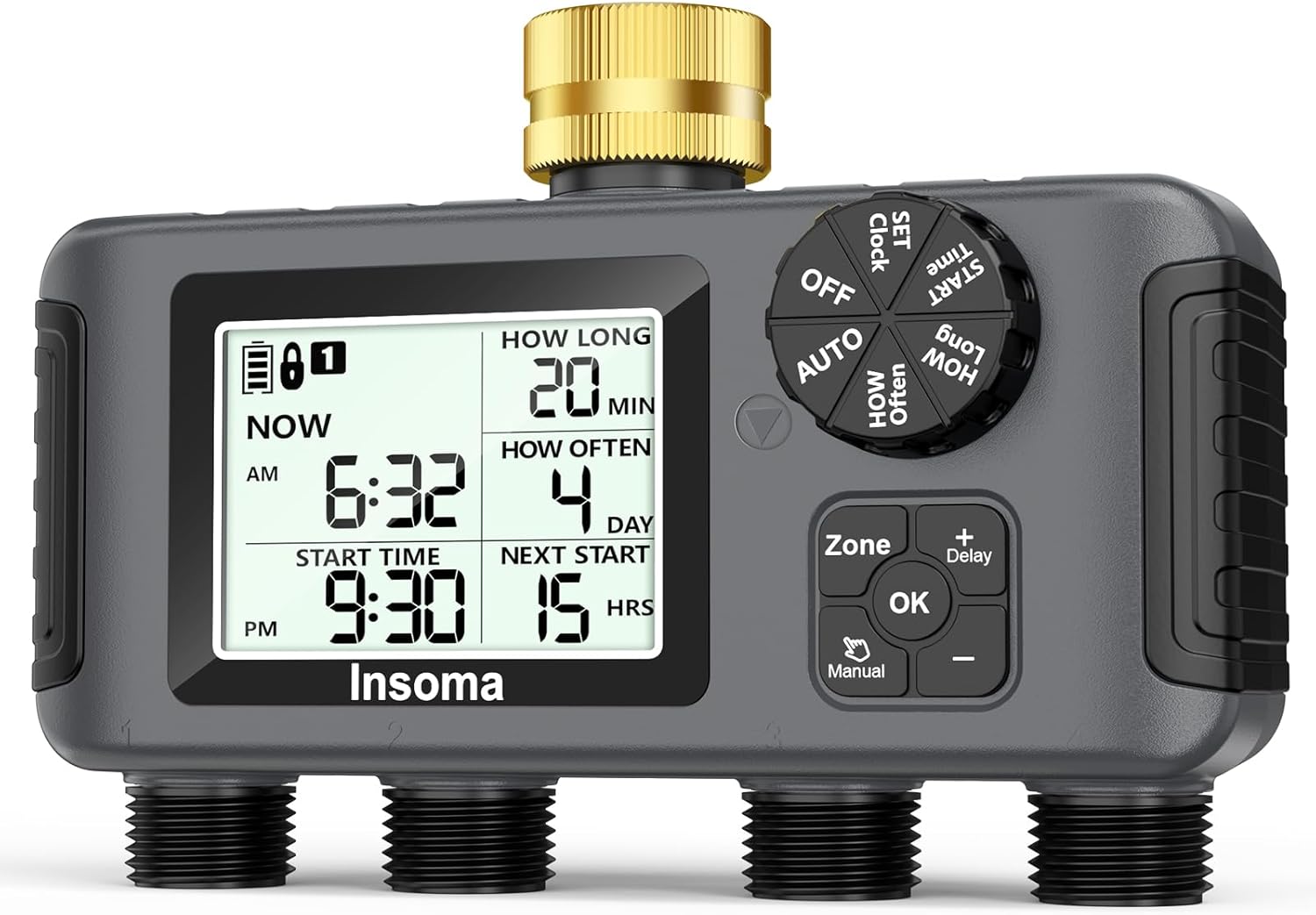
Insoma 4-Zone Hose Watering Timer with Brass Inlet
| Number of settings | 4 |
|---|---|
| Battery Life | 6 months |
| Waterproof rating | IPX5 |
| Power | 4×AA 1.5V batteries |
The Insoma 4-zone timer lets you automate watering across four separate outlets by programming individual start times, durations and frequencies for each zone; zones run sequentially rather than simultaneously. Setup is straightforward on the large LCD with options for 12/24-hour display, and the AUTO mode can repeat cycles from hourly intervals up to once every 30 days. Handy extras include a manual-watering override, a rain-delay pause (1 to 15 days) and a child-lock to prevent accidental changes. The unit uses four AA batteries and claims over six months of operation, while IPX5 waterproofing, anti-UV coating and rust-resistant components aim to keep it working outdoors. Limitations to note are the sequential-only zone operation, which may extend total run time if all zones need long durations, and the requirement for minimum water pressure so it will not work with gravity-fed barrels. For routine garden, lawn or greenhouse irrigation where reliable scheduling and weather pauses matter, this timer covers the essentials with durable construction and clear controls.
Best for: Gardeners who want a reliable, low-maintenance way to schedule multiple planting areas and prefer clear controls and weather-safe hardware over simultaneous multi-valve operation.
Less Ideal for: People who need all zones to run at the same time or those using rain barrels or other no-pressure water sources should consider a different solution.
- Four independent programable zones allow unique start time, duration, and frequency per area
- Large LCD and simple controls make programming and monitoring quick
- IPX5 waterproof rating, anti-UV coating and rust-resistant parts for outdoor durability
- Manual override, rain-delay and child-lock modes add practical control and protection
- Zones operate one at a time rather than simultaneously which can lengthen total watering cycle
- Requires sufficient water pressure so it does not work with gravity-fed or no-pressure systems
Verdict: A durable, easy-to-program four-zone timer that simplifies scheduled watering and weather pauses for practical multi-area garden irrigation.
ThermoHalo 4-Zone Programmable Hose Sprinkler Timer

| Number of settings | 4 |
|---|---|
| Battery Type | Aa |
| Ingress protection | IP65 |
| Operating pressure range | 0.03-0.8MPa |
The ThermoHalo 4-zone programmable sprinkler timer lets you set up to four independent watering programs with customizable start times, durations and intervals, making it easy to manage a small lawn or mixed garden beds. Installation is tool-free on a standard 3/4" faucet and the large LCD and simple controls make programming straightforward for busy homeowners or caregivers. Notable features include manual and rain-delay modes that temporarily override schedules without losing settings, a child lock to prevent accidental changes, and a Leak Guard that shuts the valve when batteries run low to reduce water waste. The housing is weather-resistant to stand up outdoors and the unit supports very short to very long run times and intervals, so it covers everything from frequent short sips to weekly deep watering. Limitations to keep in mind are basic plastic construction and a recommendation to remove the timer before freezing temperatures, so it is not intended for permanent year-round outdoor mounting in cold climates. The single-valve design also means this particular model controls four programs from one outlet rather than separate physical valves.
Best for: Gardeners who want an affordable, easy-to-program timer to automate watering across up to four zones for small lawns, flower beds, or container gardens without paying for a complex valve system.
Less Ideal for: Users who need robust year-round outdoor hardware in freezing climates or who want smart home integration and remote control should consider a more heavy-duty or Wi-Fi-capable alternative.
- Four independent programs with adjustable start time, duration and interval for flexible zone scheduling
- Large, easy-to-read LCD and straightforward controls simplify setup and daily use
- Weather-resistant housing and child lock for reliable outdoor operation and safer handling
- Manual and rain-delay modes that pause or run watering without erasing programmed schedules
- Leak Guard feature that shuts valve when battery is low to prevent unintended watering
- Plastic construction and advised removal below 3°C means limited durability in freezing climates
- Controls and features are local only; this model does not offer remote or app-based control
Verdict: An affordable, user-friendly 4-program timer that automates watering for small lawns and gardens without complexity.
Melnor 4-Zone Programmable Digital Water Timer (Model 77280)

| Brand Name | Melnor |
|---|---|
| Number of settings | 24 |
| Item Type Name | 4 Zone Programmable Water Timer |
| UPC | 042206162656 |
The Melnor 4-Zone Programmable Digital Water Timer controls up to four watering lines from a single hose connection, letting you set timed cycles for different zones without manual switching. It is typically mounted at a faucet and used with garden hoses or splitter manifolds to automate lawn, bed, or container watering. Notable features include a dirt-resistant valve for longevity, a user-friendly interface with 24 available settings, and built-in water usage tracking so you can monitor consumption. Practical benefits include easy zone scheduling to prevent over- or under-watering, reduced daily attention, and straightforward installation for homeowners who want dependable automatic watering. Important limitations are the lack of battery backup which means program loss during power or battery failure and the basic feature set compared with app-connected or sensor-integrated timers. The unit appears compact and focused on durable, no-frills performance rather than smart-home integration.
Best for: Home gardeners and homeowners who prioritize a straightforward, reliable automated timer to keep multiple beds or lawn zones watered with minimal fuss.
Less Ideal for: People who want smart-home features, remote app control, or soil/moisture sensor integration should consider a Wi-Fi or smart timer instead.
- Controls four separate watering zones from a single faucet for flexible scheduling
- Dirt-resistant valve designed to reduce clogging and extend reliable operation
- User-friendly interface with 24 settings simplifies programming for common watering needs
- Water usage tracking helps monitor and manage consumption
- No battery backup so programmed schedules can be lost if power or batteries fail
- Does not offer wireless app control or sensor integration for advanced automation
Verdict: Choose this Melnor 4-zone timer if you want a simple, durable, no-frills controller that reliably automates multiple watering zones.
Melnor AquaTimer 4-Zone Programmable Digital Water Timer

| Battery Type | AA |
|---|---|
| Number of settings | 4 |
| Item Type Name | Timer |
| Manufacturer Warranty Description | 7 years limited. |
The Melnor AquaTimer 4-Zone is a straightforward digital hose timer designed to automate watering for four separate zones or hoses. You program frequency (hourly to weekly) and run time (1 minute to 6 hours) independently for each zone, so you can water a lawn less often while running a soaker line for flower beds more frequently. The large LCD and simple controls make programming accessible without an app. A manual watering button lets you quickly use the faucet without changing schedules, and a 7-day rain delay pauses all programs when needed. It runs on two AA batteries and is housed in a plastic body that is lightweight and easy to mount at an outdoor spigot. Limitations to note are the lack of wireless control or weather sensor input and the plastic construction that may not be as durable as metal-bodied controllers, so you should protect it from prolonged sun and freezing conditions. For gardeners who want reliable local scheduling across multiple hoses, this model covers the basics well.
Best for: Gardeners or homeowners who want a dependable, no-frills timer to run multiple hoses or zones with straightforward local programming and clear on-device controls.
Less Ideal for: Users who want smartphone control, integration with weather sensors, or a heavy-duty metal controller for exposed or extreme climates should consider other options.
- Four independently programmable zones for different watering needs
- Wide run-time range from 1 minute to 6 hours for flexibility
- Large LCD and simple interface that make programming straightforward
- Manual watering option for temporary faucet use without changing schedules
- 7-day rain delay to avoid unnecessary watering during wet periods
- No wireless or app-based control for remote adjustments
- Plastic housing may require extra protection from harsh sun or freezing temperatures
Verdict: A simple, reliable 4-zone digital timer that delivers flexible on-device scheduling for gardeners who prioritize easy local control over smart features.
Orbit Easy-Set Logic 4-Station Indoor/Outdoor Sprinkler Controller (Model 27894)

| Model | 27894 |
|---|---|
| Voltage | 24 volts |
| Programs | 3 programs |
| Start times | 4 per program |
The Orbit Easy-Set Logic 4-station controller is a straightforward indoor/outdoor timer designed to run up to four irrigation zones with minimal fuss. It is typically mounted near the valve manifold and wired using the swing panel and push-in terminals so homeowners or installers can set three independent programs, each with up to four start times. Notable features include a large LCD, battery backup to preserve programming during power loss, rain delay and freeze sensor compatibility, and a locking weatherproof cabinet for outdoor protection. Practical benefits are ease of setup for nontechnical users, flexible start-time and program options for cycle-and-soak scheduling, and surge protection at the transformer and zone level for added reliability. Limitations to keep in mind are the lack of smart connectivity or app control and no built-in weather adjustments, so you must manually change schedules for seasonal needs or use a separate sensor. For buyers who want a dependable, no-frills timer that avoids complexity, this controller covers the essentials well.
Best for: Homeowners who want a dependable, low-complexity controller for a small yard and prefer a device that is easy to install and maintain without smart-home features.
Less Ideal for: Users who want cloud control, smartphone scheduling, or automatic weather-based adjustments should consider a smart controller instead.
- Easy, guided programming with three programs and four start times per program
- Weatherproof locking cabinet with two keys suitable for outdoor mounting
- Battery backup preserves settings during power outages
- Push-in wire terminals and swing panel simplify installation and servicing
- No Wi-Fi or app connectivity for remote scheduling or automatic weather adjustments
- Does not include an integrated rain/freeze sensor and relies on optional external sensors
Verdict: A reliable, easy-to-program 4-station timer that prioritizes simplicity and durability for homeowners who want a no-nonsense irrigation controller.
Choosing the Right 4 Station Watering Timer: Key Factors to Consider
Programming Flexibility
How the timer handles schedules affects how closely you can match plant water needs. Look for units that allow multiple start times per day, adjustable run durations down to the minute or at least small increments, and weekday/weekend or interval scheduling options. Flexible programming helps you run short, frequent cycles for sandy soil or longer, infrequent soakings for clay.
A clearer interface reduces mistakes when changing seasonal schedules. Consider whether the display is readable in bright sunlight and whether common tasks like skipping a scheduled run or setting a rain delay are accessible without digging through nested menus.
Valve Compatibility and Output
Most home irrigation valves are standard 24 VAC solenoids. Ensure the timer provides the correct voltage and supports the current draw of multiple valves, especially if wiring runs combine outputs. Some timers have built-in surge protection or isolated outputs to prevent one faulty valve from affecting others.
Check whether the controller supports master valves or pump start relays if your setup needs them. Valve output behavior also affects how well the system handles long wiring runs and whether it reliably opens and closes valves under load.
Durability and Weather Resistance
Timers mounted outdoors face sun, rain, temperature swings, and insects. A well-sealed enclosure with an IP rating or gasketed door resists moisture intrusion and extends service life. UV-resistant plastics and corrosion-resistant mounting hardware reduce long-term degradation.
Think about the placement: mounting under eaves or inside a small protective box will help, but the timer itself should tolerate occasional splashes and high humidity. Battery compartments and terminal strips should be designed to keep corrosion risk low.
Installation and Wiring
Simple wiring and clear terminal labeling make installation faster and less error-prone. Look for controllers with screw terminals that accept standard gauge irrigation wire and with space to route wires neatly. A clear wiring diagram and accessible mounting holes save time during setup.
If you are not comfortable with low-voltage wiring, choose a unit with straightforward labels and color-coded terminals. Consider whether the timer can be mounted vertically or horizontally to fit your valve box or wall space.
Power Options and Backup
Timers may be AC powered, battery powered, or offer both. Battery backup preserves schedules during power outages, preventing skipped runs or forgotten reprogramming. Evaluate battery life expectations and whether the unit uses common battery sizes.
Some controllers include solar-compatible inputs or can run on low-voltage from existing landscape lighting transformers. Consider how often you want to change batteries and whether the timer will run reliably through seasonal power interruptions.
User Interface and Alerts
An intuitive user interface reduces the time spent programming and troubleshooting. Large buttons, a readable LCD, and logical menu structure help gardeners make quick changes. Local alerts such as flashing indicators for active zones or battery warnings help you verify operation without opening the enclosure.
Some timers offer simple diagnostics like manual station testing and history of skipped runs. If remote access or app control matters, verify that the unit supports it and whether that adds complexity to setup or ongoing maintenance.
Matching a Timer to Your Irrigation Layout
Start by mapping the areas you want to water and grouping emitters into four logical zones. Each station should control a coherent section of plants with similar water needs. For example, keep shrubs on a different station than lawn or vegetable beds.
Consider run-time planning: zones with deep-rooted plants usually need longer, less frequent cycles, while containers and new seedlings benefit from shorter, more frequent watering. Plan wiring to minimize run length and avoid running multiple valve wires in tight bundles that could confuse connections.
- Label valve wires during installation to match controller terminals
- Place the controller near valve manifolds to reduce wire runs
- Group plants with similar needs on the same station for consistent watering
Protecting Your Timer From the Elements
Even weatherproof controllers benefit from placement that reduces direct sun and wind-driven rain. Mount under an eave or inside a simple weather hood when possible. Good airflow helps prevent overheating in hot climates.
Regularly inspect seals and battery compartments for corrosion, especially after heavy storms. Replace any cracked gaskets and keep the enclosure clean from debris and insect nests to preserve longevity.
- Use a small drip-edge canopy or plastic hood for extra protection
- Check terminal screws annually for tightness and corrosion
- Keep batteries fresh and replace on a seasonal schedule if used heavily
Using Rain Sensors and Soil Moisture Inputs
Integrating a rain sensor or a soil moisture sensor prevents unnecessary runs and conserves water. Rain sensors are simple to wire and will interrupt scheduled cycles when triggered by precipitation. Soil moisture sensors provide a more precise reading of when plants actually need water.
Not all timers accept both sensor types, so confirm compatibility during selection. Sensors can reduce water usage dramatically during wet spells and protect plants from overwatering.
- Rain sensors are ideal for preventing watering during and after storms
- Soil moisture probes help avoid schedule-based overwatering
- Verify the controller supports the sensor type before purchase
Adapting Schedules Through the Seasons
Water needs change with plant maturity, weather, and daylight hours. During spring and fall, reduce runtimes and increase frequency to encourage root development. In summer, increase duration or add start times to meet higher evapotranspiration demands.
Use program presets or seasonal adjustments if the controller offers them. If not, plan two or three manual program checks across the season to tweak durations and start times for optimal plant health and water efficiency.
- Set shorter cycles for newly planted beds
- Increase run times gradually during heat waves
- Use multiple start times for long-duration needs to prevent runoff
Basic Troubleshooting Tips
If a zone does not run, check that the master valve or pump relay is not preventing operation and verify fuse or breaker status for powered units. Confirm battery voltage in battery-backed units. Manual station testing on the controller helps isolate wiring or valve faults.
Corroded terminals or broken valve diaphragms are common failure points. Clean terminals and inspect valve bodies periodically. When in doubt about electrical issues, consult a licensed technician for safety.
- Use the controller's manual run feature to test each station
- Inspect valve solenoids for debris or damaged diaphragms
- Replace suspect batteries before troubleshooting complex electrical faults
How We Chose the Best 4 Station Watering Timer
We focused on features and real-world behavior that matter for home irrigation systems. First, programming flexibility was essential: timers needed straightforward schedules, multiple daily start times, and easy duration settings to adapt to seasonal changes. Second, valve reliability and electrical output were checked conceptually so we favored timers designed to drive common 24 VAC solenoid valves without frequent failures. Third, weather resistance and enclosure quality were prioritized for outdoor installs where moisture and sun exposure shorten equipment life. Fourth, user interface and installation complexity were considered so gardeners can mount and wire a unit without professional help. Fifth, power options and battery life were reviewed to support uninterrupted schedules during outages. We excluded specialty controllers meant for large commercial systems and units that only support fewer than four stations. Our selection process emphasized practical durability, simple but capable programming, and compatibility with typical residential valve hardware.
FAQ
Can a 4 station timer handle drip systems and sprinklers on the same controller?
Often yes, but you should group similar emitters on the same station. Drip systems usually need different run durations than spray sprinklers, so keeping them on separate stations avoids compromises in run time.
Do I need a weatherproof housing if the timer is rated for outdoor use?
It depends on exposure. A weather rated timer can withstand normal outdoor conditions, but additional shelter reduces UV stress and direct rain exposure and generally increases service life.
How important is battery backup on a timer?
Battery backup preserves schedules and prevents missed runs during power outages. It is especially useful if you cannot easily reprogram the timer or if outages are frequent in your area.
Will a 4 station timer work with my existing valves?
Usually a 4 station controller is compatible with standard 24 VAC solenoid valves. Confirm the controller supports the voltage and current draw of your valves and check whether a pump start relay or master valve output is required.
Can I expand a 4 station system later?
Yes, expansion is possible using expansion modules or by replacing the controller with a higher-station unit. Plan conduit and wiring runs to allow future additions so you do not need to rewire extensively.
Final Verdict
Choose a 4 station watering timer that matches the complexity of your irrigation layout and the level of automation you want. Prioritize clear programming, reliable valve outputs, and weather-resistant construction for long-term trouble-free operation. If you need remote control or advanced sensor inputs, factor those capabilities into your decision while remembering they add setup complexity. Focus on durability and ease of use so the controller becomes a dependable part of seasonal watering routines.
