

Note: This article contains affiliate links. If you click on these links and make a purchase, I may earn a small commission at no extra cost to you. This helps support my research and content. Read my full affiliate disclosure here.
Choosing the right fall weed and feed matters because autumn applications both suppress cool-season weeds and lay the groundwork for strong spring lawns. The wrong product or timing can leave bare patches, ineffective weed control, or nutrient imbalance come spring. This guide covers the top shortlisted fall weed and feed options gardeners rely on for pre-winter weed control and root-feeding. We evaluate spread consistency, active ingredient effectiveness, and fertilizer formulation so you can pick a product suited to your lawn type and seasonal plan.
Top Picks at a Glance
| Best Overall The best all-around choice for most situations | Scotts Turf Builder WinterGuard Fall Weed & Feed5, 11.28 lb | 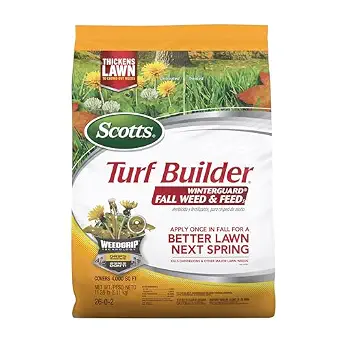 |
| Best Quality Built to a higher standard if you want something more solid | The Andersons Surge Weed & Feed 16-0-9 Granular Lawn Fertilizer (40 lb) |  |
| Best Value The sweet spot between price and what you get | BioAdvanced 3-in-1 Weed and Feed Granules for Southern Lawns, 20 lb |  |
| Best Budget The cheapest option that still gets the job done reliably | GreenView Weed & Feed Lawn Fertilizer, 13 lb Bag |  |
| Highest Rated A top-rated pick with lots of positive feedback | Scotts Turf Builder WinterGuard Fall Weed & Feed, 11.43 lb |  |
| Most Popular A crowd favorite that many people choose with confidence | Scotts Turf Builder Weed & Feed 3, Granular Lawn Fertilizer and Weed Killer, 14.29 lb |  |
| Best Seller A high-volume bestseller chosen again and again | Scotts Turf Builder WinterGuard Fall Weed & Feed (33.84 lb) |  |
Scotts Turf Builder WinterGuard Fall Weed & Feed5, 11.28 lb

| Item Form | Granule |
|---|---|
| Coverage | 4000 sq ft |
| Unit Count | 1 Count |
Scotts Turf Builder WinterGuard Fall Weed & Feed5 is a granular lawn treatment intended for a single fall application to kill listed broadleaf weeds while feeding cool- and warm-season grasses for winter hardiness and spring green-up. You apply it to a wet lawn when weeds are actively growing and temperatures are between 60°F and 90°F, using a broadcast or drop spreader (Scotts provides recommended settings). The formula targets more than 50 common lawn weeds such as dandelions and clover and supplies fertilizer so the lawn stores nutrients over winter. Practical benefits include clear application guidance, single-bag coverage of 4,000 sq ft, and the convenience of combined weed control plus fertilization so you skip separate products. Important limitations are that it requires calm, dry weather for 24 hours after application and specific timing to be effective, and it is not a post-emergent solution for all weed types or for use outside the listed grass species. Follow safety and disposal instructions and keep children and pets away until the product is settled.
Best for: Homeowners who prioritize a dependable, no-fuss fall treatment to reduce weeds and feed their lawn before winter and who prefer a single product with clear application guidance.
Less Ideal for: People needing immediate control of weeds outside the listed species or those who cannot ensure the recommended 24-hour dry window and application timing.
- Combines broadleaf weed control and fertilizer in one application
- Covers up to 4,000 sq ft per 11.28 lb bag
- Clear application instructions and spreader settings for consistent results
- Targets a long list of common fall lawn weeds
- Requires specific temperature and moisture conditions for best results
- Must stay dry for 24 hours after application which limits timing windows
Verdict: A reliable single-bag fall weed-and-feed that treats 4,000 sq ft and simplifies fall lawn care by combining broadleaf control with winter-feeding.
The Andersons Surge Weed & Feed 16-0-9 Granular Lawn Fertilizer (40 lb)

| Item Form | Granule |
|---|---|
| Coverage | 16000 square_feet |
| Unit Count | 640 Ounce |
| Active Ingredients | Herbicide |
The Andersons Surge Weed and Feed is a professional four‑way granular treatment that combines herbicide action with a 16-0-9 fertilizer to feed lawns while eliminating broadleaf weeds. It is applied with a broadcast spreader to established turf when broadleaf weeds are actively growing; best results come from mowing 1–2 days before application, applying to a damp lawn so granules adhere, and avoiding irrigation for at least 24 hours afterward. The product claims control of more than 250 common weeds and uses relatively small granules for wider coverage per square inch. In practice this means you can treat a large yard quickly and expect both greening and weed suppression over the season, including cooler spring and fall windows. Important limitations are that it is not suitable for certain turf types such as Floratam St. Augustine, dichondra, carpetgrass, creeping bentgrass, or lawns with desirable clovers, and you must follow timing and watering instructions to avoid reduced effectiveness or damage to new grass. For a homeowner focused on strong seasonal performance, this delivers broad control and fertilizer in one application.
Best for: Buyers who prioritize strong, season‑long weed control and want a professional‑grade product that also feeds established lawns and can treat a large area efficiently.
Less Ideal for: People with sensitive or excluded turf species, newly seeded/sodded lawns, or those who prefer spot treatments rather than whole‑lawn broadcast applications.
- Combines broadleaf weed control with fertilizer (16-0-9) for two functions in one application
- Covers up to 16,000 square feet, suitable for medium to large lawns
- Small granule size increases coverage per square inch for more uniform application
- Formulated to work through a wide part of the growing season, including cooler spring and fall conditions
- Not safe for specific turf types including Floratam St. Augustine, dichondra, carpetgrass, and creeping bentgrass
- Requires careful timing and withholding irrigation for at least 24 hours to be effective
- Not recommended for newly seeded or recently sodded lawns without reduced rates and waiting periods
Verdict: Choose this if you want a professional, large‑area weed‑and‑feed that delivers broadleaf control plus fertilizer in a single application.
BioAdvanced 3-in-1 Weed and Feed Granules for Southern Lawns, 20 lb

| Item Form | Granule |
|---|---|
| Coverage | 8,000 sq ft |
| Unit Count | 320 Ounce |
| Active Ingredients | Dicamba acid 0.088%, Penoxsulam 0.041%, Indaziflam 0.027% |
This 3-in-1 weed and feed is made for established southern warm-season lawns and combines a weed killer, slow-release fertilizer, and preemergent-like protection in a single granular application. You spread it with a broadcast or drop spreader when temperatures are between 50 and 90 degrees and weeds are small and actively growing. Notable features include targeted active ingredients for common southern weeds such as dandelion and dollarweed, a slow-release feed to green and strengthen turf, and stated protection against listed broadleaf and grassy weeds for up to six months. In practice it simplifies fall lawn care by replacing separate fertilizer and weed-prevention products and covers up to 8,000 sq ft per 20 lb bag at the recommended rate. Important limitations are that it is labeled only for specific southern turf types and should not be used on nonlisted grasses or newly seeded lawns, and it is restricted from sale in many states so regional availability and label directions matter. Follow safety guidance and label timing to get the best results.
Best for: Buyers who want a single seasonal product to simplify fall maintenance on established southern warm-season lawns and prioritize convenience and long-lasting weed prevention.
Less Ideal for: Homeowners with cool-season lawns, newly seeded or sodded turf, or those who need a product usable across multiple regions should consider alternatives.
- Combines weed control, feeding, and up to six months of prevention in one application
- Slow-release fertilizer promotes longer-lasting greening and lawn strength
- Designed for use with broadcast or drop spreaders for even coverage
- Covers up to 8,000 sq ft per 20 lb bag at the labeled application rate
- Labeled for use only on specific southern turf types and not for newly seeded lawns
- Contains active herbicides that require careful adherence to safety and timing instructions
- Restricted from sale or use in many states, limiting where it can be applied
Verdict: A convenient single-application weed-and-feed that simplifies fall care for established southern warm-season lawns by combining kill, feed, and months-long prevention.
GreenView Weed & Feed Lawn Fertilizer, 13 lb Bag

| NPK | 27-0-4 |
|---|---|
| Form | Granule |
| Coverage | 5000 square_feet |
| Active ingredient | Nitrogen |
GreenView Weed & Feed is a combined granular fertilizer and selective herbicide designed to feed established turf while controlling broadleaf weeds. You apply it to a dry, established lawn when weeds are actively growing, then water to activate the product and avoid mowing for two days. It uses a controlled-release nitrogen formulation to deliver steady feeding for up to eight weeks, which helps green-up without pushing surge growth and supports deeper roots for better drought tolerance. The herbicide component targets more than 250 common lawn weeds such as dandelion, clover, and plantain, so one application handles both nutrition and weed pressure across many cool- and warm-season grasses. Practical benefits include long feeding duration, wide weed control, and coverage suitable for medium to large yards. Important limitations are that it is for established turf only, it can damage certain grasses like St. Augustine (in Florida), dichondra, and carpetgrass, and timing matters because weeds must be actively growing for best control.
Best for: Homeowners who want a single, budget-friendly product to both feed and reduce broadleaf weeds on established lawns and prefer less frequent applications over the season.
Less Ideal for: Gardeners establishing new turf, owners of sensitive or excluded grass types, or those seeking an organic or granular fertilizer without herbicide.
- Controlled-release nitrogen feeds lawns for up to eight weeks, reducing the need for frequent applications
- Provides selective control of over 250 broadleaf weeds alongside fertilization
- Covers approximately 5,000 square feet from a single 13 lb bag, suitable for medium to large yards
- Zero phosphate formulation to reduce risk of waterway runoff
- Not safe for certain turf types such as St. Augustine in Florida, dichondra, and carpetgrass
- Requires correct timing and watering after application for effective weed control
- Intended only for established lawns and can harm seedlings or sensitive grasses
Verdict: A cost-effective all-in-one weed-and-feed that delivers eight weeks of controlled-release nitrogen while knocking back a wide range of common broadleaf weeds.
Scotts Turf Builder WinterGuard Fall Weed & Feed, 11.43 lb

| Item Form | Granule |
|---|---|
| Coverage | 4000 square feet |
Scotts Turf Builder WinterGuard is a fall granular weed-and-feed formulated to kill common broadleaf weeds such as clover and dandelion while feeding cool- and warm-season grasses. It is applied with a broadcast or drop spreader to a moist lawn on a calm day when temperatures are between 60°F and 90°F. Notable features include WeedGrip Technology to improve granule adhesion to weed leaves, instructions tuned for Scotts spreaders, and coverage sized for about 4,000 square feet per 11.43 lb bag. In practice it simplifies a seasonal task by combining weed control and fertilization in one application, which helps build root strength and recover summer stress heading into winter. Important limitations are that it is labeled for specific grass types only and must not be used on St. Augustinegrass, bentgrass, or several groundcover species, and you must avoid watering for 24 hours after application for best effect. For homeowners who want a dependable, single-step fall treatment for typical lawn weeds, this performs as advertised; those with unsupported grass types or very large lawns will need a different product or multiple bags.
Best for: Homeowners who prioritize a reliable, low-effort fall solution to eliminate clover and other broadleaf weeds while feeding their lawn for winter hardiness.
Less Ideal for: Properties planted with unsupported turf species or buyers who need coverage for very large lawns without buying multiple bags.
- Kills over 50 listed lawn weeds including clover and dandelion
- Combined fertilizer and weed control saves an extra application
- WeedGrip Technology helps granules stick to moist weed leaves for better uptake
- Clear application guidance for use with Scotts spreaders and recommended timing
- Labeled for specific grass types only and should not be used on St. Augustinegrass, bentgrass, or certain groundcovers
Verdict: Choose this product if you want a dependable one-step fall treatment that both kills clover and feeds your lawn to build stronger roots for spring.
Scotts Turf Builder Weed & Feed 3, Granular Lawn Fertilizer and Weed Killer, 14.29 lb

| Item Form | Granule |
|---|---|
| Coverage | 5000 square_feet |
| Active Ingredients | 2,4-D 1.220%, Mecoprop 0.081% |
Scotts Turf Builder Weed & Feed3 is a granular lawn product that combines a fertilizer with broadleaf weed control for routine lawn maintenance. It is applied with a broadcast or drop spreader to a wet lawn when daytime temperatures are between 60 and 90°F, and it uses WeedGrip technology to help granules stick to weed leaves for better uptake. In practice it kills common weeds such as dandelion and clover while delivering nutrients to thicken grass, so treated areas often green up and look fuller over a few weeks. The package covers about 5,000 sq. ft. and manufacturer instructions recommend avoiding certain grass types and keeping people and pets off the lawn until dust settles. Important limitations are that it is not safe for some turf species and must not be watered for 24 hours after application; timing and correct spreader settings affect results. For homeowners wanting a combined feed-and-weed treatment for standard lawns, it simplifies two tasks into one application, but it requires following the label closely for safe and effective use.
Best for: Homeowners seeking a straightforward, combined fertilizer and weed-control treatment to maintain and thicken common cool- and warm-season turf in a typical yard.
Less Ideal for: Specialist turf managers, owners of sensitive turf varieties (listed on the label), or those who need spot treatment only rather than whole-lawn applications.
- Combines fertilizer and broadleaf weed control in one granular product
- WeedGrip formulation helps granules adhere to weed leaves for improved herbicide contact
- Covers approximately 5,000 sq. ft. per 14.29 lb bag, suitable for many small to medium lawns
- Clear application guidance for use with common spreaders and specific temperature/wetting windows
- Contains active herbicide ingredients not appropriate for all turf types and must be avoided on listed grasses
- Requires strict timing and no watering for 24 hours after application to be effective and safe
Verdict: A practical one-step weed-and-feed for typical lawns that feeds turf while targeting common broadleaf weeds across a 5,000 sq. ft. area.
Scotts Turf Builder WinterGuard Fall Weed & Feed (33.84 lb)

| Item Form | Granule |
|---|---|
| Coverage | 12000 sq ft |
| Unit Count | 541.44 Ounce |
Scotts Turf Builder WinterGuard Fall Weed & Feed is a granular all-in-one product for fall lawn care that combines weed control and fertilizer to strengthen turf before winter. It is applied with a broadcast or drop spreader to a wet lawn on calm days when weeds are actively growing and temperatures are between 60°F and 90°F. The formulation claims control of over 50 listed weeds such as dandelion and clover while delivering nutrients to build stronger roots and help turf recover from summer stress. Practical benefits include wide coverage from a single 33.84 lb. bag, straightforward spreader settings provided by the manufacturer, and timing guidance that helps maximize efficacy. Important limitations are that it is season-specific for fall application and requires following precise conditions around moisture, temperature, and no rain for 24 hours after application to work correctly. Also it is a conventional chemical treatment so users should follow safety instructions to avoid exposure to children, pets, and non-target plants.
Best for: Homeowners who prioritize a dependable, single-step fall treatment to reduce weeds and strengthen lawns for spring and who follow label directions and application timing carefully.
Less Ideal for: People seeking an all-season weed control plan or organic/chemical-free alternatives should consider different products or integrated approaches.
- Combines weed control and fertilizer in one fall application to simplify lawn care
- Manufacturer provides specific spreader settings for accurate application
- Covers up to 12,000 sq ft from a single bag for broad yard coverage
- Targets over 50 common lawn weeds while promoting stronger root development
- Formulated for fall use only and not suitable as a general year-round weed solution
- Requires specific weather and moisture conditions and a 24-hour rain-free window for best results
Verdict: A reliable fall-focused weed-and-feed that simplifies prep for a healthier lawn next spring by combining broad weed control with fertilizer in one application.
Choosing the Right Fall Weed and Feed: Key Factors to Consider
Active Herbicide Spectrum
Knowing which weeds a formula controls is central to picking a fall weed and feed. Many autumn weed problems are cool-season broadleaf weeds and winter annuals; look for active ingredients that list those targets. A product that controls the specific species present in your lawn will reduce seed return and lessen spring weed pressure.
Labels vary in which broadleaf species and winter annuals they list. Some herbicides suppress lawn grasses at higher rates or on certain grass types, so matching the herbicide spectrum with your turf species avoids damage while maximizing control.
Nitrogen Formulation and Timing
Fall fertilizer needs differ from peak-season feeding. A mix of slow-release and a modest soluble nitrogen helps strengthen roots without stimulating excessive late-season top growth. Check the guaranteed analysis for the percentage of slow-release nitrogen and the N-P-K balance recommended for autumn use.
Too much quick-release nitrogen in fall can produce lush, tender shoots vulnerable to frost. Conversely, only very slow-release sources may not provide the short-term nutrient boost that aids root carbohydrate replenishment before winter.
Spreadability and Even Coverage
How a granule flows through a common broadcast or drop spreader affects coverage quality. Uniform granule size, flowability, and a clear recommended spreader setting reduce streaking and missed patches. Even coverage is especially important with herbicides; overlapping or gaps can produce uneven weed control and patchy turf color.
Also consider whether the product requires pre-wetting or specific post-application irrigation; these instructions change how you plan an application and influence the chance of runoff or lawn burn.
Turf Type Compatibility
Different cool-season and warm-season turfgrasses vary in sensitivity to herbicides and fall nitrogen. Confirm the label lists your grass species or a compatible range to avoid damage. Some fall formulations are optimized for cool-season lawns and may not be safe on warm-season varieties coming out of dormancy.
If you overseed or plan spring reseeding, look for formulations and timings that will not inhibit seed germination or require long wait periods before seeding.
Application Window and Environmental Guidance
Timing a fall application properly ensures herbicide uptake and safe nutrient assimilation. Labels typically specify the temperature range and soil conditions best suited for application. Applying too early or during drought lowers efficacy, while applying during heavy rain risks runoff.
Environmental instructions also cover setback distances from water, flower beds, and hardscapes. Choose products with clear, conservative guidance if you have nearby pollinator plantings, vegetable beds, or water features.
When To Apply In Autumn
Aim for the period when cool-season weeds are actively growing but before consistent hard frosts set in. That window often coincides with cooler daytime temperatures and soils that are not frozen. Applying during active weed growth improves herbicide uptake and increases the chance of systemic control.
Avoid treating during drought stress or immediately before heavy rain. If rain is expected within 24 hours, check product instructions for rainfast periods; some formulations need several hours of dry conditions after application.
- Target active weed growth, not dormancy.
- Follow label rainfast and irrigation guidance.
- Consider local first frost dates and typical fall weather.
Spreader Types and Calibration Tips
Both broadcast and drop spreaders are used for weed and feed granules, but even flow depends on correct calibration. Before applying, test the spreader on a driveway to observe the pattern and adjust settings as needed. Use the product label's suggested settings as a starting point and walk at a consistent pace to avoid overlap streaks.
Clean spreader parts after use to prevent moisture-induced caking. For small areas, hand-held seeders can provide better control, while larger lawns benefit from a wider-coverage broadcast spreader.
- Test settings on a hard surface before lawn application.
- Maintain consistent walking speed and overlap edges carefully.
- Store granules in a dry place and clean spreader after use.
How Weather Affects Performance
Temperature, soil moisture, and rainfall all influence herbicide activity and nutrient uptake. Cool, moist soils favor systemic herbicide movement into weed roots, while hot or dry conditions can limit uptake and reduce control. Fertilizer uptake is also limited if the turf is dormant from drought or extreme cold.
Plan applications around forecasts and avoid windows of heavy rain that could wash granules into storm drains. Light irrigation after application is sometimes recommended to activate fertilizer but follow label instructions for the timing and amount.
- Apply during mild, stable weather for best uptake.
- Avoid heavy rain forecasts within 24 hours of application.
- Use light irrigation only when label guidance allows.
Safety and Environmental Best Practices
Read and follow all label directions, including personal protective equipment before handling granules and restrictions about applying near water or ornamentals. Keep children and pets off the treated area for the period specified on the label.
Consider buffer zones near pollinator plantings and use spreader shields along edges to prevent granules entering beds or walkways. Proper storage and disposal of unused product prevent accidental contamination and protect local waterways.
- Follow label re-entry and pet restrictions.
- Use spreader shields along garden beds and paved edges.
- Store product in original container in a cool, dry place.
Seasonal Lawn Care Sequence Around Application
Integrate fall weed and feed into a seasonal plan: mow at a normal height before application so granules reach the turf canopy, and avoid dethatching or aggressive aeration for a short period around treatment. If aeration or overseeding is planned, check label restrictions and recommended intervals to avoid interfering with herbicide activity or seed germination.
After the recommended waiting period, follow up with aeration or overseeding as needed to repair thin areas so that turf density improves and outcompetes future weeds.
- Mow before applying, not immediately after.
- Delay overseeding or heavy cultural work until label-approved intervals pass.
- Use follow-up cultural practices to strengthen turf after treatment.
How We Chose the Best Fall Weed and Feed
We focused on formulations specifically intended for autumn application that combine weed control with nutrients aimed at root development and winter hardiness. Key evaluation filters included accuracy of active ingredients for common fall weeds, nitrogen formulation and release profile, and recommended application windows. We also checked spreader compatibility and recommended spread rates to ensure homeowners can achieve even coverage without burning turf. Safety directions and homeowner-use guidance were considered so products needing professional application or restricted by local regulations were excluded. Performance-related criteria included how well the active herbicide targets common cool-season weeds, the balance of fast-acting versus slow-release nitrogen for autumn use, and compatibility with common cool-season turf species. Finally, we considered environmental notes such as runoff risk and label guidance for nearby beds and water features. Products that lacked clear label instructions for fall timing or that were formulated only for spring use were not shortlisted.
FAQ
Can I apply fall weed and feed if I plan to overseed?
It depends on the product. Many herbicides require a waiting period before seed germination will proceed safely. Check the label for recommended intervals between application and overseeding. If you plan heavy overseeding, consider timing the weed-and-feed application earlier or after new grass is established according to label guidance.
Will fall weed and feed harm my flower beds or vegetable garden?
Granules can damage sensitive plants if they drift or are placed directly on roots. Use spreader shields, keep a safe distance from beds, and sweep any granules off hard surfaces back onto the lawn. Follow label setbacks and avoid applying when wind or runoff risk is high.
How long before rain should I apply?
Most formulas need several hours to become rainfast, but exact timings vary by product. Check the label for the rainfast window and avoid applying if heavy rain is expected within that period to reduce runoff and ensure effectiveness.
Can I use fall weed and feed on all turf types?
Not always. Some fall formulations are formulated for cool-season lawns and may not be safe on warm-season grasses or overseeded turf. Confirm the label lists your turf species or follow recommended cautionary guidance to prevent turf injury.
Is slow-release nitrogen better for fall feeding?
A mix usually works best. Slow-release nitrogen supports steady root strengthening, while a modest portion of quick-release nitrogen can provide a short-term boost to restore carbohydrate reserves. Balance is important to avoid excessive top growth before winter.
How often should I apply fall weed and feed each year?
Fall weed-and-feed products are typically applied once in the autumn season during the recommended timing window. Repeated treatments within the same season are uncommon and depend on label instructions; follow application limits and annual usage guidance on the product label.
Final Verdict
Pick a fall weed and feed that matches the weeds you need to control, the turf species you have, and the application conditions in your region. Prioritize an herbicide spectrum that targets common cool-season weeds, a nitrogen mix that favors root development, and clear spreader and timing instructions to avoid uneven results. Weigh the tradeoffs between quick-acting control and long-term nutrient delivery, and follow label guidance for safe application around beds and water. With the right choice and proper timing, a single well-executed autumn treatment will reduce spring weed pressure and help your lawn enter winter stronger.
